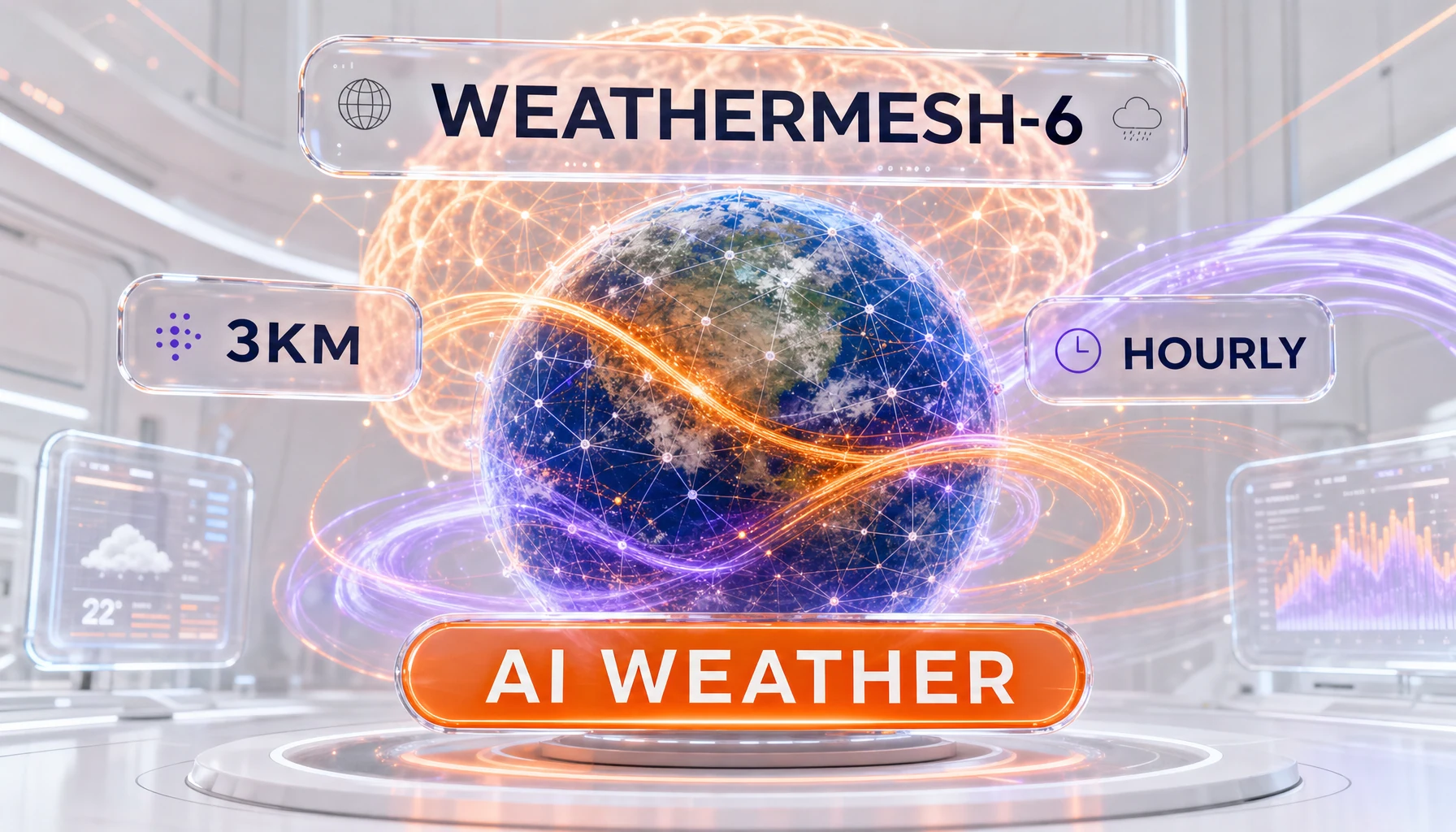
WeatherMesh-6 (WM-6) is WindBorne Systems’ AI weather model, announced on June 1, 2026, that produces forecasts at 3 km resolution over Europe and the continental United States and updates every hour. According to WindBorne, WM-6 matches or beats the forecasts of leading government and intergovernmental systems — including both the physics-based and AI models from the European Centre for Medium-Range Weather Forecasts (ECMWF) — on key variables such as surface temperature. Its chief product officer, Kai Marshland, says WM-6 "is as accurate five days out as a traditional forecast is the day before." The differentiator is data: WindBorne flies roughly 400 weather balloons at any given moment, launched from 15 sites worldwide, and assimilates that proprietary observation stream directly into the model.
What WindBorne Just Announced
On June 1, 2026, WindBorne Systems made the outputs and benchmarks of its newest forecasting model, WeatherMesh-6, publicly available. The headline claim is blunt: a venture-backed startup says its AI model is, on important measures, more accurate than the operational systems run by national weather services and intergovernmental agencies that have spent decades and billions of dollars building supercomputer-driven physics simulations.
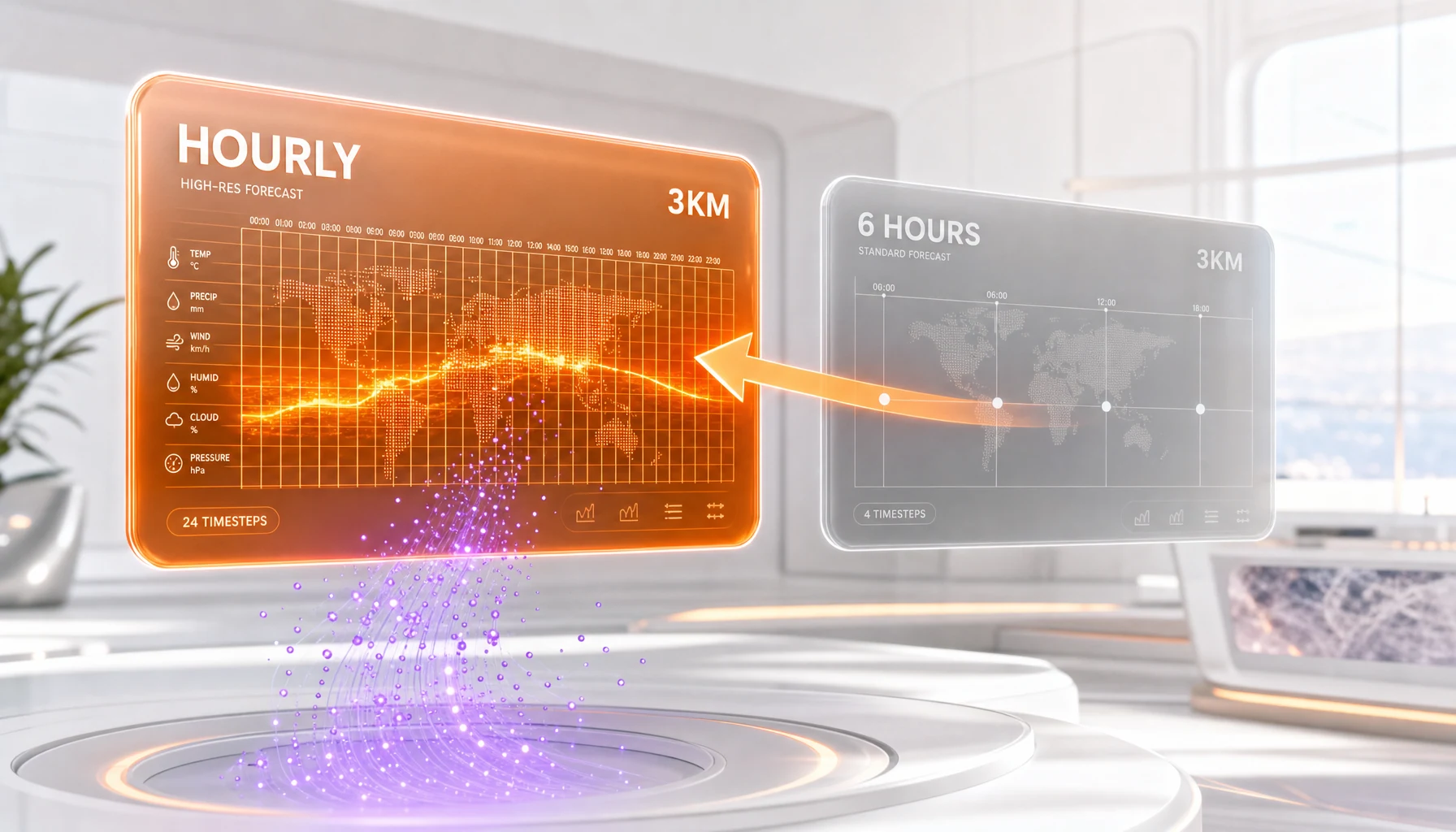
The two numbers that define WM-6 are resolution and cadence. It forecasts at 3 km resolution across Europe and the continental United States, and it refreshes hourly. That hourly update is the part practitioners will notice first: most traditional global forecasting systems run on a roughly six-hour cadence, meaning a fresh full forecast cycle arrives only a few times a day. An hourly model assimilates new observations and re-forecasts far more often, which matters most for fast-moving, high-impact weather.
WindBorne frames the accuracy gain in plain language rather than a single marketing percentage. As Marshland put it, WM-6 "is as accurate five days out as a traditional forecast is the day before." In other words, the company claims a five-day WM-6 forecast carries roughly the confidence you would previously have associated with a one-day-ahead forecast — a compression of the skill horizon, not a marginal tweak. WindBorne says this holds on key variables and that WM-6 beats both ECMWF’s traditional physics model and ECMWF’s own AI model on measures including surface temperature.
How Accuracy Is Measured Here
The reference metric in this space is latitude-weighted RMSE (root-mean-square error). It compares a model’s predicted values for a variable — temperature, wind, pressure — against what was actually observed, with a weighting that accounts for the fact that grid cells near the poles cover less surface area than cells near the equator. Lower latitude-weighted RMSE means a more accurate forecast. It is the same yardstick used to evaluate the AI weather models that have emerged from large research labs, which makes a head-to-head comparison meaningful rather than apples-to-oranges.
A note on numbers, because the weather-AI space is littered with them. WindBorne has shipped several generations of WeatherMesh over the past two years, and earlier versions carried their own headline percentages against systems like the US Global Forecast System (GFS), ECMWF’s high-resolution forecast, and Google DeepMind’s GraphCast. Those figures belong to those older models and those older benchmarks. The WM-6 announcement leads with qualitative, horizon-based claims rather than a fresh single percentage, so that is what we report here. We are deliberately not attaching legacy percentages to WM-6.
The Real Moat Is the Data, Not the Model
The most important sentence in the announcement is not about accuracy. It is about data ownership. WindBorne’s chief executive, John Dean, has put the company’s thesis bluntly: "I don’t understand the business model of being an AI based weather company without a dataset advantage." That single line explains why WindBorne built balloons before it built a frontier model.
Here is the mechanism. Most AI weather models — including the celebrated ones from large research labs — are trained on the same public reanalysis datasets, dominated by ECMWF’s archive. They are extraordinary at learning the patterns inside that data, but they are all drinking from the same well. If everyone trains on the same observations, the ceiling on differentiation is set by architecture and compute, not by what the model can actually see.
WindBorne changed what the model can see. The company operates a fleet of long-duration, steerable weather balloons — roughly 400 aloft at any given moment, launched from 15 sites around the world. Those balloons drift through the atmosphere collecting observations from places that are chronically under-sampled: the open oceans, remote regions, and the upper air where conventional radiosondes and surface stations simply are not present. That raw observation stream is assimilated directly into WM-6.
The strategic logic is that a forecast is only as good as the picture of the current atmosphere you feed it. Numerical weather prediction has always been bottlenecked by initial conditions: you cannot forecast tomorrow accurately if you do not know today precisely. By owning a global, real-time, proprietary observation network, WindBorne is attacking the part of the problem that more compute alone cannot fix. A competitor can copy an architecture; it cannot copy 400 balloons in the sky.
Why Balloons, and Why Now
Weather balloons are not new — national services have launched radiosondes twice a day for generations. What is new is treating a steerable, persistent balloon constellation as a data product feeding a machine learning model, rather than as isolated soundings feeding a physics simulation. WindBorne’s balloons stay aloft far longer than a single ascent and can be guided to where the model is most uncertain, which turns the fleet into a kind of active sensing layer for the forecast.
This is the same structural insight that has reshaped other corners of AI: proprietary, high-signal data beats a clever model trained on a commodity corpus. In language, the labs with unique data and feedback loops pulled ahead. WindBorne is making the meteorological version of that bet — and the timing works because the AI side of weather modeling matured at the same moment cheap, long-duration balloons became practical to operate at fleet scale.
Inside the Observation Network
To understand why WindBorne thinks balloons are decisive, it helps to see where the gaps are in today’s atmospheric observations. The global network is dense over wealthy, populated land masses and thin almost everywhere else. Vast stretches of the open ocean, the polar regions, and most of the world’s upper atmosphere are observed only intermittently — often by satellites that infer conditions remotely rather than measure them in place. Weather that develops in those data-poor zones can be well underway before any model has good information about it.
A steerable balloon fleet attacks exactly that gap. Because the balloons are long-duration and can adjust altitude to ride different wind layers, WindBorne can position observations over the ocean and in the upper air where almost nothing else is sampling continuously. Each balloon contributes a vertical and horizontal slice of real, in-situ measurements — pressure, temperature, humidity, and winds — that flow into the model’s picture of the current atmosphere. The roughly 400 balloons aloft at any moment, launched from 15 global sites, form a moving mesh of fresh observations rather than a fixed grid of stations.
That assimilation step is the quiet center of the whole system. In numerical weather prediction, "data assimilation" is the process of blending new observations with the model’s prior state to produce the best estimate of current conditions — the starting line for every forecast. WindBorne folds its proprietary balloon stream directly into that process for WeatherMesh-6, which means the model does not just learn from public archives; it sees parts of the live atmosphere that competitors training purely on shared reanalysis data never see at all.

How WM-6 Compares to the Incumbents
The systems WM-6 is measured against fall into two camps, and WM-6 claims to beat representatives of both.
The first camp is traditional physics-based numerical weather prediction. This includes ECMWF’s flagship integrated forecast system — long regarded as the global gold standard — and the US National Oceanic and Atmospheric Administration’s (NOAA) Global Forecast System, the GFS. These run enormous fluid-dynamics simulations of the atmosphere on supercomputers, typically on a six-hour cycle. They are physically principled, globally trusted, and computationally expensive.
The second camp is AI weather models. ECMWF now ships its own AI forecasting system alongside its physics model, and the research world produced landmark systems such as Google DeepMind’s GraphCast, which demonstrated that a neural network could match or beat traditional forecasts on many variables while running in a fraction of the time. WindBorne’s claim is that WM-6 beats ECMWF’s AI model too, on key variables — which, if it holds up to independent scrutiny, is the more striking result, because it means WM-6 is not just beating old physics, it is beating other modern AI trained on the same public data.
The cleanest way to read WindBorne’s positioning is this: against physics models, WM-6 competes on both accuracy and cadence; against other AI models, it competes on the one axis they cannot easily match — the proprietary balloon observations folded into its training and assimilation.
Why It Matters
If an independent, venture-backed company can out-forecast the agencies that have defined the science for half a century, the implications run well past one product launch.
The first is economic. Weather forecasts are a public good in most of the world, produced by government agencies and distributed freely. A model that is meaningfully better — especially at the multi-day horizon — has obvious commercial value to industries where weather is a direct profit-and-loss line: aviation, shipping, agriculture, insurance and reinsurance, and, increasingly, energy grids balancing intermittent renewables. A five-day forecast that behaves like a one-day forecast is the kind of edge those buyers pay for.
The second is architectural. WM-6 is a clear data point in the argument that the differentiator in applied AI is increasingly the proprietary data pipeline, not the model weights. The frontier labs can build a better architecture; only WindBorne has the balloons. That same pattern — own the unique data, then wrap a strong model around it — is showing up across applied AI, from drug design to grid optimization.
The third is about trust and verification. Extraordinary forecasting claims deserve ordinary scientific scrutiny. WindBorne has published outputs and benchmarks, which is the right move, but the meteorology community will want to see sustained, independent, operational evaluation across seasons, regions, and the rare high-impact events that matter most — not just favorable averages. The honest read on June 1, 2026 is that the claim is credible and well-documented enough to take seriously, and important enough to verify carefully.
The Bigger AI-for-Science Pattern
WindBorne is not an isolated story. It sits inside a wave of companies and labs pointing frontier AI at hard physical-world problems where the bottleneck has historically been data and simulation cost. The same logic — a strong model is necessary but a unique dataset is decisive — underpins AI drug discovery, where the binding-data and structure pipeline is the asset, and it shows up in the infrastructure layer that all of this runs on. We have tracked that drug-design version of the bet in Isomorphic Labs raising $2.1 billion for AI drug design, and a more direct lab-bench result in ApexGO, a Penn AI that designed antibiotics that beat a last-resort drug.
There is also a power-and-infrastructure thread that connects directly to weather. Better hourly forecasting is a lever for the energy grid, where balancing solar and wind output against demand is fundamentally a prediction problem. That is the same grid-AI frontier we covered in GridCARE’s Series A for unlocking power for AI and in the largest US utility merger in history, NextEra’s $67 billion acquisition of Dominion. And the broader thesis — frontier AI being deployed against high-stakes physical risk — mirrors what we saw in OpenAI’s Rosalind biodefense launch.
Who Benefits Most From Hourly, 3 km Forecasts
The combination of higher resolution and a faster update cycle does not help every use case equally. Its value concentrates in sectors where the cost of a missed or delayed forecast is measured in money, safety, or both — and where decisions are made on the timescale of hours rather than days.
Energy grids are the clearest example. As solar and wind take a larger share of generation, grid operators must constantly match supply to demand without the easy buffer of always-on fossil plants. An hourly forecast that resolves cloud cover and wind at 3 km lets operators anticipate ramps in renewable output and price power more efficiently. Aviation and shipping similarly run on tight, time-sensitive routing decisions where a sharper near-term picture of winds and storms translates into fuel saved and risk avoided.
Agriculture and insurance sit at the multi-day end of the value curve. For a grower, the difference between a five-day forecast that behaves like a one-day forecast and one that does not can decide when to irrigate, spray, or harvest. For insurers and reinsurers, better medium-range skill sharpens exposure estimates ahead of severe-weather events. Across all of these buyers, the shared theme is that a forecast is only useful if it is both accurate and timely — and WindBorne is selling improvements on both axes at once.
There is also a public-interest dimension. Government agencies distribute forecasts freely as a public good, and they remain the backbone of severe-weather warnings worldwide. A commercial model that is sharper on certain variables does not replace that role; it adds a layer that specialized, weather-exposed industries may pay to access. The open question is how the public and private forecasting layers end up coexisting as AI raises the ceiling on what is possible.
What to Watch Next
Three things will tell us whether WM-6 is a genuine inflection point or a strong launch that needs seasoning.
Independent benchmarking. The credibility of any weather model lives or dies on third-party, multi-season evaluation against the operational baselines — ECMWF, the GFS, GraphCast, and ECMWF’s AI model — on consistent latitude-weighted RMSE, including the extreme events where averages hide failures.
Coverage expansion. WM-6’s 3 km, hourly product currently covers Europe and the continental United States. Whether WindBorne extends that resolution and cadence globally, and how the balloon fleet scales to support it, will determine how broadly the advantage applies.
The data moat under pressure. The most interesting strategic question is whether anyone can replicate WindBorne’s observation advantage. National agencies have their own vast networks; large labs have capital. If the balloon dataset is the moat, expect the competitive action to move toward who else can build, buy, or partner their way into a comparable real-time observation stream. As Dean argues, without that dataset advantage, the business model does not hold.
The Bottom Line
WeatherMesh-6 is the clearest sign yet that AI weather modeling has moved from "promising research" to "competitive with the institutions that own the field." WindBorne claims a 3 km, hourly model that forecasts five days out about as well as traditional systems do the day before, and that beats both ECMWF’s physics and AI models on key variables. The claim rests not on a flashy single percentage but on a structural advantage: a proprietary fleet of roughly 400 balloons feeding observations no competitor has. Whether or not every benchmark survives independent scrutiny, the strategy is the story — in weather, as in the rest of applied AI, the team that owns the data, not just the model, is the one to beat.
Frequently Asked Questions
What is WeatherMesh-6 (WM-6)?
WeatherMesh-6 is WindBorne Systems’ AI weather forecasting model, announced on June 1, 2026. It produces forecasts at 3 km resolution over Europe and the continental United States and updates hourly, rather than on the roughly six-hour cadence of traditional systems. WindBorne says it matches or beats leading government and intergovernmental forecasts on key variables.
How accurate is WeatherMesh-6 compared to traditional forecasts?
According to WindBorne chief product officer Kai Marshland, WeatherMesh-6 "is as accurate five days out as a traditional forecast is the day before." In other words, a five-day WM-6 forecast is claimed to carry roughly the confidence previously associated with a one-day-ahead forecast on key variables.
Does WeatherMesh-6 beat ECMWF?
WindBorne claims WeatherMesh-6 beats both the European Centre for Medium-Range Weather Forecasts (ECMWF) traditional physics-based model and ECMWF’s own AI model on key variables, including surface temperature. ECMWF’s system has long been considered the global gold standard, so beating its AI model is the more notable claim if it holds up to independent review.
How is WeatherMesh-6 different from Google DeepMind’s GraphCast?
GraphCast and most other AI weather models are trained largely on the same public reanalysis data, dominated by ECMWF’s archive. WeatherMesh-6’s key difference is data ownership: WindBorne assimilates a proprietary stream of observations from its own balloon fleet, which competitors training on public data cannot replicate.
What is WindBorne’s data advantage?
WindBorne flies roughly 400 weather balloons at any given moment, launched from 15 sites worldwide. These long-duration, steerable balloons collect observations from under-sampled regions such as open oceans and the upper atmosphere, and that data is assimilated directly into WeatherMesh-6. CEO John Dean argues a weather AI company has no viable business model without such a dataset advantage.
What does "3 km, hourly" mean for a weather model?
3 km is the spatial resolution, meaning the model resolves weather features down to roughly 3-kilometer grid spacing over its coverage area. Hourly is the temporal cadence: WeatherMesh-6 produces a fresh forecast every hour, versus the roughly six-hour update cycle of traditional global systems. Higher resolution and faster cadence matter most for fast-developing, high-impact weather.
What metric is used to compare WeatherMesh-6 to other models?
The standard metric is latitude-weighted RMSE (root-mean-square error), which measures the difference between predicted and observed values for variables like temperature, wind, and pressure, weighted to account for grid cells covering less area near the poles. Lower latitude-weighted RMSE means a more accurate forecast, and it is the common yardstick across modern AI weather models.
Is WeatherMesh-6 better than NOAA’s GFS?
WindBorne positions WeatherMesh-6 against traditional physics-based systems including the US National Oceanic and Atmospheric Administration’s Global Forecast System (GFS), competing on both accuracy and update cadence. The GFS runs on a roughly six-hour cycle, while WeatherMesh-6 refreshes hourly. WindBorne’s headline claims center on beating ECMWF systems; independent benchmarking against the GFS across seasons is what observers will want to see.
Who is WindBorne Systems?
WindBorne Systems is the venture-backed company behind the WeatherMesh model family and a global fleet of long-duration weather balloons. Its leadership includes CEO John Dean and chief product officer Kai Marshland. The company’s strategy pairs a proprietary balloon observation network with AI forecasting, on the thesis that unique data, not just model architecture, is the decisive advantage.
Why does WeatherMesh-6 matter for the AI industry?
WeatherMesh-6 is a clear example of the pattern that in applied AI the differentiator is increasingly the proprietary data pipeline rather than the model weights. Frontier labs can build strong architectures, but only WindBorne has its balloon observations. The same own-the-data logic appears across AI for science, from drug design to energy-grid optimization.
Should I trust WeatherMesh-6’s accuracy claims yet?
WindBorne has published outputs and benchmarks, which is the right step, but extraordinary forecasting claims warrant independent, multi-season evaluation across regions and high-impact events. As of June 1, 2026, the claims are credible and well-documented enough to take seriously, while sustained third-party verification on consistent latitude-weighted RMSE is still the standard the model must clear.