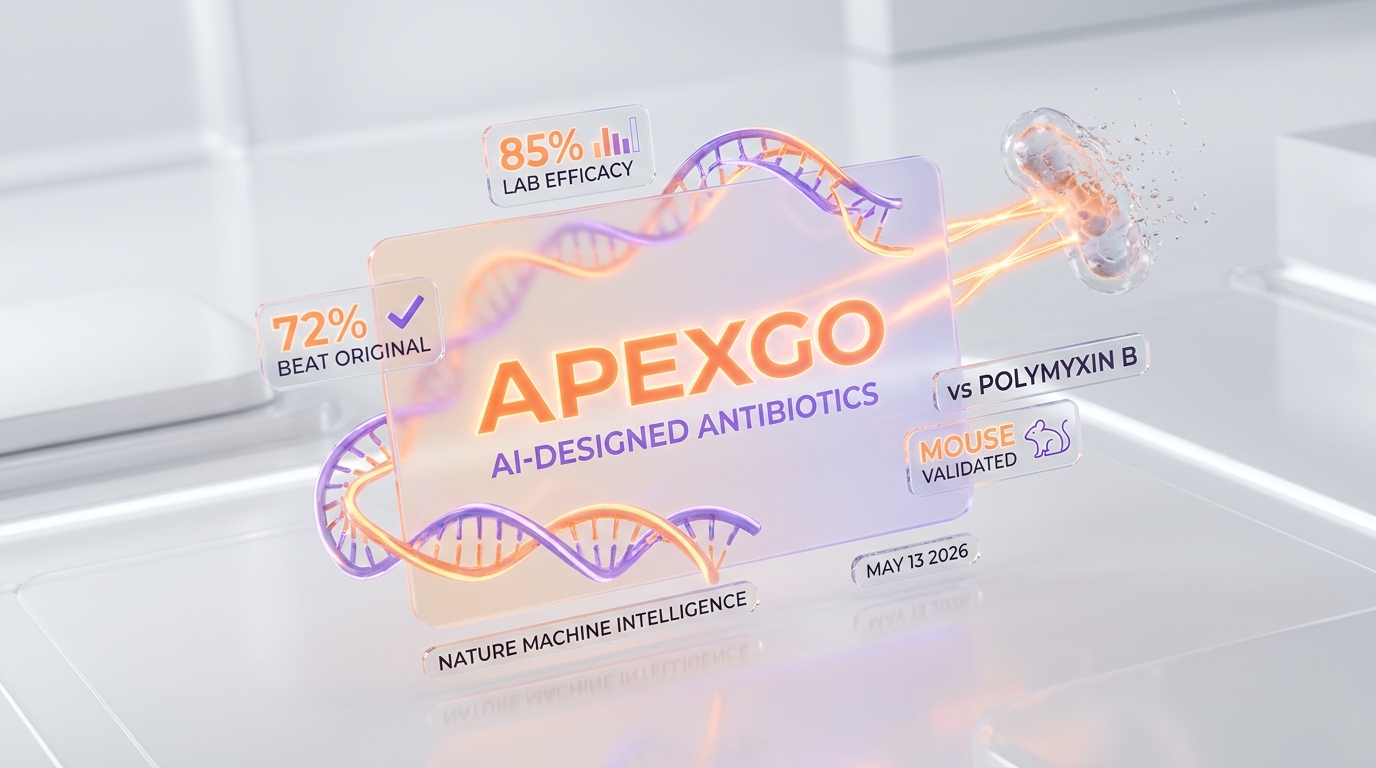
ApexGO (APEX Generative Optimization) is an AI system from the University of Pennsylvania that designs antimicrobial peptides instead of screening existing ones. In results published in Nature Machine Intelligence on May 13, 2026, 85% of the molecules it generated stopped bacterial growth in the lab and 72% outperformed the original peptide they were derived from. Two of its peptides reduced infection in mice at levels comparable to polymyxin B, an FDA-approved last-resort antibiotic. ApexGO pairs a generative model with Bayesian optimization, and over several months of runs it surfaced hundreds of antibiotic candidates.
What Penn Actually Reported
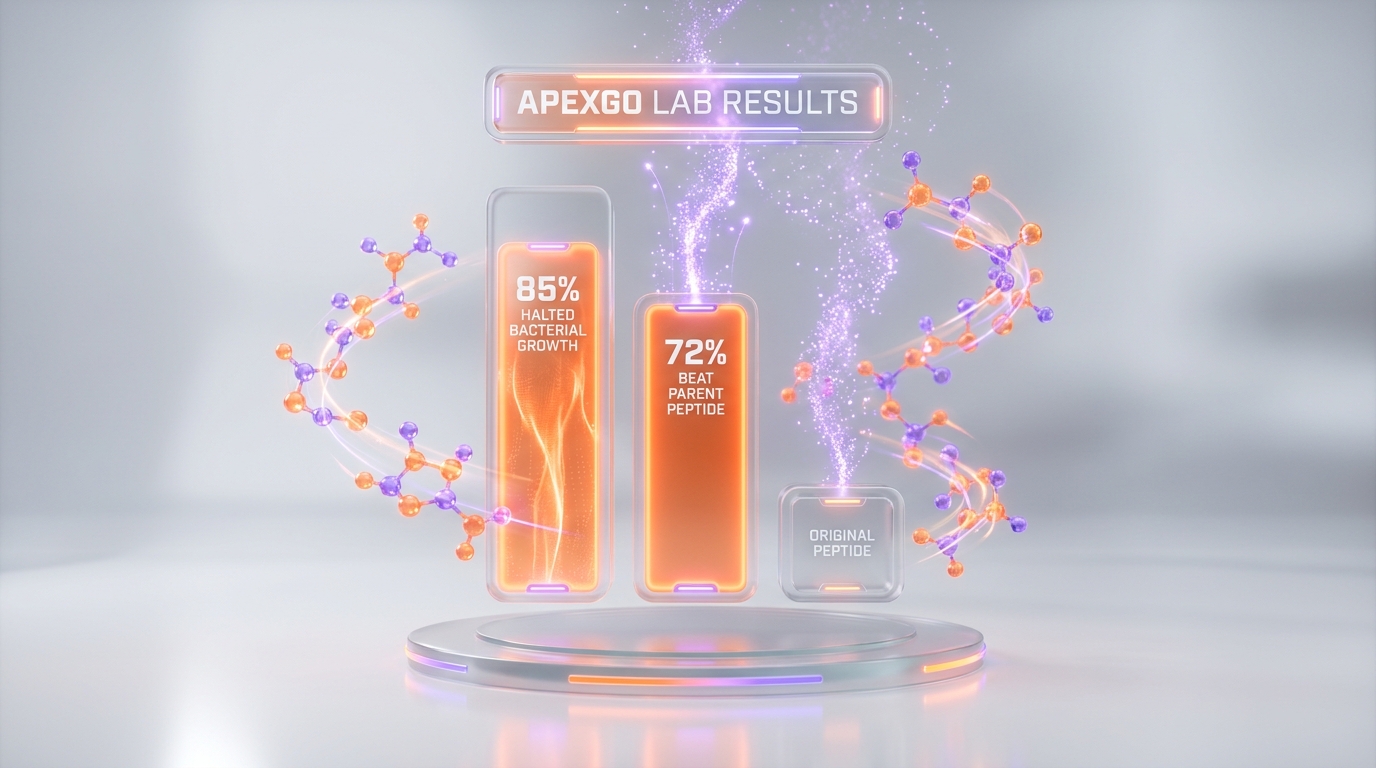
The headline number is the one worth anchoring on: 85% of the AI-generated molecules halted bacterial growth in laboratory assays, and 72% of them outperformed the parent peptide they were optimized from. That second figure is the more interesting one. Generating a molecule that works at all is a low bar in 2026. Generating one that systematically beats the human-discovered starting point, three times out of four, is a different kind of claim — it says the model is not just sampling a known good region, it is climbing a fitness landscape.
The work comes out of the lab of César de la Fuente, a Presidential Associate Professor at the University of Pennsylvania, in collaboration with Jacob R. Gardner, an assistant professor in Computer and Information Science. Research Assistant Professor Marcelo Torres, doctoral student Yimeng Zeng, and co-first author Fangping Wang are on the paper. It spans the Perelman School of Medicine, the School of Engineering and Applied Science, and the School of Arts & Sciences — the cross-disciplinary signature you expect when a wet lab and an ML group share a project. It was published in Nature Machine Intelligence, a peer-reviewed tier-1 venue, on May 13, 2026.
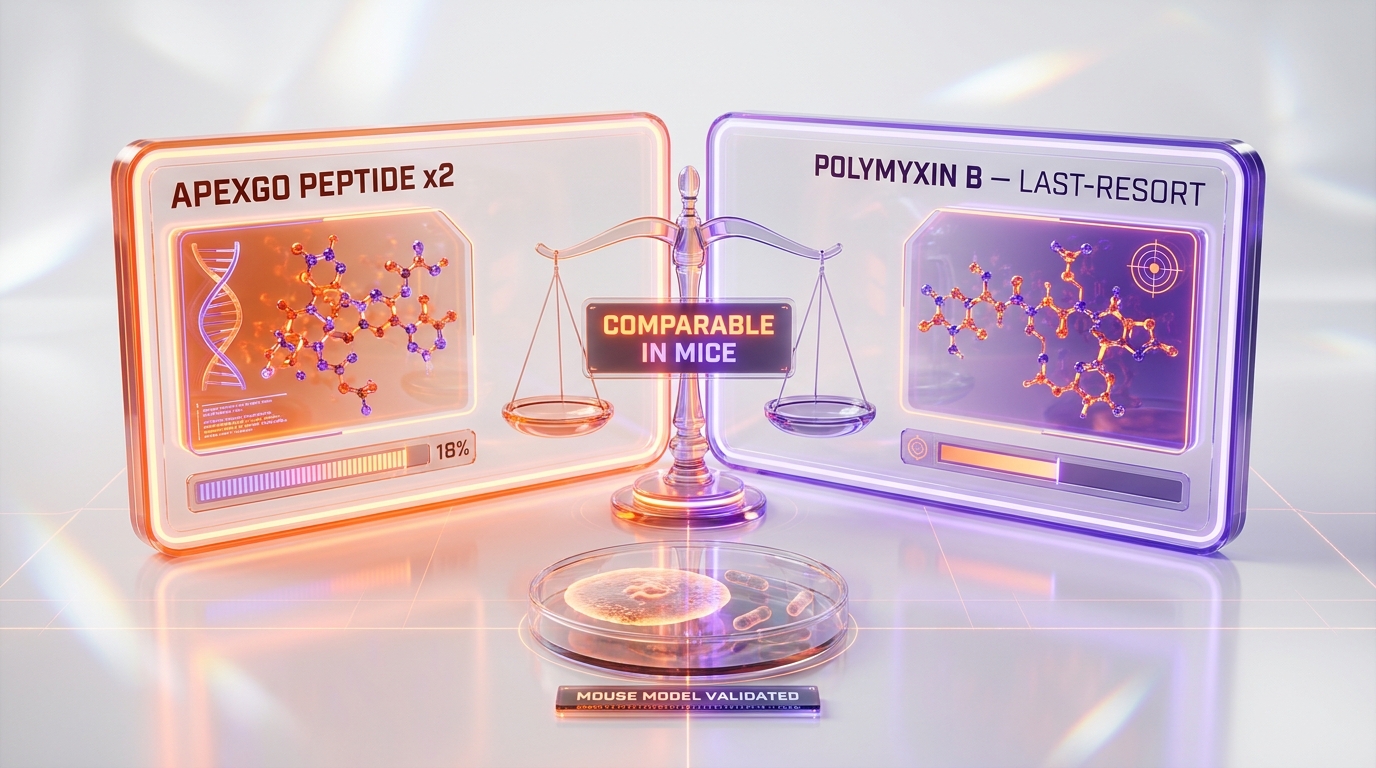
The validation that matters most is the in vivo result. Two antimicrobial peptides designed by ApexGO reduced bacterial counts in a mouse model at levels comparable to polymyxin B. Polymyxin B is not a casual benchmark. It is an FDA-approved antibiotic of last resort, the drug clinicians reach for when carbapenem-resistant Gram-negative infections have exhausted the safer options. Matching it in mice is the difference between a computational curiosity and a candidate worth a real preclinical program.
Why Antimicrobial Resistance Is the Right Problem to Aim AI At
Antimicrobial resistance (AMR) is one of the few areas where the gap between the size of the problem and the rate of new supply is genuinely structural, not cyclical. The antibiotic pipeline has been thin for decades because the economics are upside down: a new antibiotic is most valuable when it is used least, which makes it the worst possible asset for a commercial pharma portfolio. The result is that resistance keeps compounding while the discovery engine that is supposed to answer it has been running on fumes.
That asymmetry is exactly why an AI design tool is strategically interesting here, and why I would push back on anyone who frames this as just another "AI does science" press cycle. The bottleneck in antibiotics has never been purely scientific — it is the cost and time of exploring chemical space when each physical test is slow and expensive. A system that proposes high-probability candidates before anyone touches a pipette changes the unit economics of the search, not just its speed. That is the lever ApexGO is pulling.
It is worth being precise about what this is not. These peptides are validated in vitro and in a mouse model. They are not approved drugs, they are not in human trials, and "comparable to polymyxin B in mice" is a milestone, not a finish line. The honest framing is that AI has produced a credible preclinical antibiotic candidate faster and with a higher hit rate than conventional screening — which is significant precisely because of how starved this field is, not because the molecules are ready for a pharmacy shelf.

How ApexGO Works: Generation Plus Bayesian Optimization
The architectural choice is the part worth dwelling on, because it is what separates this from the brute-force screening that has dominated computational antibiotic work. ApexGO does not screen a database of existing molecules looking for hits. It proposes new molecular modifications and then evaluates them systematically, using Bayesian optimization to decide what to try next.
De la Fuente framed the contribution in terms of navigation: the relevant molecular space is astronomically large, and "ApexGO gives us a way to navigate that space with far more direction." That word — direction — is the whole thesis. A generative model alone can sample novel sequences, but it has no principled way to spend its next evaluation wisely. Bayesian optimization is the part that turns sampling into search: it builds a model of which regions of sequence space are promising, balances exploration against exploitation, and concentrates expensive evaluations where the expected payoff is highest.
Generation: proposing candidates that do not exist yet
The generative component is what makes the 72% figure meaningful. Because the system proposes modifications rather than retrieving known peptides, the candidates it produces are genuinely new sequences, not rediscoveries. When 72% of them beat the parent peptide, that is the optimizer doing its job — moving uphill from a known-good starting point rather than randomly stumbling onto something adjacent.
Bayesian optimization: spending each test where it counts
This is the strategically important half. In antibiotic discovery the binding constraint is the cost of evaluation — every candidate that gets physically tested costs time and money. Bayesian optimization is the right tool for exactly the regime where evaluations are scarce and expensive. It is the same family of methods used to tune systems where you cannot afford millions of trials. Applying it to peptide design is not flashy, but it is the correct engineering decision, and it is the reason the hit rate is high enough to matter economically.
Several months of runs, hundreds of candidates
The scale figure is sobering in a useful way. Researchers ran ApexGO for several months and identified hundreds of antibiotic candidates. This is not an overnight miracle, and the paper does not pretend it is. It is a sustained optimization campaign that produced a rich pool of candidates — which is exactly what a starved pipeline needs. The value is throughput of credible leads, not a single magic molecule.
Reading the 85% and 72% Numbers Carefully
It is easy to mis-cite these two numbers, so it is worth separating them cleanly. The 85% figure is a hit rate: of the molecules ApexGO generated, 85% halted bacterial growth in laboratory testing. The 72% figure is a relative-improvement rate: 72% outperformed the original peptide candidate they were optimized from. They measure different things, and conflating them — for example into "ApexGO is 85% effective" — would be wrong.
The strategically meaningful number is 72%. A high raw hit rate can come from a model that has learned to stay in a safe, already-known region of sequence space. A high beat-the-parent rate is much harder to fake, because it requires the system to consistently improve on a baseline that human researchers already selected as good. That is the signal that the generation-plus-optimization loop is doing real work rather than memorizing.
What the paper does not claim — and what we should not extrapolate — is anything about human efficacy, dosing, toxicity at therapeutic levels, or resistance development over time. "72% beat the parent peptide in vitro" and "two peptides matched polymyxin B in mice" are the load-bearing claims. Everything beyond that is open question, and the responsible reading keeps it that way.
The Polymyxin B Benchmark, and Why It Was Chosen
Benchmarks tell you what the authors think the bar is. ApexGO's two lead peptides were compared against polymyxin B, and the choice is deliberate. Polymyxin B is an old, FDA-approved antibiotic that has been pulled back into frontline use precisely because resistance has hollowed out the newer options. It is the drug of last resort for some of the hardest Gram-negative infections, and it carries real toxicity baggage of its own. Matching it in a mouse model is a strong claim because last-resort drugs are, by definition, the molecules that still work when most others have failed.
The strategic read: the team did not benchmark against a soft target. They benchmarked against the antibiotic clinicians use when they are out of better choices. Reaching parity there in vivo is the kind of result that justifies a real preclinical investment, which is the actual currency in this field. It does not mean the ApexGO peptides are safer or better than polymyxin B — that is unknown — only that the design loop produced molecules in the same efficacy neighborhood as a serious clinical drug.
What still has to happen next
The path from "comparable to polymyxin B in mice" to "approved antibiotic" is long and most candidates do not survive it. Pharmacokinetics, off-target toxicity, stability, manufacturability, formulation, and the regulatory gauntlet all sit between this result and a clinic. None of that diminishes the milestone — it contextualizes it. The correct expectation is that ApexGO has produced strong preclinical leads and, more importantly, a reusable engine for producing more of them.

Where This Sits in the AI-for-Biology Landscape
ApexGO is one node in a fast-moving map. The capital has been pouring into AI drug design — Isomorphic Labs raised a $2.1 billion Series B for its AI drug-design engine, and the pharma incumbents have been buying their way in, from the Novo Nordisk and OpenAI partnership on AI drug discovery to Anthropic's $400M acquisition of Coefficient Bio. ApexGO is a different shape of story: not a megaround or an acquisition, but an academic lab publishing a peer-reviewed in vivo result in Nature Machine Intelligence. In a field where a lot of the noise is fundraising, a validated wet-lab outcome from a university group is a useful counterweight.
It also rhymes with the broader democratization arc we have tracked elsewhere. The move from raw models to usable workflows is the recurring pattern — the same compression that put AI protein design within reach of bench biologists is visible here in antibiotic design. ApexGO is the optimization layer on top of generative chemistry, the same way agentic environments became the layer on top of raw language models.
The general-purpose model angle
One reason this field is moving so fast is that the surrounding tooling improved. General-purpose reasoning models like Claude and Gemini 3.1 Pro have made the connective work around specialized pipelines — data wrangling, literature synthesis, experiment design — dramatically cheaper, even when the core scientific model is a domain-specific system like ApexGO. The strategic point is that the cost of orchestrating a discovery pipeline has fallen alongside the cost of the discovery model itself.
Why the Generation-Plus-Optimization Pattern Generalizes
Step back from antibiotics for a moment, because the architecture is the reusable asset, not the molecules. The recurring failure mode in computational discovery — drug design, materials, enzyme engineering — has been the same: a model that can propose plausible candidates but has no economical way to decide which proposal is worth a real experiment. Generation without a search policy burns the evaluation budget on noise. ApexGO's contribution is showing, with a peer-reviewed in vivo endpoint, that wrapping a generative model in Bayesian optimization closes that loop well enough to beat a human-selected baseline most of the time.
That pattern is domain-agnostic in a way that matters strategically. The same loop — propose, model the landscape, spend the next expensive test where expected improvement is highest — is the right shape for any field where the experiment is the bottleneck and the search space is astronomically large. Antimicrobial peptides happen to be an unusually clean testbed because the readout (does it stop bacterial growth) is fast and unambiguous. But the lesson the field should take is methodological, not molecular: directed search beats both blind generation and brute-force screening when evaluations are scarce.
The caution I would attach is that a high beat-the-parent rate is conditional on a good parent. ApexGO climbs from a known-good starting peptide; it is an optimizer, not a from-scratch oracle. That is a strength for near-term applied work — you bring a promising scaffold and the system improves it — but it is not the same as designing a novel antibiotic class with no precedent. Reading the result as "AI now invents antibiotics from nothing" overstates what an optimization loop does. Reading it as "AI can reliably out-design the human starting point in a hard domain" is exactly right, and is the more durable claim.
What I Would Watch From Here
The signals that would move this from a strong result to a category-defining one are concrete and worth naming in advance. First, independent replication: a second lab reproducing the beat-the-parent rate on different bacterial targets would convert a single-paper result into a method. Second, breadth of pathogen coverage — the mouse parity with polymyxin B is meaningful, but Gram-negative resistance is a wide problem and the value scales with how many targets the loop handles. Third, the survival rate of these leads through preclinical pharmacology, which is where most computationally promising molecules quietly die.
On the strategic-positioning axis, the more interesting question is institutional. ApexGO is an academic result published in a peer-reviewed venue, not a company raising on a slide. If the de la Fuente and Gardner groups keep publishing reproducible in vivo endpoints, the academic track becomes a credible counter-narrative to the fundraising-driven AI-bio story — and a credibility asset that the capital-heavy players will want to be associated with. That is a healthier dynamic for the field than a pure megaround race, and it is the part of this story I would track most closely over the next year.
None of these watch-items diminish what was reported. They are the difference between a milestone and an inflection, and being explicit about them is how you stay honest about a result this early. The defensible summary stands: a peer-reviewed engine that systematically out-designs the human starting point in one of medicine's most underfunded corners, validated to a mouse model against a real last-resort drug.
The Strategic Bottom Line
ApexGO matters less as a single antibiotic and more as evidence that the generation-plus-Bayesian-optimization recipe produces credible leads at a hit rate high enough to change the economics of antibiotic search. The 72% beat-the-parent number is the one to remember; the polymyxin B mouse parity is the one that earns it a preclinical path. AMR is precisely the domain where this kind of supply-side compression has outsized leverage, because the bottleneck was never ambition — it was the cost of exploring chemical space against a broken commercial model.
The disciplined position is to treat this as a strong, peer-reviewed preclinical result and a reusable engine, not as a solved problem. No human data, no approved drug, no resistance-over-time picture yet. But as a directional signal — that AI can systematically out-design the human starting point in one of the hardest and most underfunded corners of medicine — it is one of the more substantive AI-for-science results of 2026.
Frequently Asked Questions
What is ApexGO?
ApexGO (APEX Generative Optimization) is an AI system from the University of Pennsylvania that designs antimicrobial peptides rather than screening existing molecules. It combines a generative model with Bayesian optimization to propose and systematically evaluate new molecular modifications. It was developed in the lab of César de la Fuente with Jacob R. Gardner's group and published in Nature Machine Intelligence on May 13, 2026.
What were ApexGO's main results?
In laboratory testing, 85% of the molecules ApexGO generated halted bacterial growth, and 72% outperformed the original peptide candidate they were optimized from. Two of the designed antimicrobial peptides reduced bacterial counts in a mouse model at levels comparable to polymyxin B, an FDA-approved last-resort antibiotic. Over several months of runs, the system identified hundreds of antibiotic candidates.
What does the 85% versus 72% difference mean?
They measure different things. The 85% is a hit rate — the share of generated molecules that stopped bacterial growth in the lab. The 72% is a relative-improvement rate — the share that outperformed the parent peptide they were derived from. The 72% figure is the more meaningful one because it shows the system consistently improves on a human-selected baseline rather than rediscovering known-good molecules. Citing it as "85% effective" would be incorrect.
Why is the polymyxin B comparison significant?
Polymyxin B is an FDA-approved antibiotic of last resort, used for drug-resistant Gram-negative infections when safer options have failed. The Penn team benchmarked ApexGO's two lead peptides against it rather than a soft target. Reaching comparable bacterial reduction in mice is a strong result because last-resort drugs are, by definition, the molecules that still work when most others do not. It does not mean the ApexGO peptides are safer or better than polymyxin B — that is unknown.
Are ApexGO's peptides approved antibiotics?
No. They are validated in vitro and in a mouse model only. They are not approved drugs and are not in human trials. "Comparable to polymyxin B in mice" is a preclinical milestone, not a finish line. Pharmacokinetics, toxicity at therapeutic doses, stability, manufacturability, and regulatory approval all sit between this result and clinical use. The honest framing is a strong preclinical candidate plus a reusable design engine.
How does ApexGO differ from conventional antibiotic screening?
Conventional computational approaches screen databases of existing molecules for hits. ApexGO does not screen — it proposes new molecular modifications and uses Bayesian optimization to decide what to evaluate next, concentrating expensive tests where the expected payoff is highest. César de la Fuente described it as a way to navigate the vast molecular space "with far more direction." That directed search is why the beat-the-parent rate is high enough to matter economically.
Why is AMR the right problem for AI design tools?
Antimicrobial resistance has a structural supply problem: a new antibiotic is most valuable when used least, which makes it a poor commercial asset, so the discovery pipeline has been thin for decades while resistance compounds. The binding constraint is the cost and time of exploring chemical space. A system that proposes high-probability candidates before physical testing changes the unit economics of the search, which is exactly the lever AMR needs.
Who built ApexGO?
ApexGO was developed at the University of Pennsylvania in the lab of César de la Fuente, a Presidential Associate Professor, in collaboration with Jacob R. Gardner, an assistant professor in Computer and Information Science. Research Assistant Professor Marcelo Torres, doctoral student Yimeng Zeng, and co-first author Fangping Wang contributed. The work spans Penn's Perelman School of Medicine, School of Engineering and Applied Science, and School of Arts & Sciences.
What role does Bayesian optimization play?
Bayesian optimization is the search engine that turns generative sampling into directed exploration. In antibiotic discovery the binding constraint is the cost of physically evaluating candidates. Bayesian optimization builds a model of which regions of sequence space are promising and balances exploration against exploitation, so each expensive test is spent where the expected payoff is highest. It is the part of ApexGO that makes the hit rate high enough to be economically meaningful.
How does ApexGO compare to other AI drug-discovery efforts?
Most recent headlines have been about capital — Isomorphic Labs' $2.1 billion Series B, the Novo Nordisk and OpenAI partnership, Anthropic's $400M Coefficient Bio acquisition. ApexGO is a different shape: an academic lab publishing a peer-reviewed in vivo result in Nature Machine Intelligence rather than announcing a megaround. In a field with a lot of fundraising noise, a validated wet-lab outcome from a university group is a useful counterweight.
What should we not extrapolate from this result?
Nothing about human efficacy, safe dosing, toxicity at therapeutic levels, or resistance development over time. The load-bearing claims are narrow and specific: 72% of generated peptides beat the parent in vitro, and two peptides matched polymyxin B in a mouse model. Framing this as "AI replaces antibiotics" or "AI cures resistant infections" overstates a preclinical result. The defensible read is a strong directional signal plus a reusable engine.
Where was the research published and when?
The work was published in Nature Machine Intelligence, a peer-reviewed tier-1 journal, on May 13, 2026, with a companion writeup from Penn Engineering. Funding came from the NIH, the Defense Threat Reduction Agency, and the National Science Foundation, including an NSF graduate research fellowship. The peer-reviewed venue and named in vivo benchmark are why this result carries more weight than a typical AI-for-science announcement.