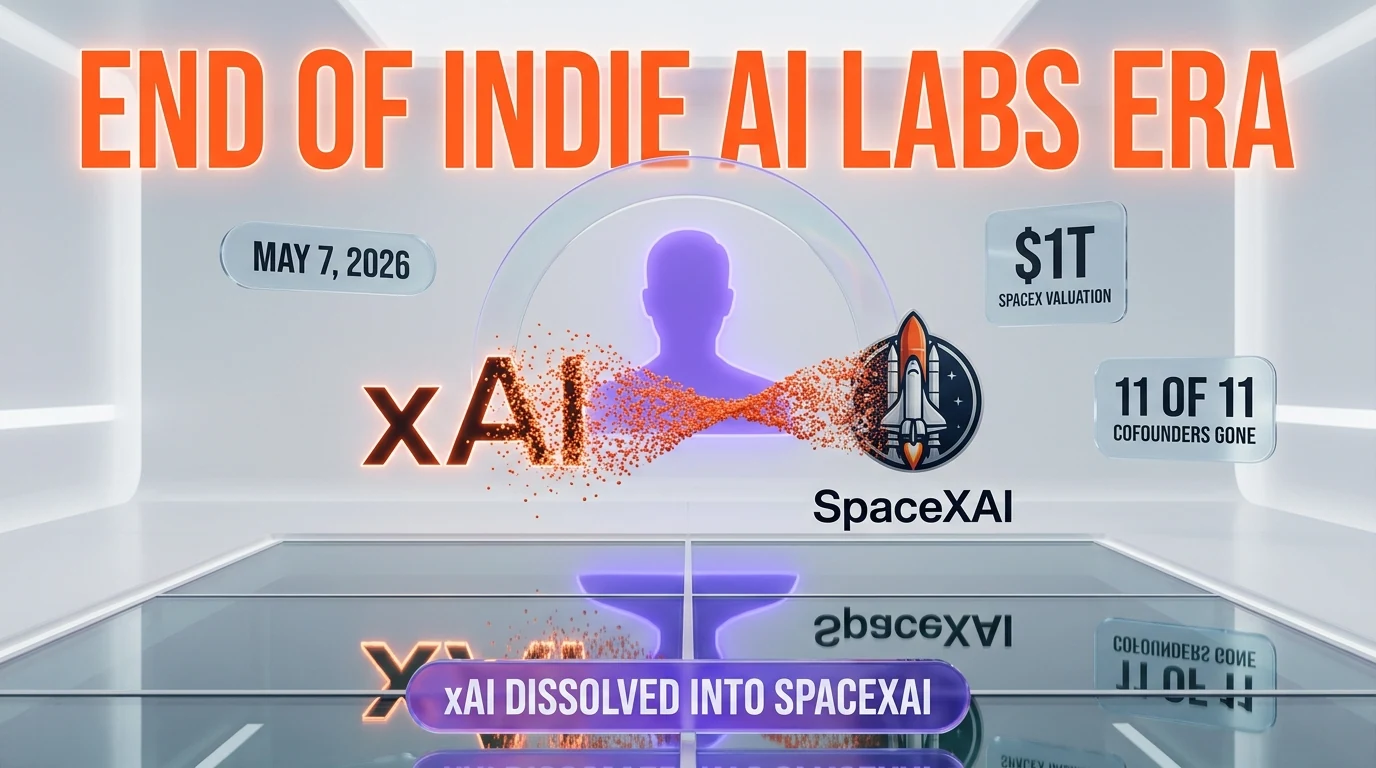
xAI no longer exists. On May 7, 2026, Elon Musk announced the company is being dissolved and rebuilt inside SpaceX as a sub-brand called SpaceXAI — a structural admission, made one year and ten months after xAI was founded, that the lab was, in his own words, "not built right first time around." All 11 original cofounders are gone. Grok stays. The Memphis Colossus 1 supercomputer is now subleased to Anthropic. And the entire frontier-model market just lost its last big "indie" lab.
What Musk actually announced on May 7
The announcement landed inside a reply on X. Musk wrote, verbatim, that "xAI will be dissolved as a separate company, so it will just be SpaceXAI, the AI products from SpaceX." There was no press release, no investor letter, no formal SEC filing — just a post threaded under a discussion of the new Anthropic-SpaceX Colossus 1 deal announced the day before. The framing matters. xAI is not being shut down or sold; its corporate shell is being collapsed into SpaceX so that what used to be an LLC with its own cap table, board, and executives becomes an internal product line.
Musk added a second admission that has not gotten enough attention: "xAI was not built right first time around, so is being rebuilt from the foundations up." That phrase carries weight. It is the same founder who, eighteen months earlier, framed xAI as the "third option" between OpenAI and Anthropic — now publicly stating that the structure he built in 2023 was wrong. The dissolution is not a victory lap. It is a reset. Gagadget captured the original post in full, and our reading of the context lines up with the Republic World breakdown: this is a wholesale absorption, not a rebrand of the marketing layer.
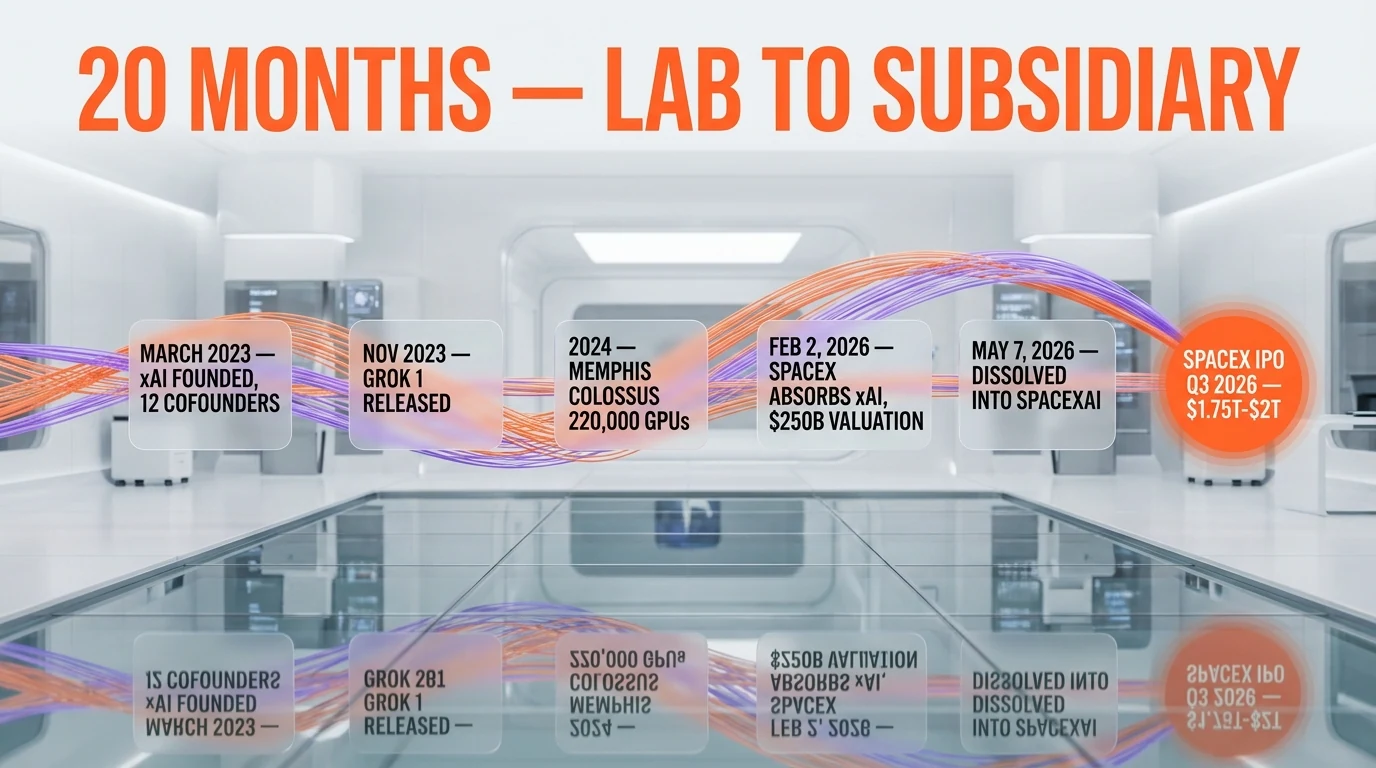
From standalone lab to subsidiary in twenty months
The dissolution is the final act of a longer compression. xAI was incorporated in March 2023 with twelve cofounders. By February 2, 2026, SpaceX absorbed it in an all-stock transaction that valued SpaceX at $1 trillion and xAI at $250 billion — what insiders called the "K2 restructuring." That deal kept xAI as a wholly owned subsidiary with its own brand. Three months later, that wrapper is gone too. We covered the original merger when it broke (our April 23 analysis is here); the May 7 announcement is the structural completion of what February only started.
The cofounder exodus tells the same story from a different angle. Tools-Insider and a half-dozen other outlets tracked the drift through 2024 and 2025: Igor Babuschkin, Yuhuai "Tony" Wu, Jimmy Ba, Christian Szegedy, Manuel Kroiss, Greg Yang, Kyle Kosic, Ross Nordeen, and Toby Pohlen all left for OpenAI, DeepMind, Meta Superintelligence, or new startups. By March 28, 2026, the eleventh and last cofounder had walked. Musk is the only signature on the original incorporation paper still inside the building. A founding team that was supposed to be xAI's competitive moat had eroded to zero before the corporate shell was even dissolved.
The frontier model market is now three labs, not four
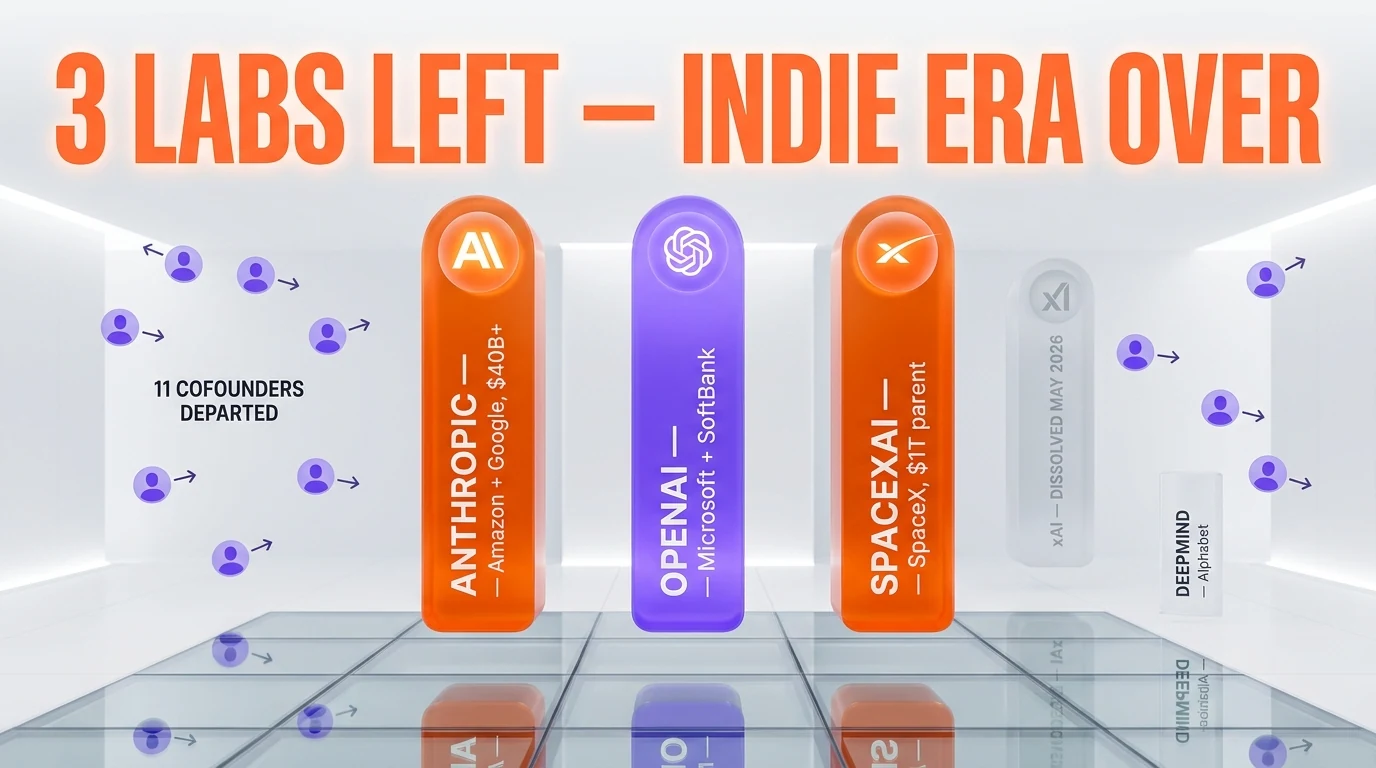
The strategic implication is the part most coverage is missing. Until May 7, the U.S. frontier-model landscape had four labs that mattered: OpenAI, Anthropic, Google DeepMind, and xAI. Three of them were already de facto subsidiaries of trillion-dollar parents — OpenAI through the Microsoft alliance and the SoftBank-led 2025 round, Anthropic through Amazon and Google's combined $40B-plus commitment, DeepMind as a wholly owned Alphabet unit. xAI was the last lab with the public posture of an independent company chasing its own destiny. That posture is now retired.
What this means for the market: the era of indie frontier AI labs is over. There is no longer a serious U.S. frontier-model effort that is not embedded inside a hyperscaler, a defense-adjacent aerospace giant, or a cloud-platform conglomerate. TradingKey's analyst note on the SpaceX IPO frames the consolidation as a $2 trillion bet that compute scale plus existing customer franchises (Falcon launches, Starlink subscriptions, X social) is the only viable path to fund $30B-per-year training runs. The math is brutal. xAI burned $7.8 billion in the first nine months of 2025 alone and posted a $1.46 billion net loss in Q3 2025. No standalone lab can sustain that without parent-company subsidy.
What happens to Grok, the X platform, and the Colossus campuses
The product story is straightforward and the reporting is consistent. Grok continues, unchanged at the user-facing layer, but now ships under the SpaceXAI sub-brand. The X social platform's AI features (the in-feed Grok summaries, the Grok-powered search, the upcoming agent integrations) move under the same banner. Memphis Colossus 1 — 220,000+ Nvidia GPUs and roughly 300 megawatts of compute — has been subleased in full to Anthropic, with Musk publicly stating he was "ok leasing Colossus 1 to Anthropic, as SpaceXAI had already moved training to Colossus 2." Colossus 2, the latest campus, becomes the SpaceXAI training base.
That sublease is the most surprising business detail. Musk spent two years publicly attacking Anthropic's leadership; now SpaceX is the company powering one of its main rivals. Musk's own framing: "I spent a lot of time last week with senior members of the Anthropic team to understand what they do to ensure Claude is good for humanity and was impressed." Anthropic confirmed the deal in its May 6 announcement, and the financial logic for SpaceX is obvious: monetize Colossus 1's stranded capacity while SpaceXAI's training shifts to the newer site, instead of letting depreciation eat $300 million-plus of monthly run-rate. Reporting in Tesla North and several outlets tracking the deal puts the sublease near $300 million per month, though neither company has formally confirmed that figure.
The IPO is the real driver, not the AI roadmap
Read this as an IPO play, not a research realignment. SpaceX is preparing for a public listing that bankers expect to land between late June and July 2026, with target valuations ranging from $1.75 trillion (the conservative case) up to $2 trillion (the bull case). That would be the largest IPO in financial history by a wide margin. To carry that valuation, SpaceX needs a clean equity story. A messy structure with a cash-burning AI subsidiary that posted $7.8 billion in losses is not a clean story. Folding xAI inside the SpaceX P&L, recategorizing Colossus capex as compute infrastructure, and turning the Anthropic deal into recurring infrastructure revenue is.
There is also a regulatory dimension. xAI as a standalone entity drew scrutiny from the FTC and from EU regulators over Grok's deepfake problem, the open class actions from 35 state attorneys general, and the data-handling questions tied to the X integration. Some of that liability is solved — or at least muddied — by burying the brand inside an aerospace parent that has its own regulatory shielding. We are not making a legal claim here; we are describing a structural reality. SpaceXAI as a subsidiary is a much harder antitrust target than xAI as a $250 billion solo company on the verge of an IPO.
What actually changes for users, builders, and the market
For developers: very little, immediately. The Grok API endpoints remain live, the X platform integrations keep shipping, and the Grok 4 family stays on the roadmap with no announced deprecations. SpaceXAI inherits all xAI commercial contracts. The model card branding will eventually shift, but accounts and credits transfer cleanly. On longer horizons, the question is whether Colossus 2 gets the kind of compute scale that makes Grok 5 or 6 competitive with Claude Opus 5 and GPT-6 — and that depends entirely on SpaceX's ability to redirect Falcon and Starship cash flow into AI capex instead of spaceflight expansion.
For Anthropic: an unambiguous win. Anthropic gets 220,000 GPUs of immediate compute it could not have built itself in 2026, doubled Claude Code rate limits for paid users (the announcement doubled five-hour windows on Pro and Max), and a powerful narrative: even Musk, after years of public hostility, decided Anthropic was the responsible operator for Colossus 1. That last point is worth more than the compute itself in the current safety-focused regulatory cycle.
For OpenAI: the strategic picture tightens. OpenAI now competes against three integrated stacks — Anthropic + Amazon-Google + SpaceX compute, SpaceXAI + SpaceX + X distribution, and itself + Microsoft + SoftBank capital. Anthropic's targeted $900B valuation round already showed the market repricing frontier labs upward; the SpaceXAI consolidation pushes that repricing further. Standalone OpenAI is no longer the obvious leader; it is one of three vertically integrated AI-plus-platform plays, and the one with the most exposed governance structure.
The end of the indie lab era and what replaces it
What we are watching is the closing of a five-year window. From Anthropic's 2021 founding through xAI's 2023 launch, it looked plausible that a small group of founders with elite research talent could build a frontier model lab as an independent company. The capital markets supported the idea — xAI raised at $250 billion, Anthropic at $200 billion-plus, OpenAI through repeated mega-rounds. But three forces collapsed that window: training runs that now cost $5-10 billion each, energy and grid constraints that require hyperscaler-grade infrastructure access, and regulatory exposure that punishes standalone frontier-model companies more harshly than embedded ones.
SpaceXAI does not solve those problems. It just shows the only structure that survives them: lab folded inside a parent with cash flow, real-estate, energy contracts, and regulatory cover. Expect this to be the template, not the exception. If you are building an AI startup right now and your medium-term plan does not include a credible parent-company partnership — Amazon, Google, Microsoft, Oracle, NVIDIA, or one of the new AI-native conglomerates — you are building toward the dissolution announcement, not away from it. xAI to SpaceXAI is the warning. Read it accordingly.
Frequently Asked Questions
What exactly was announced on May 7, 2026?
Elon Musk announced on X that xAI is being dissolved as a separate company and folded into SpaceX as a sub-brand called SpaceXAI. His exact words: "xAI will be dissolved as a separate company, so it will just be SpaceXAI, the AI products from SpaceX." It is a structural collapse, not a rebrand. xAI's corporate shell, cap table, and standalone board cease to exist. Grok and all xAI engineering work now ship under the SpaceXAI banner inside SpaceX. The announcement followed by one day Anthropic's confirmation that it had subleased the Memphis Colossus 1 supercomputer from SpaceX.
Why did Musk dissolve xAI instead of keeping it as a subsidiary?
Three drivers, in our reading. First, the SpaceX IPO targeting $1.75T to $2T, expected late June or July 2026, requires a clean equity story without a cash-burning AI subsidiary on the books. Second, every original xAI cofounder had departed by March 28, 2026, removing the leadership rationale for an independent shell. Third, Musk himself stated xAI was "not built right first time around" and is being rebuilt from the foundations. The combination of failed execution, departed leadership, and pre-IPO balance-sheet hygiene made dissolution the cleanest outcome.
Does Grok still work? What changes for current users?
Grok continues to operate without interruption. The API endpoints remain live, the X platform integrations keep shipping, the consumer Grok app stays available, and the Grok 4 model family is still on the roadmap with no deprecations announced. The only change at the product layer is the brand attribution: Grok is now a SpaceXAI product rather than an xAI product. Existing API keys, accounts, and credits transfer cleanly. Enterprise contracts signed with xAI inc. are inherited by SpaceX as the legal successor.
Where did the 11 original xAI cofounders go?
Founders left in waves through 2024 and 2025. Igor Babuschkin departed for an OpenAI-adjacent project, Yuhuai "Tony" Wu and Jimmy Ba moved to Meta Superintelligence-related teams, Christian Szegedy returned to research roles, and several others including Manuel Kroiss, Greg Yang, Kyle Kosic, Ross Nordeen, and Toby Pohlen joined Anthropic, DeepMind, or launched independent startups. The eleventh and final cofounder exited on March 28, 2026. Musk is the only person from the original founding incorporation still inside the building.
Why is SpaceX leasing Colossus 1 to Anthropic, a competitor?
Capital efficiency and a strategic narrative shift. SpaceXAI moved its training workloads to Colossus 2, leaving Colossus 1's roughly 300 megawatts and 220,000 GPUs underutilized. Subleasing the full capacity to Anthropic monetizes a depreciating asset that would otherwise burn cash. Reporting puts the monthly amount near $300 million, though neither company has formally confirmed the figure. Musk also publicly said he was impressed by Anthropic's safety work after meeting the team. For Anthropic, the deal doubled Claude Code rate limits and added enormous training compute that would have taken a year-plus to build internally.
How much is the SpaceX IPO expected to value the combined entity?
Bankers and tracking outlets cite a target range of $1.75 trillion (conservative case) to $2 trillion (bull case), with trading expected to begin late June or July 2026. That would make it the largest IPO in financial history by a wide margin. The valuation depends on Falcon and Starship launch cadence, Starlink subscription growth, and now the SpaceXAI compute monetization story including the Anthropic sublease. Folding xAI's $7.8B nine-month 2025 losses into a clean parent P&L is part of how the underwriting gets to that range.
Does this make Anthropic and OpenAI more dominant in frontier AI?
Functionally yes, in the U.S. market. With xAI absorbed, the standalone frontier-model field reduces to OpenAI, Anthropic, and the rebuilt SpaceXAI inside SpaceX, plus Google DeepMind. Anthropic gets the most direct lift: 220,000 GPUs of immediate compute, doubled Claude Code rate limits for paid users, and a credibility narrative when even Musk publicly endorses the team's safety work. OpenAI faces tighter competition because the market now has three vertically integrated AI-plus-platform plays rather than a wider field of independent labs.
What does this mean for AI startups in 2026 and beyond?
The independent frontier-lab path is functionally closed. Training a frontier model now costs $5 billion to $10 billion per generation, requires hyperscaler-grade energy and grid contracts, and exposes the standalone company to regulatory pressure that embedded labs avoid. xAI raised $250 billion at peak and still could not sustain the burn rate. The viable structure is now lab inside parent: Anthropic with Amazon-Google, OpenAI with Microsoft-SoftBank, DeepMind in Alphabet, SpaceXAI in SpaceX. Startups planning a five-year frontier-model run without a credible parent partnership are building toward the same dissolution announcement.
Is the X social platform also being absorbed into SpaceX?
The AI features of X (in-feed Grok summaries, Grok-powered search, agent integrations, image generation) move to SpaceXAI as part of the consolidation. X Corp itself, the social platform's separate corporate entity, has not been dissolved in this announcement and remains a distinct Musk-controlled company. The practical effect is that AI development on X happens inside SpaceX going forward, while the social platform's posting, moderation, and advertising layers remain in X Corp. Whether X Corp itself eventually folds into SpaceX is a separate question that this announcement does not answer.
Could xAI be revived or spun back out as an independent lab later?
Unlikely in the medium term. Once the SpaceX IPO completes, the SpaceXAI compute and product line becomes a material contributor to the public-company P&L, and unwinding it would face shareholder, regulatory, and operational friction. The cofounder pool that would lead a revival has already dispersed across competing labs. The brand "xAI" carries reputational weight from the Grok deepfake litigation and the 35 state attorneys-general actions that the parent company will not want to re-attach to. A future Musk-led standalone AI lab is possible; a literal xAI revival is not the most likely outcome.
How does this affect Grok's deepfake legal exposure?
The corporate-successor doctrine applies. SpaceX, as the legal successor to xAI's assets and liabilities through the February 2026 acquisition, inherits the open litigation, including the Baltimore class action, the 35-state attorneys general matter, and the international regulatory cases tracked across multiple jurisdictions. Burying the xAI brand does not extinguish the claims. What it does change is the defendant balance sheet: plaintiffs now face a parent with deep aerospace and Starlink revenue, and SpaceX gets stronger incentive to settle or restructure rather than carry the cases into IPO trading.
What is our verdict on this restructuring?
Our verdict: the dissolution is the right call structurally, even if the messaging is rough. Musk publicly admitting xAI was "not built right first time around" is unusual founder honesty. The IPO logic, the cofounder exodus, the cash-burn math, and the Anthropic sublease all point to one outcome: xAI as a standalone entity could not survive 2026, and folding it into SpaceX is the cleanest path to keeping Grok competitive. Skip the optimism that this fixes the safety or product problems — those follow execution, not org charts. Best alternative for users right now: Claude Code, which now ships with doubled rate limits courtesy of the same Colossus deal that confirmed xAI's collapse.