Claude Opus 4.8 vs Claude Sonnet 4.6: Capability vs Cost (2026)


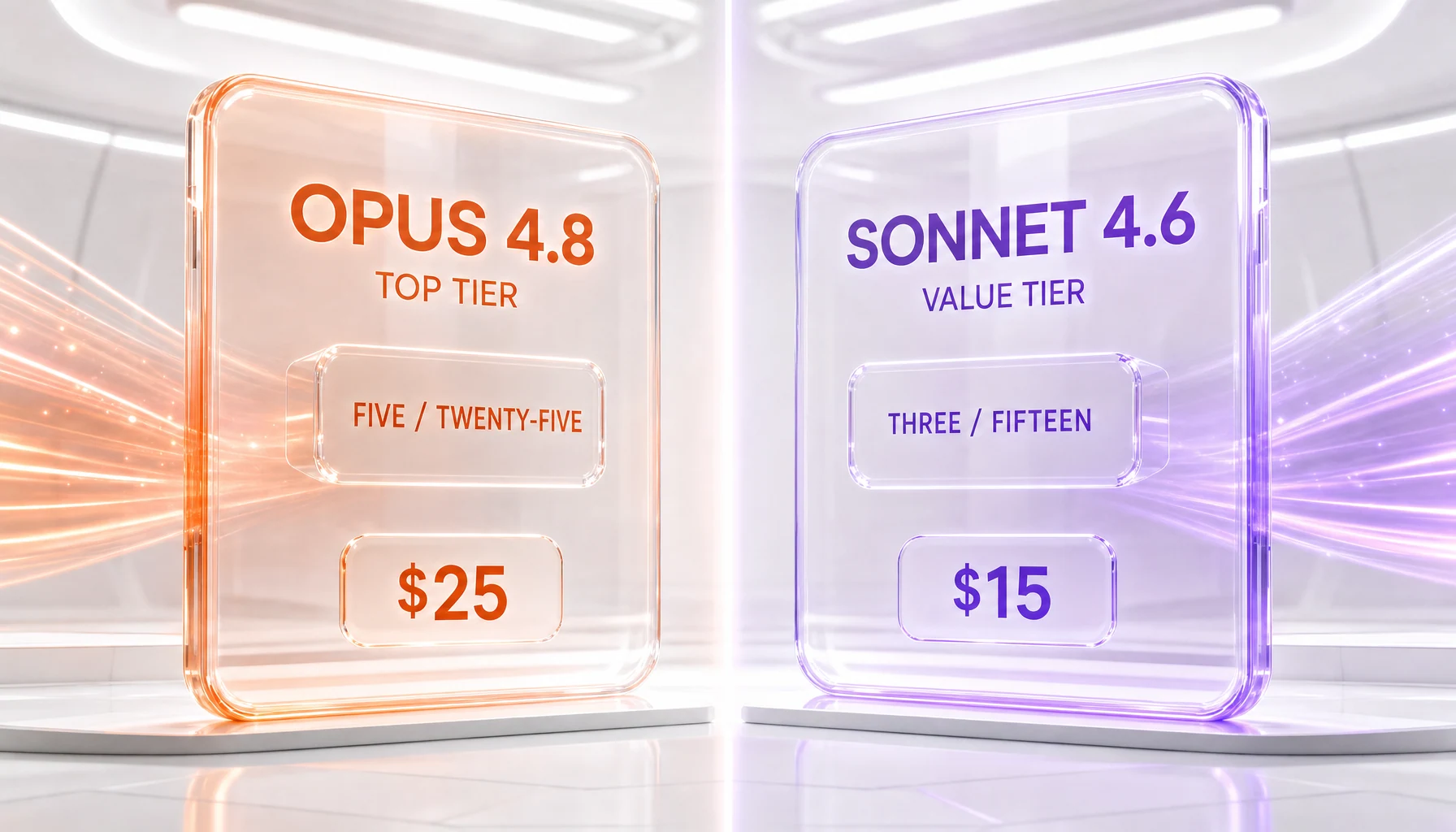
Claude Opus 4.8 ($5/$25) vs Sonnet 4.6 ($3/$15): Sonnet is 40% cheaper, Opus is stronger. We run both — here is which tier to pick by job.
Feature Comparison
| Feature | Claude Opus 4.8 | Claude Sonnet 4.6 |
|---|---|---|
| Tier | Top-end flagship | Mid-tier workhorse |
| Release date | May 28, 2026 | February 17, 2026 |
| Input price (per 1M tokens) | $5.00 | $3.00 |
| Output price (per 1M tokens) | $25.00 | $15.00 |
| Batch input / output (per 1M) | $2.50 / $12.50 | $1.50 / $7.50 |
| Cache hit (per 1M) | $0.50 | $0.30 |
| Context window | 1M tokens (standard pricing) | 1M tokens (beta) |
| Fast Mode (2.5x speed) | Yes — $10 / $50 per 1M | No |
| Dynamic Workflows (parallel sub-agents) | Yes (research preview) | No (runs as worker) |
| SWE-bench Verified (different launch tables) | 88.6% | 79.6% (80.2% with prompt mod) |
| Terminal-Bench (different versions: 2.1 vs 2.0) | 74.6% (v2.1) | 59.1% (v2.0) |
| Computer use (different benchmarks) | 84% Online-Mind2Web | 94% insurance benchmark |
| Self-review reliability | ~4x fewer code flaws than prior Opus | Fewer false success claims than Sonnet 4.5 |
| Best fit | Hardest agentic, reasoning, computer use | Volume, latency, cost-sensitive production |
Pricing Comparison
Claude Opus 4.8
Claude Sonnet 4.6
Detailed Comparison
Claude Opus 4.8 vs Claude Sonnet 4.6: Opus 4.8 is Anthropic's top-tier flagship, built for complex agentic coding, deep reasoning, and computer use, priced at $5 per million input tokens and $25 per million output tokens. Sonnet 4.6 is the mid-tier workhorse, priced at $3 per million input tokens and $15 per million output tokens — roughly 40 percent cheaper — and both ship a 1M token context window. We run both every day. The honest answer is that there is no single winner: pick Opus 4.8 for the hardest agentic and reasoning work where reliability matters most, and pick Sonnet 4.6 for high-volume, latency-sensitive, and cost-sensitive workloads where it does most of the job at a fraction of the spend.
Before we dig in, a quick note on where Sonnet 4.6 now sits in the lineup: since June 30, 2026, Claude Sonnet 5 is Anthropic's current-generation Sonnet — near-Opus capability at $2 per million input tokens and $10 per million output tokens — and we have already put it head-to-head with a rival flagship in Claude Sonnet 5 vs Gemini 3.1 Pro. Sonnet 4.6 remains available through the API at the rates covered here, so if it is the tier you run, this capability-versus-cost guide still applies as written.
Quick Verdict
No overall winner — it is a split decision by job. Opus 4.8 and Sonnet 4.6 are not really competing for the same slot. They are two tiers of the same Claude family, and the smart move is almost always to run both: Opus where the task is hard enough to justify the spend, Sonnet for everything else. We do exactly that in our own production work, and the cost difference is the whole reason the tiering exists. Opus 4.8 costs $5 per million input tokens and $25 per million output tokens; Sonnet 4.6 costs $3 per million input tokens and $15 per million output tokens. That is roughly 40 percent cheaper on both input and output, and the gap widens once you stack batch and caching discounts.
- Pick Claude Opus 4.8 for: complex multi-file agentic coding, long autonomous runs where self-verification matters, the hardest reasoning tasks (legal, analytical, research), computer and browser automation at the top end, and any workload where a single mistake is expensive enough to justify paying more per token.
- Pick Claude Sonnet 4.6 for: high-volume production pipelines, sub-agent worker roles under an Opus coordinator, latency-sensitive interactive work, long-context document Q&A over its 1M window, and anything cost-sensitive where near-flagship quality is good enough.
- Cost gap: Sonnet 4.6 is about 40 percent cheaper per token than Opus 4.8, and the gap grows with Batch API (50 percent off) and prompt caching (cache hits at one-tenth of input price) on top.
- Honest caveat: the headline benchmark numbers for these two models come from different launch announcements, different dates, and in some cases different benchmark versions — they are not a clean same-table like-for-like. We flag exactly where below, because it changes how much weight you should put on any single percentage.
A note on the numbers: the only data in this comparison that is genuinely same-source and like-for-like is pricing — we pulled both models' rates from the same Anthropic pricing table on the day we wrote this. The benchmark figures are not like-for-like: Opus 4.8's scores come from its May 2026 launch table, Sonnet 4.6's from its February 2026 launch, and the Terminal-Bench versions differ (2.1 for Opus, 2.0 for Sonnet). Treat the benchmark percentages as directional, not as a head-to-head measured under one harness. The pricing, the feature sets, and our hands-on experience are where the real decision lives.
What each model is
Claude Opus 4.8
Claude Opus 4.8 is Anthropic's flagship model, launched May 28, 2026. It is the top tier of the Claude lineup, positioned for the most demanding coding, agentic, and reasoning work. It ships with a Fast Mode that runs at roughly 2.5x the speed of standard inference, effort controls that let you dial how much reasoning the model spends, and Dynamic Workflows that orchestrate hundreds of parallel sub-agents. Anthropic reports Opus 4.8 is about four times less likely than the previous Opus to let flaws slip through in its own code, leads computer-use testing at 84 percent on Online-Mind2Web, and is the first model to clear 10 percent all-pass on the Legal Agent Benchmark. Pricing is $5 per million input tokens and $25 per million output tokens for standard usage, with a 1M token context window included at standard pricing. Fast Mode is priced at $10 per million input and $50 per million output.
Claude Sonnet 4.6
Claude Sonnet 4.6 is Anthropic's mid-tier workhorse, released February 17, 2026. It is the model most teams actually run in production, because it delivers near-flagship coding quality at a much lower price. It carries a 1M token context window in beta, adaptive thinking that decides on its own when to extend reasoning, and strong computer-use scores — 94 percent on the insurance benchmark Anthropic highlighted at release. Pricing is $3 per million input tokens and $15 per million output tokens, with a Batch API that halves both rates and prompt caching that drops cache reads to one-tenth of the input price. There is no Fast Mode — that is an Opus-only feature. Sonnet 4.6 is what coding agents like Claude Code, Cursor, and Windsurf default to for their cost-performance balance, and it is the worker model we run under Opus coordinators in our own pipelines.
Claude Opus 4.8 vs Claude Sonnet 4.6: head-to-head
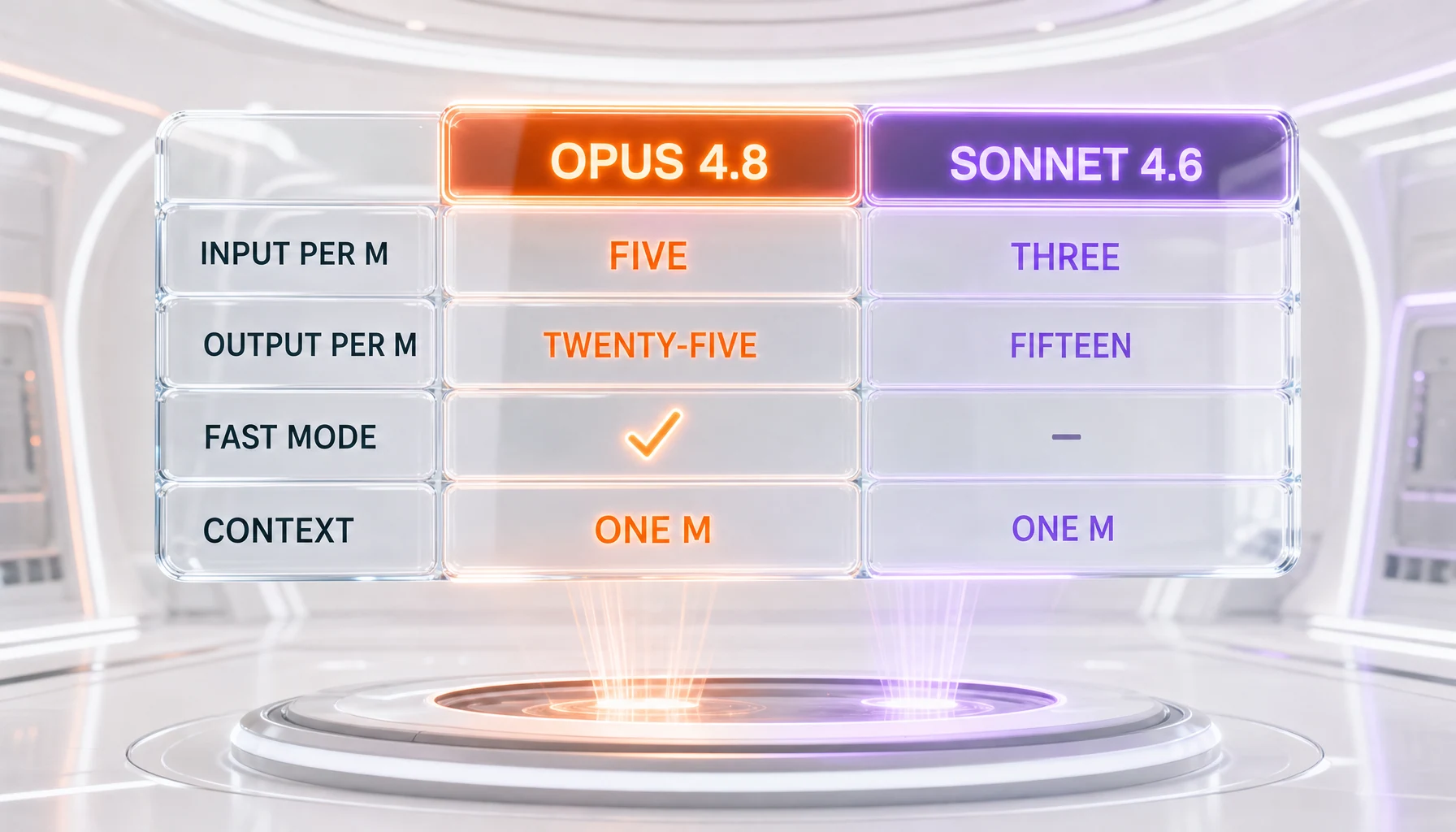
The table below puts the two tiers side by side. Pricing is same-source and directly comparable. Benchmark rows are marked where the figures come from different launch tables, so you can weigh them accordingly. Where a value is not directly comparable, we say so rather than force a winner.
| Feature | Claude Opus 4.8 | Claude Sonnet 4.6 | Winner |
|---|---|---|---|
| Tier | Top-end flagship | Mid-tier workhorse | By job |
| Release date | May 28, 2026 | February 17, 2026 | Tie |
| Input price (per 1M tokens) | $5.00 | $3.00 | Sonnet 4.6 |
| Output price (per 1M tokens) | $25.00 | $15.00 | Sonnet 4.6 |
| Batch input / output (per 1M) | $2.50 / $12.50 | $1.50 / $7.50 | Sonnet 4.6 |
| Cache hit (per 1M) | $0.50 | $0.30 | Sonnet 4.6 |
| Context window | 1M tokens (standard pricing) | 1M tokens (beta) | Tie |
| Fast Mode (2.5x speed) | Yes — $10 / $50 per 1M | No | Opus 4.8 |
| Dynamic Workflows (parallel sub-agents) | Yes (research preview) | No (runs as worker) | Opus 4.8 |
| SWE-bench Verified (different launch tables) | 88.6% | 79.6% (80.2% with prompt mod) | Opus 4.8 |
| Terminal-Bench (different versions: 2.1 vs 2.0) | 74.6% (v2.1) | 59.1% (v2.0) | Not directly comparable |
| Computer use (different benchmarks) | 84% Online-Mind2Web | 94% insurance benchmark | Not directly comparable |
| Self-review reliability | ~4x fewer code flaws than prior Opus | Fewer false success claims than Sonnet 4.5 | Opus 4.8 |
| Best fit | Hardest agentic, reasoning, computer use | Volume, latency, cost-sensitive production | By job |
Read the table and the shape of the decision is clear. Sonnet 4.6 wins every pricing row by a consistent margin. Opus 4.8 wins on the capability ceiling — Fast Mode, Dynamic Workflows, the highest agentic-coding scores, and the strongest self-verification behavior. The two computer-use numbers (84 percent and 94 percent) look like Sonnet wins, but they measure entirely different benchmarks, so we mark them not directly comparable rather than hand the row to Sonnet. That is the kind of trap a careless comparison falls into.
What the benchmarks actually measure — and why they are not like-for-like
This is the section most comparisons skip, and it is the one that matters most here. Opus 4.8 and Sonnet 4.6 launched three months apart, and their headline scores come from separate announcements. That has real consequences for how you read them.
SWE-bench Verified (88.6% vs 79.6%) is a curated set of real GitHub issues with human-verified solvability — the most widely cited coding benchmark. The roughly nine-point gap is real and points in the direction you would expect: the flagship is a stronger coder. But Opus 4.8's 88.6 percent comes from its May launch table, and Sonnet 4.6's 79.6 percent (80.2 percent with a prompt modification) comes from its February launch. They were not run in the same evaluation pass, so treat the gap as directional. The honest read is "Opus is meaningfully stronger on hard real-world coding," not "Opus is exactly 9 points better."
Terminal-Bench (74.6% vs 59.1%) is even less comparable, because the versions differ: Opus 4.8's figure is on Terminal-Bench 2.1, and Sonnet 4.6's is on the older 2.0. Benchmark versions change the task set, so you cannot subtract one from the other and call it a gap. What you can say is that both are strong agentic, tool-using coders, and the flagship leads — but we will not pretend this is a clean head-to-head.
Computer use (84% vs 94%) is the row careless comparisons get wrong. Opus 4.8's 84 percent is on Online-Mind2Web, a web-navigation benchmark. Sonnet 4.6's 94 percent is on an insurance-workflow benchmark Anthropic highlighted at its release. These are different tasks measuring different things. The 94 percent does not mean Sonnet is better at computer use than Opus — it means Sonnet scored very high on one specific workflow. We flag this explicitly so you do not draw the wrong conclusion from two numbers that happen to sit in the same row.
The takeaway: benchmarks tell you the tiers are roughly where you would expect — Opus stronger at the top, Sonnet impressively close for the price — but they do not give you a clean scoreboard. The pricing does. That is why our verdict leans on cost-per-job and hands-on behavior more than on any single percentage.
Pricing compared
Pricing is the cleanest part of this comparison because both rates come from the same Anthropic pricing table, fetched the day we wrote this. Here is the full breakdown for standard API usage.
| Pricing tier | Claude Opus 4.8 | Claude Sonnet 4.6 |
|---|---|---|
| Input (per 1M tokens) | $5.00 | $3.00 |
| Output (per 1M tokens) | $25.00 | $15.00 |
| 5-minute cache write (per 1M) | $6.25 | $3.75 |
| 1-hour cache write (per 1M) | $10.00 | $6.00 |
| Cache hit / read (per 1M) | $0.50 | $0.30 |
| Batch input (per 1M) | $2.50 | $1.50 |
| Batch output (per 1M) | $12.50 | $7.50 |
| Fast Mode input / output (per 1M) | $10.00 / $50.00 | Not available |
| 1M context window | Standard pricing | Standard pricing (beta) |
The pattern is consistent: Sonnet 4.6 costs exactly 60 percent of Opus 4.8 on both input and output, across standard, batch, and cache-hit rates. On a workload that runs heavy output — which most agentic coding does — that gap compounds fast. Run a million output tokens through Opus 4.8 and you pay $25; run the same through Sonnet 4.6 and you pay $15. Push both through the Batch API and it is $12.50 versus $7.50. Stack prompt caching on a long, reused system prompt and the cache-read line drops to $0.50 versus $0.30 per million.
The practical upshot: if you can do a job acceptably on Sonnet 4.6, doing it on Opus 4.8 is a deliberate choice to spend about 67 percent more for the capability headroom. Sometimes that is exactly right — the task is hard, the stakes are high, and a wrong answer costs more than the token premium. Often it is overspend, and that is the entire reason the tier exists.
What the cost gap looks like in practice
Abstract per-token numbers do not land until you put them against a real workload, so here are three patterns we actually run, and what the tier choice costs in each.
A high-volume content pipeline. Say you process a batch of jobs that consumes 50 million input tokens and produces 10 million output tokens in a month — a realistic shape for bulk drafting, summarization, or classification. On Sonnet 4.6 at standard rates that is 50 times $3 plus 10 times $15, or $150 plus $150, for $300. On Opus 4.8 it is 50 times $5 plus 10 times $25, or $250 plus $250, for $500. Sonnet does the same job for $200 less, a 40 percent saving — and push it through the Batch API and Sonnet drops to $150 total against Opus at $250. For work of this shape, the model that is "better on benchmarks" is simply the wrong tool, because the marginal quality gain does not justify a 67 percent cost increase on a job Sonnet already handles.
A hard agentic coding run. Now flip it. A single complex refactor might burn far fewer tokens but demand the strongest possible reasoning and self-verification, because a wrong answer means a broken build, a bad merge, or hours of human cleanup. Here the token cost is almost irrelevant — even a token-heavy Opus 4.8 session is a few dollars — and the thing you are buying is reliability. Spending the Opus premium to avoid one expensive mistake pays for itself many times over. This is the case where the cheaper model is the false economy.
A mixed coordinator-and-worker stack. The pattern we actually run combines both. Opus 4.8 sits as the coordinator, planning and reviewing, while Sonnet 4.6 does the parallel execution underneath it. The coordinator burns relatively few tokens making good decisions; the workers burn most of the tokens doing the bulk work at Sonnet's lower rate. You end up paying the Opus premium only on the small slice of tokens where judgment matters most, and Sonnet's price on everything else. That is how you get most of the flagship's quality at close to the workhorse's cost — and it is exactly what the two-tier lineup is designed to enable.
How we tested both
We run both models in our own production work, every day. Opus 4.8 is our coordinator and heavy-lifter for the hardest agentic jobs — long multi-file refactors, complex reasoning, anything where we need the model to verify its own work and back out cleanly when it is wrong. Sonnet 4.6 is our worker model: it does the high-volume, repetitive, and latency-sensitive work, and it runs as a sub-agent under Opus coordinators on tasks that fan out into many parallel steps.
This is not a controlled lab benchmark. We have not run a fixed task suite through both models under one harness and measured wall-clock and pass rates — and we are not going to claim we did. What we can tell you is what living with both daily feels like: where each one earns its keep, where each one frustrates us, and which one we reach for when. That hands-on read is the part a spec sheet cannot give you, and it is consistent with Anthropic's positioning of the two tiers. Where our experience and the vendor numbers agree, we say so; where the numbers are vendor-reported and unverified, we flag it.
Winners by category
Best for hard agentic coding: Claude Opus 4.8
On the genuinely difficult multi-file work — large refactors, migrations, anything that requires holding a complex plan across many steps — Opus 4.8 is the one we trust. Its self-verification behavior is the difference-maker: it catches and flags its own mistakes more often, which on a long autonomous run is worth far more than a few points of benchmark headroom. Sonnet 4.6 is genuinely close and handles most coding well, but when the task is hard and the run is long, Opus 4.8 is the safer hand.
Best for cost-sensitive volume: Claude Sonnet 4.6
For high-volume production — content pipelines, classification, structured extraction, bulk summarization — Sonnet 4.6 wins decisively, and it is not close on the economics. At 60 percent of Opus 4.8's per-token cost, plus 50 percent off via Batch API and 90 percent off on cache hits, it does the bulk work at a fraction of the spend. Running these jobs on Opus 4.8 would be a textbook overspend.
Best for sub-agent orchestration: Claude Sonnet 4.6 as worker, Opus 4.8 as coordinator
This is the pattern we actually run. Opus 4.8 plans and coordinates; Sonnet 4.6 executes the parallel sub-tasks. You get the flagship's judgment where it matters and the workhorse's price everywhere else. Opus 4.8's Dynamic Workflows is built precisely for fanning work out to many parallel sub-agents, and Sonnet 4.6 is the cost-effective model to put in those worker slots.
Best for latency-sensitive interactive work: depends
For raw speed at the top tier, Opus 4.8's Fast Mode runs at roughly 2.5x standard speed — but at double the per-token price ($10 / $50 per million). For interactive work that does not need flagship capability, Sonnet 4.6 at standard speed and standard price is usually the better value. Pick Fast Mode Opus only when you need both top-end capability and low latency and can absorb the premium.
Best for long-context document work: tie
Both ship a 1M token context window, so either can load entire codebases, long contracts, or large research libraries in a single call. Sonnet 4.6's 1M window is beta on the API and we have seen intermittent overload errors at very high token counts, so for synchronous user-facing latency we lean Opus; for batch jobs over huge context, Sonnet's price advantage wins.
Reliability and self-verification in practice
The single behavior that most justifies reaching for Opus 4.8 over Sonnet 4.6 is not a benchmark — it is how each model behaves when it is uncertain or wrong. Anthropic reports that Opus 4.8 is about four times less likely than the previous Opus to let flaws slip through in its own code on self-review, and in our hands-on use that maps to something we can feel on long runs: Opus 4.8 backtracks and self-corrects more cleanly, and it is more willing to say "I am not sure this is right, let me check" instead of declaring a task done. On a five-minute chat that barely matters. On a thirty-step autonomous run, it is the difference between a clean result and a confidently broken one that you only discover later.
Sonnet 4.6 is not unreliable — Anthropic specifically improved it over Sonnet 4.5 to make fewer false success claims and over-engineer less, and in everyday work it is dependable. But the gap shows up under pressure. When a task is long, ambiguous, or high-stakes, Opus 4.8's stronger self-verification is the safety margin we pay for. When a task is short, well-scoped, and repetitive, Sonnet 4.6's reliability is more than enough, and the extra margin would be wasted. This is why our routing rule is not "use the better model" but "match the reliability requirement to the stakes of the task."
One honest limitation worth repeating: the four-times-fewer-flaws figure is Anthropic's own, measured on their own evaluation, and we have not reproduced it in a controlled head-to-head. We are reporting that our day-to-day experience is consistent with the claim, not that we have independently verified the multiplier. Treat it as a vendor claim corroborated by hands-on use, not as a measured fact.
Pros and cons of each
Claude Opus 4.8
Pros: Strongest agentic coding and reasoning in the Claude family; about four times less likely than the prior Opus to let flaws through on self-review; Fast Mode for 2.5x speed; Dynamic Workflows for parallel sub-agent orchestration; effort controls for predictable cost-versus-depth; 1M context at standard pricing; leads Anthropic's computer-use testing at 84 percent Online-Mind2Web.
Cons: About 67 percent more expensive per token than Sonnet 4.6; benchmark scores are vendor-reported and not independently reproduced; for most volume work the extra capability is wasted spend; Fast Mode doubles the per-token cost.
Claude Sonnet 4.6
Pros: Roughly 40 percent cheaper per token than Opus 4.8, with the gap widening under Batch and caching discounts; near-flagship coding quality for most tasks; 1M context window; adaptive thinking that extends reasoning only when it helps; the default worker model for coding agents; excellent value as a sub-agent under an Opus coordinator.
Cons: No Fast Mode and no Dynamic Workflows — those are Opus-only; 1M context is beta and can throw overload errors at very high token counts; max synchronous output stops at 64k tokens; reliable knowledge cutoff is August 2025 (vs January 2026 for Opus 4.8), so for the most current-events-aware tasks we still default to Opus or the web search tool; adaptive thinking can occasionally over-trigger and inflate output tokens.
When to pick which
Pick Claude Opus 4.8 when the task is genuinely hard — complex multi-file agentic coding, deep reasoning, legal or analytical work, or a long autonomous run where the model needs to verify itself and a single uncaught mistake is expensive. Pick it when you need Fast Mode's low latency at the top tier, or Dynamic Workflows to orchestrate parallel sub-agents. In short: pick Opus 4.8 when the cost of being wrong is higher than the token premium.
Pick Claude Sonnet 4.6 when you are running volume — content pipelines, classification, extraction, bulk summarization — or when latency and cost matter more than the last few points of capability. Pick it as the worker model under an Opus coordinator, for long-context document Q&A over its 1M window, and for any production workload where near-flagship quality is good enough and the 40-percent cost saving is real money at scale.
Run both when you are building anything serious. The mature pattern is not to choose one model — it is to route each task to the right tier. Opus 4.8 for the hard parts, Sonnet 4.6 for everything else. That is what the two-tier design is for, and it is how we run our own stack.
If you are weighing Opus 4.8 against models outside the Claude family, see our Claude Opus 4.8 vs GPT-5.5 and Claude Opus 4.8 vs Gemini 3.1 Pro comparisons — both run the same hands-on methodology on price versus capability. And if you want to see how the newer Claude Sonnet 5 fares outside the family, our Claude Sonnet 5 vs DeepSeek V4 comparison runs the same playbook against the open-weight flagship.
Final verdict
There is no overall winner here, and any comparison that crowns one is missing the point. Claude Opus 4.8 and Claude Sonnet 4.6 are two tiers of the same family, designed to be used together. Opus 4.8 is the stronger model — better agentic coding, better reasoning, better self-verification, plus Fast Mode and Dynamic Workflows that Sonnet does not have. Sonnet 4.6 is the better value — about 40 percent cheaper per token, near-flagship quality on most work, and a 1M context window of its own.
Our verdict: pick Opus 4.8 for the hardest agentic and reasoning work where reliability is worth the premium, and pick Sonnet 4.6 for high-volume, latency-sensitive, and cost-sensitive production where it does most of the job for far less. If you are building anything at scale, run both and route by task. The one thing we will not do is hand you a fake "winner" — the honest answer is that the right Claude depends on the job in front of you, and the cost gap is exactly why the choice exists.
Frequently asked questions
Is Claude Opus 4.8 better than Claude Sonnet 4.6?
On raw capability, yes — Opus 4.8 is the stronger model. It scores higher on hard agentic-coding benchmarks (88.6 percent on SWE-bench Verified versus Sonnet 4.6's 79.6 percent), it has better self-verification on long autonomous runs, and it adds Fast Mode and Dynamic Workflows that Sonnet does not have. But "better" is not the same as "the right choice." Sonnet 4.6 costs about 40 percent less per token and handles most production work well, so for high-volume or cost-sensitive jobs it is the smarter pick. The two are different tiers, and the best answer for most teams is to run both and route each task to the right one.
How much cheaper is Claude Sonnet 4.6 than Opus 4.8?
Sonnet 4.6 costs exactly 60 percent of Opus 4.8 on both input and output: $3 per million input tokens versus $5, and $15 per million output tokens versus $25. That is about 40 percent cheaper. The gap holds across batch pricing ($1.50 / $7.50 versus $2.50 / $12.50 per million) and cache-hit pricing ($0.30 versus $0.50 per million). On output-heavy workloads like agentic coding, that difference compounds quickly, which is why routing volume work to Sonnet saves real money at scale.
Do Claude Opus 4.8 and Sonnet 4.6 both have a 1M token context window?
Yes, both include a 1M token context window. On Opus 4.8 the full 1M window is available at standard pricing. On Sonnet 4.6 the 1M window is in beta on the Claude API. In our use, Sonnet's 1M beta is reliable for batch jobs but we have occasionally hit overload errors at very high token counts, so for synchronous, user-facing latency we lean toward Opus. For large batch jobs over huge context, Sonnet's price advantage usually wins.
Which Claude model should I use with Claude Code or Cursor?
For most coding-agent work, Sonnet 4.6 is the sensible default — it is what tools like Claude Code, Cursor, and Windsurf route to for the cost-performance balance, and it handles the majority of tasks well at a fraction of Opus pricing. Switch to Opus 4.8 for the genuinely hard jobs: large multi-file refactors, complex migrations, and long autonomous runs where its stronger self-verification and agentic-coding scores earn the premium. The best setup runs Sonnet as the everyday worker and escalates to Opus when a task is hard enough to justify it.
Are the benchmark numbers a fair head-to-head comparison?
Not exactly, and we flag this plainly. Opus 4.8's benchmark scores come from its May 2026 launch table; Sonnet 4.6's come from its February 2026 launch. They were not run in the same evaluation pass, and the Terminal-Bench versions even differ (2.1 for Opus, 2.0 for Sonnet). The computer-use numbers (84 percent for Opus on Online-Mind2Web, 94 percent for Sonnet on an insurance benchmark) measure entirely different tasks. Treat the percentages as directional — they confirm Opus is the stronger tier — but do not subtract one from the other as if they were measured under one harness. The pricing, by contrast, is same-source and directly comparable.
Does Claude Sonnet 4.6 have Fast Mode like Opus 4.8?
No. Fast Mode is an Opus-only feature. Opus 4.8's Fast Mode runs at roughly 2.5x standard inference speed at a premium price — $10 per million input tokens and $50 per million output tokens, double the standard rate. Sonnet 4.6 has no equivalent. If you need low latency, Sonnet at standard speed is often fast enough and far cheaper; use Opus Fast Mode only when you need both flagship capability and low latency and can absorb the premium.
Can I run Sonnet 4.6 as a worker under an Opus 4.8 coordinator?
Yes, and it is the pattern we use ourselves. Opus 4.8 plans and coordinates the hard parts; Sonnet 4.6 executes the parallel sub-tasks at a much lower cost. Opus 4.8's Dynamic Workflows feature is built specifically to fan work out across many parallel sub-agents, and Sonnet 4.6 is the cost-effective model to put in those worker slots. You get the flagship's judgment where it matters and the workhorse's price everywhere else — the best of both tiers in one stack.
Is Opus 4.8 worth the extra cost over Sonnet 4.6?
It depends entirely on the job. For hard agentic coding, deep reasoning, and long autonomous runs where a single uncaught mistake is expensive, Opus 4.8's stronger capability and self-verification are worth the roughly 67 percent per-token premium. For volume work — bulk content, classification, extraction, summarization — paying that premium is overspend, and Sonnet 4.6 does the job for far less. The premium is worth it when the cost of being wrong exceeds the cost of the extra tokens, and not before.
Which model has a more recent knowledge cutoff?
Opus 4.8 has the more recent reliable knowledge cutoff. Both models share a January 2026 training-data cutoff, but Anthropic lists their reliable knowledge cutoff differently: January 2026 for Opus 4.8 and August 2025 for Sonnet 4.6. So for tasks that depend on awareness of recent events we default to Opus or to the web search tool. For most coding and structured work the cutoff rarely matters, but for current-events-aware reasoning it is a real reason to choose Opus or to ground either model with web search.
What is the maximum output length for each model?
Sonnet 4.6 caps synchronous output at 64k tokens on the Messages API; longer outputs require the extended-output beta header on the Batch API. Opus 4.8's standard usage runs over the full 1M context window at standard pricing. For most tasks neither limit bites, but if you are generating very long single outputs synchronously, confirm the current output ceiling for your chosen model before architecting around a fixed number — output limits are the kind of spec that changes between releases.
Can I switch between Opus 4.8 and Sonnet 4.6 without code changes?
Largely yes. Both are accessed through the same Claude API and are available across the same clouds — Claude API, AWS, Google Cloud, and Microsoft Foundry — using the same request format, so switching is typically a model-ID change rather than a rewrite. The practical caveats are feature-level: Fast Mode and Dynamic Workflows exist only on Opus 4.8, and Sonnet's 1M context is still beta. If your code relies on an Opus-only feature, you cannot drop Sonnet in for that specific call, but for ordinary completions the swap is trivial.
If I can only pick one Claude model, which should it be?
For most teams, Sonnet 4.6 is the single best pick if you are forced to choose one — it covers the majority of production workloads at a much lower cost and stays close to flagship quality on most tasks. Choose Opus 4.8 as your one model only if your work is dominated by the hardest agentic and reasoning jobs where its capability headroom and self-verification are load-bearing. But the honest recommendation is to avoid picking just one: the two tiers exist precisely so you can route hard work to Opus and everything else to Sonnet.
Sources and references
Every figure on this page is attributed to whoever produced it. Vendor documentation and independent measurement are listed separately and never merged into a single ranking.
- Artificial Analysis — Claude Opus 4.8 (independent index score and cost per task)
- Artificial Analysis — Claude Sonnet 4.6 (independent index score)
- Artificial Analysis — Model leaderboard (Intelligence Index scores and cost per task across configurations)
Our Verdict
There is no overall winner: Claude Opus 4.8 and Claude Sonnet 4.6 are two tiers of the same family, built to be used together. Opus 4.8 is the stronger model — better agentic coding, deeper reasoning, cleaner self-verification, plus Fast Mode and Dynamic Workflows that Sonnet lacks — at $5 per million input tokens and $25 per million output tokens. Sonnet 4.6 is the better value at $3 input and $15 output, roughly 40 percent cheaper, with near-flagship quality on most work and its own 1M context window. Pick Opus 4.8 for the hardest agentic and reasoning work where reliability is worth the premium; pick Sonnet 4.6 for high-volume, latency-sensitive, and cost-sensitive production. If you build at scale, run both and route by task. We will not hand you a fake winner — the right Claude depends on the job, and the cost gap is exactly why the choice exists.
Choose Claude Opus 4.8
Anthropic's flagship model for agentic coding, computer use, and multi-agent orchestration.
Try Claude Opus 4.8 →Choose Claude Sonnet 4.6
Anthropic's mid-tier workhorse — near-Opus coding quality at 1M context for $3 per million input tokens, $15 per million output tokens.
Try Claude Sonnet 4.6 →Frequently Asked Questions
Is Claude Opus 4.8 better than Claude Sonnet 4.6?
There is no overall winner: Claude Opus 4.8 and Claude Sonnet 4.6 are two tiers of the same family, built to be used together. Opus 4.8 is the stronger model — better agentic coding, deeper reasoning, cleaner self-verification, plus Fast Mode and Dynamic Workflows that Sonnet lacks — at $5 per million input tokens and $25 per million output tokens. Sonnet 4.6 is the better value at $3 input and $15 output, roughly 40 percent cheaper, with near-flagship quality on most work and its own 1M context window. Pick Opus 4.8 for the hardest agentic and reasoning work where reliability is worth the premium; pick Sonnet 4.6 for high-volume, latency-sensitive, and cost-sensitive production. If you build at scale, run both and route by task. We will not hand you a fake winner — the right Claude depends on the job, and the cost gap is exactly why the choice exists.
Which is cheaper, Claude Opus 4.8 or Claude Sonnet 4.6?
Claude Opus 4.8 starts at $5 in / $25 out per M tokens. Claude Sonnet 4.6 starts at $3 in / $15 out per M tokens. Check the pricing comparison section above for a full breakdown.
What are the main differences between Claude Opus 4.8 and Claude Sonnet 4.6?
The key differences span across 14 features we compared. For Tier, Claude Opus 4.8 offers Top-end flagship while Claude Sonnet 4.6 offers Mid-tier workhorse. For Release date, Claude Opus 4.8 offers May 28, 2026 while Claude Sonnet 4.6 offers February 17, 2026. For Input price (per 1M tokens), Claude Opus 4.8 offers $5.00 while Claude Sonnet 4.6 offers $3.00. See the full feature comparison table above for all details.