GPT-5.6 Sol vs Claude Opus 4.8: Two Flagships, One Split Verdict (2026)


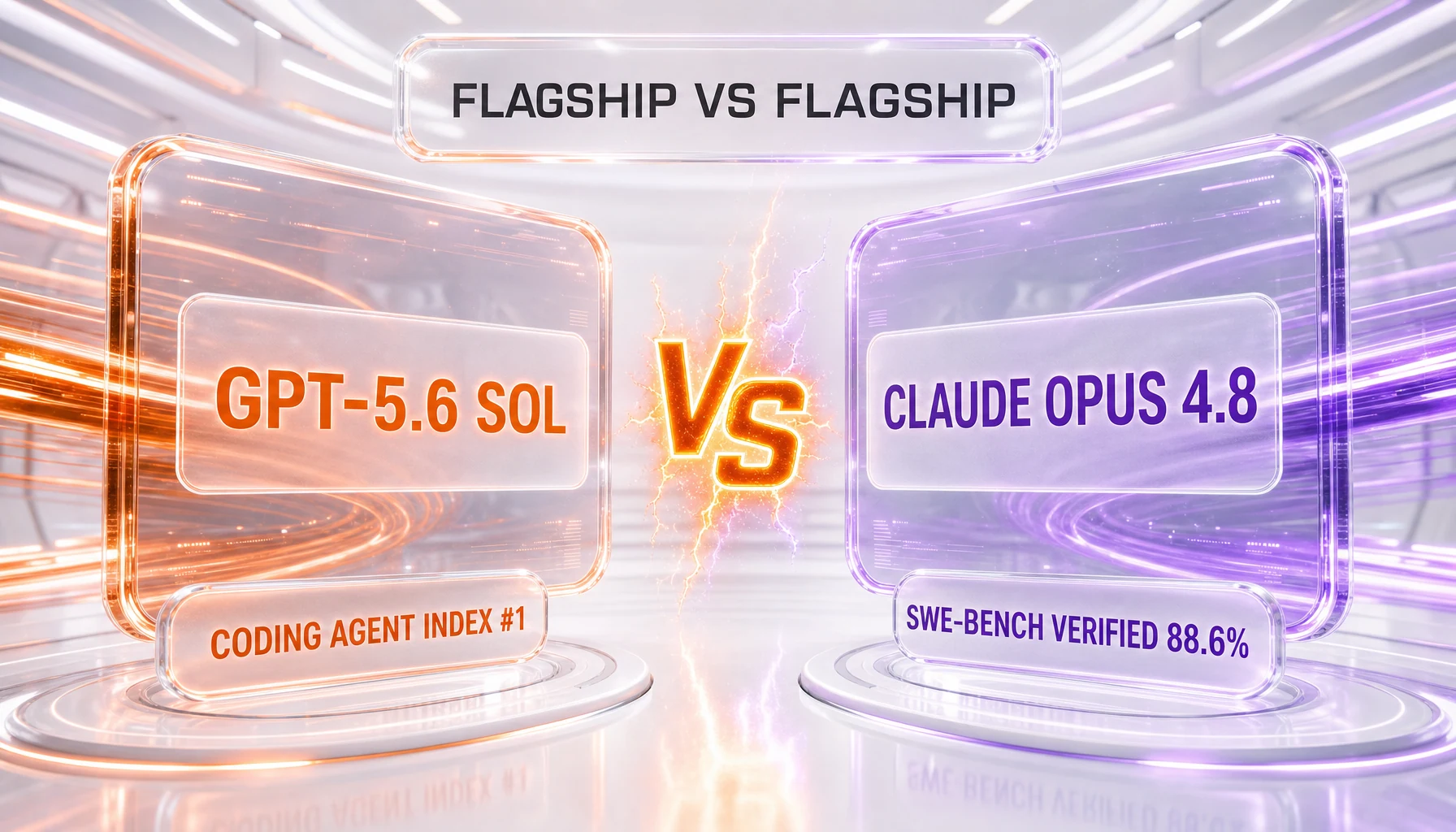
On promotional rates GPT-5.6 Sol now undercuts Claude Opus 4.8 at $4 vs $5 input. Sol is 2nd of 52 on the Coding Agent Index; Opus posts a verified 88.6%.
Feature Comparison
| Feature | GPT-5.6 Sol | Claude Opus 4.8 |
|---|---|---|
| API input price (per million tokens) | $4.00 promotional, $8.00 above 272,000 input tokens (verified) | $5.00 flat (verified) |
| API output price (per million tokens) | $20.00 promotional, $30.00 above 272,000 input tokens (verified) | $25.00 flat (verified) |
| Cached input price (per million tokens) | $0.40 promotional (verified) | $0.50 (verified) |
| Batch output price (per million tokens) | $10.00 promotional (verified) | $12.50 (verified) |
| SWE-bench Verified, vals.ai (independent) | Not submitted | 88.6% (submitted) |
| AA Coding Agent Index v1.3 (independent, read August 2, 2026) | 66.57 — 2nd of 52 (Codex harness, max effort) | 60.54 (Claude Code harness, max effort) |
| AA Intelligence Index (independent) | 59 | 56 to 61.4 (configuration-dependent) |
| LMArena Elo (independent, human preference) | 1486 (Xhigh) | 1482 (Thinking) |
| Cost per task, AA Intelligence Index (independent) | ~$1.04 (Artificial Analysis) | Not published as a per-task figure in our sources |
| Declared context window | 1,050,000 tokens | 1,000,000 tokens |
| Max output tokens | 128,000 tokens | 128,000 tokens |
| Knowledge cutoff | February 16, 2026 | January 2026 |
| Reasoning control | Low to xhigh, plus new max and ultra multi-agent modes | Adaptive thinking with an effort dial (defaults to high) |
| Multi-agent orchestration | Ultra mode: up to 16 parallel reasoning agents | Dynamic Workflows: hundreds of parallel subagents |
| Code execution and tool use | Programmatic Tool Calling: model-written JS in an isolated V8 runtime (ZDR-compatible) | Code execution tool (container-based) plus function calling and structured outputs |
| Computer use / browser agent (vendor-reported) | OSWorld 2.0 62.6%, BrowseComp 90.4% (self-reported) | 84% Online-Mind2Web (self-reported) |
| Input and output modalities | Text and image in, text out | Text and image in, text out |
Pricing Comparison
GPT-5.6 Sol
Claude Opus 4.8
Detailed Comparison
GPT-5.6 Sol and Claude Opus 4.8 are the two frontier flagships compared here. GPT-5.6 Sol is OpenAI's top capability tier, priced at $4 per million input tokens and $20 per million output tokens on requests up to 272,000 input tokens — promotional rates cut on August 21, 2026 — and $8 and $30 above that threshold, with a 1,050,000-token context window. Claude Opus 4.8 is Anthropic's flagship, priced at $5 per million input tokens and $25 per million output tokens, flat across its full 1,000,000-token context window. On independent leaderboards, GPT-5.6 Sol places second of the 52 harness-and-model-effort entries on the Artificial Analysis Coding Agent Index v1.3, at 66.57 against 60.54 for Claude Opus 4.8 at the same max effort, while Claude Opus 4.8 posts 88.6 percent on the independent vals.ai SWE-bench Verified suite — a leaderboard GPT-5.6 Sol has not been submitted to. While Sol's promotional rate holds, Sol is 20 percent cheaper than Opus 4.8 on both input and output for requests under 272,000 input tokens, and more expensive on both above that threshold. This is a genuine split, and we do not crown a single overall winner.
Quick Verdict
This is a split verdict, and we will not fake a single overall winner: GPT-5.6 Sol appears on the independent agentic-coding leaderboard, where Opus 4.8 is absent, and carries a marginally larger context and newer knowledge cutoff, while Claude Opus 4.8 is the one of the two with an independently verified SWE-bench score, a rate card that stays flat across its full context window, and a longer public track record. GPT-5.6 Sol reached general availability on July 9, 2026; Claude Opus 4.8 has been generally available since late May 2026. We ran both side-by-side through our own OpenAI and Anthropic API keys, so the hands-on notes on Sol are sharp first impressions rather than a matured verdict, and we lean on attributed third-party numbers from Artificial Analysis, LMArena, and vals.ai wherever our own time is too short. Every figure below carries its source, and self-reported vendor numbers are labeled as such. Here is the short version.
- Best on the independent coding-agent leaderboard: GPT-5.6 Sol. Artificial Analysis charts it second of 52 on the Coding Agent Index v1.3 at 66.57, through the Codex harness at max reasoning effort, against 60.54 for Claude Opus 4.8 through the Claude Code harness at the same max effort — 6.03 points, in different harnesses.
- Best on independently verified SWE-bench: Claude Opus 4.8. It posts 88.6 percent on the vals.ai SWE-bench Verified suite, where GPT-5.6 Sol has not been submitted, so there is no third-party Verified number for Sol.
- Best token price under 272,000 input tokens: GPT-5.6 Sol, on promotional rates — $4 input and $20 output per million against Opus 4.8's $5 and $25, or 20 percent lower on every line. Above 272,000 input tokens Sol's long-context rate of $8 and $30 applies to the whole request and Opus 4.8 becomes the cheaper of the two.
- Best measured cost per task: GPT-5.6 Sol. Artificial Analysis measured it at about $1.04 to run its Intelligence Index evaluation when we read that figure in July 2026, before the August 21 price cut, so it reflects the older and higher rate card.
- Best for the largest single context: GPT-5.6 Sol, marginally, at 1,050,000 tokens against Opus 4.8's 1,000,000 — close enough that most workloads will not notice.
- Best for multi-agent reasoning depth: a split. Sol adds a new ultra mode that spawns parallel reasoning agents; Opus 4.8 answers with adaptive thinking, an effort dial, and Dynamic Workflows that orchestrate hundreds of parallel subagents.
- Best for independent verifiability and track record: Claude Opus 4.8. It appears on SWE-bench Verified, LMArena, and the Artificial Analysis Intelligence Index with published numbers, while several of Sol's headline coding figures are still self-reported.
No single overall winner. Route capability-benchmark-critical agentic-coding throughput, the longest context, and — while the promotional rate holds — cost-sensitive work that stays under 272,000 input tokens to GPT-5.6 Sol; route independently verifiable software-engineering work, prompts that routinely exceed 272,000 tokens, and computer-use agents to Claude Opus 4.8. The rest of this comparison shows every number behind those calls.
GPT-5.6 Sol vs Claude Opus 4.8 at a Glance
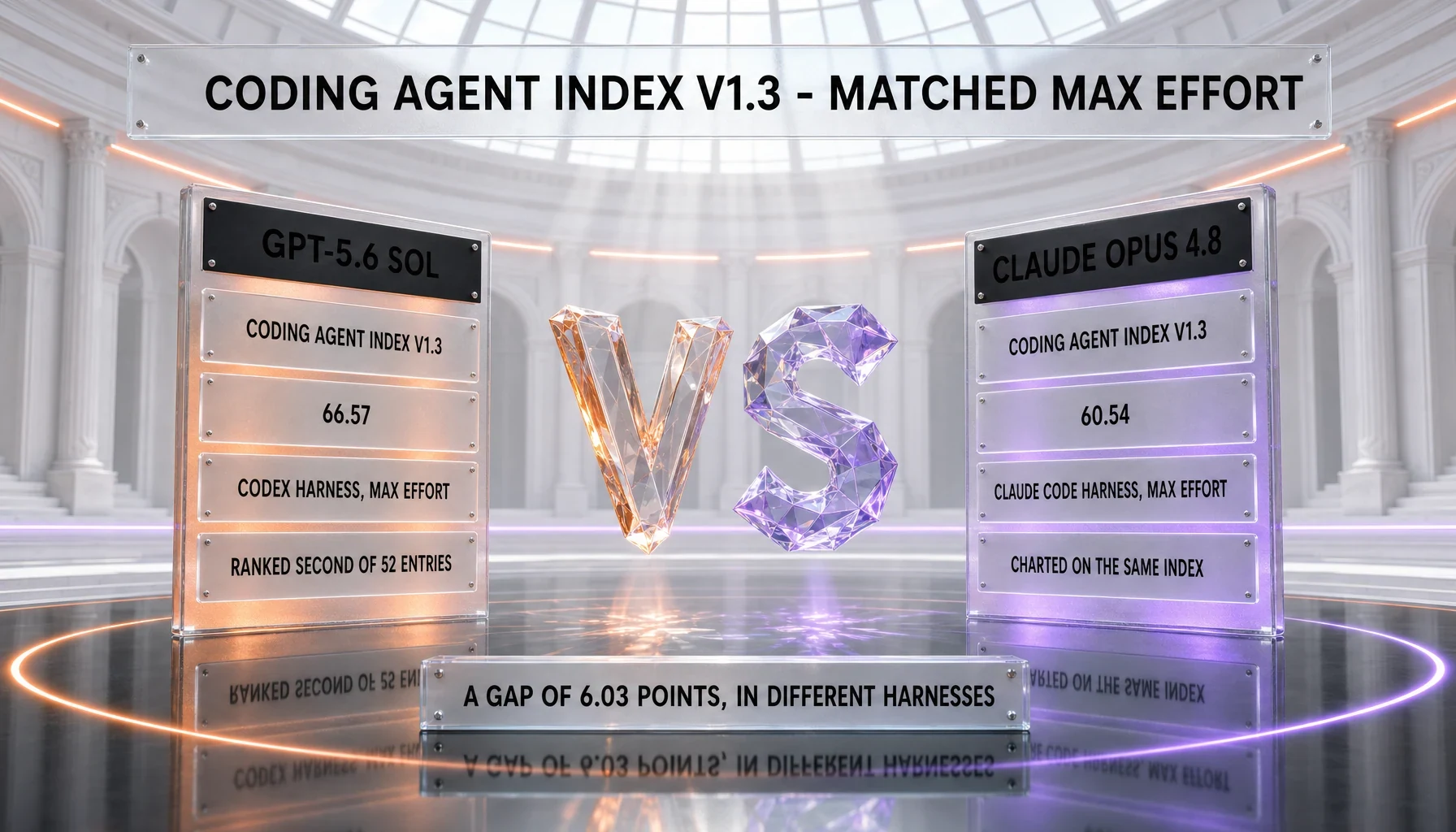
The two models are close on paper and split on evidence. On short prompts Sol's promotional rate card undercuts Opus 4.8 on both sides — $4 against $5 on input, $20 against $25 on output — while above 272,000 input tokens Sol switches to $8 and $30 and Opus 4.8 becomes the cheaper of the two. Their context windows are both roughly one million tokens. Where they separate is the benchmark evidence: each holds a No.1-class result on one independent leaderboard and a data gap on the other, which is exactly why a single crown would be dishonest.
| Attribute | GPT-5.6 Sol | Claude Opus 4.8 |
|---|---|---|
| Vendor | OpenAI | Anthropic |
| API model ID | gpt-5.6-sol | claude-opus-4-8 |
| Input price (per million tokens, up to 272,000 input tokens) | $4.00 (promotional) | $5.00 |
| Output price (per million tokens, up to 272,000 input tokens) | $20.00 (promotional) | $25.00 |
| Cached input (per million tokens) | $0.40 (promotional) | $0.50 |
| Long-context rate (above 272,000 input tokens) | $8.00 input, $30.00 output | None — flat to 1,000,000 tokens |
| Context window | 1,050,000 tokens | 1,000,000 tokens |
| Max output | 128,000 tokens | 128,000 tokens |
| Knowledge cutoff | February 16, 2026 | January 2026 |
| AA Coding Agent Index v1.3 (independent, read August 2, 2026) | 66.57 — 2nd of 52 (Codex harness, max effort) | 60.54 (Claude Code harness, max effort) |
| SWE-bench Verified, vals.ai (independent) | Not submitted | 88.6% |
| LMArena Elo (independent) | 1486 (Xhigh) | 1482 (Thinking) |
| Modalities | Text and image in, text out | Text and image in, text out |
Sources for this table are OpenAI's model documentation and Anthropic's models overview for specifications, and Artificial Analysis and LMArena for the independent scores. We confirmed both price cards directly on the vendors' own pricing pages, covered in the pricing section below.
What Each Model Is
GPT-5.6 Sol
GPT-5.6 Sol is the top "capability tier" of OpenAI's GPT-5.6 generation, which reached public general availability on July 9, 2026 after a gated preview on June 26. In OpenAI's new naming scheme the number is the generation and the names Sol, Terra, and Luna are durable capability tiers rather than sizes, with Sol aimed at the hardest problems: complex coding, long-horizon agentic work, cyber, science, and computer use. Per OpenAI's model documentation, Sol carries a 1,050,000-token context window, a 128,000-token maximum output, a February 16, 2026 knowledge cutoff, and text-plus-image input with text output. Its headline new feature is an expanded reasoning-effort scale that runs from low through xhigh, then adds a new max level and, above that, an ultra multi-agent mode. GPT-5.5 remains active and is not deprecated; GPT-5.6 is an addition to the lineup, as OpenAI describes in its GPT-5.6 announcement.
Claude Opus 4.8
Claude Opus 4.8 is Anthropic's flagship model, positioned for complex agentic coding, computer use, and multi-agent orchestration, and generally available since late May 2026. Per Anthropic's models overview, Opus 4.8 carries a 1,000,000-token context window (roughly 555,000 words), a 128,000-token maximum output, a January 2026 training cutoff, adaptive thinking with an effort control that defaults to high, and text-plus-image input with text output. Anthropic pairs it with Dynamic Workflows, which orchestrate hundreds of parallel subagents on large multi-file tasks, and reports it as its best computer-use and browser-agent model to date. It sits below Anthropic's very top tier — Claude Fable 5 — on price and headline capability, but at half Fable 5's rate card. For the full hands-on breakdown, see our Claude Opus 4.8 review.
Pricing: Sol Undercuts Opus 4.8 Below 272,000 Tokens, and Loses Above It
The price story changed on August 21, 2026, and it now runs the other way. GPT-5.6 Sol costs $4 per million input tokens, $0.40 per million cached input tokens, and $20 per million output tokens on requests up to 272,000 input tokens; above that threshold a long-context rate of $8 input and $30 output applies to the entire request rather than to the excess. We re-confirmed both tiers on OpenAI's API pricing documentation on August 28, 2026. Claude Opus 4.8 costs $5 per million input tokens, $0.50 per million cached input tokens, and $25 per million output tokens, and Anthropic states that its full 1,000,000-token window bills at that standard rate, so a 900,000-token request costs the same per token as a 9,000-token one; we confirmed this directly on Anthropic's pricing documentation the same day. So under 272,000 input tokens Sol is 20 percent cheaper on input, on cached reads, and on output alike; above it, Sol costs 60 percent more on input and 20 percent more on output than Opus 4.8.
Which side of the 272,000-token threshold your prompts land on therefore decides more than the rate card does. An agent that reads a large context and writes a short answer can cross the threshold on input alone and then pay Sol's long-context rate on every token of the request; one that reads little and writes a lot stays on the promotional rate and keeps the 20 percent. Both vendors discount below that: Opus 4.8 has a Batch API at $2.50 per million input and $12.50 per million output, half its standard rate, while Sol's Batch and Flex tiers both run $2.00 per million input and $10 per million output under 272,000 tokens — cheaper than Opus 4.8 on both sides again. Opus 4.8 exposes a Fast mode at $10 per million input and $50 per million output for a speed premium; Sol's equivalent, renamed from Priority to Fast mode on July 30, 2026, runs $8 and $40 on short requests. On the current rate cards, every short-context line goes to Sol and every long-context line goes to Opus 4.8.
These are promotional rates, and they are what flips this section. OpenAI cut Sol's API and credit pricing on August 21, 2026, and the company's two published descriptions of how long the cut lasts do not say the same thing. The GPT-5.6 launch page carries an update reading: "OpenAI dropped the API and credit pricing of GPT-5.6 Sol by over 20% for the next 3 months." The API pricing page states: "GPT-5.6 Sol's promotional pricing is available at least through November 21, 2026." One phrasing closes a window; the other sets a floor and leaves the end open. We are not going to pick between them. Sol's standard rate before the cut was $5 input and $30 output per million — the same input as Opus 4.8 and above it on output, which is how this comparison read before August 21. Budget for both readings, and do not plan around the rate reverting on a specific date, because neither page says it will.
Sticker price is still not the same as measured cost. Artificial Analysis publishes the cost to run its Intelligence Index evaluation, and when we read it in July 2026 it listed GPT-5.6 Sol at about $1.04 per task — a figure driven by token efficiency on that specific run, and measured against the pre-cut rate card, so it overstates what the same run would cost today. Which number decides your bill depends on how output-heavy and how token-efficient your own workloads are, and on whether your prompts clear 272,000 input tokens, so test both on your real prompts rather than reading either rate card straight. For a primer on why input, output, and cached tokens are billed differently, see our guide to AI model pricing explained.
Benchmarks: Where the Independent Numbers Split
This is the heart of the comparison, and it is genuinely split rather than diplomatically hedged. Each model appears on one independent coding leaderboard and is absent from the other, so neither can claim a clean sweep. We separate independent third-party results from vendor self-reported numbers throughout, because the two are not the same class of evidence.
Agentic coding: Sol places second on the Coding Agent Index
On the Artificial Analysis Coding Agent Index — a composite that measures agentic, tool-using coding — GPT-5.6 Sol places second of 52 charted entries at 66.57, through the Codex harness at max reasoning effort. Claude Opus 4.8 is charted there too, through the Claude Code harness — 60.54 at the same max effort, and behind Sol at every other setting the two share: 58.47 to 65.09 at xhigh, 56.70 to 64.11 at high, 53.56 to 60.61 at medium. The entry that leads the index is Claude Code running Opus 5 at xhigh effort, at 66.74 — ahead of Sol by 0.17. So Sol's 66.57 is both a placement on the board and a real 6.03-point margin over Opus 4.8 at matched max effort, in different harnesses. If your definition of coding is "an agent that plans, calls tools, and iterates," this is the independent leaderboard that speaks to it, and Sol is on top.
Verified software engineering: Opus 4.8 is submitted, Sol is not
On the independently run SWE-bench Verified suite tracked by vals.ai, Claude Opus 4.8 posts 88.6 percent. GPT-5.6 Sol has not been submitted to that leaderboard, so as of this comparison there is no third-party SWE-bench Verified figure for it at all. This is the mirror image of the Coding Agent Index result: on the benchmark that resolves real GitHub issues against a hidden test suite, Opus 4.8 has a verified number and Sol has a hole. We flag that gap rather than fill it with a self-reported figure. For context on that leaderboard, Claude Fable 5 leads it at 95 percent and Grok 4.5 sits at 86.6 percent, so 88.6 percent places Opus 4.8 near the top of the independently verified field.
What OpenAI reports for Sol, labeled as self-reported
OpenAI does publish coding numbers for Sol, and they are strong — but they are vendor self-reported, not independent. According to OpenAI, Sol scores 88.8 percent on Terminal-Bench 2.1 (rising to 91.9 percent in ultra mode) and 72.7 percent on DeepSWE, and OpenAI cites Opus 4.8 at 59 percent on that same DeepSWE test. On SWE-bench Pro — a different and harder suite than Verified — OpenAI reports Sol at 64.6 percent while openly disputing that benchmark's validity. We report these because they are the only coding figures OpenAI provides for Sol, but we weight them below the independent results: a self-reported 88.8 percent and an independently verified 88.6 percent are not equivalent evidence, even though the digits look alike.
Broad intelligence and human preference: effectively a tie
On the Artificial Analysis Intelligence Index, a composite spanning reasoning, knowledge, math, and coding, GPT-5.6 Sol scores 59. Claude Opus 4.8's number on the same index is configuration-dependent and, frankly, noisy: Artificial Analysis's launch analysis put Opus 4.8 at the top of the Intelligence Index at 61.4, while the live per-model page currently shows 56 for a specific max-effort reading. Because the source itself reports Opus 4.8 between 56 and 61.4 depending on reasoning setting and index revision, we treat the broad-intelligence composite as a near-tie in the top tier rather than a decisive win for either. On LMArena's human-preference Elo, the two are within four points — Sol Xhigh at 1486 and Opus 4.8 Thinking at 1482 — which is inside the noise band of that leaderboard. Call intelligence and human preference a wash.
Context, Reasoning, and Specifications
On raw specifications the two flagships are close enough that the differences rarely decide a project. Both carry roughly a one-million-token context window — 1,050,000 tokens for Sol against 1,000,000 for Opus 4.8 — and both cap output at 128,000 tokens. Sol's window is nominally about 5 percent larger, which will matter only at the extreme edge of whole-repository or long-document work; for the vast majority of workloads, both hold a codebase or a document set in a single pass. Sol's knowledge cutoff of February 16, 2026 is a few weeks more recent than Opus 4.8's January 2026 training cutoff, a minor edge for questions about very recent events. Both accept text and image input and return text; neither generates images natively, treating image generation as a callable tool.
The more interesting difference is how each exposes reasoning depth. GPT-5.6 Sol introduces a reasoning-effort scale that runs low, xhigh, then a new max level, and above that an ultra mode that spawns multiple reasoning agents in parallel — four by default, up to sixteen — to attack a single hard problem. Sol also ships Programmatic Tool Calling, which lets the model write and run JavaScript in an isolated, ephemeral V8 runtime that is compatible with zero-data-retention setups. Claude Opus 4.8 takes a different route to the same goal: adaptive thinking with an explicit effort dial that trades latency for depth, plus Dynamic Workflows that orchestrate hundreds of parallel subagents on large multi-file tasks, and a documented computer-use and browser-agent capability that Anthropic reports at 84 percent on Online-Mind2Web. Both are betting on parallel orchestration for hard, long-horizon work; Sol packages it as a reasoning mode, Opus 4.8 as a workflow layer. For readers new to the distinction between a chat model and an agentic one, our explainer on agentic coding models versus chatbots covers the ground.
How We Compared Them
We ran both models side-by-side through our own OpenAI and Anthropic API keys. GPT-5.6 Sol reached general availability on July 9, 2026, so our hands-on time with it is measured in days, not weeks, and we scope our own notes to first impressions accordingly; Claude Opus 4.8 we have used in production since its late-May release and reviewed in depth. Because Sol is new, we deliberately avoid leaning on our own short experience for capability claims and instead anchor every performance statement to attributed third-party benchmarks — Artificial Analysis, LMArena, and vals.ai — and to each vendor's own documentation for prices and specifications. Where a number is self-reported by a vendor, we say so.
We disclose plainly that we have no affiliate relationship with either OpenAI or Anthropic, and we paid standard API rates to test both. Neither model is "ours," and this comparison is not sponsored by either vendor. Our first-impression read is that both feel like flagship models in daily use: Sol's ultra mode is visibly slower but noticeably more thorough on gnarly multi-step tasks, and Opus 4.8 remains the steadier instruction-follower and self-verifier in long agent runs, consistent with its independent SWE-bench Verified standing. Those are impressions, not measurements, and we treat them as such. The verdict below rests on the attributed numbers, not on our vibes.
Strengths and Weaknesses
GPT-5.6 Sol
Where GPT-5.6 Sol leads
- Second of 52 on the independent Coding Agent Index v1.3. Artificial Analysis charts it at 66.57 on agentic, tool-using coding, against 60.54 for Claude Opus 4.8 at the same max effort — the one independent coding leaderboard where it leads this matchup.
- Marginally larger context and newer knowledge. A 1,050,000-token window and a February 16, 2026 cutoff edge Opus 4.8's 1,000,000 tokens and January 2026 cutoff.
- Lower measured cost per task. About $1.04 to run the Artificial Analysis Intelligence Index, a token-efficiency win despite the higher output rate card.
- Ultra multi-agent reasoning mode. A new setting that spawns up to sixteen parallel reasoning agents for the hardest long-horizon problems.
- Programmatic Tool Calling. Writes and runs JavaScript in an isolated, zero-data-retention-compatible V8 runtime, a genuinely different tool-use primitive.
Where GPT-5.6 Sol falls short
- Absent from SWE-bench Verified. It has not been submitted to the independently run suite, so there is no third-party verified software-engineering score for it.
- Several headline coding numbers are self-reported. Terminal-Bench 2.1 and DeepSWE figures come from OpenAI, not an independent evaluator.
- A step function at 272,000 tokens, on top of a promotional headline rate. Past that threshold Sol bills the whole request at $8 input and $30 output, above Opus 4.8 on both, and the $4 and $20 below it is a promotional rate OpenAI has committed to only for a limited window.
- Very new. Days of public availability at the time of writing means independent benchmark coverage is still filling in.
Claude Opus 4.8
Where Claude Opus 4.8 leads
- Independently verified SWE-bench. 88.6 percent on the vals.ai SWE-bench Verified suite, a submitted, third-party number where Sol has none.
- One flat rate across the whole context window. $5 input and $25 output per million from the first token to the millionth, with no long-context tier and no promotional expiry to plan around — which makes it cheaper than Sol on both sides once a request passes 272,000 input tokens.
- Documented computer-use record. Anthropic reports it as its best browser-agent model at 84 percent on Online-Mind2Web.
- Longer public track record. Live since late May, with published numbers on SWE-bench Verified, LMArena, and the Artificial Analysis Intelligence Index.
- Dynamic Workflows. Orchestrates hundreds of parallel subagents on large multi-file tasks, a mature multi-agent layer.
Where Claude Opus 4.8 falls short
- Behind Sol on the Coding Agent Index. It is charted at 60.54 through Claude Code at max effort against Sol's 66.57 through Codex, and trails at every shared effort setting, so on that specific agentic-coding leaderboard it cedes the headline.
- Noisy broad-intelligence number. Its Artificial Analysis Intelligence Index reading spans 56 to 61.4 depending on configuration, which muddies clean head-to-head comparison on that composite.
- Some capability claims are vendor-reported. The 84 percent computer-use figure comes from Anthropic rather than an independent evaluator.
- Higher-priced tier above it. Teams wanting Anthropic's very top capability must step up to Claude Fable 5 at double the output rate.
- Costs 25 percent more than Sol on short prompts right now. While Sol's promotional rate holds, $5 and $25 sit above Sol's $4 and $20 on every line for requests under 272,000 input tokens.
When to Pick GPT-5.6 Sol vs Claude Opus 4.8
Pick GPT-5.6 Sol if...
- Your yardstick for coding is the independent Coding Agent Index v1.3, where Sol places second of 52 at 66.57 on agentic, tool-using work against 60.54 for Opus 4.8 at the same max effort.
- You want the most recent knowledge and the largest single context of the two — a February 2026 cutoff and a 1,050,000-token window.
- Your prompts stay under 272,000 input tokens and cost matters, where Sol's promotional $4 and $20 undercut Opus 4.8's $5 and $25 by 20 percent on every line.
- You need a multi-agent reasoning mode — ultra, up to sixteen parallel agents — or code-orchestrated tool use through Programmatic Tool Calling.
- You are comfortable weighting a vendor's self-reported coding numbers while independent SWE-bench coverage for Sol catches up.
Pick Claude Opus 4.8 if...
- You prize independently verified benchmarks — Opus 4.8's 88.6 percent on the submitted SWE-bench Verified suite is the kind of third-party number Sol currently lacks.
- Your prompts routinely exceed 272,000 input tokens, where Sol's long-context rate of $8 and $30 puts Opus 4.8's flat $5 and $25 ahead on both sides.
- You are building computer-use or browser agents, where Anthropic reports Opus 4.8 as its strongest model to date.
- You value a longer track record and published numbers across multiple independent leaderboards over a brand-new flagship.
- You want Anthropic's flagship without stepping up to Claude Fable 5's higher rate card.
Frequently Asked Questions
Is GPT-5.6 Sol better than Claude Opus 4.8 in 2026?
It depends on what you are optimizing for, and we will not fake a single overall winner. On independent leaderboards the two split: Artificial Analysis charts GPT-5.6 Sol second of 52 on its Coding Agent Index v1.3 at 66.57, against 60.54 for Claude Opus 4.8 at the same max effort, while Claude Opus 4.8 posts 88.6 percent on the independent vals.ai SWE-bench Verified suite that Sol has not been submitted to. On price they now split by prompt size: under 272,000 input tokens Sol's promotional $4 and $20 undercut Opus 4.8's $5 and $25 by 20 percent, and above that threshold Sol's long-context rate of $8 and $30 puts Opus 4.8 ahead on both. Best for the independent coding-agent leaderboard, the largest context, and per-task cost: GPT-5.6 Sol. Best for independently verified SWE-bench, cheaper output above 272,000 input tokens, and computer-use work: Claude Opus 4.8.
How much do GPT-5.6 Sol and Claude Opus 4.8 cost?
GPT-5.6 Sol costs $4 per million input tokens, $0.40 per million cached input tokens, and $20 per million output tokens on requests up to 272,000 input tokens, with Batch and Flex both at $2.00 and $10.00; above that threshold a long-context rate of $8 input and $30 output applies to the entire request. Those are promotional rates: OpenAI cut them on August 21, 2026, describing the cut as "for the next 3 months" on its launch page and as "available at least through November 21, 2026" on its pricing page, and the standard rate before the cut was $5 and $30. Claude Opus 4.8 costs $5 per million input tokens, $0.50 per million cached input tokens, and $25 per million output tokens, flat across its full 1,000,000-token window, with a Batch tier at $2.50 and $12.50 per million. We re-confirmed both rate cards on the vendors' own pricing documentation on August 28, 2026.
Which is cheaper, GPT-5.6 Sol or Claude Opus 4.8?
It depends on the size of your prompts, and the answer flipped on August 21, 2026. Under 272,000 input tokens GPT-5.6 Sol is cheaper on every line of the rate card — $4 against $5 on input, $0.40 against $0.50 on cached reads, and $20 against $25 on output, 20 percent lower throughout — because OpenAI cut Sol's pricing by over 20 percent and describes the cut as promotional. Above 272,000 input tokens Sol bills the whole request at $8 and $30, and Claude Opus 4.8's flat $5 and $25 is cheaper on both sides. Artificial Analysis separately measured Sol at about $1.04 to run its Intelligence Index evaluation, but we read that figure in July 2026, before the cut, so it reflects the older rate card. Test both on your real prompts, because which figure decides your bill depends on how often you cross the long-context threshold.
Which is better for coding: GPT-5.6 Sol or Claude Opus 4.8?
The coding answer is a genuine split across two independent leaderboards. On the Artificial Analysis Coding Agent Index v1.3, which pairs each model with a coding harness, GPT-5.6 Sol places second of 52 at 66.57 through Codex at max effort, against 60.54 for Claude Opus 4.8 through Claude Code at the same effort. On the vals.ai SWE-bench Verified suite, which resolves real GitHub issues, Opus 4.8 posts a submitted 88.6 percent and Sol has not been submitted at all. OpenAI separately reports Sol at 88.8 percent on Terminal-Bench 2.1, but that is self-reported rather than independent. So Sol leads the independent coding-agent index, and Opus 4.8 leads the independently verified software-engineering benchmark. Which lens matters depends on whether your coding is agentic orchestration or issue resolution.
Why is GPT-5.6 Sol missing from SWE-bench Verified?
Because OpenAI has not submitted GPT-5.6 Sol to the independently run SWE-bench Verified suite as of this comparison, so there is no third-party Verified figure for it. On that vals.ai leaderboard, Claude Fable 5 sits at 95 percent, Claude Opus 4.8 at 88.6 percent, and Grok 4.5 at 86.6 percent, but Sol is simply absent. We flag the gap rather than substitute a self-reported number. OpenAI instead publishes Sol on Terminal-Bench 2.1 at 88.8 percent and on the different, harder SWE-bench Pro at 64.6 percent while disputing that benchmark's validity. For an independent coding signal that does cover Sol, we use the Artificial Analysis Coding Agent Index v1.3, where it places second of 52 at 66.57, against 60.54 for Opus 4.8 at the same max effort.
Which has the larger context window: GPT-5.6 Sol or Claude Opus 4.8?
GPT-5.6 Sol, but only marginally. OpenAI's model documentation lists Sol at a 1,050,000-token context window, while Anthropic's models overview lists Claude Opus 4.8 at 1,000,000 tokens, or roughly 555,000 words. That is about a 5 percent difference, not the more-than-double gaps seen in some frontier matchups, so in practice both hold a large codebase or document set in a single pass. Both also cap output at 128,000 tokens. If your workloads sit comfortably under a million tokens, which is almost all of them, the context difference between these two will not affect your choice; pick on price, benchmarks, or ecosystem instead.
What is GPT-5.6 Sol's ultra reasoning mode, and does Opus 4.8 have an equivalent?
Ultra is a new multi-agent reasoning setting introduced with the GPT-5.6 generation and centered on Sol. Per OpenAI's documentation, the reasoning-effort scale now runs from low through xhigh, then adds a new max level and, above it, ultra, which spawns multiple reasoning agents in parallel — four by default and up to sixteen — to attack one hard problem, and OpenAI reports Sol at 91.9 percent on Terminal-Bench 2.1 in ultra mode versus 88.8 percent standard. Claude Opus 4.8 does not expose an identical mode, but it answers with adaptive thinking, an effort dial, and Dynamic Workflows that orchestrate hundreds of parallel subagents. Both bet on parallel orchestration; Sol packages it as a reasoning mode, Opus 4.8 as a workflow layer.
Which model has the higher Artificial Analysis Intelligence Index?
It is too close and too noisy to call cleanly. Artificial Analysis scores GPT-5.6 Sol at 59 on its Intelligence Index. Claude Opus 4.8's number on the same index is configuration-dependent: the launch analysis put it at the top at 61.4, while the live per-model page currently shows 56 for a specific max-effort reading. Because the source itself reports Opus 4.8 between 56 and 61.4 depending on reasoning setting and index revision, we treat the broad-intelligence composite as a near-tie in the top tier rather than a decisive win for either. LMArena tells the same story, with Sol at 1486 Elo and Opus 4.8 at 1482 — inside the noise band. Neither wins broad intelligence outright.
Which is better for computer use and browser agents?
On the published evidence, Claude Opus 4.8 has the stronger documented computer-use record, though the two are measured on different tests so it is not a clean head-to-head. Anthropic reports Opus 4.8 as its best computer-use and browser-agent model at 84 percent on Online-Mind2Web. OpenAI positions Sol for computer use as well and self-reports 62.6 percent on OSWorld 2.0 and 90.4 percent on BrowseComp, but on a different benchmark set. Both figures are vendor-reported rather than independent, so we present them as each vendor's own claim. If browser automation is your core workload, Opus 4.8 has the more established track record here, but you should benchmark both against your own target sites before committing.
Did you test both GPT-5.6 Sol and Claude Opus 4.8?
Yes, we ran both side-by-side through our own OpenAI and Anthropic API keys, and we have no affiliate relationship with either vendor. Because GPT-5.6 Sol only reached general availability on July 9, 2026, our hands-on time with it is measured in days, so we scope our own notes on it to first impressions and anchor every capability claim to attributed third-party benchmarks. Claude Opus 4.8 we have used in production since its late-May release and reviewed in depth. Where a performance number is self-reported by a vendor, we label it as such rather than presenting it as independent evidence, and the verdict rests on attributed numbers rather than our short hands-on with the newer model.
Is Claude Opus 4.8 or GPT-5.6 Sol better for enterprise and agentic work?
Both are built for it, and the choice turns on your evidence bar and cost shape. Claude Opus 4.8 suits enterprises that require independently verifiable benchmarks — its 88.6 percent on the submitted SWE-bench Verified suite is auditable — and that run pipelines whose prompts routinely pass 272,000 input tokens, where its flat $5 and $25 beats Sol's long-context $8 and $30. GPT-5.6 Sol suits teams that value its independent Coding Agent Index v1.3 placement, the newest knowledge cutoff, an ultra multi-agent reasoning mode, and lower measured cost per task on Artificial Analysis's run. Both offer mature multi-agent orchestration: Sol through ultra mode and Programmatic Tool Calling, Opus 4.8 through Dynamic Workflows. For most enterprises the rational move is to route, not to standardize on one.
What are the alternatives to GPT-5.6 Sol and Claude Opus 4.8?
Several sit close by. Claude Fable 5 is Anthropic's top tier, currently leading the Artificial Analysis Intelligence Index at 60, at $10 per million input and $50 per million output tokens. GPT-5.5, OpenAI's prior flagship, remains active and cheaper for routine work. Gemini 3.1 Pro is Google's value-focused frontier option, and Claude Sonnet 5 is Anthropic's faster mid-tier workhorse. For the adjacent matchups in detail, see our Claude Opus 4.8 vs GPT-5.5 comparison, our Claude Fable 5 vs Claude Opus 4.8 comparison, our Claude Opus 4.8 vs Gemini 3.1 Pro comparison, and our GPT-5.5 review for the nearest neighbor to Sol.
Final Verdict — A True Split, Not a Diplomatic One
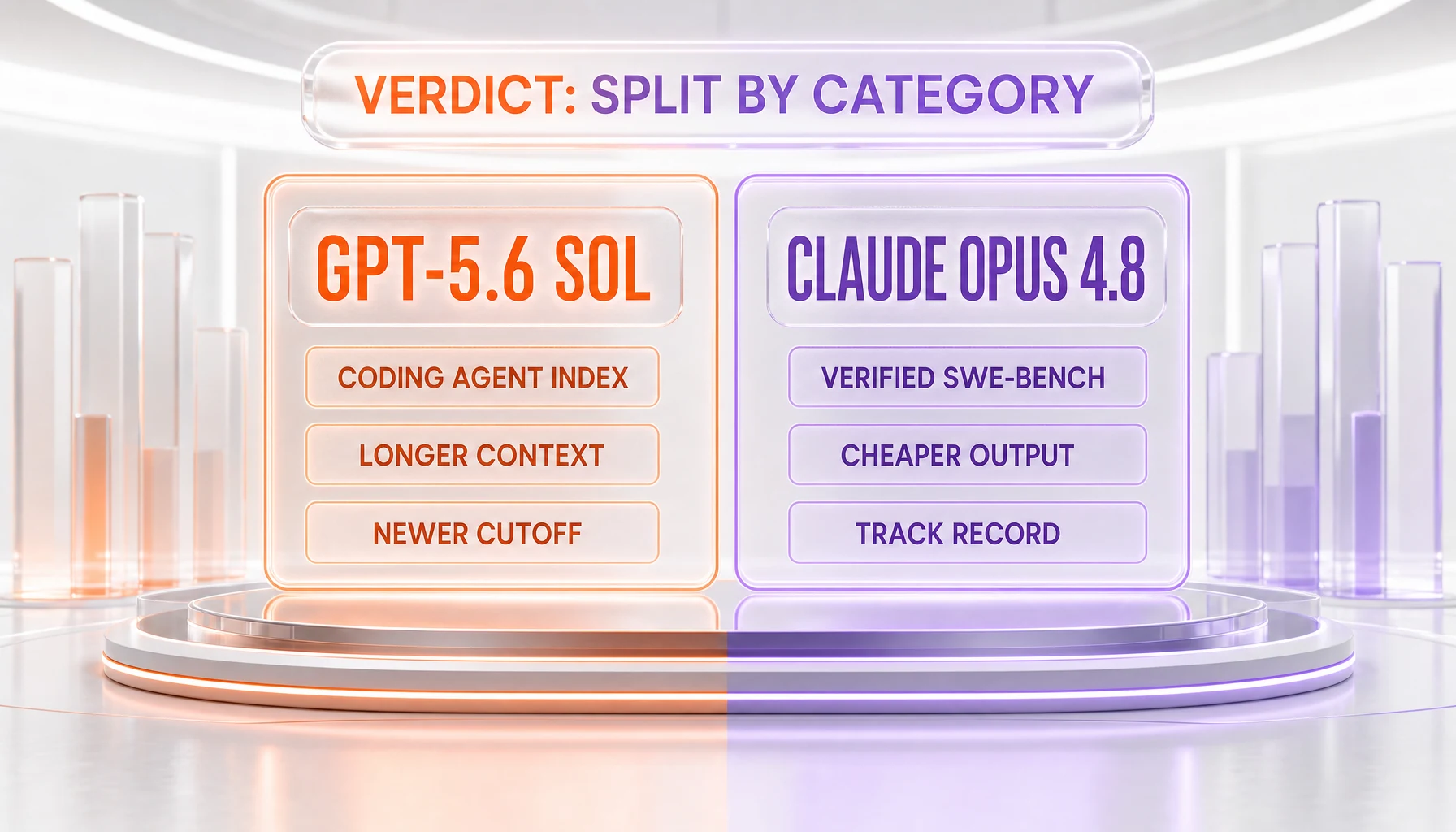
After running both side-by-side, confirming pricing on each vendor's own documentation, and holding every capability claim to independent benchmarks, our verdict is a genuine split. GPT-5.6 Sol is the independent coding-agent and freshness leader: it places second of 52 on the Artificial Analysis Coding Agent Index v1.3, at 66.57 against Opus 4.8's 60.54 at the same max effort, carries a marginally larger 1,050,000-token context and a February 2026 knowledge cutoff, adds an ultra multi-agent reasoning mode, and undercuts Opus 4.8 by 20 percent on every line of the rate card while its promotional pricing holds and prompts stay under 272,000 input tokens. Claude Opus 4.8 is the verifiability and long-context-cost leader: it posts an independently verified 88.6 percent on the submitted vals.ai SWE-bench Verified suite where Sol has no number, holds a flat $5 and $25 across its entire context window against Sol's $8 and $30 above 272,000 input tokens, and carries the stronger documented computer-use record and the longer public track record. We disclose plainly that we have no affiliate relationship with either vendor and tested both through our own API keys.
We did not crown a single overall winner because the evidence does not support one honestly. Sol's coding-agent lead, context edge, and promotional price advantage on short prompts are real; so are Opus 4.8's verified SWE-bench standing, flat long-context pricing, and computer-use record. On broad intelligence and human preference the two are inside the noise — Intelligence Index 59 for Sol against a configuration-dependent 56 to 61.4 for Opus 4.8, and LMArena Elo of 1486 against 1482. If your work rewards the top independent coding-agent score, the newest knowledge, or the lowest price on prompts under 272,000 input tokens, pick GPT-5.6 Sol. If your work rewards independently verified benchmarks, predictable pricing on very long prompts, or computer-use maturity, pick Claude Opus 4.8. For many teams the rational endgame is routing: Sol for the hardest agentic-coding throughput and freshest context, Opus 4.8 for auditable, very-long-prompt, and browser-agent work. For the neighbors around this matchup, see our Claude Opus 4.8 review, our GPT-5.5 review, our Claude Fable 5 review, our Claude Opus 4.8 vs GPT-5.5 comparison, and our Claude Sonnet 5 vs Claude Opus 4.8 comparison.
Sources
Every figure in this comparison is attributed to a primary or independent source. Pricing and specifications come from the vendors' own documentation; capability scores come from independent third parties; self-reported vendor figures are labeled as such throughout.
- OpenAI — GPT-5.6 announcement and positioning
- OpenAI — GPT-5.6 Sol model documentation and specifications
- OpenAI — GPT-5.6 API pricing
- Anthropic — Claude Opus product page
- Anthropic — Claude Opus 4.8 API pricing
- Anthropic — Claude models overview and specifications
- Artificial Analysis — Intelligence Index, Coding Agent Index, and cost per task
- LMArena — human-preference Elo leaderboard
- vals.ai — SWE-bench Verified independent leaderboard
Last compared: July 2026; Sol's pricing re-verified on August 28, 2026, after OpenAI's August 21, 2026 promotional cut. GPT-5.6 Sol reached general availability on July 9, 2026, and Claude Opus 4.8 has been generally available since late May 2026. Both are current flagships, and we will revise this comparison as independent benchmark coverage of GPT-5.6 Sol matures.
Our Verdict
A split verdict between two frontier flagships, and we will not fake a single overall winner. Under 272,000 input tokens GPT-5.6 Sol now undercuts Claude Opus 4.8 on every line — $4 against $5 on input and $20 against $25 on output, 20 percent lower throughout — on promotional rates OpenAI cut on August 21, 2026; above that threshold Sol bills the whole request at $8 and $30 and Opus 4.8's flat rate card is cheaper on both. On independent leaderboards the two split cleanly: Artificial Analysis charts GPT-5.6 Sol second of 52 on its Coding Agent Index v1.3 at 66.57, against 60.54 for Opus 4.8 at the same max effort in the Claude Code harness, while Claude Opus 4.8 posts an independently verified 88.6 percent on the vals.ai SWE-bench Verified suite, a leaderboard GPT-5.6 Sol has not been submitted to. Sol carries a marginally larger 1,050,000-token context and a February 2026 knowledge cutoff, and was measured at about $1.04 per task on Artificial Analysis's Intelligence Index run when we read it in July 2026, before the cut. Opus 4.8 carries a flat rate card across its full context window, the stronger documented computer-use record, and the longer public track record. On broad intelligence the two are inside the noise — Intelligence Index 59 for Sol against a configuration-dependent 56 to 61.4 for Opus 4.8 — and on LMArena human preference they sit at 1486 to 1482. Best for the independent coding-agent leaderboard, longest context, newest knowledge, and per-task economics: GPT-5.6 Sol. Best for independently verified SWE-bench, predictable pricing on very long prompts, and computer-use maturity: Claude Opus 4.8. No single overall winner — route capability-benchmark-critical agentic-coding and long-context work to GPT-5.6 Sol, and independently verifiable, very-long-prompt, or browser-agent work to Claude Opus 4.8.
Choose GPT-5.6 Sol
OpenAI's flagship GPT-5.6 capability tier, with Programmatic Tool Calling and a 1.05M-token context.
Try GPT-5.6 Sol →Choose Claude Opus 4.8
Anthropic's flagship model for agentic coding, computer use, and multi-agent orchestration.
Try Claude Opus 4.8 →Frequently Asked Questions
Is GPT-5.6 Sol better than Claude Opus 4.8?
A split verdict between two frontier flagships, and we will not fake a single overall winner. Under 272,000 input tokens GPT-5.6 Sol now undercuts Claude Opus 4.8 on every line — $4 against $5 on input and $20 against $25 on output, 20 percent lower throughout — on promotional rates OpenAI cut on August 21, 2026; above that threshold Sol bills the whole request at $8 and $30 and Opus 4.8's flat rate card is cheaper on both. On independent leaderboards the two split cleanly: Artificial Analysis charts GPT-5.6 Sol second of 52 on its Coding Agent Index v1.3 at 66.57, against 60.54 for Opus 4.8 at the same max effort in the Claude Code harness, while Claude Opus 4.8 posts an independently verified 88.6 percent on the vals.ai SWE-bench Verified suite, a leaderboard GPT-5.6 Sol has not been submitted to. Sol carries a marginally larger 1,050,000-token context and a February 2026 knowledge cutoff, and was measured at about $1.04 per task on Artificial Analysis's Intelligence Index run when we read it in July 2026, before the cut. Opus 4.8 carries a flat rate card across its full context window, the stronger documented computer-use record, and the longer public track record. On broad intelligence the two are inside the noise — Intelligence Index 59 for Sol against a configuration-dependent 56 to 61.4 for Opus 4.8 — and on LMArena human preference they sit at 1486 to 1482. Best for the independent coding-agent leaderboard, longest context, newest knowledge, and per-task economics: GPT-5.6 Sol. Best for independently verified SWE-bench, predictable pricing on very long prompts, and computer-use maturity: Claude Opus 4.8. No single overall winner — route capability-benchmark-critical agentic-coding and long-context work to GPT-5.6 Sol, and independently verifiable, very-long-prompt, or browser-agent work to Claude Opus 4.8.
Which is cheaper, GPT-5.6 Sol or Claude Opus 4.8?
GPT-5.6 Sol starts at $4 in / $20 out per M tokens. Claude Opus 4.8 starts at $5 in / $25 out per M tokens. Check the pricing comparison section above for a full breakdown.
What are the main differences between GPT-5.6 Sol and Claude Opus 4.8?
The key differences span across 17 features we compared. For API input price (per million tokens), GPT-5.6 Sol offers $4.00 promotional, $8.00 above 272,000 input tokens (verified) while Claude Opus 4.8 offers $5.00 flat (verified). For API output price (per million tokens), GPT-5.6 Sol offers $20.00 promotional, $30.00 above 272,000 input tokens (verified) while Claude Opus 4.8 offers $25.00 flat (verified). For Cached input price (per million tokens), GPT-5.6 Sol offers $0.40 promotional (verified) while Claude Opus 4.8 offers $0.50 (verified). See the full feature comparison table above for all details.