Claude Opus 5 vs Claude Sonnet 5: How Much of Your Work Actually Needs Opus? (2026)


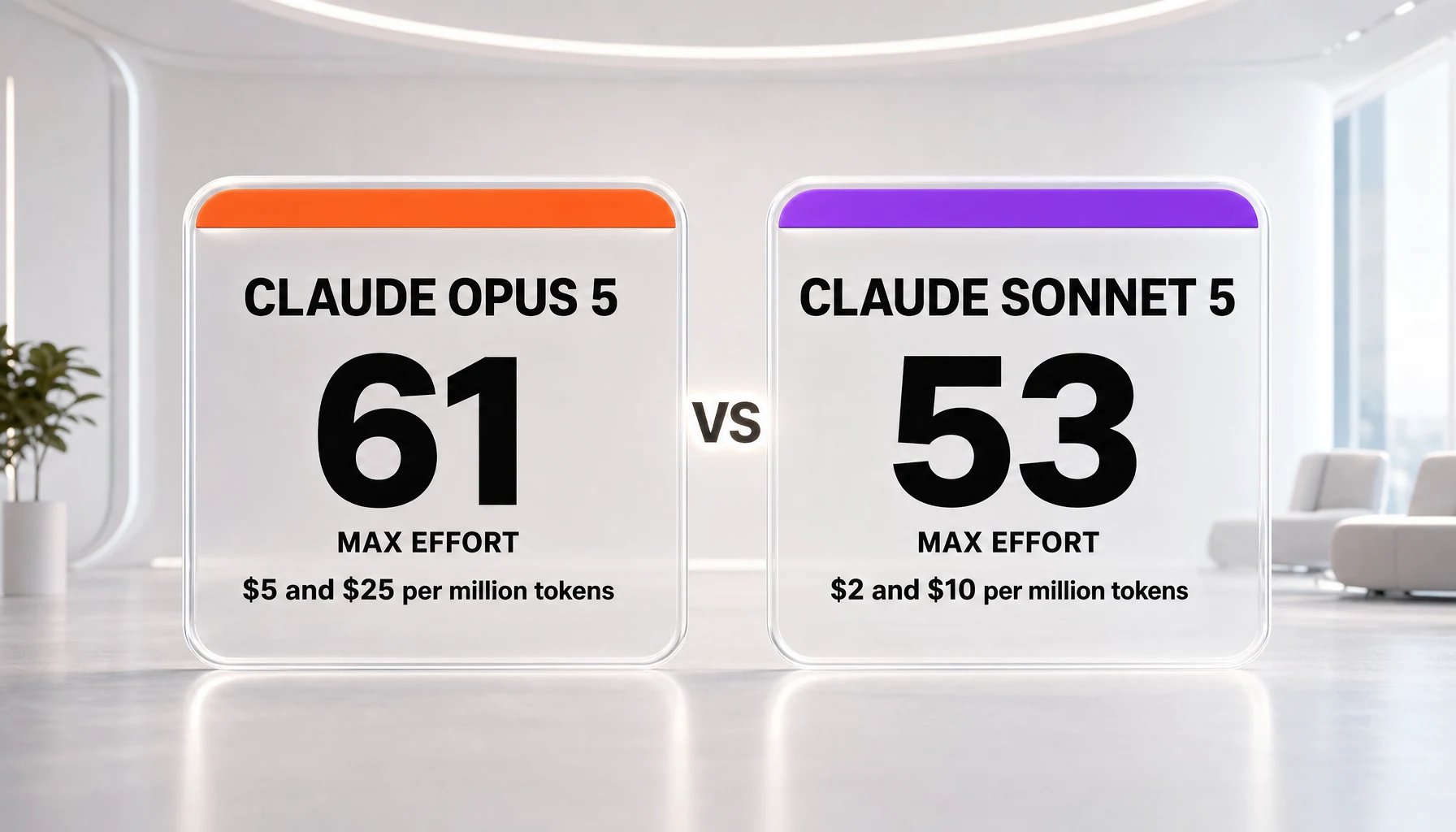
Opus 5 scores 59 at its default setting for $1.06 per task; Sonnet 5 scores 53 at max for $1.53. Plus what happens when the $2 and $10 promo ends.
Feature Comparison
| Feature | Claude Opus 5 | Claude Sonnet 5 |
|---|---|---|
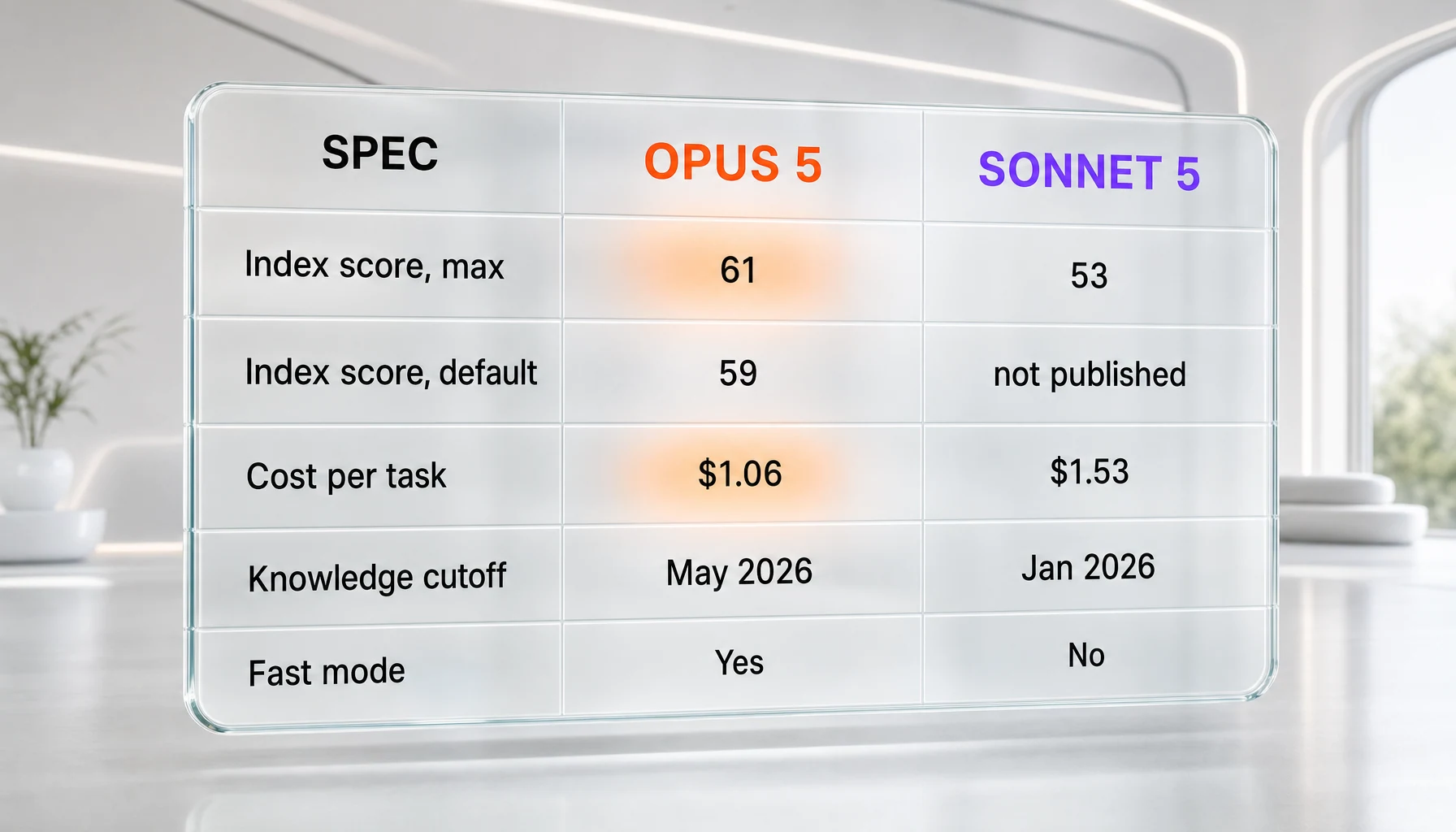
| Artificial Analysis Intelligence Index v4.1, max effort | 61 | 53 |
| Intelligence Index v4.1, default high effort | 59 | Not published |
| Cost per task, best published configuration | USD 1.06 at high effort | USD 1.53 at max effort |
| Input price per million tokens | USD 5.00 | USD 2.00 through Aug 31, 2026, then USD 3.00 |
| Output price per million tokens | USD 25.00 | USD 10.00 through Aug 31, 2026, then USD 15.00 |
| Output tokens emitted on the Intelligence Index | 100M | 300M |
| Total cost to run the Intelligence Index | USD 3,835.51 | USD 4,010.12 |
| Reliable knowledge cutoff | May 2026 | January 2026 |
| Context window | 1,000,000 tokens | 1,000,000 tokens |
| Maximum output, sync and batch | 128,000 and 300,000 tokens | 128,000 and 300,000 tokens |
| Effort levels supported | low, medium, high, xhigh, max | low, medium, high, xhigh, max |
| Fast mode | Yes, research preview at USD 10 and USD 50 | Not supported |
| Time to first token, max effort, measured July 28, 2026 | 67.72 s | 155.43 s |
| Output speed, max effort, measured July 28, 2026 | 53.5 tokens per second | 70.1 tokens per second |
| Priority Tier and data retention requirement | Not supported; no retention requirement | Not supported; no retention requirement |
Pricing Comparison
Claude Opus 5
Claude Sonnet 5
Detailed Comparison
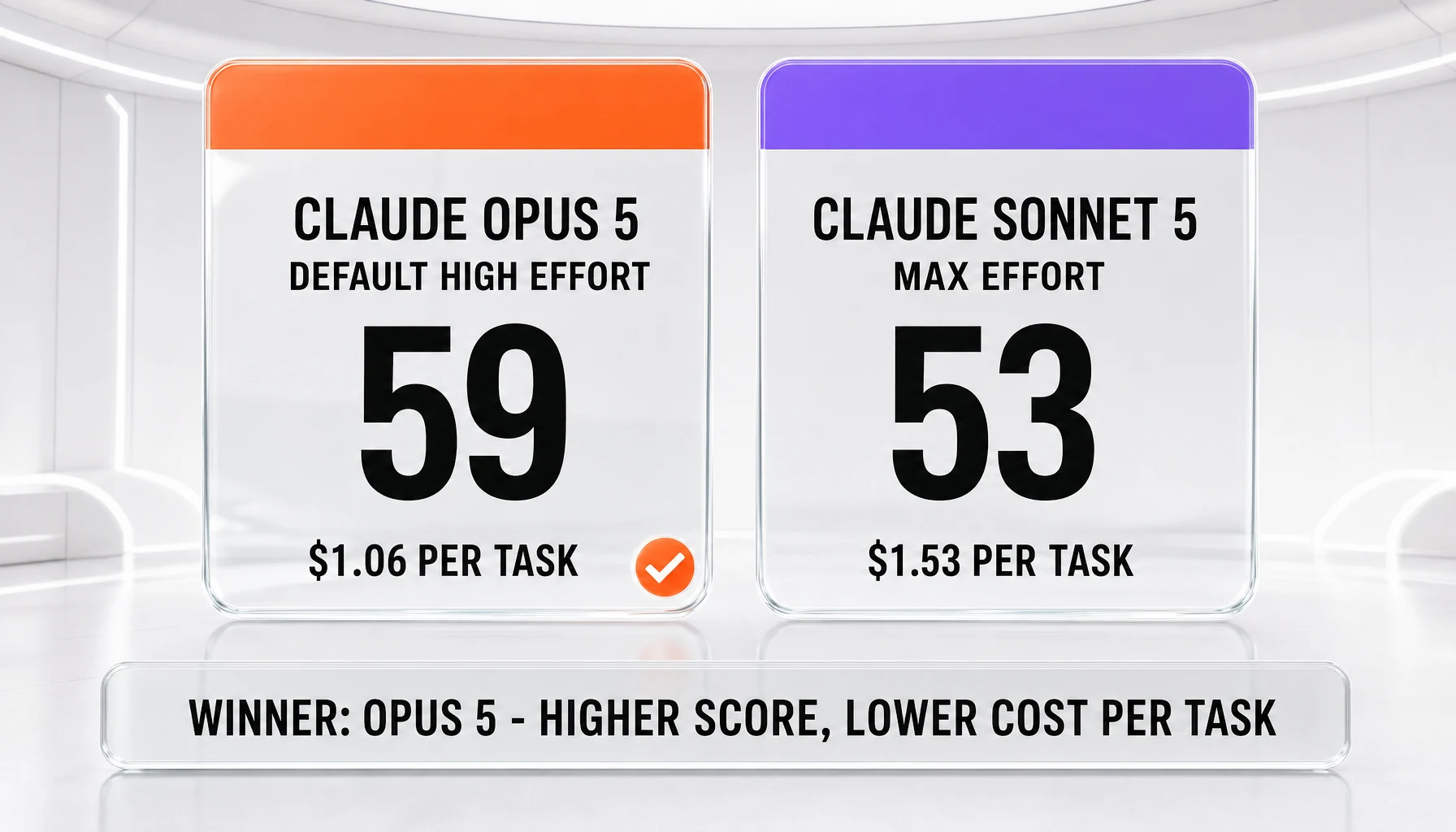
Claude Opus 5 vs Claude Sonnet 5: Opus 5 scores 61 and Sonnet 5 scores 53 on version 4.1 of the independent Artificial Analysis Intelligence Index, both measured at maximum effort. Opus 5 costs $5 per million input tokens and $25 per million output tokens. Sonnet 5 bills $2 and $10. The number that decides most stacks is neither of those: at its default high effort setting, Opus 5 scores 59 and costs $1.06 per task on Artificial Analysis measurements taken July 28, 2026, against Sonnet 5's 53 at $1.53 per task at maximum effort. Opus 5 at its default is six points higher and 31 percent cheaper per task than Sonnet 5 flat out. Our verdict: Opus 5 wins on measured capability per unit of cost, and Sonnet 5 keeps a real, defensible win on raw per-token price for input-heavy and high-volume work.
The short answer
Less of your work needs Opus 5 at maximum effort than you think, and more of it belongs on Opus 5 at low or medium effort than you would guess from the price list. That is the whole comparison. Reading these two models as "expensive one" and "cheap one" produces the wrong answer, because both models carry a five-level effort control that moves cost and capability far more than the gap between their price sheets. Anthropic sells Opus 5 at 2.5 times Sonnet 5's per-token rate. Artificial Analysis, measuring both on the same benchmark suite, reports that Opus 5 at its default setting delivers more intelligence per dollar of measured task cost than Sonnet 5 delivers at maximum.
The two models come from the same vendor, five weeks apart. Claude Sonnet 5 shipped June 30, 2026 as the default model on Anthropic's Free and Pro plans, and it is the model most production teams standardized on. Claude Opus 5 arrived July 24, 2026 at the same price Anthropic has charged for every Opus release since 4.5. Neither replaces the other on the price list. What changed is that the effort parameter now makes the boundary between them a spending decision rather than a model-selection decision.
- Claude Opus 5 wins for: measured intelligence per unit of task cost, agentic and coding work, anything needing knowledge after January 2026, workloads where output tokens dominate the bill, and teams that want one model configured five ways instead of two models to route between.
- Claude Sonnet 5 wins for: raw per-token price, input-heavy workloads such as retrieval, extraction and classification where output is short, and high-volume traffic billed mostly on the input side.
- Where it is genuinely a tie: context window, maximum output, adaptive thinking, effort levels supported, data-retention posture and Priority Tier availability. These two models are architecturally the same surface.
What are Claude Opus 5 and Claude Sonnet 5?
Claude Opus 5 is Anthropic's model for complex agentic coding and enterprise work, released July 24, 2026 at $5 per million input tokens and $25 per million output tokens, with a May 2026 knowledge cutoff. Claude Sonnet 5 is Anthropic's speed-and-intelligence balance, released June 30, 2026, currently $2 and $10, with a January 2026 cutoff. Both carry a one-million-token context window and 128,000-token maximum output.
Anthropic's own framing separates them by job rather than by tier. The models overview describes Opus 5 as "For complex agentic coding and enterprise work" and Sonnet 5 as "The best combination of speed and intelligence." The launch post for Sonnet 5 called it "the most agentic Sonnet model yet," and positioned it against its predecessor and against the previous Opus generation: Anthropic wrote that Sonnet 5's "performance is close to that of Opus 4.8, but at lower prices."
That sentence is worth pausing on, because it is the closest thing to a vendor head-to-head that exists, and it does not involve Opus 5. Sonnet 5 launched 24 days before Opus 5. Every comparison in its announcement is against Sonnet 4.6 or Opus 4.8. Anthropic has published no benchmark table putting Sonnet 5 and Opus 5 side by side, which is why the independent index carries the weight on this page.
How do the effort levels compare?
This is the section that changes the decision. Both models expose five effort levels and both default to high on the Claude API and Claude Code. Artificial Analysis publishes a separate index entry and a separate cost per task for each Opus 5 effort level, which lets you read capability against cost across the whole range instead of at a single point. For Sonnet 5, Artificial Analysis publishes two entries only.
Here is the complete published ladder for both models, from the Artificial Analysis model leaderboard, version 4.1 of the Intelligence Index, with cost figures read on July 28, 2026.
| Configuration | Intelligence Index v4.1 | Cost per Task USD (measured July 28, 2026) |
|---|---|---|
| Claude Opus 5 — max effort | 61 | $2.03 |
| Claude Opus 5 — xhigh effort | 60 | $1.56 |
| Claude Opus 5 — high effort (API default) | 59 | $1.06 |
| Claude Opus 5 — medium effort | 56 | $0.62 |
| Claude Opus 5 — low effort | 51 | $0.36 |
| Claude Sonnet 5 — max effort | 53 | $1.53 |
| Claude Sonnet 5 — non-reasoning | 42 | $0.37 |
| Claude Sonnet 5 — xhigh, high, medium, low | Supported by the model, not published by Artificial Analysis | Not published |
The last row is a distinction worth stating precisely, because two different kinds of absence are easy to merge. Anthropic's effort documentation lists Claude Sonnet 5 among the models supporting max, xhigh, high, medium and low, and publishes per-level guidance for it, including "Medium effort: Cost-saving step-down from the default." Those levels exist. Artificial Analysis has simply not measured and published them. That is an unmeasured level, not a missing capability, and anyone telling you Sonnet 5 lacks an effort ladder is reading a leaderboard gap as a product gap.
Read the ladder and three facts fall out. First, Opus 5 at its default high setting scores 59 against Sonnet 5's 53 at maximum, and does it at $1.06 per task against $1.53, which is 31 percent less. Second, Opus 5 at medium scores 56, still three points above Sonnet 5 flat out, at $0.62 per task, which is 59 percent less. Third, Opus 5 at low scores 51, two points below Sonnet 5 at maximum, at $0.36 per task against $1.53, which is 76 percent less.
On this measurement, there is no published Sonnet 5 configuration that beats the Opus 5 ladder on both score and cost per task at once. The one place Sonnet 5 lands cleanly is the bottom: its non-reasoning entry costs $0.37 per task, effectively the same as Opus 5 at low effort, and scores 42 against 51. If your work is simple enough for non-reasoning, Opus 5 at low is the better buy at the same measured cost.
What do they cost?
Opus 5 costs $5 per million input tokens and $25 per million output tokens, with cache reads at $0.50 and batch at $2.50 and $12.50. Sonnet 5 currently bills $2 and $10, with cache reads at $0.20 and batch at $1 and $5. Anthropic's pricing page states that this rate is permanent: "The $2/$10 per million input/output token pricing for Claude Sonnet 5, announced at launch as introductory pricing through August 31, 2026, is now the standard price. The previously scheduled increase to $3/$15 per million input/output tokens on September 1, 2026 will not occur."
That cancellation, announced on August 10, 2026, removes what used to be the single most important date on this page. The price ratio between these two models no longer changes in September.
| Rate | Claude Opus 5 | Claude Sonnet 5 |
|---|---|---|
| Input per million tokens | $5 | $2 |
| Output per million tokens | $25 | $10 |
| Cache hits and refreshes | $0.50 | $0.20 |
| Cache writes, 5 minute | $6.25 | $2.50 |
| Cache writes, 1 hour | $10 | $4 |
| Batch input | $2.50 | $1 |
| Batch output | $12.50 | $5 |
| Opus 5 multiple of Sonnet 5 | — | 2.5 times |
Opus 5 is 2.5 times Sonnet 5's rate on every line, and that ratio is now stable. A team that signs off on a Sonnet 5 architecture at today's rate will not see the bill rise in September: Anthropic cancelled the increase it had scheduled for September 1.
On a workload of 20 million input and 4 million output tokens per month, Opus 5 bills $200. Sonnet 5 bills $80. The gap is $120 per month, and it no longer closes in September.
Artificial Analysis publishes a blended rate that folds cache reads into the comparison at a 7:2:1 cache hit to input to output ratio: $3.85 per million tokens for Opus 5, and $1.54 per million tokens for Sonnet 5. With the September increase cancelled, that blended rate is the one that stands.
One caution on that $3.85. It is a blended price per million tokens, not a cost per task. Artificial Analysis publishes both, and they are different metrics with different units. The $2.03 figure on the leaderboard is dollars per Intelligence Index task; the $3.85 on the model page is dollars per million tokens at an assumed traffic mix. Quoting one as the other is an easy and consequential error.
How do the specifications differ?
Less than the price gap suggests. Both models share a one-million-token context window, a 128,000-token maximum output rising to 300,000 in batch, adaptive thinking, all five effort levels, a high default effort, no data-retention requirement and no Priority Tier availability. They differ on knowledge cutoff, on fast mode, on measured index score, and on price.
| Specification | Claude Opus 5 | Claude Sonnet 5 |
|---|---|---|
| Claude API model ID | claude-opus-5 | claude-sonnet-5 |
| Released | July 24, 2026 | June 30, 2026 |
| Intelligence Index v4.1, max effort | 61 | 53 |
| Intelligence Index v4.1, default high effort | 59 | Not published |
| Context window | 1,000,000 tokens | 1,000,000 tokens |
| Maximum output, synchronous | 128,000 tokens | 128,000 tokens |
| Maximum output, Batch API beta | 300,000 tokens | 300,000 tokens |
| Reliable knowledge cutoff | May 2026 | January 2026 |
| Training data cutoff | May 2026 | January 2026 |
| Effort levels supported | low, medium, high, xhigh, max | low, medium, high, xhigh, max |
| Default effort | high | high |
| Adaptive thinking | Yes | Yes |
| Extended thinking | No | No |
| Fast mode | Yes, research preview, $10 and $50 | Not supported |
| Comparative latency, Anthropic's rating | Moderate | Fast |
| Priority Tier | Not supported | Not supported |
| Data retention requirement | None | None |
Two of those rows deserve their sourcing spelled out, because both are absences and absences are where comparison pages invent things.
Fast mode is documented as supported on exactly two models. Anthropic's fast mode page lists them: "Fast mode is supported on the following models: Claude Opus 5 (claude-opus-5), Claude Opus 4.8 (claude-opus-4-8)," and states that requesting speed: "fast" on a model that does not support fast mode returns an error. Sonnet 5 is not on that list. Fast mode delivers "up to 2.5x higher output tokens per second" at $10 and $50 per million tokens, and Anthropic notes the gain lands on output speed rather than time to first token.
Priority Tier is unavailable to both, and the reason is not a slight against either model. Anthropic's service tiers page states that "Priority Tier is supported on all available Claude models except Claude Mythos 5, Claude Mythos Preview, Claude Opus 5, and Claude Sonnet 5," and separately that "Priority Tier capacity commitments are no longer available for purchase." Neither model can get you guaranteed capacity, and no new commitment can be bought at all.
Which model is faster, and which one talks more?
Anthropic rates Sonnet 5's comparative latency as Fast and Opus 5's as Moderate. Artificial Analysis measurements at maximum effort point the other way: Sonnet 5 records a 155.43-second time to first token against Opus 5's 67.72 seconds, and generated 300 million output tokens across the Intelligence Index against Opus 5's 100 million. Sonnet 5 is quicker per token at 70.1 output tokens per second against 53.5, and far slower to finish.
These are sliding measurements, taken on Anthropic's API and re-measured over time, and they describe both models at maximum effort. Artificial Analysis publishes no default-effort latency figure for Sonnet 5, so this is a maximum-to-maximum reading and should not be quoted as a default-configuration result.
The verbosity number is the one with a bill attached. Running the full Intelligence Index cost $3,835.51 on Opus 5 at maximum effort and $4,010.12 on Sonnet 5 at maximum effort, per the respective Artificial Analysis model pages. Sonnet 5, priced at 40 percent of Opus 5 per token, cost 4.6 percent more to run the same benchmark suite, because it emitted three times the output tokens. A per-token discount does not survive a three-times token multiplier.
That is the mechanism behind the whole effort-ladder result, and it generalizes with a caveat: it holds for reasoning-heavy and agentic work, which is what the Intelligence Index measures. It does not automatically hold for your workload. If your prompts are long and your outputs are short — retrieval, classification, extraction, summarization into a fixed schema — the token multiplier never fires, per-token price dominates, and Sonnet 5's advantage is real and large.
Where does Sonnet 5 win?
Sonnet 5 wins wherever the bill is driven by input tokens rather than reasoning tokens. At $2 per million input tokens against $5 today, and $3 against $5 from September, it processes context at 40 to 60 percent of Opus 5's rate. On a one-million-token context filled once per request, that difference is the entire cost structure, and no effort setting on Opus 5 makes its input tokens cheaper.
Concretely, Sonnet 5 is the better instrument for high-volume retrieval-augmented generation over large documents, for classification and routing at scale, for extraction into fixed schemas, for chat where Anthropic explicitly recommends low effort for "high-volume or latency-sensitive workloads," and for any pipeline where you have measured that quality holds at a lower capability tier. It is also the default model on Anthropic's Free and Pro plans, which means it is what the largest number of people are already using and what most existing prompt libraries were tuned against.
There is a second, narrower Sonnet 5 win, and it no longer expires. Its rate puts it at 40 percent of Opus 5 on every pricing line, and Anthropic made that permanent on August 10, 2026 by cancelling the increase it had scheduled for September 1.
What could not be measured between them?
Three comparisons that a page like this is expected to make do not exist in any source we could verify, and we would rather name them than fill them.
There is no independent same-benchmark hallucination comparison between these two models. AA-Omniscience, which measures knowledge reliability and hallucination and contributes 12 percent of the Intelligence Index, lists Claude Opus 5 at maximum effort with a score of 31. Claude Sonnet 5 does not appear on that leaderboard at all. A comparison drawn through a third model would not be a measurement of these two, so we have not made one.
There is no vendor head-to-head. Anthropic's Sonnet 5 announcement predates Opus 5 by 24 days and benchmarks against Sonnet 4.6 and Opus 4.8. The Opus 5 announcement contains one claim that names both models, and it is an alignment claim rather than a capability one: Anthropic writes that Opus 5 "adheres to Claude's Constitution better than Opus 4.8, Sonnet 5, or Fable 5; exhibits the lowest rates of deceptive behavior; and is the least susceptible to being tricked into misuse." That is vendor-reported, produced by Anthropic's own automated behavioral audit, and we have not merged it with independent index figures.
There is no published migration path between them. Anthropic's migration guide covers Fable 5, Mythos 5, Opus 5, Opus 4.8, Opus 4.7, and Opus 4.6 and earlier. It contains no Sonnet 5 section in either direction. What can be said from the models overview is that both expose adaptive thinking, neither exposes extended thinking, and both default to high effort — so the request surfaces are closely aligned. The specific breaking changes Anthropic documents for Opus 5 are stated per migration path, and the counts differ by path: Anthropic states "There are two breaking changes for code already running on Claude Opus 4.8," the same two for Opus 4.7, and for Opus 4.6 and earlier lists seven items under Breaking changes while describing them only as "a handful of behavioral and API changes." Quoting a single number without naming the path you are migrating from is wrong in at least two of the three cases.
Which model wins in each category?
Opus 5 takes measured intelligence, intelligence per unit of task cost, knowledge recency, agentic and coding work, and output-heavy economics. Sonnet 5 takes per-token price, input-heavy economics, high-volume simple work, and installed base. Context window, maximum output, effort control, thinking behavior, retention posture and Priority Tier availability are ties.
| Category | Winner | Why |
|---|---|---|
| Measured intelligence, like for like | Claude Opus 5 | 61 against 53 on Intelligence Index v4.1, both at max effort |
| Intelligence per unit of task cost | Claude Opus 5 | 59 at $1.06 per task, default effort, against 53 at $1.53 at max |
| Raw per-token price | Claude Sonnet 5 | $2 and $10 against $5 and $25 |
| Input-heavy workloads | Claude Sonnet 5 | Input billed at 40 to 60 percent of Opus 5, unaffected by effort |
| Output-heavy and agentic workloads | Claude Opus 5 | Emitted one third the output tokens on the same benchmark suite |
| Knowledge recency | Claude Opus 5 | May 2026 cutoff against January 2026 |
| Peak output speed | Claude Opus 5 | Fast mode, up to 2.5 times output tokens per second, not offered on Sonnet 5 |
| Time to first token, max effort | Claude Opus 5 | 67.72 seconds against 155.43 seconds, measured July 28, 2026 |
| Cost-control granularity | Tie | Five effort levels on both, default high on both |
| Context and output limits | Tie | 1M context, 128k output, 300k in batch, on both |
| Compliance posture | Tie | Neither is a Covered Model; neither requires data retention |
| Guaranteed capacity | Tie | Priority Tier supports neither, and is closed to new purchase |
Pros and cons of each model
Both models are strong and neither is miscast. The honest summary is that Opus 5 is underpriced relative to its measured capability once you use the effort control, and Sonnet 5 is priced exactly where its per-token economics justify.
Claude Opus 5 — pros
- Scores 61 at max effort on Intelligence Index v4.1, eight points above Sonnet 5
- At default high effort, scores 59 at $1.06 per task against Sonnet 5's 53 at $1.53
- May 2026 knowledge cutoff, four months fresher than Sonnet 5
- Emitted 100 million output tokens on the Intelligence Index against Sonnet 5's 300 million
- Fast mode available at up to 2.5 times output tokens per second
- Priced identically to every Opus release since 4.5, so migration carries no rate increase
Claude Opus 5 — cons
- 2.5 times Sonnet 5's per-token rate
- Input tokens cost $5 per million regardless of effort setting, which no configuration reduces
- Anthropic rates its comparative latency Moderate against Sonnet 5's Fast
- Not supported on Priority Tier
- Fast mode is a research preview requiring account-manager access, not generally available
- Thinking cannot be disabled at xhigh or max effort; those requests return a 400 error
Claude Sonnet 5 — pros
- $2 and $10 per million tokens, the lowest rate either model carries
- Input at 40 percent of Opus 5's rate, which dominates the bill on context-heavy work
- Same one-million-token context and 128,000-token output ceiling as Opus 5
- Full five-level effort control, defaulting to high, same as Opus 5
- Default model on Anthropic's Free and Pro plans, so prompt libraries are already tuned for it
- Anthropic rates its comparative latency Fast, the better of the two
Claude Sonnet 5 — cons
- Scores 53 against 61 at max effort, and no default-effort figure is published
- Generated three times Opus 5's output tokens on the same benchmark suite
- Cost $4,010.12 to run the Intelligence Index against Opus 5's $3,835.51, despite the lower rate
- January 2026 knowledge cutoff, four months behind Opus 5
- Fast mode is not supported, and Priority Tier is unavailable
When should you pick each one?
Pick Opus 5 when reasoning tokens drive your bill: agentic loops, coding, multi-step tool use, and analysis. Pick Sonnet 5 when input tokens drive your bill: retrieval over large context, classification, extraction, and high-volume chat. The test is not how hard your task is. It is which side of the token ledger your spending sits on.
Pick Claude Opus 5 if your workload is agentic or coding-heavy and you have never swept the effort parameter; if you are currently routing between two models to control cost and would rather configure one; if you need knowledge after January 2026; if your outputs are long relative to your prompts; if you want fast mode's throughput ceiling; or if you are already on any Opus release, since the rate has not moved since 4.5.
Pick Claude Sonnet 5 if your prompts are large and your completions are short; if you are running high-volume retrieval or classification where per-token input price is the whole cost model; if you have measured that quality holds at a lower capability tier on your own evaluations; if you are on the Free or Pro plan where it is already the default.
Run a fresh effort sweep either way. Anthropic's own guidance for Opus 5 is explicit: "If you carried effort settings over from an earlier model, run a fresh effort sweep on your evals rather than reusing them." The same logic applies to choosing between these two. The measured result on this page — that Opus 5 at default beats Sonnet 5 at maximum on both score and task cost — comes from a benchmark mix that may not resemble yours. It is a strong prior, not a substitute for measuring your own workload.
Final verdict
Claude Opus 5 wins this comparison on measured capability per unit of cost, and the margin is wider than the price sheets suggest. At its default high effort it scores 59 on Intelligence Index v4.1 against Sonnet 5's 53 at maximum effort, and costs $1.06 per task against $1.53 — six points higher and 31 percent cheaper on the same benchmark suite. Sonnet 5 retains a real win on per-token price for input-heavy work.
The reason the price list misleads is verbosity. Sonnet 5 bills at 40 percent of Opus 5's rate per token, and still cost more to run the full Intelligence Index — $4,010.12 against $3,835.51 — because it emitted 300 million output tokens where Opus 5 emitted 100 million. Per-token price is the rate. Tokens consumed is the quantity. Comparing rates while ignoring quantity is how a 2.5-times cheaper model produces a more expensive bill.
So the answer to "how much of my work actually needs Opus 5" is not the one the tiering implies. On reasoning-heavy and agentic work, the honest answer is most of it, provided you turn the effort down rather than paying for maximum. On input-heavy work, the answer is almost none of it, and Sonnet 5 is the correct instrument. The decision splits by workload shape, not by task difficulty, and the effort parameter is what makes that split affordable.
One date belongs in your notes rather than your calendar. Sonnet 5's $2 and $10 was announced at launch as introductory pricing through August 31, 2026, and Anthropic cancelled the scheduled increase on August 10, 2026. Any comparison of these two models written before that announcement will show a Sonnet 5 rate rise that never happened, so a cost model needs only one column.
Frequently Asked Questions
Which is better overall, Claude Opus 5 or Claude Sonnet 5?
Claude Opus 5, on measured capability per unit of cost. It scores 61 at maximum effort on version 4.1 of the Artificial Analysis Intelligence Index against Sonnet 5's 53 in the same configuration. More usefully, at its default high effort setting Opus 5 scores 59 and costs $1.06 per task, against Sonnet 5's 53 at $1.53 per task at maximum effort — six points higher for 31 percent less, on cost figures measured July 28, 2026. Sonnet 5 keeps a genuine advantage on raw per-token price, which decides input-heavy workloads.
How much cheaper is Claude Sonnet 5 than Claude Opus 5?
It is 2.5 times cheaper on every pricing line: $2 per million input tokens and $10 per million output tokens against Opus 5's $5 and $25, with cache reads at $0.20 against $0.50 and batch at $1 and $5 against $2.50 and $12.50. On 20 million input and 4 million output tokens per month, Opus 5 bills $200 against Sonnet 5's $80.
Is Claude Sonnet 5 still priced at $2 and $10?
Yes, permanently. Anthropic announced $2 per million input tokens and $10 per million output tokens at launch as introductory pricing through August 31, 2026, then cancelled the scheduled increase to $3 and $15 on August 10, 2026, making $2 and $10 the standard price. Batch rates stay at $1 and $5.
Does Claude Sonnet 5 support the effort parameter?
Yes, all five levels. Anthropic's effort documentation lists Claude Sonnet 5 among the models supporting max, xhigh, high, medium and low, and publishes per-level guidance for it, describing medium as a "Cost-saving step-down from the default." It defaults to high on the Claude API and Claude Code, the same default as Opus 5. What does not exist is independent measurement: Artificial Analysis publishes index scores for Sonnet 5 at maximum effort and in a non-reasoning configuration only, not at the intermediate levels.
Is Claude Opus 5 at low effort better than Claude Sonnet 5?
Not on score, but substantially cheaper. Opus 5 at low effort scores 51 on Intelligence Index v4.1 against Sonnet 5's 53 at maximum effort — two points lower — at $0.36 per task against $1.53, which is 76 percent less. The configuration that does beat Sonnet 5 outright is Opus 5 at medium: 56 against 53, at $0.62 per task, 59 percent less. Against Sonnet 5's non-reasoning entry, Opus 5 at low wins clearly, scoring 51 against 42 at $0.36 per task against $0.37.
Why did Claude Sonnet 5 cost more to benchmark than Claude Opus 5?
Verbosity. Running the full Intelligence Index cost $4,010.12 on Sonnet 5 at maximum effort and $3,835.51 on Opus 5 at maximum effort, per the Artificial Analysis model pages. Sonnet 5 bills at 40 percent of Opus 5's per-token rate but generated 300 million output tokens against Opus 5's 100 million on the same suite. A three-times token multiplier cancels a 2.5-times rate discount. This is the mechanism behind the effort-ladder result, and it applies to reasoning-heavy work rather than to every workload.
Which model has the more recent knowledge cutoff?
Claude Opus 5, by four months. Anthropic's models overview lists Opus 5 with a training data cutoff and a reliable knowledge cutoff of May 2026, and Sonnet 5 with both at January 2026. Anthropic distinguishes the two terms: reliable knowledge cutoff "indicates the date through which a model's knowledge is most extensive and reliable," while training data cutoff "is the broader date range of training data used." For these two models the dates coincide. Opus 5 is currently the only model in the lineup with a May 2026 cutoff.
Does Claude Sonnet 5 support fast mode?
No. Anthropic's fast mode documentation lists the supported models explicitly as Claude Opus 5 and Claude Opus 4.8, and states that requesting speed: "fast" on a model that does not support it returns an error. Fast mode delivers up to 2.5 times higher output tokens per second at premium pricing of $10 per million input tokens and $50 per million output tokens, and is a research preview requiring account-manager access. Anthropic notes the benefit lands on output speed rather than time to first token.
Which model is faster, Claude Opus 5 or Claude Sonnet 5?
It depends which measure you use. Anthropic rates Sonnet 5's comparative latency as Fast and Opus 5's as Moderate. Artificial Analysis measurements at maximum effort run the other way: Sonnet 5 records a 155.43-second time to first token against Opus 5's 67.72 seconds, while producing tokens faster once started, at 70.1 output tokens per second against 53.5. Those are sliding measurements taken July 28, 2026, both at maximum effort. No default-effort latency figure is published for Sonnet 5.
Which model hallucinates less?
No independent measurement covering both models exists, so we will not answer with a number. AA-Omniscience, which measures knowledge reliability and hallucination and contributes 12 percent of the Intelligence Index, lists Claude Opus 5 at maximum effort with a score of 31; Claude Sonnet 5 does not appear on that leaderboard. Anthropic has published no hallucination rate comparing the two. The one vendor claim naming both is about alignment rather than accuracy: Anthropic states Opus 5 "adheres to Claude's Constitution better than Opus 4.8, Sonnet 5, or Fable 5."
Is switching between Claude Opus 5 and Claude Sonnet 5 a breaking change?
Anthropic publishes no migration path in either direction between them — its migration guide covers Fable 5, Mythos 5, Opus 5, Opus 4.8, Opus 4.7, and Opus 4.6 and earlier, with no Sonnet 5 section. What the models overview does show is that both expose adaptive thinking, neither exposes extended thinking, and both default to high effort, so the request surfaces align closely. For migrations Anthropic does document, the breaking-change count depends on the path: it states two for code running on Opus 4.8 and two for Opus 4.7, while listing seven items for Opus 4.6 and earlier.
Can I get guaranteed capacity on either model?
No. Anthropic's service tiers documentation states that "Priority Tier is supported on all available Claude models except Claude Mythos 5, Claude Mythos Preview, Claude Opus 5, and Claude Sonnet 5." Both models are excluded. Separately, Anthropic notes that "Priority Tier capacity commitments are no longer available for purchase," with existing commitments running to their contract end date. Neither model carries a data-retention requirement either, since neither is designated a Covered Model — that requirement applies to Claude Fable 5 and Claude Mythos 5.
Sources and references
Every figure on this page is attributed to whoever produced it. Independent measurement and vendor-reported results are listed separately and never merged. Artificial Analysis cost, latency and throughput figures are sliding measurements read on July 28, 2026; index scores are stable within a given index version.
- Anthropic — Introducing Claude Opus 5 (launch announcement, July 24, 2026; pricing and vendor alignment claims)
- Anthropic — Introducing Claude Sonnet 5 (launch announcement, June 30, 2026; introductory pricing at launch)
- Anthropic — Pricing (per-token rates, the cancelled Sonnet 5 increase, cache and Batch API rates, fast mode pricing)
- Anthropic — Models overview (model IDs, context windows, maximum output, knowledge cutoffs, thinking modes, latency ratings)
- Anthropic — Effort (the five effort levels, per-model support and defaults, per-level guidance for both models)
- Anthropic — Fast mode (supported models list, throughput gain, premium rates)
- Anthropic — Service tiers (Priority Tier exclusions and closure to new purchase)
- Anthropic — Batch processing (the 300,000-token extended output beta header)
- Anthropic — Migration guide (per-path breaking-change counts for Claude Opus 5)
- Anthropic — API and data retention (Covered Model designation and retention requirements)
- Artificial Analysis — Model leaderboard (Intelligence Index v4.1 scores and Cost per Task USD for every published effort level, read July 28, 2026)
- Artificial Analysis — Claude Opus 5 (blended rate, time to first token, output speed, output tokens and total evaluation cost)
- Artificial Analysis — Claude Sonnet 5 (blended rate, time to first token, output speed, output tokens and total evaluation cost)
- Artificial Analysis — Intelligence Index methodology (the nine evaluations composing version 4.1 and their weights)
- Artificial Analysis — AA-Omniscience (index definition, hallucination rate definition, published model entries)
Related reading on ThePlanetTools: our full reviews of Claude Opus 5 and Claude Sonnet 5, our launch coverage of Claude Opus 5 and Claude Sonnet 5, and adjacent comparisons including Claude Sonnet 5 against Claude Fable 5, Claude Sonnet 5 against Claude Opus 4.8 and Claude Opus 4.8.
Our Verdict
Claude Opus 5 wins on measured capability per unit of cost, and the margin is wider than the price sheets suggest. At its default high effort it scores 59 on Artificial Analysis Intelligence Index v4.1 against Claude Sonnet 5’s 53 at maximum effort, and costs USD 1.06 per task against USD 1.53 — six points higher and 31 percent cheaper on the same benchmark suite, on figures measured July 28, 2026. The mechanism is verbosity: Sonnet 5 bills at 40 percent of Opus 5 per token, yet cost more to run the full index (USD 4,010.12 against USD 3,835.51) because it emitted 300 million output tokens where Opus 5 emitted 100 million. Sonnet 5 keeps a real and defensible win on raw per-token price for input-heavy work such as retrieval, classification and extraction, where output stays short and the token multiplier never fires. That win is permanent: Anthropic cancelled the September 1, 2026 increase to USD 3 and USD 15 on August 10, 2026, so the gap stays at 2.5 times.
Choose Claude Opus 5
Anthropic's frontier reasoning model — top of the independent index at half the price of Fable 5.
Try Claude Opus 5 →Choose Claude Sonnet 5
Anthropic's most agentic midsize model — near-Opus 4.8 coding and computer use at $2 per million input tokens.
Try Claude Sonnet 5 →Frequently Asked Questions
Is Claude Opus 5 better than Claude Sonnet 5?
Claude Opus 5 wins on measured capability per unit of cost, and the margin is wider than the price sheets suggest. At its default high effort it scores 59 on Artificial Analysis Intelligence Index v4.1 against Claude Sonnet 5’s 53 at maximum effort, and costs USD 1.06 per task against USD 1.53 — six points higher and 31 percent cheaper on the same benchmark suite, on figures measured July 28, 2026. The mechanism is verbosity: Sonnet 5 bills at 40 percent of Opus 5 per token, yet cost more to run the full index (USD 4,010.12 against USD 3,835.51) because it emitted 300 million output tokens where Opus 5 emitted 100 million. Sonnet 5 keeps a real and defensible win on raw per-token price for input-heavy work such as retrieval, classification and extraction, where output stays short and the token multiplier never fires. That win is permanent: Anthropic cancelled the September 1, 2026 increase to USD 3 and USD 15 on August 10, 2026, so the gap stays at 2.5 times.
Which is cheaper, Claude Opus 5 or Claude Sonnet 5?
Claude Opus 5 starts at $5 in / $25 out per M tokens. Claude Sonnet 5 starts at $2 in / $10 out per M tokens (free plan available). Check the pricing comparison section above for a full breakdown.
What are the main differences between Claude Opus 5 and Claude Sonnet 5?
The key differences span across 15 features we compared. For Artificial Analysis Intelligence Index v4.1, max effort, Claude Opus 5 offers 61 while Claude Sonnet 5 offers 53. For Intelligence Index v4.1, default high effort, Claude Opus 5 offers 59 while Claude Sonnet 5 offers Not published. For Cost per task, best published configuration, Claude Opus 5 offers USD 1.06 at high effort while Claude Sonnet 5 offers USD 1.53 at max effort. See the full feature comparison table above for all details.