Claude Sonnet 5 vs Claude Fable 5: Value Tier or Flagship? (2026)


We put Claude Sonnet 5 against Claude Fable 5 side by side. Sonnet wins on price and speed, Fable on intelligence and 95% verified coding. The split verdict.
Feature Comparison
| Feature | Claude Sonnet 5 | Claude Fable 5 |
|---|---|---|
| Input price per million tokens | $2 intro, $3 standard | $10 |
| Output price per million tokens | $10 intro, $15 standard | $50 |
| Cached input price per million tokens | $0.20 intro, $0.30 standard | $1.00 (90% caching discount) |
| Artificial Analysis Intelligence Index | 53 | 60 (ranked No. 1) |
| SWE-bench Verified (vals.ai, independent) | N/A (not listed) | 95% |
| LMArena ranking | N/A (not charted) | No. 1 (Elo 1509) |
| SWE-bench Pro (Anthropic self-reported) | 63.2% | About 80.3% |
| Measured output speed | About 79 tokens per second | N/A (not charted) |
| Context window | 1,000,000 tokens | 1,000,000 tokens |
| Max output per request | 128K (up to 300K in Batch beta) | 128K |
| Tokenizer overhead | About 30% more tokens (Opus 4.7 tokenizer) | About 30% more tokens (same tokenizer) |
| Knowledge cutoff | January 2026 | Not publicly disclosed |
| Free consumer access | Yes, default on Claude.ai free and Pro | No free API tier |
| Publisher | Anthropic | Anthropic |
Pricing Comparison
Claude Sonnet 5
Claude Fable 5
Detailed Comparison
Anthropic now sells two very different Claude models to the same buyer. Claude Sonnet 5 is the balanced, high-value midsize tier. Claude Fable 5 is the most capable model Anthropic has widely released in 2026, and also the most expensive. We ran both side by side to answer one question: do you actually need the flagship, or is the balanced Sonnet enough for the work in front of you?
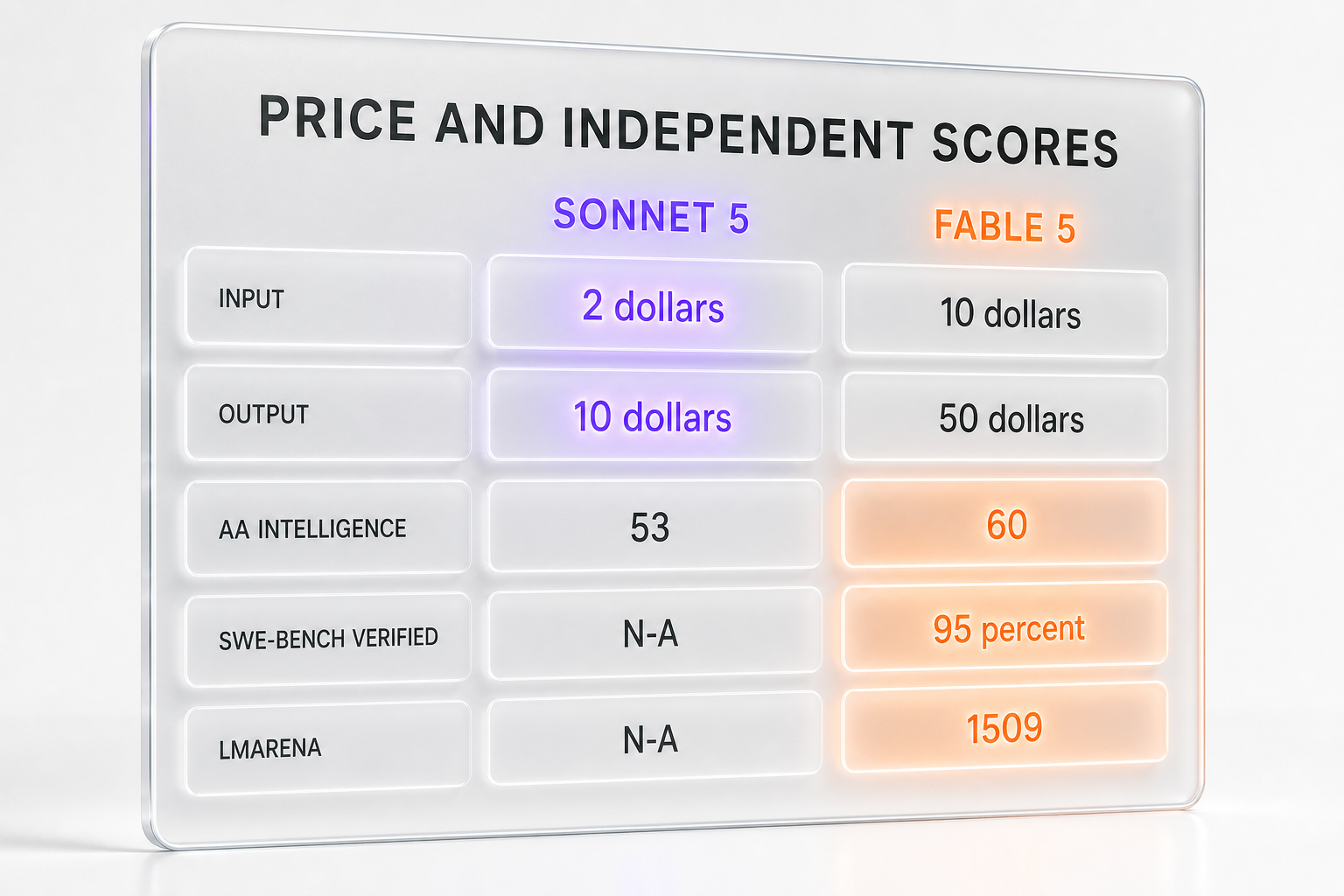
Claude Sonnet 5 and Claude Fable 5 are both Anthropic models, but they sit at opposite ends of the price-to-capability curve. Sonnet 5 costs 2 dollars per million input tokens on its introductory rate and runs at about 79 tokens per second, which makes it the value pick for volume. Fable 5 costs 10 dollars per million input tokens but leads every independent leaderboard we checked: 60 on the Artificial Analysis Intelligence Index, first on LMArena at an Elo of 1509, and 95 percent on SWE-bench Verified. The verdict is a split. Choose Sonnet 5 for cost and speed, and Fable 5 for raw capability.
Last compared: July 2026. Both are Anthropic API models; figures below are attributed to their sources throughout.
Quick Verdict
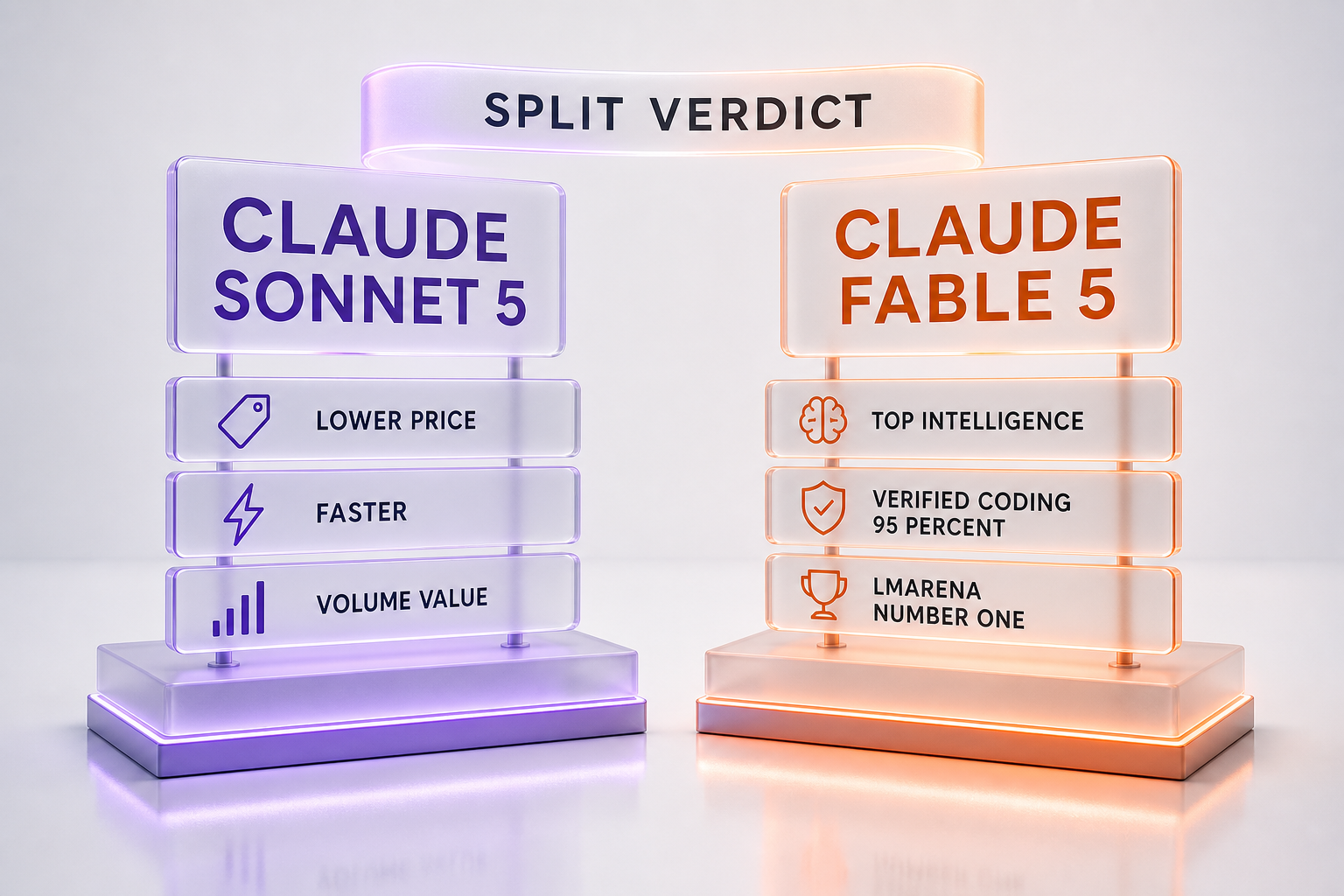
This is a split decision, and we did not force a single winner. Claude Sonnet 5 wins on price, measured speed, and value at high volume. Claude Fable 5 wins on raw intelligence, independently verified coding, and human-preference ranking. Because both run on the same Anthropic API, the practical answer for many teams is to use both: Sonnet 5 as the everyday default, Fable 5 for the hardest subtasks. On the public boards, Fable 5 sits first on the Artificial Analysis model index and first on the LMArena leaderboard, while Sonnet 5 is not charted on either.
- Claude Sonnet 5 wins: input and output price, cached-token price, measured throughput (about 79 tokens per second), and free access on Claude.ai.
- Claude Fable 5 wins: Artificial Analysis Intelligence Index (60 vs 53), SWE-bench Verified (95 percent vs not listed), LMArena (No. 1 at Elo 1509 vs not charted), and Anthropic’s self-reported SWE-bench Pro (about 80.3 percent vs 63.2 percent).
- Ties: both share a 1,000,000-token context window, the same Opus 4.7 tokenizer, the Anthropic ecosystem, and the same publisher.
Sonnet 5 vs Fable 5 at a Glance
The table below is the whole comparison in one view. Prices are per million tokens; Sonnet 5 shows both its introductory rate through August 31, 2026 and its standard rate afterward. Every benchmark is attributed in the sections that follow.
| Feature | Claude Sonnet 5 | Claude Fable 5 | Winner |
|---|---|---|---|
| Input price per million tokens | $2 intro, $3 standard | $10 | Claude Sonnet 5 |
| Output price per million tokens | $10 intro, $15 standard | $50 | Claude Sonnet 5 |
| Cached input price per million tokens | $0.20 intro, $0.30 standard | $1.00 (90% caching discount) | Claude Sonnet 5 |
| Artificial Analysis Intelligence Index | 53 | 60 (ranked No. 1) | Claude Fable 5 |
| SWE-bench Verified (vals.ai, independent) | N/A (not listed) | 95% | Claude Fable 5 |
| LMArena ranking | N/A (not charted) | No. 1 (Elo 1509) | Claude Fable 5 |
| SWE-bench Pro (Anthropic self-reported) | 63.2% | About 80.3% | Claude Fable 5 |
| Measured output speed | About 79 tokens per second | N/A (not charted) | Claude Sonnet 5 |
| Context window | 1,000,000 tokens | 1,000,000 tokens | Tie |
| Max output per request | 128K (up to 300K in Batch beta) | 128K | Tie |
| Tokenizer overhead | About 30% more tokens (Opus 4.7 tokenizer) | About 30% more tokens (same tokenizer) | Tie |
| Knowledge cutoff | January 2026 | Not publicly disclosed | Tie |
| Free consumer access | Yes, default on Claude.ai free and Pro | No free API tier | Claude Sonnet 5 |
| Publisher | Anthropic | Anthropic | Tie |
Claude Sonnet 5 in Brief
Claude Sonnet 5 is Anthropic’s balanced midsize model and, since launch, the default model on the free and Pro plans of Claude.ai. It runs a 1,000,000-token context window, takes text and image input and returns text, and lists a knowledge cutoff of January 2026. On Artificial Analysis it scores 53 on the Intelligence Index and runs at about 79 tokens per second, which is quick for a model of its class.
Its headline is price. The introductory API rate is 2 dollars per million input tokens and 10 dollars per million output tokens through August 31, 2026, and 3 dollars and 15 dollars after that. Anthropic self-reports 63.2 percent on SWE-bench Pro and 81.2 percent on OSWorld-Verified, but Sonnet 5 is not yet listed on the independent SWE-bench Verified board and is not charted on the Artificial Analysis Coding Index, so treat its coding strength as promising but not independently ranked. If you want the tier above it inside the same family, see our Anthropic pricing notes and our Sonnet 5 vs Opus 4.8 comparison.
Practically, Sonnet 5 is a drop-in upgrade from Sonnet 4.6 at the same standard price, with better coding, better computer use, and a cleaner safety profile, which is why it became the default the day it shipped. For most teams already on Claude, it is the model the majority of traffic should run on, with the flagship held in reserve.
Claude Fable 5 in Brief
Claude Fable 5 is the publicly available, safety-classified version of Anthropic’s Mythos-class frontier model, generally available since June 2026 across the Claude API plus Amazon Bedrock, Vertex AI, and Microsoft Foundry. It also runs a 1,000,000-token context window with up to 128K output tokens, and it is the model to beat in 2026: first on the Artificial Analysis Intelligence Index at 60, first on LMArena at an Elo of 1509, and 95 percent on the independently run SWE-bench Verified board.
That capability comes at a price. Fable 5 costs 10 dollars per million input tokens and 50 dollars per million output tokens, the most of any model in this comparison, softened by a 90 percent prompt-caching discount on cached input. Its adaptive thinking is always on and cannot be disabled, and it can return a clean refusal on some cybersecurity or biology requests, with a fallback path to another Claude model. For the tier just below it, see our Fable 5 vs Opus 4.8 comparison and Anthropic’s launch notes.
For agent builders, Fable 5’s practical toolkit is part of the appeal: an effort parameter and task budgets in beta to dial reasoning depth and cap spend, a memory tool, context editing to clear tool results, and compaction for long-running sessions. Those are the controls that keep a frontier model usable across multi-hour work rather than merely powerful in a single call.
Pricing: Where Sonnet 5 Wins Big
Price is the clearest gap between these two, and it is wide. At Sonnet 5’s introductory rate the two models are five times apart: 2 dollars per million input tokens versus 10 dollars, and 10 dollars per million output tokens versus 50 dollars. When the introductory window closes on August 31, 2026 and Sonnet 5 moves to 3 dollars and 15 dollars, the gap narrows but stays large, at more than three times cheaper on both input and output. Cached input follows the same pattern: 20 cents per million on Sonnet 5’s introductory rate against roughly 1 dollar per million on Fable 5 after its 90 percent caching discount.
Absolute cost per task tells the same story. Artificial Analysis pegs a representative Fable 5 run at about 11.80 dollars, a figure that reflects both its token price and its always-on thinking. For a team sending millions of tokens a day, that difference compounds into a real budget line. If token pricing terms like input, output, and cached tokens are unfamiliar, our explainer on Anthropic API pricing and our guide to AI model pricing break them down. The full model list lives in the Claude model documentation.
Put concrete numbers on it. Suppose a workload processes ten million input tokens and two million output tokens in a day. On Claude Sonnet 5’s introductory rate that is 20 dollars of input and 20 dollars of output, about 40 dollars in total; at its standard rate from September it is 30 dollars and 30 dollars, about 60 dollars. The same day on Claude Fable 5 is 100 dollars of input and 100 dollars of output, about 200 dollars. That is five times more at the introductory rate and more than three times more at the standard rate, before any prompt-caching savings, which favor Fable 5’s 90 percent cached-input discount but rarely close a gap that wide. The Anthropic pricing page and model documentation carry the current rate card.
Capability and Benchmarks: Where Fable 5 Wins
On measured capability, Fable 5 leads on every board that ranks both. The clearest independent signal is coding: on SWE-bench Verified as tracked by vals.ai, Fable 5 posts 95 percent, the highest in this comparison, while Sonnet 5 is not listed at all. That is the single most important line in this whole comparison, because it is an independent third-party number rather than a vendor figure. For context on what a coding-agent benchmark measures, see our guide to agentic coding models and the SWE-bench project.
The pattern holds on general intelligence and human preference. Fable 5 scores 60 on the Artificial Analysis Intelligence Index and ranks first overall; Sonnet 5 scores 53. On blind human-preference voting, Fable 5 tops LMArena at an Elo of 1509, while Sonnet 5 is not charted there. Even on Anthropic’s own self-reported launch figures the ranking is the same: Fable 5 is about 80.3 percent on SWE-bench Pro against Sonnet 5’s 63.2 percent. We label those two numbers self-reported because they come from the vendor rather than an independent evaluator, and the flagship Claude Opus 4.8 sits between them at 69.2 percent on the same metric.
It helps to know what each benchmark measures. SWE-bench Verified and SWE-bench Pro both score a model as a software-engineering agent that must resolve real repository issues, so they proxy coding-agent skill rather than chat quality; the Verified set tracked by vals.ai is the independent one cited here. Computer use is a separate axis: Anthropic self-reports Sonnet 5 at 81.2 percent on OSWorld-Verified, its strongest published result, which measures driving real applications through a screen rather than through an API. Fable 5 leads the reasoning and preference boards outright, but Sonnet 5’s computer-use number is a real strength worth weighing if your work is agentic in a browser or a desktop. Read independent boards like Artificial Analysis alongside the vendor slides.
Speed and Throughput
Speed flips the advantage back to Sonnet 5. Artificial Analysis measures Sonnet 5 at about 79 tokens per second, and as a midsize tier it is engineered for throughput and latency. Fable 5 is not independently charted for output speed, and because its adaptive thinking is always on and cannot be switched off, it deliberately spends more time reasoning before it answers. That is the right trade for hard problems and the wrong trade for a high-volume, latency-sensitive endpoint.
In practice this means the two models suit different parts of a stack. Sonnet 5 is comfortable behind a user-facing feature that needs to feel responsive; Fable 5 is better as an asynchronous worker on a queue where an extra few seconds of thinking buys a materially better answer. The Artificial Analysis model index is the cleanest place to watch these throughput numbers as they settle.
The throughput figure is easy to translate. At about 79 tokens per second, Claude Sonnet 5 returns a 1,000-token answer in roughly 13 seconds of generation time and a short 200-token reply in under 3 seconds. For a chat feature or an autocomplete surface, that responsiveness is part of the product. Fable 5 has no published tokens-per-second figure, and its always-on adaptive thinking means first-token and total latency run higher by design, so if you place it on a synchronous path you should budget for the wait or stream partial output to keep the interface alive. The Artificial Analysis methodology pages explain how these throughput numbers are measured.
Context, Tokenizer, and Ecosystem: The Ties
Several things are genuinely equal, and they matter. Both models run a 1,000,000-token context window with up to 128K output tokens per request, so neither has a headroom advantage on long documents or long agent runs. Both use the tokenizer introduced with Opus 4.7, which means the same text produces roughly 30 percent more tokens on either one than on older Claude models; budget for that overhead whichever you pick. And both are Anthropic models, so they share the Messages API, SDKs, safety tooling, and the Claude model lineup.
That shared foundation is the quiet reason a split verdict is workable rather than a compromise. Routing a request from Sonnet 5 to Fable 5, or down to the cheaper Claude Haiku 4.5, is a one-line change to the model identifier, not a migration. Anthropic documents the family and its shared features in its model announcements, and the whole lineup bills through one account.
Safety, Refusals, and Data Retention
The two models handle safety differently in ways that touch production code. Claude Fable 5 ships with safety classifiers that can decline some cybersecurity or biology requests; when that happens the Messages API returns a clean refusal as a successful response with a stop reason of refusal, not an error, and you are not billed for a request refused before output. Anthropic pairs this with a fallbacks parameter and SDK middleware so an agent can automatically retry on another Claude model such as Claude Opus 4.8. If you route hard security or bio-adjacent work to Fable 5, build that refusal-and-fallback path in from the start. Anthropic documents the behavior in its model announcements and model documentation.
Claude Sonnet 5’s safety story is quieter: Anthropic reports lower hallucination, lower sycophancy, and better refusal of malicious requests than the model it replaces, with cyber safeguards on by default, though it notes Sonnet 5 shows somewhat higher rates of misaligned behavior than Opus 4.8. One operational detail matters for regulated teams: Fable 5 is a Covered Model with a mandatory 30-day data-retention requirement and is not available under zero data retention, so if your compliance posture depends on zero retention, that is a hard constraint Sonnet 5 does not impose in the same way. Confirm the current terms on the Anthropic site before you commit either model to sensitive work.
Where Each Model Runs
Availability tilts toward Sonnet 5 for reach into consumer surfaces and toward Fable 5 for enterprise cloud placement. Claude Sonnet 5 is the default model on Claude.ai for Free, Pro, Max, Team, and Enterprise users, and it runs in Claude Code and through the Claude API under the identifier claude-sonnet-5. That free consumer tier is a genuine advantage if you want to try the model before wiring it into anything, and it is why most people using Claude in a browser are using Sonnet 5 whether they realize it or not.
Claude Fable 5 has no free API tier, but it is placed where large teams already build: generally available on the Claude API plus Amazon Bedrock, Google Cloud’s Vertex AI, and Microsoft Foundry, with cloud-specific identifiers such as anthropic.claude-fable-5 on Bedrock. It is the safety-classified, publicly callable version of Anthropic’s Mythos-class frontier model, so it is the top of the stack you can actually reach without a special-access program. Its overview lives on Anthropic’s Fable page, and the whole lineup, down to the cheaper Claude Haiku 4.5, is in the model documentation.
How We Compared Them
We compared Claude Sonnet 5 and Claude Fable 5 across three axes: published pricing taken from Anthropic’s own materials, independent third-party benchmarks, and the practical shape of the work we route to each. For capability we leaned on independent sources rather than vendor slides wherever a model was ranked: vals.ai for SWE-bench Verified, Artificial Analysis for the Intelligence Index and throughput, and LMArena for human preference.
Where only a vendor figure exists, we say so in the text, as with Anthropic’s self-reported SWE-bench Pro and OSWorld-Verified numbers for Sonnet 5. Where a model is simply not on a board, we mark it not listed or not charted rather than estimate, which is why several Sonnet 5 cells read that way. The goal is a comparison you can audit line by line rather than a leaderboard we invented.
Winner by Category
Best for cost and volume: Claude Sonnet 5. Three to five times cheaper on tokens, measurably faster, and free to try as the default on Claude.ai. For the large, routine majority of most workloads, this is the correct default.
Best for the hardest work and verified coding: Claude Fable 5. First on the Intelligence Index, first on LMArena, and the only model here with an independent 95 percent SWE-bench Verified score. When a task is failing because it is too hard, this is the escalation.
Best overall: it is a split. We set no global winner because the two models optimize for different things and, on the same API, complement each other. If forced to run only one, a cost-sensitive team should pick Sonnet 5 and a capability-first team facing hard problems should pick Fable 5. Compare each against OpenAI’s flagship in our Sonnet 5 vs GPT-5.5 and Fable 5 vs GPT-5.5 pieces, and see the current pricing before you commit.
Pros and Cons
Claude Sonnet 5
What we liked
- Cheapest here: 2 dollars per million input tokens on the introductory rate, three to five times below Fable 5.
- Fast, at about 79 tokens per second, and engineered for throughput.
- Free to try as the default model on the Claude.ai free and Pro plans.
- Near-flagship quality on routine coding, drafting, and analysis.
- Strong computer use, with Anthropic self-reporting 81.2 percent on OSWorld-Verified.
- One-line migration on the same Anthropic Messages API.
Where it falls short
- Introductory pricing ends on August 31, 2026, after which input and output rise to 3 and 15 dollars per million tokens.
- Not listed on the independent SWE-bench Verified board, and not charted on LMArena or the Artificial Analysis Coding Index.
- A lower ceiling than Fable 5 on the hardest, long-horizon tasks.
- Anthropic notes somewhat higher rates of misaligned behavior than Opus 4.8.
Claude Fable 5
What we liked
- The most capable model here: first on the Artificial Analysis Intelligence Index at 60.
- An independent 95 percent on SWE-bench Verified via vals.ai, the strongest verified coding score in this comparison.
- First on LMArena at an Elo of 1509 on blind human preference.
- Best on long-horizon agents and large multi-file code migrations.
- A real agent toolkit: effort parameter, task budgets, memory tool, and compaction.
Where it falls short
- The most expensive: 10 dollars per million input tokens and 50 dollars output, roughly five times Sonnet 5 on the introductory rate.
- No free API tier.
- Slower by design, with always-on thinking and no published throughput figure.
- A Covered Model with a mandatory 30-day data-retention requirement and no zero-data-retention option.
- Can refuse some cybersecurity or biology requests, so agents need a fallback path.
When to Pick Sonnet 5 vs Fable 5
Pick Claude Sonnet 5 when cost per token is the constraint, when latency matters, when volume is high, or when you are prototyping and want the free Claude.ai default. It also covers the majority of everyday coding, drafting, extraction, and analysis tasks at near-flagship quality for a fraction of the price. Start here and only escalate when you hit a wall.
Pick Claude Fable 5 when the task is genuinely hard and failure is expensive: long-horizon agents that lose coherence on lighter models, large multi-file refactors, and complex reasoning where its independent 95 percent verified coding score and top intelligence ranking translate into fewer failed runs. Reserve it for the subtasks that need it and let Sonnet 5 or the Claude.ai default carry the rest. Fable 5’s own page details its refusal-and-fallback design on Anthropic’s site.
As a concrete split: a support-triage bot that classifies and drafts replies at high volume is a Sonnet 5 job, where cost and latency dominate and the task sits well within its range. A one-time migration of a large legacy codebase across a breaking framework change, run overnight as an agent, is a Fable 5 job, where a higher success rate on a hard, expensive task easily repays the token premium. Most roadmaps contain both kinds of work, which is the practical case for keeping both models on hand.
A Simple Routing Rule
Because both models share one API, the most cost-effective setup for many teams is not to choose but to route. Send everything to Claude Sonnet 5 by default, and escalate a request to Claude Fable 5 only when a cheap signal says the task is hard: a low-confidence result, a failed self-check, a long agent trajectory that stalls, or a class of task you already know Sonnet struggles with. Because switching models is a one-line change, this routing logic is a few lines of code rather than a rebuild, and the cheaper Claude.ai default absorbs the bulk of the volume.
The economics reward that discipline. If Fable 5 handles only the hardest 10 to 20 percent of calls and Sonnet 5 takes the rest, your blended token cost stays close to Sonnet’s while your worst-case quality rises toward Fable’s. That hybrid is why the split verdict is not a dodge: on the same platform the two models are complementary tools, and the pricing gap is exactly what makes routing worth doing. For a cross-lab counterpoint, our Fable 5 vs GPT-5.5 comparison weighs the same trade against OpenAI.
Final Verdict
Same lab, opposite ends of the curve. Claude Sonnet 5 is the value tier and wins the practical majority of work on price and speed: 2 dollars per million input tokens on its introductory rate, about 79 tokens per second, and free as the Claude.ai default. Claude Fable 5 is the flagship and wins the hardest slice on capability: first on the Artificial Analysis Intelligence Index at 60, first on LMArena at an Elo of 1509, and 95 percent on SWE-bench Verified, at five times the price.
So we call it a split, and we mean it as advice rather than a dodge. Do not pay the Fable 5 premium for routine work, and do not send a genuinely hard, high-stakes task to Sonnet 5 to save a few dollars. Most teams should run Sonnet 5 as the default and escalate to Fable 5 only where the difficulty justifies it. Check the live Anthropic pricing before you budget, since Sonnet 5’s introductory rate ends on August 31, 2026.
Frequently Asked Questions
Is Claude Sonnet 5 or Claude Fable 5 the better model?
It depends on what you optimize for, which is why this is a split verdict. Claude Fable 5 is the more capable model: it leads the Artificial Analysis Intelligence Index at 60 to Sonnet 5’s 53, tops LMArena with an Elo of 1509, and posts 95 percent on the independently run SWE-bench Verified leaderboard, where Sonnet 5 is not listed. Claude Sonnet 5 wins on economics: it costs 2 dollars per million input tokens on its introductory rate versus 10 dollars for Fable 5, and it runs faster at about 79 tokens per second. Pick Fable 5 for the hardest work and Sonnet 5 for cost-sensitive volume.
How much cheaper is Claude Sonnet 5 than Claude Fable 5?
At Sonnet 5’s introductory rate, which runs through August 31, 2026, it is five times cheaper on both sides: 2 dollars per million input tokens versus 10 dollars, and 10 dollars per million output tokens versus 50 dollars. From September 1, 2026 Sonnet 5 moves to its standard rate of 3 dollars input and 15 dollars output, which still keeps it more than three times cheaper than Fable 5 on both input and output.
What are the SWE-bench scores for Claude Sonnet 5 and Claude Fable 5?
On SWE-bench Verified, the version tracked independently by vals.ai, Claude Fable 5 scores 95 percent and Claude Sonnet 5 is not listed. On SWE-bench Pro, using Anthropic’s own self-reported launch figures, Fable 5 is about 80.3 percent and Sonnet 5 is 63.2 percent. The independent 95 percent figure is the strongest single data point in Fable 5’s favor, because Sonnet 5 has no comparable independent coding-agent number yet.
Which model is smarter, Sonnet 5 or Fable 5?
By the Artificial Analysis Intelligence Index, Claude Fable 5 is smarter: it scores 60 and ranks first among all models, while Claude Sonnet 5 scores 53. Fable 5 also holds the top spot on LMArena with an Elo of 1509, a measure of blind human preference. Sonnet 5 is a strong midsize model, but Fable 5 is the most capable model Anthropic has widely released in 2026.
Is Claude Fable 5 worth five times the price of Sonnet 5?
Only for the hardest slice of your workload. Fable 5 costs 10 dollars per million input tokens against Sonnet 5’s introductory 2 dollars, so the gap is real. On routine tasks the two models often feel similar, so paying five times more buys little. Fable 5 earns its price on genuinely difficult work: long-horizon agents, large multi-file code migrations, and problems where its 95 percent verified coding score and top intelligence ranking translate into fewer failed runs. For everything else, Sonnet 5 is the economical default.
Which is faster, Claude Sonnet 5 or Claude Fable 5?
Claude Sonnet 5 is the faster model. Artificial Analysis measures it at about 79 tokens per second, and as a midsize tier it is built for throughput. Fable 5 is not independently charted for speed, and because its adaptive thinking is always on and cannot be disabled, it trades latency for reasoning depth. For latency-sensitive or high-volume work, Sonnet 5 is the better fit.
Do Sonnet 5 and Fable 5 have the same context window?
Yes. Both Claude Sonnet 5 and Claude Fable 5 run a 1,000,000-token context window with up to 128K output tokens per request. Sonnet 5 additionally offers up to 300K output tokens in a Batch beta. Both also use the tokenizer introduced with Opus 4.7, so the same text produces roughly 30 percent more tokens than older Claude models on either one.
Are Claude Sonnet 5 and Claude Fable 5 from the same company?
Yes. Both are Anthropic models, so they share the same Messages API, SDKs, safety approach, and ecosystem across the Claude API, Claude Code, and cloud platforms such as Amazon Bedrock, Vertex AI, and Microsoft Foundry. That shared foundation is why moving between them is a one-line model-string change rather than a migration.
Does the Sonnet 5 introductory price last?
No. Claude Sonnet 5’s introductory API pricing of 2 dollars per million input tokens and 10 dollars per million output tokens runs only through August 31, 2026. From September 1, 2026 it moves to the standard rate of 3 dollars input and 15 dollars output. Cached input tokens rise in step, from 20 cents to 30 cents per million. Even at the standard rate, Sonnet 5 remains far cheaper than Fable 5.
Which model should I use for high-volume production work?
For high-volume production work, Claude Sonnet 5 is usually the right default. It is three to five times cheaper than Fable 5, faster at about 79 tokens per second, and is the default model on the free and Pro plans of Claude.ai. Reserve Fable 5 for the subtasks that genuinely need frontier capability and route the bulk of traffic to Sonnet 5 to control cost.
Is Sonnet 5 ranked on LMArena or the Artificial Analysis leaderboards?
Claude Sonnet 5 appears on the Artificial Analysis Intelligence Index with a score of 53, but it is not charted on the Artificial Analysis Coding Index and is not listed on the LMArena leaderboard or on vals.ai’s SWE-bench Verified board. Claude Fable 5 sits at the top of all three: 60 on the Intelligence Index, first on LMArena at an Elo of 1509, and 95 percent on SWE-bench Verified. When comparing them, treat Fable 5’s numbers as independently ranked and Sonnet 5’s coding strength as, for now, self-reported.
Can I switch between Sonnet 5 and Fable 5 without changing my code?
Effectively yes. Both use the same Anthropic Messages API and SDKs, so switching is a one-line change to the model identifier, claude-sonnet-5 or claude-fable-5. One difference to plan for: Fable 5 keeps adaptive thinking always on and cannot disable it, and it can return a clean refusal on some cybersecurity or biology requests, so agentic code should handle a refusal-and-fallback path when you route to Fable 5.
Sources
Our Verdict
Split verdict, no forced winner. Claude Sonnet 5 wins on price (2 dollars per million input tokens on its introductory rate versus 10 dollars) and measured speed (about 79 tokens per second), making it the value pick for volume. Claude Fable 5 wins on raw capability: 60 on the Artificial Analysis Intelligence Index versus 53, first on LMArena at an Elo of 1509, and an independent 95 percent on SWE-bench Verified where Sonnet 5 is not listed. Both are Anthropic models on one API, so most teams should run Sonnet 5 as the default and escalate to Fable 5 only for the hardest work.
Choose Claude Sonnet 5
Anthropic's most agentic midsize model — near-Opus 4.8 coding and computer use at $2 per million input tokens (introductory through August 2026).
Try Claude Sonnet 5 →Choose Claude Fable 5
Anthropic's most capable widely released model — the public, safety-classified Mythos-class frontier tier.
Try Claude Fable 5 →Frequently Asked Questions
Is Claude Sonnet 5 better than Claude Fable 5?
Split verdict, no forced winner. Claude Sonnet 5 wins on price (2 dollars per million input tokens on its introductory rate versus 10 dollars) and measured speed (about 79 tokens per second), making it the value pick for volume. Claude Fable 5 wins on raw capability: 60 on the Artificial Analysis Intelligence Index versus 53, first on LMArena at an Elo of 1509, and an independent 95 percent on SWE-bench Verified where Sonnet 5 is not listed. Both are Anthropic models on one API, so most teams should run Sonnet 5 as the default and escalate to Fable 5 only for the hardest work.
Which is cheaper, Claude Sonnet 5 or Claude Fable 5?
Claude Sonnet 5 is priced at $2 in / $10 out per M tokens (free plan available). Claude Fable 5 is priced at $10 in / $50 out per M tokens. Check the pricing comparison section above for a full breakdown.
What are the main differences between Claude Sonnet 5 and Claude Fable 5?
The key differences span across 14 features we compared. For Input price per million tokens, Claude Sonnet 5 offers $2 intro, $3 standard while Claude Fable 5 offers $10. For Output price per million tokens, Claude Sonnet 5 offers $10 intro, $15 standard while Claude Fable 5 offers $50. For Cached input price per million tokens, Claude Sonnet 5 offers $0.20 intro, $0.30 standard while Claude Fable 5 offers $1.00 (90% caching discount). See the full feature comparison table above for all details.