Claude Opus 5 vs GPT-5.6 Sol: Stronger Model, Pricier Task


Opus 5 leads the independent index 61 to 59 — but Sol now undercuts it by 20% per token and finished the same tasks for $1.54 against $2.03. Here's why.
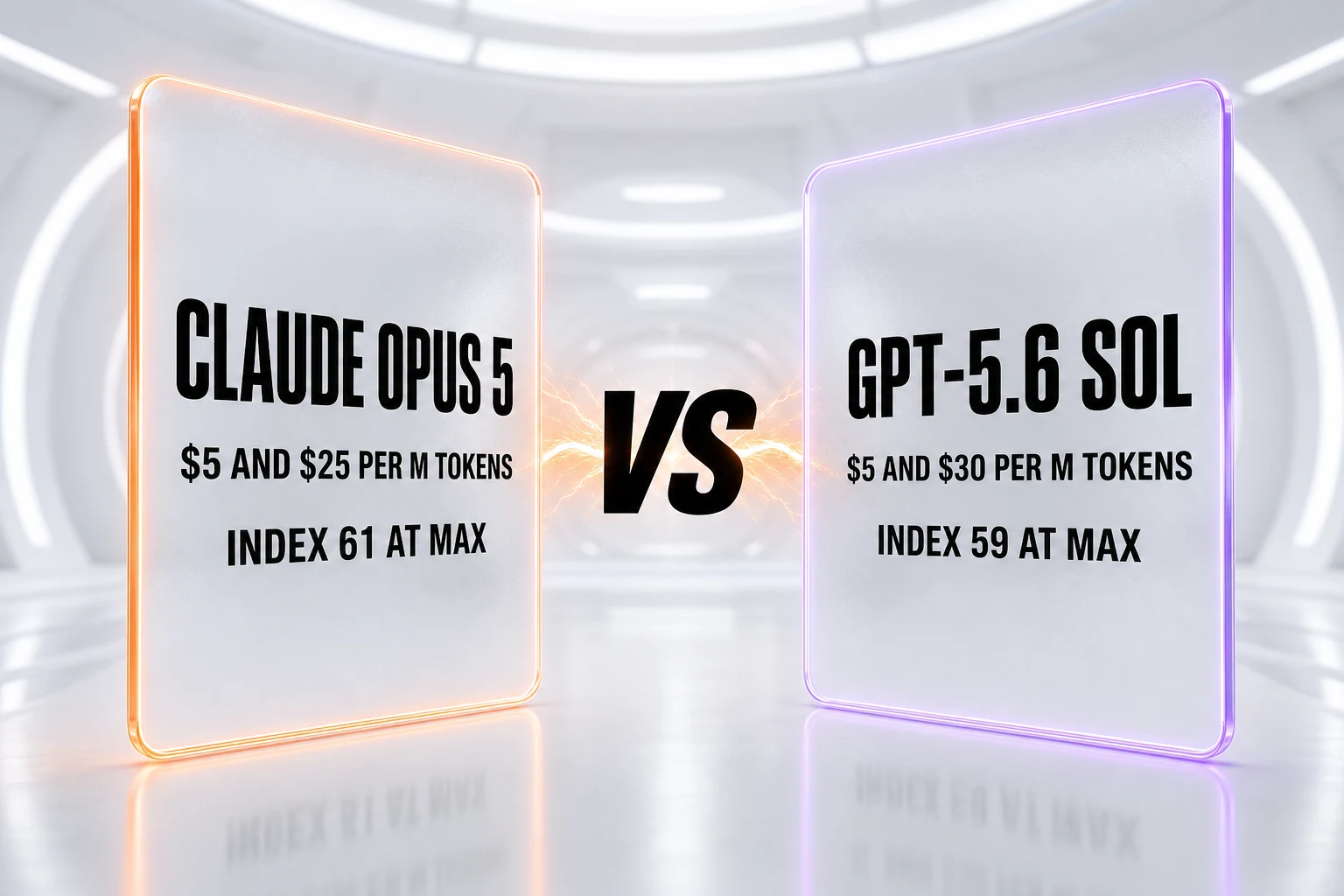
Feature Comparison
| Feature | Claude Opus 5 | GPT-5.6 Sol |
|---|---|---|
| Input price per million tokens, short context | USD 5.00 | USD 4.00, promotional |
| Output price per million tokens, short context | USD 25.00 | USD 20.00, promotional |
| Artificial Analysis Intelligence Index v4.1, max effort | 61 | 59 |
| Cost per index task, max effort | USD 2.03 | USD 1.54 |
| Cost per index task at each vendor default | USD 1.06 at high | USD 0.41 at medium |
| ARC-AGI-2, max effort (ARC Prize Foundation) | 90.4 percent | 92.5 percent |
| ARC-AGI-1, max effort (ARC Prize Foundation) | 97.5 percent | 96.5 percent |
| Context window | 1,000,000 tokens | 1,050,000 tokens |
| Long-context pricing | USD 5.00 and USD 25.00 at any prompt length | USD 8.00 and USD 30.00 above 272,000 tokens |
| Knowledge cutoff | May 2026 | February 16, 2026 |
| Effort levels | Five, default high | Six, default medium |
| Output tokens per second, max effort | 52.8 | 75.9 |
| Time to first token, max effort | 69.71 seconds | 129.47 seconds |
| Vendor-reported agentic evaluations (Anthropic system card) | Ahead on FrontierBench, FrontierCode and AutomationBench | Behind on all three |
Pricing Comparison
Claude Opus 5
GPT-5.6 Sol
Detailed Comparison
Claude Opus 5 vs GPT-5.6 Sol: Opus 5 charges $5 per million input tokens and $25 per million output tokens. GPT-5.6 Sol charges $4 and $20 on requests up to 272,000 input tokens, which puts it 20 percent below Opus 5 on both sides — promotional rates OpenAI introduced on August 21, 2026. Above 272,000 input tokens Sol's long-context rate of $8 and $30 applies to the whole request, and there Opus 5 is the cheaper model. On version 4.1 of the independent Artificial Analysis Intelligence Index, Opus 5 scores 61 against Sol's 59, with both measured at max effort. Sol is also the cheaper model per finished task: the same index cost $2.03 per task on Opus 5 and $1.54 on Sol when Artificial Analysis measured it on July 27, 2026, because Opus 5 is markedly more verbose. On ARC-AGI-2, verified independently by the ARC Prize Foundation, Sol leads 92.5 percent to 90.4 percent at max effort. Our verdict: Opus 5 is the stronger model on the independent aggregate, on knowledge freshness, and on every agentic evaluation Anthropic published — but Sol now wins the invoice twice over, on the rate card and on the finished task, and only prompts past 272,000 input tokens put Opus 5 back in front on cost.
The short answer
Opus 5 wins the benchmark sheet; Sol wins the invoice. That sentence is the whole comparison, and every shortcut around it produces a wrong answer. The two models are unusually well matched for a cross-vendor pairing: each is the current flagship of its lab, each offers roughly a million tokens of context, and the independent index separates them by two points. What separates them in practice is token economics. Until August 21, 2026 the price list and the invoice pointed in opposite directions; since OpenAI cut Sol's rates they point the same way, and the only place Opus 5 is still the cheaper model is prompts above 272,000 input tokens.
This is the cleanest matchup of the Opus 5 launch cycle for a specific structural reason. There is no tier confusion — Claude Opus 5 and GPT-5.6 Sol are each the model their vendor points customers toward first. There is no same-vendor cannibalization to explain away, and no asymmetry in how the two labs handle refusals within a single family. Two labs, two flagships, and — since August 21, 2026 — a gap of a clean 20 percent on both sides of the short-context rate card.
- Claude Opus 5 wins for: peak measured intelligence on the independent aggregate, knowledge freshness, agentic and computer-use work as measured by Anthropic, responsiveness at maximum effort, and very long prompts, where its million-token window carries no surcharge.
- GPT-5.6 Sol wins for: the short-context rate card, cost per completed task, sustained generation speed, abstract visual reasoning as scored by the ARC Prize Foundation, and workloads that benefit from a sixth effort level and a cheaper default setting.
- Effectively identical: synchronous output capped at 128,000 tokens, and a context window of one million tokens or a little more. Pricing is no longer on that list — Sol has undercut Opus 5 on input, output and cached input since August 21, 2026.
- The trap to avoid: pricing this matchup from a rate card you last read in July. Until August 21, 2026 Opus 5's output token was 17 percent cheaper than Sol's while Opus 5 still cost about 32 percent more to finish the same benchmark suite; OpenAI's cut removed that contradiction by putting Sol ahead on both. Sol's new rates are promotional, and OpenAI's own two descriptions of how long they last do not agree.
What each model is
Claude Opus 5
Claude Opus 5 shipped on July 24, 2026 as Anthropic's newest frontier model at $5 per million input tokens and $25 per million output tokens — the same figures the Opus tier has carried since Opus 4.5. Cache reads bill at $0.50 per million tokens, five-minute cache writes at $6.25, one-hour writes at $10, and the Batch API halves the base rates to $2.50 and $12.50.
Its knowledge cutoff is May 2026 for both reliable knowledge and training data, making it the freshest model Anthropic ships. Its context window is one million tokens, and Anthropic's pricing documentation is explicit that the full window bills at standard rates: a 900,000-token request costs the same per token as a 9,000-token request. Output runs to 128,000 tokens synchronously and 300,000 tokens in batch behind a dedicated beta header. It exposes five effort levels — low, medium, high, xhigh and max — with high as the documented default on both the Claude API and Claude Code. There is no priority tier, though a research-preview fast mode is offered at $10 and $50 per million tokens on the first-party API, which raises output speed only. For the full specification sheet, see our launch coverage of Opus 5.
GPT-5.6 Sol
GPT-5.6 Sol arrived on July 9, 2026 as the standout member of OpenAI's GPT-5.6 family, sitting above the cheaper Terra and Luna variants that share its architecture. It bills at $4 per million input tokens and $20 per million output tokens on requests up to 272,000 input tokens, with cached input at $0.40 per million and batch rates of $2.00 and $10. Those are promotional rates OpenAI introduced on August 21, 2026; the pricing section below sets out exactly what the company has and has not committed to. Unlike Opus 5, it also offers a published fast mode — the tier OpenAI renamed from priority processing on July 30, 2026 — at $8 and $40 per million tokens, and a flex processing option priced at batch rates.
Its context window is 1.05 million tokens and its maximum output is 128,000 tokens, both marginally different from or identical to Opus 5. Its knowledge cutoff is February 16, 2026, five months behind Opus 5. One pricing detail deserves attention that the headline rates hide: OpenAI's documentation states that prompts above 272,000 input tokens are billed at twice the input rate and 1.5 times the output rate for the entire request. Sol accepts six effort levels — none, low, medium, high, xhigh and max — and defaults to medium, a lower and cheaper default than Opus 5's high. We measured it against the previous Anthropic flagship in GPT-5.6 Sol vs Claude Opus 4.8.
Head-to-head specifications
Every figure in this table comes from Anthropic's or OpenAI's published platform documentation, or from the independent Artificial Analysis index. No vendor benchmark results appear here; those are handled separately, and deliberately so.
| Specification | Claude Opus 5 | GPT-5.6 Sol | Edge |
|---|---|---|---|
| Input price per million tokens, short context | USD 5.00 | USD 4.00, promotional | Sol |
| Output price per million tokens, short context | USD 25.00 | USD 20.00, promotional | Sol |
| Cached input per million tokens, short context | USD 0.50 | USD 0.40, promotional | Sol |
| Batch input and output per million tokens | USD 2.50 and USD 12.50 | USD 2.00 and USD 10.00 | Sol |
| Artificial Analysis Intelligence Index v4.1, max effort | 61 | 59 | Opus 5 |
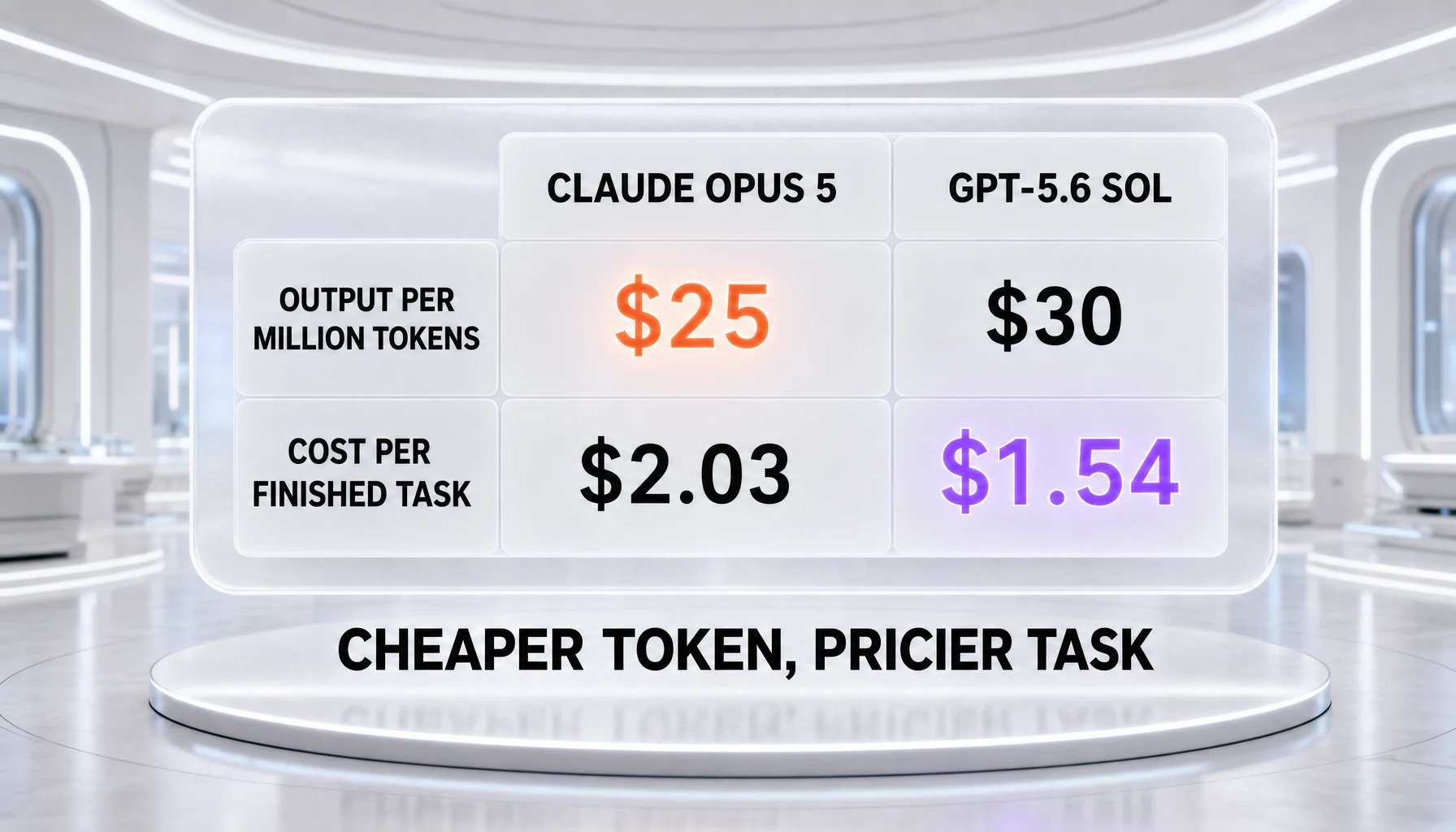
| Cost per index task, max effort (measured July 27, 2026) | USD 2.03 | USD 1.54 | Sol |
| Cost per index task at each vendor default (measured July 27, 2026) | USD 1.06 at high | USD 0.41 at medium | Sol |
| Context window | 1,000,000 tokens | 1,050,000 tokens | Sol, marginally |
| Long-context pricing | USD 5.00 and USD 25.00 at any prompt length | USD 8.00 and USD 30.00 above 272,000 tokens, 2x input and 1.5x output | Opus 5 |
| Maximum synchronous output | 128,000 tokens | 128,000 tokens | Tie |
| Maximum batch output | 300,000 tokens with beta header | Not published | Opus 5 |
| Knowledge cutoff | May 2026 | February 16, 2026 | Opus 5 |
| Effort levels | Five: low to max, default high | Six: none to max, default medium | Sol, marginally |
| Output tokens per second, max effort (measured July 27, 2026) | 52.8 | 75.9 | Sol |
| Time to first token, max effort (measured July 27, 2026) | 69.71 seconds | 129.47 seconds | Opus 5 |
| Total response time on the index, max effort (measured July 27, 2026) | 79.17 seconds | 136.06 seconds | Opus 5 |
| ARC-AGI-1, max effort | 97.5 percent | 96.5 percent | Opus 5 |
| ARC-AGI-2, max effort | 90.4 percent | 92.5 percent | Sol |
| Fast mode, renamed from priority processing on July 30, 2026 | USD 10.00 and USD 50.00 per million tokens, research preview | USD 8.00 and USD 40.00 per million tokens | Sol |
Read that table as two clusters rather than a score line. Opus 5 takes the capability rows, the freshness rows and the long-prompt row; Sol takes the throughput rows, every short-context price row and, decisively, the cost-per-task rows. Until August 21, 2026 the price rows and the cost-per-task rows pointed in opposite directions, and that contradiction was the whole tension of this matchup. OpenAI's cut resolved it in Sol's favor and left Opus 5 with exactly one cost argument: prompts long enough to trip Sol's 272,000-token threshold.
Pricing: Sol now undercuts the rate card and the invoice
Here is where this comparison stood for its first month, and where it stands now. Until August 21, 2026, Opus 5's output tokens cost $25 per million against Sol's $30 — about 17 percent less — while Artificial Analysis measured a weighted average cost of $2.03 per task to run Opus 5 through version 4.1 of its Intelligence Index at max effort, against $1.54 for Sol in the same configuration. Opus 5 cost roughly 32 percent more to finish the same body of work while charging 17 percent less for each unit of it. OpenAI then cut Sol to $4 input and $20 output per million tokens on requests up to 272,000 input tokens, which is 20 percent under Opus 5 on both sides, with cached input at $0.40 against $0.50 and batch at $2.00 and $10.00 against $2.50 and $12.50. The contradiction is gone, and it resolved against Opus 5: at short context Sol is now the cheaper model per token and per finished task.
These are promotional rates. OpenAI cut Sol's API and credit pricing on August 21, 2026, and its two published descriptions of how long the cut lasts do not say the same thing. The GPT-5.6 launch page carries an update reading: "OpenAI dropped the API and credit pricing of GPT-5.6 Sol by over 20% for the next 3 months." The API pricing page states: "GPT-5.6 Sol's promotional pricing is available at least through November 21, 2026." One phrasing closes a window; the other sets a floor and leaves the end open. We are not going to pick between them, and neither page says the rate reverts on a particular day. Sol's standard rate before the cut was $5 input and $30 output per million tokens.
Artificial Analysis re-measures cost, speed and latency continuously, so every such figure on this page is a reading taken on July 27, 2026 rather than a fixed property of either model. Those readings also predate OpenAI's August 21, 2026 rate cut, so they understate Sol's current cost advantage rather than overstating it. The mechanism is verbosity. Artificial Analysis notes that Opus 5 generated approximately 100 million tokens across the index run, against a median of 63 million for comparable models — a model it describes as very verbose relative to its peers. A per-token discount does not help when you buy substantially more of them — and at short context Opus 5 no longer has one. The independent ARC-AGI figures reproduce the same pattern from a different harness: at max effort, ARC-AGI-2 cost $2.06 per task on Opus 5 against $1.44 on Sol. Two unrelated evaluation harnesses, run by two unrelated organizations, both put Opus 5 between 30 and 45 percent more expensive per completed task.
This is why per-token comparison is close to useless on these two models, and why we have not built the usual illustrative monthly-bill table. Such a table requires assuming both models emit the same number of tokens for the same work, and that assumption is precisely what the evidence contradicts. A calculation that multiplied four million output tokens by $25 and $30 and concluded Opus 5 saved you money was arithmetically correct and practically backwards; at $25 against $20 the arithmetic no longer points Opus 5's way either.
The effort ladder makes the gap wider rather than narrower, because the two vendors set different defaults. Artificial Analysis publishes cost per task at every level for both models. Opus 5 runs $0.36 at low, $0.62 at medium, $1.06 at high, $1.56 at xhigh and $2.03 at max. Sol runs $0.24 at low, $0.41 at medium, $0.62 at high, $0.95 at xhigh and $1.54 at max. At every single rung Sol is cheaper per task. And because Anthropic defaults to high while OpenAI defaults to medium, a team that changes nothing pays $1.06 per task on Opus 5 against $0.41 on Sol — a gap of roughly two and a half times, driven as much by the default setting as by the model.
Two caveats keep this honest. First, cost per task is a weighted average across one particular benchmark suite; your workload is not that suite, and a task mix heavier on short structured outputs would compress the gap. Second, cost per task is not the same figure as the total cost of running the index, which Artificial Analysis reports separately as $3,835.51 for Opus 5 and $3,442.81 for Sol — an 11 percent gap rather than a 32 percent one. We lead with cost per task because it is the figure that maps onto a production workload, but anyone quoting either number should say which one they mean.
The independent index, at matched effort
The Artificial Analysis Intelligence Index is the only third-party measurement scoring both models under a single harness, which makes it the only place a direct capability comparison is defensible at all. Version 4.1 combines nine evaluations, among them GDPval-AA v2, Terminal-Bench v2.1, SciCode, Humanity's Last Exam, GPQA Diamond and AA-Omniscience.
At max effort, Opus 5 scores 61 and Sol scores 59. That is the comparison we are making, and the configuration matters more than the numbers.
Here is a trap worth naming explicitly, because we nearly published it ourselves. Opus 5 scores 59 at high, its default setting. Sol scores 59 at max. Those two figures are identical, and setting them against each other to declare a tie would be meaningless — one is a default configuration, the other is a maximum. The comparable pairing is max against max, which is 61 to 59, and the full ladders are worth seeing side by side: Opus 5 runs 51, 56, 59, 60, 61 from low to max, while Sol runs 49, 54, 56, 58, 59 across the same five named levels. Opus 5 leads by two to three points at every matched rung. That consistency is a more meaningful result than the headline pair, because it does not depend on picking a configuration.
Three qualifications travel with these numbers. A score exists only with its index version — version 4.1 is not version 4.0, and models have moved by double digits across index revisions. A score exists only with its configuration, which is why every figure on this page carries its effort level. And a rank is not a score: small raw differences can move a model several leaderboard positions, and position is a presentation artifact rather than a performance fact.
ARC-AGI: the third-party result that favors Sol
The ARC Prize Foundation independently verifies scores on its own eval sets, which makes ARC-AGI the least conflicted evidence available on either model — neither vendor built it, ran it or scored it. It is also the place where the ranking inverts, and we are putting it in its own section rather than folding it into a footnote.
On ARC-AGI-2 at max effort, GPT-5.6 Sol scores 92.5 percent against Claude Opus 5's 90.4 percent. Sol also completed those tasks for less: $1.44 per task against $2.06. ARC-AGI-2 is the harder and more current of the two sets, designed specifically to resist the pattern-matching shortcuts that saturated its predecessor. On the older ARC-AGI-1, the ranking flips back: Opus 5 scores 97.5 percent at max against Sol's 96.5 percent.
One widely repeated claim about these two models is that they tie at 97.5 percent on ARC-AGI-1. They do not, at matched effort. Sol reaches 97.5 percent at xhigh, not at max — its max-effort figure is 96.5 percent, slightly lower, which is not unusual on a near-saturated benchmark where additional reasoning can overshoot. Setting Opus 5's max-effort 97.5 against Sol's xhigh 97.5 compares two different configurations and manufactures a tie that the data does not contain. At max against max, Opus 5 leads ARC-AGI-1 by one point and trails ARC-AGI-2 by two.
The honest reading is that these two models are close enough on independent abstract reasoning that the winner changes with the eval set. If your work resembles ARC-AGI-2's novel-pattern induction more than it resembles the aggregate index, Sol is the better-evidenced choice, and it is cheaper per task on that set as well.
Anthropic's own numbers, kept separate
Everything in this section comes from Anthropic's 194-page system card for Opus 5. These are one vendor's evaluations of its own model against a competitor's, and we are keeping them in a separate section rather than mixing them into the table above, because a self-reported figure and an independently measured one do not belong in the same row. OpenAI has published no equivalent head-to-head against Opus 5. Read these as Anthropic's account.
- FrontierBench v0.1 — Opus 5 scores 44.4 percent at xhigh against Sol's 37.5 percent. Run internally by Anthropic.
- FrontierCode — built and scored by Cognition rather than by Anthropic. Opus 5 scores 53.4 against Sol's 47.5 on the main set. The third-party scoring makes this the strongest item in this section.
- AutomationBench — a held-out private set from Zapier. Opus 5 scores 26.0 percent against Sol's 18.1 percent. Held-out sets resist contamination, which strengthens the result relative to its low absolute numbers.
- OSWorld 2.0 — Opus 5 scores 70.57 percent. The 62.6 percent figure shown for Sol is taken from OpenAI's own launch post rather than re-run on Anthropic's harness, so the two numbers were produced under different conditions and should not be read as a like-for-like margin.
- Indirect prompt injection, evaluated with Gray Swan — attacker success across 15 attempts is 2.0 percent for Opus 5 against 20.0 percent for Sol. Anthropic states directly that its own models are evaluated without additional safeguards while competitor models are tested through their public endpoints, which means these two numbers were not produced under comparable conditions. We report the figure and the disclaimer together because the figure is meaningless without it.
One further item from the system card cuts against Opus 5, and it belongs here rather than in a footnote. Anthropic reports that Opus 5 improved accuracy by 11 percent over Opus 4.8 while its hallucination rate rose by 6 percent, both as relative changes. That comparison is against Opus 4.8 and only against Opus 4.8 — it says nothing about how Opus 5 compares with Sol on factual reliability, and no published measurement does. A model that is more often right and also more often confidently wrong argues for a verification layer on any output feeding an automated decision, independent of which competitor you were considering.
Speed: Sol generates faster, Opus 5 starts sooner
Latency on these two models splits cleanly into two questions with opposite answers, and reporting either half alone produces a false impression.
Sol generates output faster once it begins: 75.9 output tokens per second at max effort against Opus 5's 52.8, roughly 44 percent quicker. Opus 5 begins far sooner: 69.71 seconds to first token against Sol's 129.47, roughly 46 percent faster to respond. Opus 5 also finishes sooner overall on the index at that setting, at 79.17 seconds of total response time against 136.06.
That combination is less contradictory than it looks. Sol spends longer reasoning before emitting anything and then writes quickly; Opus 5 starts writing sooner and writes more slowly, but emits more tokens overall. For any surface with a person waiting on it, both models are severe at maximum effort — the median time to first token across models in this band is measured in single-digit seconds, and both of these are more than an order of magnitude slower. Neither belongs in an interactive product at max effort, and both are far more reasonable at their default settings, where Opus 5 reaches first token in 21.67 seconds and Sol in 4.48.
Context, cutoffs and operational limits
Both models advertise roughly a million tokens of context, but they price long prompts very differently. Anthropic's documentation states that Claude 4.6 and later models include the full one-million-token window at standard pricing, with a 900,000-token request billed at the same per-token rate as a 9,000-token one. OpenAI's pricing page lists Sol at $8 per million input tokens and $30 per million output above 272,000 input tokens — twice the input rate and 1.5 times the output rate, applied to the full request rather than to the excess. For genuinely long-context work — whole-repository analysis, large document sets, long agent transcripts — that single line inverts the cost comparison in Opus 5's favor: past the threshold, Opus 5's $5 and $25 sit under Sol's $8 and $30 on both sides. It is now the only cost argument Opus 5 has.
On knowledge freshness, Opus 5's May 2026 cutoff leads Sol's February 16, 2026 by about five months. Whether that matters is entirely workload-dependent and easy to overstate: for most tasks it is irrelevant, and for anything touching recent events, recent library versions or recent regulation it is decisive.
Rate limits are the one axis where we will not declare a winner, because the two vendors do not publish comparable units. OpenAI lists Sol's Tier 1 limits as 500 requests per minute and 500,000 tokens per minute as a single combined figure. Anthropic publishes separate input and output allowances for the Start tier, at 2,000,000 input tokens per minute and 400,000 output tokens per minute. A combined bucket and a split bucket cannot be reduced to one number, and any comparison that does so is manufacturing a result. Check both against your own traffic shape.
Sol offers a published fast mode — the tier OpenAI renamed from priority processing on July 30, 2026 — at $8 and $40 per million tokens. Anthropic offers a research-preview fast mode of its own at $10 and $50 per million tokens, which raises output speed without improving time to first token. The two are not equivalent products, but they occupy the same slot in each vendor's lineup, each is exactly double its vendor's standard rate, and Sol's is now the cheaper of the two.
How we researched this
We researched both models rather than running our own hands-on evaluation of them. No benchmark figure on this page was produced by us, and saying so plainly is worth more than an implied authority we have not earned.
Pricing, context windows, output limits, cutoffs, effort levels, defaults and rate limits were read directly from Anthropic's and OpenAI's published platform documentation on July 27, 2026, not from summaries or secondhand reporting, and every price on this page was re-read on both vendors' documentation on August 28, 2026. Index scores, cost per task, output speed, time to first token and verbosity figures come from version 4.1 of the Artificial Analysis Intelligence Index as consulted on the same date. ARC-AGI figures come from the ARC Prize Foundation's published results for each model. Benchmark results attributed to Anthropic come from the Opus 5 system card and are labeled as vendor-reported wherever they appear.
Two disciplines shaped this page more than any other. Every number carries the configuration it was measured at, because on these models almost every figure moves with effort level — and comparing a default against a maximum is the single most common error in model comparisons, including in the widely repeated ARC-AGI-1 tie we corrected above. And we did not claim either model lacks a capability without checking the vendor's documentation first; where a measurement simply has not been published, we say it has not been published rather than implying absence.
Winner by category
| Category | Winner | Why |
|---|---|---|
| Peak measured intelligence | Claude Opus 5 | 61 against 59 on the independent index, both at max effort, and ahead at every matched rung |
| Cost per completed task | GPT-5.6 Sol | USD 1.54 against USD 2.03 at max effort, and cheaper at every effort level |
| Price per input token, short context | GPT-5.6 Sol | USD 4.00 against USD 5.00 per million tokens under Sol's promotional rate |
| Price per output token, short context | GPT-5.6 Sol | USD 20.00 against USD 25.00 per million tokens under Sol's promotional rate |
| Abstract reasoning on ARC-AGI-2 | GPT-5.6 Sol | 92.5 percent against 90.4 percent at max effort, independently verified |
| Abstract reasoning on ARC-AGI-1 | Claude Opus 5 | 97.5 percent against 96.5 percent at max effort |
| Long-context economics | Claude Opus 5 | USD 5.00 and USD 25.00 at any length against Sol's USD 8.00 and USD 30.00 above 272,000 tokens |
| Agentic and computer-use work | Claude Opus 5, vendor-reported | Ahead on FrontierBench, FrontierCode and AutomationBench in Anthropic's system card |
| Sustained generation speed | GPT-5.6 Sol | 75.9 against 52.8 output tokens per second at max effort |
| Responsiveness | Claude Opus 5 | 69.71 seconds to first token against 129.47 at max effort |
| Knowledge freshness | Claude Opus 5 | May 2026 against February 16, 2026 |
| Conciseness | GPT-5.6 Sol | Opus 5 generated roughly 100 million tokens on the index against a 63 million peer median |
| Cost at the out-of-the-box default | GPT-5.6 Sol | USD 0.41 per task at medium against USD 1.06 at high |
| Rate limits | Not comparable | OpenAI publishes a combined token bucket, Anthropic publishes split input and output allowances |
| Factual reliability against each other | Not measured | Anthropic reports Opus 5's hallucination rate against Opus 4.8 only, never against Sol |
Strengths and limitations
Claude Opus 5 — where it is strong
- Leads the independent Artificial Analysis Intelligence Index v4.1 at max effort, 61 against 59, and leads at every matched effort level.
- Stable, non-promotional pricing at $5 and $25 per million, unchanged across the Opus tier since Opus 4.5, where Sol's current rate is a promotion with no agreed end date.
- The full one-million-token context window bills at standard rates with no long-prompt surcharge.
- A May 2026 knowledge cutoff, about five months fresher than Sol's.
- Reaches first token roughly 46 percent sooner at max effort, and finishes the index faster overall.
- Ahead on every agentic evaluation Anthropic published, including the Cognition-scored FrontierCode set.
- Supports 300,000 output tokens in batch behind a beta header, where OpenAI publishes no equivalent figure.
Claude Opus 5 — where it is weak
- Cost about 32 percent more per completed index task when Artificial Analysis measured both on July 27, 2026, at $2.03 against $1.54 — a reading taken before OpenAI cut Sol's rates, so it understates the current gap.
- No longer the cheaper token: since August 21, 2026 Sol undercuts Opus 5 by 20 percent on input, output and cached input at short context.
- Markedly verbose: roughly 100 million tokens on the index run against a 63 million peer median.
- Trails on ARC-AGI-2, the harder and more current independently verified set, 90.4 against 92.5.
- Generates output about 30 percent more slowly once it starts, at 52.8 tokens per second.
- Hallucination rate rose 6 percent in relative terms against Opus 4.8 even as accuracy rose 11 percent.
- Defaults to high effort, which costs $1.06 per task before you have tuned anything.
- No priority processing tier; fast mode raises output speed only and does not improve time to first token.
GPT-5.6 Sol — where it is strong
- Cheaper per completed task at every effort level, and about a quarter cheaper at max on Artificial Analysis's July 27, 2026 readings.
- Cheaper per token as well since August 21, 2026: $4 input, $20 output and $0.40 cached per million against Opus 5's $5, $25 and $0.50 — 20 percent less on all three, up to 272,000 input tokens.
- Wins ARC-AGI-2 at max effort, 92.5 against 90.4, on an independently verified set, and for less per task.
- Generates output roughly 44 percent faster once it begins, at 75.9 tokens per second.
- A cheaper default setting at medium, costing $0.41 per task out of the box.
- Six effort levels including a none setting, giving one more rung of control than Opus 5.
- A published fast mode at $8 and $40 per million tokens, renamed from priority processing on July 30, 2026, and a flex processing option at batch rates.
- A marginally larger context window at 1.05 million tokens.
GPT-5.6 Sol — where it is weak
- Trails the independent index at max effort, 59 against 61, and at every matched rung.
- Long prompts are penalized: above 272,000 input tokens billing goes to $8 input and $30 output for the whole request, which puts Sol above Opus 5 on both sides.
- Time to first token is 129.47 seconds at max effort, roughly 86 percent longer than Opus 5's.
- A February 16, 2026 knowledge cutoff, about five months behind Opus 5.
- Its price advantage is promotional. OpenAI describes the August 21, 2026 cut as lasting "for the next 3 months" on its launch page and as "available at least through November 21, 2026" on its pricing page, and has not said what follows either window.
- Trails on all four agentic evaluations Anthropic published, though only Anthropic has published such a comparison.
- No published maximum batch output figure to compare against Opus 5's 300,000 tokens.
When to pick which
Pick Claude Opus 5 if
Your hardest tasks sit at the frontier and you are buying capability rather than throughput. Opus 5 leads the independent aggregate at every matched effort level, and a two-point lead that holds across five configurations is a more durable result than a single headline pairing. Pick it if your prompts are genuinely long, because its flat $5 and $25 against Sol's $8 and $30 above 272,000 tokens reverses the cost picture on repository-scale or document-set work — that threshold is the one place Opus 5 is still the cheaper model. Pick it if your work depends on events after February 2026. Pick it for agentic and computer-use pipelines, where Anthropic's evaluations favor it and the Cognition-scored coding set is the least conflicted of them. And pick it if a person is waiting on the response, since it reaches first token in roughly half the time.
Pick GPT-5.6 Sol if
You are paying per finished task or per token — at prompts under 272,000 input tokens, Sol has won both since August 21, 2026. On Artificial Analysis's July 27, 2026 readings Sol was cheaper at every rung of the effort ladder, about a quarter cheaper at max, and roughly two and a half times cheaper if both models run at their vendor defaults. Pick it if your work resembles ARC-AGI-2's novel-pattern reasoning, where it leads on the only fully independent head-to-head available and costs less per task doing it. Pick it for streaming surfaces and batch pipelines that care about sustained token rate. And pick it if you want the finer effort control, including a none setting with no equivalent on the Anthropic side.
Consider neither if
Both models are expensive and slow to start at high effort. If your tasks do not genuinely require frontier reasoning, Claude Sonnet 5 covers a large share of production work at a fraction of the price, and Claude Opus 4.8 remains available at identical Opus pricing with a lower hallucination rate. Claude Fable 5 is worth pricing if long-horizon duration is your bottleneck, and Kimi K3 changes the arithmetic entirely for teams whose hardest task sits below the frontier line.
Final verdict
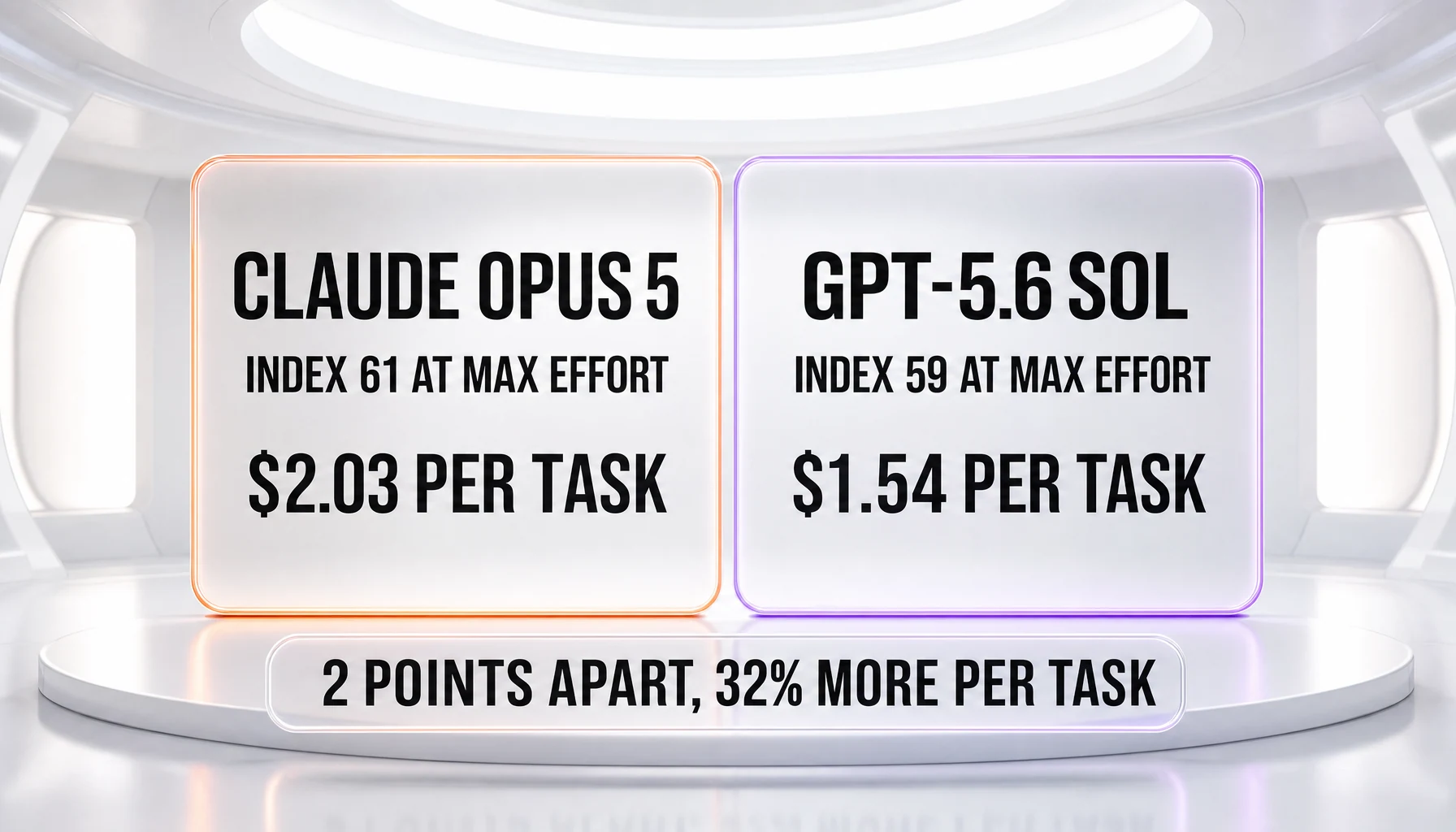
Claude Opus 5 is the stronger model, and GPT-5.6 Sol is the better buy for a large share of teams. Those statements are not in tension; they are the two halves of an honest answer. Opus 5 leads version 4.1 of the independent Artificial Analysis Intelligence Index by two points at max effort, holds a two-to-three point lead at every matched effort level, wins ARC-AGI-1, carries a five-month fresher cutoff, reaches first token in roughly half the time, and takes every agentic evaluation Anthropic has published. That is a consistent capability lead, and we are not going to talk it down.
What we also will not do is let the price list stand in for the invoice. When Artificial Analysis measured both models on July 27, 2026, Opus 5 charged 17 percent less per output token and cost about 32 percent more per completed task, because it emits far more tokens to get there — roughly 100 million across the index run against a 63 million peer median. Two independent harnesses agreed on the direction: Artificial Analysis put it at $2.03 against $1.54 per task, and the ARC Prize Foundation at $2.06 against $1.44. OpenAI's August 21 cut removed the paradox without touching the conclusion: Sol is now 20 percent cheaper per token as well, so the gap widens rather than closes, and it widens to roughly two and a half times when both models run at their vendor defaults.
Sol's claim is not only economic. It wins ARC-AGI-2 at matched max effort, 92.5 against 90.4, on the one benchmark neither vendor built, ran or scored. That is the least conflicted evidence on this page and it does not favor Opus 5. Anyone presenting this matchup as a clean Anthropic win is leaving out the most independent measurement available.
We give the overall verdict to Opus 5, narrowly, on the strength of a capability lead that holds across every matched configuration plus the long-context pricing advantage — but the qualification is not decoration. Buy Opus 5 if you are buying the top of the capability curve or if your prompts are long. Buy Sol if you are buying completed tasks at a budget. The one thing not to do is price this matchup from a rate card you last read in July. Opus 5 at $25 against Sol's $30 was the picture until August 21, 2026; it is $25 against $20 up to 272,000 input tokens now, and $25 against $30 only above that threshold.
Frequently Asked Questions
Which is better overall, Claude Opus 5 or GPT-5.6 Sol?
Claude Opus 5 is the stronger model on measured capability. It scores 61 against Sol's 59 on version 4.1 of the independent Artificial Analysis Intelligence Index with both at max effort, and it leads by two to three points at every matched effort level. It also carries a fresher knowledge cutoff and reaches first token in roughly half the time. GPT-5.6 Sol is the better buy on cost, on both measures: it finished the same benchmark suite for about a quarter less when Artificial Analysis measured it on July 27, 2026, and since August 21, 2026 it also charges 20 percent less per token on prompts up to 272,000 input tokens. The right answer depends on whether you are buying capability or throughput.
Is Claude Opus 5 cheaper than GPT-5.6 Sol?
No longer, on either measure. Up to 272,000 input tokens GPT-5.6 Sol charges $4 per million input tokens, $0.40 per million cached input and $20 per million output, against Opus 5's $5, $0.50 and $25 — 20 percent less on all three, under promotional rates OpenAI introduced on August 21, 2026. Sol is cheaper per finished task too: Artificial Analysis measured a weighted average of $2.03 per task for Opus 5 against $1.54 for Sol on version 4.1 of its Intelligence Index at max effort on July 27, 2026, because Opus 5 generates substantially more tokens doing the same work. Opus 5 is the cheaper model only above 272,000 input tokens, where Sol's long-context rate of $8 and $30 applies to the whole request.
Why does Claude Opus 5 cost more per task than GPT-5.6 Sol?
Because it is verbose. Artificial Analysis reports that Opus 5 generated approximately 100 million tokens across its index run, against a median of 63 million for comparable models. When Opus 5 still had the cheaper output token, a 17 percent per-token discount did not offset generating considerably more of them; since OpenAI cut Sol's rates on August 21, 2026, Opus 5 no longer has that discount to work with at short context. The ARC Prize Foundation's independent figures show the same pattern from a different harness: $2.06 per ARC-AGI-2 task on Opus 5 against $1.44 on Sol at max effort, both measured before the cut.
Do Claude Opus 5 and GPT-5.6 Sol tie at 97.5 percent on ARC-AGI-1?
No, not at matched effort. Claude Opus 5 scores 97.5 percent on ARC-AGI-1 at max effort, while GPT-5.6 Sol scores 96.5 percent at max. Sol reaches 97.5 percent at xhigh effort, one rung below max. Comparing Opus 5 at max against Sol at xhigh sets two different configurations against each other and produces a tie the data does not contain. At max against max, Opus 5 leads ARC-AGI-1 by one point.
Which model wins ARC-AGI-2?
GPT-5.6 Sol, at 92.5 percent against Claude Opus 5's 90.4 percent, with both measured at max effort and both verified by the ARC Prize Foundation. Sol also completed those tasks for less, at $1.44 per task against $2.06. ARC-AGI-2 is the harder and more current of the two sets, and because neither vendor built, ran or scored it, this is the least conflicted head-to-head evidence available on these two models.
What are the default effort settings, and why do they matter?
Claude Opus 5 defaults to high effort on the Claude API and Claude Code, and supports five levels from low to max. GPT-5.6 Sol defaults to medium and supports six levels, from none to max. The defaults matter because they set what you pay before any tuning: $1.06 per index task on Opus 5 at high against $0.41 on Sol at medium, a gap of roughly two and a half times that is driven as much by the default as by the model itself.
Do both models have a one-million-token context window?
Roughly. Claude Opus 5 offers one million tokens and GPT-5.6 Sol offers 1.05 million. The important difference is pricing rather than size. Anthropic's documentation states the full window bills at standard rates, so a 900,000-token request costs the same per token as a 9,000-token one. OpenAI's documentation prices Sol requests above 272,000 input tokens at $8 per million input and $30 per million output — twice the input rate and 1.5 times the output rate — applied to the entire request. On genuinely long prompts that reverses the cost comparison in Opus 5's favor, since its $5 and $25 apply at any length.
Which model is faster?
Each wins one half of the question. GPT-5.6 Sol generates output faster once it starts, at 75.9 tokens per second against Opus 5's 52.8 at max effort. Claude Opus 5 starts far sooner, reaching first token in 69.71 seconds against Sol's 129.47, and finishes the index faster overall at 79.17 seconds against 136.06. For anything with a person waiting, time to first token usually matters more, which favors Opus 5. Both are far more responsive at their default settings.
What do Anthropic's own benchmarks say, and can they be trusted?
Anthropic's system card puts Opus 5 ahead on all four evaluations it published: FrontierBench v0.1 at 44.4 percent against 37.5, FrontierCode at 53.4 against 47.5, AutomationBench at 26.0 percent against 18.1, and OSWorld 2.0 at 70.57 percent against 62.6. They should be read as one vendor's account of a competitor. The FrontierCode set is the strongest item because Cognition built and scored it rather than Anthropic. The OSWorld figure for Sol is taken from OpenAI's own launch post rather than re-run on Anthropic's harness, so it is not a like-for-like margin.
Is GPT-5.6 Sol really 10 times more vulnerable to prompt injection?
That figure cannot support such a claim. Anthropic reports attacker success across 15 attempts at 2.0 percent for Opus 5 against 20.0 percent for Sol, evaluated with Gray Swan. Anthropic states directly that its own models are evaluated without additional safeguards while competitor models are tested through their public endpoints, which means the two numbers were produced under different conditions. The comparison is not like-for-like and should not be quoted as a ratio.
Does Claude Opus 5 hallucinate more than GPT-5.6 Sol?
No published measurement answers that. Anthropic reports that Opus 5 improved accuracy by 11 percent over Opus 4.8 while its hallucination rate rose by 6 percent, both as relative changes. That comparison is against Opus 4.8 and only against Opus 4.8, and it says nothing about Sol. Anyone extrapolating from it to a claim about Sol is inventing a result. What it does support is adding a verification layer to any Opus 5 output that feeds an automated decision.
Which model has the more recent knowledge cutoff?
Claude Opus 5, by about five months. Anthropic lists May 2026 for both reliable knowledge and training data, while OpenAI lists February 16, 2026 for GPT-5.6 Sol. For most tasks the difference is irrelevant. For work touching recent events, recent library versions or recent regulation, it is decisive, and it is one of the clearer structural advantages Opus 5 holds.
Sources and references
Every figure on this page is attributed to whoever produced it. Independent measurement, vendor-reported results and third-party-verified scores are listed separately and never merged.
- Anthropic — Introducing Claude Opus 5 (launch announcement, July 24, 2026)
- Anthropic — Claude Opus 5 System Card (194 pages; source for every vendor benchmark figure quoted here)
- Anthropic — Models overview (model IDs, context windows, knowledge cutoffs, availability)
- Anthropic — Pricing (per-token rates, cache pricing, Batch API)
- Anthropic — Effort parameter (the five effort levels and per-model defaults)
- Anthropic — Rate limits (the separate Opus 5 bucket and per-tier allowances)
- Artificial Analysis — Model leaderboard (Intelligence Index v4.1 scores and cost per task, consulted July 27, 2026)
- Artificial Analysis — Claude Opus 5 (index score, speed, latency and verbosity)
- OpenAI — API pricing (GPT-5.6 Sol per-token, cached, batch and priority rates)
- ARC Prize Foundation — Claude Opus 5 results (ARC-AGI-1 and ARC-AGI-2 verified scores by effort level)
- ARC Prize Foundation — GPT-5.6 results (ARC-AGI-1 and ARC-AGI-2 verified scores by effort level)
Our Verdict
Claude Opus 5 is the stronger model and GPT-5.6 Sol is the better buy for a large share of teams, and both halves of that sentence are needed. Opus 5 leads version 4.1 of the independent Artificial Analysis Intelligence Index by two points at max effort, 61 against 59, and holds a two-to-three point lead at every matched effort rung. It also carries a May 2026 knowledge cutoff against February 16, 2026, reaches first token in roughly half the time, prices its full million-token window at USD 5 and USD 25 with no long-context surcharge where Sol doubles input billing above 272,000 tokens, and leads every agentic evaluation Anthropic published. But it no longer produces the cheaper invoice on either measure. Since OpenAI's promotional cut of August 21, 2026, Sol charges USD 4 input and USD 20 output per million tokens on requests up to 272,000 input tokens against Opus 5's USD 5 and USD 25 — 20 percent less on both sides, and on cached input too — and Opus 5 costs about 32 percent more per completed task, USD 2.03 against USD 1.54 on the Artificial Analysis index and USD 2.06 against USD 1.44 on ARC-AGI-2 as measured on July 27, 2026, because it generated roughly 100 million tokens on the index run against a 63 million peer median. Sol also wins ARC-AGI-2 outright at matched max effort, 92.5 percent against 90.4, on the one benchmark neither vendor built, ran or scored. We give the verdict to Opus 5 on the consistency of its capability lead and on its long-context pricing — the one place it is still the cheaper model, above 272,000 input tokens where Sol bills USD 8 and USD 30 — with the explicit caveat that buyers on shorter prompts should choose Sol, which now wins the rate card and the invoice alike.
Choose Claude Opus 5
Anthropic's frontier reasoning model — top of the independent index at half the price of Fable 5.
Try Claude Opus 5 →Choose GPT-5.6 Sol
OpenAI's flagship GPT-5.6 capability tier, with Programmatic Tool Calling and a 1.05M-token context.
Try GPT-5.6 Sol →Frequently Asked Questions
Is Claude Opus 5 better than GPT-5.6 Sol?
Claude Opus 5 is the stronger model and GPT-5.6 Sol is the better buy for a large share of teams, and both halves of that sentence are needed. Opus 5 leads version 4.1 of the independent Artificial Analysis Intelligence Index by two points at max effort, 61 against 59, and holds a two-to-three point lead at every matched effort rung. It also carries a May 2026 knowledge cutoff against February 16, 2026, reaches first token in roughly half the time, prices its full million-token window at USD 5 and USD 25 with no long-context surcharge where Sol doubles input billing above 272,000 tokens, and leads every agentic evaluation Anthropic published. But it no longer produces the cheaper invoice on either measure. Since OpenAI's promotional cut of August 21, 2026, Sol charges USD 4 input and USD 20 output per million tokens on requests up to 272,000 input tokens against Opus 5's USD 5 and USD 25 — 20 percent less on both sides, and on cached input too — and Opus 5 costs about 32 percent more per completed task, USD 2.03 against USD 1.54 on the Artificial Analysis index and USD 2.06 against USD 1.44 on ARC-AGI-2 as measured on July 27, 2026, because it generated roughly 100 million tokens on the index run against a 63 million peer median. Sol also wins ARC-AGI-2 outright at matched max effort, 92.5 percent against 90.4, on the one benchmark neither vendor built, ran or scored. We give the verdict to Opus 5 on the consistency of its capability lead and on its long-context pricing — the one place it is still the cheaper model, above 272,000 input tokens where Sol bills USD 8 and USD 30 — with the explicit caveat that buyers on shorter prompts should choose Sol, which now wins the rate card and the invoice alike.
Which is cheaper, Claude Opus 5 or GPT-5.6 Sol?
Claude Opus 5 starts at $5 in / $25 out per M tokens. GPT-5.6 Sol starts at $4 in / $20 out per M tokens. Check the pricing comparison section above for a full breakdown.
What are the main differences between Claude Opus 5 and GPT-5.6 Sol?
The key differences span across 14 features we compared. For Input price per million tokens, short context, Claude Opus 5 offers USD 5.00 while GPT-5.6 Sol offers USD 4.00, promotional. For Output price per million tokens, short context, Claude Opus 5 offers USD 25.00 while GPT-5.6 Sol offers USD 20.00, promotional. For Artificial Analysis Intelligence Index v4.1, max effort, Claude Opus 5 offers 61 while GPT-5.6 Sol offers 59. See the full feature comparison table above for all details.