Claude Sonnet 5
Anthropic's most agentic midsize model — near-Opus 4.8 coding and computer use at $2 per million input tokens.

Quick Summary
Claude Sonnet 5 is Anthropic's most agentic midsize model, released June 30, 2026. It scores 63.2% on SWE-bench Pro and 81.2% on OSWorld-Verified, close to Opus 4.8 at a fraction of the price, and it is the default model on the free and Pro plans of Claude.ai. API pricing: $2 per million input tokens, $10 per million output tokens. Score 9.3 out of 10.
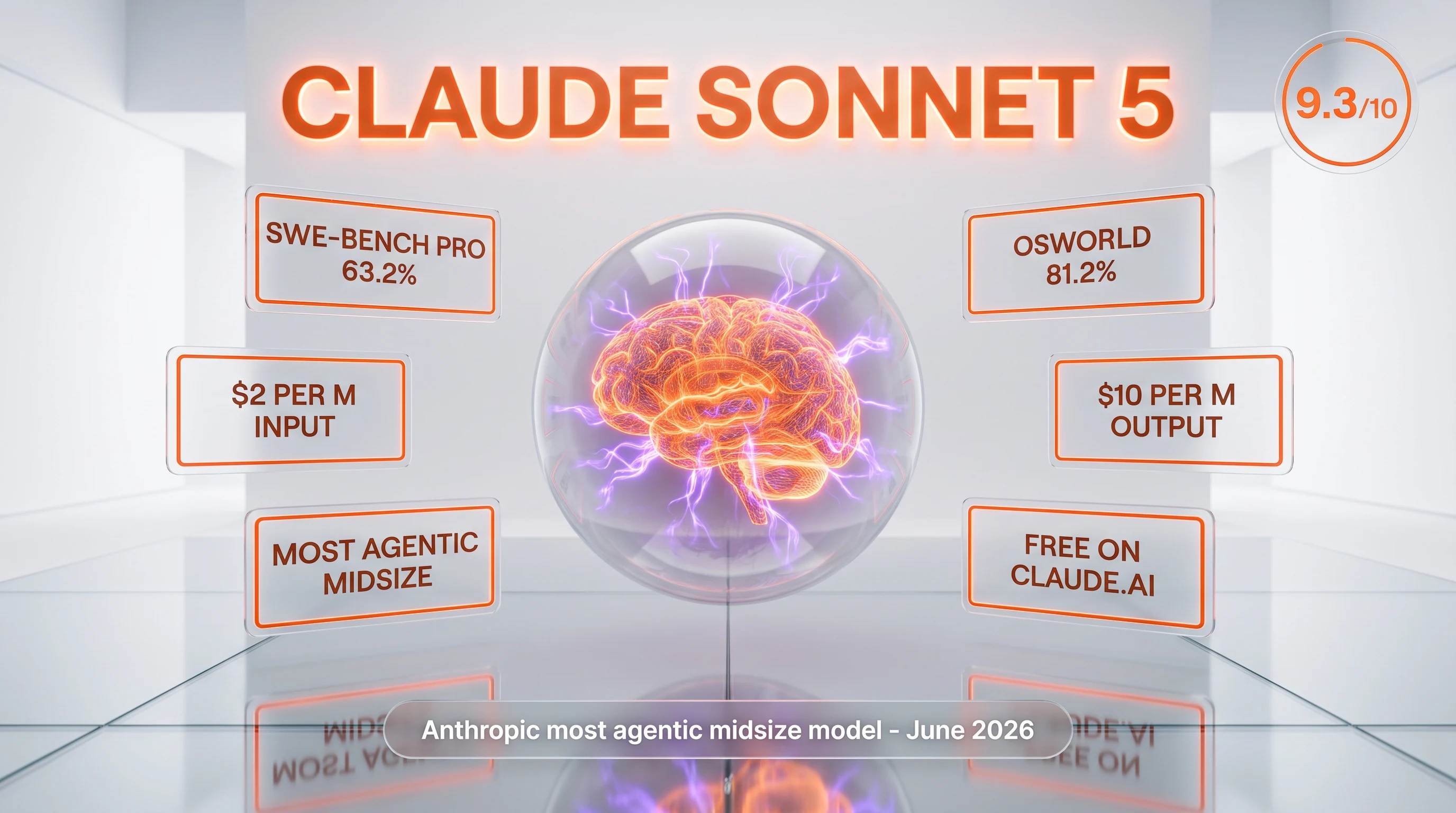
Claude Sonnet 5 is Anthropic's most agentic midsize model, released June 30, 2026. Anthropic's system card puts it at 63.2% on SWE-bench Pro and 81.2% on OSWorld-Verified, close to Opus 4.8 on agentic work at a fraction of the price. API pricing runs $2 per million input tokens and $10 per million output tokens. It is the default model on the free and Pro plans of Claude.ai. Our score: 9.3 out of 10.
Our Verdict — 9.3 out of 10
Score: 9.3 out of 10. Claude Sonnet 5 is the most compelling value in Anthropic's lineup right now: near-flagship agentic behavior at midsize prices, and it is what free and Pro users get by default on Claude.ai. Anthropic positions it as its most agentic midsize model, and the published numbers back that up — 63.2% on SWE-bench Pro is roughly 91% of Claude Opus 4.8's 69.2%, and a 5.1-point jump over Claude Sonnet 4.6's 58.1%. In our first day of hands-on testing since the June 30 launch, it matched the quality we normally reserve Opus for on several refactor and tool-use tasks. What keeps it under a 9.5 is that Opus 4.8 still leads on the hardest and most safety-sensitive autonomous work.
- ✅ 63.2% on SWE-bench Pro — about 91% of Opus 4.8, and 5.1 points above Sonnet 4.6
- ✅ 81.2% on OSWorld-Verified computer use, up from Sonnet 4.6's 78.5%
- ✅ Default model on the free and Pro plans of Claude.ai — try the exact model before you pay
- ✅ API pricing of $2 per million input tokens and $10 per million output tokens
- ❌ Opus 4.8 remains the safer pick for the most sensitive long-horizon agent deployments
What Is Claude Sonnet 5?
Claude Sonnet 5 is the mid-tier model in Anthropic's Claude lineup, released June 30, 2026. Anthropic describes it as its most agentic midsize model — built to make plans, use tools like browsers and terminals, and run autonomously across multi-step tasks. It sits below Claude Opus 4.8, the flagship, and replaces Claude Sonnet 4.6 as the default workhorse most people and products will touch day to day.
The Claude API model identifier is claude-sonnet-5. Availability is broad from launch: it is the default model on the free and Pro plans of Claude.ai, and it is available to Max, Team, and Enterprise users, inside Claude Code, and through the Claude API. That distribution matters — the same model that runs your production agents is the one a free user chats with in the browser, so there is no capability cliff between the consumer product and the developer platform.
The headline of this release is agentic performance, not raw chat quality. Anthropic's own framing is that Sonnet 5's performance is close to Opus 4.8 but at lower prices, and that it is a substantial improvement over Sonnet 4.6 on important aspects of agentic behavior: planning, tool use, and running longer without going off the rails. In practice that means Sonnet 5 is aimed squarely at the thing the market actually wants in 2026 — models that can act, not just answer.
Two numbers anchor the claim. On SWE-bench Pro, a coding-agent benchmark, Anthropic's system card reports 63.2% for Sonnet 5 versus 69.2% for Opus 4.8 and 58.1% for Sonnet 4.6. On OSWorld-Verified, which measures computer use, Sonnet 5 scores 81.2%, up from Sonnet 4.6's 78.5%. Neither number tops the flagship, but both land close enough that for most agent workloads the cheaper model is the rational default.
Key Features
Long-horizon agentic behavior
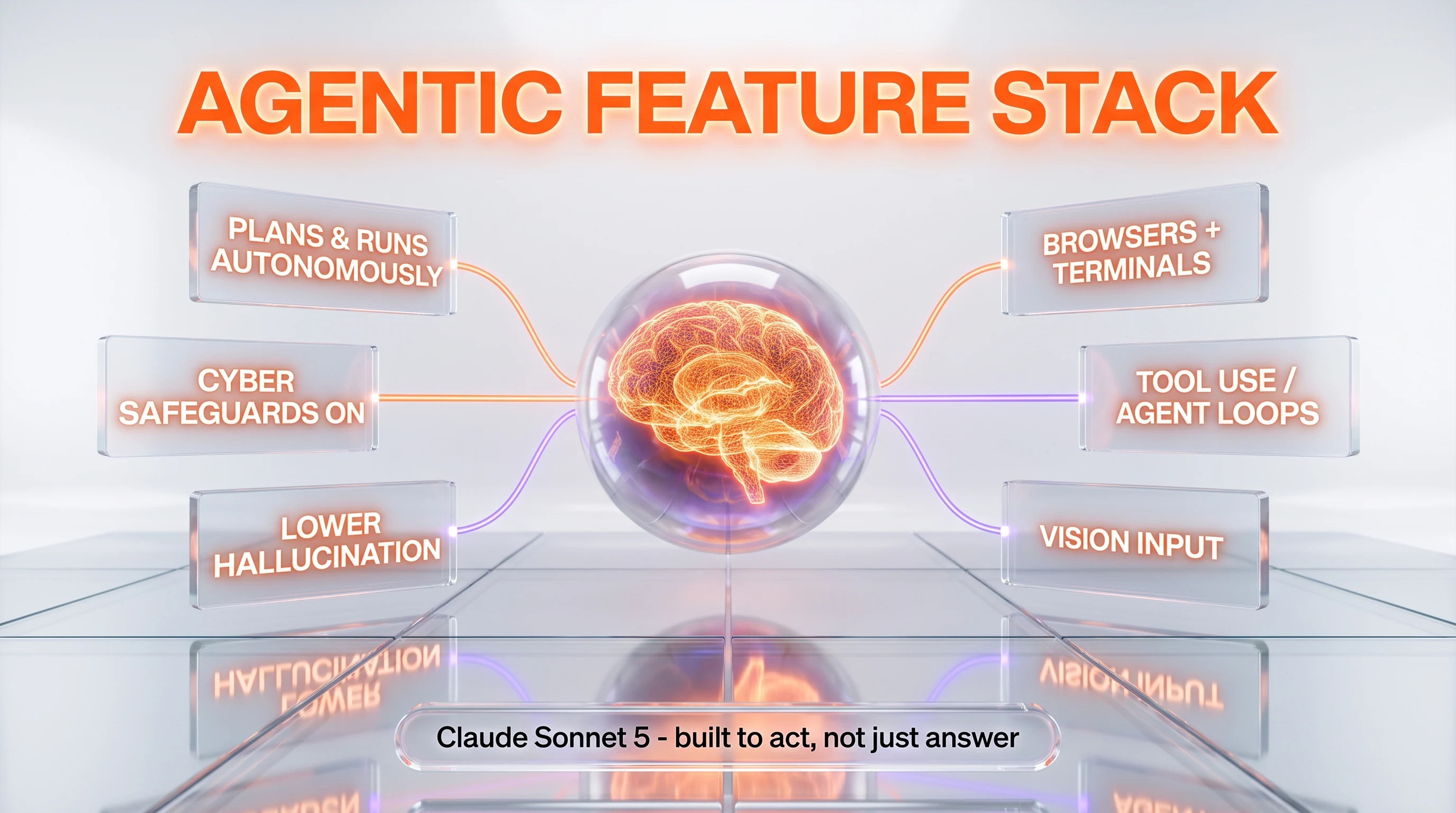
The defining upgrade in Sonnet 5 is autonomy. Anthropic frames it as its most agentic midsize model: it can make plans, call tools, drive browsers and terminals, and keep working across multi-step tasks without constant hand-holding. In our first hands-on sessions we pointed it at longer tool chains than we would trust a midsize model with, and it stayed on task further before needing a nudge. This is qualitative, first-day observation rather than a benchmarked claim — but the direction matches Anthropic's published gains on agentic evaluations.
Coding performance
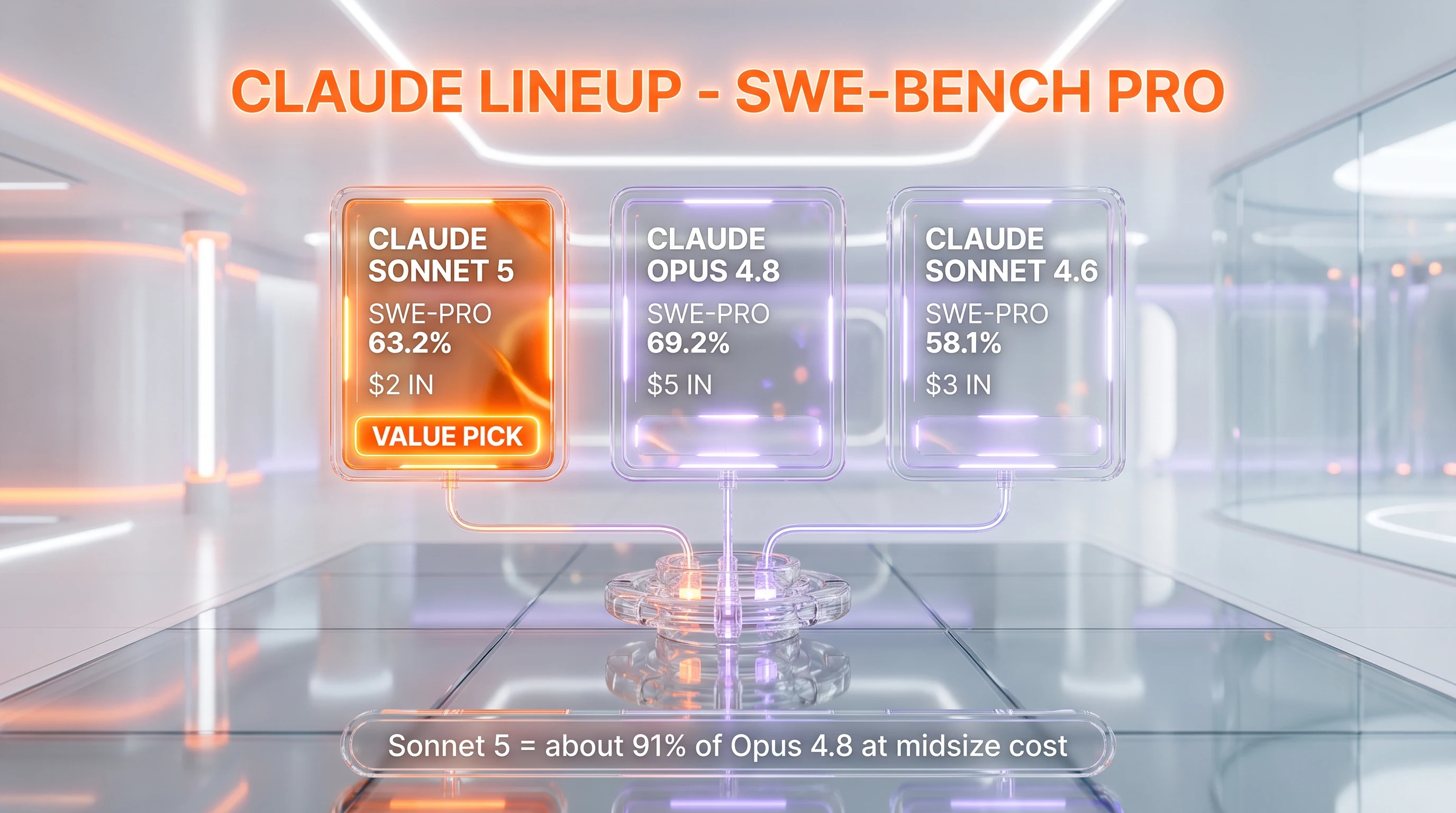
On SWE-bench Pro, Anthropic reports 63.2% for Sonnet 5. That is roughly 91% of Opus 4.8's 69.2% and a clear step up from Sonnet 4.6's 58.1%. For a model at midsize pricing, closing most of the gap to the flagship on a coding-agent benchmark is the whole pitch. It is also why Sonnet 5 is the sensible default inside coding tools like Claude Code: you get near-flagship code quality on the majority of tasks and save the flagship for the hardest slice.
Computer use and browser automation
Sonnet 5 scores 81.2% on OSWorld-Verified, the computer-use benchmark, up from Sonnet 4.6's 78.5%. Computer use is the capability that turns a chatbot into an agent that can operate real software — clicking through a SaaS dashboard, filling forms, extracting data from interfaces that have no API. In early testing, browser and terminal control felt steadier than 4.6 on multi-step UI tasks, which tracks with the benchmark gain.
Tool use and function calling
Tool use is where an agentic model earns its keep, and Anthropic singled out improved tool use as a core gain in Sonnet 5. The model selects tools, chains them, and recovers from tool errors as part of longer autonomous loops. If you are building anything that dispatches function calls in sequence — a research agent, a data pipeline, a support workflow — this is the axis that matters most, and it is the one Sonnet 5 was tuned to improve.
Vision input
Like the rest of the current Claude line, Sonnet 5 accepts image input alongside text: screenshots, diagrams, charts, and PDF pages. Output is text only. For agent workflows that read a screen and then act on it — the loop behind computer use — vision is not a nice-to-have, it is load-bearing. Parsing a dashboard screenshot into structured data and deciding the next click is exactly the kind of task Sonnet 5 is built for.
Safety improvements
Anthropic's system card reports that Sonnet 5 shows an overall lower rate of undesirable behaviors than Sonnet 4.6, with lower hallucination and sycophancy, better refusal of malicious requests, and stronger resistance to prompt-injection attacks. It launches with cyber safeguards enabled by default. These are meaningful, measured improvements over the predecessor — and they matter more, not less, as the model is handed more autonomy. We cover the nuances, including where Opus 4.8 still leads, in the pros and cons below.
Availability and access
Sonnet 5 is unusually easy to reach for a frontier-adjacent model. It is the default on the free and Pro tiers of Claude.ai, available to Max, Team, and Enterprise, built into Claude Code, and exposed through the Claude API as claude-sonnet-5. If you already write against the Claude API, adopting Sonnet 5 is a one-line model-string change.
Claude Sonnet 5 Pricing in 2026
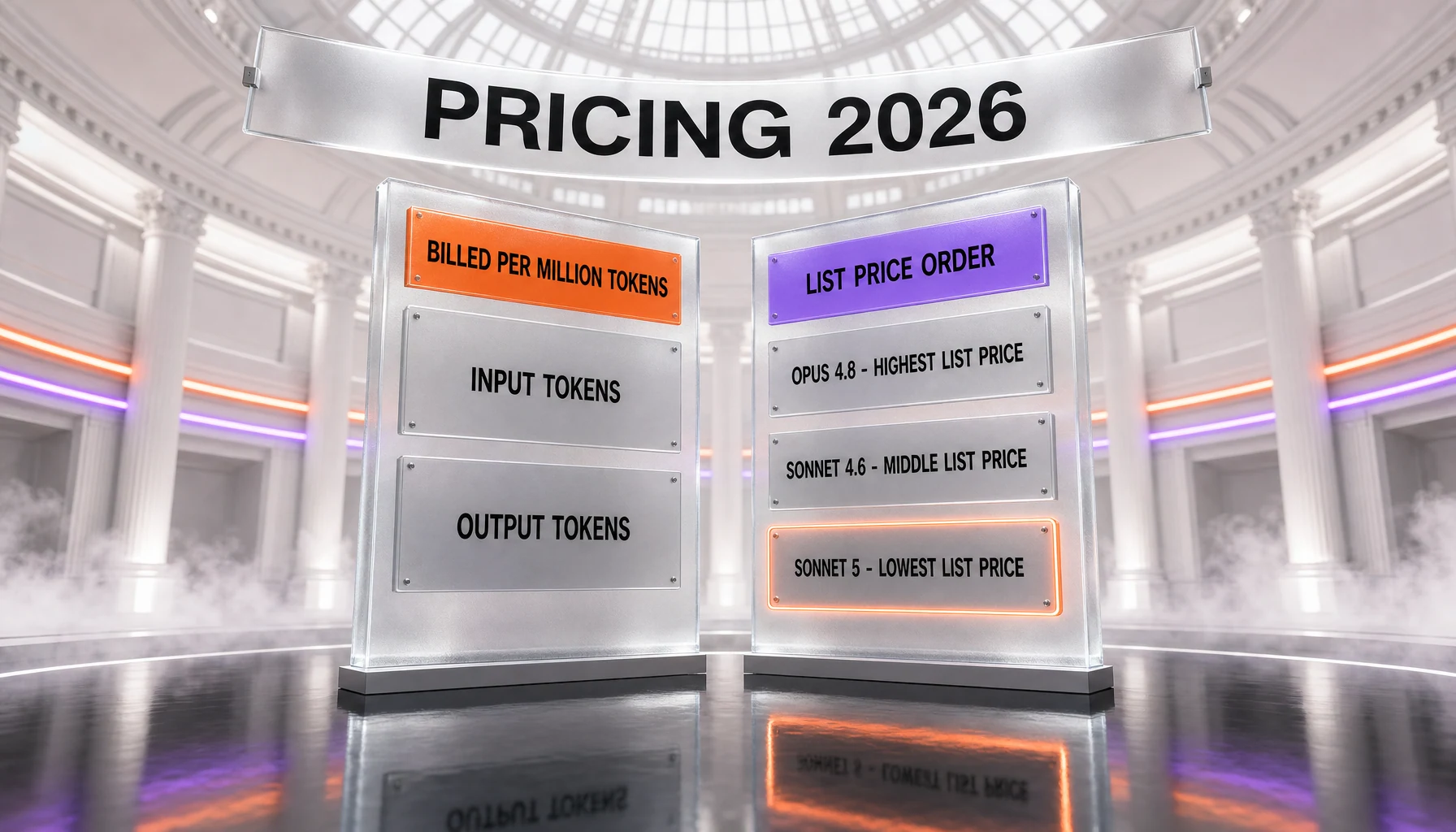
Sonnet 5 uses Anthropic's standard per-token API pricing. The API rate is $2 per million input tokens and $10 per million output tokens. Anthropic launched the model with that rate as introductory pricing through August 31, 2026, and had scheduled an increase to $3 and $15 on September 1, 2026. On August 10, 2026 it cancelled that increase and made $2 and $10 the standard price. Separately, Sonnet 5 is available at no cost as the default model on the free plan of Claude.ai, so you can evaluate the exact model in the browser before committing to API spend.
| Pricing dimension | Rate | Notes |
|---|---|---|
| Input | $2 per million tokens | Standard price since August 10, 2026 |
| Output | $10 per million tokens | Standard price since August 10, 2026 |
| Claude.ai free plan | No cost | Sonnet 5 is the default model |
| Claude.ai Pro | Subscription | Sonnet 5 is the default model |
How it compares across the Claude lineup — Sonnet 5 now undercuts Sonnet 4.6 on price while beating it on capability, and it undercuts the Opus 4.8 flagship substantially:
| Model | Input (per million tokens) | Output (per million tokens) | SWE-bench Pro |
|---|---|---|---|
| Claude Opus 4.8 | $5 | $25 | 69.2% |
| Claude Sonnet 5 | $2 | $10 | 63.2% |
| Claude Sonnet 4.6 | $3 | $15 | 58.1% |
Best for: coding agents, long-horizon autonomous workflows, computer-use automation, worker-tier models in a multi-agent stack, and any team that wants near-flagship agentic quality without flagship pricing. At $2 and $10 per million tokens it is also the cheapest way to prototype agentic products on a top-tier model.
Hands-on Testing — What We Found
A note on method, because honesty matters more than hype on a day-old model: Sonnet 5 launched on June 30, 2026, and this review reflects our first day of hands-on testing plus Anthropic's published system card, not months of production data. Every headline benchmark figure here (SWE-bench Pro, OSWorld-Verified) is Anthropic's own reported number, clearly attributed as such — we have not independently reproduced them. What follows is what we actually observed pointing the model at our own tasks in the launch window, with the hedging that a one-day sample deserves. We will update this review as we log real production hours.
Setup and onboarding
Adopting Sonnet 5 on the API is a one-line change. We pointed existing Anthropic SDK calls at model: "claude-sonnet-5" and everything kept working — same Messages API, same tool-use format, same SDKs. There was no prompt re-engineering: the system prompts we wrote for the previous Sonnet generation were honored without edits. For anyone already on the Claude API, migration cost is effectively zero.
First impressions on our tasks
We ran Sonnet 5 through the same coding, refactor, and tool-use tasks we put every model through. On several multi-file refactor prompts it produced output at a quality we normally associate with Opus — tight, correct on the first pass, without the over-engineering we sometimes see from cheaper models. On tool-use loops it stayed coherent across longer chains than we would trust a midsize model with, recovering from a failed tool call instead of derailing. These are first-day, qualitative impressions on a limited sample, not measured win rates, and we are flagging them as such.
Computer use in practice
Computer use is where the 81.2% OSWorld-Verified number becomes tangible. On a couple of browser-driven tasks — navigating a multi-step form, extracting a table from a gated UI — Sonnet 5 felt steadier than Sonnet 4.6 at picking the right next action. It still occasionally mis-clicks, which is why production computer-use agents wrap actions in verification and retry logic; but the base reliability is trending in the right direction, consistent with the benchmark gain.
What we have not tested yet
We have not run Sonnet 5 through a full production week, a large batch pipeline, or long-running unattended agent deployments. We have not stress-tested the 529-overload behavior under sustained load, and we have not measured cost at scale on real workloads. Those are the numbers that separate a launch-day impression from a verdict earned over time, and we will add them here as we gather them. Treat the score below as a well-informed early read, not a final production audit.
Pros and Cons
What stands out
- Near-flagship agentic quality at midsize cost. 63.2% on SWE-bench Pro is about 91% of Opus 4.8's 69.2%, at $2 per million input tokens. For most agent workloads, that ratio makes Sonnet 5 the rational default.
- A real jump over Sonnet 4.6. 5.1 points on SWE-bench Pro and a 2.7-point gain on OSWorld-Verified (81.2% versus 78.5%) are not rounding errors — this is a meaningful generational step on the axes that matter for agents.
- Free by default. Sonnet 5 is the default model on the free and Pro plans of Claude.ai. You can evaluate the exact model in the browser before you spend a cent on the API — rare for a frontier-adjacent release.
- Safer than its predecessor. The system card reports lower rates of undesirable behavior, lower hallucination and sycophancy, better malicious-request refusal, and stronger prompt-injection resistance, with cyber safeguards on by default.
- Zero-friction migration. Same Messages API, same SDKs, model id
claude-sonnet-5. Adopting it is a one-line change with no prompt rework.
Where it falls short
- Opus 4.8 still leads where it counts most. The system card notes Sonnet 5 shows somewhat higher rates of misaligned behavior than Opus 4.8 and Mythos, so Opus remains the safer choice for the most sensitive long-horizon autonomous deployments.
- Broader capability shows up on security evals too. On the Firefox 147 exercise Anthropic ran with Mozilla, neither Sonnet 4.6 nor Sonnet 5 produced a working exploit (both 0.0%), but Sonnet 5's partial-success rate rose to 13.2% from 8.8% — a byproduct of general capability gains, not offensive training, per Anthropic.
- It is brand new. Released June 30, 2026, so the long-run track record is thin — though independent measurement already exists: Artificial Analysis scores Sonnet 5 at 53.4 on its Intelligence Index and measures 80.5 percent on Terminal-Bench 2.1 and 91.1 percent on GPQA Diamond, as of August 3, 2026. Our own assessment is one day of hands-on plus Anthropic's published evaluations, not months of production data.
- No verifiable external community rating yet. Third-party reviews on platforms like G2, Trustpilot, or Capterra do not exist this early for the model, so no review-platform star rating corroborates the score; the community signal that does exist is LMArena, which holds Sonnet 5's high-effort variant at an Elo of 1440 across 15,622 votes as of August 3, 2026.
Real-World Use Cases
Coding agents and IDE assistants
With 63.2% on SWE-bench Pro at midsize pricing, Sonnet 5 is the natural default inside coding tools. It is built into Claude Code, and IDE assistants that route to Claude models will lean on it for the cost-performance balance. You reserve Opus 4.8 for the hardest slice of tasks and let Sonnet 5 handle the majority — which is where the volume, and the cost, actually lives.
Long-horizon autonomous agents
The reason Anthropic calls this its most agentic midsize model is that it is meant to plan and act over extended tasks. Research agents, browser automations, and multi-tool workflows that need to keep going without supervision are the target. Sonnet 5's gains in planning and tool use are aimed exactly here.
Computer-use automation
At 81.2% on OSWorld-Verified, Sonnet 5 is a strong fit for operating real software: filling forms, navigating dashboards, and extracting data from interfaces that lack an API. Wrap it in verification and retry logic and it can automate workflows that previously needed a human in the loop.
Worker tier in a multi-agent stack
A common 2026 pattern is a flagship coordinator dispatching sub-tasks to cheaper worker models. Sonnet 5 is an excellent worker under an Opus 4.8 coordinator: you get flagship-tier planning on the hard parts and near-flagship execution on the volume parts, at a fraction of all-flagship cost.
Everyday assistant work for free and Pro users
Because Sonnet 5 is the default on Claude.ai's free and Pro plans, it is also the model behind ordinary chat, writing, and analysis for millions of users. The distribution is the point: the same model powering production agents is the one answering a free user's question in the browser.
Prototyping agentic products cheaply
At $2 and $10 per million tokens, Sonnet 5 is the cheapest way to prototype on a top-tier agentic model. Anthropic made that rate permanent on August 10, 2026, so an agent idea validated on Sonnet 5 costs the same to run in production.
Claude Sonnet 5 vs Opus 4.8 vs Sonnet 4.6 vs GPT-5.5
The most useful comparisons for Sonnet 5 are inside Anthropic's own lineup, plus the obvious cross-lab alternative. Here is how we frame the choice.
| Model | Input (per million tokens) | Output (per million tokens) | SWE-bench Pro | Best for |
|---|---|---|---|---|
| Claude Sonnet 5 | $2 | $10 | 63.2% | Default agentic workhorse |
| Claude Opus 4.8 | $5 | $25 | 69.2% | Hardest, most sensitive work |
| Claude Sonnet 4.6 | $3 | $15 | 58.1% | Prior-gen midsize |
| GPT-5.5 | $5 | $30 | Different ecosystem | OpenAI-native stacks |
Pick Claude Sonnet 5 if you want the best balance of agentic capability and cost in 2026. It is the default for a reason: near-flagship coding and computer use, a clear step up from Sonnet 4.6, and a price that undercuts the flagship by a wide margin.
Pick Claude Opus 4.8 if you need the top of the range: the highest SWE-bench Pro score in the family and the strongest safety profile for the most sensitive autonomous deployments. The system card is explicit that Opus 4.8 shows lower rates of misaligned behavior than Sonnet 5, so it remains the pick when the stakes are highest. Sonnet 5 versus Opus 4.8 is the full accounting of that trade.
Stay on Claude Sonnet 4.6 only if you have a validated, pinned deployment you are not ready to migrate. On price and capability there is little reason to prefer it — Sonnet 5 now costs less than Sonnet 4.6, at $2 and $10 against $3 and $15, while beating it on every agentic axis Anthropic measured. We walk the migration case in Sonnet 5 versus Sonnet 4.6.
Pick GPT-5.5 if your stack is OpenAI-native and the ecosystem lock-in outweighs the price and agentic-benchmark differences. Cross-lab benchmark comparisons are noisy, so we compare Sonnet 5 to its Anthropic siblings on the shared SWE-bench Pro figures and treat GPT-5.5 as an ecosystem choice rather than a like-for-like number. Our Sonnet 5 versus GPT-5.5 comparison treats it as exactly that.
Every head-to-head with Claude Sonnet 5
Sonnet 5 is the tier most teams actually deploy, so it is the one we have compared most widely. Every published matchup, grouped by what it decides.
Inside the Claude family.
- Sonnet 5 versus Claude Opus 4.8 — the escalation question: what the flagship buys over the default.
- Sonnet 5 versus Claude Fable 5 — the widest price gap in the family, against 10 and 50 dollars per million tokens.
- Sonnet 5 versus Claude Sonnet 4.6 — the migration case off the prior mid tier.
Against the OpenAI line.
- GPT-5.6 Terra versus Sonnet 5 — the closest like-for-like: two balanced tiers aimed at the same workloads.
- GPT-5.6 Sol versus Sonnet 5 — paying flagship rates on one side against the mid tier on the other.
- GPT-5.6 Luna versus Sonnet 5 — how far down the price curve you can go before quality bites.
- Sonnet 5 versus GPT-5.5 — the outgoing OpenAI flagship, for stacks still built on it.
Other frontier challengers.
- Sonnet 5 versus Gemini 3.1 Pro — the Google option, long context included.
- Grok 4.5 versus Sonnet 5 — a cheaper frontier-class model on the same agentic ground.
- Muse Spark 1.1 versus Sonnet 5 — a newer entrant judged on the same axes.
Cost-focused challengers.
- Sonnet 5 versus Kimi K2.7 Code — the value case against the default tier.
- Sonnet 5 versus Kimi K2.6 — where that line stood a generation earlier.
- Sonnet 5 versus DeepSeek V4 — cost per task on comparable work.
- Sonnet 5 versus GLM-5.2 — what the cheaper tier gives up in agentic reliability.
- Sonnet 5 versus MiniMax M3 — another low-cost challenger on the same benchmarks.
- Sonnet 5 versus Qwen 3.6 — the Qwen line against Anthropic's default.
Frequently Asked Questions
Claude Sonnet 5 FAQ
Is Claude Sonnet 5 free?
Yes, in one sense: Claude Sonnet 5 is the default model on the free plan of Claude.ai, so you can use it at no cost in the browser. The Claude API, however, is paid per token from the first call. So the consumer chat experience is free, while programmatic access through the API bills per token.
How much does Claude Sonnet 5 cost?
API pricing is $2 per million input tokens and $10 per million output tokens. Anthropic announced that rate at launch as introductory pricing through August 31, 2026, then cancelled the scheduled increase on August 10, 2026, making it the standard price. On Claude.ai, Sonnet 5 is included at no extra cost as the default model on the free and Pro plans.
What is Claude Sonnet 5?
Claude Sonnet 5 is the mid-tier model in Anthropic's Claude lineup, released June 30, 2026, and described by Anthropic as its most agentic midsize model. It can make plans, use tools like browsers and terminals, and run autonomously. The Claude API model identifier is claude-sonnet-5. It sits below Claude Opus 4.8 and replaces Claude Sonnet 4.6 as the default.
Is Claude Sonnet 5 better than Sonnet 4.6?
Yes, on the axes Anthropic measured. Sonnet 5 scores 63.2% on SWE-bench Pro versus 58.1% for Sonnet 4.6 — a 5.1-point gain — and 81.2% on OSWorld-Verified versus 78.5%. The system card also reports lower rates of undesirable behavior, hallucination, and sycophancy. It also costs less than Sonnet 4.6 — $2 and $10 per million tokens against $3 and $15 — so it is a straightforward upgrade for most workloads.
How does Claude Sonnet 5 compare to Claude Opus 4.8?
Opus 4.8 is the flagship and leads on raw capability: 69.2% on SWE-bench Pro versus Sonnet 5's 63.2%, so Sonnet 5 reaches roughly 91% of Opus on that benchmark. Opus also has a stronger safety profile — the system card notes Sonnet 5 shows somewhat higher rates of misaligned behavior than Opus 4.8. Sonnet 5 costs far less ($2 input versus $5), which makes it the better default for most work, with Opus reserved for the hardest and most sensitive tasks.
What is the SWE-bench Pro score of Claude Sonnet 5?
Anthropic's system card reports 63.2% on SWE-bench Pro for Claude Sonnet 5. For context, that is about 91% of Claude Opus 4.8's 69.2% and a 5.1-point improvement over Claude Sonnet 4.6's 58.1%. SWE-bench Pro is a coding-agent benchmark, so the figure is a proxy for how well the model performs as a software engineering agent.
Can Claude Sonnet 5 use a computer and browser?
Yes. Computer use is a core focus of this release. Sonnet 5 scores 81.2% on OSWorld-Verified, the computer-use benchmark, up from Sonnet 4.6's 78.5%. It can drive browsers and terminals, navigate dashboards, fill forms, and extract data from interfaces without an API. Production deployments wrap those actions in verification and retry logic, since the model can still occasionally mis-click.
How safe is Claude Sonnet 5?
Anthropic's system card reports that Sonnet 5 has an overall lower rate of undesirable behaviors than Sonnet 4.6, with lower hallucination and sycophancy, better refusal of malicious requests, and stronger prompt-injection resistance. It launches with cyber safeguards on by default. On a Firefox 147 exercise run with Mozilla, neither Sonnet 4.6 nor Sonnet 5 produced a working exploit (both 0.0%), though Sonnet 5's partial-success rate rose to 13.2% from 8.8% as a byproduct of general capability. Anthropic notes Sonnet 5 shows somewhat higher rates of misaligned behavior than Opus 4.8, which remains the safer pick for the most sensitive agentic work.
Does Claude Sonnet 5 have an API?
Yes. Claude Sonnet 5 is available through the Claude API with the model identifier claude-sonnet-5, using the same Messages API and SDKs as prior Claude models. It is also available in Claude Code and on Claude.ai for Free, Pro, Max, Team, and Enterprise users. Migrating existing Claude API code is a one-line model-string change.
When was Claude Sonnet 5 released?
Claude Sonnet 5 was released on June 30, 2026. From launch it was available as the default model on the free and Pro plans of Claude.ai, to Max, Team, and Enterprise users, in Claude Code, and through the Claude API. API pricing is $2 per million input tokens and $10 per million output tokens.
What are the best alternatives to Claude Sonnet 5?
Within Anthropic's lineup, the alternatives are Claude Opus 4.8 (the flagship, higher capability and a stronger safety profile at higher cost) and Claude Sonnet 4.6 (the prior-generation midsize model). The main cross-lab alternative is GPT-5.5 from OpenAI, which is the better fit if your stack is OpenAI-native. For most teams already on Claude, Sonnet 5 is the default and Opus 4.8 is the step-up option.
Should I switch to Claude Sonnet 5?
For most workloads, yes. If you are on Sonnet 4.6, Sonnet 5 is a straightforward upgrade at a lower price, $2 and $10 against $3 and $15, with better coding, computer use, and safety. If you are on Opus 4.8 for cost reasons, Sonnet 5 can likely handle the majority of your tasks at a fraction of the price, with Opus reserved for the hardest slice. Anthropic made the $2 and $10 rate permanent on August 10, 2026, so the cost advantage is not time-limited.
Verdict: 9.3 out of 10
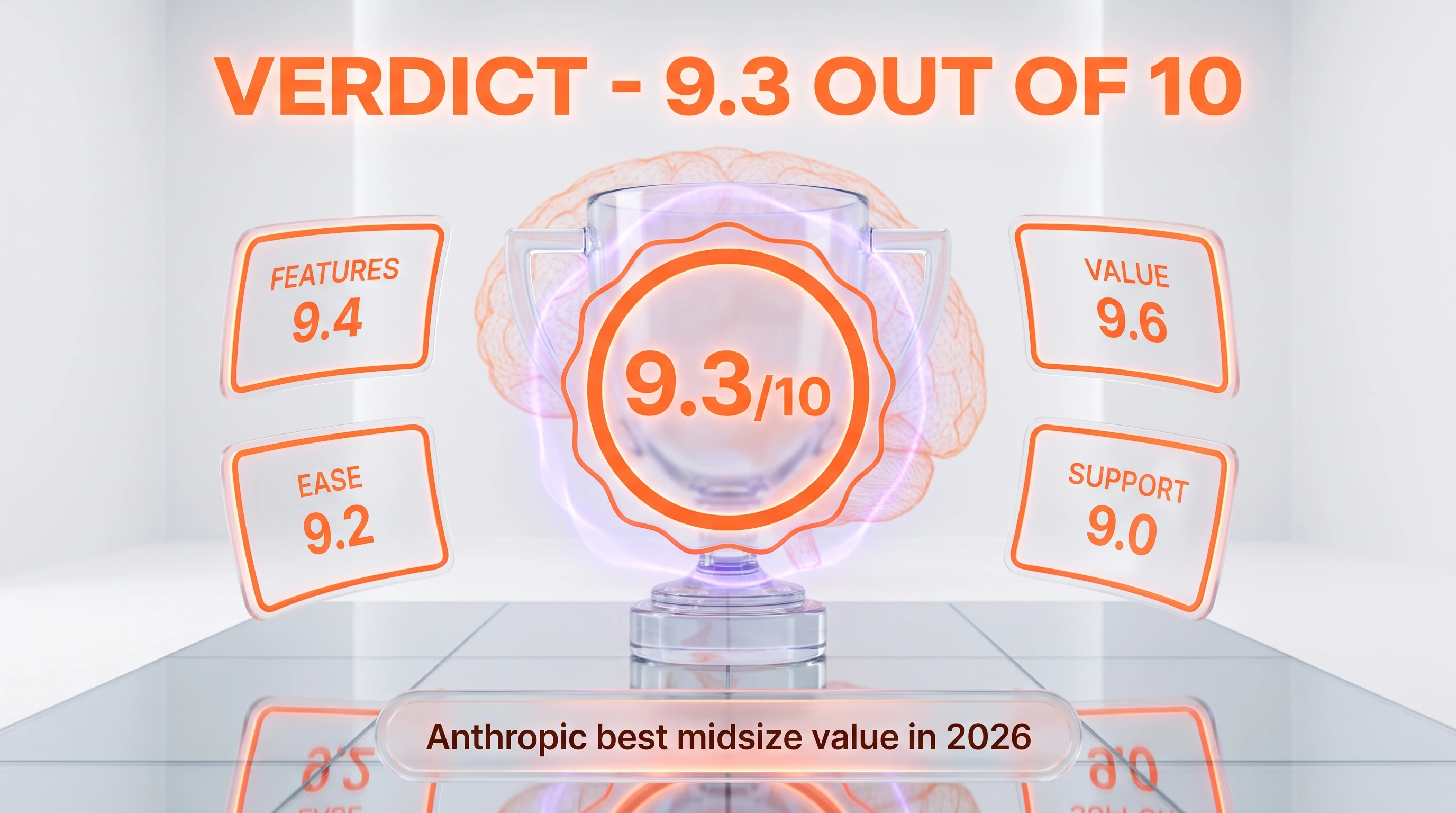
Claude Sonnet 5 earns a 9.3 out of 10 for one clear reason: it delivers near-flagship agentic capability at midsize pricing, and it is the model most people and products will use by default. Anthropic's system card puts it at 63.2% on SWE-bench Pro — about 91% of Opus 4.8 — and 81.2% on OSWorld-Verified, both clear gains over Sonnet 4.6, with a safety profile that improves on its predecessor across hallucination, sycophancy, malicious-request refusal, and prompt-injection resistance. In our first day of hands-on testing it repeatedly matched the quality we reserve Opus for. What keeps it under a 9.5 is honest: Opus 4.8 still leads on the hardest and most safety-sensitive work.
Score breakdown:
- Features: 9.4 out of 10 — most agentic midsize model in the lineup, with strong coding, computer use, tool use, and vision, plus improved safety defaults.
- Ease of Use: 9.2 out of 10 — default on Claude.ai, one-line API migration, same SDKs.
- Value: 9.6 out of 10 — near-flagship agentic quality at $2 per million input tokens, and free by default on Claude.ai. Best price-to-capability ratio in the family.
- Support: 9.0 out of 10 — excellent Anthropic documentation, mature SDKs, and a detailed public system card. Enterprise SLAs sit on the higher plans, as is normal for the category.
Final word: if you are building anything agent-shaped in 2026 — coding assistants, autonomous workflows, computer-use automation — Claude Sonnet 5 should be your default. Reach for Opus 4.8 on the hardest and most sensitive slice where its capability and safety edge earn the premium. But for the majority of production work, Sonnet 5 is the model that gets it done, and at $2 and $10 per million tokens it is the cheapest way to run top-tier agentic work.
First tested: July 2026, within 24 hours of the June 30 launch, alongside Anthropic's published system card. All headline benchmark figures (SWE-bench Pro, OSWorld-Verified) are Anthropic's own reported numbers, attributed as such; we have not independently reproduced them, and the independent measurements we cite are attributed to their measurers (Artificial Analysis, LMArena). External community ratings on platforms like G2, Trustpilot, and Capterra are not available or verifiable for a model this new, so no review-platform star rating is reflected in our score; the external signals we can cite are Artificial Analysis's independent battery and LMArena's community Elo (1440 for the high-effort variant, 15,622 votes, as of August 3, 2026). We will update this review as we log production hours. Pricing verified against Anthropic's official announcement on July 1, 2026.
Key Features
Pros & Cons
Pros
- Near-flagship agentic quality at midsize cost: Anthropic's system card puts Sonnet 5 at 63.2% on SWE-bench Pro, about 91% of Opus 4.8's 69.2%, at $2 per million input tokens. For most agent workloads that ratio makes it the rational default.
- A real generational jump over Sonnet 4.6: 5.1 points on SWE-bench Pro (63.2% versus 58.1%) and a 2.7-point gain on OSWorld-Verified computer use (81.2% versus 78.5%).
- Free by default: Sonnet 5 is the default model on the free and Pro plans of Claude.ai, so you can evaluate the exact model in the browser before spending anything on the API.
- Most agentic midsize model in the lineup: Anthropic tuned it to make plans, use browsers and terminals, and run autonomously across longer tool chains, with improved tool use and error recovery.
- Safer than its predecessor: the system card reports lower rates of undesirable behavior, lower hallucination and sycophancy, better refusal of malicious requests, and stronger prompt-injection resistance, with cyber safeguards on by default.
- Zero-friction migration: same Messages API, same SDKs, model id claude-sonnet-5. Adopting it is a one-line model-string change with no prompt rework.
- Broad day-one availability: default on Claude.ai free and Pro, plus Max, Team, Enterprise, Claude Code, and the Claude API.
Cons
- Opus 4.8 still leads where it matters most: the system card notes Sonnet 5 shows somewhat higher rates of misaligned behavior than Opus 4.8 and Mythos, so Opus remains the safer choice for the most sensitive long-horizon autonomous deployments.
- General capability gains show up on security evaluations too: on Anthropic's Firefox 147 exercise with Mozilla, neither Sonnet 4.6 nor Sonnet 5 produced a working exploit (both 0.0%), but Sonnet 5's partial-success rate rose to 13.2% from 8.8% as a byproduct of broader capability rather than offensive training.
- It is brand new: released June 30, 2026, so the long-run track record is thin, though Artificial Analysis already measures it independently (Intelligence Index 53.4, Terminal-Bench 2.1 at 80.5 percent, as of August 3, 2026). Our assessment reflects one day of hands-on testing plus Anthropic's published evaluations, not months of production data.
- No verifiable external community rating yet: third-party reviews on G2, Trustpilot, or Capterra do not exist this early, so no review-platform star rating corroborates the score; the community signal that does exist is LMArena, which holds Sonnet 5's high-effort variant at an Elo of 1440 across 15,622 votes as of August 3, 2026.
Best Use Cases
Platforms & Integrations
Available On
Integrations
Compare Claude Sonnet 5

We're developers and SaaS builders who use these tools daily in production. Every review comes from hands-on experience building real products — DealPropFirm, ThePlanetIndicator, PropFirmsCodes, and many more. We don't just review tools — we build and ship with them every day.
Written and tested by developers who build with these tools daily.
Frequently Asked Questions
What is Claude Sonnet 5?
Anthropic's most agentic midsize model — near-Opus 4.8 coding and computer use at $2 per million input tokens.
How much does Claude Sonnet 5 cost?
Claude Sonnet 5 has a free tier. Premium plans start at $2/month.
Is Claude Sonnet 5 free?
Yes, Claude Sonnet 5 offers a free plan. Paid plans start at $2/month.
What are the best alternatives to Claude Sonnet 5?
Top-rated alternatives to Claude Sonnet 5 can be found in our WebApplication category, where we've reviewed and scored every tool on ThePlanetTools.ai.
Is Claude Sonnet 5 good for beginners?
Claude Sonnet 5 is rated 9.2/10 for ease of use.
What platforms does Claude Sonnet 5 support?
Claude Sonnet 5 is available on Claude.ai (Free, Pro, Max, Team, Enterprise), Claude Code, Claude API, Web, REST API.
Does Claude Sonnet 5 offer a free trial?
Yes, Claude Sonnet 5 offers a free trial.
Is Claude Sonnet 5 worth the price?
Claude Sonnet 5 scores 9.6/10 for value. We consider it excellent value.
Who should use Claude Sonnet 5?
Claude Sonnet 5 is ideal for: Coding agents and IDE assistants that need near-flagship quality at midsize cost, Long-horizon autonomous agents that plan and act across browsers and terminals, Computer-use automation — form filling, dashboard navigation, data extraction from no-API interfaces, Worker-tier model under a Claude Opus 4.8 coordinator in a multi-agent stack, High-volume assistant, writing, and analysis work for free and Pro users on Claude.ai, Research and multi-tool workflows that dispatch function calls in sequence, Structured extraction and tool-driven pipelines via the Claude API, Prototyping agentic products cheaply on a top-tier agentic model.
What are the main limitations of Claude Sonnet 5?
Some limitations of Claude Sonnet 5 include: Opus 4.8 still leads where it matters most: the system card notes Sonnet 5 shows somewhat higher rates of misaligned behavior than Opus 4.8 and Mythos, so Opus remains the safer choice for the most sensitive long-horizon autonomous deployments.; General capability gains show up on security evaluations too: on Anthropic's Firefox 147 exercise with Mozilla, neither Sonnet 4.6 nor Sonnet 5 produced a working exploit (both 0.0%), but Sonnet 5's partial-success rate rose to 13.2% from 8.8% as a byproduct of broader capability rather than offensive training.; It is brand new: released June 30, 2026, so the long-run track record is thin, though Artificial Analysis already measures it independently (Intelligence Index 53.4, Terminal-Bench 2.1 at 80.5 percent, as of August 3, 2026). Our assessment reflects one day of hands-on testing plus Anthropic's published evaluations, not months of production data.; No verifiable external community rating yet: third-party reviews on G2, Trustpilot, or Capterra do not exist this early, so no review-platform star rating corroborates the score; the community signal that does exist is LMArena, which holds Sonnet 5's high-effort variant at an Elo of 1440 across 15,622 votes as of August 3, 2026..
Ready to try Claude Sonnet 5?
Start with the free plan
Try Claude Sonnet 5 Free →