Claude Opus 5 vs GLM-5.2: Same 51, Opposite Ends of the Effort Ladder

GLM-5.2 scores 51 at max effort, its default and its ceiling, for $0.32 per task. Claude Opus 5 scores 51 at low effort, its floor, for $0.36.
Feature Comparison
| Feature | Claude Opus 5 | GLM-5.2 |
|---|---|---|
| Intelligence Index v4.1 (max effort) | 61 | 51 |
| Intelligence Index at default effort | 59 (default: high) | 51 (default: max) |
| Cost per task at index 51 (measured July 28, 2026) | $0.36 (low effort) | $0.32 (max effort) |
| Cost per task at best score (measured July 28, 2026) | $2.03 for index 61 | $0.32 for index 51 |
| Effort granularity | Five measured rungs (low to max) | Seven strings accepted, three behaviors honored |
| Input price (per million tokens) | $5.00 | $1.40 |
| Output price (per million tokens) | $25.00 | $4.40 |
| Blended price at 7:2:1 (per million tokens) | $3.85 | $0.90 |
| Context window | 1M tokens | 1M tokens |
| Maximum output tokens | 128K | 128K |
| Weights availability | Not released | 753B parameters, downloadable, MIT license |
| Training data cutoff | May 2026 (published) | Not published by the vendor |
| Output speed (measured July 28, 2026) | About 55 tokens per second | About 220 tokens per second |
| Time to first token (measured July 28, 2026) | About 68 seconds at max effort | About 1.3 seconds |
| Standalone AA-Omniscience score | 31 (max effort) | Not published in the standalone ranking |
Pricing Comparison
Claude Opus 5
GLM-5.2
Detailed Comparison
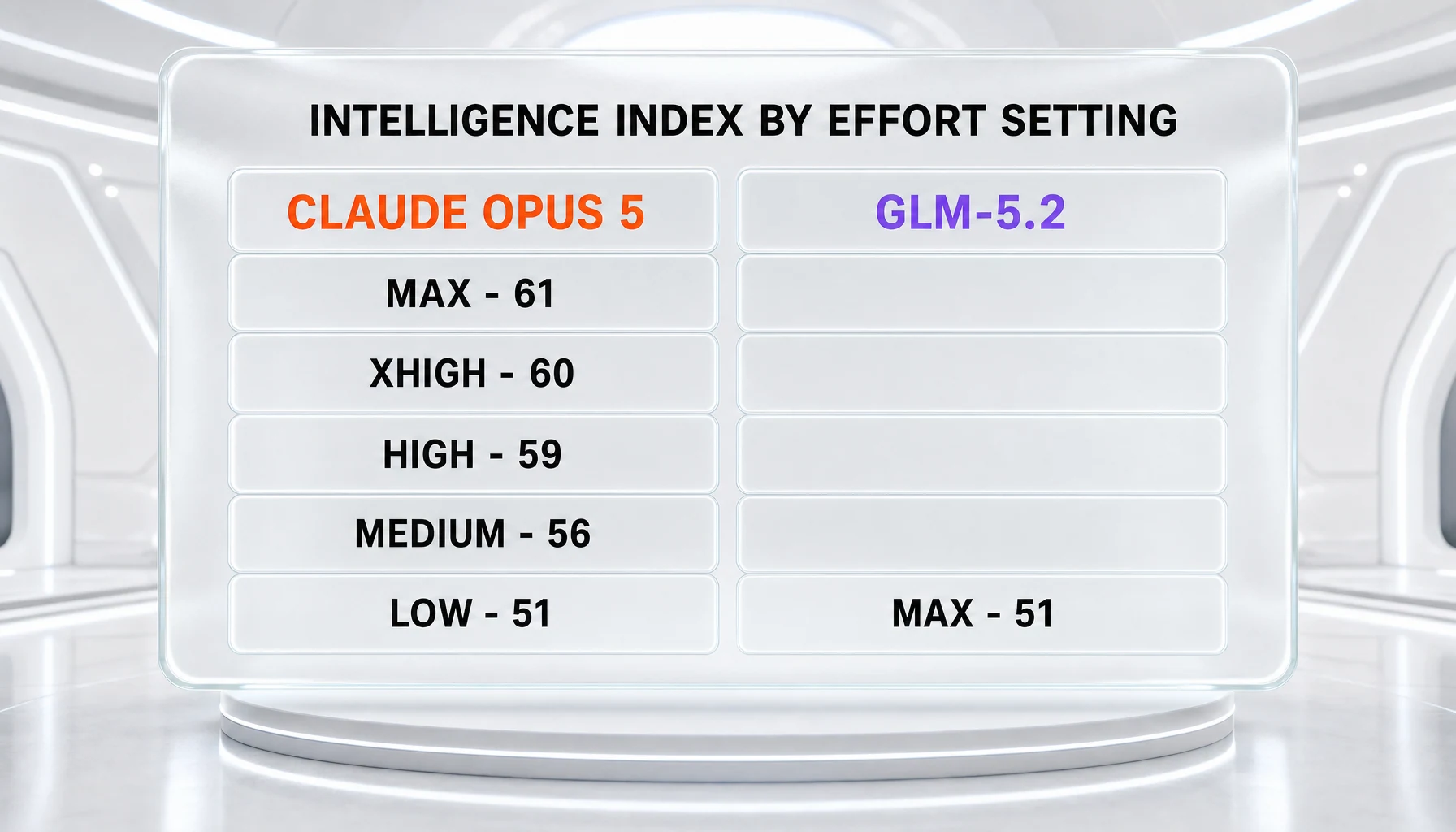
Claude Opus 5 scores 61 and GLM-5.2 scores 51 on the independent Artificial Analysis Intelligence Index v4.1 — a ten-point gap. But the two models meet exactly once. Opus 5 at its lowest effort setting also scores 51, at $0.36 per task, while GLM-5.2 scores 51 at max effort for $0.32 per task. GLM-5.2 is therefore about 11 percent cheaper at the tie, so it is not beaten on price. It is beaten on headroom: max is GLM-5.2's default and its ceiling, and Anthropic's low is four rungs below Opus 5's default. Above 51, Opus 5 charges $2.03 per task to reach 61 — 5.6 times the tie price for ten more points — and GLM-5.2 has no answer at any price. GLM-5.2 costs $1.40 per million input tokens and $4.40 per million output against $5 and $25 for Opus 5, ships 753B parameters of MIT-licensed weights you can download, and returns tokens roughly four times faster. We researched both through vendor documentation and independent benchmarks. Pick GLM-5.2 when index-51 work is enough or you need the weights; pick Opus 5 when you need what only exists above 51.
Quick verdict: the tie is real, the headroom is not shared
This comparison has an unusual shape. Most model matchups are a straight line — one costs more and scores higher. Here the two models genuinely tie at one point, and everything interesting is about where on each model's range that tie sits.
On the Artificial Analysis Intelligence Index v4.1, Claude Opus 5 posts 61 at max effort and GLM-5.2 posts 51 at max effort. Ten points. But Opus 5 publishes a full five-rung effort ladder, and its bottom rung also scores 51 — for $0.36 per task, against GLM-5.2's $0.32. That is the whole comparison in two numbers: the same score, 11 percent cheaper on GLM-5.2, but it is GLM-5.2's ceiling and Opus 5's floor.
Pick GLM-5.2 if your workload is satisfied by index-51 output, you want the cheapest route to it, you need downloadable MIT-licensed weights for self-hosting, data residency or fine-tuning, or you need fast responses — GLM-5.2 returns about 220 tokens per second against Opus 5's 55, and starts answering in about a second rather than about a minute.
Pick Claude Opus 5 if your work sits above what a 51 can do. That is the one thing money cannot buy on the GLM-5.2 side: there is no higher setting. Opus 5 sells four further rungs — 56, 59, 60 and 61 — and its default setting alone is 59, eight points clear of anything GLM-5.2 produces.
We are not naming an overall winner, because the numbers do not support one. Neither model dominates: GLM-5.2 wins the tie on price and wins outright on weights, speed and token cost; Opus 5 wins on everything above the tie. The honest verdict is a threshold, not a trophy, and the rest of this page is about locating it.
Why the effort setting decides this comparison
An intelligence score is only meaningful with the configuration that produced it. Claude Opus 5 exposes five effort rungs scoring 51 to 61 at $0.36 to $2.03 per task. GLM-5.2 accepts seven effort strings but honors three states, and its default is max — the setting that produces its 51. Comparing Opus 5's 61 against GLM-5.2's 51 compares a top rung to a top rung; comparing 51 against 51 compares a floor to a ceiling.
Both vendors ship reasoning effort controls, and both benchmark at the top of them. That is fair — it is the standard way independent evaluators report a model. What it hides is that the two ladders are shaped completely differently.
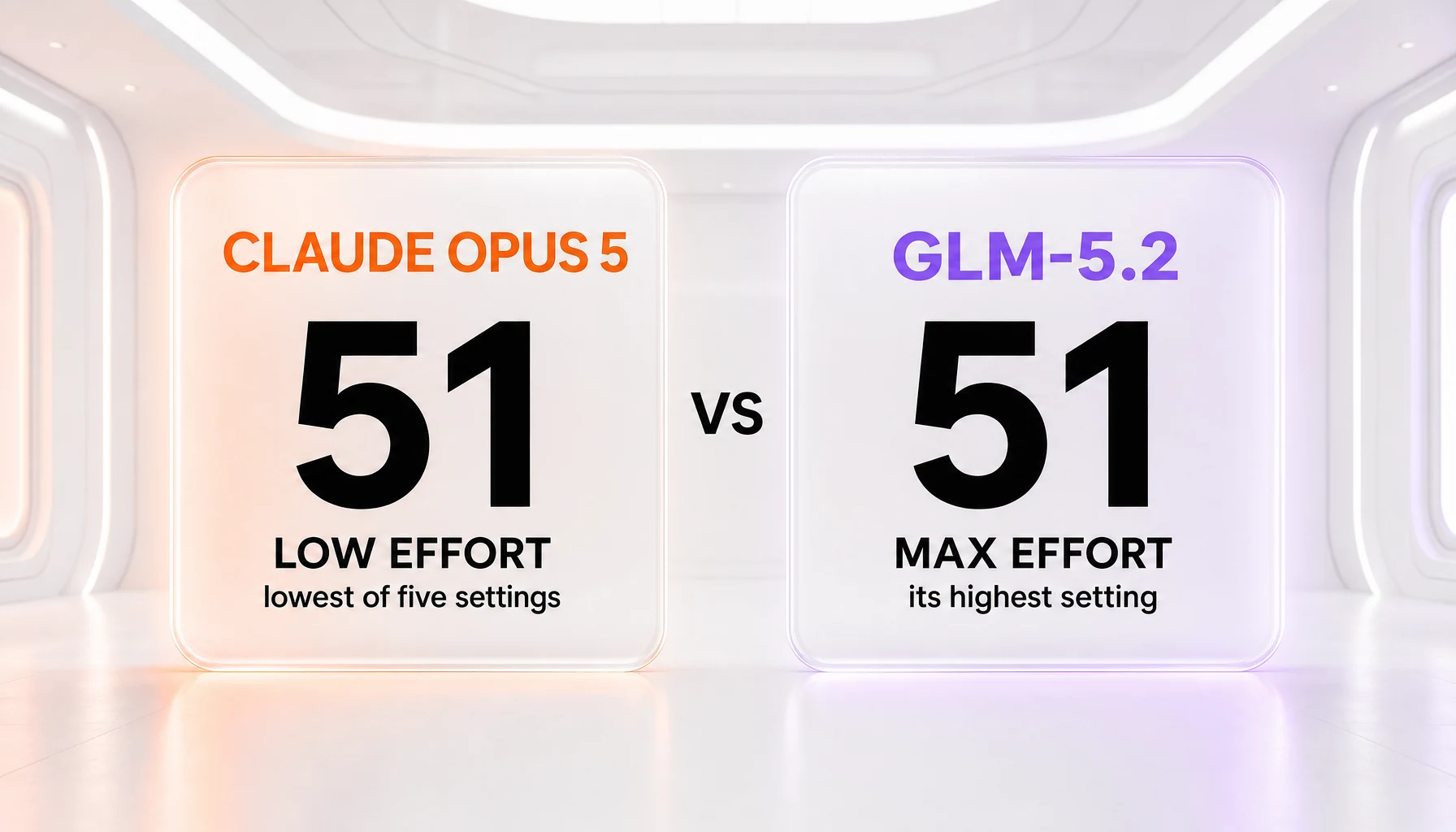
Anthropic's ladder for Opus 5 has five distinct rungs, each independently measured by Artificial Analysis with its own score and its own cost per task:
| Effort setting | Intelligence Index v4.1 | Cost per task (measured July 28, 2026) | Note |
|---|---|---|---|
| Claude Opus 5 — max | 61 | $2.03 | Headline score |
| Claude Opus 5 — xhigh | 60 | $1.56 | |
| Claude Opus 5 — high | 59 | $1.06 | Default setting |
| Claude Opus 5 — medium | 56 | $0.62 | |
| Claude Opus 5 — low | 51 | $0.36 | Ties GLM-5.2 |
| GLM-5.2 — max | 51 | $0.32 | Default setting and ceiling |
Read the last two rows together and the comparison snaps into focus. Opus 5 has to be turned all the way down to match GLM-5.2, and it still costs slightly more per task when it gets there. GLM-5.2 has to be at full throttle to hold that line — which it is, by default.
The GLM-5.2 side of that ladder deserves care, because the API is more subtle than it looks. Z.ai's chat-completion reference documents a reasoning_effort parameter whose default is max, and it states plainly what happens to the other values: passing none or minimal will cause the model to skip thinking; low and medium will be mapped to high; xhigh will be mapped to max. Seven strings are accepted, but they collapse to three real behaviors: no thinking, high, or max. The extra names exist for compatibility with other providers' parameter conventions.
That has a concrete consequence for anyone trying to economize. You cannot dial GLM-5.2 down to a cheap-but-adequate middle setting the way you can with Opus 5, because low and medium are silently promoted to high. GLM-5.2's own blog describes the user-facing choice as two rungs: You can also choose different thinking effort, High or Max, depending on the task. Turning thinking off entirely is possible, but that is a different product — the leaderboard carries a separate non-reasoning GLM-5.2 row scoring 34.
So the ladders are asymmetric in both directions. Opus 5 can go higher than GLM-5.2 and it can also be tuned more finely underneath. GLM-5.2's answer is that it does not need to be tuned, because it is already at its best setting and that setting is cheap.
Claude Opus 5 at a glance
Claude Opus 5 is Anthropic's highest-scoring model on this index, released July 24, 2026, at $5 per million input tokens and $25 per million output — the same rates as Opus 4.8. It carries a 1M-token context window at standard pricing, a training data cutoff of May 2026, and five reasoning effort rungs with an API default of high. Artificial Analysis scores it 61 at max effort on Intelligence Index v4.1.
Opus 5 arrived as a same-price generational upgrade, which is the detail that made it notable: Anthropic held the $5 and $25 per million token rates from the previous flagship rather than charging a premium for the new one. Our launch coverage of that pricing decision is in Claude Opus 5 launches at the same price as Opus 4.8.
The 1M-token context window matters here because GLM-5.2 matches it exactly — this is one dimension where the two are level on paper. Artificial Analysis classifies Opus 5 as a Proprietary model; that is the evaluator's classification of the access model, not a marketing term from Anthropic, and it means what it says: there are no downloadable weights.
One characteristic worth knowing before you budget: Opus 5 is verbose when it reasons. Artificial Analysis noted that the model produced 100M output tokens across the index evaluation, describing it as very verbose in comparison to the median of 63M. Because output tokens are the expensive side of the bill at $25 per million, verbosity is not a cosmetic trait — it is a cost multiplier, and it is part of why the max-effort cost per task reaches $2.03.
GLM-5.2 at a glance
GLM-5.2 is the model Z.ai calls its flagship model for long-horizon tasks, released June 16, 2026, at $1.40 per million input tokens, $0.26 cached input and $4.40 per million output. It has a 1M-token context window, 128K maximum output, and 753B parameters published under an MIT license on Hugging Face. Artificial Analysis scores it 51 at max effort on Intelligence Index v4.1 and classifies it as an Open weights model.
GLM-5.2 shipped as a flat-price generational upgrade too — it is listed at exactly the same token rates as GLM-5.1, $1.40 and $4.40. The headline engineering change was context: Z.ai's announcement states the model extends the maximum context length from 200K to 1M tokens, and its release notes for June 16, 2026 describe 1M lossless context, significantly improving long-horizon task capabilities and reducing context drift.
The vendor's own name is worth pinning down, because it varies by surface. The blog footer reads © 2026 Z.ai Inc.; the Hugging Face organization zai-org displays as Zhipu AI (Z.ai); and the privacy policy names JINGSHENG HENGXING TECHNOLOGY PTE.LTD, a Singapore-registered entity, as the controller for the international service. For a buyer running a vendor-risk assessment, that last one is the operative fact and it is not the one most coverage reports.
Maximum output is 128K tokens, with the API documenting a max_tokens range of 1 to 131072. Alongside the metered API, Z.ai sells a subscription Coding Plan on which GLM-5.2 consumes quota at a multiplier rather than a token rate — the vendor states it consumes quota at 3× during peak hours and 2× during off-peak hours, with peak defined as 14:00 to 18:00 Beijing time, and a promotion billing off-peak usage at 1× through the end of September.
Head-to-head specifications
Claude Opus 5 and GLM-5.2 both offer 1M-token context windows. They diverge on everything priced: Opus 5 costs $5 and $25 per million input and output tokens against GLM-5.2's $1.40 and $4.40, a 3.6x and 5.7x gap. On Artificial Analysis blended pricing at a 7:2:1 ratio, Opus 5 is $3.85 per million tokens and GLM-5.2 is $0.90 — about 4.3 times.
| Dimension | Claude Opus 5 | GLM-5.2 | Edge |
|---|---|---|---|
| Vendor | Anthropic (US) | Z.ai Inc. / Zhipu AI, international entity registered in Singapore | Depends on buyer |
| Release date | July 24, 2026 | June 16, 2026 | Opus 5 (newer) |
| Intelligence Index v4.1 (max effort) | 61 | 51 | Claude Opus 5 |
| Intelligence Index at default effort | 59 (high) | 51 (max) | Claude Opus 5 |
| Lowest measured effort rung | 51 (low) | 51 (max is also the floor for reasoning) | Tie on score |
| Cost per task at index 51 (measured July 28, 2026) | $0.36 | $0.32 | GLM-5.2 |
| Cost per task at each model's best (measured July 28, 2026) | $2.03 for index 61 | $0.32 for index 51 | Depends on requirement |
| Input price (per million tokens) | $5.00 | $1.40 | GLM-5.2 |
| Output price (per million tokens) | $25.00 | $4.40 | GLM-5.2 |
| Cached input (per million tokens) | $0.50 | $0.26 | GLM-5.2 |
| Blended price at 7:2:1 (per million tokens) | $3.85 | $0.90 | GLM-5.2 |
| Context window | 1M tokens | 1M tokens | Tie |
| Maximum output tokens | 128K synchronous | 128K | Tie |
| Effort control | Five measured rungs, default high | Seven strings accepted, three behaviors honored, default max | Claude Opus 5 |
| Weights | Not released | 753B parameters, downloadable, MIT license | GLM-5.2 |
| Training data cutoff | May 2026 | Not published by the vendor | Claude Opus 5 |
| Output speed (measured July 28, 2026) | About 55 tokens per second | About 220 tokens per second | GLM-5.2 |
| Time to first token (measured July 28, 2026) | About 68 seconds at max effort | About 1.3 seconds | GLM-5.2 |
| Independent classification | Proprietary model (Artificial Analysis) | Open weights model (Artificial Analysis) | GLM-5.2 |
Two rows in that table are easy to misread, so they are worth spelling out.
The blended price row uses Artificial Analysis's own weighting — a 7:2:1 ratio across cache-hit, input and output tokens — and it is a like-for-like construct because the same formula is applied to both models. It is not a cost per task, and the two must not be confused. Opus 5's blended $3.85 per million tokens and its $2.03 cost per task are different measures of different things: one prices a million tokens, the other prices completing the benchmark suite's work.
The time-to-first-token row is a snapshot, not a specification. Opus 5's roughly 68 seconds is measured at max effort, where the model is doing extended reasoning before it emits anything; that figure would fall substantially at lower rungs. Treat it as an indication of what maximum-effort reasoning feels like in an interactive setting, not as a fixed latency number.
Pricing compared: three different questions
Token price, blended price and cost per task answer different questions and rank these two models differently. On tokens, GLM-5.2 is 3.6 to 5.7 times cheaper. On blended price it is about 4.3 times cheaper. On cost per task at equal intelligence, it is only 11 percent cheaper — because Opus 5 reaches that score using far less reasoning effort.
That collapse from 4.3x to 1.11x is the single most useful number on this page, and it is what makes token-price comparisons misleading for reasoning models. GLM-5.2's tokens are dramatically cheaper, but at max effort it spends many more of them to land on 51 than Opus 5 spends at low effort to land on the same 51. Efficiency eats most of the sticker-price advantage.
It does not eat all of it. GLM-5.2 still finishes ahead at the tie, $0.32 against $0.36, and that matters for the verdict: Opus 5 cannot undercut GLM-5.2 anywhere on the range they share. Anthropic's cursor does not go low enough. If it did — if there were an Opus 5 rung scoring 51 at $0.25 — this page would have a straightforward winner. There is not, so it does not.
For the two extremes, the arithmetic is worth stating directly. A balanced job of one million input tokens plus one million output tokens costs $30.00 on Opus 5 and $5.80 on GLM-5.2 at listed rates, before any caching. With cached input, Opus 5's cache read is $0.50 per million and GLM-5.2's is $0.26. Anthropic also publishes Batch API rates at half the standard price. Z.ai publishes no batch column on its pricing page, and its batch documentation path returned an error when we checked — so we can say a published batch discount is absent, but not that batch processing is unavailable. Those are different claims and we are only making the first.
The subscription route changes the picture again for heavy coding use. Z.ai's Coding Plan meters GLM-5.2 in quota multipliers rather than tokens, and self-hosting the MIT weights removes per-token cost entirely in exchange for infrastructure cost. Neither has an equivalent on the Opus 5 side. If you want the general framework for weighing those trade-offs, we wrote it up separately in closed vs open-weight AI models: how to actually choose.
What the index does not measure: weights, license and sovereignty
GLM-5.2's weights are published: 753B parameters on Hugging Face under an unmodified MIT license, ungated, with no revenue threshold, no user-count trigger and no attribution requirement beyond the standard MIT copyright notice. Training data and training code are not published, so GLM-5.2 is open-weight rather than open source. Claude Opus 5 publishes no weights.
This is the axis the Intelligence Index cannot see, and for a large share of buyers it decides the question before any benchmark does.
We read the license file rather than relying on how it has been described. The zai-org/GLM-5.2 repository publishes its terms at a plain LICENSE file, and that file is the canonical MIT license, copyright 2026 Zhipu AI, with nothing added. There is no revenue ceiling, no monthly-active-user trigger, no commercial restriction, no jurisdiction clause and no term governing distilled or derivative models. The only obligation in the document is the standard MIT one: The above copyright notice and this permission notice shall be included in all copies or substantial portions of the Software. The repository metadata tag, the model card front matter and the license file all agree on mit.
That verification matters because permissive-sounding license claims do not always survive contact with the actual file — we have seen a Chinese lab's release described everywhere as a lightly modified MIT license when the published terms in fact carried a revenue threshold and an attribution duty at scale. GLM-5.2 is the opposite case: the permissive description is accurate, and we are saying so because we checked, not because it was repeated.
Two precisions keep this honest. First, the accompanying code repository at github.com/zai-org/GLM-5 is Apache-2.0, not MIT. That is a split across two artifacts — weights under MIT, tooling under Apache-2.0 — not a contradiction. Second, and more important: open-weight is not open source. The weights are downloadable, but the training data and the training pipeline are not published. The model card describes the corpus in volume terms — pre-training data rising from 23T to 28.5T tokens — and describing a corpus is not releasing one. Z.ai does open-source the reinforcement learning framework its team uses, which is more than most labs publish, but GLM-5.2 as trained is not reproducible. Z.ai's own marketing line is Pure Open: An MIT open-source license — no regional limits, technical access without borders, which is accurate about the license specifically and should be read that way.
On the other side, the Proprietary model label attached to Claude Opus 5 comes from Artificial Analysis, a third-party evaluator classifying access models across its whole catalog. It is a reasonable description and Anthropic does not publish Opus 5 weights, but it is a classification applied by an evaluator rather than a term Anthropic uses to sell the product, and we are not going to present it as one.
What this buys you in practice: with GLM-5.2 you can run the model inside your own network, in a jurisdiction of your choosing, with no inference data leaving your infrastructure, and you can fine-tune it. With Opus 5 you can do none of those things at any price. If that is a hard requirement — regulated data, air-gapped deployment, national sovereignty policy — the ten-point gap is not the deciding factor, because one of the two models simply does not qualify. Similar reasoning drives our comparisons of Claude Opus 4.8 vs GLM-5.2 and Muse Spark 1.1 vs GLM-5.2, the latter being another case where GLM-5.2's 51 met an equal score from a closed model.
Speed, latency and what they cost you
GLM-5.2 returns about 220 tokens per second and begins responding in about 1.3 seconds. Claude Opus 5 at max effort returns about 55 tokens per second and takes about 68 seconds to first token, because it reasons extensively before emitting output. Both figures were measured on July 28, 2026 and drift with provider load, unlike index scores which are fixed within a version.
The latency gap is not a defect on the Opus 5 side; it is the visible cost of the reasoning that produces 61. But it does define which interfaces each model suits. A model that takes about a minute before its first token is not what you put behind a chat box a user is watching. It is what you put behind a queue, a batch job, an overnight agent run or a task where the answer matters more than the wait.
GLM-5.2's profile is the inverse and pairs naturally with interactive work — code completion, iterative editing, anything where a person is waiting. Combined with token prices roughly a quarter of Opus 5's, that makes it the more comfortable model to leave running in a loop.
Treat both numbers as readings, not specifications. Throughput and latency are measured through API providers and move with load, routing and time of day; the intelligence scores quoted throughout this page are stable within Intelligence Index v4.1 and only change when the index version changes.
How we researched this, and what we could not verify
We researched both models rather than running production workloads on them. Pricing and specifications come from each vendor's own documentation, and all comparative scores come from Artificial Analysis Intelligence Index v4.1 so that both models are measured by one methodology. Three facts we wanted are unavailable, and each is unavailable for a different reason.
Every score on this page is from the same independent index version, run by the same evaluator, which is the only way a cross-vendor number means anything. We have deliberately not stacked a vendor's self-reported benchmark against an independent one — those are different kinds of evidence and mixing them produces a comparison that looks rigorous and is not.
The three gaps, stated precisely because the distinctions are not cosmetic:
- GLM-5.2's training data cutoff — published nowhere by the vendor. The cutoff exists; every model has one. Z.ai does not state it on the model page, in the release notes, in the model card or in the announcement. This is a disclosure gap, not an absence of the fact, and we will not infer a date. Opus 5's cutoff is May 2026.
- A batch discount for GLM-5.2 — we could not verify either way. Z.ai's pricing page publishes input, cached input, storage and output columns with no batch column, and the batch documentation path we tried returned an error. So: no published batch rate. Whether batch processing exists undocumented, we do not know, and we are not claiming it does not exist.
- A like-for-like hallucination figure — exists for one model, not surfaced for the other. AA-Omniscience, which rewards correct answers and penalizes confident wrong ones on a scale from -100 to 100, publishes a standalone score of 31 for Claude Opus 5 at max effort. GLM-5.2 does not appear in that published standalone ranking. AA-Omniscience is one of the nine evaluations inside Intelligence Index v4.1, so a component result exists behind GLM-5.2's 51 — it is simply not broken out publicly. The honest position: there is no published head-to-head reliability number between these two.
That last gap has a trap attached, and it is worth being explicit about how we avoided it. Anthropic does not publish a hallucination rate for Opus 5 at all. The one intervention figure in its announcement concerns cyber classifiers and is benchmarked against Claude Fable 5, not against Claude Opus 4.8 and certainly not against GLM-5.2 — the company says it expects those classifiers to intervene around 85% less often than they do for Fable 5. Anthropic's alignment claims are measured against its own models too. None of that transfers to GLM-5.2. Reading a gain measured against one model as though it were a gain against another is exactly the kind of inference that turns a sourced fact into an invented one, and we are not making it here.
One more scoping note on the index itself. Intelligence Index v4.1 aggregates nine evaluations: agentic tasks at 34 percent, coding at 24 percent, scientific reasoning at 24 percent and general capability at 18 percent. It is a composite. A ten-point gap on it means a broad average difference across those nine, not a uniform ten-point gap on every task you might care about.
Winner by category
Claude Opus 5 wins peak capability, effort granularity and published cutoff. GLM-5.2 wins token price, blended price, cost per task at the tie, speed, latency, weight availability and license terms. Neither wins the overall matchup outright, because the two models do not compete across the same range — they overlap at exactly one score.
- Best peak intelligence — Claude Opus 5. 61 against 51 on the same index version. Not close, and not purchasable on the other side.
- Best value at equal intelligence — GLM-5.2. $0.32 per task against $0.36 for the same 51.
- Best cost control — Claude Opus 5. Five measured rungs let you buy exactly the intelligence a job needs. GLM-5.2 honors three states and promotes
lowandmediumup tohigh. - Best raw token economics — GLM-5.2. $1.40 and $4.40 per million against $5 and $25; $0.90 blended against $3.85.
- Best for interactive work — GLM-5.2. About 220 tokens per second and roughly a second to first token.
- Best for self-hosting, fine-tuning and data residency — GLM-5.2. 753B MIT-licensed parameters, ungated. Opus 5 does not compete here at all.
- Best documented — Claude Opus 5. Published cutoff, published batch rates, published per-rung behavior. GLM-5.2 leaves the cutoff and batch pricing unstated.
- Best for hard problems — Claude Opus 5. This is the category that justifies the price, and the only one where GLM-5.2 has no counter at any budget.
Pros and cons
Claude Opus 5 — pros
- Top score on Artificial Analysis Intelligence Index v4.1 at 61, ten points clear of GLM-5.2
- Five measured effort rungs from 51 to 61, so you can buy the intelligence a task actually needs
- Default setting alone scores 59, eight points above anything GLM-5.2 produces
- 1M-token context at the standard rate
- Published May 2026 training cutoff and published Batch API rates at half price
- Same $5 and $25 per million token rates as the previous flagship
Claude Opus 5 — cons
- 3.6x the input price and 5.7x the output price of GLM-5.2
- No weights at any price — rules it out for self-hosting, air-gapped and residency-constrained deployments
- About 68 seconds to first token at max effort makes it unsuitable for watched interactive use
- About 55 tokens per second, roughly a quarter of GLM-5.2's throughput
- Verbose when reasoning — 100M output tokens across the index evaluation against a 63M median — and output is the expensive side of the bill
- Cannot undercut GLM-5.2 on cost per task even at its lowest rung
GLM-5.2 — pros
- Cheapest route to an index-51 result at $0.32 per task, beating Opus 5's floor
- 753B parameters downloadable under an unmodified MIT license, ungated, with no revenue or user thresholds
- $1.40 and $4.40 per million tokens, about a quarter of Opus 5 blended
- About 220 tokens per second and roughly 1.3 seconds to first token
- 1M-token context, matching Opus 5, with 128K maximum output
- Self-hostable and fine-tunable, which removes per-token cost and keeps data in your jurisdiction
- Subscription Coding Plan as an alternative to metered billing
GLM-5.2 — cons
- Ceiling of 51 with no higher setting available at any price
- Max effort is already the default, so there is no performance reserve to call on
lowandmediumare remapped up tohigh, removing the cheap middle gear the parameter names imply- Training data cutoff not published anywhere by the vendor
- No published batch pricing
- Open-weight but not open source — training data and training pipeline are not released
- Vendor entity structure spans several names and jurisdictions, which complicates procurement review
When to pick which
Pick GLM-5.2 when index-51 output completes your work, when you need weights for self-hosting or data residency, or when latency and token cost dominate. Pick Claude Opus 5 when tasks fail at 51, when you want to tune effort per job, or when a published training cutoff is a compliance requirement. The switchover is a capability threshold, not a budget.
Pick GLM-5.2 when:
- Your evaluation set passes at index-51 quality. This is the test that matters and it is cheap to run — if GLM-5.2 clears your bar, nothing above it is worth paying for.
- You need the weights. Regulated data, air-gapped environments, national sovereignty requirements or fine-tuning all make this binary, and Opus 5 loses it automatically.
- Volume is high and margins are thin. At roughly a quarter of the blended token price, GLM-5.2 changes what is economically viable to run at scale.
- A person is waiting for the output. About a second to first token against about a minute is not a preference, it is a different product category.
- You want predictable spend without tuning. Max is the default and the ceiling, so there is no configuration drift to manage.
Pick Claude Opus 5 when:
- Tasks fail at 51. This is the whole argument. If your hardest work does not complete at GLM-5.2's ceiling, the comparison ends there and the ten points are worth whatever they cost.
- Difficulty varies across your workload. Five rungs let you run easy jobs at $0.36 per task and hard ones at $2.03, which is a genuinely different cost curve from a single fixed setting.
- You need a documented training cutoff. May 2026 is published; GLM-5.2's is not, and for some compliance reviews an unstated cutoff is a blocker on its own.
- The work is asynchronous. Batch jobs, overnight agent runs and queued pipelines make the latency irrelevant and the Batch API halves the price.
- Reliability on knowledge-heavy questions is critical and you want a published standalone figure to point at — Opus 5 has one at 31 on AA-Omniscience, GLM-5.2 does not.
The pragmatic setup, if neither constraint is absolute, is to run both: GLM-5.2 as the default for volume and interactive work, Opus 5 reserved for the tasks that fail. The ten points are not worth paying for on every request, and they are worth almost any price on the requests that need them. That is a routing decision, not a purchasing one.
Frequently asked questions
Which is smarter, Claude Opus 5 or GLM-5.2?
Claude Opus 5, by ten points. On Artificial Analysis Intelligence Index v4.1, Opus 5 scores 61 at max effort and GLM-5.2 scores 51 at max effort. Both figures are from the same evaluator on the same index version, which is what makes them comparable. The gap holds at default settings too, though it narrows to eight points: Opus 5's default effort setting is high, which scores 59, while GLM-5.2's default is max, which scores 51. The one place they meet is at Opus 5's lowest rung, where it also scores 51. So GLM-5.2 matches Opus 5 only when Opus 5 is turned down as far as it goes.
Is GLM-5.2 cheaper than Claude Opus 5?
On tokens, dramatically. GLM-5.2 lists $1.40 per million input tokens and $4.40 per million output, against $5 and $25 for Opus 5 — 3.6 times and 5.7 times cheaper. On Artificial Analysis blended pricing at a 7:2:1 ratio, GLM-5.2 is $0.90 per million tokens and Opus 5 is $3.85, about 4.3 times. But at equal intelligence the advantage nearly disappears: reaching index 51 costs $0.32 per task on GLM-5.2 and $0.36 on Opus 5 at low effort, only 11 percent apart, because Opus 5 needs far less reasoning to get there. GLM-5.2 is still ahead at that point, so Opus 5 never undercuts it.
Why do both models score 51 if one is better?
Because the 51s are measured at opposite ends of each model's effort range. GLM-5.2's 51 is recorded at max effort, which is both its default setting and its highest available setting — there is nothing above it. Opus 5's 51 is recorded at low effort, the bottom of a five-rung ladder that continues upward through 56, 59, 60 and 61. The same number therefore means opposite things: for GLM-5.2 it is a ceiling, for Opus 5 it is a floor. Comparing headline scores compares two ceilings, 61 against 51, which is the fairer like-for-like reading.
Is GLM-5.2 open source?
It is open-weight, which is not the same thing. The weights are genuinely published: 753B parameters on Hugging Face under an unmodified MIT license, ungated, with no revenue threshold, no user-count trigger and no attribution requirement beyond MIT's standard copyright notice. We read the license file rather than relying on descriptions of it. But the training data and the training pipeline are not released, so the model cannot be reproduced from what is public. Z.ai does open-source the reinforcement learning framework its team uses, which is more than most labs publish. The accompanying code repository is Apache-2.0 while the weights are MIT — two artifacts, two licenses, not a contradiction.
Does GLM-5.2 have reasoning effort levels like Claude Opus 5?
It accepts the same parameter names but honors far fewer states. Z.ai's API documents a reasoning_effort parameter with seven accepted values and a default of max, then states that none and minimal skip thinking, that low and medium are mapped up to high, and that xhigh is mapped up to max. So seven strings collapse to three real behaviors: no thinking, high, or max. Z.ai's own announcement describes the user-facing choice as two rungs, high or max. Claude Opus 5 by contrast has five independently measured rungs, each with its own score and cost, which is meaningfully more granular control.
What is Claude Opus 5's default effort setting?
High. Anthropic's documentation states the API default is high, and that setting scores 59 on Artificial Analysis Intelligence Index v4.1 at a measured $1.06 per task. That matters for anyone reading the headline number, because the widely quoted 61 is the max-effort result at $2.03 per task, not what you get by default. The gap between default and maximum is two index points for roughly twice the cost per task. GLM-5.2's default is the opposite arrangement: max effort by default, so its published 51 is what you get without configuring anything.
How much do the ten index points cost?
On Opus 5, going from index 51 at low effort to index 61 at max effort takes cost per task from $0.36 to $2.03, about 5.6 times, for ten points. Going only as far as the default high setting gives 59 for $1.06, about 2.9 times the tie price for eight points. On GLM-5.2 the points are not purchasable at all — 51 at max effort is the ceiling, and no amount of spending moves it. So the ten points are priced on one side of this comparison and unavailable on the other, which is why the decision is a capability threshold rather than a budget question.
Which model is faster?
GLM-5.2, by a wide margin on both measures. It returns about 220 tokens per second against about 55 for Opus 5, and begins responding in about 1.3 seconds against about 68 seconds for Opus 5 at max effort. Both readings were taken on July 28, 2026 and will drift with provider load and routing, unlike index scores which are fixed within a version. The Opus 5 latency is not a defect — it is extended reasoning happening before any output appears, and it would fall at lower effort settings — but it does mean Opus 5 at max effort suits queued and batch work rather than interfaces where someone is watching.
What is GLM-5.2's training data cutoff?
Z.ai does not publish it. We checked the model documentation page, the release notes, the Hugging Face model card and the launch announcement, and none states a cutoff date. The cutoff exists — every trained model has one — but the vendor has not disclosed it, and we will not estimate a date from release timing because that would be a guess presented as a fact. Claude Opus 5's cutoff is published as May 2026. For compliance reviews that require a documented cutoff, this asymmetry is a real difference between the two models rather than a trivia gap.
Which model hallucinates less?
There is no published head-to-head figure between these two. AA-Omniscience, which rewards correct answers and penalizes confident wrong ones on a scale from -100 to 100, publishes a standalone score of 31 for Claude Opus 5 at max effort. GLM-5.2 does not appear in that published standalone ranking. Because AA-Omniscience is one of the nine evaluations inside Intelligence Index v4.1, a component result exists behind GLM-5.2's score but is not broken out publicly. Anthropic does not publish a hallucination rate for Opus 5 at all, and the one intervention figure in its announcement concerns cyber classifiers measured against Claude Fable 5 — not against GLM-5.2. Reading a figure benchmarked against one model as though it applied to another would be an invented conclusion.
Do both models really have 1M-token context windows?
Yes, and this is one dimension where they are level. Claude Opus 5 offers a 1M-token context window, and GLM-5.2 offers the same. Z.ai's launch notes describe extending the maximum context length from 200K to 1M tokens and emphasize stability over the raw figure, describing 1M lossless context that sustains long-horizon work. Maximum output is also matched at 128K tokens on both sides, with GLM-5.2's API documenting a max_tokens range of 1 to 131072. Since context and output ceilings are equal, they cannot break the tie in either direction — which pushes the decision back onto intelligence headroom, price and weight availability.
Should I use both models together?
For many workloads that is the strongest answer. The ten index points are not worth paying for on every request, and they are worth nearly any price on the requests that need them, which makes this a routing problem rather than a purchasing one. A common arrangement is GLM-5.2 as the default for volume, interactive and latency-sensitive work at $0.32 per task, with Claude Opus 5 reserved for the tasks that fail at 51 and run asynchronously where its latency does not matter. Both offer 1M-token context, so long-context work can route either way without restructuring prompts.
Final verdict
We are not naming an overall winner, because the measurements refuse to produce one. GLM-5.2 wins the tie at index 51 on cost, $0.32 against $0.36 per task, and wins outright on token price, speed and weight availability. Claude Opus 5 wins everything above 51, where GLM-5.2 has no product at any price. The decision is a threshold: test whether your hardest work completes at 51.
The comparison that mattered turned out not to be 61 against 51. It was $0.36 against $0.32 — the price of the one score both models can produce. GLM-5.2 wins that by 11 percent, which is narrow but real, and it wins it while running at maximum effort by default. Opus 5 matches the score while idling, and still costs slightly more to do it. Anthropic's cursor does not reach low enough to take that point away.
What Opus 5 has instead is somewhere to go. Four more rungs, ending at 61, at 5.6 times the tie price. GLM-5.2's max is a wall, not a setting — and the parameter design makes that concrete, since even the values that sound like lower gears are promoted back up to high. It is a model with one speed, and the speed is fast and cheap.
So the useful question is not which model is better. It is where your work sits relative to a single score. Run your hardest real tasks against GLM-5.2 at max effort. If they complete, the ten points are money you have no reason to spend, and GLM-5.2 additionally hands you 753B parameters of MIT-licensed weights, roughly four times the throughput and about a quarter of the blended token cost. If they fail, no budget fixes it on the GLM-5.2 side, and Opus 5 becomes the only one of the two that can do the job.
The weights question can settle it before any of that. If you need to self-host, fine-tune, or keep inference inside a jurisdiction, Opus 5 is disqualified regardless of its score, and GLM-5.2's MIT license — which we verified by reading the file, not by trusting a summary of it — is about as unencumbered as a published model gets.
Sources and references
- Artificial Analysis — model leaderboard — Intelligence Index v4.1 scores and cost per task for every effort rung of both models (readings taken July 28, 2026)
- Artificial Analysis — Claude Opus 5 — index 61 at max effort, blended $3.85 per million tokens at 7:2:1, throughput and latency readings, release date, classification
- Artificial Analysis — GLM-5.2 — index 51 at max effort, token prices, throughput and latency readings, release date, open-weights classification
- Artificial Analysis — Intelligence Index methodology — v4.1 composition and category weightings across nine evaluations
- Artificial Analysis — AA-Omniscience — scoring scale and the standalone Claude Opus 5 result
- Anthropic — model overview — Claude Opus 5 context window, 128K maximum output and May 2026 training data cutoff
- Anthropic — pricing — $5 and $25 per million tokens, $0.50 cache reads, Batch API at half price, and 1M context at standard pricing
- Anthropic — effort levels — the five effort values low, medium, high, xhigh and max, and the high API default
- Anthropic — Claude Opus 5 announcement — July 24, 2026 release, and the cyber-classifier intervention figure measured against Claude Fable 5
- Z.ai — GLM-5.2 model documentation — 1M context, 128K maximum output, model positioning
- Z.ai — pricing — $1.40 input, $0.26 cached input, $4.40 output per million tokens, all in USD, no batch column
- Z.ai — chat completion API reference — reasoning_effort default and value remapping, thinking parameter, max_tokens range
- Z.ai — release notes — GLM-5.2 release dated June 16, 2026 and the 1M lossless context claim
- Hugging Face — zai-org/GLM-5.2 — 753B parameter open-weight release, MIT license metadata, model card
- Hugging Face — GLM-5.2 LICENSE file — the unmodified MIT license text we verified directly
- GitHub — zai-org/GLM-5 — accompanying code repository, Apache-2.0
Last compared: July 2026. We researched both models rather than running extended production workloads on them: pricing and specifications come from each vendor's own documentation, and all comparative scores come from Artificial Analysis Intelligence Index v4.1 so that a single methodology covers both. Independent evaluator figures and vendor self-reported figures are labeled as such throughout and never stacked against each other. Cost per task, throughput and latency are readings taken on July 28, 2026 and drift over time; index scores are stable within a version. Classification labels such as "Proprietary model" and "Open weights model" are Artificial Analysis's, not the vendors' own marketing terms.
Our Verdict
No overall winner, because the measurements refuse to produce one — and the tie is not where the headline suggests. On Artificial Analysis Intelligence Index v4.1, Claude Opus 5 scores 61 at max effort and GLM-5.2 scores 51 at max effort, a ten-point gap. But the two models meet exactly once, at 51: Opus 5 reaches it at low effort, the bottom of a five-rung ladder, for $0.36 per task, while GLM-5.2 reaches it at max effort, which is both its default and its ceiling, for $0.32 per task. GLM-5.2 therefore wins the tie by about 11 percent and Anthropic's cursor never descends low enough to take that point back. What Opus 5 has instead is headroom: four further rungs ending at 61, at 5.6 times the tie price, against a wall on the GLM-5.2 side that no budget moves. GLM-5.2 also wins on token price ($1.40 and $4.40 per million against $5 and $25), on blended price ($0.90 against $3.85 per million), on throughput and latency, and on 753B parameters of weights published under an unmodified MIT license we verified by reading the file. The decision is a capability threshold, not a budget: run your hardest work against GLM-5.2 at max effort, and if it completes, the ten points are money with no job to do.
Choose Claude Opus 5
Anthropic's frontier reasoning model — top of the independent index at half the price of Fable 5.
Try Claude Opus 5 →Choose GLM-5.2
Zhipu AI open-weight coding flagship: 753B MoE (~40B active), 1M context, MIT license, headline SWE-bench Pro 62.1 (vendor self-reported); GLM Coding Plan from around $18 per month or $1.40 in / $4.40 out per million tokens.
Try GLM-5.2 →Frequently Asked Questions
Is Claude Opus 5 better than GLM-5.2?
No overall winner, because the measurements refuse to produce one — and the tie is not where the headline suggests. On Artificial Analysis Intelligence Index v4.1, Claude Opus 5 scores 61 at max effort and GLM-5.2 scores 51 at max effort, a ten-point gap. But the two models meet exactly once, at 51: Opus 5 reaches it at low effort, the bottom of a five-rung ladder, for $0.36 per task, while GLM-5.2 reaches it at max effort, which is both its default and its ceiling, for $0.32 per task. GLM-5.2 therefore wins the tie by about 11 percent and Anthropic's cursor never descends low enough to take that point back. What Opus 5 has instead is headroom: four further rungs ending at 61, at 5.6 times the tie price, against a wall on the GLM-5.2 side that no budget moves. GLM-5.2 also wins on token price ($1.40 and $4.40 per million against $5 and $25), on blended price ($0.90 against $3.85 per million), on throughput and latency, and on 753B parameters of weights published under an unmodified MIT license we verified by reading the file. The decision is a capability threshold, not a budget: run your hardest work against GLM-5.2 at max effort, and if it completes, the ten points are money with no job to do.
Which is cheaper, Claude Opus 5 or GLM-5.2?
Claude Opus 5 starts at $5 in / $25 out per M tokens. GLM-5.2 starts at $1.4 in / $4.4 out per M tokens. Check the pricing comparison section above for a full breakdown.
What are the main differences between Claude Opus 5 and GLM-5.2?
The key differences span across 15 features we compared. For Intelligence Index v4.1 (max effort), Claude Opus 5 offers 61 while GLM-5.2 offers 51. For Intelligence Index at default effort, Claude Opus 5 offers 59 (default: high) while GLM-5.2 offers 51 (default: max). For Cost per task at index 51 (measured July 28, 2026), Claude Opus 5 offers $0.36 (low effort) while GLM-5.2 offers $0.32 (max effort). See the full feature comparison table above for all details.