Claude Opus 4.8 vs GLM-5.2: Closed Flagship vs Open-Weight Price (2026)

Claude Opus 4.8 vs GLM-5.2: 56 vs 51 on Artificial Analysis, $25 vs $4.40 per million output tokens, closed API vs MIT open weights. When to pick each.
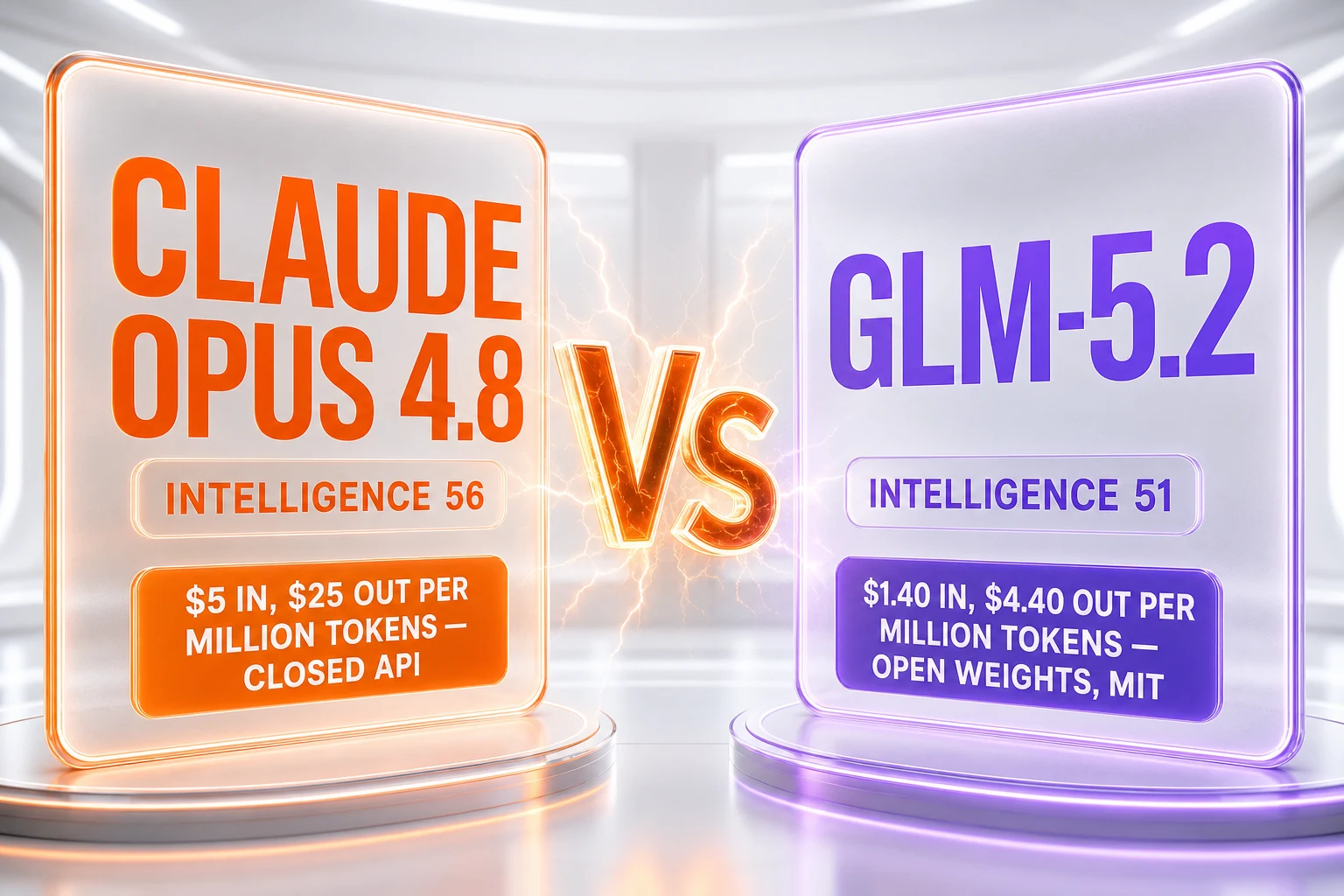
Feature Comparison
| Feature | Claude Opus 4.8 | GLM-5.2 |
|---|---|---|
| Artificial Analysis Intelligence Index (independent) | 56 | 51 — the top open-weight score in the world |
| SWE-bench Pro, agentic coding (both vendor-reported) | 69.2 (Anthropic self-reported) | 62.1 (Zhipu AI self-reported) |
| SWE-bench Verified | 88.6 percent (Anthropic self-reported) | Not reported on this benchmark — no comparison possible |
| Input price (per million tokens) | $5 standard, $10 in Fast Mode | $1.40 ($0.26 cached) |
| Output price (per million tokens) | $25 standard, $50 in Fast Mode | $4.40 |
| Flat-rate plan | Metered per token in the published figures we reviewed | GLM Coding Plan from around $18 per month |
| Model access and license | Closed, proprietary, API only | Open weights under an MIT license — mixture-of-experts, roughly 753B total and about 40B active |
| Self-hosting and data residency | Not possible — vendor endpoints only | Download the weights and run them on your own compute |
| Documented context window | Not specified by Anthropic for Opus 4.8 — confirm with the vendor | 1,000,000 tokens (output up to 131,072) |
| Latency option | Fast Mode, about 2.5 times quicker, at $10 input and $50 output per million tokens | No comparable published fast tier in the figures we reviewed |
| First-party ecosystem and support | Mature Anthropic developer stack, SDKs, first-party agentic tooling | Drop-in with third-party agentic coding tools; smaller first-party surface |
| Benchmark transparency | Coding scores vendor-reported; index score independent | Coding score vendor-reported; index score independent |
Pricing Comparison
Claude Opus 4.8
GLM-5.2
Detailed Comparison
Editorial independence: ThePlanetTools.ai has no affiliate relationship with Anthropic or with Zhipu AI (Z.ai), and earns nothing whichever model you choose. This comparison is based on running both models side by side on our own coding and agent workloads, on each vendor's published pricing, and on the one independent benchmark that scores them both. Every benchmark figure below is labeled either independent or vendor-reported, and where a specification has not been published, we say that instead of guessing.
Claude Opus 4.8 vs GLM-5.2 in 2026: Claude Opus 4.8 is Anthropic's closed flagship, scoring 56 on the Artificial Analysis Intelligence Index — the only independent yardstick that covers both models — at $5 per million input tokens and $25 per million output tokens, with a Fast Mode at $10 and $50 that runs about 2.5 times quicker. GLM-5.2 is Zhipu AI's open-weight coding flagship, a mixture-of-experts model of roughly 753 billion total parameters with about 40 billion active, released under an MIT license you can download and self-host, scoring 51 on the same independent index at $1.40 per million input tokens and $4.40 per million output tokens, with a documented one-million-token context window. Opus 4.8 leads on every capability number that can be compared. GLM-5.2 costs about 3.6 times less on input and about 5.7 times less on output, and you can own the weights. That is a split decision, not a tie: the winner depends entirely on whether the model is your product or your cost center.
Quick Verdict
Opus 4.8 wins the capability argument outright. GLM-5.2 wins the economics argument outright. Neither win is close, and neither cancels the other. On the one independent scoreboard that ranks both, Opus 4.8 sits at 56 and GLM-5.2 at 51 — a real five-point lead, not a rounding error. On the one coding benchmark both vendors report, SWE-bench Pro, Opus 4.8 claims 69.2 and GLM-5.2 claims 62.1, a seven-point gap in the same direction (both figures are self-reported by their vendors, and we treat them accordingly). Then you look at the invoice: GLM-5.2 charges $4.40 per million output tokens against Opus 4.8's $25. Same task, roughly one fifth the output bill, plus MIT-licensed weights you can run inside your own network. There is no version of this comparison where one model is simply better.
- 🏆 Claude Opus 4.8 wins for: the highest measured capability of the two, a consistent lead across both the independent index and the shared vendor benchmark, a Fast Mode for latency-critical agent loops, and the maturity of Anthropic's first-party developer stack
- 🏆 GLM-5.2 wins for: price at every tier, MIT open weights you can self-host and fine-tune, a documented one-million-token context window, a flat coding subscription from around $18 per month, and freedom from vendor lock-in
- 💰 Cheaper option: GLM-5.2, decisively — $1.40 input and $4.40 output per million tokens against $5 and $25, which is about 3.6 times less on input and about 5.7 times less on output, before you even consider self-hosting
- 🧠 Higher independent intelligence: Claude Opus 4.8 at 56 versus GLM-5.2 at 51 on the Artificial Analysis Intelligence Index — GLM-5.2 delivers roughly 91 percent of that score at a fraction of the cost, which is the whole argument in one number
- 🔓 Openness and control: GLM-5.2 — MIT weights, self-hosting, fine-tuning, no regional or vendor lock-in; Opus 4.8 is closed and API-only
- ⚠️ Unresolved: Anthropic has not published a context-window figure for Opus 4.8 in the materials we reviewed. GLM-5.2 documents one million tokens. We do not carry an older Opus number forward, and neither should your architecture
Both models are shipping today. If you want the full breakdown of either one on its own terms, read our Claude Opus 4.8 review and our GLM-5.2 review, or see where each lands against the wider field in our best AI coding tools of 2026 roundup.
How We Compared Them
We ran both models side by side the way a team actually decides between them: same repositories, same agent harness, same prompts, and then we went and read what each vendor is willing to put its name to.
Claude Opus 4.8 we have used hands-on through the Claude API and inside agentic terminal workflows, on multi-file refactors and long tool-calling loops, including in Fast Mode to see what the latency premium actually buys. GLM-5.2 we evaluated through Zhipu AI's hosted API and by working with the open weights, which have been downloadable under an MIT license since shortly after the model's release on June 13, 2026. Because GLM-5.2 is a drop-in model for the same agentic coding tools many teams already run, putting the two head to head on an identical harness is straightforward, and that is exactly what we did.
What we did not do is generate our own benchmark scores and present them as neutral. Every number in this comparison comes with a label, and the labels matter more than usual here:
- Independent: the Artificial Analysis Intelligence Index. This is a third-party lab that runs both models on its own harness, so 56 versus 51 is an apples-to-apples measurement. It is the only such figure that covers both models.
- Vendor-reported: the SWE-bench numbers. Anthropic reports 88.6 percent on SWE-bench Verified and 69.2 on SWE-bench Pro for Opus 4.8. Zhipu AI reports 62.1 on SWE-bench Pro for GLM-5.2. None of those figures has been independently reproduced at the time of writing, and we do not treat them as if they had been.
- Not published: the context window of Opus 4.8. Anthropic has not stated one for this model in the materials we reviewed, so there is no number in this comparison. An unstated spec is not a small spec — it is an unknown one.
That third category is the one most comparisons quietly skip, and it is the one most likely to break something in production. We would rather tell you what we do not know.
Claude Opus 4.8 and GLM-5.2 at a Glance
These two models sit at opposite ends of the market, which is precisely what makes the comparison interesting rather than academic.
Claude Opus 4.8 is Anthropic's flagship: closed, proprietary, sold as a metered API at $5 per million input tokens and $25 per million output tokens, with an optional Fast Mode at $10 and $50 that Anthropic positions as roughly 2.5 times quicker. It is the most capable of the pair on every measurement that can be compared, and it is priced like it. You cannot download it, you cannot fine-tune the weights, and you cannot run it on a machine you control. You rent intelligence from Anthropic, and the meter runs on every token.
GLM-5.2 is the other model of AI entirely. Released by Zhipu AI — trading internationally as Z.ai — on June 13, 2026, it is a sparse mixture-of-experts model of roughly 753 billion total parameters with about 40 billion active per forward pass, and the weights are published under an MIT license. You can download them, run them on your own compute, fine-tune them, redistribute them, and never send a token to a vendor. The hosted API costs $1.40 per million input tokens, $0.26 per million cached input tokens, and $4.40 per million output tokens, and there is a flat GLM Coding Plan from around $18 per month for teams who prefer a subscription to a meter. Its documented context window is one million tokens, with output up to 131,072 tokens.
The number that reframes the whole comparison: on the Artificial Analysis Intelligence Index, GLM-5.2 scores 51 against Opus 4.8's 56. That is the top open-weight score in the world, and it is roughly 91 percent of the closed flagship's score. Two years ago the open-weight gap was a chasm. Today it is five points, and those five points cost you about 5.7 times more per million output tokens.
One important caveat on the openness side: open weights is not the same as open source. Zhipu AI has released the model weights under a permissive license, but not the training code or the data recipe. You can run and modify the artifact; you cannot rebuild it from scratch. That distinction matters for auditability, and it is worth knowing before you write "fully open source" into a compliance document.
The Only Independent Score That Covers Both: 56 vs 51
Start with the one number that neither vendor controls.
The Artificial Analysis Intelligence Index is a composite score produced by a third-party lab that runs each model through its own evaluation harness. Because the harness is the same for every model, the scores are directly comparable — which is exactly what you cannot say about a vendor's own benchmark table. On that index, Claude Opus 4.8 scores 56 and GLM-5.2 scores 51.
Read that two ways, because both readings are true:
- Opus 4.8 is genuinely ahead. Five points on a composite index is not noise. Across reasoning, knowledge, and general problem-solving, the closed flagship is the stronger model, and in our own side-by-side runs on gnarly multi-file refactors and long agent loops, the difference showed up where you would expect it: Opus 4.8 recovered from its own mistakes more reliably deep into a long tool-calling chain, and needed fewer corrective prompts to stay on a plan.
- GLM-5.2 is the highest-scoring open-weight model on the planet. Fifty-one is not a consolation prize; it is fourth overall on that index and first among models whose weights you can actually download. For a model you can run on your own hardware, that is the most capable thing available.
The honest way to hold both facts at once is a ratio rather than a rank. GLM-5.2 delivers about 91 percent of Opus 4.8's measured intelligence. The question that decides your purchase is not "which is smarter" — that one is settled — but "what is the last 9 percent worth to me, and what am I paying for it?" We will put a dollar figure on that in the pricing section, and it is a large one.
If you want to see how GLM-5.2 stacks up against other open-weight and mid-tier models on the same index, our GLM-5.2 vs DeepSeek V4 and GLM-5.2 vs GPT-5.5 comparisons cover that ground.
Coding: 69.2 vs 62.1 on SWE-bench Pro — and the Asterisk Both Numbers Carry
This is the section where most comparisons go wrong, so we are going to be pedantic about it.
Anthropic reports two SWE-bench figures for Opus 4.8: 88.6 percent on SWE-bench Verified and 69.2 on SWE-bench Pro. Zhipu AI reports 62.1 on SWE-bench Pro for GLM-5.2. Here is how to use those correctly:
- You may compare 69.2 to 62.1. Same benchmark (SWE-bench Pro), same reporting regime (each vendor's own harness, each vendor's own announcement). Opus 4.8 claims a lead of about seven points. That is a real, meaningful gap on agentic coding — much wider than the near-tie you see between GLM-5.2 and the mid-tier closed models — and it points in the same direction as the independent index. Two independent-ish signals agreeing is worth something.
- You may not compare 88.6 percent to 62.1. SWE-bench Verified and SWE-bench Pro are different benchmarks with different task sets and different difficulty. Putting Opus 4.8's Verified score next to GLM-5.2's Pro score would manufacture a 26-point gap that does not exist. We see that mistake constantly. Do not make it, and do not trust a comparison that does.
- Neither number is independent. Both are vendor self-reported and neither has been reproduced by a neutral third party at the time of writing. Vendors choose their scaffolding, their retry budgets, and their prompt templates, and those choices routinely move SWE-bench scores by several points. A seven-point gap between two first-party figures is meaningful, but it is not the same kind of fact as the five-point gap on the independent index.
So what did we see when we ran them ourselves? Consistent with the benchmark direction, but less dramatic than the headline numbers suggest. On well-scoped tasks — write this function, fix this failing test, refactor this module — the two models produced work of comparable quality often enough that a blind review would struggle to separate them. The gap opened on the hard stuff: long autonomous sessions with many tool calls, ambiguous requirements, and the need to notice that an earlier assumption was wrong and back out of it. That is where Opus 4.8's extra capability earns its keep, and it is also the workload where a failed run costs you more than the tokens it burned.
The practical read: if your agent runs are short, well-specified, and heavily reviewed by a human, GLM-5.2 will close most of the gap in practice. If your agents run unattended for a long time on messy code and you pay for their mistakes, Opus 4.8's lead is worth more than the benchmark delta implies.
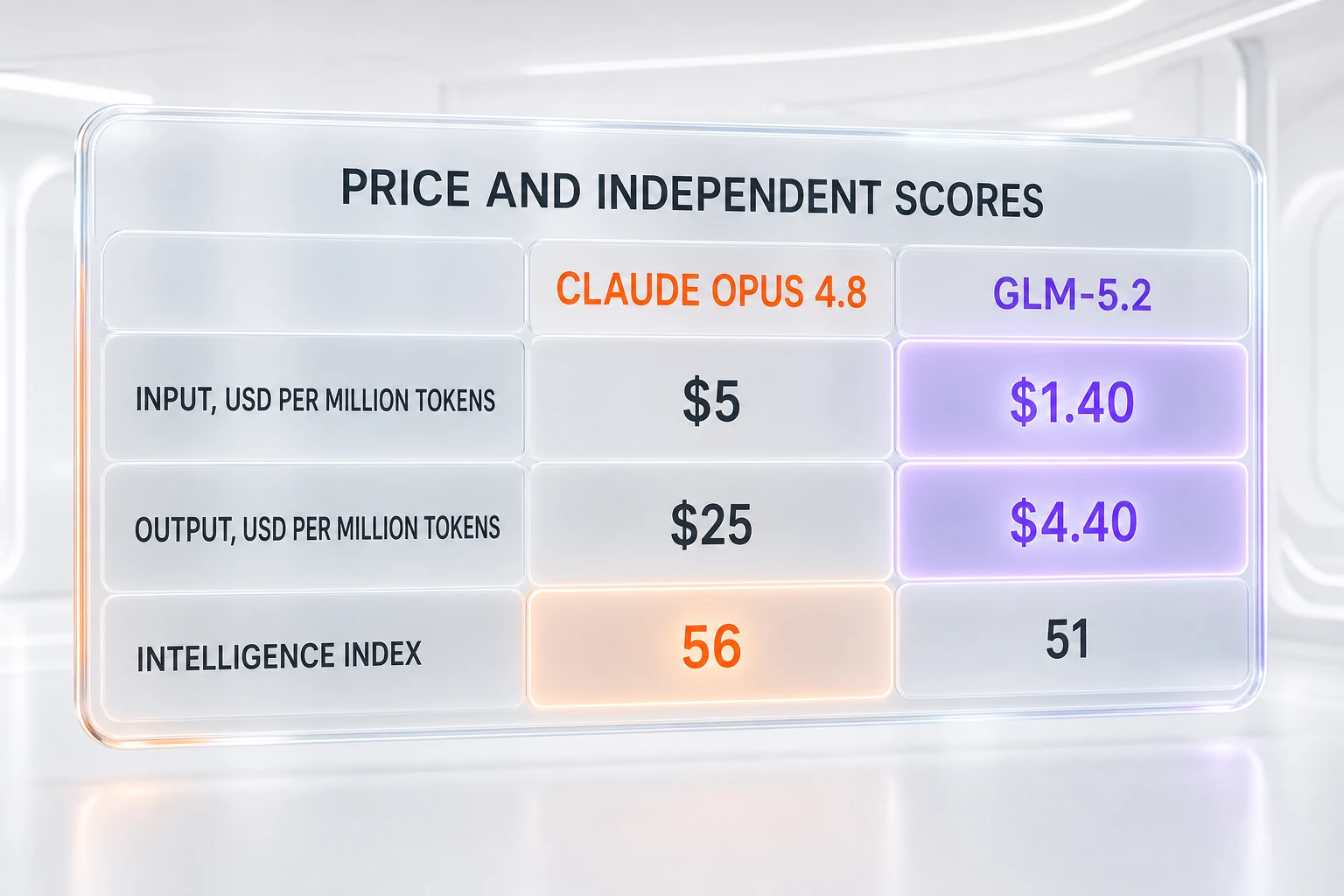
Pricing: The Gap Is About 5.7 Times on Output
Now the part that decides most real purchases.
Claude Opus 4.8 is metered at $5 per million input tokens and $25 per million output tokens on the standard tier. Fast Mode, which Anthropic positions as roughly 2.5 times quicker, doubles both: $10 per million input tokens and $50 per million output tokens.
GLM-5.2 is metered at $1.40 per million input tokens, $0.26 per million cached input tokens, and $4.40 per million output tokens. There is also a flat GLM Coding Plan from around $18 per month, and — the option no closed model can offer — you can skip the meter entirely by running the MIT-licensed weights on compute you already pay for.
Against the standard Opus tier, GLM-5.2 is about 3.6 times cheaper on input and about 5.7 times cheaper on output. Against Fast Mode, it is about 7.1 times cheaper on input and about 11.4 times cheaper on output. Those multiples do not stay abstract for long. Take a mid-sized engineering team burning 50 million input tokens and 20 million output tokens in a month — a realistic figure for a handful of developers running coding agents daily:
- Claude Opus 4.8 (standard): 50 million input tokens at $5 per million is $250, plus 20 million output tokens at $25 per million is $500. Total: $750 per month.
- Claude Opus 4.8 (Fast Mode): $500 of input plus $1,000 of output. Total: $1,500 per month.
- GLM-5.2 (hosted API): 50 million input tokens at $1.40 per million is $70, plus 20 million output tokens at $4.40 per million is $88. Total: $158 per month.
That is a difference of $592 per month, or about $7,100 per year, for the same nominal workload — roughly 4.7 times the bill. Multiply the workload by ten, which is a normal trajectory once agents move from a pilot to a platform, and you are comparing $7,500 a month with $1,580 a month: a gap of about $71,000 a year. Five points of independent intelligence, five figures of annual cost. That is the trade, stated plainly.
Two things keep this from being a rout, though, and both deserve honesty:
- Token cost is not total cost. If Opus 4.8 solves a task in one pass where GLM-5.2 needs two attempts and a human correction, the cheaper model was not cheaper. Engineering time is more expensive than tokens by an order of magnitude, and a model that reliably finishes autonomous work can pay for a 5.7-times token premium with a single avoided debugging session. Measure completion rate on your tasks, not price per token.
- Self-hosting is not free. A roughly 753-billion-parameter mixture-of-experts model needs serious hardware, and the sticker price of "free weights" arrives as GPU capacity, ops headcount, and uptime responsibility. Self-hosting wins on cost at sustained high volume, and on control at any volume. It rarely wins for a small team running occasional jobs — for those, GLM-5.2's hosted API or the flat coding plan is the pragmatic path.
We also do not have a published cached-input rate for Opus 4.8 in the figures we reviewed, so we are not scoring that row. GLM-5.2's $0.26 per million cached input tokens is documented, and for repetitive agent prompts with a large stable prefix, that is a meaningful additional saving on its side of the ledger.
Context: What Anthropic Has Not Published
Here is the one specification where we are going to give you a non-answer, and where a non-answer is the only responsible thing to give.
GLM-5.2 documents a one-million-token context window, with a maximum output of 131,072 tokens. That figure is published, and it is a headline feature: whole-repository prompts, long agent transcripts, and multi-document analysis all fit without a retrieval layer bolted on top.
For Claude Opus 4.8, Anthropic has not published a context-window figure in the materials we reviewed. We are not going to invent one. We are also not going to carry forward the numbers from earlier Opus generations, tempting as that is, because a specification you inherit is not a specification you verified — and models do change their limits between releases. As of July 13, 2026, the correct statement is: unknown, confirm with the vendor before you architect around it. If Anthropic publishes the figure, this page will be updated with it.
What that means in practice, today:
- If very long context is a hard requirement — you are feeding whole codebases, long legal corpora, or hours of agent history into a single call — GLM-5.2 is the model with a documented answer, and that alone can decide the choice.
- If your workloads sit comfortably inside a few hundred thousand tokens, this row is unlikely to be the thing that separates the two models, and you should let capability and cost drive the decision instead.
- Either way, do not design a pipeline around an assumed Opus 4.8 limit. Confirm it with Anthropic's own documentation before you commit, and build a chunking fallback if the answer matters to you.
We flag this because unstated specs are how production incidents happen. A comparison that fills the gap with a confident-sounding number is not being helpful — it is being wrong faster.
Open Weights vs Closed API: Ownership, Residency, Lock-in
Strip away the benchmarks and the price sheet and you are left with the real dividing line: one of these models is a service, and the other is an artifact you can own.
What GLM-5.2's MIT license actually buys you. You can download the weights, run them on your own infrastructure, fine-tune them on your own data, redistribute the result, and use all of that commercially without asking permission. Three consequences follow, and they are the reason serious buyers care:
- Data residency. Self-hosted, no prompt or completion leaves your network. For regulated industries, air-gapped environments, or anyone whose legal team has opinions about where inference happens, this is not a nice-to-have — it is the entire requirement. Note the flip side: if you use the hosted GLM API instead of self-hosting, that inference runs on Zhipu AI's infrastructure, which raises its own residency questions for Western buyers. The open weights are what neutralize that concern, so if residency is why you are here, plan to self-host.
- No lock-in. Owning the weights means no vendor can deprecate your model, change its pricing, rate-limit you, or alter its behavior underneath you. The version you validated is the version you keep running, for as long as you choose to run it. Anyone who has had a closed model silently updated mid-project understands exactly what this is worth.
- Fine-tuning. You can specialize the model on your codebase, your domain, your style. That is not available on Opus 4.8 at any price.
What Opus 4.8's closed model buys you in return. The counter-argument is not nothing. You get a managed, supported, continuously improved service with a mature first-party developer stack, SDKs, and an agentic ecosystem that has been hardened by scale. You get Fast Mode when latency matters. You get a vendor with a security and safety posture you can point to in a procurement review. And you get zero operational burden: no GPUs to provision, no inference stack to keep alive at 3 a.m., no capacity planning. For most teams, that convenience is worth real money — the honest question is whether it is worth about 5.7 times the output rate.
The pattern we keep seeing is that the answer is not uniform across a company. Teams are increasingly running both: the expensive flagship on the hard 10 percent of the work where failure is costly, and the open-weight model on the routine 90 percent where it is not. That is not fence-sitting — it is the correct architecture when the price ratio is this wide and the capability ratio is this narrow. If you want to see how the same logic plays out against other models in each camp, our Claude Opus 4.8 vs Kimi K2.7 Code and Claude Sonnet 5 vs GLM-5.2 comparisons run the same test on adjacent pairs, and Claude Fable 5 vs Claude Opus 4.8 covers what happens when you go up a tier instead of down.
Feature-by-Feature Comparison
Every row below is labeled by source. Rows where a directly comparable figure does not exist are marked as such rather than filled in with a guess.
| Feature | Claude Opus 4.8 | GLM-5.2 | Winner |
|---|---|---|---|
| Artificial Analysis Intelligence Index (independent) | 56 | 51 — the top open-weight score in the world | Opus 4.8 |
| SWE-bench Pro (both vendor-reported) | 69.2 (Anthropic self-reported) | 62.1 (Zhipu AI self-reported) | Opus 4.8 |
| SWE-bench Verified | 88.6 percent (Anthropic self-reported) | Not reported on this benchmark | No comparison possible |
| Input price (per million tokens) | $5 standard, $10 in Fast Mode | $1.40 ($0.26 cached) | GLM-5.2 |
| Output price (per million tokens) | $25 standard, $50 in Fast Mode | $4.40 | GLM-5.2 |
| Flat-rate plan | Metered per token in the published figures we reviewed | GLM Coding Plan from around $18 per month | GLM-5.2 |
| Model access and license | Closed, proprietary, API only | Open weights under an MIT license — mixture-of-experts, roughly 753B total and about 40B active | GLM-5.2 |
| Self-hosting and data residency | Not possible — vendor endpoints only | Download the weights and run them on your own compute | GLM-5.2 |
| Documented context window | Not specified by Anthropic for Opus 4.8 — confirm with the vendor | 1,000,000 tokens (output up to 131,072) | GLM-5.2 |
| Latency option | Fast Mode, about 2.5 times quicker, at $10 input and $50 output per million tokens | No comparable published fast tier in the figures we reviewed | Opus 4.8 |
| First-party ecosystem and support | Mature Anthropic developer stack, SDKs, first-party agentic tooling | Drop-in with third-party agentic coding tools; smaller first-party surface | Opus 4.8 |
| Benchmark transparency | Coding scores vendor-reported; index score independent | Coding score vendor-reported; index score independent | Tie |
Pros and Cons
Claude Opus 4.8 — Pros
- Highest measured capability of the pair: 56 on the independent Artificial Analysis Intelligence Index against GLM-5.2's 51
- Leads the one shared coding benchmark as well — 69.2 against 62.1 on SWE-bench Pro, both vendor-reported — so the capability lead is consistent across two different measures
- Fast Mode gives a latency lever no open-weight competitor here offers: about 2.5 times quicker for double the token price
- Mature first-party developer stack, SDKs, and agentic tooling, with a vendor and a support relationship a procurement team can point to
- Zero operational burden — no GPUs to provision, no inference stack to keep alive
Claude Opus 4.8 — Cons
- Expensive: $25 per million output tokens is about 5.7 times GLM-5.2's rate, and Fast Mode doubles that to $50
- Closed and proprietary — no self-hosting, no fine-tuning, no data residency control, and no way to freeze the version you validated
- Anthropic has not published a context-window figure for Opus 4.8 in the materials we reviewed, which is a real planning gap for long-context work
- Both of its coding scores are self-reported and not independently reproduced at the time of writing
- Full vendor lock-in: pricing, availability, and model behavior are all Anthropic's to change
GLM-5.2 — Pros
- MIT open weights: download, self-host, fine-tune, redistribute, and use commercially without permission
- Dramatically cheaper — $1.40 input and $4.40 output per million tokens, about 3.6 times and 5.7 times below Opus 4.8, plus $0.26 cached input and a flat coding plan from around $18 per month
- Top open-weight model in the world on the independent index at 51, which is roughly 91 percent of Opus 4.8's score
- Documented one-million-token context window with output up to 131,072 tokens — a published figure, where Opus 4.8 has none
- Self-hosting answers data-residency requirements outright and eliminates vendor lock-in entirely
GLM-5.2 — Cons
- Measurably behind on capability: five points down on the independent index and seven points down on the shared vendor-reported coding benchmark
- The gap widens exactly where it hurts most — long, unattended agent runs on ambiguous code, where recovering from a wrong assumption is the whole job
- Open weights, not open source: the training code and data recipe are not released, so full auditability is not on the table
- The hosted API runs on Zhipu AI's infrastructure, which raises residency questions unless you self-host
- Self-hosting a roughly 753-billion-parameter mixture-of-experts model is a real infrastructure project — "free weights" arrive as GPU capacity, ops headcount, and uptime responsibility
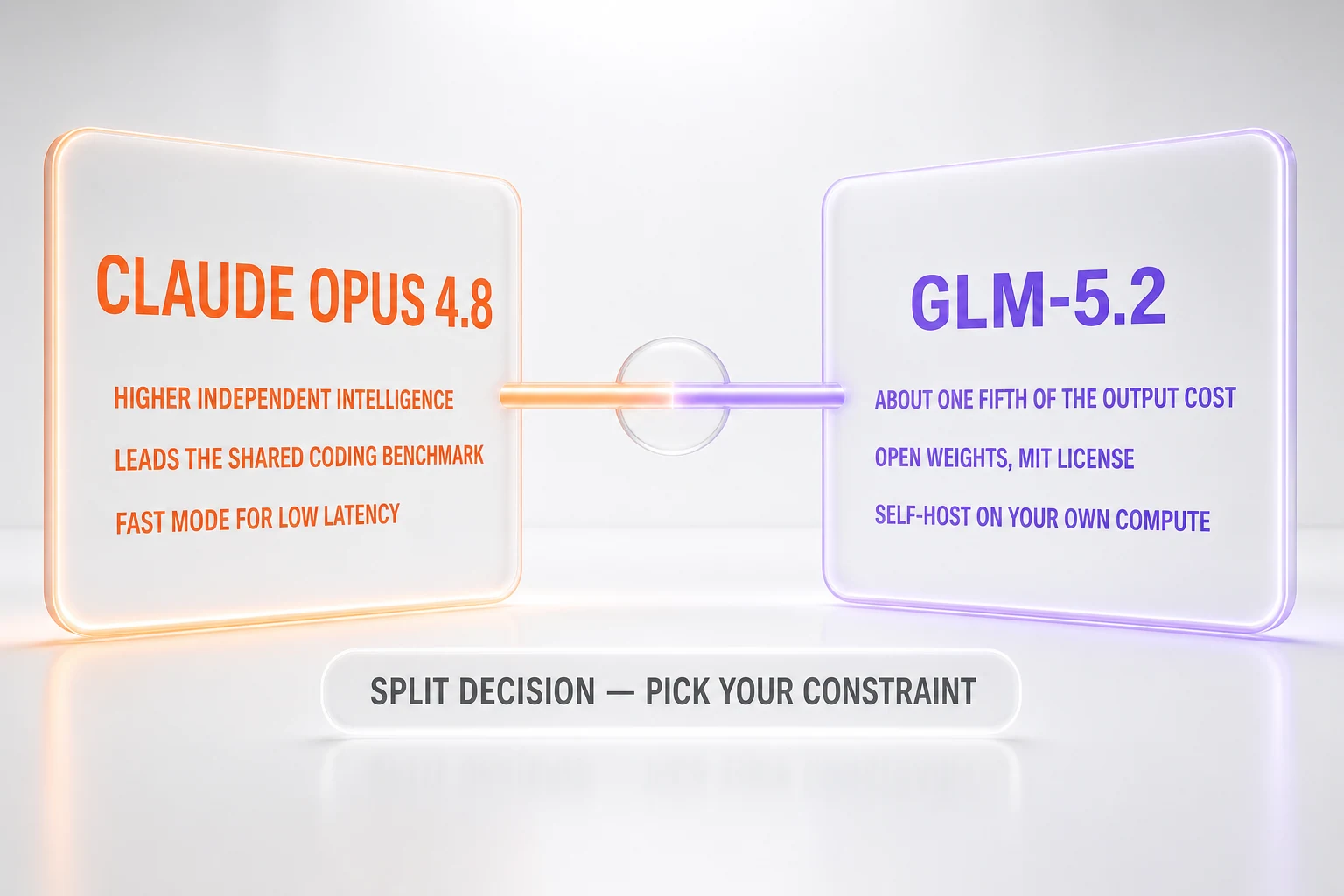
When to Pick Each Model
The decision rule is simpler than the spec sheet suggests. Ask one question: is the model's output what your customers pay for, or is it infrastructure you burn at volume?
Pick Claude Opus 4.8 when
- Failure is expensive. Unattended agents on production code, long autonomous sessions, refactors where a wrong turn costs an engineer a day. The five-point independent lead and the seven-point coding lead concentrate exactly here, and one avoided debugging session pays for a lot of $25 output tokens.
- Quality is the product. If your users are paying for what the model writes, spending 5.7 times more on output to get the best available model is not extravagance — it is your cost of goods sold, and it is still small next to payroll.
- Latency is a feature. Interactive agents, developer-facing loops, anything where a user is watching a spinner. Fast Mode has no equivalent on the other side of this comparison.
- You have no appetite for infrastructure. No GPU budget, no ops team, no desire to be in the inference business. Renting the flagship is the correct call.
- Procurement wants a throat to choke. A named vendor, a support contract, and a published safety posture clear compliance hurdles that "we downloaded the weights" does not.
Pick GLM-5.2 when
- Volume is your constraint. High-throughput pipelines, batch code generation, bulk analysis. At scale the arithmetic is brutal: about $71,000 a year separates the two on a workload of 500 million input and 200 million output tokens per month, and GLM-5.2 gives up only five points of index to save it.
- Data cannot leave your network. Regulated industries, air-gapped environments, sensitive codebases. Self-hosted MIT weights are the only answer here that a closed API can never match — and this is the case where GLM-5.2 does not merely win, it is the sole option of the two.
- Lock-in is a board-level risk. Owning the weights means no deprecation, no surprise price change, no silent behavior drift. You keep running the version you validated for as long as you want.
- You need very long documented context. One million tokens, published. Opus 4.8 has no stated figure at the time of writing, so if this is load-bearing, GLM-5.2 is the model with an answer.
- You want to fine-tune. Specializing the model on your codebase or domain is possible with GLM-5.2 and impossible with Opus 4.8.
Run both when
- Your workload splits cleanly into hard and routine — which, for most engineering organizations, it does. Route the difficult, high-stakes, unattended work to Opus 4.8 and everything else to GLM-5.2. With the price ratio this wide and the capability ratio this narrow, a two-model routing layer usually pays for itself in the first month, and both models drop into the same agentic tooling, so the switching cost is a config line rather than a migration.
Final Verdict
There is no overall winner here, and calling one would require ignoring half the evidence. Claude Opus 4.8 is the more capable model, and we are not going to soften that because the number is inconvenient for the cheaper option: 56 against 51 on the only independent index that covers both, and 69.2 against 62.1 on the only coding benchmark both vendors report. Two different measures, same direction, no ambiguity. If capability is what you are buying, Opus 4.8 is what you buy.
GLM-5.2 answers with the other half of the evidence, and it is just as unambiguous. It costs $1.40 and $4.40 per million input and output tokens against $5 and $25 — about a fifth of the output bill — it publishes a one-million-token context window where Anthropic publishes nothing for Opus 4.8, and its MIT-licensed weights let you self-host, fine-tune, and walk away from vendor risk entirely. It gives up roughly 9 percent of the measured intelligence to do all of that. Framed as a ratio rather than a rank, that is the best value proposition in the open-weight market right now.
So the verdict is a split decision, and the tie-breaker is not a benchmark — it is your cost structure. If the model's output is your product and a failed autonomous run costs you an engineer's afternoon, five points of intelligence is cheap and you should stop optimizing the invoice. If the model is infrastructure you burn at volume, or if your data cannot leave the building, GLM-5.2 at about a fifth of the output cost, running on hardware you control, is the more rational purchase — and at 51 on the independent index you are no longer sacrificing much to get it.
One last piece of advice that applies whichever way you lean: the coding numbers on both sides are vendor-reported, and the context window on one side is unpublished. Neither is a reason to distrust the models, but both are reasons to test rather than trust. Run both on your own repository, on your own hardest tickets, and count completion rates instead of leaderboard points. The gap you measure on your work is the only one that will show up on your invoice.
Frequently Asked Questions
Is Claude Opus 4.8 better than GLM-5.2?
On capability, yes, and by a consistent margin: Claude Opus 4.8 scores 56 on the Artificial Analysis Intelligence Index against GLM-5.2's 51 — the only independent benchmark that covers both — and 69.2 against 62.1 on SWE-bench Pro, the only coding benchmark both vendors report, though both of those coding figures are vendor self-reported rather than independently verified. On economics, the answer flips completely: GLM-5.2 costs $1.40 per million input tokens and $4.40 per million output tokens against Opus 4.8's $5 and $25, which is about 3.6 times and 5.7 times cheaper, and its MIT-licensed weights can be self-hosted and fine-tuned, which Opus 4.8 cannot. Opus 4.8 is the better model; GLM-5.2 is often the better purchase. Which one is right depends on whether the last 9 percent of measured intelligence is worth roughly five times the output bill on your workload.
How much cheaper is GLM-5.2 than Claude Opus 4.8?
On the hosted APIs, GLM-5.2 charges $1.40 per million input tokens and $4.40 per million output tokens, against Claude Opus 4.8's $5 and $25 on the standard tier. That is about 3.6 times cheaper on input and about 5.7 times cheaper on output. Against Opus 4.8's Fast Mode, at $10 and $50 per million tokens, GLM-5.2 is roughly 7.1 times and 11.4 times cheaper. In practical terms, a team burning 50 million input tokens and 20 million output tokens a month pays about $750 on standard Opus 4.8 and about $158 on GLM-5.2 — a difference of $592 a month, or about $7,100 a year, for the same nominal workload. GLM-5.2 also offers cached input at $0.26 per million tokens, a flat GLM Coding Plan from around $18 per month, and the option to self-host the MIT-licensed weights with no per-token vendor fee at all.
What is the SWE-bench Pro difference between Claude Opus 4.8 and GLM-5.2?
Anthropic reports 69.2 on SWE-bench Pro for Claude Opus 4.8, and Zhipu AI reports 62.1 for GLM-5.2 — a gap of about seven points in Opus 4.8's favor. These two figures are directly comparable in one important sense: they are the same benchmark measured under the same reporting regime, since both are self-reported by the vendor that built the model. That makes the seven-point gap a real signal, and it points in the same direction as the independent Artificial Analysis Intelligence Index, which is the strongest reason to believe it. What it is not is an independently verified result, so treat it as a well-supported claim rather than a settled fact.
Are the coding benchmark scores independently verified?
No. Every SWE-bench figure in this comparison is vendor self-reported: Anthropic's 88.6 percent on SWE-bench Verified and 69.2 on SWE-bench Pro for Claude Opus 4.8, and Zhipu AI's 62.1 on SWE-bench Pro for GLM-5.2. None has been reproduced by a neutral third party at the time of writing. Vendors choose their own scaffolding, retry budgets, and prompt templates, and those choices routinely swing SWE-bench results by several points, so first-party numbers deserve an asterisk even when they are honestly produced. The only independently measured figure that covers both models is the Artificial Analysis Intelligence Index, where Opus 4.8 scores 56 and GLM-5.2 scores 51. That is the number to lean on when you want a comparison neither vendor controls.
Can I compare Claude Opus 4.8's 88.6 percent to GLM-5.2's 62.1?
No, and this is the single most common mistake in comparisons of these two models. Opus 4.8's 88.6 percent is on SWE-bench Verified, while GLM-5.2's 62.1 is on SWE-bench Pro. Those are different benchmarks with different task sets and different difficulty levels, so placing the two numbers side by side manufactures a 26-point gap that does not exist anywhere in reality. The only legitimate coding comparison between these models is SWE-bench Pro against SWE-bench Pro: 69.2 for Opus 4.8 against 62.1 for GLM-5.2, both vendor-reported. If you see a chart stacking 88.6 percent next to 62.1, that chart is wrong and so is anything built on it.
What context window does Claude Opus 4.8 have?
Anthropic has not published a context-window figure for Claude Opus 4.8 in the materials we reviewed, and as of July 13, 2026 we are not aware of an official number. We deliberately do not carry forward the limits from earlier Opus generations, because a specification you inherit is not a specification you verified, and models do change their limits between releases. If long context is central to your workflow, confirm the current limit directly with Anthropic's documentation before you architect around it, and build a chunking fallback if the answer is load-bearing for you. We will update this page if and when Anthropic states the figure.
Which model has the larger documented context window?
GLM-5.2, because it is the only one of the two with a published figure. Zhipu AI documents a one-million-token context window for GLM-5.2, with a maximum output of 131,072 tokens, which comfortably supports whole-repository prompts and long autonomous agent transcripts without an external retrieval layer. Anthropic has not stated a context window for Claude Opus 4.8 in the materials we reviewed, so this row is a win for GLM-5.2 on documentation rather than a proven win on raw capacity. If you need a guaranteed, contractually stated long-context limit today, GLM-5.2 is the model that gives you one.
Can I self-host GLM-5.2, and is it really open source?
You can self-host it, and that is the single biggest structural advantage it has over Claude Opus 4.8. Zhipu AI released the GLM-5.2 weights under an MIT license, which means you can download them, run them on your own compute, fine-tune them, redistribute them, and use all of that commercially without asking permission. The precise term, though, is open weights rather than open source: the model artifact is published, but the training code and the data recipe are not, so you can run and modify the model without being able to rebuild it from scratch. Be careful writing fully open source into a compliance document. Also budget honestly for the hardware — a roughly 753-billion-parameter mixture-of-experts model with about 40 billion active parameters is a serious infrastructure commitment, and free weights arrive as GPU capacity, ops headcount, and uptime responsibility.
What is Claude Opus 4.8 Fast Mode, and is it worth the price?
Fast Mode is Anthropic's low-latency tier for Claude Opus 4.8, positioned as roughly 2.5 times quicker than the standard tier, and it costs $10 per million input tokens and $50 per million output tokens — exactly double the standard $5 and $25. Whether it is worth it comes down to whether a human is waiting. For interactive developer loops, user-facing agents, or anything where somebody is watching a spinner, cutting the wait by more than half is often worth more than the tokens cost, because the expensive resource in that moment is attention, not compute. For batch pipelines and unattended overnight jobs, it is money set on fire — nobody is watching, so pay the standard rate. For reference, GLM-5.2 has no comparable published fast tier, and at $50 per million output tokens Fast Mode sits about 11.4 times above GLM-5.2's $4.40.
Which model is better for agentic coding at high volume?
At genuinely high volume, GLM-5.2 usually wins on the arithmetic, but only if your completion rate holds up. Take a workload of 500 million input and 200 million output tokens a month: Claude Opus 4.8 costs about $7,500 and GLM-5.2 about $1,580, a difference of roughly $71,000 a year. GLM-5.2 gives up five points on the independent index and about seven on vendor-reported SWE-bench Pro to save that. The catch is that token cost is not total cost — if Opus 4.8 finishes an unattended run where GLM-5.2 needs a second attempt and a human correction, the cheaper model was not cheaper, because engineering time is more expensive than tokens by an order of magnitude. Measure completion rate on your own tasks before you let the price sheet decide, and consider routing the hard, unattended work to Opus 4.8 and the routine bulk to GLM-5.2.
Is GLM-5.2 good enough to replace Claude Opus 4.8 entirely?
For many teams, yes — but not for every workload, and being honest about which is the whole job. GLM-5.2 scores 51 on the independent Artificial Analysis Intelligence Index against Opus 4.8's 56, which is roughly 91 percent of the capability at about a fifth of the output price. On well-scoped tasks — write this function, fix this failing test, refactor this module — the two are close enough in practice that a blind review struggles to separate them. Where Opus 4.8 pulls away is long, unattended agent runs on ambiguous code, where the model has to notice that an earlier assumption was wrong and back out of it. If that describes your hardest work, keep Opus 4.8 for it and move everything else to GLM-5.2. A full replacement is a real option; a routing layer is usually the better one.
What is the Artificial Analysis Intelligence Index, and why does it matter here?
It is a composite intelligence score produced by an independent third-party lab that runs every model through the same evaluation harness, which is precisely what makes it useful: the scores are directly comparable in a way that vendors' own benchmark tables are not. It matters enormously in this comparison because it is the only independent figure that covers both models — Claude Opus 4.8 scores 56, GLM-5.2 scores 51, and GLM-5.2's 51 is the highest score any open-weight model in the world has posted. Every other capability number on this page comes from the vendor that built the model. When you need a comparison that neither Anthropic nor Zhipu AI controls, this is the one to use, and it says the same thing the vendor benchmarks do: Opus 4.8 is ahead, and the lead is real but not enormous.
Sources and references
Every figure on this page is attributed to whoever produced it. Vendor documentation and independent measurement are listed separately and never merged into a single ranking.
- Artificial Analysis — Claude Opus 4.8 (independent index score and cost per task)
- Hugging Face — zai-org/GLM-5.2 (published weights and license)
- Artificial Analysis — GLM-5.2 (independent index score and cost per task)
- Artificial Analysis — Model leaderboard (Intelligence Index scores and cost per task across configurations)
Our Verdict
This is a split decision, and both halves of it are emphatic. Claude Opus 4.8 is the more capable model, and the evidence points one way: 56 against GLM-5.2's 51 on the Artificial Analysis Intelligence Index — the only independent yardstick that scores them both — and 69.2 against 62.1 on SWE-bench Pro, the only coding benchmark both vendors report, though both of those coding figures are vendor self-reported rather than independently reproduced. Two different measures, same direction. GLM-5.2 answers with economics that are just as decisive: $1.40 input and $4.40 output per million tokens against Opus 4.8's $5 and $25, which is about 3.6 times and 5.7 times cheaper, plus MIT-licensed open weights you can self-host and fine-tune, a documented one-million-token context window where Anthropic publishes no figure at all for Opus 4.8, and a flat coding plan from around $18 per month. It gives up roughly 9 percent of measured intelligence to do all of that. The tie-breaker is not a benchmark, it is your cost structure: if the model's output is your product and a failed unattended run costs an engineer a day, five points of intelligence is cheap and you should stop optimizing the invoice. If the model is infrastructure you burn at volume, or if your data cannot leave your network, GLM-5.2 at about a fifth of the output cost, running on hardware you control, is the more rational purchase. Most engineering organizations should route the hard, unattended work to Opus 4.8 and everything else to GLM-5.2. One caveat that applies either way: the coding numbers on both sides are vendor-reported and Opus 4.8's context window is unpublished, so test on your own repository instead of trusting either leaderboard.
Choose Claude Opus 4.8
Anthropic's flagship model for agentic coding, computer use, and multi-agent orchestration.
Try Claude Opus 4.8 →Choose GLM-5.2
Zhipu AI open-weight coding flagship: 753B MoE (~40B active), 1M context, MIT license, headline SWE-bench Pro 62.1 (vendor self-reported); GLM Coding Plan from around $18 per month or $1.40 in / $4.40 out per million tokens.
Try GLM-5.2 →Frequently Asked Questions
Is Claude Opus 4.8 better than GLM-5.2?
This is a split decision, and both halves of it are emphatic. Claude Opus 4.8 is the more capable model, and the evidence points one way: 56 against GLM-5.2's 51 on the Artificial Analysis Intelligence Index — the only independent yardstick that scores them both — and 69.2 against 62.1 on SWE-bench Pro, the only coding benchmark both vendors report, though both of those coding figures are vendor self-reported rather than independently reproduced. Two different measures, same direction. GLM-5.2 answers with economics that are just as decisive: $1.40 input and $4.40 output per million tokens against Opus 4.8's $5 and $25, which is about 3.6 times and 5.7 times cheaper, plus MIT-licensed open weights you can self-host and fine-tune, a documented one-million-token context window where Anthropic publishes no figure at all for Opus 4.8, and a flat coding plan from around $18 per month. It gives up roughly 9 percent of measured intelligence to do all of that. The tie-breaker is not a benchmark, it is your cost structure: if the model's output is your product and a failed unattended run costs an engineer a day, five points of intelligence is cheap and you should stop optimizing the invoice. If the model is infrastructure you burn at volume, or if your data cannot leave your network, GLM-5.2 at about a fifth of the output cost, running on hardware you control, is the more rational purchase. Most engineering organizations should route the hard, unattended work to Opus 4.8 and everything else to GLM-5.2. One caveat that applies either way: the coding numbers on both sides are vendor-reported and Opus 4.8's context window is unpublished, so test on your own repository instead of trusting either leaderboard.
Which is cheaper, Claude Opus 4.8 or GLM-5.2?
Claude Opus 4.8 starts at $5 in / $25 out per M tokens. GLM-5.2 starts at $1.4 in / $4.4 out per M tokens. Check the pricing comparison section above for a full breakdown.
What are the main differences between Claude Opus 4.8 and GLM-5.2?
The key differences span across 12 features we compared. For Artificial Analysis Intelligence Index (independent), Claude Opus 4.8 offers 56 while GLM-5.2 offers 51 — the top open-weight score in the world. For SWE-bench Pro, agentic coding (both vendor-reported), Claude Opus 4.8 offers 69.2 (Anthropic self-reported) while GLM-5.2 offers 62.1 (Zhipu AI self-reported). For SWE-bench Verified, Claude Opus 4.8 offers 88.6 percent (Anthropic self-reported) while GLM-5.2 offers Not reported on this benchmark — no comparison possible. See the full feature comparison table above for all details.