Claude Opus 5 vs GPT-5.6 Terra: Frontier Model Against Mid-Tier


Opus 5 at medium scores 56 for $0.62 per task, beating Terra at max (55, $0.82). Effort level matters more than model choice here.
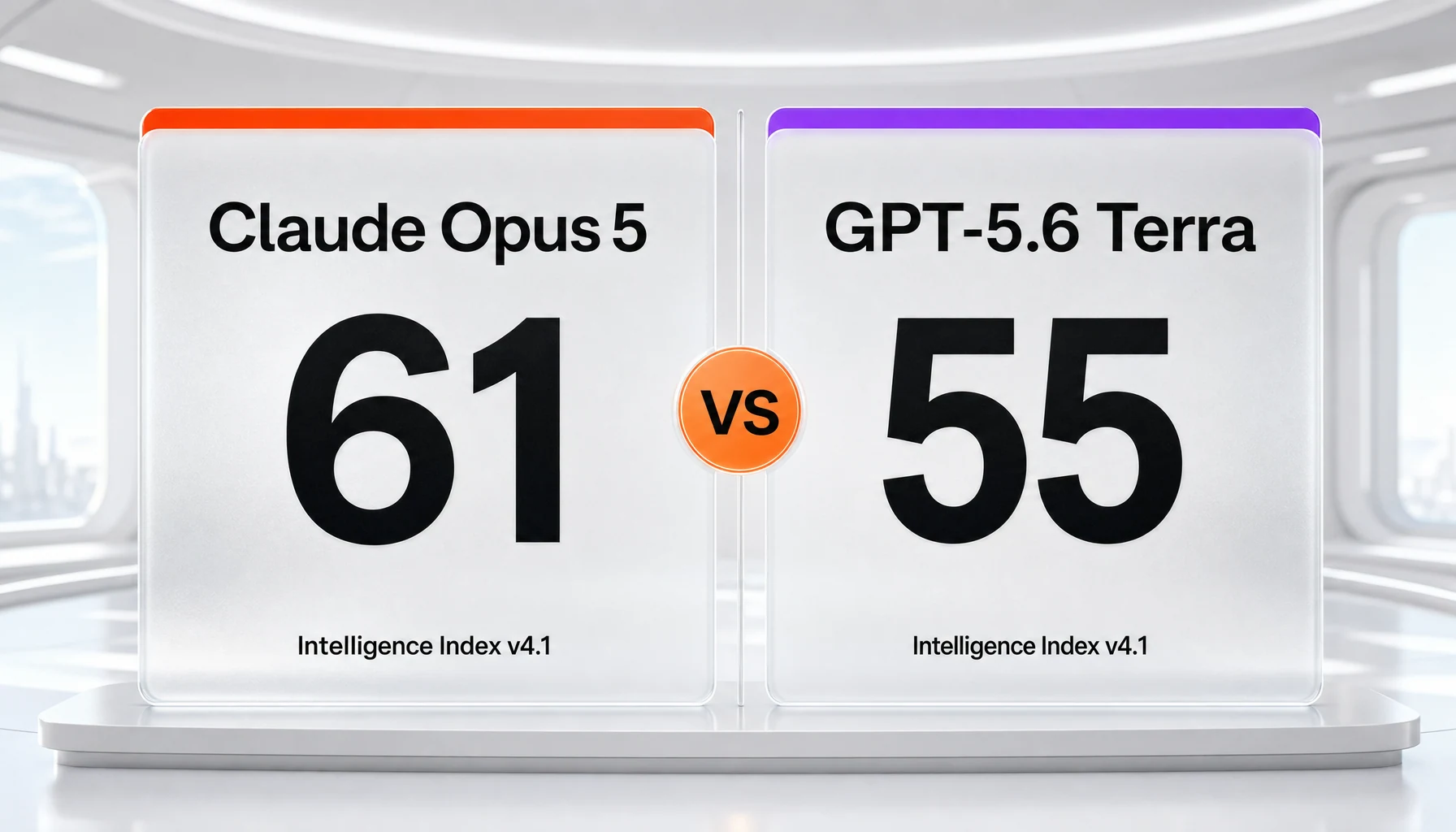
Feature Comparison
| Feature | Claude Opus 5 | GPT-5.6 Terra |
|---|---|---|
| Intelligence Index at max effort | 61 | 55 |
| Cost per task at max effort (measured July 27, 2026) | $2.03 | $0.82 |
| Intelligence Index at medium effort | 56 | 46 |
| Cost per task at medium effort (measured July 27, 2026) | $0.62 | $0.18 |
| Best score available below $1.00 per task | 56 at medium effort, $0.62 | 55 at max effort, $0.82 |
| Score span across effort levels | 51 to 61 (10 points) | 40 to 55 (15 points) |
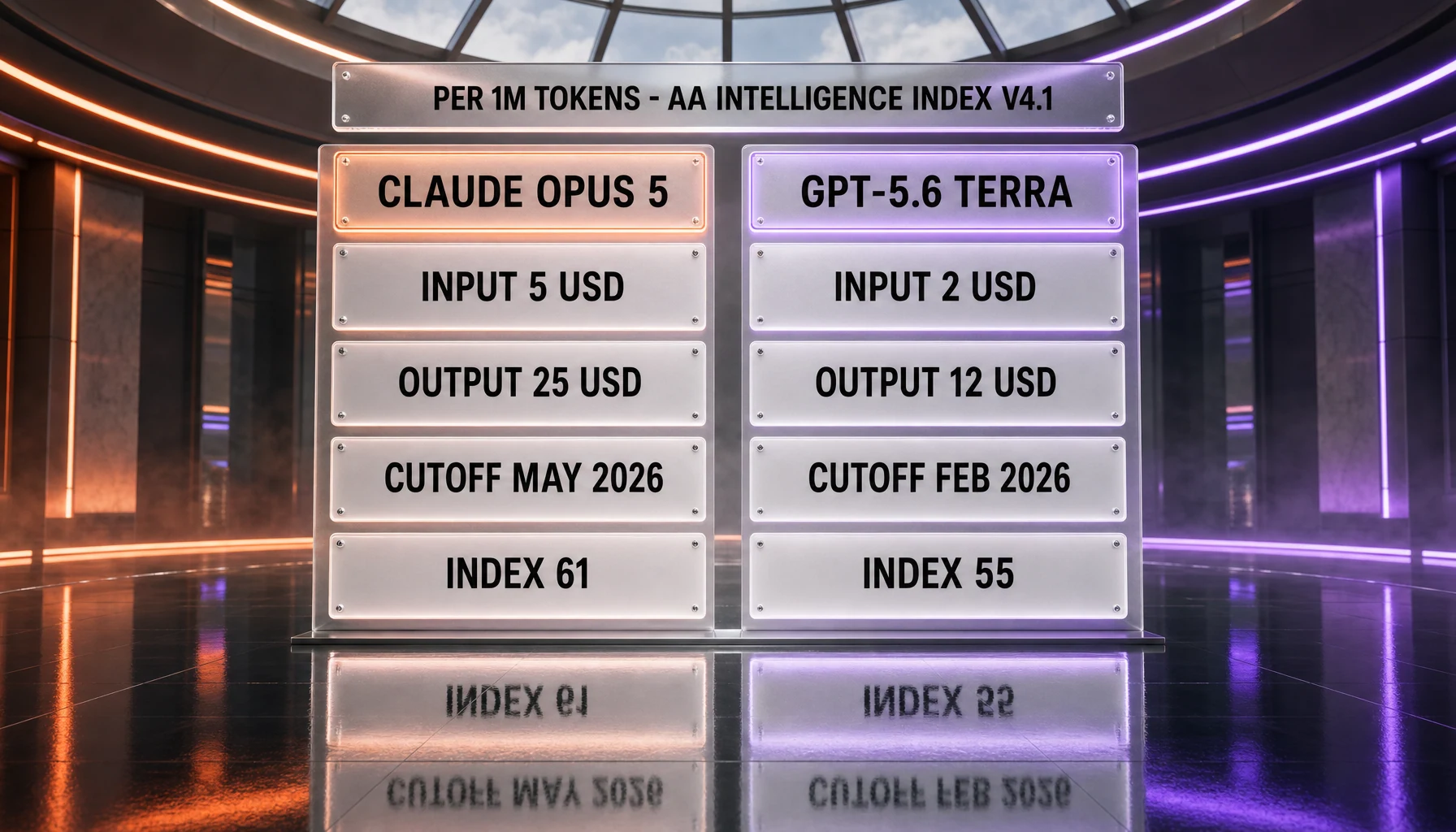
| Input price per 1M tokens | $5 | $2 |
| Output price per 1M tokens | $25 | $12 |
| Context window | 1M tokens | 1,050,000 tokens |
| Long-context surcharge | None across the full 1M window | 2 times input and 1.5 times output above 272,000 input tokens |
| Knowledge cutoff | May 2026 | February 16, 2026 |
| Effort levels and default | Five documented, default high | Not published on the model page |
| Output speed (measured July 27, 2026) | 53.7 tokens per second | 132.6 tokens per second |
| Time to first token (measured July 27, 2026) | 68.04 seconds | 160.11 seconds |
Pricing Comparison
Claude Opus 5
GPT-5.6 Terra
Detailed Comparison
Claude Opus 5 and GPT-5.6 Terra are not two flagships trading blows — they sit in different tiers, and the most useful finding is not which one wins. On the independent Artificial Analysis Intelligence Index, both measured at max effort, Claude Opus 5 scores 61 at $2.03 per task and GPT-5.6 Terra scores 55 at $0.82 per task, so Opus 5 costs about 2.5 times as much for 6 more points. But Artificial Analysis publishes both models at five effort levels, and the ladder overturns the obvious conclusion: Claude Opus 5 at medium effort scores 56 for $0.62 per task, which is one point above Terra at its maximum and 24 percent cheaper. Anthropic prices Opus 5 at $5 per million input tokens and $25 per million output tokens; OpenAI prices Terra at $2 and $12. The real lesson is that on these two models, the effort level you choose moves the result more than the model you choose.
Quick Verdict
This is a tier comparison, not a title fight — and the effort setting matters more than the badge on the box. We researched both models rather than claiming a controlled bake-off: every number below comes from Anthropic's and OpenAI's own documentation or from Artificial Analysis, an independent evaluator, and each is attributed where it appears. Vendor-reported claims are labeled as vendor claims and never stacked on top of independent scores.
- Best at peak capability: Claude Opus 5. It scores 61 at max effort against Terra's 55, the widest gap in the current tier-one set.
- Best value at matched effort: GPT-5.6 Terra. At every one of the five effort levels, Terra costs less per task than Opus 5 at the same setting.
- Best single configuration on this page: Claude Opus 5 at medium effort — 56 points for $0.62 per task, one point above Terra's best result at 24 percent lower cost.
- Best for very long prompts: Claude Opus 5. Anthropic bills the full 1M-token context window at standard rates, while OpenAI charges 2 times input and 1.5 times output on any Terra request above 272,000 input tokens.
- Best for sustained throughput: GPT-5.6 Terra, at 132.6 tokens per second against 53.7 for Opus 5 (measured July 27, 2026).
- Best for recent knowledge: Claude Opus 5, with a May 2026 cutoff against Terra's February 16, 2026.
- Overall winner: none declared. Each model wins outright somewhere on the ladder, and the configuration you pick decides the outcome more than the vendor does.
Why is this a frontier model against a mid-tier model?
GPT-5.6 Terra is the balanced tier of OpenAI's GPT-5.6 generation, sitting below GPT-5.6 Sol, which scores 59 at max effort. Claude Opus 5 is Anthropic's model for complex agentic coding and enterprise work. The 6-point gap at max effort is the widest in our current tier-one set, and it exists because the two models are aimed at different jobs.
Most head-to-head model pages are written as though every pairing were a close contest. This one is not, and saying so plainly is more useful than manufacturing suspense. OpenAI ships GPT-5.6 in tiers: GPT-5.6 Sol is the capability flagship at 59, and Terra is the balanced tier at 55, priced at 40 percent of Sol's output rate. If you want OpenAI's answer to a frontier Anthropic model, Sol is the structurally fair opponent, and we cover that pairing separately in GPT-5.6 Sol vs GPT-5.6 Terra.
So the interesting question is not "which model wins" — the index already answers that — but the one you are actually asking: when is the cheaper mid-tier model good enough? That question has a precise answer here, and it is not the one the price list suggests.
What do the independent benchmarks actually say?
Artificial Analysis publishes both models at five separate effort levels on its leaderboard, each with an Intelligence Index score and a cost per task. Claude Opus 5 runs from 51 at low effort to 61 at max; GPT-5.6 Terra runs from 40 to 55. Opus 5 scores higher than Terra at every matched effort level, and Terra costs less at every matched level.
Reading a single pair of numbers off these two models would have been misleading, because a score only means something alongside its index version and the effort level it was produced at. Below is the full published ladder rather than one row of it.
One caveat travels with every cost-per-task figure on this page, and it is not decoration. We read them on July 27, 2026, three days before OpenAI cut the GPT-5.6 list prices on July 30, 2026. Because Artificial Analysis derives cost per task from tokens consumed multiplied by the prices in force when it measures, its Terra figures were produced at Terra's former rates of $2.50 and $15 rather than the current $2 and $12, and it is likely to republish lower figures for Terra. Claude Opus 5's numbers are unaffected, because Anthropic's rates did not change. We report these figures as measured rather than recomputing them ourselves, but the Terra column should be read as an upper bound until Artificial Analysis re-measures.
Intelligence Index and cost per task, by effort level
| Effort level | Claude Opus 5 score | Claude Opus 5 cost per task | GPT-5.6 Terra score | GPT-5.6 Terra cost per task | Point gap |
|---|---|---|---|---|---|
| max | 61 | $2.03 | 55 | $0.82 | 6 |
| xhigh | 60 | $1.56 | 52 | $0.48 | 8 |
| high | 59 | $1.06 | 49 | $0.34 | 10 |
| medium | 56 | $0.62 | 46 | $0.18 | 10 |
| low | 51 | $0.36 | 40 | $0.15 | 11 |
Artificial Analysis also lists a non-reasoning entry for GPT-5.6 Terra scoring 34 at $0.18 per task. That entry is worth one line of attention because it is dominated by Terra's own medium setting, which costs the same $0.18 and scores 12 points higher. If you are running Terra without reasoning to save money, the published data says you are paying the same and getting less.
Anthropic documents that Claude Opus 5 supports all five effort levels and that the API default is high — so an Opus 5 request you send without configuring anything lands on the 59-point, $1.06 row. OpenAI does not publish Terra's default effort level, which means the equivalent row for an unconfigured Terra request is not something we can name.
Where does the cheaper model stop being the cheaper choice?
At Claude Opus 5's medium effort setting. Opus 5 at medium scores 56 for $0.62 per task, while GPT-5.6 Terra at its maximum scores 55 for $0.82. That is one point higher for 24 percent less money — the frontier model, throttled down, beating the mid-tier model at full stretch on both score and cost simultaneously.
This is the finding that a price-list comparison cannot produce. Terra's published token prices are 40 percent of Opus 5's on input and 48 percent on output, which makes it look like the obvious budget option. Measured on completed tasks, that advantage survives only when you hold the effort level constant. Once you are free to move the dial, Opus 5 reaches into Terra's price range while carrying more capability with it.
The crossing works in the other direction too. Claude Opus 5 at low effort scores 51 for $0.36, which lands 4 points below Terra at max while costing 56 percent less — and 2 points above Terra at high effort for almost the same money ($0.36 against $0.34). Opus 5's ladder spans 51 to 61; Terra's spans 40 to 55. The two ranges overlap between 51 and 55, and inside that overlap the choice of effort level decides everything.
Put the two spans side by side and the conclusion is hard to avoid. Moving Claude Opus 5 from low to max buys 10 points and multiplies cost per task by about 5.6 times. Moving GPT-5.6 Terra from low to max buys 15 points at about 5.5 times the cost. The gap between the two models at any matched effort level is 6 to 11 points. In other words, the effort dial has a wider range of effect than the model badge does.
How much does each model cost?
Anthropic charges $5 per million input tokens and $25 per million output tokens for Claude Opus 5, with cache hits at $0.50 and Batch API pricing at $2.50 and $12.50. OpenAI charges $2.00 per million input tokens and $12.00 per million output tokens for GPT-5.6 Terra, with cached input at $0.20. Terra is cheaper on every published token line item.
| Published price | Claude Opus 5 | GPT-5.6 Terra |
|---|---|---|
| Input, per million tokens | $5 | $2 |
| Output, per million tokens | $25 | $12 |
| Cached input read, per million tokens | $0.50 | $0.20 |
| Cache write, 5 minutes, per million tokens | $6.25 | Not applicable |
| Cache write, 1 hour, per million tokens | $10 | Not applicable |
| Batch pricing, per million tokens | $2.50 input, $12.50 output | Not published on the model page |
| Surcharge above 272,000 input tokens | None | 2 times input, 1.5 times output, applied to the full request |
Read that table alone and Terra is half price. Read it next to the effort ladder and the picture changes, because a price per token is not a price per answer. A model that reasons longer to reach the same result costs more per finished task at a lower rate per token. That is why the cost-per-task column is the one we anchor on: it is published by the same evaluator, on the same index, for both models, at matched settings.
For completeness, Artificial Analysis also reports what it spent running the entire evaluation suite once per model: $3,835.51 for Claude Opus 5 at max effort against $2,060.40 for GPT-5.6 Terra at max. That is a different metric from cost per task — a single total for the whole index run rather than a per-task average — and we mention it only because it is published, not as the basis for any conclusion here.
What happens to the price on very long prompts?
This is the sharpest structural divide between the two. Anthropic's pricing documentation states that Claude 4.6 and later models "include the full 1M token context window at standard pricing," adding that "a 900k-token request is billed at the same per-token rate as a 9k-token request." OpenAI's Terra documentation states that "prompts with >272K input tokens are priced at 2x input and 1.5x output for the full request."
The phrase to notice in OpenAI's wording is for the full request. The surcharge is not applied only to the tokens above the 272,000 threshold — it reprices the entire request. Cross that line by a single token and the whole prompt bills at the higher rate. For a workload that regularly loads large repositories, long transcripts, or document sets into context, this narrows the price gap sharply: Terra's effective input rate above the threshold is $4 per million tokens against Opus 5's flat $5, and its output rate rises to $18 against Opus 5's flat $25. Terra stays the cheaper of the two, but most of its advantage is gone.
Both models offer comparable raw capacity — 1,050,000 tokens for Terra against 1M for Opus 5 — so the difference is not what fits, but what it costs once it does. If your prompts sit comfortably under 272,000 tokens, Terra's token-price advantage holds in full. If they straddle that line, model the bill before committing, because most of the cheaper model's advantage evaporates at exactly the point where long context is doing the work.
Why does the effort level matter more than the model?
Because the published spread within each model is wider than the spread between them. Claude Opus 5 moves 10 points across its five effort levels and GPT-5.6 Terra moves 15, while the gap between the two models at any matched effort level is between 6 and 11 points. A buyer comparing list prices without looking at the effort dial is optimizing the smaller variable.
Anthropic documents five effort levels for Claude Opus 5 — low, medium, high, xhigh and max — and states that the API default is high, on both the Claude API and Claude Code. Its own guidance is to "start with high, the default" and to use low and medium "liberally as your primary control for token cost and response time wherever your evals show quality holds." The measured ladder supports that advice: stepping from max down to the default high costs 2 points and cuts cost per task from $2.03 to $1.06, roughly in half.
There is one hard constraint worth knowing before you build. On Claude Opus 5, thinking cannot be disabled at xhigh or max effort, and requests that set thinking: {"type": "disabled"} at those levels return a 400 error. If your design depends on suppressing thinking, the top two rungs of the ladder are closed to you.
On the OpenAI side, the reasoning guide lists seven effort values across its reasoning models — none, minimal, low, medium, high, xhigh and max — while stating that "some models support only a subset of these values, so check the relevant model page before choosing a setting." The GPT-5.6 Terra model page does not publish which subset applies or which level is the default. Artificial Analysis evaluated Terra at five of them plus a non-reasoning mode, so those six configurations are demonstrably available, but the default remains unpublished and we do not guess at it.
Which model is faster?
Neither wins outright, because they lead on different measures. Measured July 27, 2026, GPT-5.6 Terra at max effort produces 132.6 tokens per second against 53.7 for Claude Opus 5 — roughly 2.5 times the throughput. But Terra takes 160.11 seconds to first token against Opus 5's 68.04 seconds, so Opus 5 starts answering well over twice as fast.
These are sliding measurements, not fixed properties of either model. Artificial Analysis re-measures throughput, latency and cost continuously, and providers adjust serving capacity, so the figures in this section carry the date we read them and will drift. Index scores behave differently: within a given index version they are stable, which is why we date the speed and cost figures but treat the ladder as a fixed reading of one index revision.
| Performance at max effort (measured July 27, 2026) | Claude Opus 5 | GPT-5.6 Terra |
|---|---|---|
| Output speed, tokens per second | 53.7 | 132.6 |
| Time to first token, seconds | 68.04 | 160.11 |
The practical read: for interactive work where a user is watching a cursor, Opus 5's much shorter wait to first token shapes the experience. For batch generation where total time to finish a long output matters, Terra's throughput advantage dominates. Anthropic also offers a research-preview fast mode for Opus 5 at premium pricing of $10 input and $50 output per million tokens, available on the Claude API only and not compatible with the Batch API.
Full specification comparison
Claude Opus 5 and GPT-5.6 Terra offer near-identical raw capacity — a 1M-token context window against 1,050,000, and a 128,000-token output ceiling on both. The meaningful differences are the knowledge cutoff, the long-context billing rule, the published effort defaults, and Opus 5's 300,000-token output ceiling on the Batch API.
| Specification | Claude Opus 5 | GPT-5.6 Terra |
|---|---|---|
| Vendor | Anthropic | OpenAI |
| Released | July 24, 2026 | July 9, 2026 |
| Context window | 1M tokens | 1,050,000 tokens |
| Max output, synchronous | 128,000 tokens | 128,000 tokens |
| Max output, batch | 300,000 tokens with the output-300k-2026-03-24 beta header | Not published on the model page |
| Knowledge cutoff | May 2026 | February 16, 2026 |
| Effort levels | Five: low, medium, high, xhigh, max | Five plus a non-reasoning mode measured by Artificial Analysis; the supported set is not published |
| Default effort | high, on the Claude API and Claude Code | Not published on the model page |
| Long-context surcharge | None across the full 1M window | Above 272,000 input tokens: 2 times input, 1.5 times output |
| Intelligence Index at max effort | 61 | 55 |
| Cost per task at max effort | $2.03 | $0.82 |
| Best score below $1.00 per task | 56 at medium, $0.62 | 55 at max, $0.82 |
One further operational note on Terra that favors high-volume deployment: OpenAI publishes rate limits rising to 15,000 requests per minute and 40,000,000 tokens per minute at Tier 5, with limits increasing automatically as API spend grows. Anthropic documents Start, Build and Scale tiers for Claude but directs customers beyond Scale to its sales team rather than publishing a comparable ceiling, so the two rate-limit structures cannot be compared line for line.
Pros and cons of each model
Claude Opus 5
Pros
- Scores higher than Terra at every matched effort level, by 6 to 11 points.
- At medium effort it scores 56 for $0.62 per task, beating Terra's best result of 55 while costing 24 percent less.
- Bills the full 1M-token context window at standard rates, with no long-context surcharge at any length.
- Knowledge cutoff of May 2026, roughly three months more recent than Terra's.
- Reaches first token in 68.04 seconds against Terra's 160.11 seconds, measured July 27, 2026.
- Five documented effort levels with a published default and vendor guidance on where to start.
Cons
- Costs more per task than Terra at every matched effort level, by roughly 2.4 to 3.4 times.
- 2.5 times Terra's published input price and about 2.1 times its output price.
- Sustained throughput of 53.7 tokens per second, well under half of Terra's.
- Thinking cannot be disabled at xhigh or max effort — those requests return a 400 error, which closes off the top of the ladder for latency-sensitive designs.
GPT-5.6 Terra
Pros
- Cheaper per task than Opus 5 at every matched effort level, and dramatically so at the bottom — $0.15 against $0.36 at low effort.
- 40 percent of Opus 5's published input price and 48 percent of its output price.
- 132.6 tokens per second of sustained output, roughly 2.5 times Opus 5's rate, measured July 27, 2026.
- Marginally the larger context window at 1,050,000 tokens.
- Published rate limits scaling to 15,000 requests per minute and 40,000,000 tokens per minute at Tier 5.
Cons
- Its best available result, 55 at max effort, is beaten by Opus 5 at medium effort on both score and cost.
- Requests above 272,000 input tokens reprice the entire request at 2 times input and 1.5 times output.
- Time to first token of 160.11 seconds at max effort, measured July 27, 2026.
- Knowledge cutoff of February 16, 2026, the older of the two.
- Neither the supported effort levels nor the default are published on the model page, which makes cost and latency harder to plan before you build.
- Its non-reasoning mode scores 34 at $0.18 per task, the same price as its medium setting, which scores 46.
When should you pick each one?
Pick the effort level first, then the model. If your budget lands near $0.60 per task, Claude Opus 5 at medium is the strongest configuration on this page. If it lands near $0.15 to $0.35, GPT-5.6 Terra is the only one of the two that reaches those rungs with reasoning enabled at a competitive score.
Choose Claude Opus 5 if
- You can spend $0.60 or more per task — at that point Opus 5 at medium outscores anything Terra offers, at any Terra setting.
- Your hardest tasks define the value of the system, and you want the 61-point ceiling available when you need it.
- Your prompts routinely exceed 272,000 tokens, where Terra's surcharge closes the price gap anyway.
- You need knowledge past February 2026.
- A person is waiting on the response and time to first token shapes the experience.
Choose GPT-5.6 Terra if
- Your budget per task sits below roughly $0.35, where Opus 5's ladder cannot follow at a comparable score.
- You are running high volumes of routine work — classification, extraction, summarization — well within reach of a 46-to-55-point model.
- Total throughput matters more than first-token latency, as in batch pipelines and offline generation.
- Your prompts stay under 272,000 input tokens, where its price advantage is undiluted.
- You need headroom on published rate limits for a high-concurrency deployment.
Consider a third option if
- You want OpenAI's frontier tier rather than its balanced tier — GPT-5.6 Sol scores 59 at max effort and is the structurally fairer opponent for a frontier Anthropic model.
- You want Anthropic capability at a lower rate — Claude Sonnet 5 is priced at $2 input and $10 output per million tokens.
- You are weighing a lower-cost alternative from outside the two big US labs — Kimi K3 is the other model we track in this tier.
- You are already on Claude Opus 4.8 and want to know what upgrading changes, which we cover in our Claude Opus 5 launch analysis.
Frequently asked questions
Is Claude Opus 5 better than GPT-5.6 Terra?
On measured intelligence, yes, at every matched effort level. Claude Opus 5 scores 61 at max effort against GPT-5.6 Terra's 55, and it leads by 6 to 11 points at each of the five settings Artificial Analysis publishes. But Terra costs less per task at every one of those settings, so "better" depends on the budget you are working to rather than on the models alone.
How much cheaper is GPT-5.6 Terra than Claude Opus 5?
On published token prices up to 272,000 input tokens, 40 percent on input and 48 percent on output: $2 against $5 per million input tokens, and $12 against $25 per million output tokens. Above that threshold Terra bills $4 and $18 across the whole request, cutting the gap to 20 percent and 28 percent, because Claude Opus 5 charges the same rates at any prompt length. On measured cost per task at matched max effort, Terra costs $0.82 against Opus 5's $2.03, so Opus 5 is about 2.5 times more expensive for the same evaluation suite.
Can Claude Opus 5 beat GPT-5.6 Terra on price?
Yes, at one specific setting. Claude Opus 5 at medium effort scores 56 for $0.62 per task, while GPT-5.6 Terra at its maximum scores 55 for $0.82. That is one point higher for 24 percent less money. It is the only configuration on this page where the frontier model wins on score and cost at the same time.
What effort levels does Claude Opus 5 support?
Anthropic states that Claude Opus 5 supports all five effort levels: low, medium, high, xhigh and max. The API default is high, on both the Claude API and Claude Code. Anthropic also documents that thinking cannot be disabled at xhigh or max effort on Opus 5, and requests attempting it at those levels return a 400 error.
What effort levels does GPT-5.6 Terra support?
OpenAI does not publish the supported effort levels or the default for Terra on its model page. Its reasoning guide lists seven values across its reasoning models — none, minimal, low, medium, high, xhigh and max — while stating that some models support only a subset. Artificial Analysis measured Terra at low, medium, high, xhigh and max plus a non-reasoning mode, so those six configurations are demonstrably available.
Does the 6-point Intelligence Index gap actually matter?
Less than the effort level does. The gap between the two models at matched effort ranges from 6 to 11 points, while moving Claude Opus 5 across its own five effort levels swings 10 points and moving GPT-5.6 Terra across its own swings 15. A buyer who compares the two models without setting the effort dial is optimizing the smaller of the two variables.
What does each model cost per task?
Artificial Analysis publishes cost per task at every effort level. Claude Opus 5 costs $2.03 at max, $1.56 at xhigh, $1.06 at high, $0.62 at medium and $0.36 at low. GPT-5.6 Terra costs $0.82 at max, $0.48 at xhigh, $0.34 at high, $0.18 at medium and $0.15 at low. These are measurements that update over time rather than fixed prices.
Which model has the larger context window?
GPT-5.6 Terra, marginally, at 1,050,000 tokens against 1M for Claude Opus 5. The more consequential difference is the billing. Anthropic charges standard rates across the entire window, stating that a 900k-token request bills at the same per-token rate as a 9k-token request. OpenAI charges 2 times input and 1.5 times output on Terra requests above 272,000 input tokens, applied to the full request.
Does GPT-5.6 Terra stay cheaper on very long prompts?
Yes, but by much less. Above 272,000 input tokens Terra's effective input rate doubles to $4 per million tokens against Claude Opus 5's flat $5, and its output rate rises to $18 against Opus 5's flat $25. Terra is still the cheaper of the two, but most of its price advantage disappears. Because the surcharge reprices the full request rather than only the tokens above the line, crossing it by a single token applies the higher rate to everything.
Which model is faster?
Each leads on a different measure. Measured July 27, 2026, Terra produces 132.6 tokens per second against 53.7 for Opus 5, but takes 160.11 seconds to first token against Opus 5's 68.04 seconds. Opus 5 starts responding much sooner; Terra finishes long outputs faster. Both figures are sliding measurements that Artificial Analysis updates continuously.
Which model has more recent knowledge?
Claude Opus 5, with a knowledge cutoff of May 2026 against February 16, 2026 for GPT-5.6 Terra. Anthropic lists May 2026 as both the reliable knowledge cutoff and the training data cutoff for Opus 5. The roughly three-month difference matters for questions about recent events, library versions and API changes.
Should I use GPT-5.6 Terra in non-reasoning mode to save money?
The published data argues against it. Artificial Analysis measures Terra's non-reasoning mode at 34 points for $0.18 per task, while Terra at medium effort costs the same $0.18 and scores 46. On that evidence you pay identical money for 12 fewer points, so medium effort dominates non-reasoning mode on this index.
Final verdict
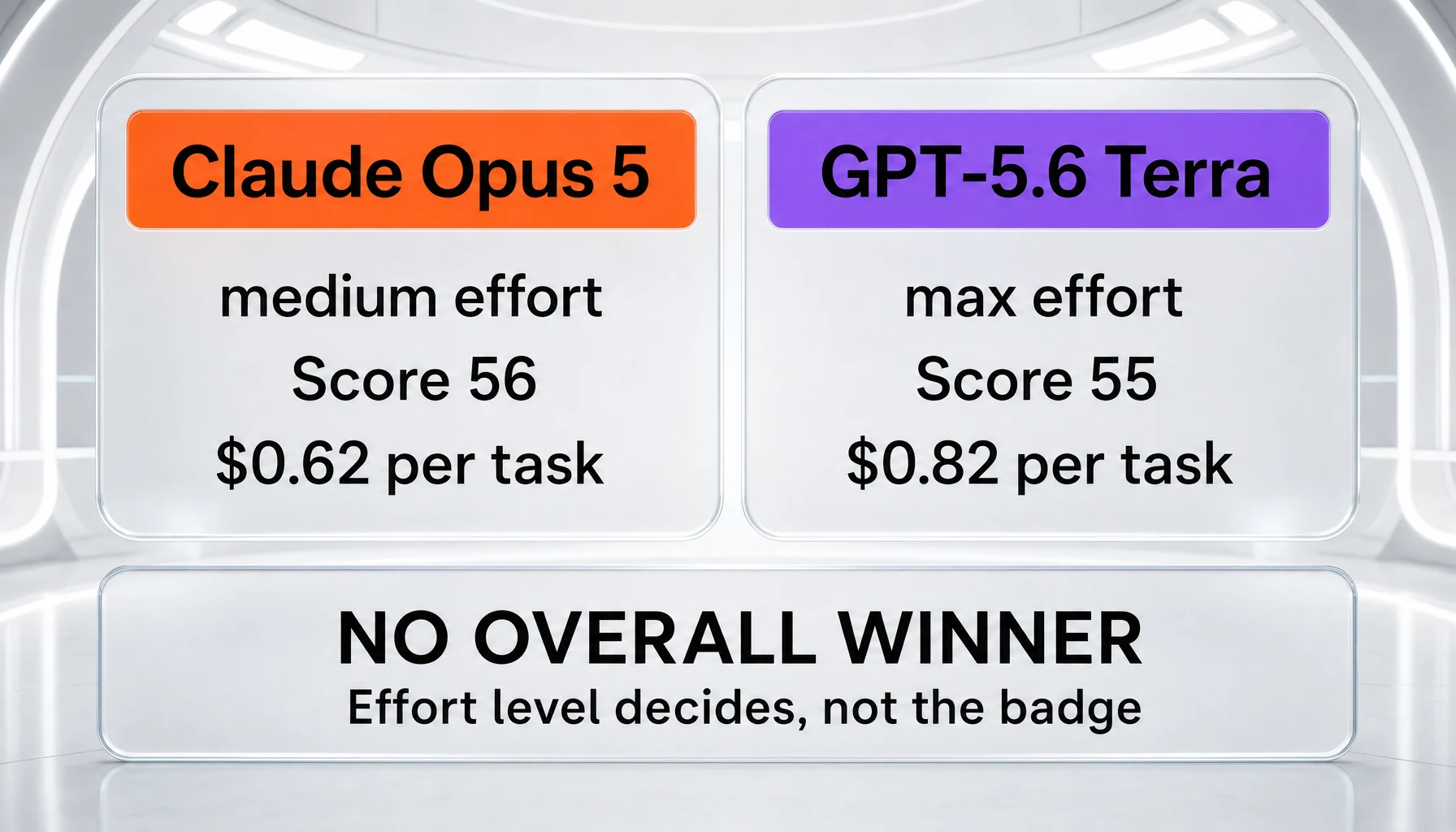
We declare no overall winner, because the honest conclusion is about configuration rather than brand. Claude Opus 5 leads at every matched effort level and holds the 61-point ceiling. GPT-5.6 Terra costs less at every matched level and reaches price points Opus 5 cannot. But the single most useful fact on this page is that Opus 5 at medium effort scores 56 for $0.62 per task, beating Terra's best result of 55 at $0.82 on both score and price.
The temptation on a page like this is to crown the frontier model because it scores higher, or the cheap one because value sells. Both would be lazy, and both would miss the finding. The published ladder shows the two models' ranges overlapping between 51 and 55, and inside that overlap the effort setting decides the outcome, not the vendor. Anyone choosing between these two on list price alone is picking the variable that moves the result least.
What would change our view is a published default effort level for GPT-5.6 Terra. Anthropic tells you that an unconfigured Opus 5 request runs at high effort and therefore costs $1.06 per task and scores 59; OpenAI publishes no equivalent for Terra, so we cannot say what an out-of-the-box Terra request actually costs or scores. That gap is the one real hole in this comparison, and it sits on OpenAI's side of the table.
Our practical recommendation: decide your budget per task first, then read it off the ladder. Above roughly $0.60, Claude Opus 5 at medium or higher is the better instrument. Below roughly $0.35, GPT-5.6 Terra is the only one of the two still in the room. Between those figures the two are genuinely close, and fifty of your own real tasks will tell you more than any index will.
Last compared: July 27, 2026. Intelligence Index scores and cost-per-task figures are read from the Artificial Analysis model leaderboard; the model pages for both models report these scores on Intelligence Index v4.1. Cost, throughput and latency figures are sliding measurements read on July 27, 2026 and will change; the Terra cost-per-task column predates OpenAI's July 30, 2026 price cut and is an upper bound until Artificial Analysis re-measures. ThePlanetTools.ai has no commercial relationship with Anthropic or OpenAI, and this comparison is not sponsored.
Sources and references
- Artificial Analysis — model leaderboard: Intelligence Index scores and cost per task for both models at each of the five effort levels, plus Terra's non-reasoning entry.
- Artificial Analysis — Claude Opus 5: Intelligence Index v4.1 score at max effort, total index run cost, output speed and time to first token.
- Artificial Analysis — GPT-5.6 Terra: Intelligence Index v4.1 score at max effort, total index run cost, output speed, time to first token and release date.
- Artificial Analysis — Claude Opus 5 vs GPT-5.6 Terra: the side-by-side comparison at matched max effort.
- Artificial Analysis — Intelligence Index methodology: the composition of the index.
- Anthropic — Claude API pricing: Claude Opus 5 token, cache and Batch API pricing, long-context pricing, and fast mode pricing.
- Anthropic — Models overview: Claude Opus 5 context window, maximum output, knowledge cutoff and default effort by surface.
- Anthropic — Effort parameter: the five effort levels, the high default, recommended levels for Claude Opus 5, and the thinking constraint at xhigh and max.
- Anthropic — Batch processing: the 300,000-token extended output beta for Claude Opus 5.
- OpenAI — GPT-5.6 Terra model reference: token pricing, context window, maximum output, knowledge cutoff, the 272,000-token pricing rule and rate limit tiers.
- OpenAI — Reasoning guide: the list of reasoning effort values and the statement that some models support only a subset.
- Anthropic — Claude Opus 5 announcement: launch positioning and release date.
Our Verdict
No overall winner, because on these two models the effort level decides the outcome more than the model does. Claude Opus 5 scores higher than GPT-5.6 Terra at every matched effort level, by 6 to 11 points on the Artificial Analysis Intelligence Index, and Terra costs less per task at every matched level. The decisive figure is the crossover: Claude Opus 5 at medium effort scores 56 for $0.62 per task, beating Terra at its maximum setting (55 for $0.82) on both score and cost. Opus 5 spans 51 to 61 points across its five effort levels and Terra spans 40 to 55, so the two ranges overlap and the dial matters more than the badge. Choose Opus 5 above roughly $0.60 per task, and Terra below roughly $0.35, where Opus 5 cannot follow at a comparable score.
Choose Claude Opus 5
Anthropic's frontier reasoning model — top of the independent index at half the price of Fable 5.
Try Claude Opus 5 →Choose GPT-5.6 Terra
OpenAI's balanced GPT-5.6 tier — GPT-5.5-competitive quality at 40 percent of the GPT-5.5 rate, with a 1.05M-token context and the full agentic toolbox.
Try GPT-5.6 Terra →Frequently Asked Questions
Is Claude Opus 5 better than GPT-5.6 Terra?
No overall winner, because on these two models the effort level decides the outcome more than the model does. Claude Opus 5 scores higher than GPT-5.6 Terra at every matched effort level, by 6 to 11 points on the Artificial Analysis Intelligence Index, and Terra costs less per task at every matched level. The decisive figure is the crossover: Claude Opus 5 at medium effort scores 56 for $0.62 per task, beating Terra at its maximum setting (55 for $0.82) on both score and cost. Opus 5 spans 51 to 61 points across its five effort levels and Terra spans 40 to 55, so the two ranges overlap and the dial matters more than the badge. Choose Opus 5 above roughly $0.60 per task, and Terra below roughly $0.35, where Opus 5 cannot follow at a comparable score.
Which is cheaper, Claude Opus 5 or GPT-5.6 Terra?
Claude Opus 5 starts at $5 in / $25 out per M tokens. GPT-5.6 Terra starts at $2 in / $12 out per M tokens. Check the pricing comparison section above for a full breakdown.
What are the main differences between Claude Opus 5 and GPT-5.6 Terra?
The key differences span across 14 features we compared. For Intelligence Index at max effort, Claude Opus 5 offers 61 while GPT-5.6 Terra offers 55. For Cost per task at max effort (measured July 27, 2026), Claude Opus 5 offers $2.03 while GPT-5.6 Terra offers $0.82. For Intelligence Index at medium effort, Claude Opus 5 offers 56 while GPT-5.6 Terra offers 46. See the full feature comparison table above for all details.