GPT-5.6 Terra vs DeepSeek V4: Balanced Flagship vs Open-Weight Price (2026)

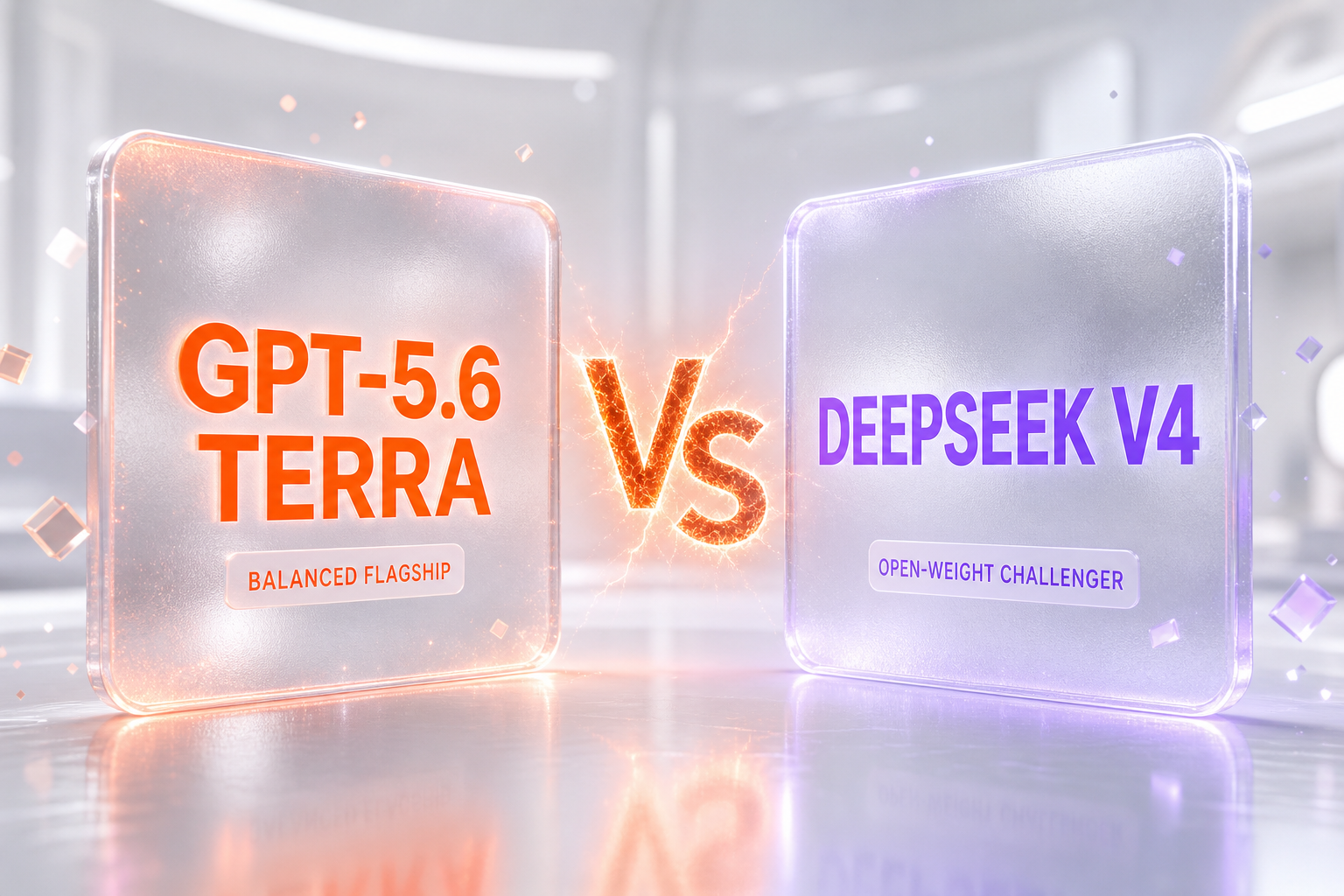
GPT-5.6 Terra leads the AA Intelligence Index 55 to 44 and charts 77 on coding. DeepSeek V4 is open-weight and 17x cheaper. A split verdict.
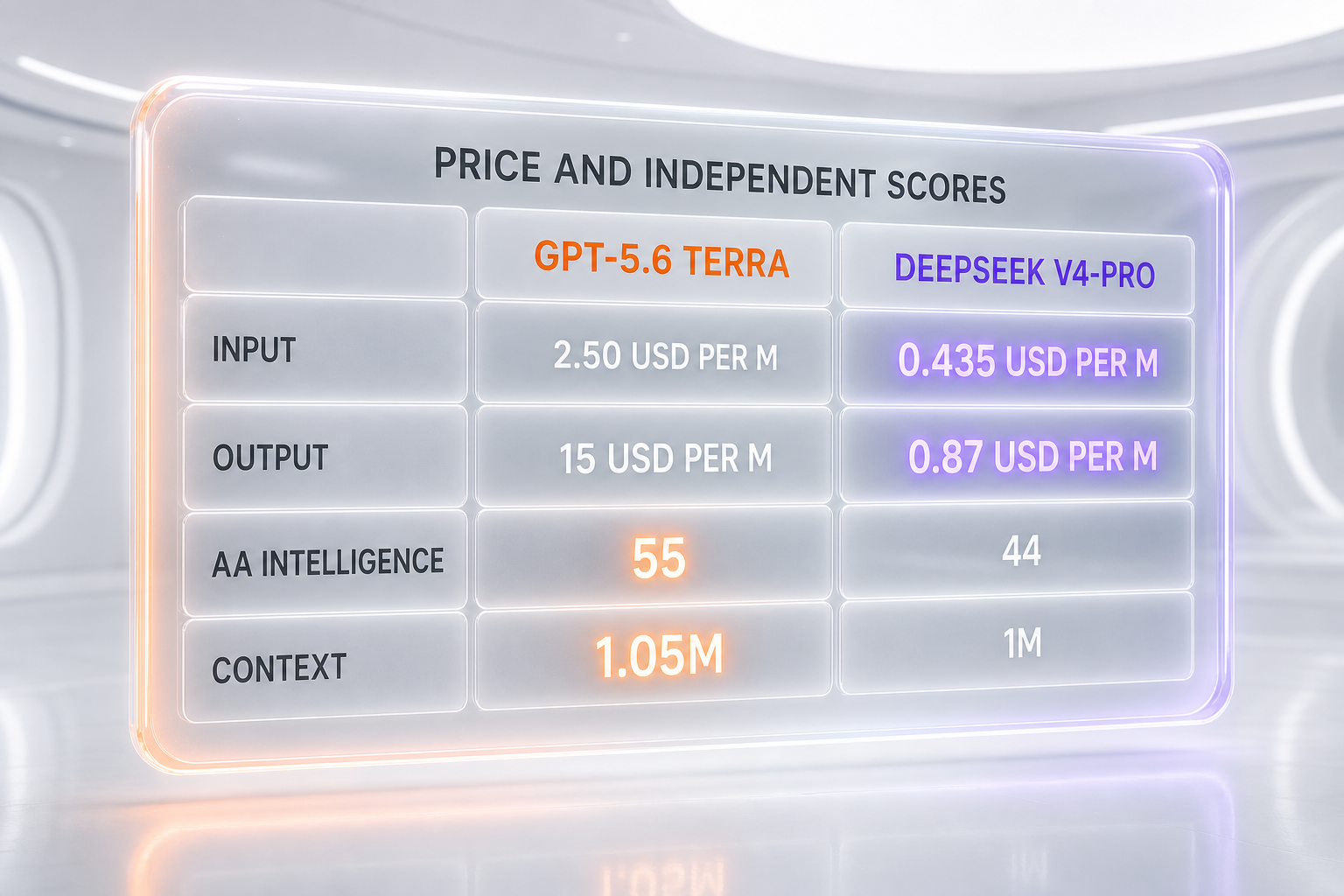
Feature Comparison
| Feature | GPT-5.6 Terra | DeepSeek V4 |
|---|---|---|
| AA Intelligence Index (Artificial Analysis v4.1, same evaluator) | 55 | 44 (V4-Pro, max reasoning) |
| AA Coding Agent Index (Artificial Analysis) | 77 (charted) | Not on the independent leaderboard |
| Input price (per million tokens) | 2.50 dollars | V4-Pro 0.435 dollars, V4-Flash 0.14 dollars |
| Output price (per million tokens) | 15.00 dollars | V4-Pro 0.87 dollars, V4-Flash 0.28 dollars |
| Cached input (per million tokens) | 0.25 dollars | V4-Pro 0.003625 dollars, V4-Flash 0.0028 dollars |
| Context window | 1,050,000 tokens | 1,000,000 tokens |
| Max output tokens | 128,000 tokens | 384,000 tokens |
| Weights and license | Closed (API, ChatGPT, Codex) | Open weights, MIT license |
| Self-hostable | No | Yes, including Huawei Ascend |
| Modality | Text and image input | Text only |
| SWE-bench Verified (independent) | Not yet charted (too new) | Not independently charted (80.6 percent self-reported) |
| Western data residency and compliance | US-hosted, regional residency endpoints | China-hosted API, or self-host anywhere |
Pricing Comparison
GPT-5.6 Terra
DeepSeek V4
Detailed Comparison
GPT-5.6 Terra and DeepSeek V4 are the two large language models compared here, and they sit at opposite ends of the same frontier — but closer together than any other pairing in this series. GPT-5.6 Terra is OpenAI's balanced, high-volume capability tier, generally available July 9, 2026, priced at 2.50 dollars per million input tokens and 15 dollars per million output tokens. DeepSeek V4 is DeepSeek's open-weight Chinese flagship, shipped under an MIT license on Hugging Face, with a hosted V4-Pro tier at 0.435 dollars input and 0.87 dollars output per million tokens and an even cheaper V4-Flash tier. On the one independent evaluator that scores both models the same way, Artificial Analysis, GPT-5.6 Terra leads the Intelligence Index 55 to 44 for DeepSeek V4-Pro, and Terra is the only one of the two with a charted coding score, at 77 on the AA Coding Agent Index. DeepSeek V4 is roughly 5.7 times cheaper on input and about 17 times cheaper on output, ships open weights you can self-host for full data sovereignty, and matches Terra on context. This is a split verdict, not a single winner. Best for measured intelligence, charted coding, image input, and Western data residency: GPT-5.6 Terra. Best for the lowest price, open weights, and self-hosting: DeepSeek V4.
Quick Verdict
This is a split verdict by use case, not a single overall winner — and it is the tightest split in the DeepSeek V4 series. We ran both models side-by-side through their hosted APIs, pulled the pricing directly from each vendor's own pages, and added our own hands-on observations from using both on coding and reasoning prompts. We have not run weeks of controlled, identical-task benchmarking of the two against each other, so where we lean on numbers we attribute them to their source. The honest summary is that these two models are not fighting for exactly the same buyer — but because Terra is OpenAI's most cost-efficient tier, the usual chasm between a managed US flagship and an open Chinese challenger narrows to something you can actually reason about. Here is the short version.
- Best for measured intelligence: GPT-5.6 Terra. On the Artificial Analysis Intelligence Index — the one composite that scores both models with the same battery — Terra sits at 55 while DeepSeek V4-Pro in its maximum reasoning mode scores 44, a clear 11-point lead.
- Best for measured coding: GPT-5.6 Terra. It carries a charted 77 on the Artificial Analysis Coding Agent Index; DeepSeek V4 is not placed on that independent leaderboard at all. Terra also ships a full agentic tool stack — function calling, web search, file search, code interpreter, computer use, and MCP — on by default.
- Best for cost: DeepSeek V4, though by less than you might expect. V4-Pro output at 0.87 dollars per million tokens is roughly 17 times cheaper than Terra at 15 dollars, and V4-Flash output at 0.28 dollars is over 50 times cheaper. On input, V4-Pro at 0.435 dollars is about 5.7 times cheaper than Terra at 2.50 dollars.
- Best for open weights and self-hosting: DeepSeek V4. The weights ship under an MIT license and run on your own hardware, including Huawei Ascend chips. Terra is closed and API-only.
- Best for Western data residency and compliance: GPT-5.6 Terra. It is hosted by OpenAI in the US with regional data-residency endpoints. DeepSeek's hosted API runs in China, which is a non-starter for many regulated buyers unless they self-host the open weights.
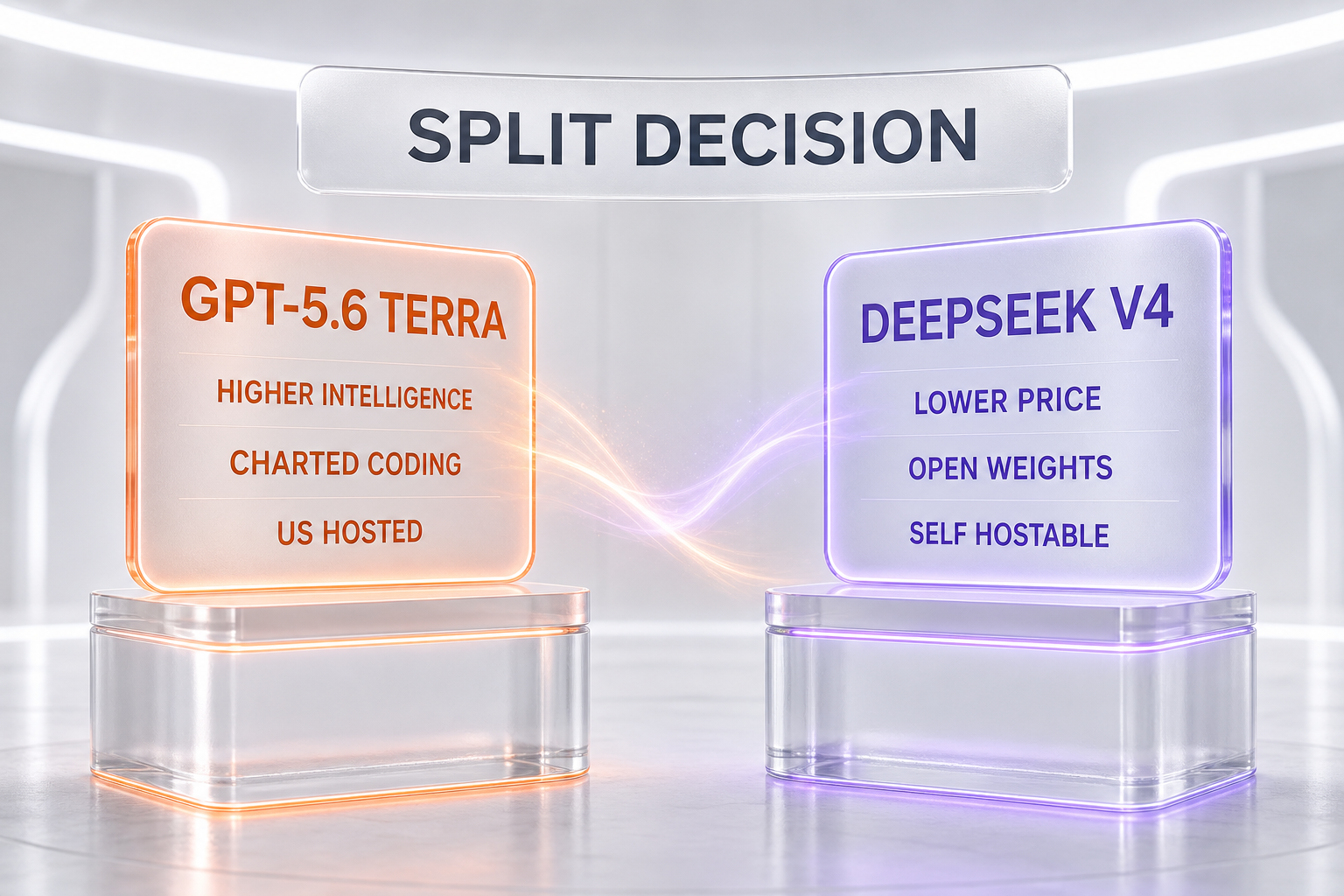
Bottom line: if you want more measured intelligence, a charted coding score, image input, or US-hosted compliance, pick GPT-5.6 Terra. If you are cost-constrained, want to own your weights, or need to self-host for data sovereignty, DeepSeek V4 gives you frontier-adjacent quality at a fraction of the price. We did not crown a single winner because the two models optimize for different things — but the reason this pairing is interesting is that Terra is the OpenAI flagship where the price penalty for staying managed is smallest, so the trade is a genuine judgment call rather than a foregone conclusion.
At a Glance
Before the detail, here is the side-by-side that frames everything below. All pricing in this table was fetched directly from each vendor's pricing page in July 2026. All benchmark figures are attributed to their source, and independent scores are kept strictly separate from vendor-reported ones.
| Dimension | GPT-5.6 Terra | DeepSeek V4 |
|---|---|---|
| Vendor and origin | OpenAI (US) | DeepSeek (China) |
| License | Closed — API, ChatGPT, and Codex only | Open weights, MIT license |
| Available | July 9, 2026 (general availability) | April 24, 2026 |
| Input price (per million tokens) | 2.50 dollars (verified) | Pro 0.435 dollars, Flash 0.14 dollars (verified) |
| Output price (per million tokens) | 15.00 dollars (verified) | Pro 0.87 dollars, Flash 0.28 dollars (verified) |
| Cached input (per million tokens) | 0.25 dollars (verified) | Pro 0.003625 dollars, Flash 0.0028 dollars (verified) |
| Context window | 1,050,000 tokens (verified) | 1,000,000 tokens (verified) |
| Max output tokens | 128,000 tokens | 384,000 tokens |
| AA Intelligence Index | 55 (Artificial Analysis v4.1) | 44 for V4-Pro max reasoning (Artificial Analysis v4.1) |
| AA Coding Agent Index | 77 (charted, Artificial Analysis) | Not on the independent leaderboard |
| Modality | Text and image input, text output | Text only |
| Self-hostable | No | Yes, including Huawei Ascend chips |
| Data residency | US, plus regional residency endpoints | China-hosted API, or self-host anywhere |
Overview of Each Model
GPT-5.6 Terra
GPT-5.6 Terra is the balanced, high-volume tier of OpenAI's GPT-5.6 generation, which became generally available on July 9, 2026 across ChatGPT, Codex, and the API. In the new naming scheme the number is the generation and the names Sol, Terra, and Luna are durable capability tiers rather than model sizes: Terra is the workhorse built for high-throughput business use — customer support, document processing, and everyday agentic tasks — which OpenAI positions as competitive with the previous GPT-5.5 flagship at roughly half the price. It carries a 1,050,000-token context window with up to 128K output tokens, a February 16, 2026 knowledge cutoff, and accepts text and image input while producing text output. On independent benchmarks it is the stronger model in this matchup: it scores 55 on the Artificial Analysis Intelligence Index and carries a charted 77 on the AA Coding Agent Index. It ships the same agentic tool stack as the rest of the generation, all on by default — function calling, structured outputs, web search, file search, code interpreter, a hosted shell, computer use, and MCP — alongside a reasoning-effort scale that runs from low through xhigh and adds a new max level, plus a programmatic tool-calling feature that lets the model write and execute JavaScript in an isolated, ephemeral runtime. Pricing is 2.50 dollars per million input tokens and 15 dollars per million output, with prompt caching at a 90 percent discount (0.25 dollars per million cached input tokens) and a Batch API at half price. It is closed and available only through OpenAI's surfaces. In our hands-on use, the standout is reliability and tool orchestration at a rate card that, for a managed frontier model, is genuinely restrained. For the full breakdown, see our GPT-5.6 Terra review; if you need the top capability tier or the cheapest one, we also cover GPT-5.6 Sol and GPT-5.6 Luna.
DeepSeek V4
DeepSeek V4 is the Chinese open-weight flagship, shipped April 24, 2026 in two sizes: V4-Pro, a 1.6-trillion-parameter mixture-of-experts model with about 49 billion parameters active per token, and V4-Flash, a 284-billion-parameter model with about 13 billion active. Both carry a 1,000,000-token context window with up to 384K tokens of output, and both ship under an MIT license that permits free commercial use, redistribution, and modification of the weights — although the training code and data recipe are not released, so this is open weights rather than fully open source. Artificial Analysis scores V4-Pro at 44 on its Intelligence Index in maximum reasoning mode, well above the median for open-weight models of similar size, and DeepSeek separately reports 80.6 percent on SWE-bench Verified — a self-reported figure on its own harness, not an independently charted one. The architecture is genuinely novel rather than just bigger: a Hybrid Attention design combining Compressed Sparse Attention at four-times compression with Heavily Compressed Attention at 128-times compression cuts inference compute and KV-cache footprint sharply, and three built-in thinking modes — Non-Think, Think High, and Think Max — let you dial cost against quality per request. It is text only, the hosted API is OpenAI-compatible, and it runs day one on Huawei Ascend hardware. The headline, though, is price: V4-Pro output sits at 0.87 dollars per million tokens and V4-Flash at 0.28 dollars. Our full DeepSeek V4 review covers the architecture and licensing in more depth.
Pricing Compared
Pricing is still where the two models diverge most — but this is the matchup where the gap is narrowest, because Terra is deliberately the cost-efficient OpenAI tier rather than the premium one. We fetched every number below directly from each vendor's pricing page in July 2026.
| Tier | Input (per million tokens) | Output (per million tokens) | Cached input (per million tokens) |
|---|---|---|---|
| GPT-5.6 Terra (standard) | 2.50 dollars | 15.00 dollars | 0.25 dollars |
| GPT-5.6 Terra (Batch API, 50 percent off) | 1.25 dollars | 7.50 dollars | — |
| DeepSeek V4-Pro | 0.435 dollars | 0.87 dollars | 0.003625 dollars |
| DeepSeek V4-Flash | 0.14 dollars | 0.28 dollars | 0.0028 dollars |
Run the arithmetic and the picture is different from Terra's pricier sibling tiers. On output tokens — the comparison most people care about, because output dominates real agentic spend — Terra at 15 dollars is roughly 17 times the cost of V4-Pro at 0.87 dollars, and over 50 times the cost of V4-Flash at 0.28 dollars. On input tokens, Terra at 2.50 dollars is about 5.7 times V4-Pro and nearly 18 times V4-Flash. Those are large multiples, but they are the smallest of any OpenAI flagship against DeepSeek: the top-tier Sol runs at 30 dollars output, some 34 times V4-Pro, so choosing Terra rather than Sol already halves the distance to DeepSeek's rate card. Terra's prompt caching is genuinely cheap by frontier standards at 0.25 dollars per million cached input tokens, though DeepSeek's cache-hit input at 0.003625 dollars for V4-Pro is close to free, roughly 69 times cheaper again.
The most telling number is what happens with Terra's Batch API. Its 50 percent discount brings Terra to 1.25 dollars input and 7.50 dollars output, which lands under three times V4-Pro on input and under nine times on output — single-digit multiples for a managed, US-hosted frontier model against an open Chinese one. That is a genuinely different conversation from the order-of-magnitude gaps you see with the premium tiers. Two nuances worth flagging honestly. First, the DeepSeek V4-Pro rates above are the discounted tier, which DeepSeek has kept in place as the durable price; V4-Flash is the even cheaper tier for lighter, high-volume work. Both are pay-per-token on a hosted API, and both were read straight off DeepSeek's pricing page. Second, a self-hosted DeepSeek deployment is not free: running V4-Pro yourself in full precision requires enterprise GPU clusters, and even V4-Flash needs INT4 or INT8 quantization to fit on a single high-end consumer card. The open weights buy you control and remove per-token billing, but they shift cost into hardware and operations. For most teams the hosted DeepSeek API is the relevant comparison, and there DeepSeek is still clearly cheaper — just not by the chasm you get against Sol.
Benchmarks Compared
Benchmarks across two different labs are a minefield, because vendors pick favorable evaluations and report them their own way. We discipline this by leaning on the one independent evaluator that scores both models the same way — Artificial Analysis — and by treating vendor-reported figures as attributed claims, not verified facts. That distinction matters more than usual in this matchup, because the two models have very different amounts of independent data available.
| Benchmark | GPT-5.6 Terra | DeepSeek V4 | Like-for-like? |
|---|---|---|---|
| AA Intelligence Index (Artificial Analysis v4.1) | 55 | 44 (V4-Pro, max reasoning) | Yes — same independent evaluator |
| AA Coding Agent Index (Artificial Analysis) | 77 (charted) | Not on the independent leaderboard | Only Terra is charted |
| SWE-bench Verified (independent) | Not yet charted (too new) | 80.6 percent (DeepSeek self-reports) | No independent head-to-head |
| Terminal-Bench 2.1 | 87.4 percent (OpenAI reports) | Not reported the same way | No clean counterpart |
| Context window | 1,050,000 tokens | 1,000,000 tokens | Effectively tied, slight edge Terra |
The cleanest signal is the Artificial Analysis Intelligence Index, because it is one evaluator running the same battery on both: GPT-5.6 Terra at 55 versus V4-Pro at 44, a clear 11-point lead. The second independent signal points the same way — the AA Coding Agent Index charts Terra at 77, a solid score in the same band as GPT-5.5 and Grok 4.5, while DeepSeek V4 is not placed on that leaderboard at all. Together those two independent, same-evaluator numbers are the backbone of the capability case for Terra, and they are consistent with each other. Note that Terra's 77 sits below the top-tier Sol at 80, which is the expected order within OpenAI's own lineup.
Where we will not overreach is SWE-bench Verified. Terra is too new to be charted on the independent SWE-bench Verified leaderboard as of mid-July 2026, and DeepSeek's widely quoted 80.6 percent is a self-reported figure run on DeepSeek's own harness, not an independently verified result. So there is no clean independent head-to-head on that specific benchmark, and we do not manufacture one. The same honesty applies to Terra's Terminal-Bench 2.1 at 87.4 percent: that is OpenAI's own reported number, DeepSeek does not report the same way, so we present it as an attributed claim with no DeepSeek counterpart rather than as a scoreboard. The numbers we can trust — the two Artificial Analysis indices — say clearly that GPT-5.6 Terra is the stronger model on measured capability, and that DeepSeek V4 is far closer on quality than its price would suggest.
Architecture and What Is Actually Different
It is tempting to treat two frontier models as interchangeable black boxes that you poke through an API, but the engineering underneath shapes how they behave, what they cost to run, and where they can be deployed. The two could hardly be more different in philosophy.
GPT-5.6 Terra is a closed model, so OpenAI discloses behavior rather than internals. What it surfaces is a product-level capability set built for high-volume agentic work: the full tool stack on by default, a reasoning-effort scale that runs low, medium, high, and xhigh plus a new max level, and a programmatic tool-calling feature that lets the model write and execute JavaScript in an isolated, ephemeral runtime compatible with zero-data-retention. Snapshot pinning gives production teams reproducibility, prompt caching reads at a 90 percent discount, and the model is tuned to be token-efficient, biasing toward shorter responses that soften the per-task impact of the rate card. The trade-offs are real and worth naming: there is no fine-tuning of the Terra base model, it is text and image in but text only out, and it cannot be moved off OpenAI's infrastructure at all. Terra shares the multi-agent ultra reasoning mode of the generation, though that capability is oriented mainly toward the top-tier Sol.
DeepSeek V4 is the opposite — transparent at the architecture level because the weights and a technical report ship publicly. It is a mixture-of-experts model: V4-Pro carries 1.6 trillion total parameters with about 49 billion active per token, V4-Flash carries 284 billion total with about 13 billion active. The headline innovation is a Hybrid Attention design that combines Compressed Sparse Attention, at four-times compression, with Heavily Compressed Attention, at 128-times compression, to make a 1,000,000-token context affordable to serve. DeepSeek reports this cuts inference compute to a small fraction of the previous generation and shrinks the KV cache dramatically. It bakes three reasoning modes directly into the model rather than bolting them on as a separate API, and it is the first major Chinese frontier model with day-one inference on Huawei Ascend hardware, removing the hard dependency on a single chip vendor. This is why DeepSeek V4 can be both frontier-adjacent in quality and far cheaper on output: the efficiency is engineered in, not just priced in.
The practical upshot is that GPT-5.6 Terra gives you a polished, deeply integrated, multimodal-input agent you cannot inspect or move, while DeepSeek V4 gives you an inspectable, movable, text-only model that you operate yourself. Neither philosophy is wrong; they serve different risk, cost, and sovereignty profiles — and with Terra priced as OpenAI's value tier, the cost axis no longer overwhelms every other consideration.
Total Cost of Ownership
Per-token price is the headline, but the real economics depend on volume, caching, and whether you self-host. Here is how to think about it without overstating the case in either direction.
For the hosted-API path, the gap still matters but no longer changes what is buildable in the way it does with the premium tiers. A pipeline that processes, say, a billion output tokens a month costs about 15,000 dollars on GPT-5.6 Terra at standard pricing, around 7,500 dollars with the Batch API discount, roughly 870 dollars on DeepSeek V4-Pro, and about 280 dollars on V4-Flash. Those are meaningful differences, but at Terra's Batch rate the ratio to V4-Pro is under nine to one rather than the tens-to-one you see against Sol — a premium many teams will pay for managed infrastructure, image input, and a higher measured score. Prompt caching narrows the input side further: Terra cache reads at 0.25 dollars per million tokens are cheap, and DeepSeek's cache hits at 0.003625 dollars for V4-Pro are almost free.
For the self-hosted path, the calculus flips from per-token billing to capital and operations. DeepSeek's open weights remove the API meter entirely, but you pay in hardware: full-precision V4-Pro requires enterprise GPU clusters, and even V4-Flash needs INT4 or INT8 quantization to fit a single high-end consumer card. For a team with steady, predictable, very high volume and the operational maturity to run model infrastructure, self-hosting V4 can be the cheapest option of all, and the only one that guarantees data never leaves your premises. For a team with spiky or modest volume, the hosted DeepSeek API is the sensible comparison — and it is still cheaper than Terra, just not overwhelmingly so once you weigh what Terra's premium buys. The honest conclusion is that DeepSeek wins on raw cost in every scenario; what you buy for Terra's modest premium is the measured capability lead, image input, managed operations, and the compliance story, not cheaper tokens.
How We Tested
Honesty about methodology matters more in a cross-lab, cross-country comparison than almost anywhere else. Here is exactly what is hands-on and what is research.
We ran both models through their hosted APIs on coding and reasoning prompts to confirm they behave as documented — Terra's tool stack, its reasoning-effort scale including the new max level, and its snapshot pinning, and DeepSeek V4's three thinking modes and OpenAI-compatible endpoint. Those behavioral observations are first-hand. What we have not done is stand up a self-hosted V4-Pro cluster, or run weeks of controlled, identical-task benchmarking of both models against each other on a private suite. For that reason, every capability claim that rests on a number is attributed to its source — Artificial Analysis for the independent Intelligence and Coding Agent indices, and OpenAI or DeepSeek for their own self-reported figures, each labeled as such. We pulled all pricing by fetching each vendor's pricing page directly rather than trusting secondhand summaries. Where we could not verify a like-for-like number — most importantly on SWE-bench Verified, where Terra is not yet charted and DeepSeek's figure is self-reported — we said so and left the head-to-head uncommitted. That is the standard we hold ourselves to, and it is the only honest way to compare a closed US model against an open Chinese one.
Winner by Category
A single overall winner would be dishonest here, because these models are tuned for different buyers. Here is who wins what.
- Best for measured intelligence: GPT-5.6 Terra. It sits at 55 on the Artificial Analysis Intelligence Index, a clear 11 points ahead of V4-Pro at 44.
- Best for measured coding: GPT-5.6 Terra. It carries a charted 77 on the AA Coding Agent Index, an independent score DeepSeek V4 does not have, and it ships the full agentic tool stack — function calling, web search, code interpreter, computer use, and MCP — on by default.
- Best for cost: DeepSeek V4. Roughly 17 times cheaper per output token on V4-Pro and over 50 times cheaper on V4-Flash, with cache-hit input pricing that is close to free.
- Best for narrowest price gap to a managed flagship: A DeepSeek win too, but this is the point — with Terra's Batch API the output gap drops under nine to one, the smallest of any OpenAI flagship against DeepSeek, which is what makes the managed option defensible here.
- Best for open weights and self-hosting: DeepSeek V4. MIT-licensed downloadable weights, with native Huawei Ascend support; Terra cannot be self-hosted at all.
- Best for Western data residency and compliance: GPT-5.6 Terra. US-hosted with regional residency endpoints; DeepSeek's hosted API runs in China, and self-hosting is the only compliant path to the open weights for many buyers.
- Best for long-context work: Near-tie, edge to Terra on raw size (1,050,000 versus 1,000,000 tokens), though DeepSeek allows up to 384K output tokens against Terra's 128K, so heavy generation jobs can favor DeepSeek.
- Best for multimodal input: GPT-5.6 Terra. It accepts image input alongside text; DeepSeek V4 is text only, so any image-in-the-loop workflow needs a separate vision model.
Pros and Cons
GPT-5.6 Terra — Pros
- Leads the Artificial Analysis Intelligence Index at 55, a clear 11 points ahead of DeepSeek V4-Pro at 44.
- Carries a charted 77 on the AA Coding Agent Index — an independent coding score DeepSeek V4 does not have at all.
- OpenAI's most price-competitive flagship tier: at 2.50 dollars input and 15 dollars output per million tokens, it halves the distance to DeepSeek versus the top-tier Sol.
- Complete agentic tool stack on by default — function calling, structured outputs, web search, file search, code interpreter, hosted shell, computer use, and MCP.
- US-hosted with regional data-residency endpoints, clearing Western compliance bars that DeepSeek's China-hosted API cannot.
- Accepts image input alongside text, and offers prompt caching at a 90 percent discount plus a Batch API at half price that drops output to 7.50 dollars.
GPT-5.6 Terra — Cons
- Still costs meaningfully more per output token than DeepSeek's hosted API — 15 dollars output per million versus 0.28 to 0.87 dollars.
- Closed model: no self-hosting, no downloadable weights, no data-sovereignty option.
- No fine-tuning of the Terra base model, so tuned production variants must stay on other models.
- Text and image in, but text only out — no native audio or image generation without calling separate tools.
- Not yet charted on the independent SWE-bench Verified leaderboard, so its coding case rests on the AA Coding Agent Index and OpenAI's own reports.
- Sits below the top-tier Sol at 59 intelligence and 80 coding, so the very hardest problems point up the lineup rather than out to DeepSeek.
DeepSeek V4 — Pros
- Frontier-adjacent capability at open weights: 44 on the Artificial Analysis Intelligence Index, remarkable for a downloadable MIT-licensed model.
- Dramatically cheaper hosted API — V4-Pro output at 0.87 dollars per million tokens is roughly 17 times cheaper than Terra, and V4-Flash at 0.28 dollars is over 50 times cheaper.
- MIT-licensed weights downloadable from Hugging Face for free commercial use, redistribution, and modification.
- Self-hostable for full data sovereignty, with day-one support on Huawei Ascend chips that removes NVIDIA dependency.
- 1,000,000-token context with up to 384K output tokens — larger max output than Terra — plus three built-in reasoning modes to tune cost against quality.
- Near-free cache-hit input pricing at 0.003625 dollars per million tokens for V4-Pro, which makes stable-prompt RAG and tool loops almost cost-free.
DeepSeek V4 — Cons
- Trails Terra on the independent Intelligence Index, 44 versus 55, and has no charted score on the AA Coding Agent Index where Terra sits at 77.
- Hosted API runs in China, a non-starter for US Federal, EU healthcare, and many regulated buyers without self-hosting or a Western reseller.
- Text only — no native image input, so visual workflows need a separate vision model, where Terra reads images directly.
- Open weights, not open source: the training code and data recipe are not released, so the run cannot be fully reproduced.
- Self-hosting requires serious hardware — full-precision V4-Pro needs enterprise GPU clusters, and V4-Flash needs quantization to fit a single high-end card.
- Its price edge over Terra, while real, is the smallest against any OpenAI flagship, so cost alone is a weaker argument here than against Sol.
When to Pick Each
When to pick GPT-5.6 Terra
Pick GPT-5.6 Terra when you want a managed frontier model and the price premium over open weights is small enough to justify the convenience. If you are running high-volume business workloads — support automation, document processing, everyday coding agents — Terra is the stronger model on both independent indices, its tool stack and image input add leverage DeepSeek does not match out of the box, and at Batch pricing its output cost lands within single-digit multiples of DeepSeek rather than orders of magnitude above. Pick it if you are a Western enterprise with data-residency or compliance obligations, because US hosting and regional residency endpoints clear bars DeepSeek's China-hosted API cannot. And pick it if you value not operating model infrastructure at all: Terra is a fully managed endpoint, where self-hosting DeepSeek means owning GPUs, quantization, and uptime. If you live inside ChatGPT, Codex, or the Responses API and want the balanced tier rather than the expensive one, Terra is the natural default. If your tasks are the very hardest, look up the lineup to GPT-5.6 Sol instead.
When to pick DeepSeek V4
Pick DeepSeek V4 when cost, control, or sovereignty dominate. If you are running very high-volume inference where token spend is the binding constraint, a 17-times-cheaper API on V4-Pro — and V4-Flash cheaper still — changes what is economically viable, even against a value tier like Terra. Pick it if you need to own your weights: the MIT license lets you self-host, fine-tune, and redistribute, and the Huawei Ascend support means you are not locked to a single chip vendor. Pick it if you are operating where Chinese hosting is acceptable, or where self-hosting is mandatory for data sovereignty, or where you simply need the largest possible output generation at 384K tokens. You give up a measurable slice of frontier capability, the charted coding score, image input, and the Western compliance story, but you get most of the quality at a fraction of the price — and you keep total control of where your data lives.
Final Verdict
This is a split verdict by use case — tilted toward GPT-5.6 Terra on capability and toward DeepSeek V4 on cost and openness — but it is the closest split in the series. On the two independent signals that score both — the Artificial Analysis Intelligence Index and the AA Coding Agent Index — Terra leads 55 to 44 on intelligence and carries a charted 77 on coding where DeepSeek V4 is not charted at all. It is the stronger model on measured capability, the only one that reads images, and the only one that clears Western data-residency requirements. DeepSeek V4, in return, costs roughly 17 times less per output token on V4-Pro and over 50 times less on V4-Flash, ships MIT-licensed open weights you can self-host anywhere, matches Terra on context, and beats it on maximum output length — a genuinely remarkable package for an open model.
We did not crown a single overall winner because the two models are not competing for exactly the same buyer. What makes this pairing distinct from Terra's pricier sibling tiers is how defensible the managed choice becomes: because Terra is OpenAI's value flagship, its Batch API output cost lands under nine times DeepSeek's rather than the tens-to-one gap you get with Sol, so paying a modest premium for more measured intelligence, image input, and US-hosted compliance is a real judgment call rather than an obvious splurge. If you need more measured capability, a charted coding score, image input, or Western compliance, the answer is GPT-5.6 Terra. If you are cost-constrained, want to own your weights, or need to self-host for sovereignty, the answer is DeepSeek V4. Both answers are correct — for different people. Every benchmark number here is either drawn from the Artificial Analysis independent indices or explicitly attributed to a vendor's own report; only the pricing is fetch-verified directly from each vendor.
If you are weighing DeepSeek V4 against other models, we also ran it head-to-head with the previous OpenAI flagship in GPT-5.5 vs DeepSeek V4, against Anthropic's mid-tier flagship in Claude Sonnet 5 vs DeepSeek V4, against the leading open-weight coding model in GLM-5.2 vs DeepSeek V4, and against the newest open-weight agentic model in Kimi K2.7 vs DeepSeek V4. For the deep dive on each model on its own, see our full GPT-5.6 Terra review and DeepSeek V4 review.
Frequently Asked Questions
Is GPT-5.6 Terra better than DeepSeek V4?
On measured capability, yes. GPT-5.6 Terra leads the Artificial Analysis Intelligence Index at 55 versus 44 for DeepSeek V4-Pro, and it carries a charted 77 on the AA Coding Agent Index, an independent score DeepSeek V4 does not have. But DeepSeek V4 is roughly 17 times cheaper per output token on V4-Pro and is open-weight and self-hostable, so the better choice depends on whether you are optimizing for capability and compliance or for cost and control.
How much cheaper is DeepSeek V4 than GPT-5.6 Terra?
On output tokens, DeepSeek V4-Pro at 0.87 dollars per million is roughly 17 times cheaper than GPT-5.6 Terra at 15 dollars per million, and V4-Flash at 0.28 dollars is over 50 times cheaper. On input tokens, V4-Pro at 0.435 dollars is about 5.7 times cheaper than Terra at 2.50 dollars, and V4-Flash at 0.14 dollars is nearly 18 times cheaper. This is the smallest price gap between DeepSeek and any OpenAI flagship, because Terra is OpenAI's value tier. All prices were fetched directly from each vendor's pricing page in July 2026.
Why is GPT-5.6 Terra cheaper than GPT-5.6 Sol?
Sol and Terra are durable capability tiers in the GPT-5.6 generation rather than different sizes of the same model. Sol is the top tier built for the hardest problems and is priced at 5 dollars input and 30 dollars output per million tokens. Terra is the balanced, high-volume tier that OpenAI positions as competitive with the previous GPT-5.5 flagship at roughly half the price, so it runs at 2.50 dollars input and 15 dollars output. Terra scores 55 on the Artificial Analysis Intelligence Index against Sol's 59, and 77 on coding against Sol's 80 — a small step down for a large drop in price.
Is DeepSeek V4 open source?
It is open weights, not fully open source. DeepSeek V4 ships its model weights under an MIT license on Hugging Face, allowing free commercial use, redistribution, and modification. However, the training code and data recipe are not released, so the community cannot fully reproduce the training run. You can self-host and fine-tune the model, but you cannot rebuild it from scratch. GPT-5.6 Terra, by contrast, is fully closed and cannot be self-hosted at all.
Can I self-host DeepSeek V4 or GPT-5.6 Terra?
You can self-host DeepSeek V4 because its weights are MIT-licensed and downloadable, including native support for Huawei Ascend chips. You cannot self-host GPT-5.6 Terra — it is a closed model available only through OpenAI's API, ChatGPT, and Codex. Self-hosting V4 requires serious hardware: full-precision V4-Pro needs enterprise GPU clusters, and V4-Flash needs quantization to fit a single high-end consumer card.
What is the context window for each model?
GPT-5.6 Terra ships a 1,050,000-token context window with up to 128K output tokens. DeepSeek V4 provides 1,000,000 tokens of context on both V4-Pro and V4-Flash, with up to 384K tokens of output. The two are effectively tied on raw context length, with Terra slightly larger on input and DeepSeek larger on maximum output — so heavy generation jobs can actually favor DeepSeek.
Which model is better for coding?
GPT-5.6 Terra leads on the one independent coding signal that charts it: the Artificial Analysis Coding Agent Index, where it scores 77 and DeepSeek V4 is not placed at all. Terra also ships a full agentic tool stack on by default. DeepSeek self-reports 80.6 percent on SWE-bench Verified, but that is a vendor figure on its own harness, not an independently charted result, so we do not treat it as a head-to-head. DeepSeek V4 is still strong and far cheaper, which makes it attractive for high-volume coding where cost dominates over the last few points of measured capability.
Is DeepSeek V4 safe to use for a Western company?
It depends on your data-residency rules. DeepSeek's hosted API runs in China, which keeps many regulated buyers — US Federal, EU healthcare — from adopting it without a Western reseller. The MIT-licensed open weights let you sidestep this by self-hosting the model on your own infrastructure anywhere in the world. If compliance is the concern and you cannot self-host, GPT-5.6 Terra's US hosting and regional residency endpoints are the safer default.
How do the two models score on independent benchmarks?
The cleanest independent signals come from Artificial Analysis, which scores both with the same battery. On the Intelligence Index, GPT-5.6 Terra sits at 55 while DeepSeek V4-Pro in maximum reasoning mode scores 44. On the AA Coding Agent Index, Terra is charted at 77 while DeepSeek V4 is not on the leaderboard. Terra is not yet charted on the independent SWE-bench Verified leaderboard, and DeepSeek's 80.6 percent on that benchmark is self-reported, so we do not present a SWE-bench head-to-head.
What are the different DeepSeek V4 tiers?
DeepSeek V4 ships in two sizes. V4-Pro is a 1.6-trillion-parameter mixture-of-experts model with about 49 billion parameters active per token, priced at 0.435 dollars input and 0.87 dollars output per million tokens. V4-Flash is a 284-billion-parameter model with about 13 billion active, priced at 0.14 dollars input and 0.28 dollars output. Both carry a 1,000,000-token context window with up to 384K output, and both support three reasoning modes — Non-Think, Think High, and Think Max.
Does GPT-5.6 Terra have a cheaper mode?
Yes, two cost levers. The Batch API offers a 50 percent discount for asynchronous workloads, bringing GPT-5.6 Terra to 1.25 dollars input and 7.50 dollars output per million tokens. Prompt caching drops repeated input to 0.25 dollars per million tokens on cache reads. With both applied, Terra's output cost lands under nine times DeepSeek V4-Pro rather than the order-of-magnitude gap you see with the pricier Sol tier. If you need to go cheaper still on the OpenAI side, the Luna tier is the budget option in the lineup.
When were these models released and is this comparison current?
GPT-5.6 Terra became generally available July 9, 2026, across ChatGPT, Codex, and the API. DeepSeek V4 shipped April 24, 2026. This comparison was last updated in July 2026, with all pricing fetched directly from each vendor's pricing page at that time and all benchmark figures either drawn from the Artificial Analysis independent indices or attributed to each vendor's own reports.
Our Verdict
Split decision, and the closest one in this series. GPT-5.6 Terra wins measured intelligence on the one independent index that scores both — 55 to 44 on the Artificial Analysis Intelligence Index version 4.1 — and is the only one of the two with a charted coding score, at 77 on the AA Coding Agent Index. It also reads image input, edges the context window at 1,050,000 tokens, and clears Western data-residency requirements. DeepSeek V4 wins on cost and openness: roughly 5.7 times cheaper on input and about 17 times cheaper per output token on V4-Pro, MIT-licensed open weights you can self-host including on Huawei Ascend, and a larger 384K maximum output. What makes this matchup different from the pricier flagships is how small the gap has become: Terra is OpenAI's most price-competitive tier, so with the Batch API discount it lands under three times DeepSeek on input and under nine times on output. Pick GPT-5.6 Terra for more measured intelligence, a charted coding score, image input, managed infrastructure, and US-hosted compliance; pick DeepSeek V4 for the lowest price, open weights, and self-hosting sovereignty.
Choose GPT-5.6 Terra
OpenAI's balanced GPT-5.6 tier — GPT-5.5-competitive quality at two times lower cost, with a 1.05M-token context and the full agentic toolbox.
Try GPT-5.6 Terra →Choose DeepSeek V4
Chinese open-source flagship: 1.6T MoE (49B active), 1M context, 80.6% SWE-bench Verified, MIT license — V4-Pro input costs about one-eleventh of Claude Opus 4.7
Try DeepSeek V4 →Frequently Asked Questions
Is GPT-5.6 Terra better than DeepSeek V4?
Split decision, and the closest one in this series. GPT-5.6 Terra wins measured intelligence on the one independent index that scores both — 55 to 44 on the Artificial Analysis Intelligence Index version 4.1 — and is the only one of the two with a charted coding score, at 77 on the AA Coding Agent Index. It also reads image input, edges the context window at 1,050,000 tokens, and clears Western data-residency requirements. DeepSeek V4 wins on cost and openness: roughly 5.7 times cheaper on input and about 17 times cheaper per output token on V4-Pro, MIT-licensed open weights you can self-host including on Huawei Ascend, and a larger 384K maximum output. What makes this matchup different from the pricier flagships is how small the gap has become: Terra is OpenAI's most price-competitive tier, so with the Batch API discount it lands under three times DeepSeek on input and under nine times on output. Pick GPT-5.6 Terra for more measured intelligence, a charted coding score, image input, managed infrastructure, and US-hosted compliance; pick DeepSeek V4 for the lowest price, open weights, and self-hosting sovereignty.
Which is cheaper, GPT-5.6 Terra or DeepSeek V4?
GPT-5.6 Terra is priced at $2.5 in / $15 out per M tokens. DeepSeek V4 is priced at $0.14 in / $0.28 out per M tokens (free plan available). Check the pricing comparison section above for a full breakdown.
What are the main differences between GPT-5.6 Terra and DeepSeek V4?
The key differences span across 12 features we compared. For AA Intelligence Index (Artificial Analysis v4.1, same evaluator), GPT-5.6 Terra offers 55 while DeepSeek V4 offers 44 (V4-Pro, max reasoning). For AA Coding Agent Index (Artificial Analysis), GPT-5.6 Terra offers 77 (charted) while DeepSeek V4 offers Not on the independent leaderboard. For Input price (per million tokens), GPT-5.6 Terra offers 2.50 dollars while DeepSeek V4 offers V4-Pro 0.435 dollars, V4-Flash 0.14 dollars. See the full feature comparison table above for all details.