GPT-5.6 Sol vs GPT-5.6 Terra: Flagship or Balanced Tier? (2026)
GPT-5.6 Sol costs 2x Terra on input and 1.7x on output for a 4-point Intelligence edge. We ran both via our OpenAI API key — here is who needs which.
Feature Comparison
| Feature | GPT-5.6 Sol | GPT-5.6 Terra |
|---|---|---|
| API input price (per million tokens) | $4.00 (verified, promotional) | $2.00 (verified) |
| API output price (per million tokens) | $20.00 (verified, promotional) | $12.00 (verified) |
| Cached input (per million tokens) | $0.40 (verified, promotional) | $0.20 (verified) |
| Batch mode (per million tokens) | $2.00 input / $10.00 output | $1.00 input / $6.00 output |
| Cost per task, AA Intelligence Index (independent) | ~$1.04 (Artificial Analysis, before either repricing) | ~$0.55 (Artificial Analysis, before either repricing) |
| AA Intelligence Index v4.1 (independent) | 59 | 55 |
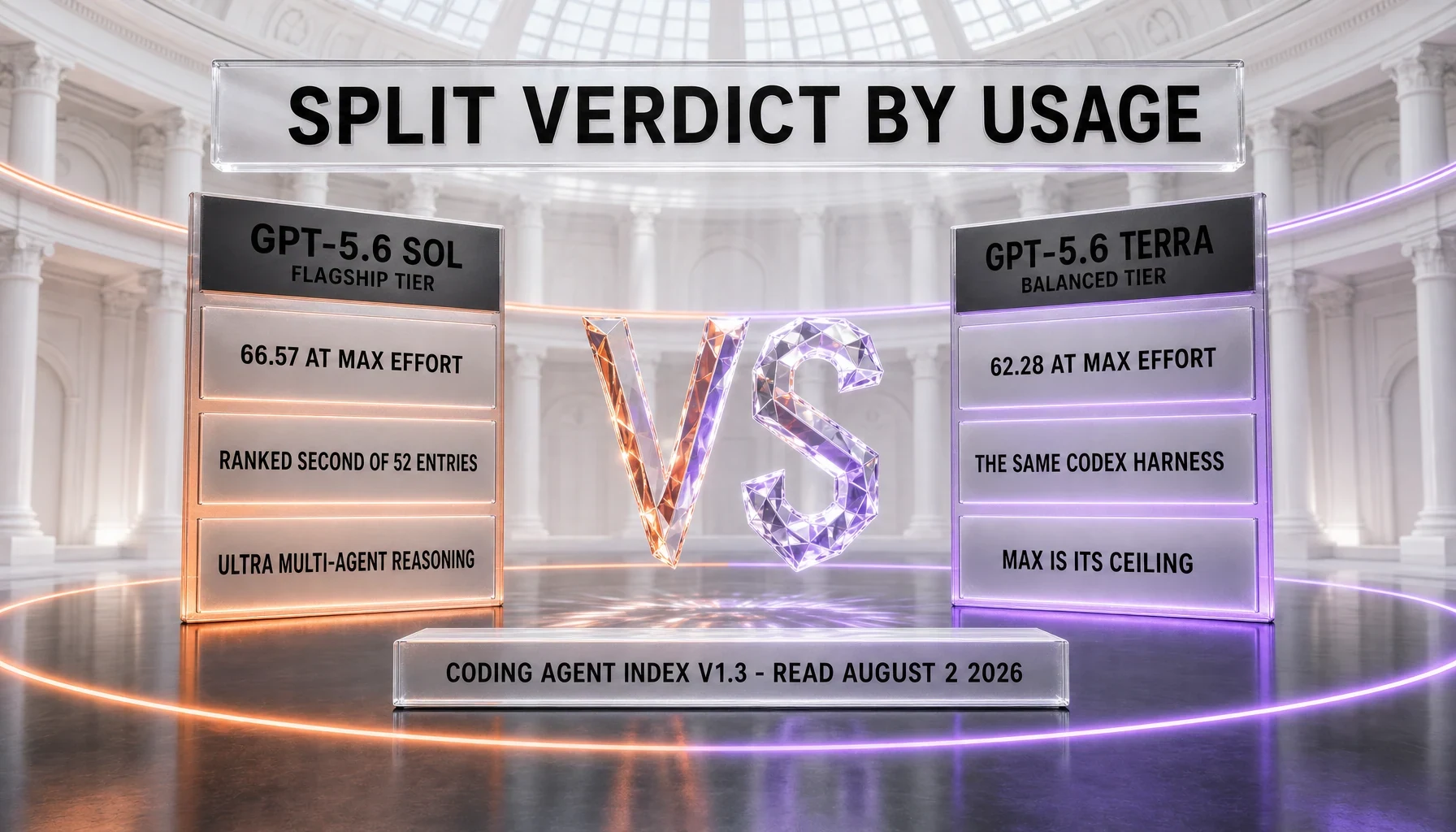
| AA Coding Agent Index v1.3 (independent, read August 2, 2026) | 66.57 — 2nd of 52 (Codex harness, max effort) | 62.28 (Codex harness, max effort) |
| SWE-bench Verified (vals.ai, independent) | N/A (not submitted) | N/A (not submitted) |
| Terminal-Bench 2.1 (self-reported, OpenAI) | 88.8% (91.9% in ultra) | 87.4% |
| Context window | 1,050,000 tokens | 1,050,000 tokens |
| Max output tokens | 128,000 | 128,000 |
| Knowledge cutoff | Feb 16, 2026 | Feb 16, 2026 |
| Reasoning-effort tiers | low to xhigh, plus max and ultra | low to max |
| Multi-agent reasoning (ultra) | Yes (up to 16 agents, 4 by default) | No (max is the ceiling) |
| Programmatic Tool Calling | Yes (isolated V8 runtime) | Yes (isolated V8 runtime) |
| Input and output modalities | Text and image in, text out | Text and image in, text out |
| Consumer ChatGPT app access | Selectable (Plus, Pro, Business, Enterprise) | API, Codex, Business/Enterprise only |
| Fine-tuning support | Not supported | Not supported |
Pricing Comparison
GPT-5.6 Sol
GPT-5.6 Terra
Detailed Comparison
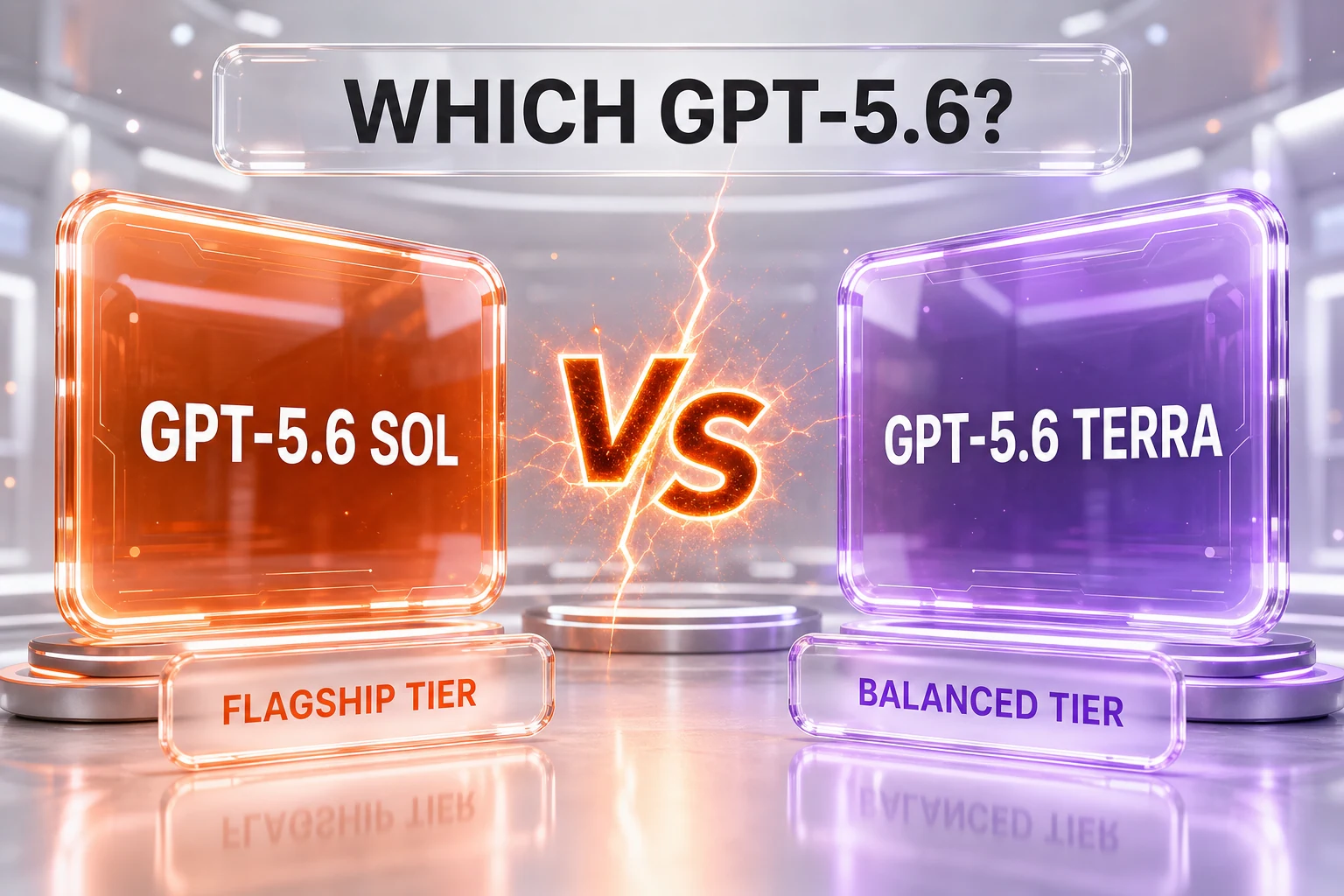
GPT-5.6 Sol and GPT-5.6 Terra are the two upper capability tiers of OpenAI's GPT-5.6 generation, released together on July 9, 2026. They share the same 1,050,000-token context window, the same February 16, 2026 knowledge cutoff, the same 128,000-token output ceiling, and the same Programmatic Tool Calling toolbox — so the decision is purely capability against price. GPT-5.6 Sol is the flagship: it scores 59 on the independent Artificial Analysis Intelligence Index and is charted second of the 52 harness-and-model-effort entries on the Coding Agent Index v1.3, at 66.57, and it alone gets the new ultra multi-agent reasoning mode, priced at $4 per million input tokens and $20 per million output tokens on requests up to 272,000 input tokens, under promotional rates OpenAI introduced on August 21, 2026. GPT-5.6 Terra is the balanced tier: it scores 55 on the Intelligence Index and 62.28 on the Coding Agent Index — the same Codex harness at the same max effort, 4.29 points behind Sol — and at $2.00 input and $12 output per million tokens, after OpenAI's July 30, 2026 price cut, it costs half of Sol's input rate and 60 percent of its output rate. Best for the hardest problems and long-horizon agents: Sol. Best for high-volume business work at a tight budget: Terra. There is no single overall winner — you pick the tier, not the model.
Quick Verdict
This is a split verdict inside one model family: GPT-5.6 Sol owns the capability ceiling, GPT-5.6 Terra owns the price — and because they share everything else, the choice is unusually clean. Both went generally available on July 9, 2026, and we have API access to both. We ran them side-by-side through our own OpenAI API key, so we scope our hands-on claims to the first few days and lean on attributed third-party benchmarks — Artificial Analysis above all — wherever our own time is too short. Every figure below carries its source, and OpenAI's self-reported numbers are labeled as such. Here is the short version, per OpenAI's own positioning.
- Best for peak measured intelligence: GPT-5.6 Sol. Artificial Analysis scores it 59 on the Intelligence Index v4.1 against Terra's 55 — a four-point gap that widens on the hardest reasoning.
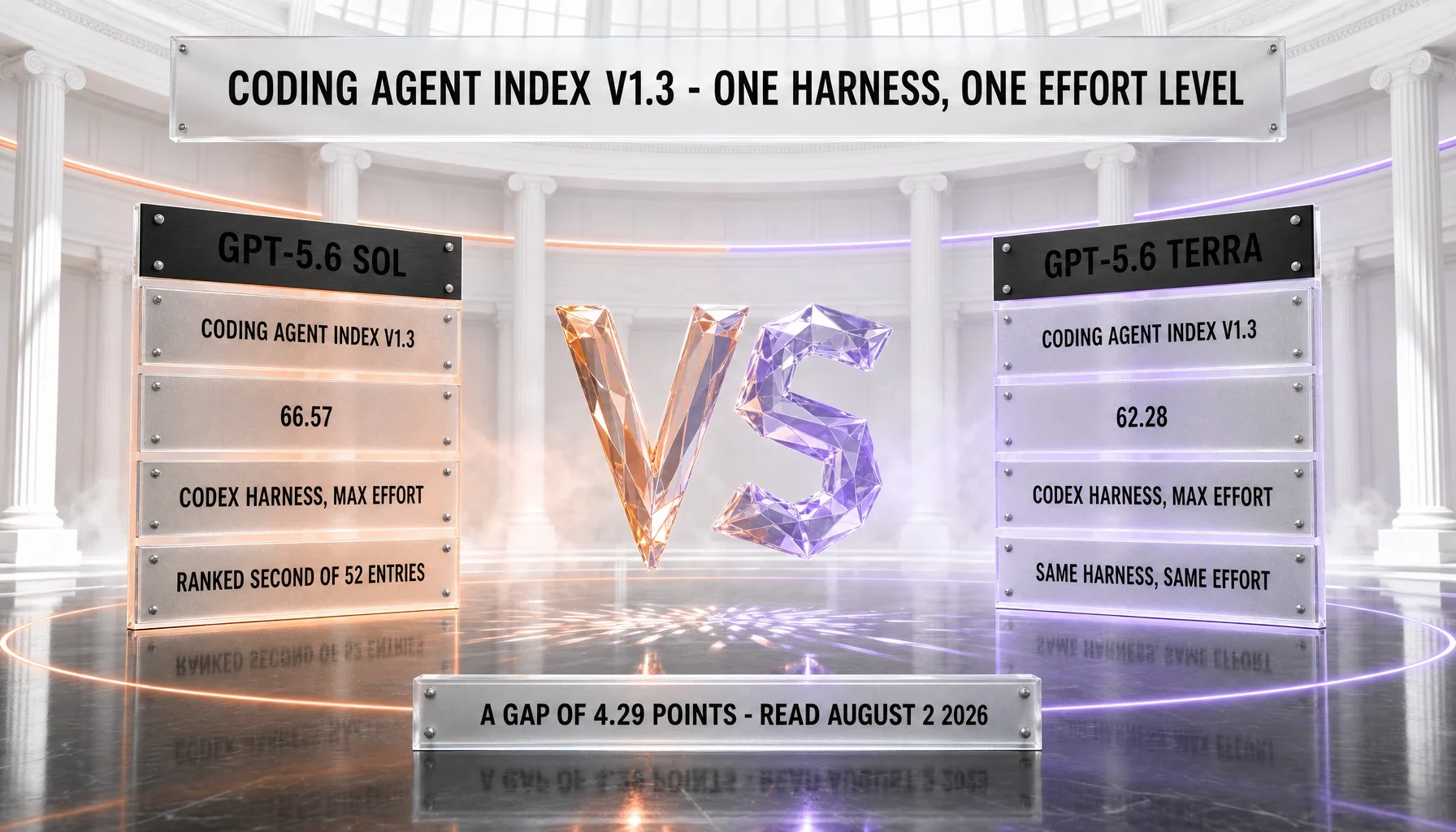
- The one measurement that is genuinely like-for-like: both tiers run the same Codex harness on the AA Coding Agent Index v1.3, so the reasoning-effort settings line up exactly. At max effort Sol scores 66.57 and Terra 62.28 — a 4.29-point gap. Lower the effort and the gap widens rather than closes: 64.11 to 55.79 at high, 60.61 to 47.80 at medium (checked August 2, 2026).
- Best for multi-agent and hardest-tier work: GPT-5.6 Sol. Its new ultra reasoning mode runs up to sixteen parallel agents; Terra's reasoning ceiling stops at max, one step below.
- Best for price: GPT-5.6 Terra, decisively. At $2.00 input and $12 output per million tokens it is half of Sol's input rate and 60 percent of its output rate. A single multiplier no longer covers both sides, because OpenAI cut Terra on July 30, 2026 and cut Sol on August 21, 2026, and the two cuts were not the same size. Both rate cards are vendor-verified.
- Best for cost per task: GPT-5.6 Terra, by better than two to one. Artificial Analysis measured about $0.55 per task for Terra against about $1.04 for Sol on the same evaluation — figures taken before either tier was repriced, so they reflect neither the July 30, 2026 cut to Terra nor the August 21, 2026 cut to Sol.
- Best value for high-volume business work: GPT-5.6 Terra. OpenAI positions it as GPT-5.5-competitive at two times lower cost, and it trails Sol only by single-digit index margins.
- Best consumer access: GPT-5.6 Sol. It is selectable in the ChatGPT app on paid plans; Terra is available through the API, Codex, and ChatGPT for Business and Enterprise only.
- Tied on everything structural: context window, output ceiling, knowledge cutoff, modalities, tokenizer, Programmatic Tool Calling, and fine-tuning support are identical across both tiers.
The honest caveats up front: both tiers are only days old at the time of writing, so we treat our hands-on notes as first impressions, not a settled verdict. Neither Sol nor Terra has been submitted to the independent SWE-bench Verified leaderboard, so there is no verified GitHub-issue coding score for either — a data gap we flag rather than paper over. And OpenAI's Terminal-Bench 2.1 figures for both models are self-reported; we label them so and keep them apart from the independent Artificial Analysis scores.
GPT-5.6 Sol vs GPT-5.6 Terra — Overview
What Is GPT-5.6 Sol?
GPT-5.6 Sol is the flagship capability tier of OpenAI's GPT-5.6 generation, generally available July 9, 2026 after a gated preview on June 26. In OpenAI's naming scheme the number is the generation and the names — Sol, Terra, and Luna — are durable capability tiers rather than sizes; Sol is the tier aimed at the hardest problems, from complex coding and long-horizon agents to cyber, science, and computer use, per OpenAI's announcement. Per OpenAI's model documentation, Sol runs a 1,050,000-token context window with up to 128,000 output tokens and a February 16, 2026 knowledge cutoff, handles text and image inputs to text output, and introduces two new reasoning levels above xhigh: max, and ultra, a multi-agent mode that runs up to sixteen reasoning agents in parallel. It also carries Programmatic Tool Calling, where the model writes and executes JavaScript in an isolated, ephemeral runtime to orchestrate its own tools. API pricing is $4 per million input tokens and $20 per million output tokens on requests up to 272,000 input tokens, with cached input at $0.40 per million — promotional rates OpenAI introduced on August 21, 2026, set out in the pricing section below. On the independent leaderboards it is the stronger of the two tiers: 59 on the Artificial Analysis Intelligence Index, and it leads the Coding Agent Index v1.3 at 66.57 against Terra's 62.28, both through Codex at max effort.
What Is GPT-5.6 Terra?
GPT-5.6 Terra is the balanced capability tier of the same generation, released alongside Sol on July 9, 2026, and built for high-volume business work — customer support, document processing, and everyday automation. OpenAI positions it as GPT-5.5-competitive at two times lower cost, a claim we treat as vendor positioning and test against the independent numbers below. Per OpenAI's model documentation, Terra shares Sol's exact envelope: a 1,050,000-token context window, up to 128,000 output tokens, a February 16, 2026 cutoff, text-and-image input to text output, and the same Programmatic Tool Calling and agentic toolbox. Where it differs is the reasoning ceiling — Terra's effort scale runs from low to max and stops there, without Sol's ultra multi-agent mode — and the price. Per OpenAI's API pricing documentation, Terra costs $2.00 per million input tokens and $12 per million output tokens — half Sol's input rate and 60 percent of its output rate, after OpenAI's July 30, 2026 price cut — with cached input at $0.20 per million. On the independent Artificial Analysis indices it scores 55 on intelligence and 62.28 on the Coding Agent Index at max effort — four points behind Sol on intelligence and 4.29 behind on coding, for half Sol's input rate and 60 percent of its output rate.
How We Compared Them — and What We Did Not Do
Method transparency matters here, because both tiers are only days old and the temptation is to over-read a handful of prompts. Here is exactly what we did and did not do, and where our numbers come from.
- Pricing: both rate cards are vendor-verified. We confirmed Sol's $4 input and $20 output per million tokens, and Terra's $2.00 input and $12 output, re-read on August 28, 2026 directly against OpenAI's API pricing documentation and cross-checked the specs on OpenAI's model docs. No relayed figures.
- Independent benchmarks: we lean on Artificial Analysis for the Intelligence Index and cost per task, because it measures both tiers on the same harness. The Coding Agent Index is a different kind of measurement — it scores a coding harness paired with a model at a stated reasoning effort — and both tiers appear on it through the same Codex harness, which is exactly what makes their effort settings line up. Where a model has not been measured — as neither Sol nor Terra has on SWE-bench Verified — we say so and do not substitute a self-reported number.
- Self-reported figures: OpenAI's Terminal-Bench 2.1 numbers for Sol (88.8 percent, 91.9 percent in ultra) and Terra (87.4 percent) are labeled as vendor-reported throughout and are not treated as head-to-head evidence against the independent indices.
- Hands-on: we ran both models side-by-side through our own OpenAI API key on the same business and coding tasks. Both returned successfully, and we report what we saw — but a few days of use is first impressions, not a controlled benchmark, and we scope every observation accordingly.
- Disclosure: we have no affiliate relationship with OpenAI. There are no sponsored links on this page. This is an internal comparison of two tiers of the same model, so there is no vendor axe to grind either way — only the question of which tier fits which job.
Features and Benchmarks Comparison
The table below lists every dimension we could verify or attribute. Read the Winner column carefully: it distinguishes vendor-verified pricing, independent benchmarks, self-reported figures, and genuine ties — and there are many ties here, because the two tiers share the same envelope. Sources for the independent scores are Artificial Analysis, and the specifications come from OpenAI's model documentation.
| Feature | GPT-5.6 Sol | GPT-5.6 Terra | Winner |
|---|---|---|---|
| API input price (per million tokens) | $4.00 (verified, promotional) | $2.00 (verified) | GPT-5.6 Terra, at half |
| API output price (per million tokens) | $20.00 (verified, promotional) | $12.00 (verified) | GPT-5.6 Terra, at 60 percent |
| Cached input (per million tokens) | $0.40 (verified, promotional) | $0.20 (verified) | GPT-5.6 Terra, at half |
| Batch mode (per million tokens) | $2.00 input / $10.00 output | $1.00 input / $6.00 output | GPT-5.6 Terra |
| Cost per task, AA Intelligence Index (independent) | ~$1.04 (Artificial Analysis) | ~$0.55 (Artificial Analysis) | GPT-5.6 Terra |
| AA Intelligence Index v4.1 (independent) | 59 | 55 | GPT-5.6 Sol |
| AA Coding Agent Index v1.3 (independent, read August 2, 2026) | 66.57 — 2nd of 52 (Codex harness, max effort) | 62.28 (Codex harness, max effort) | Sol by 4.29 — same harness, same effort |
| SWE-bench Verified (vals.ai, independent) | N/A (not submitted) | N/A (not submitted) | Tie (neither submitted) |
| Terminal-Bench 2.1 (self-reported, OpenAI) | 88.8% (91.9% in ultra) | 87.4% | GPT-5.6 Sol (self-reported) |
| Context window | 1,050,000 tokens | 1,050,000 tokens | Tie |
| Max output tokens | 128,000 | 128,000 | Tie |
| Knowledge cutoff | Feb 16, 2026 | Feb 16, 2026 | Tie |
| Reasoning-effort tiers | Low to xhigh, plus max and ultra | Low to max | GPT-5.6 Sol |
| Multi-agent reasoning (ultra) | Yes (up to 16 agents, 4 by default) | No (max is the ceiling) | GPT-5.6 Sol |
| Programmatic Tool Calling | Yes (isolated V8 runtime) | Yes (isolated V8 runtime) | Tie |
| Input and output modalities | Text and image in, text out | Text and image in, text out | Tie |
| Consumer ChatGPT app access | Selectable (Plus, Pro, Business, Enterprise) | API, Codex, Business/Enterprise only | GPT-5.6 Sol |
| Fine-tuning support | Not supported | Not supported | Tie |
Synthesis: read top to bottom, the table tells a clear story. Every structural row is a tie — same context, same output ceiling, same cutoff, same modalities, same tooling, same tokenizer — because Sol and Terra are tiers of one generation, not rival architectures. The capability rows tilt to Sol: 59 to 55 on intelligence, plus the ultra mode Terra lacks. The coding index tilts the same way and by a comparable margin: 66.57 to 62.28 at max effort, on the same Codex harness. The price rows tilt to Terra, but no longer by one number: OpenAI repriced Terra on July 30, 2026 and Sol on August 21, 2026, and Terra now sits at half of Sol on input, cached input and batch input, and at 60 percent on output and batch output. One nuance worth stating plainly: on LMArena's human-preference Elo, Sol's Xhigh configuration is charted at 1486 (No.8), while Terra has not been charted yet, so we do not treat human preference as a head-to-head row — only Sol has a number there. That leaves the decision exactly where the design intends it: capability versus cost.
Pricing — GPT-5.6 Sol vs GPT-5.6 Terra in 2026
Pricing is no longer one clean ratio. OpenAI cut Terra on July 30, 2026 and cut Sol on August 21, 2026, and the two cuts were not the same size, so Terra now sits at half of Sol's input rate and 60 percent of its output rate. Both tiers carry the same context-length surcharge — prompts above 272,000 input tokens bill at twice the input rate and 1.5 times the output rate for the entire request, not just the excess, taking Sol to $8 input and $30 output — and both use the same tokenizer, so a given prompt produces the same token count on both and trips the surcharge at the same point. Either side of that threshold, Terra remains the cheaper tier. For the mechanics of input, output, and cached-token billing, our AI model pricing explainer breaks down how these rate cards translate into real invoices. Both tables below come straight from OpenAI's API pricing documentation, cross-checked against the GPT-5.6 announcement.
GPT-5.6 Sol Pricing
| Tier | Input (per million tokens) | Output (per million tokens) | Notes |
|---|---|---|---|
| Standard API | $4.00 | $20.00 | Prompts up to 272,000 input tokens; promotional since August 21, 2026 |
| Long context (over 272K input) | $8.00 | $30.00 | 2x input, 1.5x output on the whole request |
| Cached input | $0.40 | — | 90 percent discount, verified |
| Batch mode and Flex | $2.00 | $10.00 | Half price, verified |
| Fast mode (2x) | $8.00 | $40.00 | Renamed from Priority on July 30, 2026, verified |
GPT-5.6 Terra Pricing
| Tier | Input (per million tokens) | Output (per million tokens) | Notes |
|---|---|---|---|
| Standard API | $2.00 | $12.00 | Prompts up to 272,000 input tokens |
| Long context (over 272K input) | $4.00 | $18.00 | 2x input, 1.5x output on the whole request |
| Cached input | $0.20 | — | 90 percent discount, verified |
| Batch mode | $1.00 | $6.00 | Half price, verified |
| Fast mode (2x) | $4.00 | $24.00 | Renamed from Priority on July 30, 2026, verified |
Pricing verdict: Terra wins on price everywhere, but the margin now differs by side. On a representative agentic call of 50,000 input tokens and 5,000 output tokens, Sol costs about $0.30 at the rate card ($4 times 0.05 input plus $20 times 0.005 output), while Terra costs about $0.16 ($2.00 times 0.05 plus $12 times 0.005) — a little over half. Terra is half of Sol on input, cached input and batch input, and 60 percent of Sol on output and batch output; the single clean ratio that held between July 30 and August 21, 2026 did not survive OpenAI's cut to Sol. The one place the sticker gap and the real gap diverge is cost per task, and it diverges in Terra's favor too: Artificial Analysis measured about $0.55 per task for Terra against about $1.04 for Sol on its Intelligence Index run — figures gathered before either repricing, when Terra's rate card was exactly half of Sol's on both sides. Both tiers share a tokenizer and Terra emits somewhat fewer reasoning tokens at its lower ceiling, so the measured gap tracked the rate card closely; on today's rate cards it should sit slightly tighter than that measurement on output-heavy work, since Terra's output rate is 60 percent of Sol's rather than half. If budget is the binding constraint, Terra is not a compromise — it is roughly half the invoice for a model that trails only by single-digit index points.
Hands-On Notes — Both Tiers Through Our Own API Key
We owe you precision about what this section is and is not. We ran GPT-5.6 Sol and GPT-5.6 Terra side-by-side through our own OpenAI API key on the same prompts within hours of their July 9 general availability, which gives us a few days of direct comparison at the time of writing — sharp first impressions, nowhere near a controlled benchmark. Take these observations as scoped and provisional, and weight the attributed Artificial Analysis numbers and OpenAI's own model documentation above them.
Where Sol stood out: the hardest single problems. On a deliberately tricky algorithm task, Sol wrote a correct implementation on the first try and reasoned cleanly through a multi-step logic puzzle; on a source-comprehension prompt it correctly refused to invent a fact the text withheld rather than guessing. Turned up to its higher reasoning levels, and especially in the ultra multi-agent mode, it produced visibly more thorough plans on a hard architecture task than Terra did — at a higher token bill for that call. This lines up with its 59 Intelligence Index and its second-of-52 Coding Agent Index v1.3 placement without proving either in a few days.
Where Terra held its ground: everyday business work at half the cost. On an identical cost-analysis task, Terra matched Sol's answer at roughly half the token cost and lower latency — the two-times-cheaper thesis held in our runs. It followed instructions with discipline: it obeyed "output only JSON" and "table only," respected word budgets, and did not pad across four business tasks, with responses landing in the low single-digit seconds. On routine transforms and structured extraction, the output gap between the two tiers was small to invisible, which is precisely where Terra's price advantage makes it the rational default.
What the split looked like in practice: the honest pattern was that Terra was good enough for most of what we threw at it, and Sol pulled ahead specifically on the hardest, longest, or most ambiguous tasks — the ones where an extra few index points and a parallel-agent reasoning mode actually change the result. That is exactly the tier design working as intended, and it is why we did not crown one winner.
What we cannot tell you yet: latency under controlled load, per-task economics across a real production mix, and whether either tier's early behavior holds up over weeks. We will update this comparison as our side-by-side time accumulates and as more independent harnesses publish results.
Winner per Category
Best for Peak Measured Intelligence: GPT-5.6 Sol
On the Artificial Analysis Intelligence Index v4.1, GPT-5.6 Sol scores 59 against GPT-5.6 Terra's 55 — a four-point gap on the same independent harness. On aggregate that is modest, but it is not evenly distributed: index gaps of this kind tend to concentrate on the hardest reasoning tasks, where a few points of headroom can be the difference between a correct multi-step answer and a plausible wrong one. If your workload leans on the toughest reasoning you have, Sol is the pick on the independent evidence. For everyday prompts, the four points rarely surface.
Agentic Coding Agent Index: Both Tiers Are Charted, GPT-5.6 Sol Leads
The AA Coding Agent Index v1.3 separates these two cleanly, and it can do so because both run the same Codex harness: Sol is charted at 66.57, second of 52 entries, at max reasoning effort, and Terra at 62.28 at the same effort — 4.29 points apart. Lower the effort and the gap widens rather than closes: 64.11 to 55.79 at high, 60.61 to 47.80 at medium, 43.42 to 23.70 with reasoning off. Neither tier has an independent SWE-bench Verified score — OpenAI has not submitted either — so the Coding Agent Index is the like-for-like independent coding signal between these two tiers. Our explainer on agentic coding models covers why an agent index measures something different from a single-shot coding score. For the hardest agentic coding and long-horizon refactors, Sol's lead plus its ultra mode make it the pick; for routine coding assistance, where 4.29 index points rarely change the outcome, price wins.
Best for Multi-Agent and Hardest-Tier Work: GPT-5.6 Sol
Sol owns the reasoning ceiling outright. Per OpenAI's documentation, the effort scale runs low through xhigh, then adds max — and Sol goes one step further to ultra, a multi-agent mode that runs up to sixteen reasoning agents in parallel (four by default). Terra stops at max and does not offer ultra. OpenAI reports Sol reaching 91.9 percent on Terminal-Bench 2.1 in ultra versus 88.8 percent standard, though that is self-reported. For long-horizon, hardest-tier problems that benefit from parallel reasoning, ultra is a concrete, Terra-unavailable reason to choose Sol.
Best for Price and Cost per Task: GPT-5.6 Terra
This one is not close, and it is exact. Terra costs $2.00 per million input tokens against Sol's $4, and $12 per million output against $20 — half on input, 60 percent on output, vendor-verified on OpenAI's pricing documentation. Batch mode halves each again. And on the one third-party cost-per-task measurement, Artificial Analysis put Terra at about $0.55 to run its Intelligence Index against about $1.04 for Sol, measured before the July 30, 2026 price cut. Unless your tasks demonstrably need Sol's capability lead, Terra now buys twice as many input tokens and about 1.7 times as many output tokens per dollar — the single largest advantage in this matchup.
Best Value for High-Volume Business Work: GPT-5.6 Terra
Value is capability per dollar, and on that axis Terra wins for the bulk of real workloads. It trails Sol by four points on intelligence and 4.29 on the coding index, while costing half as much on input and 60 percent as much on output — and OpenAI positions it as GPT-5.5-competitive at two times lower cost, aimed squarely at customer support, document processing, and everyday automation. For high-volume pipelines where the marginal capability gap rarely changes the output but the smaller bill compounds on every call, Terra is the rational default. Start workloads on Terra and promote to Sol only the tasks that measurably need the ceiling.
Best Consumer Access: GPT-5.6 Sol
One narrow but real edge for Sol sits outside the benchmarks: reach. Per OpenAI's rollout, GPT-5.6 Sol is selectable inside the ChatGPT app on the Plus, Pro, Business, and Enterprise plans, while Terra is available through the API, Codex, and ChatGPT for Business and Enterprise only — it is not a pickable model in the consumer ChatGPT experience. For developer teams consuming models by API, this is irrelevant; both are one model ID away. For non-developer users who want to select the model by name inside ChatGPT, Sol is the one they can reach, and Terra is not.
Pros and Cons
GPT-5.6 Sol Pros and Cons
What we like about GPT-5.6 Sol
- Highest measured capability of the two. 59 on the Artificial Analysis Intelligence Index against Terra's 55, and 66.57 against 62.28 on the Coding Agent Index v1.3, both at max effort.
- Exclusive ultra multi-agent reasoning mode. Up to sixteen parallel reasoning agents for the hardest long-horizon problems — a ceiling Terra does not reach.
- Disciplined hands-on behavior. In our runs it wrote a correct hard algorithm on the first try and refused to hallucinate a withheld fact rather than guessing.
- Selectable in the ChatGPT app. Reachable by name on paid consumer plans, which Terra is not.
- Same envelope as Terra with more headroom. Identical 1,050,000-token context, 128,000-token output, and toolbox, plus the extra reasoning tiers.
Where GPT-5.6 Sol falls short
- Twice Terra's input price and two-thirds more on output. $4 input and $20 output per million tokens against $2.00 and $12, and about $1.04 per task against $0.55 on an Artificial Analysis measurement taken before either tier was repriced.
- Capability lead is narrow on aggregate. Four intelligence points and 4.29 coding-index points rarely change the outcome on everyday work.
- Absent from independent SWE-bench Verified. Not submitted, so it has no independent verified-coding number — the same gap as Terra.
- Headline coding figures are self-reported. Terminal-Bench 2.1 and its ultra-mode number come from OpenAI, not an independent harness.
- Days old at the time of writing. Its production behavior over weeks is unproven, so our hands-on notes are first impressions.
GPT-5.6 Terra Pros and Cons
What we like about GPT-5.6 Terra
- Half Sol's input price, 60 percent of its output price. $2.00 input and $12 output per million tokens, with cached input at $0.20 and Batch mode at $1.00 and $6.00.
- Better than half the cost per task. Artificial Analysis measured about $0.55 against Sol's $1.04 on the same evaluation, before the July 30, 2026 price cut.
- Most of the capability for the money. 55 on the Intelligence Index and 62.28 on the Coding Agent Index, four points and 4.29 points behind Sol.
- Identical envelope and full toolbox. Same 1,050,000-token context, 128,000-token output, Programmatic Tool Calling, function calling, structured outputs, web and file search, code interpreter, computer use, and MCP.
- Disciplined instruction-following in our runs. Obeyed "output only JSON" and "table only," respected word budgets, and answered in the low single-digit seconds.
Where GPT-5.6 Terra falls short
- Behind Sol on every capability index. 55 to 59 on intelligence; 62.28 to 66.57 on the Coding Agent Index at max effort, and further behind at every lower effort setting.
- No ultra multi-agent mode. Its reasoning ceiling stops at max, so the hardest parallel-reasoning workloads belong to Sol.
- Not selectable in the consumer ChatGPT app. Available through the API, Codex, and ChatGPT for Business and Enterprise only.
- Absent from independent SWE-bench Verified. Not submitted, so that particular leaderboard carries no result for it — its independent agentic-coding evidence is the Coding Agent Index instead, at 62.28 (checked August 2, 2026).
- Days old at the time of writing. Like Sol, its long-run production behavior is not yet proven.
When to Pick GPT-5.6 Sol vs GPT-5.6 Terra
Pick GPT-5.6 Sol if...
- Your workload is the hardest coding, long-horizon agents, science, or computer use, where the four-point intelligence gap and Sol's 4.29-point coding-index lead actually change outcomes.
- You need the ultra multi-agent reasoning mode (up to sixteen parallel agents) that Terra does not offer.
- You want the peak of OpenAI's GPT-5.6 capability curve and the price difference is not the binding constraint.
- Non-developer users on your team need to select the model by name inside the ChatGPT app.
- You are promoting a specific task from Terra because you measured that it needs the extra headroom.
Pick GPT-5.6 Terra if...
- Price-performance is the deciding factor — half Sol's input rate, 60 percent of its output rate, and about half the cost per task on Artificial Analysis's pre-repricing runs.
- Your workload is high-volume business work — customer support, document processing, everyday automation — where a single-digit index gap is marginal.
- You want a GPT-5.5-competitive model, as OpenAI positions Terra, at two times lower cost.
- You consume models through the API or Codex, where Terra's lack of consumer-app selection is irrelevant.
- You want a sensible default tier and plan to promote only the tasks that measurably need Sol.
Frequently Asked Questions
Is GPT-5.6 Sol better than GPT-5.6 Terra in 2026?
On raw capability, yes, but not by a landslide, and it costs roughly twice as much. On the independent Artificial Analysis Intelligence Index, Sol scores 59 to Terra's 55, and on the Coding Agent Index v1.3 Sol scores 66.57 against Terra's 62.28, both through the Codex harness at max effort. Sol also gets the new ultra multi-agent reasoning mode that Terra does not. But Terra costs half as much on input and 60 percent as much on output — $2.00 input and $12 output per million tokens versus Sol's $4 and $20, after OpenAI cut Terra on July 30, 2026 and Sol on August 21, 2026 — and ran about $0.55 per task against Sol's $1.04 on Artificial Analysis's own measurements, taken before either cut. For the hardest problems, Sol is the better model; for high-volume production where a four-point index gap is marginal, Terra delivers most of the capability at half the price. There is no single winner here — it depends on your workload.
How much do GPT-5.6 Sol and GPT-5.6 Terra cost?
GPT-5.6 Sol costs $4 per million input tokens and $20 per million output tokens on requests up to 272,000 input tokens, with cached input at $0.40 per million; GPT-5.6 Terra costs $2.00 input and $12 output, with cached input at $0.20 per million. We confirmed both rate cards directly on OpenAI's API pricing documentation on August 28, 2026. Sol's figures are promotional: OpenAI cut them on August 21, 2026, describing the cut as lasting "for the next 3 months" on its GPT-5.6 launch page and as "available at least through November 21, 2026" on its pricing page, and it does not say what follows either window. Batch mode halves each again — Sol to $2.00 input and $10 output, Terra to $1.00 input and $6.00 output. Both carry the same context-length surcharge: prompts above 272,000 input tokens bill at twice the input rate and 1.5 times the output rate for the whole request, taking Sol to $8 input and $30 output and Terra to $4.00 input and $18.00 output. The headline: Terra bills half of what Sol bills on input and 60 percent on output.
What is the difference between GPT-5.6 Sol and GPT-5.6 Terra?
They are two capability tiers of the same GPT-5.6 generation, not two different models. OpenAI's naming scheme uses the number for the generation and the names — Sol, Terra, Luna — as durable capability tiers. Sol is the flagship aimed at the hardest problems: complex coding, long-horizon agents, science, and computer use. Terra is the balanced tier aimed at high-volume business work, which OpenAI positions as GPT-5.5-competitive at two times lower cost. They share the same 1,050,000-token context, the same February 16, 2026 cutoff, the same 128,000-token output ceiling, and the same tool suite. The differences are capability (Sol leads the independent indices), reasoning ceiling (Sol adds ultra multi-agent mode), consumer access (Sol is selectable in ChatGPT, Terra is not), and price (Terra is half of Sol on input and 60 percent on output).
Do GPT-5.6 Sol and Terra share the same context window and knowledge cutoff?
Yes, exactly. Per OpenAI's model documentation, both GPT-5.6 Sol and GPT-5.6 Terra run a 1,050,000-token context window, a 128,000-token maximum output, and a February 16, 2026 knowledge cutoff. Both accept text and image input and return text output, both support Programmatic Tool Calling in an isolated runtime, and neither supports fine-tuning at launch. This is deliberate: within the GPT-5.6 generation, the context, cutoff, and modalities are constant across tiers, and only the underlying capability, the reasoning ceiling, and the price change. So if your decision hinges on context size or freshness, the two are identical and you should choose on capability and cost instead.
Which is better for coding: GPT-5.6 Sol or GPT-5.6 Terra?
Sol, and on coding the two are directly comparable, because both run the same harness. On the Artificial Analysis Coding Agent Index v1.3, Sol is charted at 66.57, second of 52 entries, through the Codex harness at max reasoning effort, and Terra at 62.28 through the same harness at the same effort — 4.29 points apart. Neither model has been submitted to the independent SWE-bench Verified leaderboard, so there is no verified GitHub-issue score for either, which is a data gap we flag rather than fill. OpenAI's own materials report Sol at 88.8 percent on Terminal-Bench 2.1 and Terra at 87.4 percent, but those are self-reported. For the hardest agentic coding and long-horizon refactors, Sol's lead plus its ultra multi-agent mode make it the pick; for routine, high-volume coding assistance where 4.29 index points rarely change the outcome, Terra does the job at half the cost.
Is GPT-5.6 Terra good enough to replace the flagship Sol?
For most high-volume business work, yes — that is exactly the tier OpenAI built it for. Terra scores 55 on the Artificial Analysis Intelligence Index against Sol's 59, and 62.28 on the Coding Agent Index v1.3 against Sol's charted 66.57: it trails on intelligence by four points, while costing half as much on input and 60 percent as much on output, and running about $0.55 per task against Sol's $1.04 on an Artificial Analysis measurement taken before either tier was repriced. OpenAI positions Terra as GPT-5.5-competitive at two times lower cost, and in our own testing it matched Sol's answer on an identical cost-analysis task at roughly half the token cost. Where Terra cannot replace Sol is the genuinely hard end: the four-point intelligence gap, the 4.29-point coding-index lead, and the ultra multi-agent mode, which is Sol-only. Route the ceiling work to Sol, the volume work to Terra.
What is the ultra reasoning mode, and does GPT-5.6 Terra have it?
Ultra is a new multi-agent reasoning setting in the GPT-5.6 generation, and it is a Sol feature — Terra does not offer it. Per OpenAI's documentation, the reasoning-effort scale runs from low through xhigh, then adds a new max level; on Sol it goes one step further to ultra, which spawns multiple reasoning agents in parallel — four by default, up to sixteen — to attack a single hard problem. Terra's reasoning ceiling stops at max. OpenAI reports Sol reaching 91.9 percent on Terminal-Bench 2.1 in ultra mode versus 88.8 percent standard, though that figure is self-reported. If your workloads include long-horizon, hardest-tier problems that benefit from parallel reasoning, ultra is a concrete reason to choose Sol over Terra; for everyday work it is not.
Which model is cheaper per task: GPT-5.6 Sol or GPT-5.6 Terra?
Terra, by roughly half, on the one independent measurement available. Artificial Analysis publishes the cost to run its Intelligence Index evaluation, and it lists about $0.55 per task for GPT-5.6 Terra versus about $1.04 for GPT-5.6 Sol. Those figures were measured when Terra's per-token prices were precisely half of Sol's on both input and output. OpenAI has repriced both tiers since — Terra on July 30, 2026 and Sol on August 21, 2026 — and Terra now sits at half of Sol on input and 60 percent on output. The two tiers use the same tokenizer, so there is no hidden token-count penalty on either side. In our own runs on an identical business task, Terra produced a comparable answer at roughly half the token cost and lower latency. For cost-sensitive, high-throughput pipelines, Terra is the clear per-task value; Sol's premium only pays off where its capability lead matters.
Can I use GPT-5.6 Terra in the ChatGPT app?
Not directly in the consumer app. Per OpenAI's rollout, GPT-5.6 Sol is selectable inside ChatGPT on the Plus, Pro, Business, and Enterprise plans, while Terra and Luna are available through the API, Codex, and ChatGPT for Business and Enterprise only — they are not offered as pickable models in the consumer ChatGPT experience. So if your team lives inside the ChatGPT app and wants to select the model by name, Sol is the one you can reach; if you consume models through the API or Codex, both Sol and Terra are one model-ID away. This access difference is a genuine, if narrow, point in Sol's favor for non-developer users.
Does GPT-5.6 Terra support Programmatic Tool Calling?
Yes. Programmatic Tool Calling ships across the GPT-5.6 generation, so GPT-5.6 Terra has it just as GPT-5.6 Sol does. Per OpenAI's documentation, the model writes and executes JavaScript inside an isolated, ephemeral runtime to orchestrate its own tool use — batching, looping, and combining tool calls in code rather than emitting them one at a time — and it is compatible with zero-data-retention deployments. Terra also carries the full agentic toolbox: function calling, structured outputs, web and file search, code interpreter, computer use, and MCP. This is one of the clearest ways to see the tier design: the tooling is constant across Sol and Terra, and only the underlying reasoning capability and the price change between them.
Should I run GPT-5.6 Sol and Terra together in the same stack?
Yes, and for many teams a split stack is the rational setup. Because Sol and Terra share the same context window, cutoff, output ceiling, tokenizer, and tool suite, a prompt written for one runs on the other with no changes — only the model ID and the bill differ. A practical routing pattern sends the hardest coding, long-horizon agents, and anything that benefits from the ultra multi-agent mode to Sol, and sends high-volume, cost-sensitive business work to Terra at half the price. Abstraction layers such as the Vercel AI SDK, LangChain, or LiteLLM turn that routing into a configuration choice rather than a rewrite. Since the two tiers are drop-in compatible, you can even start every workload on Terra and promote only the tasks that measurably need Sol.
What are the alternatives to GPT-5.6 Sol and GPT-5.6 Terra?
Several sit close by. Below Terra, GPT-5.6 Luna is the cheapest tier in the same family at $0.20 input and $1.20 output per million tokens, for summarization and routine automation. OpenAI's prior flagship GPT-5.5 remains active and is a fair reference point for Terra, which OpenAI positions as GPT-5.5-competitive. Outside OpenAI, Claude Opus 4.8 at $5 input and $25 output per million tokens is a flagship rival to Sol with an independently verified SWE-bench Verified score, Claude Sonnet 5 is the balanced-tier rival to Terra, and Google's Gemini 3.1 Pro is the value play for high-volume retrieval. Our GPT-5.5 review and our Claude Opus 4.8 review cover the adjacent trade-offs, and the pricing mechanics are broken down in our AI model pricing explainer.
Final Verdict — Ceiling vs Bill, a True Split
After running both tiers side-by-side through our own OpenAI API key, verifying pricing on OpenAI's own documentation, and holding every capability claim to independent benchmarks, our verdict is a genuine split — and an unusually clean one, because Sol and Terra share everything except capability and price. GPT-5.6 Sol is the capability leader: 59 to 55 on the Artificial Analysis Intelligence Index, 66.57 to 62.28 on the Coding Agent Index v1.3, and the only one of the two with the ultra multi-agent reasoning mode. GPT-5.6 Terra is the value leader: half Sol's input price and 60 percent of its output price, about $0.55 per task against Sol's $1.04 on an Artificial Analysis measurement taken before either tier was repriced, and single-digit index margins behind for a model OpenAI positions as GPT-5.5-competitive. Both run the same 1,050,000-token context, the same February 16, 2026 cutoff, the same 128,000-token output, and the same Programmatic Tool Calling toolbox.
We did not crown a single overall winner because the evidence does not support one honestly: Sol's capability lead is real but narrow on aggregate, and it comes at twice Terra's input price and two-thirds more on output; Terra's value is real but it cannot buy the top of the measured intelligence and coding curves or the ultra mode. If your work is the hardest reasoning, longest-horizon agents, or most ambiguous coding — pick GPT-5.6 Sol and pay for the ceiling. If your work is high-volume business processing at a tight budget — pick GPT-5.6 Terra and bank the difference. Because the two tiers are drop-in compatible, the pragmatic endgame for many teams is to default to Terra and route only the tasks that measurably need the extra headroom to Sol. For the tiers and rivals around this matchup, see our GPT-5.5 review, our Claude Opus 4.8 review, our Claude Sonnet 5 review, and our Claude Opus 4.8 vs GPT-5.5 comparison.
Sources
Every figure in this comparison is attributed to a primary or independent source. Pricing and specifications come from OpenAI's own documentation; capability scores come from the independent Artificial Analysis; self-reported figures are labeled as such throughout.
- OpenAI — GPT-5.6 announcement, tiers, and positioning
- OpenAI — GPT-5.6 Sol and Terra model documentation and specifications
- OpenAI — GPT-5.6 API pricing (Sol and Terra)
- Artificial Analysis — Intelligence Index and cost per task
- Artificial Analysis — Coding Agent Index v1.3 leaderboard (Sol 66.57, Terra 62.28, Codex harness at max effort)
- LMArena — human-preference Elo leaderboard
Last compared: July 2026; pricing re-verified on OpenAI's API pricing documentation on August 28, 2026. GPT-5.6 Sol and GPT-5.6 Terra both reached general availability on July 9, 2026; both tiers are new, and we will revise this comparison as independent benchmark coverage matures.
Our Verdict
A true split verdict, capability against value, inside one model family. GPT-5.6 Sol and GPT-5.6 Terra share the same 1,050,000-token context window, the same February 16, 2026 knowledge cutoff, the same 128,000-token output ceiling, and the same Programmatic Tool Calling toolbox — so this is not a fight over features, it is a fight over how much capability you need and how much you want to pay for it. On the independent Artificial Analysis leaderboards, Sol leads: 59 to 55 on the Intelligence Index, and 66.57 to 62.28 on the Coding Agent Index v1.3, both through the Codex harness at max reasoning effort, read August 2, 2026 — the one board where the two tiers can be compared like for like, and the gap there is 4.29 points. Sol alone gets the new ultra multi-agent reasoning mode. Terra answers on price: after OpenAI's July 30, 2026 cut it costs $2.00 input and $12.00 output per million tokens, against Sol's $4.00 and $20.00 after OpenAI's own promotional cut to Sol on August 21, 2026 — half of Sol on input and 60 percent on output, so a single multiplier no longer covers both sides — for a model OpenAI positions as GPT-5.5-competitive. Artificial Analysis measured about $0.55 per task for Terra against about $1.04 for Sol before either repricing, so those figures reflect neither cut. Best for the hardest coding, long-horizon agents, and workloads where the four-point intelligence gap changes outcomes: GPT-5.6 Sol. Best for high-volume business work at a tight budget, where the gap is marginal and the price is not: GPT-5.6 Terra. No single overall winner — pick Sol for the ceiling, Terra for the bill.
Choose GPT-5.6 Sol
OpenAI's flagship GPT-5.6 capability tier, with Programmatic Tool Calling and a 1.05M-token context.
Try GPT-5.6 Sol →Choose GPT-5.6 Terra
OpenAI's balanced GPT-5.6 tier — GPT-5.5-competitive quality at 40 percent of the GPT-5.5 rate, with a 1.05M-token context and the full agentic toolbox.
Try GPT-5.6 Terra →Frequently Asked Questions
Is GPT-5.6 Sol better than GPT-5.6 Terra?
A true split verdict, capability against value, inside one model family. GPT-5.6 Sol and GPT-5.6 Terra share the same 1,050,000-token context window, the same February 16, 2026 knowledge cutoff, the same 128,000-token output ceiling, and the same Programmatic Tool Calling toolbox — so this is not a fight over features, it is a fight over how much capability you need and how much you want to pay for it. On the independent Artificial Analysis leaderboards, Sol leads: 59 to 55 on the Intelligence Index, and 66.57 to 62.28 on the Coding Agent Index v1.3, both through the Codex harness at max reasoning effort, read August 2, 2026 — the one board where the two tiers can be compared like for like, and the gap there is 4.29 points. Sol alone gets the new ultra multi-agent reasoning mode. Terra answers on price: after OpenAI's July 30, 2026 cut it costs $2.00 input and $12.00 output per million tokens, against Sol's $4.00 and $20.00 after OpenAI's own promotional cut to Sol on August 21, 2026 — half of Sol on input and 60 percent on output, so a single multiplier no longer covers both sides — for a model OpenAI positions as GPT-5.5-competitive. Artificial Analysis measured about $0.55 per task for Terra against about $1.04 for Sol before either repricing, so those figures reflect neither cut. Best for the hardest coding, long-horizon agents, and workloads where the four-point intelligence gap changes outcomes: GPT-5.6 Sol. Best for high-volume business work at a tight budget, where the gap is marginal and the price is not: GPT-5.6 Terra. No single overall winner — pick Sol for the ceiling, Terra for the bill.
Which is cheaper, GPT-5.6 Sol or GPT-5.6 Terra?
GPT-5.6 Sol starts at $4 in / $20 out per M tokens. GPT-5.6 Terra starts at $2 in / $12 out per M tokens. Check the pricing comparison section above for a full breakdown.
What are the main differences between GPT-5.6 Sol and GPT-5.6 Terra?
The key differences span across 18 features we compared. For API input price (per million tokens), GPT-5.6 Sol offers $4.00 (verified, promotional) while GPT-5.6 Terra offers $2.00 (verified). For API output price (per million tokens), GPT-5.6 Sol offers $20.00 (verified, promotional) while GPT-5.6 Terra offers $12.00 (verified). For Cached input (per million tokens), GPT-5.6 Sol offers $0.40 (verified, promotional) while GPT-5.6 Terra offers $0.20 (verified). See the full feature comparison table above for all details.