Claude Opus 5 vs Qwen 3.6: 21 Index Points Against a 10x Price Gap (2026)


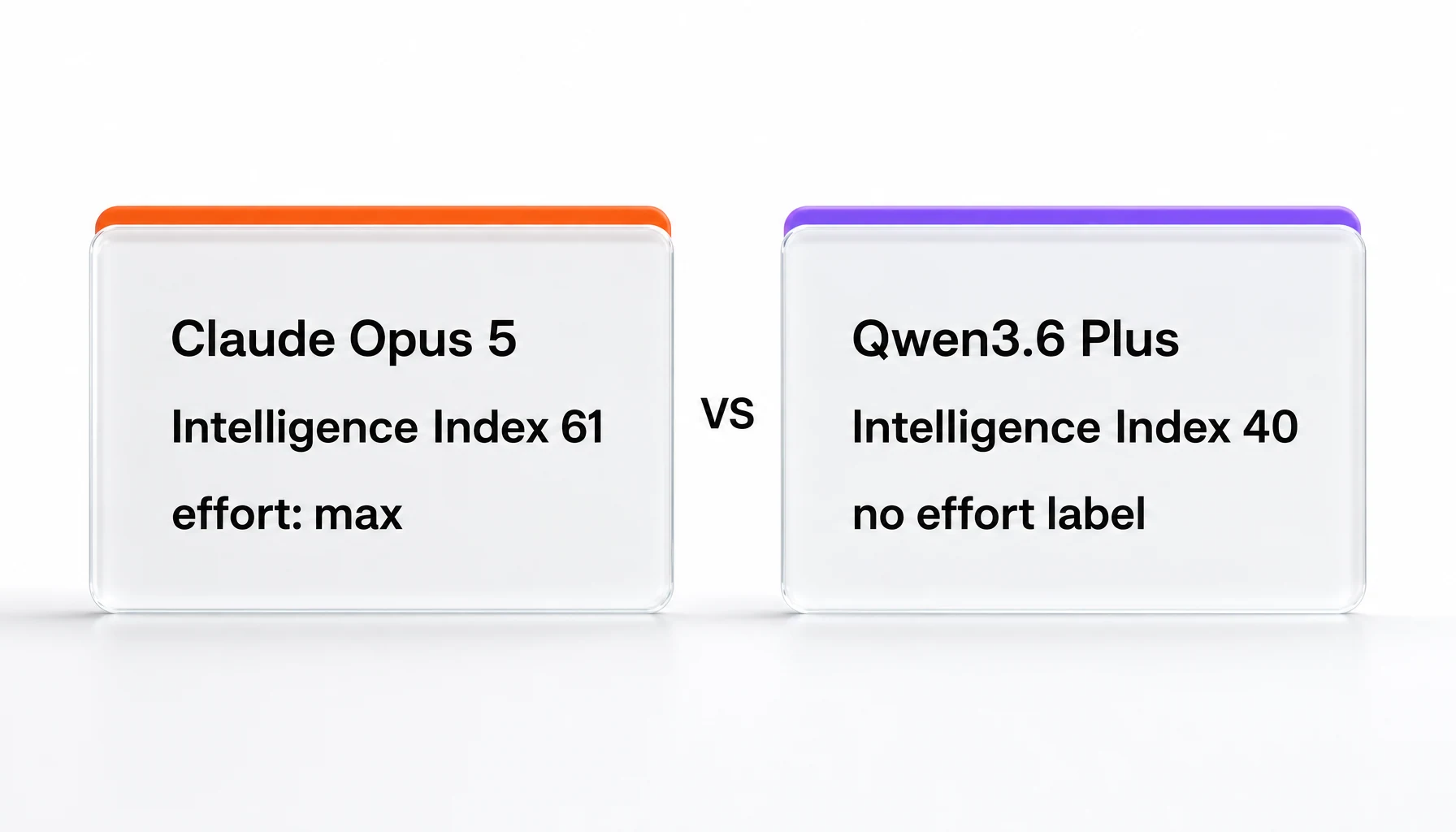
Claude Opus 5 scores 61 to Qwen3.6 Plus at 40 (AA v4.1, July 28, 2026). Opus 5 costs 10x more per input token, until you pass 256K where it is 2.5x.
Feature Comparison
| Feature | Claude Opus 5 | Qwen 3.6 |
|---|---|---|
| Intelligence Index v4.1 at top effort | 61 (max) | 40 (no effort label) |
| Intelligence Index v4.1 as shipped by default | 59 (high) | 40 (no effort label) |
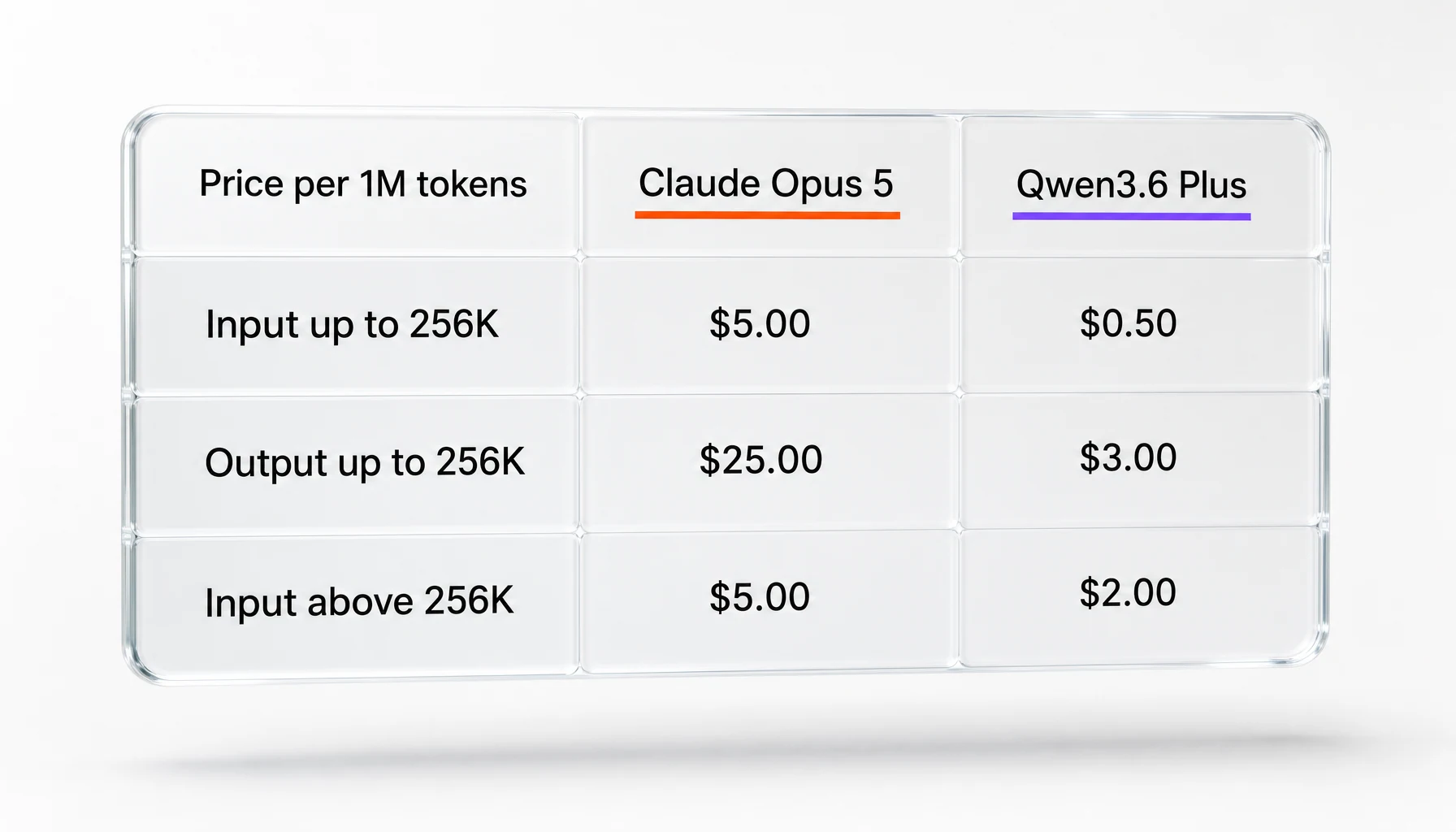
| Input price per million tokens, up to 256K | $5.00 | $0.50 (Qwen3.6 Plus) |
| Output price per million tokens, up to 256K | $25.00 | $3.00 (Qwen3.6 Plus) |
| Input price per million tokens, above 256K | $5.00 | $2.00 (Qwen3.6 Plus) |
| Long-context surcharge | None, flat rate to 1M tokens | Tiered above 256K tokens |
| Context window | 1,000,000 tokens | 1,000,000 tokens (Plus) |
| Published open weights | No | Yes, Qwen3.6-27B and Qwen3.6-35B-A3B under Apache 2.0 |
| Reasoning effort control | Five levels in output_config.effort | Not published |
| AA-Omniscience score | 31 | Not listed |
| Batch and cache pricing | 50 percent batch discount, $0.50 cache read | Not published |
| Training cutoff | May 2026 | Not published |
Pricing Comparison
Claude Opus 5
Qwen 3.6
Detailed Comparison
Claude Opus 5 scores 61 on the Artificial Analysis Intelligence Index v4.1 at its max reasoning effort, while Qwen3.6 Plus scores 40 (both measured July 28, 2026). That is a 21-point gap from Opus 5's top setting, and a 19-point gap from its high default. On list pricing, Opus 5 costs $5 per million input tokens and $25 per million output tokens; Qwen3.6 Plus costs $0.50 and $3.00 for requests up to 256,000 tokens. That is a 10 times input ratio and an 8.3 times output ratio, and both ratios compress sharply above 256,000 tokens because Alibaba raises its rate there and Anthropic does not.
We researched both models from vendor documentation and independent evaluation data rather than from press coverage. This page explains where the 21 points come from, which member of the Qwen3.6 family actually carries the score of 40, and the one place where the price gap narrows by a factor of four.
Quick verdict
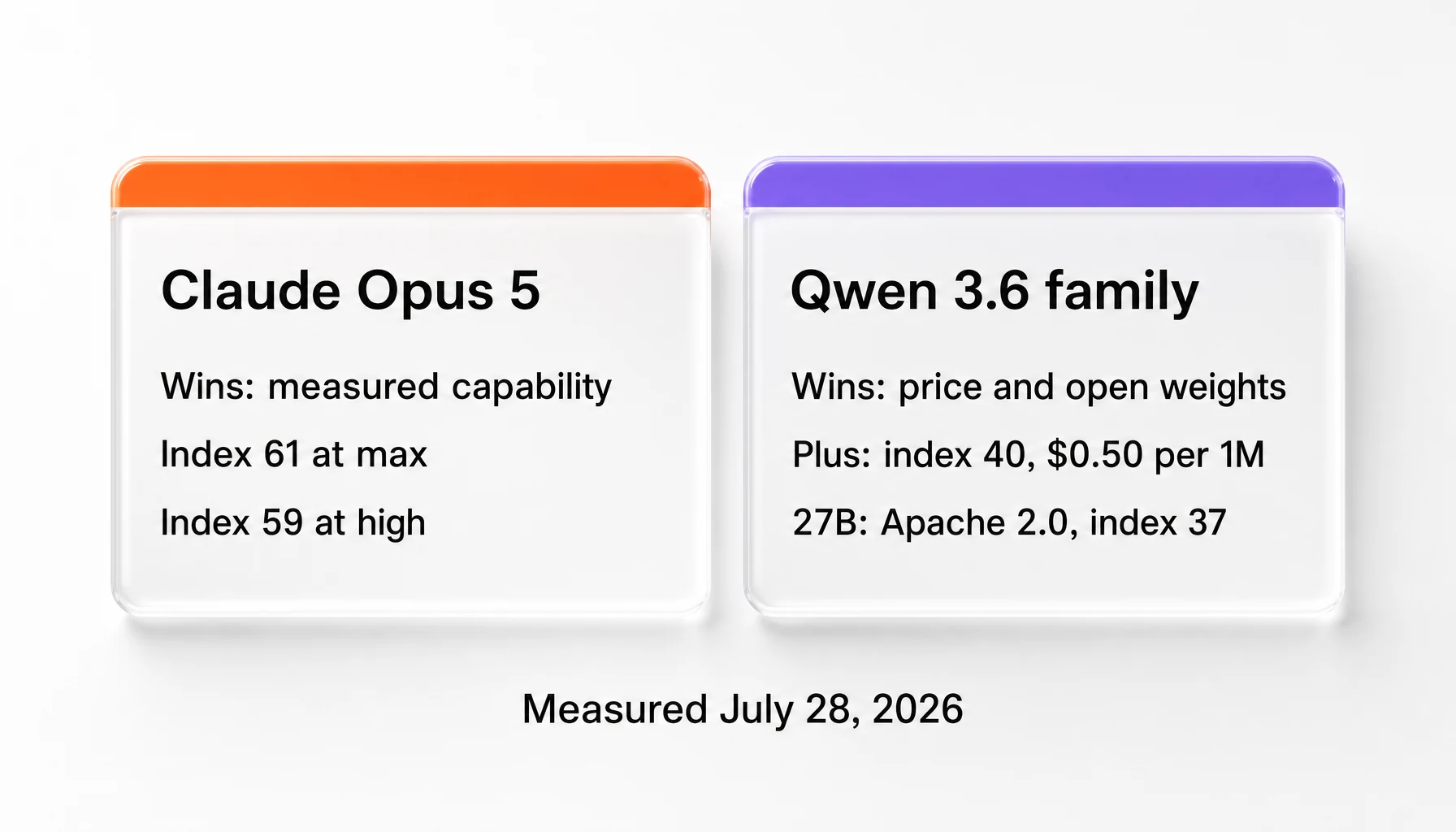
Claude Opus 5 wins on measured capability by 21 points at max effort and 19 points at its default. Qwen3.6 Plus wins on price by 10 times on input below 256,000 tokens. Above that threshold the input ratio falls to 2.5 times, which is the single most actionable number on this page for anyone loading large contexts.
Neither model is a general replacement for the other, and the choice is not close once you know your context length and your error tolerance.
- Highest measured capability: Claude Opus 5. It scores 61 at
maxagainst 40 for Qwen3.6 Plus on the same index version. - Lowest price on short and medium requests: Qwen3.6 Plus, at $0.50 per million input tokens against $5.00.
- Best value above 256,000 input tokens: much closer than the headline suggests. Qwen3.6 Plus jumps to $2.00 per million input tokens while Opus 5 stays at $5.00, cutting the input ratio from 10 times to 2.5 times.
- Weights you can download and self-host: Qwen3.6, but not the model that scores 40. The open-weight members are Qwen3.6-27B (index 37) and Qwen3.6-35B-A3B (index 32), both under an unmodified Apache 2.0 license.
- Verdict: Claude Opus 5 wins overall on capability. Qwen3.6 is the better buy for high-volume, error-tolerant, short-context work, and it is the only one of the two you can run on your own hardware.
Which Qwen3.6 actually scores 40
The 40 belongs to Qwen3.6 Plus, a proprietary API model with no published weights. It is not the open-weight Qwen3.6 release. The downloadable models score lower: Qwen3.6-27B reaches 37 and Qwen3.6-35B-A3B reaches 32 on the same index version. Conflating them overstates open-weight capability by three to eight points.
Qwen3.6 is a family, not a single model, and the distinction matters more here than in most comparisons because the cheapest headline number and the open-weight story attach to different products. Artificial Analysis lists five separate Qwen3.6 entries as of July 28, 2026.
| Artificial Analysis entry | Intelligence Index v4.1 | Cost to run the index suite | Weights published |
|---|---|---|---|
| Qwen3.6 Plus | 40 | $0.31 | No |
| Qwen3.6-27B | 37 | $0.27 | Yes, Apache 2.0 |
| Qwen3.6-35B-A3B | 32 | $0.18 | Yes, Apache 2.0 |
| Qwen3.6-27B (non-reasoning) | 30 | Not published | Yes, Apache 2.0 |
| Qwen3.6-35B-A3B (non-reasoning) | 24 | Not published | Yes, Apache 2.0 |
The two non-reasoning rows carry an asterisk on the leaderboard marking them as estimated and not fully independently benchmarked. We list them for completeness but do not treat them as measured results, and we do not fold them into any effort scale.
On the question of whether Qwen3.6 Plus has published weights, we want to be precise about what we verified and what we did not. Artificial Analysis classifies the model as proprietary and states that its weights are not publicly available. That is a third-party classification, not a statement we found from Alibaba itself. We ran our own negative check against the Hugging Face model index and found official repositories for Qwen/Qwen3.6-27B, Qwen/Qwen3.6-35B-A3B and their FP8 variants, but no repository named Qwen/Qwen3.6-Plus. A missing repository is strong evidence, not proof, and we did not find Alibaba publishing weights for Plus anywhere else. We have not located an Alibaba page that uses the word "proprietary" for this model.
For the rest of this page, every number is attached to a named variant. When we write Qwen3.6 Plus we mean the API model scoring 40, and when we write Qwen3.6-27B or Qwen3.6-35B-A3B we mean the downloadable models.
The index gap, at both configurations
Claude Opus 5 exposes five reasoning-effort levels, each separately measured. It scores 51 at low, 56 at medium, 59 at high, 60 at xhigh and 61 at max. Its default is high. Qwen3.6 Plus has a single leaderboard entry at 40 with no effort label attached, so the honest gap is 21 points from Opus 5's ceiling and 19 points from what you get out of the box.
A score only exists together with the configuration that produced it, and quoting Opus 5's 61 against a default-configuration competitor would flatter it by two points. Here is the full ladder as measured on July 28, 2026 on Intelligence Index v4.1.
| Configuration | Intelligence Index v4.1 | Cost to run the index suite | Gap over Qwen3.6 Plus |
|---|---|---|---|
| Claude Opus 5 (max) | 61 | $2.028 | +21 |
| Claude Opus 5 (xhigh) | 60 | $1.561 | +20 |
| Claude Opus 5 (high, default) | 59 | $1.057 | +19 |
| Claude Opus 5 (medium) | 56 | $0.618 | +16 |
| Claude Opus 5 (low) | 51 | $0.361 | +11 |
| Qwen3.6 Plus (no effort label) | 40 | $0.31 | reference |
Two observations follow from this table. First, Opus 5 keeps a double-digit lead even at its cheapest setting: low scores 51, still 11 points clear of Qwen3.6 Plus, and the suite cost at that setting is within five cents of Qwen's. Second, the returns from raising effort are steep in cost and shallow in score. Going from high to max buys two index points and raises the suite cost by 92 percent. If your workload is not failing at high, the top two settings are hard to justify.
The absence of an effort ladder on the Qwen3.6 Plus row is worth naming carefully. It does not mean the model has no reasoning modes; it means Artificial Analysis publishes one measured configuration for it. That is not measured, not does not exist. We did not find a published breakdown of Qwen3.6 Plus by effort level, so we do not present one.
On the separate AA-Omniscience evaluation, which tests factual recall and penalizes confident errors, Claude Opus 5 scores 31. No Qwen3.6 variant appears on that leaderboard, so we have no comparable figure and we are not going to estimate one.
The price ratio, taken from the two pricing pages
Read from vendor pricing pages rather than from benchmark spend, Claude Opus 5 costs 10 times more per million input tokens and 8.3 times more per million output tokens than Qwen3.6 Plus, for any request up to 256,000 tokens. Opus 5 lists at $5.00 input and $25.00 output; Qwen3.6 Plus lists at $0.50 and $3.00 on Alibaba Cloud Model Studio's international deployment.
These are list prices for the first-party APIs, retrieved on July 28, 2026. A price ratio is more stable than any benchmark-derived ratio because it does not move when you change reasoning effort.
| Item | Claude Opus 5 | Qwen3.6 Plus | Ratio |
|---|---|---|---|
| Input, per million tokens, up to 256K | $5.00 | $0.50 | 10.0 times |
| Output, per million tokens, up to 256K | $25.00 | $3.00 | 8.3 times |
| Input, per million tokens, above 256K | $5.00 | $2.00 | 2.5 times |
| Output, per million tokens, above 256K | $25.00 | $6.00 | 4.2 times |
| Batch input, per million tokens | $2.50 | Not published | Not comparable |
| Batch output, per million tokens | $12.50 | Not published | Not comparable |
| Cache read, per million tokens | $0.50 | Not published | Not comparable |
Anthropic publishes a 50 percent Batch API discount and a prompt-caching schedule for Opus 5: cache reads cost $0.50 per million tokens, a five-minute cache write costs $6.25 and a one-hour write costs $10.00. We did not find equivalent published batch or cache rates for Qwen3.6 Plus on Alibaba's billing documentation, so those rows read "not published" rather than zero or unavailable.
One asymmetry worth flagging for anyone modeling cost from token counts: Anthropic notes that Claude 4.7 and later models use a newer tokenizer that produces roughly 30 percent more tokens for the same text than earlier Claude models. That affects comparisons against older Claude versions more than against Qwen, but it means a naive token-count estimate carried over from a Claude 4.6-era workload will understate Opus 5 spend.
Above 256,000 tokens the price gap collapses
Alibaba tiers Qwen3.6 Plus pricing by input length: $0.50 input and $3.00 output up to 256,000 tokens, then $2.00 and $6.00 from 256,000 to one million. Anthropic applies no such tier. Opus 5 bills its full one-million-token window at one flat rate, so the input price ratio falls from 10 times to 2.5 times the moment you cross the threshold.
This is the most useful finding on the page, and it inverts the usual assumption that the cheap model stays cheap as the job gets bigger. Alibaba's billing documentation states the tiers explicitly as "0<Token≤256K" and "256K<Token≤1M". Crossing that boundary quadruples the input rate and doubles the output rate in one step.
Anthropic's position is the opposite, and it is stated in plain language in the pricing documentation: "Claude 4.6 and later models and Claude Mythos Preview include the full 1M token context window at standard pricing. (A 900k-token request is billed at the same per-token rate as a 9k-token request.)" Prompt caching and batch discounts apply at standard rates across the whole window.
The practical consequence is that the economic case for Qwen3.6 Plus is strongest exactly where most people assume it is weakest, and weakest where they assume it is strongest. For a 50,000-token request you are choosing between a model that costs 10 times less and one that scores 19 to 21 points higher. For an 800,000-token request you are choosing between a model that costs 2.5 times less on input and one that scores 19 to 21 points higher. The capability gap is unchanged; the discount that was paying for it has shrunk by a factor of four.
Two caveats keep this honest. The tiering is driven by input length, so an output-heavy job that stays under the input threshold never pays the higher rate. And the open-weight Qwen3.6 models have a native context window of 262,144 tokens, which sits just above the same 256,000 mark, so the tier boundary roughly coincides with where the downloadable models stop being a drop-in substitute without RoPE scaling.
What the benchmark cost figure is, and what it is not
Artificial Analysis publishes a "cost to run the Intelligence Index" for each model: $2.028 for Claude Opus 5 at max and $0.31 for Qwen3.6 Plus. That is what the evaluation actually spent running its suite, driven mostly by how many reasoning tokens each configuration emitted. It is not a price, and it should never be quoted as a price ratio.
The clearest proof that this figure tracks token volume rather than vendor rates comes from within Artificial Analysis's own data. Across the leaderboard there are configurations of a single model where a lower effort setting costs more to run than a higher one, despite an identical published tariff. A ratio derived from vendor pricing cannot invert like that; a ratio derived from benchmark spend can, because a model that reasons longer at one setting emits more billable tokens.
We use the figure in this comparison because it is genuinely informative about verbosity and reasoning length, which are real operational costs. We simply name it for what it is. When we want a price ratio we take it from the two pricing pages, as in the previous section, because that ratio holds regardless of which effort level you run.
Read that way, the suite costs tell a coherent story. Opus 5 at low spent $0.361 to score 51, against $0.31 for Qwen3.6 Plus to score 40. At the bottom of its ladder, Opus 5 is emitting a broadly comparable volume of tokens and converting them into 11 more index points. At max it spends 6.5 times what Qwen3.6 Plus spends and gains 21 points. The efficiency of the extra reasoning falls off steeply as effort rises.
What the index does not measure: weights, licensing and control
Qwen3.6 publishes downloadable weights for two models under an unmodified Apache 2.0 license: Qwen3.6-27B, a 27-billion-parameter dense reasoning model, and Qwen3.6-35B-A3B, a mixture-of-experts model with 35 billion total and 3 billion active parameters. Claude Opus 5 publishes no weights. No index score captures the difference between renting a model and possessing one.
We read the license file itself rather than trusting the repository tag, because the two disagree often enough to matter. The LICENSE file in Qwen/Qwen3.6-27B is the standard Apache License 2.0, unmodified, with only the appendix boilerplate filled in as "Copyright 2026 Alibaba Cloud". There is no monthly-active-user clause, no revenue threshold and no additional commercial restriction.
That verdict is worth stating plainly because the open-weight field is less uniform than it looks from the outside. Checking license files rather than headlines has produced three genuinely permissive releases in our recent coverage and two that are not what they appear: Kimi K3 ships a house license carrying a revenue threshold rather than the Modified MIT that was widely reported, and MiniMax M3 ships a community license with non-commercial terms. Against those, Qwen3.6's Apache 2.0 sits with GLM-5.2 and DeepSeek V4 as a license you can actually build a business on without a lawyer's opinion. It is the kind of detail almost nobody verifies, and it is the strongest argument in Qwen3.6's favor that the Intelligence Index cannot see.
The trade is explicit. The open-weight models give up capability against Qwen3.6 Plus, not just against Opus 5: Qwen3.6-27B scores 37 and Qwen3.6-35B-A3B scores 32, against 40 for Plus and 59 to 61 for Opus 5. What you get back is the right to run the model on your own hardware, inside your own network, with no per-token bill, no rate limit, no deprecation schedule and no vendor able to change the terms. For regulated data, air-gapped environments or workloads where a per-token bill scales badly, that can outweigh a 22-point index deficit. For a task where a wrong answer is expensive, it does not.
The architectural detail is relevant to anyone planning to self-host. Qwen3.6-35B-A3B is a mixture-of-experts design with 256 experts, of which eight routed plus one shared are activated per token, combining Gated DeltaNet and Gated Attention layers. Activating 3 billion of 35 billion parameters per token makes it far cheaper to serve than its total parameter count suggests, which is why it is the lowest-cost Qwen3.6 entry on the leaderboard at $0.18 despite scoring below the 27B dense model.
Side-by-side specifications
Both models offer a one-million-token context window, but they reach it differently and bill it differently. Claude Opus 5 has a May 2026 training cutoff, five selectable reasoning efforts and a 128,000-token synchronous output ceiling. Qwen3.6 Plus offers one million tokens of context with tiered pricing above 256,000 and a single measured configuration.
| Specification | Claude Opus 5 | Qwen3.6 Plus |
|---|---|---|
| Developer | Anthropic | Alibaba |
| Released | July 24, 2026 | Not published on the pages we checked |
| Intelligence Index v4.1 | 61 at max, 59 at high default | 40, no effort label |
| AA-Omniscience | 31 | Not listed |
| Context window | 1,000,000 tokens, flat rate | 1,000,000 tokens, tiered at 256K |
| Maximum output | 128,000 tokens synchronous, 300,000 batch | Not published |
| Training cutoff | May 2026 | Not published |
| Reasoning control | Five levels in output_config.effort | Not published |
| Input price, per million tokens | $5.00 | $0.50 up to 256K, $2.00 above |
| Output price, per million tokens | $25.00 | $3.00 up to 256K, $6.00 above |
| Published weights | No | No for Plus; yes for 27B and 35B-A3B |
| License for downloadable weights | Not applicable | Apache 2.0, unmodified |
Several cells read "not published" rather than carrying a number. That is deliberate. We did not find a stated training cutoff, output ceiling or reasoning-control parameter for Qwen3.6 Plus in Alibaba's documentation, and we would rather leave a gap than fill it with a plausible guess.
How we compared them
We researched both models rather than benchmarking them ourselves. Every price comes from the vendor's own pricing page, every index score from Artificial Analysis, and the license from the license file in the model repository. We ran no private evaluation, and we do not present one.
Our method was deliberately narrow, because the failure mode in this category is confident numbers with no provenance.
- Pricing was read directly from Anthropic's pricing documentation and Alibaba Cloud Model Studio's billing documentation on July 28, 2026. We did not take pricing from search summaries or from secondary coverage.
- Index scores come from the Artificial Analysis leaderboard, an independent evaluator, at Intelligence Index v4.1, read on July 28, 2026. Scores are recorded with the configuration that produced them.
- License was verified by opening the
LICENSEfile in the model repository and reading its text, not by reading the repository's license tag. - The weights question for Qwen3.6 Plus was checked by querying the Hugging Face model index for every published Qwen3.6 repository and confirming that no official Plus repository exists.
Two limits on what follows. Artificial Analysis figures are rolling measurements that change as index versions and model configurations are updated, so every score on this page is stamped with the date it was read. And a score obtained on a public benchmark suite is not a prediction about your workload; it is evidence about a fixed set of tasks.
Strengths and weaknesses of each
Claude Opus 5's case is capability, a flat-rate million-token window and fine-grained cost control through five effort levels. Qwen3.6's case is a 10 times lower input price below 256,000 tokens and a genuinely permissive Apache 2.0 license on its downloadable models. Each has a weakness the other does not share.
Claude Opus 5
Strengths. It scores 61 at max, 21 points clear of Qwen3.6 Plus, and holds an 11-point lead even at its cheapest low setting. The full one-million-token context window bills at a single flat rate with no long-context surcharge, and caching and batch discounts apply across the entire window. Five effort levels let you tune spend against difficulty within one model rather than switching models. A 50 percent Batch API discount and a published cache-read rate of $0.50 per million tokens make high-volume repeated-context work considerably cheaper than the headline suggests. It also has a stated May 2026 training cutoff, which is unusually recent.
Weaknesses. It is 10 times more expensive per million input tokens than Qwen3.6 Plus on short and medium requests. There are no published weights, so self-hosting, air-gapped deployment and indefinite version pinning are all off the table. The newer tokenizer used by Claude 4.7 and later produces roughly 30 percent more tokens for the same text, which inflates costs estimated from older Claude workloads. And the top of the effort ladder is poor value: max costs 92 percent more than high to run the index suite and returns two points.
Qwen3.6
Strengths. Qwen3.6 Plus costs $0.50 per million input tokens and $3.00 per million output tokens below 256,000 tokens, which makes high-volume classification, extraction and summarization dramatically cheaper. The family publishes real open weights under an unmodified Apache 2.0 license with no revenue threshold or non-commercial clause, verified in the license file. Qwen3.6-35B-A3B activates only 3 billion of 35 billion parameters per token, making self-hosting practical on modest hardware. The open-weight models offer 262,144 tokens of native context, extensible to roughly 1,010,000 with RoPE scaling.
Weaknesses. The model that scores 40 is not the one you can download, and the open-weight members score 37 and 32. Pricing tiers up sharply above 256,000 input tokens, to $2.00 input and $6.00 output, which erodes most of the cost advantage on large-context work. Artificial Analysis publishes only one measured configuration for Plus, with no effort ladder, so there is no equivalent of tuning low against max. No AA-Omniscience score is published for any Qwen3.6 variant, so we have no independent read on factual reliability. And we found no published batch pricing, cache pricing, training cutoff or output ceiling for Plus.
When to pick each one
Pick Claude Opus 5 when an error costs more than the tokens, when your requests exceed 256,000 tokens, or when you need the highest measured reasoning available. Pick Qwen3.6 when volume dominates, when requests stay short, or when you need to own the weights. The 21-point gap stops paying for itself as soon as verification is cheap.
Choose Claude Opus 5 if
- A wrong answer is expensive to catch or expensive to ship, which is the case in code that reaches production, legal and financial analysis, and anything a customer sees unreviewed.
- Your requests routinely exceed 256,000 input tokens. The flat-rate window means Opus 5 costs the same per token at 900,000 tokens as at 9,000, while Qwen3.6 Plus has already tiered up.
- You want to tune cost against difficulty inside one model. Dropping from
maxtohighsaves 48 percent of the suite cost for two index points, andmediumstill scores 56. - Your workload repeats a large stable context, where a $0.50 per million cache-read rate and the 50 percent batch discount change the arithmetic substantially.
- You need a recent training cutoff, stated as May 2026.
Choose Qwen3.6 if
- You are running high volumes of short, structured, verifiable tasks: classification, tagging, extraction, routing, first-pass summarization. Here the 10 times input saving compounds and the 19-point deficit is caught by validation.
- You need the weights. Only Qwen3.6-27B and Qwen3.6-35B-A3B qualify, and they score 37 and 32, but they are yours under Apache 2.0.
- Your data cannot leave your infrastructure. No API-only model solves this at any score.
- You want predictable cost at scale rather than per-token billing, and you can amortize hardware.
- You are building on top of a model long-term and need protection against deprecation or pricing changes. A downloaded Apache 2.0 checkpoint cannot be withdrawn.
A reasonable hybrid
The two are not mutually exclusive, and the price structure actively rewards splitting the work. Route high-volume short-context calls to Qwen3.6 Plus at $0.50 per million input tokens, keep the open-weight models for anything that cannot leave your network, and reserve Claude Opus 5 for the requests where the answer is hard, the context is long, or the cost of being wrong is high. Since the input price ratio falls to 2.5 times above 256,000 tokens, the natural split point is close to the tier boundary itself.
Frequently asked questions
Is Claude Opus 5 better than Qwen 3.6?
On measured capability, yes. Claude Opus 5 scores 61 on the Artificial Analysis Intelligence Index v4.1 at its max reasoning effort against 40 for Qwen3.6 Plus, measured July 28, 2026. That is a 21-point gap. At Opus 5's default high effort the score is 59, a 19-point gap. On price, Qwen3.6 Plus wins by 10 times on input tokens below 256,000 tokens.
Which Qwen 3.6 model scores 40 on the Intelligence Index?
Qwen3.6 Plus, which is an API-only model. The downloadable open-weight models score lower on the same index version: Qwen3.6-27B scores 37 and Qwen3.6-35B-A3B scores 32. Treating the 40 as an open-weight result overstates what you can self-host by three to eight points.
Are Qwen 3.6 weights open source?
Two members of the family publish downloadable weights under an unmodified Apache 2.0 license: Qwen3.6-27B and Qwen3.6-35B-A3B. We verified this by reading the LICENSE file, which is standard Apache 2.0 with only the copyright line filled in as Copyright 2026 Alibaba Cloud. Note that open weights is not the same as open source: the weights are downloadable, but the training data and training code are not published. Qwen3.6 Plus has no published weights.
How much does Claude Opus 5 cost compared to Qwen 3.6?
Claude Opus 5 lists at $5.00 per million input tokens and $25.00 per million output tokens. Qwen3.6 Plus lists at $0.50 and $3.00 for requests up to 256,000 tokens, and $2.00 and $6.00 above that. So Opus 5 costs 10 times more on input below the threshold and 2.5 times more above it. Both figures are list prices read from the vendors' own pricing pages on July 28, 2026.
Does Claude Opus 5 charge extra for long context?
No. Anthropic's pricing documentation states that Claude 4.6 and later models include the full one-million-token context window at standard pricing, and that a 900,000-token request is billed at the same per-token rate as a 9,000-token request. Prompt caching and batch discounts also apply at standard rates across the full window.
Does Qwen 3.6 charge extra for long context?
Yes, for Qwen3.6 Plus. Alibaba Cloud Model Studio tiers the price by input length: $0.50 input and $3.00 output for 0 to 256,000 tokens, then $2.00 input and $6.00 output for 256,000 to one million tokens. Crossing the threshold quadruples the input rate and doubles the output rate.
What reasoning effort levels does Claude Opus 5 have?
Five, set through the effort field in output_config: low, medium, high, xhigh and max. The default is high. Measured on July 28, 2026 they score 51, 56, 59, 60 and 61 respectively on Intelligence Index v4.1. Qwen3.6 Plus has a single leaderboard entry with no effort label, so no equivalent ladder is published.
Is the Artificial Analysis cost per task the same as the price?
No. The cost to run the Intelligence Index is what the evaluation actually spent executing its test suite, and it is driven mainly by how many tokens each configuration emitted, especially reasoning tokens. It is not a vendor tariff and should not be quoted as a price ratio. For a price ratio, use the per-million-token rates from the two pricing pages, which do not change with reasoning effort.
Can I self-host Qwen 3.6 to avoid API costs?
You can self-host Qwen3.6-27B or Qwen3.6-35B-A3B, but not Qwen3.6 Plus, which has no published weights. Qwen3.6-35B-A3B is the more practical target: it is a mixture-of-experts model that activates only 3 billion of its 35 billion parameters per token, so serving cost is far below what the total parameter count suggests. It scores 32 on the Intelligence Index against 61 for Claude Opus 5 at max effort.
What context window does each model support?
Both Claude Opus 5 and Qwen3.6 Plus support one million tokens of context. The open-weight Qwen3.6 models support 262,144 tokens natively, extensible to roughly 1,010,000 tokens with RoPE scaling. Claude Opus 5 caps synchronous output at 128,000 tokens and batch output at 300,000 tokens; we did not find a published output ceiling for Qwen3.6 Plus.
How does Qwen 3.6 compare on factual accuracy?
We cannot answer this from independent data. Claude Opus 5 scores 31 on AA-Omniscience, the Artificial Analysis evaluation that measures factual recall and penalizes confident errors. No Qwen3.6 variant appears on that leaderboard as of July 28, 2026, so there is no comparable published figure and we are not going to estimate one.
Which one should I pick for high-volume production work?
It depends on whether errors are cheap to catch. For high volumes of short, structured, verifiable tasks such as classification, extraction and routing, Qwen3.6 Plus at $0.50 per million input tokens is the better economic choice because validation catches the 19-point capability deficit. For work where a wrong answer ships, or where requests exceed 256,000 tokens, Claude Opus 5 is worth its premium. Splitting traffic near the 256,000-token tier boundary is a defensible hybrid.
Final verdict
Claude Opus 5 wins this comparison on measured capability, by 21 index points at max effort and 19 at its default. Qwen3.6 wins on price below 256,000 tokens and on published Apache 2.0 weights. The deciding question is not which model is better but whether your errors are cheap to catch and how long your contexts run.
The 21-point gap is the largest we have measured in this series, and it is real. But two things qualify it. The gap narrows to 19 points if you compare Opus 5 as it actually ships rather than at its ceiling, and the price advantage that funds the trade-off shrinks by a factor of four the moment your requests pass 256,000 input tokens. Anyone whose workload lives above that threshold is paying much closer to parity than the headline ratio suggests.
What the index cannot score is the part of Qwen3.6 that may matter most. Two members of the family ship under an unmodified Apache 2.0 license, verified in the license file rather than assumed from a tag, with no revenue threshold and no non-commercial clause. That is a materially different proposition from renting capability through an API, and no benchmark expresses it.
Our recommendation: default to Claude Opus 5 at high rather than max, since the top setting costs 92 percent more to run for two index points. Route high-volume short-context work to Qwen3.6 Plus. Reach for Qwen3.6-27B or Qwen3.6-35B-A3B when the weights themselves are the requirement. For related reading, see our comparisons of Claude Opus 4.8 against Qwen 3.6, Claude Sonnet 5 against Qwen 3.6 and GPT-5.6 Sol against Qwen 3.6, or the full reviews of Claude Opus 5 and Qwen 3.6.
Sources and references
Every figure on this page comes from a vendor pricing page, a model repository or an independent evaluator. We cite no press coverage. Artificial Analysis measurements are rolling and were read on July 28, 2026.
- Anthropic — Claude API pricing documentation. Source for Claude Opus 5 list pricing, prompt-caching rates, Batch API discount, the flat long-context statement and the tokenizer note.
- Alibaba Cloud — Model Studio billing documentation. Source for Qwen3.6 Plus list pricing and the 256,000-token tier boundary.
- Artificial Analysis — model leaderboard. Source for Intelligence Index v4.1 scores, the Claude Opus 5 effort ladder and the cost to run the index suite.
- Artificial Analysis — AA-Omniscience evaluation. Source for the Claude Opus 5 score of 31 and for the absence of any Qwen3.6 entry.
- Hugging Face — Qwen3.6-27B model card. Source for parameter count, dense architecture and the 262,144-token native context window.
- Hugging Face — Qwen3.6-27B license file. Read in full to confirm unmodified Apache License 2.0.
- Hugging Face — Qwen3.6-35B-A3B model card. Source for the mixture-of-experts configuration and active parameter count.
- Artificial Analysis — Qwen3.6 Plus model page. Source for the third-party classification of the model as proprietary with weights not publicly available.
Our Verdict
Claude Opus 5 wins on measured capability, scoring 61 on Artificial Analysis Intelligence Index v4.1 at max effort against 40 for Qwen3.6 Plus, a 21-point gap that narrows to 19 points at Opus 5 default high effort. Qwen 3.6 wins on price and on openness: Qwen3.6 Plus costs 10 times less per input token below 256,000 tokens, and the family publishes Qwen3.6-27B and Qwen3.6-35B-A3B under an unmodified Apache 2.0 license. The decisive detail is that Alibaba tiers its pricing above 256,000 tokens while Anthropic does not, so the input price ratio collapses from 10 times to 2.5 times on long-context work.
Choose Claude Opus 5
Anthropic's frontier reasoning model — top of the independent index at half the price of Fable 5.
Try Claude Opus 5 →Choose Qwen 3.6
Alibaba's flagship LLM family — Plus and Max Preview proprietary plus Apache 2.0 open-weight 27B and 35B-A3B.
Try Qwen 3.6 →Frequently Asked Questions
Is Claude Opus 5 better than Qwen 3.6?
Claude Opus 5 wins on measured capability, scoring 61 on Artificial Analysis Intelligence Index v4.1 at max effort against 40 for Qwen3.6 Plus, a 21-point gap that narrows to 19 points at Opus 5 default high effort. Qwen 3.6 wins on price and on openness: Qwen3.6 Plus costs 10 times less per input token below 256,000 tokens, and the family publishes Qwen3.6-27B and Qwen3.6-35B-A3B under an unmodified Apache 2.0 license. The decisive detail is that Alibaba tiers its pricing above 256,000 tokens while Anthropic does not, so the input price ratio collapses from 10 times to 2.5 times on long-context work.
Which is cheaper, Claude Opus 5 or Qwen 3.6?
Claude Opus 5 starts at $5 in / $25 out per M tokens. Qwen 3.6 offers a free plan (free plan available). Check the pricing comparison section above for a full breakdown.
What are the main differences between Claude Opus 5 and Qwen 3.6?
The key differences span across 12 features we compared. For Intelligence Index v4.1 at top effort, Claude Opus 5 offers 61 (max) while Qwen 3.6 offers 40 (no effort label). For Intelligence Index v4.1 as shipped by default, Claude Opus 5 offers 59 (high) while Qwen 3.6 offers 40 (no effort label). For Input price per million tokens, up to 256K, Claude Opus 5 offers $5.00 while Qwen 3.6 offers $0.50 (Qwen3.6 Plus). See the full feature comparison table above for all details.