Claude Opus 4.8 vs Qwen 3.6: Frontier Capability vs Open-Weight Cost (2026)


Claude Opus 4.8 leads top-end reasoning; Qwen 3.6 is ~13x cheaper with Apache 2.0 open weights at 77.2% SWE-bench. Pricing verified, split verdict.
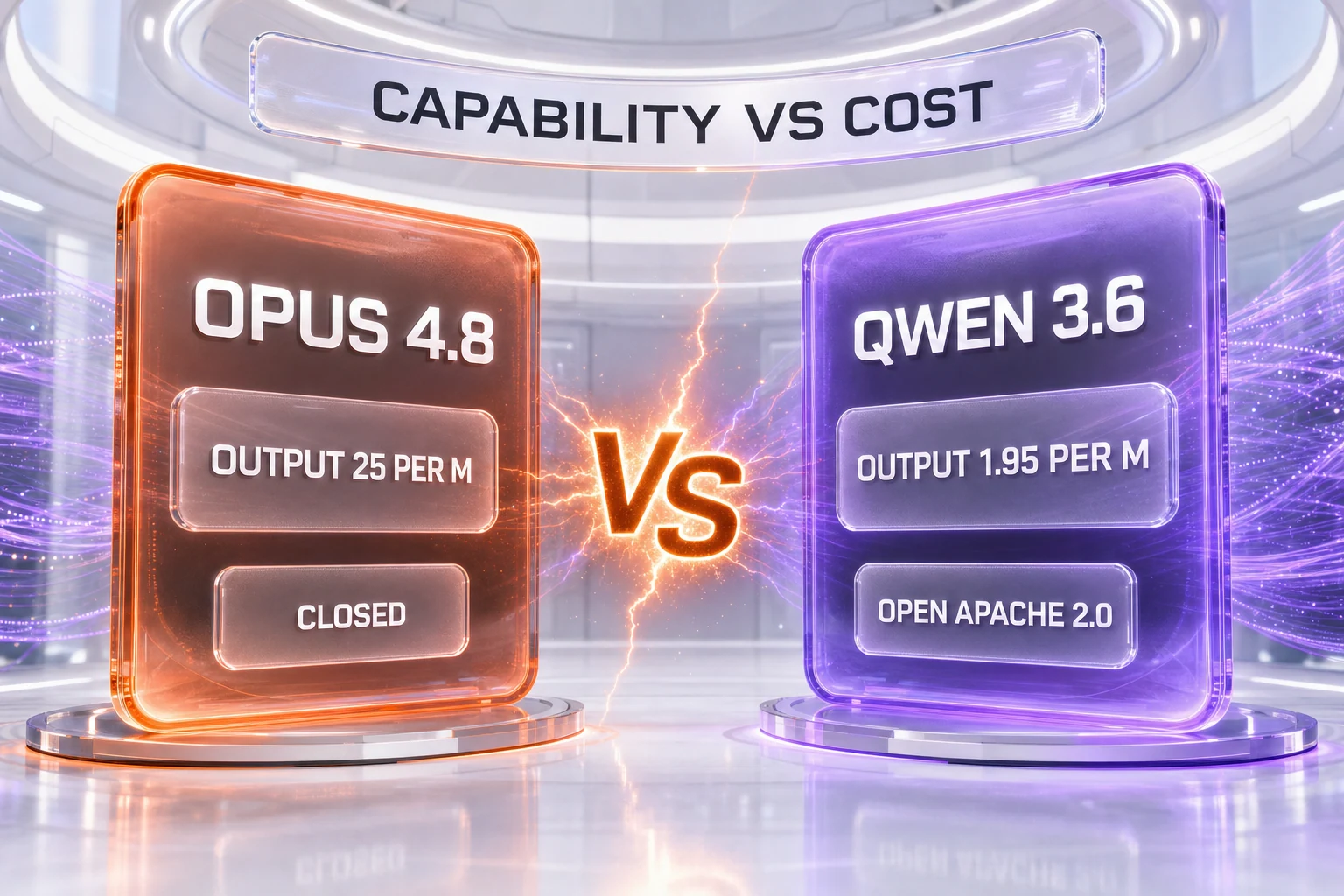
Feature Comparison
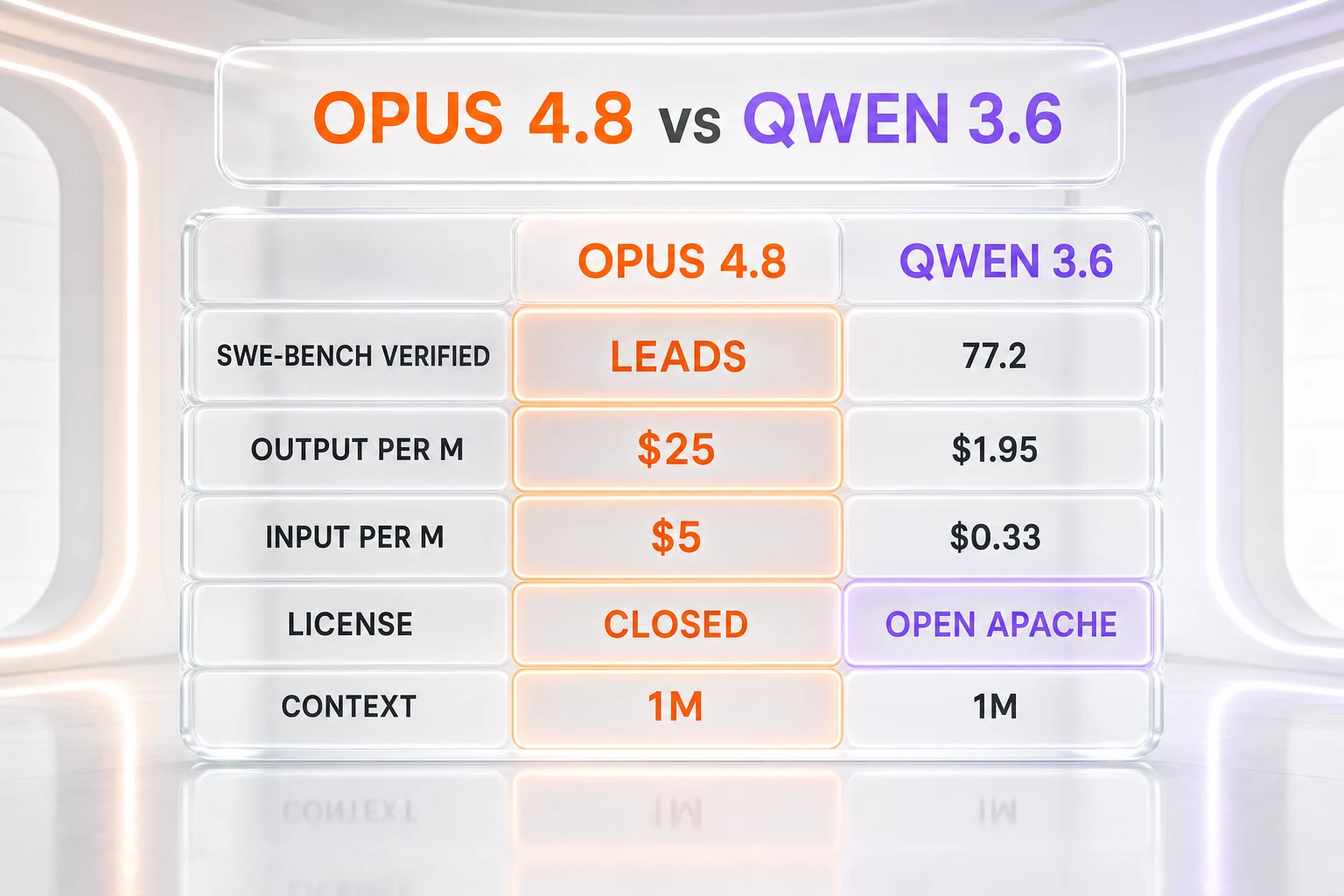
| Feature | Claude Opus 4.8 | Qwen 3.6 |
|---|---|---|
| AA Intelligence Index (Artificial Analysis, same evaluator) | Top tier (Artificial Analysis) | Mid-tier, below Opus 4.8 (Artificial Analysis) |
| SWE-bench Verified | Leads on Anthropic reported suite | 27B dense 77.2%, 35B-A3B 73.4% (Alibaba reports) |
| SWE-bench Pro (agentic coding) | Leads on Anthropic reported suite | 53.5% (27B dense, Alibaba reports) |
| Computer use — Online-Mind2Web | 84% (Anthropic reports) | Not reported |
| Output price (per million tokens) | $25.00 (verified) | Plus $1.95 / Flash $1.50 / Max Preview $6.24 (verified) |
| Input price (per million tokens) | $5.00 (verified) | Plus $0.325 / Flash $0.25 / Max Preview $1.04 (verified) |
| License / openness | Closed, API and cloud only | 27B and 35B-A3B open Apache 2.0 (Plus/Max closed) |
| Self-hostable | No | Yes — open 27B and 35B-A3B via vLLM, Ollama, llama.cpp |
| Context window | 1,000,000 tokens (verified) | Plus and Flash 1,000,000; Max Preview 262K (verified) |
| Western data residency / compliance | US, plus AWS / Google Cloud / Microsoft Foundry | Alibaba Cloud hosted (or self-host open weights) |
Pricing Comparison
Claude Opus 4.8
Qwen 3.6
Detailed Comparison
Claude Opus 4.8 and Qwen 3.6 are the two flagship large language models compared here, and they represent two opposite bets on what a frontier model should be. Claude Opus 4.8 is Anthropic's closed, US-hosted top model, announced May 28, 2026, priced at 5 dollars per million input tokens and 25 dollars per million output tokens with a 1,000,000-token context window. Qwen 3.6 is Alibaba's flagship open-weight family; alongside it Alibaba sells proprietary tiers — Qwen 3.6 Plus at 0.325 dollars input and 1.95 dollars output per million tokens with a 1,000,000-token context, and Qwen 3.6 Max Preview at 1.04 dollars input and 6.24 dollars output — plus Apache 2.0 open-weight 27B and 35B-A3B variants you can download and self-host. Alibaba has since shipped closed Qwen 3.7 Plus and Max tiers, but those have no open weights, so Qwen 3.6 remains its flagship open-weight family — the axis of this comparison against the closed Opus 4.8. Opus 4.8 is the stronger model on top-end reasoning, agentic reliability, and computer use, and it is the only one of the two that clears Western data-residency requirements out of the box. Qwen 3.6 is dramatically cheaper per token, ships genuinely open Apache 2.0 weights with no revenue threshold, and posts state-of-the-art open-model coding scores. Best for top-end capability, agentic reliability, and US-hosted compliance: Claude Opus 4.8. Best for cost, open weights, and self-hosting: Qwen 3.6.
Quick Verdict
This is a split verdict by use case, not a single overall winner. We compared the published benchmarks and specifications of Claude Opus 4.8 and Qwen 3.6 side-by-side, checked the pricing against vendor and marketplace sources, and added our own hands-on observations on Opus 4.8, which we use daily in production. We have run the open Qwen 3.6 weights and the Plus API through coding and reasoning prompts, but we have not stood up weeks of controlled, identical-task benchmarking of both models against each other, so where we lean on numbers we attribute them. The honest summary is that these two are not really fighting for the same buyer. Here is the short version.
- Best for top-end reasoning: Claude Opus 4.8. On the Artificial Analysis Intelligence Index — the one composite both families are scored on by the same evaluator — Opus 4.8 sits in the top tier, while Qwen 3.6 Plus and Max Preview both score below it, in the mid-40s to low-50s depending on tier and which snapshot of the Index you read. The gap is real and consistent.
- Best for agentic coding capability: Claude Opus 4.8 on the top end, Qwen 3.6 on value. Anthropic reports an 84 percent computer-use result and leads on its self-reported coding suite; Qwen 3.6's open 27B dense model posts a remarkable 77.2 percent on SWE-bench Verified, the kind of figure that used to require a closed frontier model.
- Best for cost: Qwen 3.6, and it is not close. Qwen 3.6 Plus output at 1.95 dollars per million tokens is roughly 13 times cheaper than Opus 4.8 output at 25 dollars. Qwen 3.6 Flash at 1.50 dollars output is about 17 times cheaper.
- Best for open weights and self-hosting: Qwen 3.6. The 27B dense and 35B-A3B variants ship under Apache 2.0 with no revenue threshold, downloadable from Hugging Face and ModelScope. Opus 4.8 is closed and API-only.
- Best for Western data residency and compliance: Claude Opus 4.8. It is hosted by Anthropic in the US and on AWS, Google Cloud, and Microsoft Foundry. Qwen's hosted API runs through Alibaba Cloud, which raises data-residency questions for many regulated Western buyers unless they self-host the open variants.
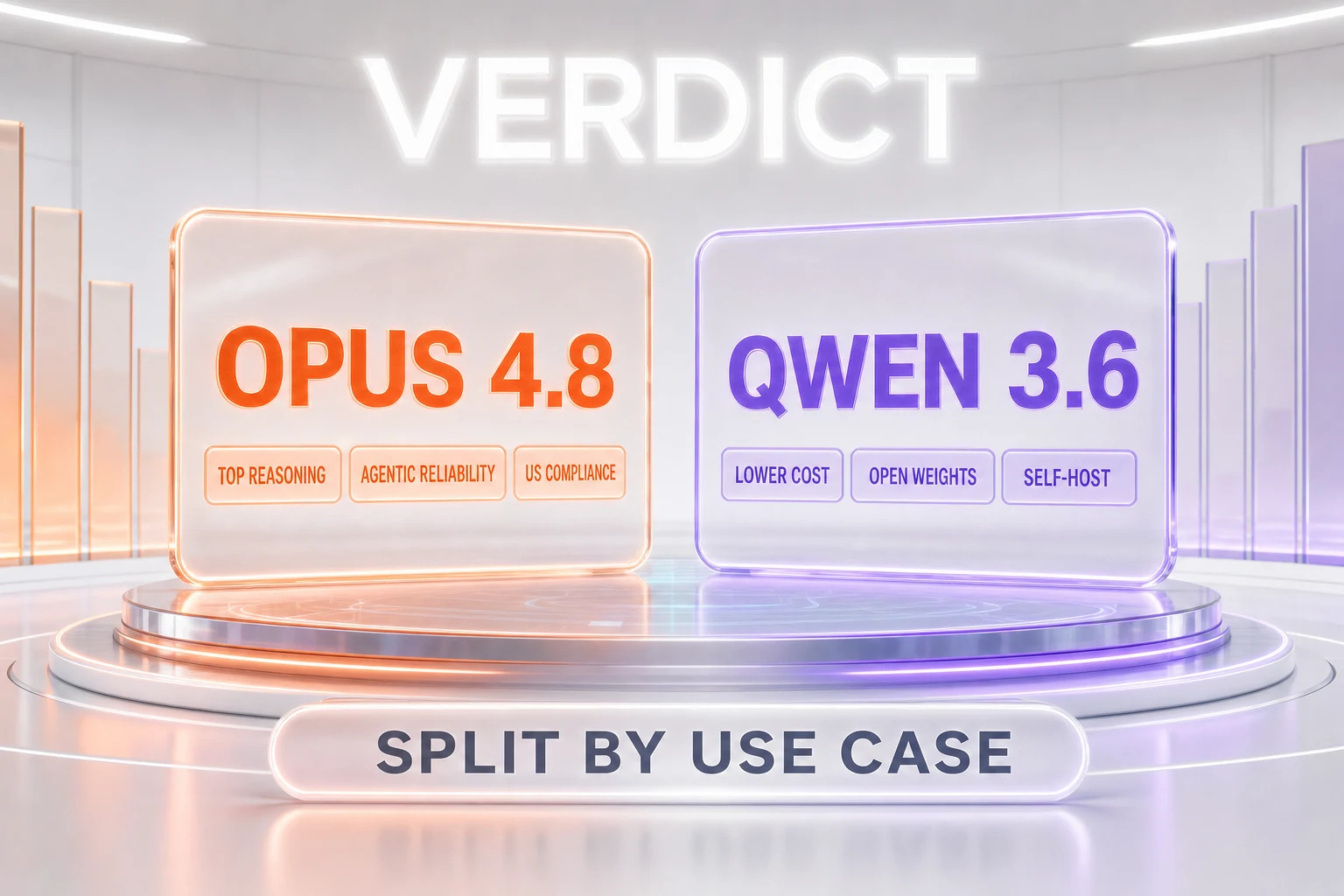
Bottom line: if you need the strongest top-end model — or you need US-hosted compliance with no engineering overhead — pick Claude Opus 4.8. If you are cost-constrained, want to own your weights under a clean Apache 2.0 license, or need to self-host for sovereignty, Qwen 3.6 gives you frontier-adjacent quality at a fraction of the price and full control. We did not crown a single winner because the two models optimize for different things.
At a Glance
Before the detail, here is the side-by-side that frames everything below. All pricing in this table was checked against vendor and marketplace pricing sources in June 2026; for Qwen 3.6 Plus, where Alibaba's list rate and the marketplace effective rate differ, the cheaper hosted rate is shown and the list rate is noted in the pricing section. All benchmark figures are attributed to their source.
| Dimension | Claude Opus 4.8 | Qwen 3.6 |
|---|---|---|
| Vendor / origin | Anthropic (US) | Alibaba (China) |
| License | Closed, API and cloud only | Mixed — Plus and Max Preview closed; 27B and 35B-A3B open Apache 2.0 |
| Released | May 28, 2026 | Spring 2026 |
| Input price (per million tokens) | 5 dollars (verified) | Plus 0.325 dollars, Max Preview 1.04 dollars (verified) |
| Output price (per million tokens) | 25 dollars (verified) | Plus 1.95 dollars, Max Preview 6.24 dollars (verified) |
| Cache-read input (per million tokens) | 0.50 dollars (verified) | Not separately published in this matchup |
| Context window | 1,000,000 tokens (verified) | Plus and Flash 1,000,000 tokens; Max Preview 262K (verified) |
| AA Intelligence Index | Top tier (Artificial Analysis) | Below Opus 4.8 (mid-40s to low-50s by tier) (Artificial Analysis) |
| SWE-bench Verified | Leads on Anthropic's reported suite | 27B dense 77.2 percent, 35B-A3B 73.4 percent (Alibaba reports) |
| Self-hostable | No | Yes — open 27B and 35B-A3B via vLLM, Ollama, llama.cpp |
| Data residency | US, plus AWS, Google Cloud, Microsoft Foundry | Alibaba Cloud hosted API, or self-host the open weights anywhere |
Overview of Each Model
Claude Opus 4.8
Claude Opus 4.8 is Anthropic's flagship model, announced May 28, 2026, aimed squarely at agentic coding, computer use, and multi-agent orchestration. It kept the same headline price as Opus 4.7 — 5 dollars per million input tokens and 25 dollars per million output tokens — while improving on the metrics Anthropic cares most about. It ranks in the top tier of the Artificial Analysis Intelligence Index, among the strongest models that evaluator scores. Anthropic reports leading scores across its coding suite alongside an 84 percent result on Online-Mind2Web that it calls its best-tested computer-use figure. It carries a 1,000,000-token context window at standard pricing, and adds Dynamic Workflows for orchestrating large numbers of parallel subagents plus explicit effort controls that trade latency against reasoning depth. In our daily production use, the real day-to-day win over Opus 4.7 is speed and reliability rather than a leap in raw capability: it reaches correct results faster and verifies its own edits instead of declaring a task done without checking. It is closed and available only through Anthropic's API, claude.ai, Claude Code, and the major cloud marketplaces. For the full breakdown, see our Claude Opus 4.8 review.
Qwen 3.6
Qwen 3.6 is Alibaba's flagship open-weight family rather than a single model, and that structure is the key to understanding it. On the proprietary side, Qwen 3.6 Plus is the workhorse — a multimodal model with a 1,000,000-token native context, priced at 0.325 dollars input and 1.95 dollars output per million tokens, optimized for agentic coding. Qwen 3.6 Max Preview is the top-end proprietary tier, a sparse mixture-of-experts design with a 262K context, priced at 1.04 dollars input and 6.24 dollars output, and it topped six coding benchmarks at its launch. Qwen 3.6 Flash is the fast, cheap tier at 0.25 dollars input and 1.50 dollars output with a 1,000,000-token context. The genuine differentiator, though, is on the open side: Qwen 3.6 ships two Apache 2.0 open-weight variants — a 27B dense model with a 262K native context extensible to 1M via YaRN scaling, and a 35B-A3B sparse mixture-of-experts model with 35 billion total parameters and only 3 billion active per token. Both are downloadable from Hugging Face and ModelScope for free commercial use, fine-tuning, and self-hosting, with no revenue threshold. Alibaba reports 77.2 percent on SWE-bench Verified for the 27B dense model and 73.4 percent for the 35B-A3B — state-of-the-art figures for open-weight models. Alibaba has since launched newer closed tiers — Qwen 3.7 Plus and Max — but neither ships open weights, so these open 27B and 35B-A3B models remain its flagship downloadable release and the relevant point of comparison here. Our full Qwen 3.6 review covers each tier and the licensing in more depth.
Pricing Compared
This is where the two diverge most sharply, and it is the single most important thing to understand about this matchup. We checked every number below against vendor and marketplace pricing sources in June 2026. One transparency note on Qwen 3.6 Plus: the 0.325-dollar input and 1.95-dollar output figures are the effective rate you actually pay through marketplaces such as OpenRouter and Alibaba's discounted endpoint, while Alibaba's standard first-party list rate for Plus is higher, at 0.50 dollars input and 3.00 dollars output per million tokens. We use the cheaper hosted rate below because it is what teams pay in practice, but the multipliers shrink if you price against the list rate instead.
| Tier | Input (per million tokens) | Output (per million tokens) | Context window |
|---|---|---|---|
| Claude Opus 4.8 (standard) | 5.00 dollars | 25.00 dollars | 1,000,000 tokens |
| Claude Opus 4.8 (Batch API, 50 percent off) | 2.50 dollars | 12.50 dollars | 1,000,000 tokens |
| Claude Opus 4.8 (Fast Mode) | 10.00 dollars | 50.00 dollars | 1,000,000 tokens |
| Qwen 3.6 Plus | 0.325 dollars | 1.95 dollars | 1,000,000 tokens |
| Qwen 3.6 Max Preview | 1.04 dollars | 6.24 dollars | 262K tokens |
| Qwen 3.6 Flash | 0.25 dollars | 1.50 dollars | 1,000,000 tokens |
| Qwen 3.6 27B / 35B-A3B (open weights) | Self-hosted — no per-token fee | Self-hosted — no per-token fee | 262K native (27B), extensible to 1M |
Run the arithmetic and the gap is large in every direction. On output tokens — the comparison most people care about, because output dominates real agentic spend — Opus 4.8 at 25 dollars is roughly 13 times the cost of Qwen 3.6 Plus at 1.95 dollars, and about 17 times the cost of Qwen 3.6 Flash at 1.50 dollars. Even against the pricier Max Preview tier at 6.24 dollars output, Opus 4.8 still costs about four times more. On input tokens, Opus 4.8 at 5 dollars is roughly 15 times Qwen 3.6 Plus at 0.325 dollars. Opus 4.8's Batch API discount and aggressive prompt caching — a cache read at 0.50 dollars per million tokens is genuinely cheap by frontier standards — narrow the input side but cannot close a gap of that magnitude on output.
One nuance worth flagging honestly: the open Qwen 3.6 weights are not free to run. The Plus and Flash API prices above are the cheap, zero-operations path. Self-hosting the 27B dense model in FP8 fits on a single H100 or a pair of high-end consumer cards, while the 35B-A3B mixture-of-experts is lighter on active compute but still needs real GPU memory. The Apache 2.0 weights buy you control and remove per-token billing, but they shift cost into hardware and operations. For most teams, the hosted Qwen Plus or Flash API is the relevant comparison, and there Opus 4.8 simply costs an order of magnitude more per token.
Benchmarks Compared
Benchmarks across two different labs are a minefield, because vendors pick favorable evaluations and report them their own way. We discipline this by leaning on the one independent evaluator that scores both families the same way — Artificial Analysis — and treating vendor-reported figures as attributed claims, not verified facts.
| Benchmark | Claude Opus 4.8 | Qwen 3.6 | Like-for-like? |
|---|---|---|---|
| AA Intelligence Index (Artificial Analysis) | Top tier | Below Opus 4.8 (mid-40s to low-50s by tier) | Yes — same evaluator |
| SWE-bench Verified | Leads on Anthropic's reported suite | 27B dense 77.2 percent, 35B-A3B 73.4 percent (Alibaba reports) | Same benchmark, different labs |
| SWE-bench Pro | Leads on Anthropic's reported suite | 53.5 percent (27B dense, Alibaba reports) | Same benchmark, different labs |
| Terminal-Bench 2.0 | Not reported on this exact version | 59.3 percent (27B dense, Alibaba reports) | No clean counterpart |
| Online-Mind2Web (computer use) | 84 percent (Anthropic reports) | Not reported | No counterpart |
| Output speed (Artificial Analysis) | On the higher-latency end for its tier | Plus 52.8 tokens per second | No clean counterpart |
The cleanest signal is the Artificial Analysis Intelligence Index, because it is one evaluator running the same battery on both: Opus 4.8 sits in the top tier, while Qwen 3.6 Plus and Max Preview both score below it, in the mid-40s to low-50s depending on tier and which snapshot of the Index you read. That places Qwen 3.6 firmly behind Opus 4.8 on the composite, though comfortably above the median for its price class. On SWE-bench Verified — the same benchmark, but self-reported by each lab — the comparison is genuinely interesting: Qwen 3.6's open 27B dense model reports 77.2 percent, a figure that lands in territory that closed frontier models occupied not long ago. We will not pretend a cross-lab comparison is exact, because the figures come from separate evaluation harnesses, but the open-model result is striking on its own terms.
Where Opus 4.8 has no Qwen counterpart we report — its 84 percent computer-use result — we leave the Qwen column blank rather than invent a number. Likewise, Qwen reports a Terminal-Bench 2.0 figure that does not map cleanly to anything Anthropic published on that exact version, so we flag it rather than force a head-to-head. The takeaway is not that either model is weak where a cell is blank; it is that the two labs did not report the same way, and we refuse to fabricate a match-up. What the numbers we do have say clearly is that Opus 4.8 is the stronger model on the independent composite, and that Qwen 3.6 — especially its open 27B model — is remarkably close on coding given its license and its price.
Openness and What That Actually Buys You
The single biggest factual difference between these two models is not a benchmark number — it is the license. Claude Opus 4.8 is closed: you reach it through Anthropic's API, claude.ai, Claude Code, or a cloud marketplace, and you can never download it, inspect it, or run it on your own hardware. Qwen 3.6's open 27B and 35B-A3B variants ship under Apache 2.0, one of the most permissive licenses in software, with no revenue threshold of the kind that gates some other open-weight families. That distinction is the whole game for a large class of buyers, and it deserves to be understood precisely.
Apache 2.0 means you can download the weights, fine-tune them on proprietary data, deploy them commercially at any scale, and redistribute derivatives — without asking permission, paying a fee, or crossing a revenue gate. For a research lab, that means you can ship a fine-tuned derivative model as a product. For a regulated enterprise, it means source code and customer data never leave your infrastructure, because the model runs inside your own walls. For a startup watching unit economics, it means the per-token meter disappears entirely once you own the hardware. None of those things are possible with Opus 4.8 at any price.
What the open weights do not give you is the top of the capability curve. The open 27B and 35B-A3B models are excellent for their size and license, but they are not Qwen's strongest models — the proprietary Plus and Max Preview tiers are — and they trail Opus 4.8 on the independent Intelligence Index. There is also an operational tax: running open weights well means owning GPU capacity, managing an inference stack like vLLM or SGLang, and handling your own scaling and uptime. Opus 4.8 hands you a polished, self-verifying agent with none of that overhead, but you can neither inspect it nor move it. Neither philosophy is wrong; they price control against capability and convenience in opposite directions.
Total Cost of Ownership
Per-token price is the headline, but the real economics depend on volume, caching, and whether you self-host. Here is how to think about it without overstating the case in either direction.
For the hosted-API path, the gap changes what is buildable at scale. A pipeline that processes, say, a billion output tokens a month costs about 25,000 dollars on Opus 4.8 at standard pricing, around 12,500 dollars with the Batch API discount, roughly 1,950 dollars on Qwen 3.6 Plus, and about 1,500 dollars on Qwen 3.6 Flash. Those are not small percentage differences; they decide whether a high-volume idea is economically viable. Prompt caching narrows the input side meaningfully — Opus 4.8 cache reads at 0.50 dollars per million tokens are genuinely cheap — but output dominates agentic spend, and there the Qwen hosted tiers are an order of magnitude ahead.
For the self-hosted path, the calculus flips from per-token billing to capital and operations. Qwen 3.6's Apache 2.0 weights remove the API meter entirely, but you pay in hardware: the 27B dense model in FP8 fits on a single H100 or a pair of high-end consumer cards, and the 35B-A3B mixture-of-experts spends only 3 billion active parameters per token, which keeps inference compute modest even though total memory is larger. For a team with steady, predictable, very high volume and the operational maturity to run model infrastructure, self-hosting Qwen 3.6 can be the cheapest option of all and the only one that guarantees data never leaves your premises. For a team with spiky or modest volume, the hosted Qwen API is the sensible comparison — and it is still far cheaper than Opus 4.8. The honest conclusion is that Qwen 3.6 wins on cost in every scenario; the only question is by how much and at what operational price.
How We Tested
Honesty about methodology matters more in a cross-lab, cross-country comparison than almost anywhere else. Here is exactly what is hands-on and what is research.
We use Claude Opus 4.8 daily in our own production workflow — agentic coding in Claude Code, multi-file refactors, and content pipelines — so our observations on its behavior (speed over Opus 4.7, tighter instruction-following, self-verification of edits) are first-hand. We have run Qwen 3.6 through the hosted Plus API and pulled the open 27B weights to confirm they behave as documented in agentic coding loops, including compatibility with Claude Code, Cline, and OpenAI-compatible toolchains. We have not, however, run weeks of controlled, identical-task benchmarking of both models against each other, and we have not stood up a production-scale self-hosted Qwen cluster. For that reason, every capability claim that rests on numbers is attributed to its source — Artificial Analysis for the independent index, Alibaba for its own SWE-bench figures, Anthropic for its computer-use result — and we checked all pricing against vendor and marketplace pricing sources rather than trusting secondhand summaries, flagging where Alibaba's list rate and the marketplace effective rate diverge. Where we could not verify a like-for-like number, we said so and left the cell blank. That is the standard we hold ourselves to.
Winner by Category
A single overall winner would be dishonest here, because these models are tuned for different buyers. Here is who wins what.
- Best for top-end reasoning: Claude Opus 4.8. It ranks in the top tier of the Artificial Analysis Intelligence Index, well ahead of Qwen 3.6, which lands further down the composite.
- Best for agentic coding value: Qwen 3.6. Its open 27B dense model reports 77.2 percent on SWE-bench Verified and 53.5 percent on SWE-bench Pro — frontier-adjacent coding under an Apache 2.0 license — at a fraction of Opus 4.8's per-token cost.
- Best for agentic reliability: Claude Opus 4.8. In our daily use it verifies its own edits and stays on the brief, and Anthropic's computer-use lead at 84 percent on Online-Mind2Web has no Qwen counterpart.
- Best for cost: Qwen 3.6. Roughly an order of magnitude cheaper per token on the hosted Plus and Flash tiers, and free of per-token billing entirely once you self-host the open weights.
- Best for open weights and self-hosting: Qwen 3.6. Apache 2.0 27B and 35B-A3B weights with no revenue threshold; Opus 4.8 cannot be self-hosted at all.
- Best for Western data residency and compliance: Claude Opus 4.8. US-hosted with major cloud options; Qwen's hosted API runs through Alibaba Cloud, though self-hosting the open weights sidesteps the question.
- Best for long-context work: Effectively a tie. Opus 4.8 and Qwen 3.6 Plus both ship a 1,000,000-token context window; Qwen Max Preview is narrower at 262K.
Pros and Cons
Claude Opus 4.8 — Pros
- Top tier on the Artificial Analysis Intelligence Index, ahead of both Qwen 3.6 Plus and Max Preview on the independent composite.
- Leads its self-reported coding suite and posts an 84 percent computer-use result on Online-Mind2Web that Qwen does not report.
- US-hosted with AWS, Google Cloud, and Microsoft Foundry options — clears Western data-residency requirements with no engineering overhead.
- Cautious, self-verifying reliability personality that flags problems instead of declaring tasks done unchecked.
- 1,000,000-token context at standard pricing, plus Dynamic Workflows and effort controls for large agentic jobs.
- Aggressive prompt caching at 0.50 dollars per million tokens on cache reads, which lowers the cost of stable-prompt workloads.
Claude Opus 4.8 — Cons
- Costs an order of magnitude more per token than Qwen's hosted tiers — 25 dollars output per million versus 1.50 to 6.24 dollars.
- Closed model: no self-hosting, no weights, no sovereignty option.
- Coding benchmarks are vendor-reported and not yet independently verified outside the Artificial Analysis composite.
- Fast Mode doubles per-token cost to 10 dollars input and 50 dollars output per million for its speed-up.
- No Apache 2.0 path: research labs cannot fine-tune and redistribute derivatives the way Qwen's open weights allow.
Qwen 3.6 — Pros
- Apache 2.0 open weights for the 27B and 35B-A3B variants — free commercial use, fine-tuning, and redistribution with no revenue threshold.
- Dramatically cheaper hosted API — Qwen 3.6 Plus output at 1.95 dollars per million tokens is roughly 13 times cheaper than Opus 4.8 output.
- State-of-the-art open-model coding: 27B dense reports 77.2 percent SWE-bench Verified and 53.5 percent SWE-bench Pro, 35B-A3B reports 73.4 percent with only 3 billion active parameters.
- Massive 1,000,000-token native context on Plus and Flash, enough to hold an entire monorepo in a single prompt.
- Self-hostable via vLLM, Ollama, llama.cpp, and SGLang, with FP8 builds for the 27B that fit a single high-end card.
- Compatible out of the box with Claude Code, Cline, and OpenAI-compatible toolchains — no proprietary IDE lock-in.
Qwen 3.6 — Cons
- Trails Opus 4.8 on the independent Intelligence Index — its tiers land in the mid-40s to low-50s while Opus 4.8 sits in the top tier.
- Hosted API runs through Alibaba Cloud in China, a non-starter for many regulated Western buyers without self-hosting the open variants.
- The strongest tiers — Plus and Max Preview — are closed weights, and Max Preview is still a preview with possible pricing and feature shifts before stable release.
- English documentation is thinner than some open-weight rivals, and some technical detail surfaces first in Chinese on ModelScope.
- Output throughput on Plus, measured at 52.8 tokens per second by Artificial Analysis, trails the fastest hosted alternatives for latency-sensitive use.
When to Pick Each
When to pick Claude Opus 4.8
Pick Opus 4.8 when top-end capability and trust matter more than per-token cost. If you are doing the hardest agentic coding, complex multi-step reasoning, or computer-use automation, it ranks in the top tier of the independent Intelligence Index, and in our own daily use it is the more reliable one — it verifies its own work and stays on the brief. Pick it if you are a Western enterprise with data-residency or compliance obligations, because US hosting and the AWS, Google Cloud, and Microsoft Foundry options clear bars Qwen's Alibaba Cloud API cannot without self-hosting. And pick it if your workload is moderate in volume but high in value, where paying 25 dollars per million output tokens for the strongest result is a rounding error against engineer time.
When to pick Qwen 3.6
Pick Qwen 3.6 when cost, control, or sovereignty dominate. If you are running high-volume inference where token spend is the binding constraint, an order-of-magnitude cheaper API changes what is economically viable — and Qwen 3.6 Plus at 1.95 dollars output makes use cases routine that would strain a budget on Opus 4.8. Pick it if you need to own your weights: the Apache 2.0 license on the 27B and 35B-A3B models lets you self-host, fine-tune, and redistribute with no revenue gate, so source and customer data never leave your infrastructure. Pick it if you are a research lab shipping derivative models, or a startup whose unit economics only survive on open weights. You give up the top of the capability curve and the turnkey Western compliance story, but you get frontier-adjacent quality at a fraction of the price and full control over deployment.
Final Verdict
This is a split verdict by use case, tilted toward Claude Opus 4.8 on top-end capability and toward Qwen 3.6 on cost and openness. On the one independent evaluator that scores both — Artificial Analysis — Opus 4.8 ranks in the top tier, well ahead of Qwen 3.6, which lands further down the composite. It is the stronger model, the more reliable one in our hands-on production use, and the only one that clears Western data-residency requirements with no engineering overhead. Qwen 3.6, in return, costs roughly an order of magnitude less per token on its hosted tiers, ships Apache 2.0 open weights you can self-host with no revenue threshold, and posts open-model coding scores — 77.2 percent SWE-bench Verified on the 27B dense model — that land within striking distance of the frontier.
We did not crown a single overall winner because the two models are not really competing for the same buyer. If you need the strongest top-end model, the most reliable agentic behavior, or turnkey US-hosted compliance, the answer is Claude Opus 4.8. If you are cost-constrained, want to own your weights, or need to self-host for sovereignty, the answer is Qwen 3.6. Both answers are correct — for different people. All benchmark numbers here are vendor-reported or drawn from the Artificial Analysis index; pricing is verified against vendor and marketplace sources, with the Qwen Plus list-versus-effective-rate difference noted above.
If you are weighing Opus 4.8 against other frontier models, we also ran it head-to-head with OpenAI's flagship in Claude Opus 4.8 vs GPT-5.5, with Google's in Claude Opus 4.8 vs Gemini 3.1 Pro, and against its own predecessor in Claude Opus 4.8 vs Claude Opus 4.7.
Frequently Asked Questions
Is Claude Opus 4.8 better than Qwen 3.6?
On top-end capability, yes. Claude Opus 4.8 ranks in the top tier of the Artificial Analysis Intelligence Index, well ahead of Qwen 3.6, which lands further down the composite, and it adds an 84 percent computer-use result Qwen does not report. But Qwen 3.6 is roughly an order of magnitude cheaper per token, ships Apache 2.0 open weights you can self-host, and posts a 77.2 percent SWE-bench Verified score on its open 27B model — so the better choice depends on whether you are optimizing for capability or for cost and control.
How much cheaper is Qwen 3.6 than Claude Opus 4.8?
Substantially. On output tokens, Qwen 3.6 Plus at 1.95 dollars per million is roughly 13 times cheaper than Claude Opus 4.8 at 25 dollars per million, and Qwen 3.6 Flash at 1.50 dollars is about 17 times cheaper. Even Qwen's pricier Max Preview tier at 6.24 dollars output is about four times cheaper than Opus 4.8. On input tokens, Qwen 3.6 Plus at 0.325 dollars is roughly 15 times cheaper than Opus 4.8 at 5 dollars. These Plus figures are the marketplace effective rate; Alibaba's standard list rate for Plus is 0.50 dollars input and 3.00 dollars output, which narrows the input and output gaps to roughly 8 to 10 times. Prices were checked against vendor and marketplace sources in June 2026.
Is Qwen 3.6 open source?
Partly. Qwen 3.6 ships two Apache 2.0 open-weight variants — a 27B dense model and a 35B-A3B mixture-of-experts model — downloadable from Hugging Face and ModelScope for free commercial use, fine-tuning, redistribution, and self-hosting, with no revenue threshold. The strongest tiers, Qwen 3.6 Plus and Max Preview, are proprietary closed weights available only through Alibaba Cloud. So the open variants are genuinely open under Apache 2.0, while the top-end models are not.
Can I self-host Qwen 3.6 or Claude Opus 4.8?
You can self-host the open Qwen 3.6 variants — the Apache 2.0 27B dense and 35B-A3B models run via vLLM, Ollama, llama.cpp, and SGLang, with FP8 builds for the 27B that fit a single high-end card. You cannot self-host Claude Opus 4.8 — it is a closed model available only through Anthropic's API, claude.ai, Claude Code, and the major cloud marketplaces. Qwen's proprietary Plus and Max Preview tiers also cannot be self-hosted; only the open weights can.
What is the context window for each model?
Claude Opus 4.8 offers a 1,000,000-token context window at standard pricing. Qwen 3.6 Plus and Flash also provide 1,000,000-token context windows, while Qwen 3.6 Max Preview is narrower at 262K tokens. The open 27B variant has a 262K native context extensible to 1M via YaRN scaling. On the main hosted tiers, the two are effectively tied at 1M.
Which model is better for coding?
It depends on the budget. Claude Opus 4.8 ranks in the top tier of the independent Intelligence Index and is the more reliable agentic coder in our hands-on use, verifying its own edits. But Qwen 3.6's open 27B dense model reports a remarkable 77.2 percent on SWE-bench Verified and 53.5 percent on SWE-bench Pro at a fraction of the per-token cost, and it works out of the box with Claude Code and Cline. For the hardest tasks, Opus 4.8 leads; for high-volume coding where cost dominates, Qwen 3.6 is hard to beat.
Is Qwen 3.6 safe to use for a Western company?
It depends on your data-residency rules. Qwen's hosted API runs through Alibaba Cloud in China, which keeps many regulated buyers — US Federal, EU healthcare — from adopting it without a Western reseller. The Apache 2.0 open weights let you sidestep this entirely by self-hosting the 27B or 35B-A3B model on your own infrastructure anywhere in the world. If compliance is the concern and you cannot self-host, Claude Opus 4.8's US hosting and major-cloud options are the safer default.
How do the two models score on independent benchmarks?
The cleanest independent signal is the Artificial Analysis Intelligence Index, which scores both with the same battery: Claude Opus 4.8 sits in the top tier, while Qwen 3.6 Plus and Max Preview both score below it, in the mid-40s to low-50s depending on tier and which snapshot of the Index you read. That places Qwen 3.6 behind Opus 4.8 on the composite but well above the median for its price class. The vendor-reported SWE-bench figures point the same direction on the top end, though Qwen's open 27B model closes the coding gap more than the composite alone suggests.
What are the different Qwen 3.6 tiers?
Qwen 3.6 is a family. On the proprietary side, Qwen 3.6 Plus is the 1M-context workhorse at 0.325 dollars input and 1.95 dollars output per million tokens; Qwen 3.6 Max Preview is the top-end 262K mixture-of-experts model at 1.04 dollars input and 6.24 dollars output; and Qwen 3.6 Flash is the fast tier at 0.25 dollars input and 1.50 dollars output. On the open side, the Apache 2.0 27B dense and 35B-A3B mixture-of-experts variants are downloadable and self-hostable with no per-token fee.
Does Claude Opus 4.8 have a cheaper mode?
Yes, two cost levers. The Batch API offers a 50 percent discount for asynchronous workloads, bringing Opus 4.8 to 2.50 dollars input and 12.50 dollars output per million tokens. Prompt caching drops repeated input to 0.50 dollars per million tokens on cache reads. Even with both applied, however, Opus 4.8 remains substantially more expensive per token than Qwen 3.6's hosted Plus and Flash tiers.
Which should I choose for a high-volume production workload?
For pure high volume where token cost is the binding constraint, Qwen 3.6 is usually the rational choice — an order-of-magnitude cheaper hosted API, or zero per-token billing once you self-host the open weights, makes workloads viable that Opus 4.8 cannot support economically. Choose Claude Opus 4.8 instead when each call is high-value, when you need the strongest top-end reasoning, or when Western data residency is mandatory. Many teams run both: Opus 4.8 for the hardest tasks, Qwen 3.6 for everything bulk.
When were these models released and is this comparison current?
Claude Opus 4.8 was announced May 28, 2026, and the Qwen 3.6 family shipped in spring 2026. This comparison was last updated in June 2026, with all pricing checked against vendor and marketplace pricing sources at that time and all benchmark figures attributed to Artificial Analysis or to each vendor's own reports.
Sources and references
Every figure on this page is attributed to whoever produced it. Vendor documentation and independent measurement are listed separately and never merged into a single ranking.
- Artificial Analysis — Claude Opus 4.8 (independent index score and cost per task)
- Alibaba — Qwen (model family and availability)
- Hugging Face — Qwen (published open-weight variants and licenses)
- Artificial Analysis — Model leaderboard (Intelligence Index scores and cost per task across configurations)
Our Verdict
Split verdict by use case. Claude Opus 4.8 wins top-end reasoning, agentic reliability, and turnkey US-hosted compliance — it ranks in the top tier of the Artificial Analysis Intelligence Index, well ahead of every Qwen 3.6 tier on that composite. Qwen 3.6 wins cost and openness — its hosted Plus tier at 1.95 dollars output per million tokens is roughly 13 times cheaper than Opus 4.8, and its Apache 2.0 27B and 35B-A3B open weights are self-hostable with no revenue threshold while still posting 77.2 percent SWE-bench Verified. Pick Opus 4.8 for the strongest top-end model or Western compliance; pick Qwen 3.6 for cost, open weights, or self-hosting.
Choose Claude Opus 4.8
Anthropic's flagship model for agentic coding, computer use, and multi-agent orchestration.
Try Claude Opus 4.8 →Choose Qwen 3.6
Alibaba's flagship LLM family — Plus and Max Preview proprietary plus Apache 2.0 open-weight 27B and 35B-A3B.
Try Qwen 3.6 →Frequently Asked Questions
Is Claude Opus 4.8 better than Qwen 3.6?
Split verdict by use case. Claude Opus 4.8 wins top-end reasoning, agentic reliability, and turnkey US-hosted compliance — it ranks in the top tier of the Artificial Analysis Intelligence Index, well ahead of every Qwen 3.6 tier on that composite. Qwen 3.6 wins cost and openness — its hosted Plus tier at 1.95 dollars output per million tokens is roughly 13 times cheaper than Opus 4.8, and its Apache 2.0 27B and 35B-A3B open weights are self-hostable with no revenue threshold while still posting 77.2 percent SWE-bench Verified. Pick Opus 4.8 for the strongest top-end model or Western compliance; pick Qwen 3.6 for cost, open weights, or self-hosting.
Which is cheaper, Claude Opus 4.8 or Qwen 3.6?
Claude Opus 4.8 starts at $5 in / $25 out per M tokens. Qwen 3.6 offers a free plan (free plan available). Check the pricing comparison section above for a full breakdown.
What are the main differences between Claude Opus 4.8 and Qwen 3.6?
The key differences span across 10 features we compared. For AA Intelligence Index (Artificial Analysis, same evaluator), Claude Opus 4.8 offers Top tier (Artificial Analysis) while Qwen 3.6 offers Mid-tier, below Opus 4.8 (Artificial Analysis). For SWE-bench Verified, Claude Opus 4.8 offers Leads on Anthropic reported suite while Qwen 3.6 offers 27B dense 77.2%, 35B-A3B 73.4% (Alibaba reports). For SWE-bench Pro (agentic coding), Claude Opus 4.8 offers Leads on Anthropic reported suite while Qwen 3.6 offers 53.5% (27B dense, Alibaba reports). See the full feature comparison table above for all details.