Claude Sonnet 5 vs Qwen 3.6: Closed Frontier vs Open-Weight Price (2026)


Claude Sonnet 5 leads SWE-bench Pro 63.2 vs 53.5 and adds computer use; Qwen 3.6 is Apache 2.0 open-weight, multimodal, and far cheaper. Split verdict inside.
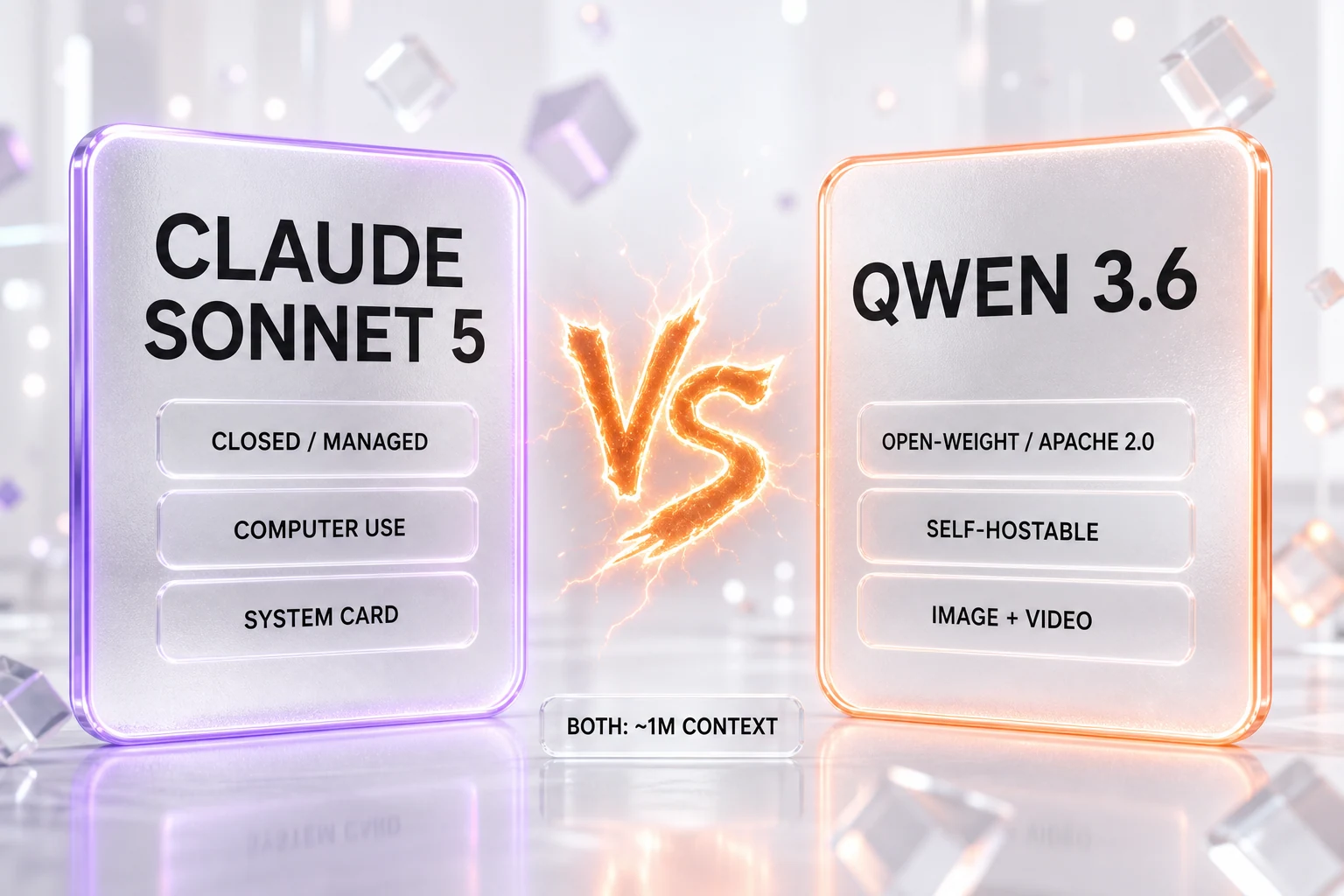
Feature Comparison
| Feature | Claude Sonnet 5 | Qwen 3.6 |
|---|---|---|
| Model access and license | Closed (Anthropic API, Claude Code, Claude.ai) | Apache 2.0 open weights (27B, 35B-A3B) plus proprietary Plus and Max tiers |
| SWE-bench Pro (shared benchmark, vendor-reported) | 63.2% | 53.5% (Qwen3.6-27B) |
| Input price per million tokens | $2 | $0 open weights; $0.325 (Plus) |
| Output price per million tokens | $10 | $0 open weights; $1.95 (Plus) |
| Context window | 1M tokens native | 262K native, ~1M via YaRN (27B); 1M native (Plus) |
| Computer use (OSWorld-Verified) | 81.2% | Not reported |
| Modality | Text and image (vision) | Text, image, and video (27B vision encoder) |
| Self-hosting | No (managed API only) | Yes (27B FP8 on a single H100; Hugging Face, vLLM/SGLang/Ollama) |
| Ecosystem, safety and distribution | Claude Code, default free and Pro on Claude.ai, public system card | Hugging Face and ModelScope weights, Alibaba Cloud Model Studio, OpenClaw/Claude Code/Cline compatible |
Pricing Comparison
Claude Sonnet 5
Qwen 3.6
Detailed Comparison
Claude Sonnet 5 and Qwen 3.6 split the decision rather than crown one winner. On the single benchmark both vendors report the same way, SWE-bench Pro, Claude Sonnet 5 posts 63.2 percent against the Qwen3.6-27B open model’s 53.5 percent, and Sonnet 5 uniquely documents a computer-use score. Qwen 3.6 answers with Apache 2.0 open weights you can download and self-host for free, a genuinely multimodal open model that reads image and video, and a proprietary Plus tier priced several times below Sonnet 5, so the right pick turns on whether documented capability and governance matter more than open weights, price, and deployment control.
We compared Claude Sonnet 5 and Qwen 3.6 as two very different answers to the same question: what does a strong, long-context coding-and-reasoning model look like in mid-2026? One is a closed frontier release from Anthropic with a public system card. The other is a family from Alibaba’s Qwen team whose flagship open-weight members you can download and run yourself under an Apache 2.0 license. Every benchmark number in this comparison is vendor-reported, taken from each company’s own system card or model card, and has not been independently reproduced by us. We say so up front because the honest version of this matchup depends entirely on reading those figures carefully rather than stacking them into a false ranking.
Quick Verdict
There is no overall winner here, and that is a deliberate call rather than a hedge. Claude Sonnet 5 wins the one clean shared benchmark (SWE-bench Pro, 63.2 out of a possible 100 versus 53.5), is the only one of the two to publish a computer-use score (OSWorld-Verified 81.2), and ships inside Anthropic’s mature ecosystem with a public safety system card. Qwen 3.6 wins openness and price decisively: its 27B and 35B-A3B flagship models are open weights under an Apache 2.0 license you can self-host at zero licensing cost, its open 27B is a genuinely multimodal model that accepts image and video, and even its proprietary Plus tier is priced several times below Sonnet 5.
Pick Claude Sonnet 5 if you need a documented computer-use score, a governance or compliance sign-off that a public system card supports, or the Claude Code and Claude.ai ecosystem, and you can absorb a higher per-token price. Pick Qwen 3.6 if open weights, self-hosting, price, or avoiding vendor lock-in dominate your decision, or if you want a multimodal open model you can fine-tune and run inside your own perimeter. On our own editorial scale we rate Claude Sonnet 5 at 9.3 out of 10 and Qwen 3.6 at 8.5 out of 10, and the gap is almost entirely about documented capability breadth and governance versus openness and cost, not about one model being broadly better than the other.
How We Compared Them
Comparisons between models from different labs go wrong when numbers that look similar get placed side by side even though they measure different things. We wrote three rules for this piece and kept to them.
First, only same-test, same-scale numbers appear next to each other. The one place where Claude Sonnet 5 and Qwen 3.6 can be lined up honestly is SWE-bench Pro, because both vendors publish a score on that exact test: Anthropic reports 63.2 percent for Sonnet 5, and Qwen’s model card reports 53.5 percent for the open-weight Qwen3.6-27B. Everything else is shown single-sided, clearly labeled as belonging to only one model, because no matching figure exists from the other vendor.
Second, we do not manufacture a counterpart when one is missing. Qwen publishes a wide battery of results for the 27B — SWE-bench Verified, Terminal-Bench 2.0, GPQA Diamond, LiveCodeBench, AIME, and a full set of vision benchmarks — for which Claude Sonnet 5’s published sheet gives no same-test counterparts, so we present Qwen’s as its own reported figures and decline to pair them. Likewise, Claude Sonnet 5’s OSWorld-Verified computer-use score has no Qwen equivalent, so it stands alone.
Third, because Qwen 3.6 is a family and not a single model, we are explicit about which member each number belongs to. Our shared benchmark and the single-sided Qwen figures come from the flagship open-weight Qwen3.6-27B dense model unless stated otherwise, because that is the member whose Apache 2.0 openness anchors this matchup and the one that publishes SWE-bench Pro. All figures are vendor-reported and not independently reproduced by us, and cross-vendor pricing is approximate because Claude and Qwen tokenize text differently. A price quoted per million tokens is not a perfectly clean per-word comparison when two models split the same paragraph into a different number of tokens. We flag the direction and the rough magnitude of the price gap, not a decimal-precise ratio. With those rules stated, here is how each model looks.
Meet Claude Sonnet 5
Claude Sonnet 5 is Anthropic’s mid-tier model, released on June 30, 2026, sitting below the flagship Opus 4.8 and replacing the previous Sonnet 4.6. It is a closed model, available through the Claude API, inside Claude Code, and as the default model on both free and Pro tiers of Claude.ai. In our reading of the system card, Anthropic positions it as a workhorse: strong enough for serious coding and agentic work, cheap enough to run at scale, and safety-hardened with cyber safeguards on by default and lower reported hallucination and sycophancy than its predecessor.
On capability, the headline numbers Anthropic reports are SWE-bench Pro at 63.2 percent and OSWorld-Verified at 81.2 percent, the latter being a computer-use benchmark that measures how well the model can operate a graphical desktop environment. It carries a one-million-token context window and is multimodal, accepting image input alongside text, consistent with the rest of the Claude family. The publisher is Anthropic, and the model ships with a public system card that documents its safety posture. For teams that need to show a reviewer or a compliance function what a model was tested against, that public documentation is itself a feature.
Meet Qwen 3.6
Qwen 3.6 is not one model but a family from Alibaba’s Qwen team, and understanding its shape is the key to reading this comparison. It splits into two delivery modes. On the open side are the Apache 2.0 flagship weights: the dense Qwen3.6-27B, released April 22, 2026, and the sparse Mixture-of-Experts Qwen3.6-35B-A3B, released April 16, 2026, which activates only about 3 billion parameters per token. On the proprietary side are the managed tiers accessible through Alibaba Cloud Model Studio: Qwen 3.6 Plus, a one-million-token multimodal model, and the preview-status Qwen 3.6 Max. The defining trait of the family is that the open weights are genuinely permissive: an Apache 2.0 license with no monthly-active-user clause and no revenue threshold, which sets it apart from community licenses that restrict scale.
The open-weight flagship we anchor on, Qwen3.6-27B, is a 27-billion-parameter dense model with a 262,144-token native context window that extends to roughly one million tokens with YaRN scaling. It is multimodal through a vision encoder that accepts text, images, and video, which is unusual for an openly downloadable model of this size. Its published benchmarks include SWE-bench Pro at 53.5 percent, SWE-bench Verified at 77.2 percent, Terminal-Bench 2.0 at 59.3, GPQA Diamond at 87.8, LiveCodeBench at 83.9, AIME 2026 at 94.1, and a suite of vision scores such as MMMU at 82.9 and VideoMME at 87.7. Weights are published on Hugging Face and ModelScope and run through vLLM, SGLang, Ollama, and llama.cpp; an FP8 build of the 27B fits on a single H100 80GB, which makes real self-hosting practical rather than theoretical.
The mixture-of-experts sibling is worth understanding because it shapes cost and deployment. Qwen3.6-35B-A3B holds 35 billion parameters in total but activates only about 3 billion per token, which is an aggressive sparsity ratio that lets a capable model run on modest hardware. It is the member you would reach for when you want open weights on consumer-grade GPUs. Across the family, Alibaba ships out-of-the-box compatibility with agentic coding harnesses including OpenClaw, Claude Code, and Cline, so a team already using one of those tools can point it at a Qwen endpoint without rebuilding its workflow. The trade-off on the proprietary tiers is that they are hosted by Alibaba Cloud, primarily in China with regional routing options, which raises the same data-residency questions any China-hosted API does — questions the open weights sidestep entirely because you can run them yourself.
Head-to-head at a glance
The table below mirrors the nine dimensions where a direct comparison is meaningful. Note what is deliberately absent: Qwen’s SWE-bench Verified score does not appear here, because it is a different and easier test than SWE-bench Pro and would create a misleading row. The only coding number in this table is the shared SWE-bench Pro figure.
| Dimension | Claude Sonnet 5 | Qwen 3.6 | Edge |
|---|---|---|---|
| Model access and license | Closed (Anthropic API, Claude Code, Claude.ai) | Apache 2.0 open weights (27B, 35B-A3B) plus proprietary Plus and Max tiers | Qwen 3.6 |
| SWE-bench Pro (shared benchmark, vendor-reported) | 63.2 percent | 53.5 percent (Qwen3.6-27B) | Claude Sonnet 5 |
| Input price per million tokens | $2 | $0 open weights; $0.325 (Plus) | Qwen 3.6 |
| Output price per million tokens | $10 | $0 open weights; $1.95 (Plus) | Qwen 3.6 |
| Context window | 1M tokens native | 262K native, ~1M via YaRN (27B); 1M native (Plus) | Tie |
| Computer use (OSWorld-Verified) | 81.2 percent | Not reported | Claude Sonnet 5 |
| Modality | Text and image (vision) | Text, image, and video (27B vision encoder) | Qwen 3.6 |
| Self-hosting | No (managed API only) | Yes (27B FP8 on a single H100; Hugging Face, vLLM/SGLang/Ollama) | Qwen 3.6 |
| Ecosystem, safety and distribution | Claude Code, default free and Pro on Claude.ai, public system card | Hugging Face and ModelScope weights, Alibaba Cloud Model Studio, OpenClaw/Claude Code/Cline compatible | Claude Sonnet 5 |
Benchmarks: what’s comparable and what isn’t
This is the section that most head-to-heads get wrong, so we are going to be pedantic about it. There is exactly one benchmark you can read as a genuine head-to-head, and a longer list of numbers that only one vendor publishes.
The one shared benchmark: SWE-bench Pro
SWE-bench Pro is a demanding, contamination-resistant software-engineering benchmark, and it is the single test where both vendors report a score. Claude Sonnet 5 reports 63.2 percent. The open-weight Qwen3.6-27B reports 53.5 percent. That is a gap of 9.7 points in Sonnet 5’s favor on the same test at the same scale. Both figures are vendor-reported and neither has been independently reproduced by us, and both vendors run their own harness, so treat the exact margin as indicative rather than a refereed result. Even with those caveats, this is the fair coding comparison, and on it Claude Sonnet 5 is ahead.
Sonnet-only figure: computer use
Claude Sonnet 5 reports OSWorld-Verified at 81.2 percent. OSWorld is a benchmark for computer use, meaning the model’s ability to operate a real desktop interface to complete tasks. Qwen publishes no OSWorld score for the 27B, so there is nothing to compare it against, and we specifically do not equate it with Qwen’s Terminal-Bench 2.0 result of 59.3, because operating a graphical desktop and driving a terminal are different tasks measured by different harnesses. If documented computer-use capability is on your requirements list, Sonnet 5 is the only one of the two that answers it with a published number.
Qwen-only figures: a broad self-reported battery
Qwen publishes a wide battery of results for the 27B that Claude Sonnet 5’s published sheet gives no same-test counterparts for, so we present them as Qwen’s own reported figures and do not pair them with anything from Sonnet 5. In coding and reasoning, Qwen reports SWE-bench Verified at 77.2, SWE-bench Multilingual at 71.3, Terminal-Bench 2.0 at 59.3, GPQA Diamond at 87.8, LiveCodeBench at 83.9, MMLU-Pro at 86.2, and AIME 2026 at 94.1. Because the open 27B carries a vision encoder, Qwen also reports a set of multimodal scores that Sonnet 5 has no equivalents for, including MMMU at 82.9, MathVista mini at 87.4, and VideoMME at 87.7. These are strong numbers on their face, but they are single-sided: without a matching Sonnet 5 figure on the identical test, they tell you what Qwen reports about itself, not who wins.
The vision battery in particular is worth calling out, because it is unusual for an openly downloadable model this size to document video understanding at all. VideoMME at 87.7 and MMMU at 82.9 are Qwen-only figures with no Sonnet 5 counterpart, so we cannot say Qwen “wins” multimodality on a benchmark basis. What we can say is structural: the open 27B accepts image and video input, Sonnet 5 accepts image input, and if your workflow involves video frames, only one of these two models documents that capability. As with the coding battery, we resist reading Qwen’s self-reported vision scores as a scoreboard against Sonnet 5, because there is no shared test.
The trap to avoid: SWE-bench Verified is not SWE-bench Pro
Qwen also reports SWE-bench Verified at 77.2 for the 27B, and this number deserves a warning label because it is the easiest way to accidentally mislead yourself. SWE-bench Verified is a different, easier test than SWE-bench Pro. The proof is in Qwen’s own numbers: the exact same Qwen3.6-27B model scores 77.2 on Verified but only 53.5 on Pro, a 23.7-point gap between two benchmarks that share a family name. Placing Qwen’s Verified 77.2 next to Claude Sonnet 5’s Pro 63.2 would suggest Qwen wins coding by a comfortable margin, when in fact the honest same-test comparison (Pro versus Pro) has Sonnet 5 ahead, 63.2 to 53.5. This trap cuts against Sonnet 5 rather than for it, which is exactly why it is worth flagging: we show SWE-bench Verified 77.2 only as a Qwen single-sided figure, and never as a rival to Sonnet’s Pro score. Whenever you see a chart that pits a Verified number against a Pro number, treat it as a red flag.
Pricing
Price is where the two models diverge most sharply, and it is Qwen 3.6’s strongest argument. Claude Sonnet 5 costs two dollars per million input tokens and ten dollars per million output tokens, confirmed on Anthropic’s platform. That rate was announced at launch as introductory pricing through August 31, 2026, and Anthropic made it the standard price on August 10, 2026 by cancelling the increase it had scheduled for September 1. Cache reads are cheaper still, at twenty cents per million tokens.
Qwen 3.6 undercuts that on two fronts. First, the open weights are free: Qwen3.6-27B and Qwen3.6-35B-A3B are released under an Apache 2.0 license, so if you self-host them your only cost is your own compute, with no license fee and no per-token charge. Second, even the managed proprietary tier is cheap: Qwen 3.6 Plus is listed at thirty-two and a half cents per million input tokens and one dollar ninety-five cents per million output tokens on Alibaba Cloud Model Studio, a rate we confirmed against its OpenRouter listing.
Put the proprietary Plus tier next to Sonnet 5’s rate and the gap is large. On input, Qwen 3.6 Plus runs roughly six times cheaper than Sonnet 5. On output, where the difference matters most for generation-heavy workloads, Plus is about five times cheaper than Sonnet 5’s ten dollars. And that comparison ignores the open weights entirely, which cost nothing per token at all.
A simple worked example makes the scale concrete. Imagine a workload that generates one hundred million output tokens in a billing period, a realistic figure for a busy production pipeline. At Sonnet 5’s output rate, that is about one thousand dollars. The same one hundred million output tokens cost about one hundred ninety-five dollars on Qwen 3.6 Plus, and nothing per token if you run the open weights on hardware you already own. Add one hundred million input tokens and Sonnet 5 adds roughly two hundred dollars, while Qwen 3.6 Plus adds about thirty-three. The point is not the exact totals, which depend on your traffic mix, but the shape: at volume, the difference between these models is measured in multiples, not percentages, and the open weights remove the per-token line item completely in exchange for running your own infrastructure.
One honest caveat applies to all of these comparisons: Claude and Qwen tokenize text differently, so a price quoted per million tokens is not a perfectly clean per-word ratio. The direction is unambiguous and the magnitude is large, but treat the exact multiples as approximate rather than exact. The self-hosting route also trades a per-token bill for a hardware and operations burden, so “free” open weights are free of license and API cost, not free of engineering effort.
Where each one pulls ahead
Openness and self-hosting. Qwen 3.6 wins this outright. Apache 2.0 weights for the 27B and 35B-A3B on Hugging Face mean you can run the model on your own hardware through vLLM, SGLang, or Ollama, fine-tune it, and keep every token inside your own perimeter, with no monthly-active-user clause or revenue threshold to trip over. An FP8 build of the 27B fits on a single H100, and the 35B-A3B runs on consumer-grade GPUs thanks to its 3-billion active-parameter design. Claude Sonnet 5 is a managed API only; there is no self-hosted option.
Context window. This is close to a tie at the family level. Claude Sonnet 5 offers a one-million-token context window natively. Qwen 3.6 Plus also offers one million tokens natively, while the open-weight 27B is 262,144 tokens natively and extends to roughly one million with YaRN scaling. Long-document and large-codebase workflows are well served by either, though Sonnet 5’s and Plus’s native million-token windows are more straightforward than relying on a scaling technique on the open model.
Computer use. Claude Sonnet 5 pulls ahead here because it publishes an OSWorld-Verified score of 81.2 and Qwen publishes nothing comparable for the 27B. If your use case involves an agent operating a desktop or browser interface, Sonnet 5 is the model with documented evidence behind it.
Modality. Qwen 3.6 has the broader documented input surface. Its open 27B carries a vision encoder that accepts image and video, and it publishes vision benchmarks such as MMMU and VideoMME to back that up. Claude Sonnet 5 accepts image input alongside text but does not advertise video-frame input the way Qwen does. For a coding or agentic workload the practical difference is usually small — both read a screenshot fine — but if video understanding is on your list, Qwen is the one that documents it, and it does so in a model you can download.
Safety and governance. Claude Sonnet 5 ships with a public system card describing lower hallucination and sycophancy than its predecessor and cyber safeguards enabled by default. For teams that need to hand a reviewer a document explaining what a model was evaluated against, that public artifact is a real advantage. Qwen offers a different kind of assurance: because the flagship weights are open, you can inspect and self-host them, keeping data inside your own perimeter, though its proprietary tiers apply the content moderation expected of a China-hosted API.
Ecosystem and distribution. Claude Sonnet 5 benefits from Claude Code, mature SDKs, and its position as the default model on both free and Pro Claude.ai, so you can test the exact production model before paying for the API. Qwen 3.6 is distributed through Hugging Face and ModelScope weights, Alibaba Cloud Model Studio, and out-of-the-box compatibility with OpenClaw, Claude Code, and Cline. Each ecosystem is coherent, but they serve different buyers: one leans toward Western developer tooling and governance, the other toward open deployment and hardware flexibility.
Claude Sonnet 5 — pros and cons
- Pro: Wins the one shared benchmark, SWE-bench Pro, at 63.2 percent versus 53.5 percent.
- Pro: Only model of the two with a documented computer-use score (OSWorld-Verified 81.2).
- Pro: Public safety system card supports governance and compliance sign-off.
- Pro: Mature ecosystem: Claude Code, Claude.ai default model, established SDKs, and a free path to test the exact model.
- Pro: A native one-million-token context window with no scaling technique required.
- Con: Materially more expensive per token.
- Con: Closed and managed-API only, with no self-hosting and no weights to inspect or fine-tune.
- Con: Accepts image input but does not document video-frame input.
Qwen 3.6 — pros and cons
- Pro: Apache 2.0 open weights for the 27B and 35B-A3B, with no monthly-active-user clause or revenue threshold, self-hostable via vLLM, SGLang, or Ollama.
- Pro: Dramatically cheaper: the open weights cost nothing per token, and the proprietary Plus tier runs roughly six times cheaper on input and about five times cheaper on output than Sonnet 5’s rate.
- Pro: Genuinely multimodal open model — the 27B accepts image and video and documents vision benchmarks such as MMMU 82.9 and VideoMME 87.7.
- Pro: Practical self-hosting: an FP8 build of the 27B fits on a single H100, and the sparse 35B-A3B runs on consumer-grade GPUs.
- Pro: Out-of-the-box compatibility with OpenClaw, Claude Code, and Cline harnesses.
- Con: Trails on the shared SWE-bench Pro benchmark, 53.5 versus 63.2.
- Con: No published computer-use benchmark for the open model.
- Con: The proprietary Plus and Max tiers are hosted by Alibaba Cloud, primarily in China, raising data-residency and moderation questions (self-hosting the open weights sidesteps this).
When to pick Claude Sonnet 5 / When to pick Qwen 3.6
When to pick Claude Sonnet 5
Choose Claude Sonnet 5 when documented capability and governance outweigh token cost and openness. It is the right call if your work involves computer use or desktop and browser automation, or if a compliance or security function needs to see a public system card before a model is approved. It is also the natural fit if your team already lives in Claude Code or relies on Claude.ai as a default, since Sonnet 5 slots into that ecosystem with mature tooling and a free path to test the exact model. In short, pick Sonnet 5 when you are optimizing for what the model can demonstrably do and how well its behavior is documented, and you can absorb a higher per-token price to get there.
When to pick Qwen 3.6
Choose Qwen 3.6 when openness, cost, or control are the dominant constraints. It is the right call for teams that want to self-host to keep data inside their own perimeter, for anyone who wants to avoid vendor lock-in by owning Apache 2.0 weights outright, and for high-volume pipelines where a several-times price advantage on the managed Plus tier — or zero per-token cost on the open weights — compounds into serious savings. It also fits workflows that need image or video input in a model you can download and run yourself. The conditions to accept are that you either self-host the open weights or use a China-hosted proprietary API, and that you can live without a published computer-use score. When those conditions hold, Qwen 3.6’s combination of open license, price, and modality is hard to argue with.
Final Verdict
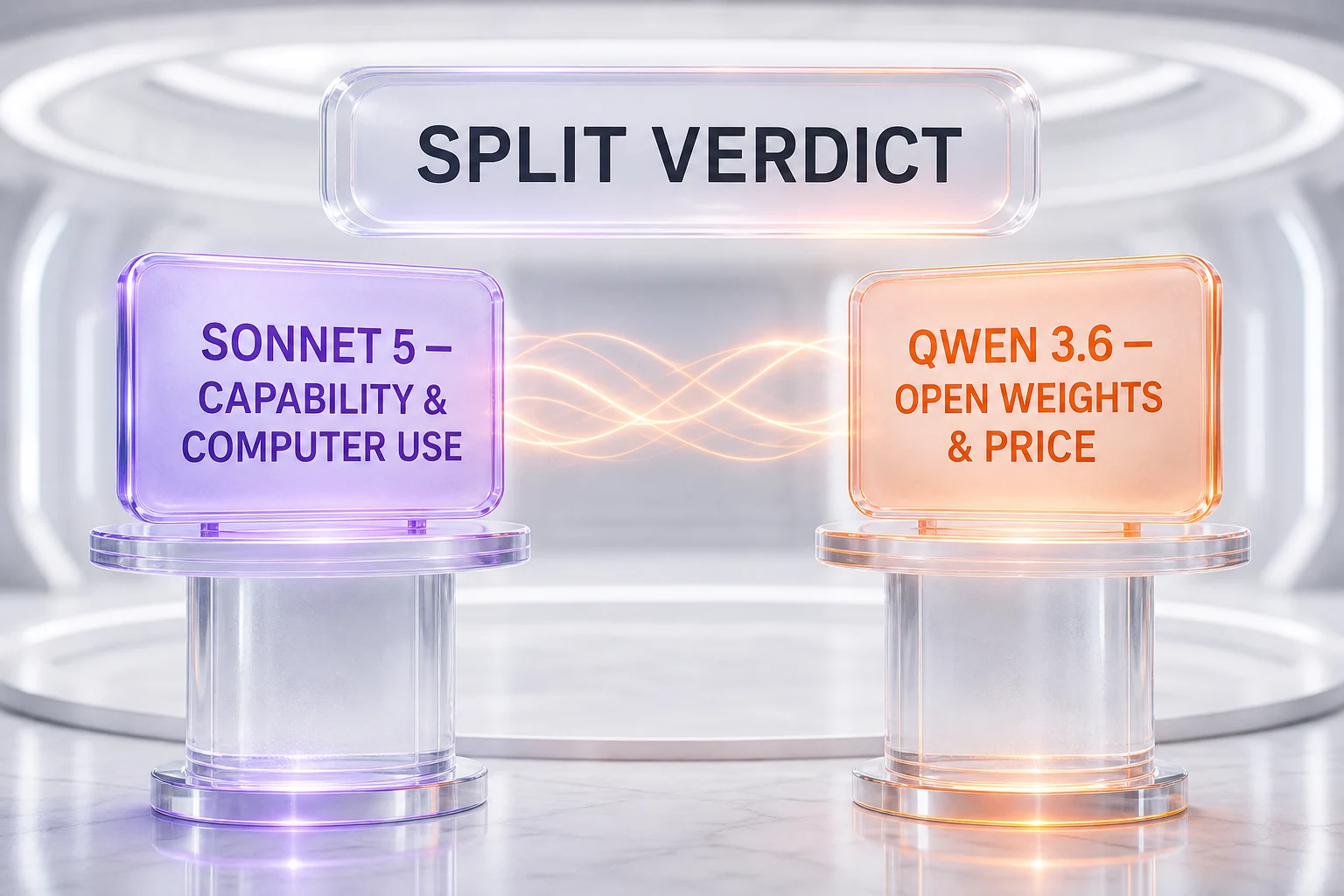
There is no overall winner, and after reviewing both models’ published material, we think forcing one would misrepresent the choice. Claude Sonnet 5 and Qwen 3.6 are optimized for different priorities. On the single test both vendors report the same way, SWE-bench Pro, Claude Sonnet 5 leads at 63.2 percent to 53.5 percent, and it is the only one of the two with documented computer use and a public safety system card. Qwen 3.6 counters with Apache 2.0 open weights you can self-host for free, a genuinely multimodal open model that reads image and video, a near-parity context window at the family level, and pricing that runs several times cheaper on its managed tier and nothing per token on its open weights.
So the decision is clean even though the verdict is split. Pick Claude Sonnet 5 if you need documented capability, computer use, or governance sign-off, and you can pay for it. Pick Qwen 3.6 if open weights, price, self-hosting, modality breadth, or avoiding lock-in dominate, and you can self-host or accept a China-hosted managed API. We score Sonnet 5 at 9.3 out of 10 and Qwen 3.6 at 8.5 out of 10, and that gap reflects documented capability breadth and governance rather than one model being broadly better than the other. Match the model to your constraint, not to a leaderboard.
One last piece of practical advice: because these two models are optimized for such different priorities, the strongest teams often do not choose between them permanently. It is entirely reasonable to route governance-sensitive or computer-use tasks to Claude Sonnet 5 while sending high-volume, cost-sensitive, or self-hosted work to Qwen 3.6, especially if you run the open weights yourself. Treat this comparison as a map of where each model’s strengths lie rather than a mandate to standardize on one, and revisit the decision as both vendors publish new benchmarks and adjust pricing.
Related comparisons
If you are weighing these two models against other frontier options, see how each fares elsewhere. On the Claude Sonnet 5 side, Claude Sonnet 5 vs GLM-5.2 and Claude Sonnet 5 vs Kimi K2.7 Code line it up against other open-weight challengers, and Claude Sonnet 5 vs Claude Opus 4.8 places it in Anthropic’s own lineup. For the wider field of coding models, see our roundup of the best AI coding tools of 2026.
Frequently asked questions
Which is better for coding, Claude Sonnet 5 or Qwen 3.6?
On the one coding benchmark both vendors report the same way, SWE-bench Pro, Claude Sonnet 5 leads at 63.2 percent against the open-weight Qwen3.6-27B’s 53.5 percent, a gap of 9.7 points. Both figures are vendor-reported and not independently reproduced by us. So on the fair same-test comparison, Sonnet 5 is ahead, though Qwen closes much of the practical gap once you weigh its far lower price and its open weights.
How much cheaper is Qwen 3.6 than Claude Sonnet 5?
Substantially. The Apache 2.0 open weights cost nothing per token if you self-host them. Against Sonnet 5’s rate of two dollars per million input and ten dollars per million output, the proprietary Qwen 3.6 Plus tier runs roughly six times cheaper on input and about five times cheaper on output, at thirty-two and a half cents input and one dollar ninety-five cents output per million tokens.
Is Qwen 3.6 open source and Claude Sonnet 5 closed?
Qwen 3.6’s flagship weights, the 27B and 35B-A3B, are open-weight under an Apache 2.0 license, with no monthly-active-user clause, published on Hugging Face and ModelScope so you can download, self-host, and fine-tune them. Qwen also offers closed proprietary tiers (Plus and Max) through Alibaba Cloud. Claude Sonnet 5 is fully closed and available only as a managed service through the Claude API, Claude Code, and Claude.ai. If open weights and the ability to run the model yourself matter to you, that is the clearest structural difference.
Why is Qwen’s 77.2 not directly comparable to Sonnet’s 63.2?
Because they are different tests. Qwen’s 77.2 is SWE-bench Verified, while Sonnet 5’s 63.2 is SWE-bench Pro, which is a harder benchmark. The proof is that the same Qwen3.6-27B model scores 77.2 on Verified but only 53.5 on Pro, a 23.7-point gap between the two. Comparing Verified against Pro would falsely suggest Qwen wins coding, when the honest same-test comparison (Pro versus Pro) has Sonnet 5 ahead, 63.2 to 53.5. Always compare Verified to Verified and Pro to Pro.
What context window does each model offer?
Claude Sonnet 5 offers a one-million-token context window natively. Qwen 3.6 Plus also offers one million tokens natively, while the open-weight Qwen3.6-27B is 262,144 tokens natively and extends to roughly one million with YaRN scaling. At the family level this is close to a tie, though Sonnet 5’s native window does not depend on a scaling technique the way the open 27B’s extended window does.
Can I self-host either model?
You can self-host Qwen 3.6’s open weights but not Claude Sonnet 5. Qwen publishes Apache 2.0 weights for the 27B and 35B-A3B on Hugging Face and ModelScope that run through vLLM, SGLang, or Ollama; an FP8 build of the 27B fits on a single H100, and the sparse 35B-A3B runs on consumer-grade GPUs. Claude Sonnet 5 is a managed API only, with no self-hosted deployment option.
Does either model do computer use?
Claude Sonnet 5 publishes a computer-use score, OSWorld-Verified at 81.2 percent, which measures operating a desktop interface to complete tasks. Qwen 3.6 publishes no OSWorld result for the 27B, so there is no comparable figure. We do not equate Qwen’s Terminal-Bench 2.0 score with computer use, because driving a terminal and operating a graphical desktop are different tasks. If documented computer use matters, Sonnet 5 is the one with evidence.
Are both models multimodal?
Both accept images, and Qwen goes further. Claude Sonnet 5 accepts image input alongside text, consistent with the Claude family. The open-weight Qwen3.6-27B carries a vision encoder that accepts image and video and publishes vision benchmarks such as MMMU 82.9 and VideoMME 87.7. If your workflow includes video frames, Qwen is the one that documents that capability, and it does so in a model you can download.
Where are Qwen’s proprietary tiers hosted, and does moderation matter?
Qwen 3.6 Plus and Max are hosted on Alibaba Cloud, primarily in China with regional routing options, which introduces data-residency and content-moderation considerations for some Western or regulated buyers. If that is a concern, the open weights offer a path around it: because the 27B and 35B-A3B are self-hostable under an Apache 2.0 license, you can run them inside your own infrastructure and avoid the hosted API entirely.
Should I switch to Qwen 3.6 just to save money?
Only if the savings map to your actual constraints. For high-volume pipelines, Qwen 3.6’s free open weights and cheap Plus tier are a strong reason to switch. But if you rely on a documented computer-use score, a public safety system card for governance, or the Claude Code ecosystem, the cheaper token price does not replace those capabilities. Match the model to what your workload actually needs rather than to price alone.
Which model is safer?
Claude Sonnet 5 ships with a public system card reporting lower hallucination and sycophancy than its predecessor and cyber safeguards enabled by default, which gives governance and security teams a documented artifact to review. Qwen 3.6’s openness offers a different kind of safety: you can inspect and self-host the open weights, keeping data inside your own perimeter, though its proprietary tiers carry the moderation expected of a China-hosted API. Neither has been independently audited by us, so weigh documented behavior against deployment control based on what your risk model prioritizes.
Do the benchmark numbers here come from independent testing?
No. Every benchmark figure in this comparison is vendor-reported, taken from each company’s system card or model card, and has not been independently reproduced by us. We only place numbers side by side when they come from the same test at the same scale, which is why SWE-bench Pro is the sole shared coding comparison and everything else is presented as a single-sided, clearly labeled figure.
Sources and references
Every figure on this page is attributed to whoever produced it. Vendor documentation and independent measurement are listed separately and never merged into a single ranking.
- Artificial Analysis — Claude Sonnet 5 (independent index score and cost per task)
- Alibaba — Qwen (model family and availability)
- Hugging Face — Qwen (published open-weight variants and licenses)
- Artificial Analysis — Model leaderboard (Intelligence Index scores and cost per task across configurations)
Our Verdict
There is no overall winner: Claude Sonnet 5 and Qwen 3.6 are optimized for different priorities. Sonnet 5 wins the one shared benchmark, SWE-bench Pro (63.2 percent versus the open-weight Qwen3.6-27B's 53.5 percent), and is the only one of the two with a documented computer-use score (OSWorld-Verified 81.2) and a public safety system card. Qwen 3.6 counters with Apache 2.0 open weights (27B and 35B-A3B) you can self-host for free, a genuinely multimodal open model that reads image and video, a near-parity context window at the family level, and pricing that runs several times cheaper on its managed Plus tier and nothing per token on its open weights. Pick Sonnet 5 for documented capability, computer use, or governance sign-off; pick Qwen 3.6 when open weights, price, self-hosting, modality breadth, or avoiding lock-in dominate and you can self-host or accept a China-hosted managed API.
Choose Claude Sonnet 5
Anthropic's most agentic midsize model — near-Opus 4.8 coding and computer use at $2 per million input tokens.
Try Claude Sonnet 5 →Choose Qwen 3.6
Alibaba's flagship LLM family — Plus and Max Preview proprietary plus Apache 2.0 open-weight 27B and 35B-A3B.
Try Qwen 3.6 →Frequently Asked Questions
Is Claude Sonnet 5 better than Qwen 3.6?
There is no overall winner: Claude Sonnet 5 and Qwen 3.6 are optimized for different priorities. Sonnet 5 wins the one shared benchmark, SWE-bench Pro (63.2 percent versus the open-weight Qwen3.6-27B's 53.5 percent), and is the only one of the two with a documented computer-use score (OSWorld-Verified 81.2) and a public safety system card. Qwen 3.6 counters with Apache 2.0 open weights (27B and 35B-A3B) you can self-host for free, a genuinely multimodal open model that reads image and video, a near-parity context window at the family level, and pricing that runs several times cheaper on its managed Plus tier and nothing per token on its open weights. Pick Sonnet 5 for documented capability, computer use, or governance sign-off; pick Qwen 3.6 when open weights, price, self-hosting, modality breadth, or avoiding lock-in dominate and you can self-host or accept a China-hosted managed API.
Which is cheaper, Claude Sonnet 5 or Qwen 3.6?
Claude Sonnet 5 starts at $2 in / $10 out per M tokens (free plan available). Qwen 3.6 offers a free plan (free plan available). Check the pricing comparison section above for a full breakdown.
What are the main differences between Claude Sonnet 5 and Qwen 3.6?
The key differences span across 9 features we compared. For Model access and license, Claude Sonnet 5 offers Closed (Anthropic API, Claude Code, Claude.ai) while Qwen 3.6 offers Apache 2.0 open weights (27B, 35B-A3B) plus proprietary Plus and Max tiers. For SWE-bench Pro (shared benchmark, vendor-reported), Claude Sonnet 5 offers 63.2% while Qwen 3.6 offers 53.5% (Qwen3.6-27B). For Input price per million tokens, Claude Sonnet 5 offers $2 while Qwen 3.6 offers $0 open weights; $0.325 (Plus). See the full feature comparison table above for all details.