Claude Sonnet 5 vs GLM-5.2: Closed Ecosystem vs Open Weights (2026)

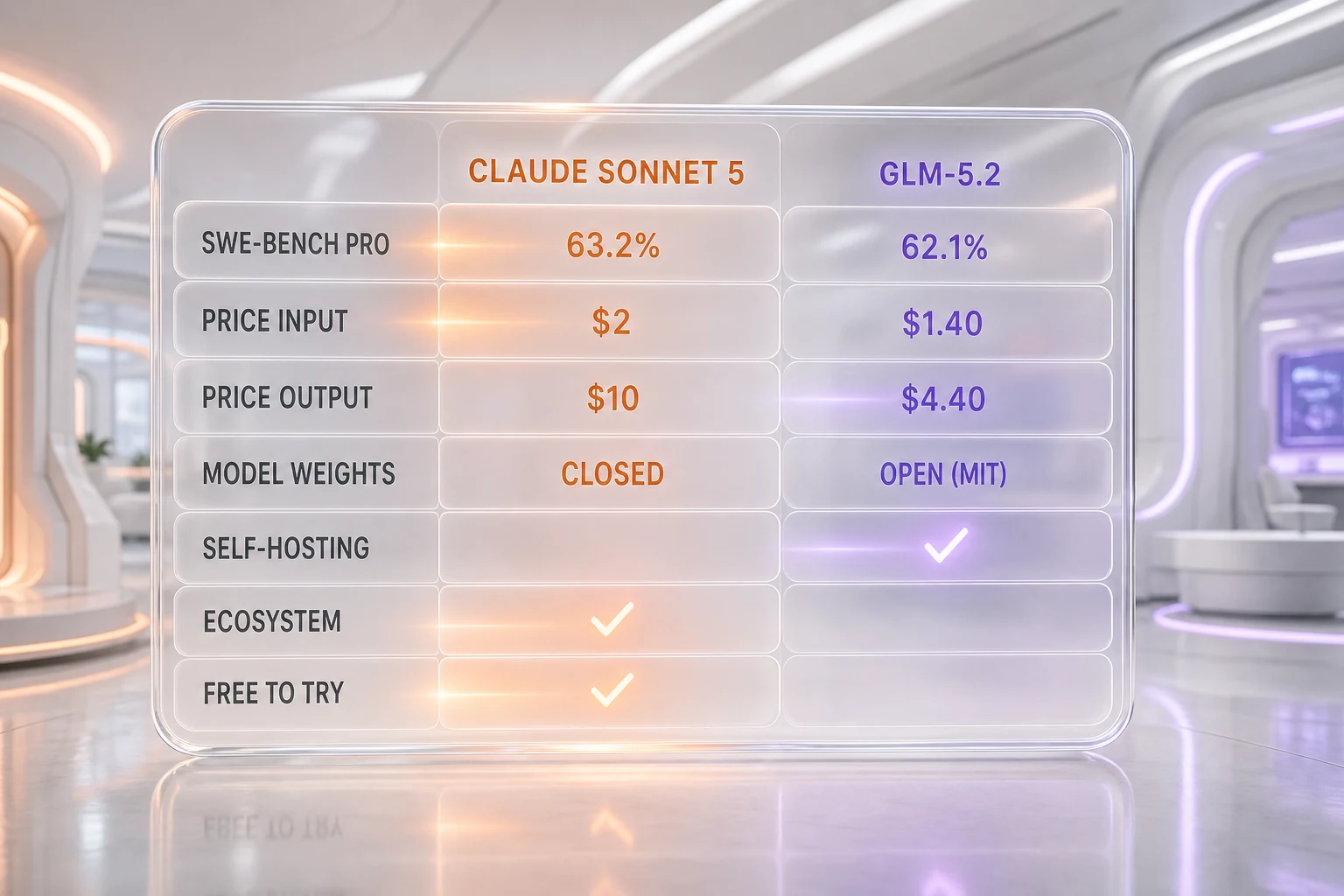
Claude Sonnet 5 vs GLM-5.2 side by side: 63.2% vs 62.1% on SWE-bench Pro, closed vs open weights, $2 vs $1.40 per million tokens. When to pick each.
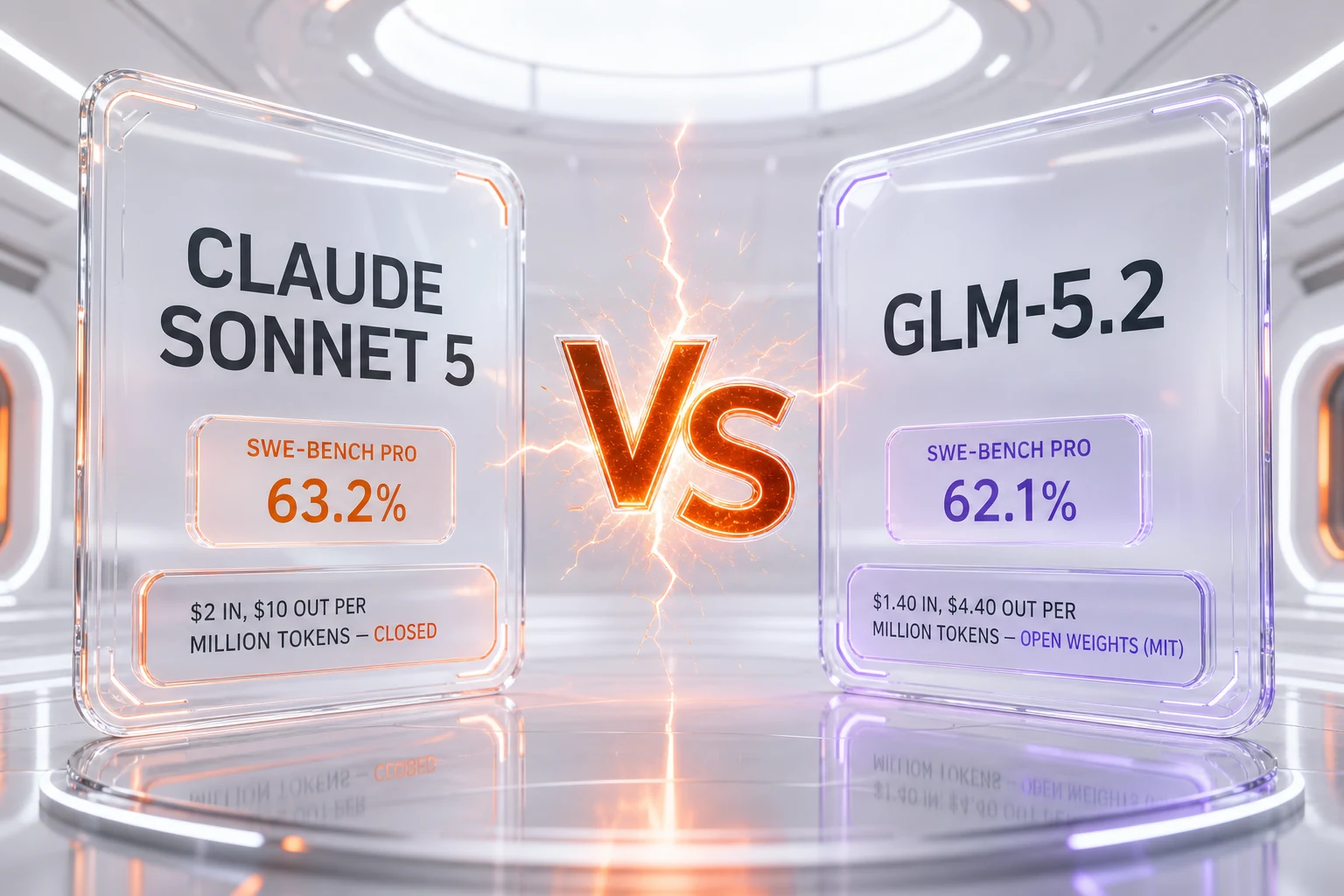
Feature Comparison
| Feature | Claude Sonnet 5 | GLM-5.2 |
|---|---|---|
| SWE-bench Pro (agentic coding) | 63.2% (Anthropic system card) | 62.1% (Zhipu self-reported) |
| Input price (per million tokens) | $2 | $1.40 |
| Output price (per million tokens) | $10 | $4.40 |
| Model access | Closed, proprietary | Open weights, MIT license |
| Self-hosting and data control | API and apps only | Download and run the MIT weights on your own compute |
| Maximum context window | Standard Claude context window | 1,000,000 tokens (vendor-reported) |
| Ecosystem and first-party support | Mature: Claude Code, Claude API, Free and Pro default, SDKs | Drop-in with Claude Code, Cline, and others; smaller first-party surface |
| Free in-browser evaluation | Default model on the Free and Pro plans of Claude | No first-party free plan |
| Documented safety posture | Published system card: prompt-injection resistance, cyber safeguards on by default | No comparable public safety card; production API hosted in China |
| Benchmark verification | Anthropic-reported (system card) | Vendor self-reported, not yet independently reproduced |
Pricing Comparison
Claude Sonnet 5
GLM-5.2
Detailed Comparison
Editorial independence: ThePlanetTools.ai has no affiliate relationship with Anthropic or with Z.ai (Zhipu AI), and earns nothing whether you choose Claude Sonnet 5 or GLM-5.2. This comparison is based on hands-on use of Claude Sonnet 5 in the Claude ecosystem, evaluation of GLM-5.2 through its hosted API and open weights, and each vendor's published figures. Where a benchmark is vendor-reported and not yet independently reproduced, we say so.
Claude Sonnet 5 vs GLM-5.2 in 2026: Claude Sonnet 5 is Anthropic's most agentic midsize model, a closed, proprietary model scoring 63.2% on SWE-bench Pro at $2 per million input tokens and $10 per million output tokens. GLM-5.2 is Z.ai's open-weight coding flagship, a 753-billion-parameter mixture-of-experts model with a one-million-token context window and an MIT license you can self-host, scoring a vendor-reported 62.1% on SWE-bench Pro at $1.40 per million input tokens and $4.40 per million output tokens. The two are about a point apart on coding — a near dead heat — so the decision comes down to distribution: closed ecosystem and documented safety with Sonnet 5, or open weights, self-hosting, and lower price with GLM-5.2.
Quick Verdict
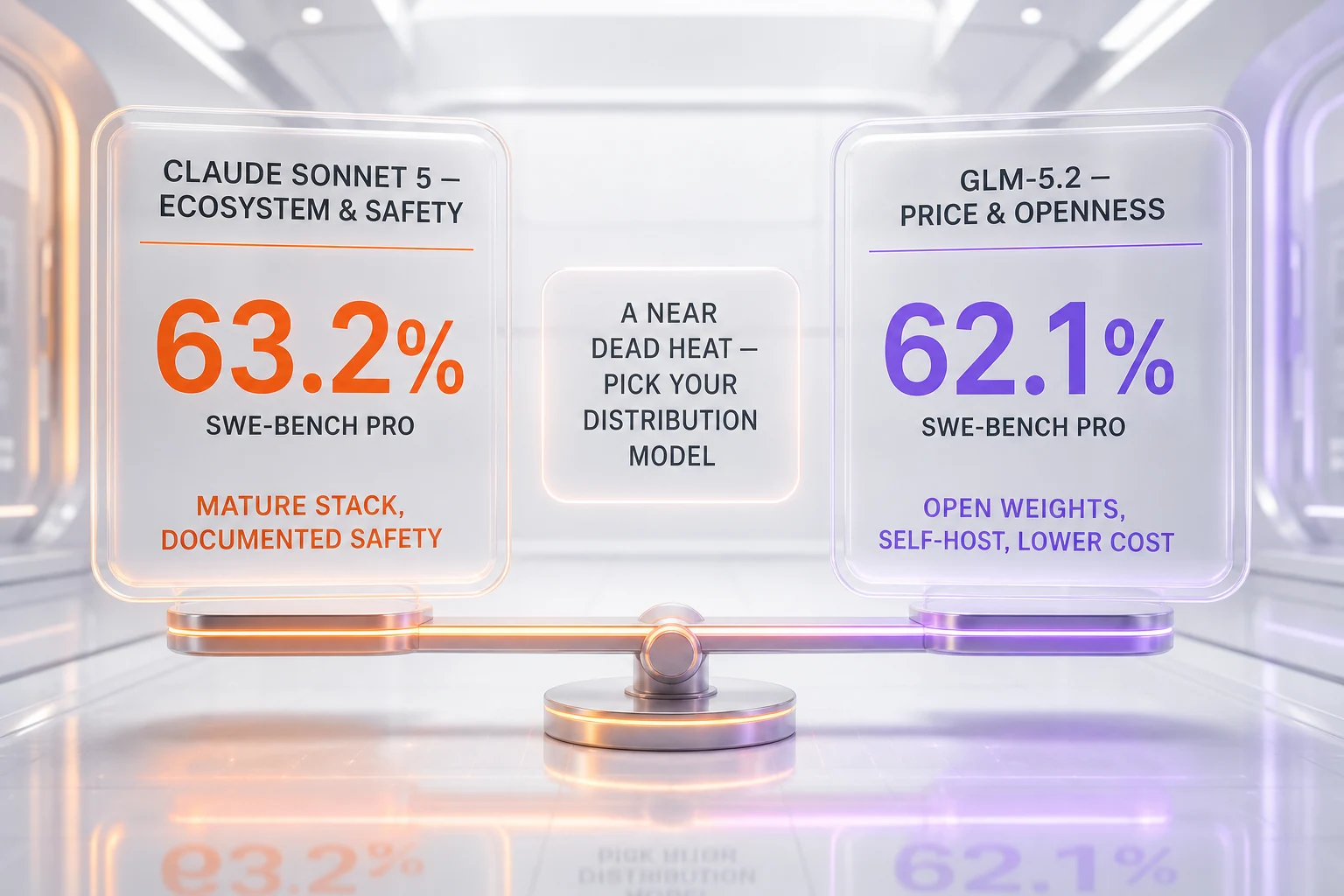
The capability gap will not choose for you — the distribution model will. On agentic coding, Claude Sonnet 5 (63.2% on SWE-bench Pro) and GLM-5.2 (62.1%) are close enough that either can carry a serious coding workload. What actually separates them is how they are shipped: Sonnet 5 is a polished, supported, closed product with a published safety card, and GLM-5.2 is an open-weight model you can download, self-host, and run for less. Most teams should pick the one whose distribution model fits their constraints, not the one that is a fraction of a point ahead on a leaderboard.
- 🏆 Claude Sonnet 5 wins for: teams that want a mature ecosystem and first-party support, a documented safety posture for sensitive agentic work, and a model they can evaluate free in a browser before paying
- 🏆 GLM-5.2 wins for: price-sensitive teams, anyone who needs to self-host or keep data on their own infrastructure, and buyers who want to fine-tune or avoid vendor lock-in under an MIT license
- 💰 Cheaper option: GLM-5.2 at $1.40 per million input tokens and $4.40 per million output tokens, plus a flat GLM Coding Plan from around $18 per month and the option to run the open weights on your own compute — clearly below Sonnet 5's $2 and $10
- 🧠 Coding capability: a near dead heat — 63.2% versus 62.1% on SWE-bench Pro, within about a point, though the two figures come from different first-party sources rather than one neutral harness
- 🔓 Openness: GLM-5.2, decisively — MIT open weights, self-hosting, fine-tuning, and no regional lock-in; Claude Sonnet 5 is closed and API-only
- 🛡️ Documented safety and support: Claude Sonnet 5 — a published system card, prompt-injection resistance, and cyber safeguards on by default, backed by Anthropic's support and SDKs
Both models are available today. You can try Claude Sonnet 5 free as the default model on the Free and Pro plans of Claude, read our full Claude Sonnet 5 review and GLM-5.2 review, or see how GLM-5.2 behaves inside an agentic terminal in our Claude Code review, since GLM-5.2 is a drop-in model for that workflow.
How We Compared Them
We put the two models side by side the way a team actually chooses between them. Claude Sonnet 5 we have run hands-on since it shipped on June 30, 2026, as the default model on the Free and Pro plans of Claude and through the Claude API, so the Sonnet notes here reflect early but genuine runs on real agent workloads plus Anthropic's published system card. GLM-5.2 we evaluated through its hosted API and by working with its open weights, drawing on Z.ai's published benchmarks and our own coding tests. Because GLM-5.2 launched on June 13, 2026 and its downloadable MIT weights arrived the week after, our GLM assessment leans on published data and short hands-on sessions rather than months of production history — and we flag that explicitly rather than dressing it up as a long track record.
On numbers, we hold a hard line: we do not mix benchmarks. When both vendors publish a score on the same test — SWE-bench Pro — we place the two figures next to each other and tell you where each came from. When only one model has a published figure on a given test, we leave the other cell empty and explain why, rather than borrowing a number from a different benchmark to fill the gap. Every headline figure below is first-party: Sonnet 5's from Anthropic's system card, GLM-5.2's self-reported by Z.ai and not yet independently reproduced. Treat both as directionally reliable rather than as precision instruments.
Claude Sonnet 5 and GLM-5.2 at a Glance
Claude Sonnet 5 is Anthropic's most agentic midsize model, released June 30, 2026. It is closed and proprietary — you reach it through the Claude apps, Claude Code, and the Claude API, not by downloading weights. It scores 63.2% on SWE-bench Pro and 81.2% on OSWorld-Verified computer use, and it is the default model on the Free and Pro plans of Claude, so anyone can evaluate the exact model in a browser before spending a cent on the API. Anthropic tuned it to plan, drive browsers and terminals, and run multi-step tasks unattended, and it ships with a published system card documenting its safety posture. API pricing is $2 per million input tokens and $10 per million output tokens.
GLM-5.2 is Z.ai's (Zhipu AI's) open-weight coding flagship, released June 13, 2026. It is a sparse mixture-of-experts model — about 753 billion total parameters with roughly 40 billion active per token — with a one-million-token context window and a maximum output of about 128,000 tokens. Its weights ship under a permissive MIT license, so commercial use, redistribution, fine-tuning, and self-hosting are all allowed. It scores a vendor-reported 62.1% on SWE-bench Pro, a step up from GLM-5.1's 58.4%, and it drops into major coding agents including Claude Code, Cline, Kilo Code, and Goose. Pricing on the hosted API is $1.40 per million input tokens and $4.40 per million output tokens, with cached input billed at $0.26 per million tokens, and a flat GLM Coding Plan starts from around $18 per month. Because you can also run the weights yourself, the effective cost floor is your own compute.
The Benchmarks: 63.2% vs 62.1% on SWE-bench Pro
The number that frames this comparison is SWE-bench Pro, the agentic software-engineering benchmark. Claude Sonnet 5 scores 63.2%, reported in Anthropic's system card. GLM-5.2 scores 62.1%, self-reported by Z.ai. That is roughly a one-point gap — close enough that on agentic coding these two models are, for practical purposes, a near dead heat. An open-weight model landing within about a point of Anthropic's most agentic midsize model is the headline of GLM-5.2's launch, and it is why this comparison is worth having at all.
Two honesty caveats matter before you lean on that one-point gap. First, the figures come from different first-party sources, not one neutral run: Sonnet 5's 63.2% is Anthropic-reported and GLM-5.2's 62.1% is Zhipu-reported and not yet independently reproduced by a third-party harness. A one-point difference between two vendors' own numbers is well inside the margin where methodology and harness differences can swamp the result, so we do not read it as "Sonnet 5 is measurably better at coding." We read it as "these two are effectively tied on this test." Second, GLM-5.2's 62.1% is a real step up from GLM-5.1's 58.4% and, per Z.ai, edges ahead of GPT-5.5's roughly 58.6% — but until an independent evaluation lands, treat the leaderboard as a vendor claim.
On computer use, Anthropic reports Claude Sonnet 5 at 81.2% on OSWorld-Verified, up from Claude Sonnet 4.6's 78.5% — a genuinely strong score for a midsize model on one of the hardest agentic skills. We do not have a comparable OSWorld-Verified figure for GLM-5.2, so we do not present a head-to-head computer-use number. Placing Sonnet 5's OSWorld score against a GLM number from a different benchmark would mislead rather than inform, so we leave that cell empty and simply note that Sonnet 5 has published a computer-use result and GLM-5.2, as far as the figures we reviewed show, has not on the same test. If browser and desktop automation is central to your use case, that published 81.2% is a point in Sonnet 5's favor that GLM-5.2 has not yet answered on the record.
Pricing: Where GLM-5.2 Pulls Ahead
Capability is a near tie. Price is not, and this is where GLM-5.2 makes its clearest case.
| Model | Input (per million tokens) | Output (per million tokens) | Notes |
|---|---|---|---|
| Claude Sonnet 5 | $2 | $10 | Default model on Free and Pro |
| GLM-5.2 — hosted API | $1.40 | $4.40 | Cached input $0.26; GLM Coding Plan from about $18 per month |
| GLM-5.2 — self-hosted | Your own compute (MIT weights) | No per-token vendor fee |
On the hosted APIs, GLM-5.2 is cheaper on both sides of the meter: $1.40 against Sonnet 5's $2 on input, and $4.40 against $10 on output. The output gap is the one that matters most for coding agents, which tend to be output-heavy — GLM-5.2's $4.40 is well under half of Sonnet 5's $10. If you route a high-volume coding pipeline through the hosted endpoints, GLM-5.2 is the lower bill by a wide margin.
The self-hosting option changes the shape of the decision entirely. Because GLM-5.2's weights are MIT-licensed, a team with its own GPUs can run the model with no per-token vendor fee at all — you pay for compute and operations instead of metered tokens. That is attractive for heavy, steady workloads and for anyone who wants inference cost decoupled from an API price list. The counterweight is honest: exact pricing above the entry GLM Coding Plan tier is not published, and the plan can consume quota at up to three times its base rate during peak hours, so heavy hosted usage is harder to model in advance than Sonnet 5's flat published rates. Sonnet 5's pricing is simpler to forecast; GLM-5.2's is cheaper but comes with more variables.
Openness and Distribution: The Real Dividing Line
This is the axis that actually decides the comparison. Claude Sonnet 5 is a closed, proprietary model. You use it through Anthropic's apps and API; you cannot download it, run it on your own hardware, fine-tune the weights, or inspect them. In exchange you get a mature, supported product: the default model on the Free and Pro plans of Claude, first-class integration in Claude Code and the Claude API, stable SDKs, and a one-line model-string migration path if you are already on the Claude platform.
GLM-5.2 is the opposite trade. Its weights are released under an MIT license, which means free commercial use, redistribution, fine-tuning, and self-hosting. A regulated enterprise can run it inside its own network; a research team can fine-tune it on a proprietary codebase; a cost-conscious shop can serve it on owned GPUs and cap its inference bill. It also drops into the major coding agents — Claude Code, Cline, Kilo Code, Goose, and others — so adopting it does not mean abandoning the tooling you already use. The open weights are the single biggest reason to choose GLM-5.2, and no amount of ecosystem polish on the closed side substitutes for the control they give you.
There are real caveats on the open side, and we will not paper over them. "Open weights" is not the same as "open source": the MIT license covers the model weights, but the training code and data recipe are not released, so you can run and fine-tune the model without being able to fully reproduce it. The downloadable weights also arrived the week after launch rather than on day one, and the production hosted API is operated in China, which raises data-residency questions for regulated Western buyers who use the endpoint rather than self-hosting. Self-hosting sidesteps the data-residency concern but shifts the operational burden — and the compute bill — onto your team. Openness buys you control; it also hands you responsibility.
Safety, Support, and Trust
Where GLM-5.2 leads on price and openness, Claude Sonnet 5 leads on documented safety and first-party support, and for many buyers that is the deciding factor. Anthropic ships Sonnet 5 with a published system card that documents its safety posture: lower hallucination and sycophancy than the previous Sonnet, stronger refusal of malicious requests, improved prompt-injection resistance, and cyber safeguards enabled by default at launch. For a customer-facing agent with tool access, a long-horizon autonomous workflow, or anything touching sensitive data or irreversible actions, that documentation and those defaults are a concrete reason to prefer Sonnet 5.
We want to be careful and fair here, because it is easy to overclaim in both directions. A published safety card is a genuine advantage, but it is not a guarantee, and its absence is not proof that GLM-5.2 is unsafe. What we can say from the public record is narrower and more honest: Sonnet 5 has a documented safety posture and defaults, and GLM-5.2, as of the material we reviewed, does not publish a comparable safety card, while its hosted API's China location raises data-residency questions that a self-hosted deployment would avoid. GLM-5.2's coding scores are also vendor self-reported and not yet independently reproduced, which is a trust consideration in its own right. None of that makes GLM-5.2 a poor model — it is clearly a capable one — but if your requirement is documented safety behavior and a vendor support relationship, Sonnet 5 is the surer footing, and if your requirement is control over where the model runs and what it costs, GLM-5.2 is.
Feature-by-Feature Comparison
Here is the head-to-head across the dimensions that actually drive the choice. We only fill a cell when we have a figure or a fact on the record for that model.
| Dimension | Claude Sonnet 5 | GLM-5.2 | Edge |
|---|---|---|---|
| SWE-bench Pro (agentic coding) | 63.2% (Anthropic system card) | 62.1% (Zhipu self-reported) | Near tie |
| Input price (per million tokens) | $2 | $1.40 | GLM-5.2 |
| Output price (per million tokens) | $10 | $4.40 | GLM-5.2 |
| Model access | Closed, proprietary | Open weights, MIT license | GLM-5.2 |
| Self-hosting and data control | API and apps only | Run the MIT weights on your own compute | GLM-5.2 |
| Maximum context window | Standard Claude context window | 1,000,000 tokens (vendor-reported) | GLM-5.2 |
| Ecosystem and first-party support | Mature: Claude Code, Claude API, Free and Pro default, SDKs | Drop-in with Claude Code, Cline, and others; smaller first-party surface | Sonnet 5 |
| Free in-browser evaluation | Default model on Free and Pro plans of Claude | No first-party free plan | Sonnet 5 |
| Documented safety posture | Published system card; cyber safeguards on by default | No comparable public safety card; API hosted in China | Sonnet 5 |
| Benchmark verification | Anthropic-reported (system card) | Vendor self-reported, not yet independently reproduced | Sonnet 5 |
Pros and Cons
Claude Sonnet 5 — Pros
- Near-tie agentic coding at 63.2% on SWE-bench Pro, plus a published 81.2% on OSWorld-Verified computer use
- Mature ecosystem: default model on the Free and Pro plans of Claude, first-class in Claude Code and the Claude API, stable SDKs
- Documented safety posture in a published system card, with cyber safeguards on by default
- Free in-browser evaluation of the exact production model before you spend on the API
- Flat, predictable published pricing that is easy to forecast
Claude Sonnet 5 — Cons
- Closed and proprietary — no self-hosting, no fine-tuning of the weights, no data-residency control
- More expensive than GLM-5.2 on both input and output tokens, especially on output
- Brand new (released June 30, 2026), so independent long-run track record is still thin
GLM-5.2 — Pros
- MIT open weights: free commercial use, fine-tuning, redistribution, and self-hosting
- Cheaper hosted pricing at $1.40 input and $4.40 output per million tokens, plus a flat plan from about $18 per month
- Self-hosting removes per-token vendor fees and answers data-residency requirements on your own infrastructure
- One-million-token context window and drop-in compatibility with Claude Code, Cline, Kilo Code, and Goose
- Vendor-reported 62.1% on SWE-bench Pro puts it within about a point of Sonnet 5 on agentic coding
GLM-5.2 — Cons
- All published scores are vendor self-reported and not yet independently reproduced
- Open weights, not open source: training code and data recipe are not released
- Production hosted API is operated in China, raising data-residency questions for regulated Western buyers who do not self-host
- No published safety card comparable to Sonnet 5's, and no first-party free plan to try the model
- Pricing above the entry plan is not published and quota can be consumed at up to three times during peak hours
When to Pick Each Model
Pick Claude Sonnet 5 when
- You want a mature, supported ecosystem — Claude Code, the Claude API, stable SDKs, and a first-party support relationship
- Documented safety behavior matters: customer-facing agents with tool access, long-horizon autonomous runs, or anything touching sensitive or irreversible actions
- You want to evaluate the exact production model for free first — it is the default on the Free and Pro plans of Claude
- Computer use is central and you want a published OSWorld-Verified result (81.2%) rather than an unquantified claim
- Predictable, flat pricing you can forecast matters more than squeezing out the lowest per-token rate
Pick GLM-5.2 when
- Price is the constraint — $1.40 input and $4.40 output per million tokens, or your own compute with no per-token vendor fee
- You need to self-host or keep data on your own infrastructure for sovereignty, compliance, or latency reasons
- You want to fine-tune the model on a proprietary codebase under a permissive MIT license
- Avoiding vendor lock-in is a priority and you value owning the weights you run
- You work with very long contexts and want the one-million-token window for whole-repository prompts
If you cannot decide, let your hardest constraint break the tie: regulated data or a fixed compute budget points to GLM-5.2; a need for documented safety and turnkey support points to Claude Sonnet 5. For more cross-vendor context on where GLM-5.2 lands, see our GLM-5.2 vs GPT-5.5 comparison on open challenger versus closed flagship, and GLM-5.2 vs DeepSeek V4 on the best coding score versus the cheapest open model.
Final Verdict
Call it a near dead heat on capability and a genuine split on everything else — so choose the distribution model, not the leaderboard. Claude Sonnet 5's 63.2% on SWE-bench Pro and GLM-5.2's 62.1% are about a point apart and come from two different first-party sources, which means neither model has a meaningful coding advantage you should base a decision on. What you should base it on is what each one gives you around the model. Claude Sonnet 5 gives you a closed but mature product: the default model on the Free and Pro plans of Claude, deep integration in Claude Code and the Claude API, a documented safety posture, and predictable pricing. GLM-5.2 gives you an open-weight model you can self-host and fine-tune under an MIT license, at a lower hosted price, with a one-million-token context window and no regional lock-in.
We are not naming a single winner because there is not one — these two models optimize for different things. If your world is governed by data-residency rules, a fixed compute budget, or a preference for owning what you run, GLM-5.2 is the right call, and it gives up almost nothing on coding to earn it. If your world is governed by the need for documented safety, first-party support, and a model your whole team can try free in a browser, Claude Sonnet 5 is the right call, and the extra cost buys real assurances. Read the full Claude Sonnet 5 review and GLM-5.2 review for the per-model deep dives, and if you are weighing GLM-5.2 against the wider field, our GLM-5.2 vs GPT-5.5 and GLM-5.2 vs DeepSeek V4 breakdowns pick up where this one leaves off.
Frequently Asked Questions
Is Claude Sonnet 5 better than GLM-5.2?
On agentic coding they are close to a tie: Claude Sonnet 5 scores 63.2% on SWE-bench Pro (Anthropic system card) and GLM-5.2 scores 62.1% (Zhipu self-reported), about a point apart and from two different first-party sources, so neither has a coding advantage worth deciding on. Where they differ is distribution. Claude Sonnet 5 is a closed, supported product with a documented safety card and a free in-browser tier; GLM-5.2 is an open-weight, MIT-licensed model you can self-host and fine-tune, at a lower price. Sonnet 5 is "better" if you value ecosystem and safety; GLM-5.2 is "better" if you value openness and cost.
How much cheaper is GLM-5.2 than Claude Sonnet 5?
On the hosted APIs, GLM-5.2 costs $1.40 per million input tokens and $4.40 per million output tokens, against Claude Sonnet 5's $2 and $10. The output side is the big gap — $4.40 is well under half of Sonnet 5's $10. GLM-5.2 also offers a flat GLM Coding Plan from around $18 per month, and because its weights are MIT-licensed you can self-host and pay only for your own compute, with no per-token vendor fee at all.
What is the SWE-bench Pro difference between Sonnet 5 and GLM-5.2?
Claude Sonnet 5 scores 63.2% and GLM-5.2 scores 62.1% on SWE-bench Pro — roughly a one-point gap. The important caveat is that these are different first-party numbers: Sonnet 5's is reported in Anthropic's system card, and GLM-5.2's is self-reported by Z.ai and not yet independently reproduced. A one-point difference between two vendors' own figures is well inside the range where testing methodology can swing the result, so the honest reading is that the two models are effectively tied on this benchmark rather than one being measurably better.
Can I self-host GLM-5.2 but not Claude Sonnet 5?
Yes. GLM-5.2's weights are released under a permissive MIT license, so you can download them, run the model on your own compute, fine-tune it on a proprietary codebase, and redistribute it, all for commercial use. Claude Sonnet 5 is closed and proprietary — you can only use it through Anthropic's apps, Claude Code, and the Claude API, and you cannot download or self-host it. If self-hosting or keeping data on your own infrastructure is a requirement, that alone points to GLM-5.2, since Sonnet 5 cannot meet it at any price.
Is GLM-5.2 open source?
Not quite — GLM-5.2 is open-weight, not fully open source. The MIT license covers the model weights, which means you can run, fine-tune, redistribute, and commercialize them freely, but Z.ai has not released the training code or the data recipe, so you cannot fully reproduce the model from scratch. That is a meaningful distinction: you get practical control over the model you run, but not complete transparency into how it was built. Claude Sonnet 5, by contrast, is closed on both counts — neither weights nor training details are available.
Which model is safer for sensitive agentic work?
On the public record, Claude Sonnet 5 has the stronger documented safety story. Anthropic ships it with a system card reporting lower hallucination and sycophancy than the previous Sonnet, stronger refusal of malicious requests, improved prompt-injection resistance, and cyber safeguards on by default. GLM-5.2, as of the material we reviewed, does not publish a comparable safety card, and its hosted API is operated in China, which raises data-residency questions for regulated buyers who use the endpoint rather than self-hosting. That does not make GLM-5.2 unsafe, but if documented safety behavior and a support relationship are requirements, Sonnet 5 is the surer choice.
Does GLM-5.2's China-hosted API raise data-residency concerns?
For some buyers, yes. GLM-5.2's production hosted API is operated in China, which can be a data-residency or compliance issue for regulated Western enterprises that would be sending data to that endpoint. The important nuance is that GLM-5.2 is open-weight, so you are not forced to use the hosted API — a team with data-residency requirements can download the MIT-licensed weights and run the model entirely inside its own infrastructure, which sidesteps the concern. That flexibility is one of the practical benefits of the open-weight model; the trade is that you take on the compute and operational burden yourself.
Which is better for high-volume coding pipelines?
If cost is the deciding factor, GLM-5.2 usually wins on high-volume coding. Coding agents are output-heavy, and GLM-5.2's $4.40 per million output tokens is well under half of Claude Sonnet 5's $10 — and self-hosting can remove per-token fees entirely. The counterpoint is predictability and support: Sonnet 5's flat published rates are easier to forecast than GLM-5.2's plan, which can consume quota at up to three times during peak hours. For pure throughput economics GLM-5.2 leads; for a supported, forecastable pipeline Sonnet 5 is easier to run.
Can I use GLM-5.2 inside Claude Code?
Yes. GLM-5.2 is a drop-in model for the major agentic coding tools, including Claude Code, Cline, Kilo Code, Goose, and Roo, so you can run it inside the terminal-based workflow many teams already use. That compatibility is part of what makes switching to GLM-5.2 low-friction: you keep your tooling and change the model behind it. Claude Sonnet 5 is also available in Claude Code as the default model on the Free and Pro plans of Claude, so the same environment can run either model — which makes a side-by-side trial on your own repository straightforward.
Which model has the bigger context window?
GLM-5.2 publishes the larger figure: a one-million-token context window, with a maximum output of about 128,000 tokens, which is well suited to whole-repository prompts and long autonomous coding sessions. Claude Sonnet 5 uses the standard Claude context window; Anthropic's launch materials we reviewed do not headline a directly comparable single number, so we do not place a specific figure against GLM-5.2's here rather than guess. If very long context is central to your workflow, GLM-5.2's published one-million-token window is a concrete point in its favor.
Is Claude Sonnet 5 free to try?
Yes. Claude Sonnet 5 is the default model on the Free and Pro plans of Claude, so you can evaluate the exact production model in a browser before spending anything on the API. For programmatic use you pay the API rate — $2 per million input tokens and $10 per million output tokens. GLM-5.2 does not offer a comparable first-party free plan, though you can trial it through hosted providers or by running the open weights yourself; the easiest free apples-to-apples test is Sonnet 5 in the Claude app.
Should I choose GLM-5.2 to avoid vendor lock-in?
If avoiding lock-in is a priority, GLM-5.2 is the stronger choice, because owning the MIT-licensed weights means you are never dependent on a single vendor's API, pricing, or availability — you can self-host, switch providers, or fine-tune without permission. Claude Sonnet 5 is closed, so using it does tie you to Anthropic's platform, pricing, and roadmap. The trade you accept with GLM-5.2 is that you give up Anthropic's documented safety posture and first-party support, and you take on the operational responsibility of running or sourcing the model yourself. Lock-in avoidance and turnkey support pull in opposite directions here.
Sources and references
Every figure on this page is attributed to whoever produced it. Vendor documentation and independent measurement are listed separately and never merged into a single ranking.
- Artificial Analysis — Claude Sonnet 5 (independent index score and cost per task)
- Hugging Face — zai-org/GLM-5.2 (published weights and license)
- Artificial Analysis — GLM-5.2 (independent index score and cost per task)
- Artificial Analysis — Model leaderboard (Intelligence Index scores and cost per task across configurations)
Our Verdict
This one is close on capability and split on everything else. Claude Sonnet 5 scores 63.2% on SWE-bench Pro (Anthropic system card) and GLM-5.2 scores 62.1% (Zhipu self-reported) — about a single point apart, close enough to call a near dead heat on agentic coding. The real fork is the distribution model. Pick Claude Sonnet 5 for the mature ecosystem, the documented safety posture, and zero-friction support: it is the default model on the Free and Pro plans of Claude, ships in Claude Code and the Claude API, and comes with a published system card. Pick GLM-5.2 for price, openness, and control: MIT open weights you can self-host, no regional lock-in, and $1.40 per million input tokens and $4.40 per million output tokens against Sonnet 5's $2 and $10. There is no single winner because the two models optimize for different things — Sonnet 5 sells you a polished, supported, closed product, and GLM-5.2 sells you a cheaper, open, self-hostable one at nearly the same coding score. Choose the distribution model your team can live with, because the capability gap will not decide it for you.
Choose Claude Sonnet 5
Anthropic's most agentic midsize model — near-Opus 4.8 coding and computer use at $2 per million input tokens.
Try Claude Sonnet 5 →Choose GLM-5.2
Zhipu AI open-weight coding flagship: 753B MoE (~40B active), 1M context, MIT license, headline SWE-bench Pro 62.1 (vendor self-reported); GLM Coding Plan from around $18 per month or $1.40 in / $4.40 out per million tokens.
Try GLM-5.2 →Frequently Asked Questions
Is Claude Sonnet 5 better than GLM-5.2?
This one is close on capability and split on everything else. Claude Sonnet 5 scores 63.2% on SWE-bench Pro (Anthropic system card) and GLM-5.2 scores 62.1% (Zhipu self-reported) — about a single point apart, close enough to call a near dead heat on agentic coding. The real fork is the distribution model. Pick Claude Sonnet 5 for the mature ecosystem, the documented safety posture, and zero-friction support: it is the default model on the Free and Pro plans of Claude, ships in Claude Code and the Claude API, and comes with a published system card. Pick GLM-5.2 for price, openness, and control: MIT open weights you can self-host, no regional lock-in, and $1.40 per million input tokens and $4.40 per million output tokens against Sonnet 5's $2 and $10. There is no single winner because the two models optimize for different things — Sonnet 5 sells you a polished, supported, closed product, and GLM-5.2 sells you a cheaper, open, self-hostable one at nearly the same coding score. Choose the distribution model your team can live with, because the capability gap will not decide it for you.
Which is cheaper, Claude Sonnet 5 or GLM-5.2?
Claude Sonnet 5 starts at $2 in / $10 out per M tokens (free plan available). GLM-5.2 starts at $1.4 in / $4.4 out per M tokens. Check the pricing comparison section above for a full breakdown.
What are the main differences between Claude Sonnet 5 and GLM-5.2?
The key differences span across 10 features we compared. For SWE-bench Pro (agentic coding), Claude Sonnet 5 offers 63.2% (Anthropic system card) while GLM-5.2 offers 62.1% (Zhipu self-reported). For Input price (per million tokens), Claude Sonnet 5 offers $2 while GLM-5.2 offers $1.40. For Output price (per million tokens), Claude Sonnet 5 offers $10 while GLM-5.2 offers $4.40. See the full feature comparison table above for all details.