Muse Spark 1.1 vs Claude Sonnet 5: Cheaper vs Smarter (2026)


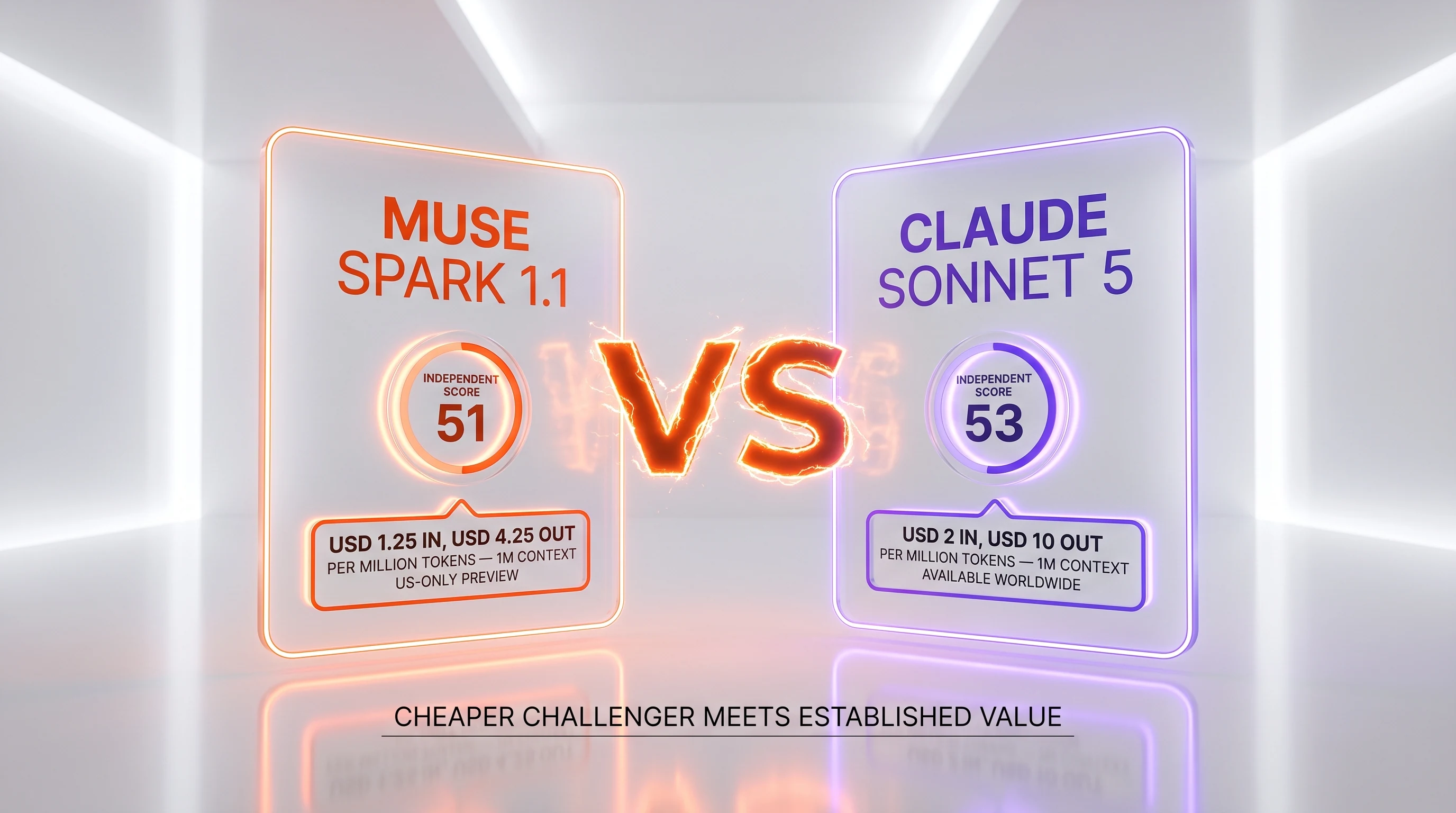
Muse Spark 1.1 undercuts Claude Sonnet 5 on price, but Sonnet scores higher (53 vs 51) and ships worldwide while Muse is US-only. Which to pick.
Feature Comparison
| Feature | Muse Spark 1.1 | Claude Sonnet 5 |
|---|---|---|
| Input price (per million tokens) | $1.25 | $2.00 |
| Output price (per million tokens) | $4.25 | $10.00 |
| Artificial Analysis Intelligence Index v4.1 | 51 | 53 |
| Context window | 1,000,000 tokens | 1,000,000 tokens |
| Availability | US-only public preview, waitlist | Generally available worldwide |
| Weights | Closed, hosted API only | Closed, hosted API only |
| Free way to try | $20 API credits (US waitlist) | Free by default on Claude.ai |
| Ecosystem and tooling | New OpenAI-compatible Meta Model API | Claude API, Claude Code, mature SDKs |
| Track record | First paid API, about a week old | Established Anthropic model line |
Pricing Comparison
Muse Spark 1.1
Claude Sonnet 5
Detailed Comparison
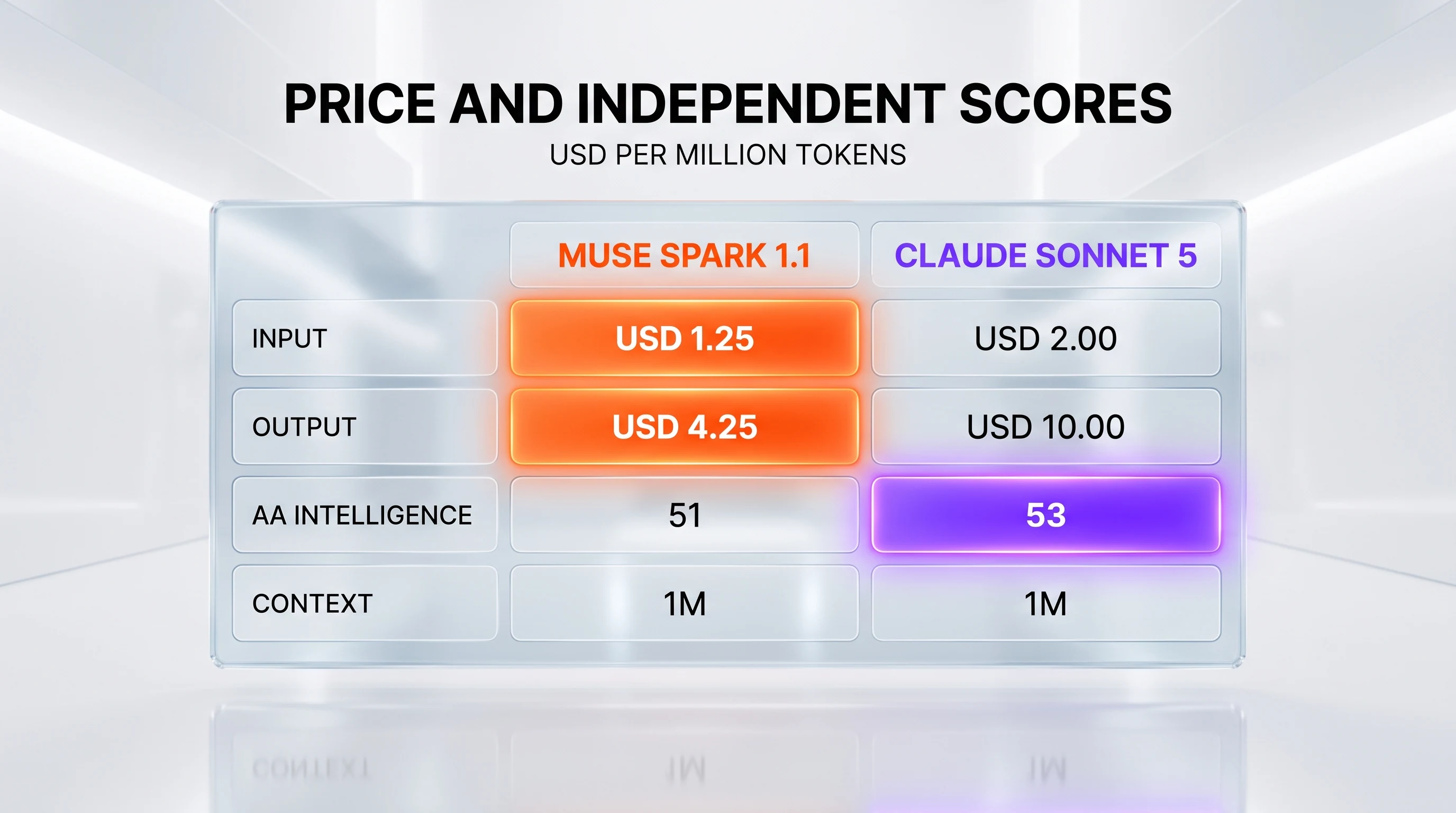
Muse Spark 1.1 and Claude Sonnet 5 answer the same question two ways. Muse Spark 1.1, from Meta Superintelligence Labs, is cheaper on every token: $1.25 per million input and $4.25 per million output, against Claude Sonnet 5 at $2 and $10. But Claude Sonnet 5 scores higher on the independent Artificial Analysis Intelligence Index v4.1 (53 versus 51), it is generally available worldwide today, and it sits in a mature ecosystem, while Muse Spark 1.1 is a US-only public preview behind a waitlist. Both carry a 1,000,000-token context. Our pick overall is Claude Sonnet 5; Muse Spark 1.1 wins only on price.
Quick Verdict
Claude Sonnet 5 wins overall; Muse Spark 1.1 wins on price. That split is the whole story. On the one scale that lets you compare them head to head, the independent Artificial Analysis Intelligence Index v4.1, Claude Sonnet 5 scores 53 to Muse Spark 1.1's 51. Sonnet is generally available worldwide right now, it is the default model on the free and Pro plans of Claude.ai, and it plugs into a settled ecosystem of SDKs, Claude Code, and a long Anthropic track record. Muse Spark 1.1 answers with one loud number: it is roughly 2.35 times cheaper on output tokens. For a US team that has cleared its waitlist and runs high-volume, output-heavy work, that price gap is decisive. For nearly everyone else, availability and measured intelligence tip it to Sonnet.
- Cheaper on both sides of the meter: Muse Spark 1.1 at $1.25 input and $4.25 output per million tokens, versus $2 and $10 for Sonnet
- Higher measured intelligence: Claude Sonnet 5 at 53 on the Artificial Analysis Intelligence Index v4.1, against 51 for Muse Spark 1.1
- Availability gap: Sonnet is worldwide today; Muse Spark 1.1 is a US-only public preview behind a waitlist
- Equal on context: both carry a 1,000,000-token window
- Both are closed models with hosted-API access only, so neither can be self-hosted
Muse Spark 1.1 in Brief
Muse Spark 1.1 is the moment Meta stopped giving models away and started selling access to a good one. Released July 9, 2026, it is the second release from Meta Superintelligence Labs and an upgrade of the April 2026 original. It scores 51 on the independent Artificial Analysis Intelligence Index v4.1, level with GPT-5.6 Luna and GLM-5.2, carries a full 1,000,000-token context, and is built for agentic work: tool use, computer use, and coding, exposed through an OpenAI-compatible Meta Model API with structured output and parallel tool calling. It costs $1.25 per million input tokens and $4.25 per million output tokens, with $20 in free credits for new accounts. The catch is twofold: the weights are closed, the exact reversal of the open Llama era, and at launch the Meta Model API is a US-only public preview behind a waitlist. It is a strong value model with a short track record.
Claude Sonnet 5 in Brief
Claude Sonnet 5 is Anthropic's most agentic midsize model, released June 30, 2026. Anthropic's system card puts it at 63.2% on SWE-bench Pro and 81.2% on OSWorld-Verified computer use, close to Claude Opus 4.8 on agentic work at a fraction of the price. It scores 53 on the independent Artificial Analysis Intelligence Index v4.1. It carries a 1,000,000-token context and caps output at 128,000 tokens per response. API pricing runs $2 per million input tokens and $10 per million output tokens. Crucially, it is the default model on the free and Pro plans of Claude.ai, and it is broadly available on day one across Claude.ai, Claude Code, and the Claude API. It is the rational default across a wide range of agent and assistant workloads.
How We Compared
We compared these two models on an uneven footing, and it is only fair to say so up front. Claude Sonnet 5 is generally available worldwide, so we tested it hands-on since its June 30 launch across coding, refactoring, and tool-use tasks, alongside Anthropic's published evaluations. Muse Spark 1.1 is a US-only public preview behind a waitlist, so our read on it is research-led: it leans on the independent Artificial Analysis Intelligence Index and coding benchmarks, Meta's own documentation, and limited preview access rather than weeks of production use. That access asymmetry is not a footnote; it is one of the comparison's central facts, and it shapes the verdict.
To keep the numbers honest, we anchor the head-to-head on figures that share a common measuring stick. The Artificial Analysis Intelligence Index v4.1 gives both models a directly comparable independent score, 51 for Muse Spark 1.1 and 53 for Claude Sonnet 5. Pricing comes straight from each vendor's published rates. Where we cite Muse Spark 1.1's improvement benchmarks, such as the SciCode and Humanity's Last Exam gains, those come from Artificial Analysis measuring the new model against the original, and we label them as such rather than mixing them with numbers from a different source.
The Numbers Side by Side
The clean comparison is price plus a shared intelligence score. Muse Spark 1.1 wins both price rows, Claude Sonnet 5 wins the intelligence row, and context is a tie. That two-to-one split on measurable specs is exactly why the softer factors, availability and maturity, end up deciding the overall call.
| Dimension | Muse Spark 1.1 | Claude Sonnet 5 | Edge |
|---|---|---|---|
| Maker | Meta Superintelligence Labs | Anthropic | Even |
| Released | July 9, 2026 | June 30, 2026 | Even |
| Input price (per million tokens) | $1.25 | $2.00 | Muse Spark 1.1 |
| Output price (per million tokens) | $4.25 | $10.00 | Muse Spark 1.1 |
| Artificial Analysis Intelligence Index v4.1 | 51 | 53 | Claude Sonnet 5 |
| Context window | 1,000,000 tokens | 1,000,000 tokens | Tie |
| Availability | US-only public preview, waitlist | Generally available worldwide | Claude Sonnet 5 |
| Weights | Closed, hosted API only | Closed, hosted API only | Tie |
| Free way to try | $20 API credits (US waitlist) | Free by default on Claude.ai | Claude Sonnet 5 |
| Ecosystem and tooling | New OpenAI-compatible Meta Model API | Claude API, Claude Code, mature SDKs | Claude Sonnet 5 |
| Track record | First paid API, about a week old | Established Anthropic model line | Claude Sonnet 5 |
Context Window in Practice
The context window is the rare headline number where these two tie cleanly: both hold 1,000,000 tokens. In practice, a million-token window is enough to load an entire mid-sized codebase, a book-length document set, or a long agent trajectory with all its intermediate tool calls, and keep it in working memory without chunking or retrieval gymnastics. For repository-scale coding assistants and long-document analysis, that headroom is a real capability rather than a spec-sheet flourish, and neither model gives up ground here.
One small asymmetry sits on the output side. Claude Sonnet 5 caps a single response at 128,000 tokens, which is generous and rarely a constraint for chat, code, or analysis, though it is worth knowing if you generate very long single outputs. Muse Spark 1.1's headline is its full million-token context for agentic, multi-file work. For most teams the practical read is a wash: if your workload is bounded by how much context you can feed rather than by how the model reasons over it, both clear the bar with room to spare.
Price: Where Muse Spark 1.1 Wins
Price is Muse Spark 1.1's home turf, and it wins it clearly. Muse charges $1.25 per million input tokens and $4.25 per million output tokens. Claude Sonnet 5 charges $2 per million input tokens and $10 per million output tokens. On input, Muse is 1.6 times cheaper. On output, where high-volume agent workloads spend most of their budget, Muse is roughly 2.35 times cheaper. New Meta accounts also get $20 in free credits, so a US team on the waitlist can prototype before committing a cent.
Sonnet's price used to carry a clock, and it no longer does. The $2 input and $10 output rate was announced at launch as introductory pricing through August 31, 2026, and Anthropic cancelled the scheduled increase to $3 and $15 on August 10, 2026, making it standard. A budget for sustained production volume can be built on $2 and $10, and at $10 output Muse Spark 1.1 becomes about 3.5 times cheaper on output. Either way, on price alone there is no contest: Muse Spark 1.1 is the cheaper model today and cheaper still in the fall.
What It Costs in Practice
Percentages are abstract, so here is a concrete bill. Take a mid-sized agent workload of 100 million input tokens and 50 million output tokens a month, a realistic figure for a small team running assistants and coding agents. On Muse Spark 1.1, that is 100 times $1.25 plus 50 times $4.25, which works out to $125 plus $212.50, or about $337.50 a month. On Claude Sonnet 5, the same traffic is 100 times $2 plus 50 times $10, which is $200 plus $500, or $700 a month.
Read the difference plainly: for identical traffic, Claude Sonnet 5 costs roughly twice as much as Muse Spark 1.1. On a small bill, a few hundred dollars a month is noise you would happily pay for worldwide availability and a two-point intelligence edge. On a large bill, at ten or a hundred times that volume, the gap turns into real money, and it is exactly the scenario where a US team that has cleared the waitlist should take Muse Spark 1.1 seriously. The price advantage is not a rounding error; it simply has to be weighed against whether you can access the model at all.
Intelligence and Benchmarks
On the one scale that measures both models the same way, Claude Sonnet 5 leads. The independent Artificial Analysis Intelligence Index v4.1 puts Sonnet at 53 and Muse Spark 1.1 at 51. Two points is a real but narrow edge, and it means Muse is frontier-adjacent rather than frontier: at 51 it trails Claude Opus 4.8 and Claude Fable 5 on the hardest reasoning while sitting level with GPT-5.6 Luna and GLM-5.2.
Both models improved sharply over their predecessors, and it is worth separating the sources. For Muse Spark 1.1, Artificial Analysis reports a 12-point higher Coding Index than the original April model, SciCode up from 52 to 58 percent, and Humanity's Last Exam up from 40 to 45 percent, with its GDPval-AA v2 rating climbing from 1,144 to 1,376 Elo. Those are Artificial Analysis figures measuring the new Muse against the old one, so we keep them in that lane rather than juxtaposing them with a differently-sourced Sonnet number. For Claude Sonnet 5, Anthropic's own system card reports 63.2% on SWE-bench Pro and 81.2% on OSWorld-Verified computer use, a 5.1-point coding jump over Sonnet 4.6. The takeaway: both are genuine upgrades, Sonnet holds a slim lead on the common independent index, and its agentic coding numbers have a longer public paper trail.
Agentic and Multimodal Features
Both models are built for agents, not just chat, and the feature sets overlap more than they differ. Muse Spark 1.1 offers multimodal reasoning tuned for agentic workflows, with tool use, computer use, and coding exposed through an OpenAI-compatible Meta Model API that supports structured output and parallel tool calling. That parallel calling matters for agents that dispatch several tool requests at once, and the OpenAI-compatible shape means popular agent frameworks work with little glue code.
Claude Sonnet 5 is Anthropic's most agentic midsize model, tuned to make plans and act across browsers and terminals over long tool chains, with improved function calling and, notably, better tool-error recovery, the unglamorous capability that keeps an agent from derailing when a step fails. It also takes vision input, reading screenshots, diagrams, charts, and PDFs, though it returns text. For computer-use automation such as form filling, dashboard navigation, and extracting data from interfaces with no API, Sonnet's published OSWorld-Verified score of 81.2% gives it a measured edge that Muse Spark 1.1 has not yet matched in public benchmarks. Both are credible agent engines; Sonnet simply has the longer, better-documented agentic track record.
Availability and Access: The Decisive Gap
This is where the comparison turns. Claude Sonnet 5 is generally available worldwide from day one, across Claude.ai on the free, Pro, Max, Team, and Enterprise plans, inside Claude Code, and through the Claude API. Anyone, anywhere, can open a browser and use the exact model for free before paying. Muse Spark 1.1 is a US-only public preview behind a waitlist on the Meta Model API, so most of the world cannot touch it on launch day, and even eligible US developers must wait for access.
That gap reframes the price advantage. A model that is roughly 2.35 times cheaper on output is compelling only if you can actually call it. For a developer in Europe, Asia, or anywhere outside the United States, Muse Spark 1.1 is not a cheaper option today; it is not an option at all yet. Availability is a hard gate, and it is the single biggest reason the overall verdict lands on Sonnet despite Muse winning the price rows.
Weights, Ecosystem, and Track Record
Both models are closed, so neither can be self-hosted, and that erases what used to be Meta's signature advantage. Muse Spark 1.1's closed weights are the sharp reversal of the open Llama heritage; there is no download and no on-premise deployment, only the hosted Meta Model API. If you specifically want open weights you can run yourself, neither of these models qualifies, and you would look elsewhere.
On ecosystem and maturity, Sonnet has the clear lead. It ships with the settled Claude API, official SDKs, and Claude Code, and it inherits a long Anthropic track record on uptime, rate limits, and safety tuning, with lower hallucination and stronger prompt-injection resistance than its predecessor. Muse Spark 1.1's Meta Model API is OpenAI-compatible, which is a genuine convenience for teams pointing existing code at a new backend, but it is Meta's first paid API with no track record yet for reliability or long-term pricing stability. A week after launch, broad third-party testing across diverse real-world workloads is still limited.
Migrating Between Them
Integration effort is close to symmetric, but the paths differ. Muse Spark 1.1 exposes an OpenAI-compatible Meta Model API with structured output and parallel tool calling, so teams whose code already speaks the OpenAI format can often point an existing client at Meta's endpoint with minimal changes and test on the $20 in free credits. That compatibility is a deliberate on-ramp: it lowers the cost of trying a cheaper backend without rewriting your stack, which is a shrewd way for a newcomer to win business from incumbents.
Claude Sonnet 5 uses Anthropic's Messages API and official SDKs, with the model id claude-sonnet-5. If you are already on Claude, adopting Sonnet 5 is a one-line model-string change with no prompt rework, and it drops straight into Claude Code. If you are coming from an OpenAI-shaped stack, moving to Anthropic's API is a larger lift than pointing at Muse's OpenAI-compatible endpoint, though it is well-trodden and heavily documented. The net read: Muse Spark 1.1 is marginally easier to slot into an OpenAI-style codebase, while Claude Sonnet 5 is trivial to adopt if you are already inside the Anthropic ecosystem.
Safety, Reliability, and Risk
On safety and reliability, the two models sit at opposite ends of the maturity curve. Anthropic's system card reports that Claude Sonnet 5 hallucinates and flatters less than Sonnet 4.6, refuses malicious requests more reliably, resists prompt injection better, and ships with cyber safeguards on by default. It is not the safest model Anthropic makes; the company notes Claude Opus 4.8 still leads on the most safety-sensitive long-horizon autonomy. But it arrives with a documented safety profile and years of operational history behind the API.
Muse Spark 1.1 carries the opposite risk shape: strong independent capability scores, but almost no public operating history. It is Meta's first paid API, so there is no track record yet for uptime, rate limits, or long-term pricing stability, and broad third-party testing across diverse real-world workloads was still limited a week after launch. That is not a knock on quality; it is a caution about the unknowns you take on when you build production systems on a service that is one week old and still in preview. For low-stakes, high-volume batch work, that risk is easy to absorb. For anything mission-critical, the mature option is the safer bet today.
Pros and Cons of Each
Muse Spark 1.1
What stands out:
- Cheapest on both meters: $1.25 input and $4.25 output per million tokens, with Sonnet output costing about 2.35 times as much
- $20 in free credits for new accounts to prototype before committing
- Full 1,000,000-token context, matching Sonnet
- Built for agentic work with tool use, computer use, and coding on an OpenAI-compatible Meta Model API
Where it falls short:
- US-only public preview behind a waitlist, unavailable in most regions on launch day
- Slightly lower measured intelligence: 51 versus 53 on the Artificial Analysis Intelligence Index v4.1
- Closed weights with no self-hosting, reversing Meta's open Llama heritage
- Meta's first paid API, with a thin track record on reliability and price stability
Claude Sonnet 5
What stands out:
- Higher measured intelligence: 53 on the Artificial Analysis Intelligence Index v4.1
- Generally available worldwide, and free by default on Claude.ai so you can try the exact model
- Mature ecosystem: Claude API, official SDKs, Claude Code, and an established Anthropic track record
- Strong public agentic numbers: 63.2% on SWE-bench Pro and 81.2% on OSWorld-Verified
Where it falls short:
- More expensive on every token
- Closed weights with no self-hosting
- Claude Opus 4.8 still leads on the hardest, most safety-sensitive autonomous work
- Brand new, so independent long-run production data is still thin
Winner by Category
No single model sweeps every use case, so here is who wins where, with the reasoning spelled out rather than hidden behind a single grade.
- Best overall: Claude Sonnet 5. Higher measured intelligence, worldwide availability, and a mature ecosystem outweigh the price gap for the large majority of buyers.
- Best on price: Muse Spark 1.1. Cheaper on both input and output, roughly 2.35 times cheaper on output, with $20 in free credits on top.
- Best available today: Claude Sonnet 5. Free by default on Claude.ai worldwide; Muse Spark 1.1 is gated behind a US-only waitlist.
- Best for high-volume US agent workloads: Muse Spark 1.1, but only for teams that have cleared the waitlist and are spending most of their budget on output tokens.
- Best track record and ecosystem: Claude Sonnet 5. Established API, SDKs, Claude Code, and a longer safety and reliability history.
When to Pick Each
Pick Muse Spark 1.1 when you are a US team that has cleared the waitlist, your workloads are output-heavy and cost-sensitive so a roughly 2.35 times cheaper output price dominates your bill, and you want a 1,000,000-token context with agentic tool use. Migrating OpenAI-compatible code to the Meta Model API is low-friction, and the $20 in free credits lets you validate quality on your own tasks before committing.
Pick Claude Sonnet 5 when you are anywhere outside the United States, you want the higher measured intelligence and a longer public agentic track record, you value a mature ecosystem with Claude Code and stable SDKs, or you simply want to try the exact model for free in a browser before paying. For most teams, most of the time, that is the safer and stronger default, and the price premium buys real availability and maturity.
The Bigger Picture: Meta's Closed Pivot
Muse Spark 1.1 matters beyond this head-to-head because of what it represents. For years, Meta's identity in AI was the open-weight Llama line: download the weights, run them yourself, fine-tune freely. Muse Spark 1.1 is the sharp reversal of that stance. It is a closed model, hosted-API only, sold by the token, with no download and no self-hosting. Meta Superintelligence Labs has chosen to compete the way Anthropic and OpenAI do, on a paid API with proprietary weights, and Muse Spark 1.1 is the clearest signal yet of that shift.
That reframes the comparison. This is no longer open versus closed; it is two closed models competing on price, intelligence, and availability. If open weights were the reason you looked at Meta in the first place, neither Muse Spark 1.1 nor Claude Sonnet 5 will satisfy you, and you would turn to genuinely open-weight alternatives instead. Against Claude Sonnet 5 specifically, Muse Spark 1.1's pitch is narrow and sharp: much the same kind of closed-API model you would buy from a frontier lab, at roughly half to a third of the price, provided you are in the United States and can clear the waitlist. Whether that trade is worth it depends entirely on how much you value price against access and measured intelligence.
Final Verdict
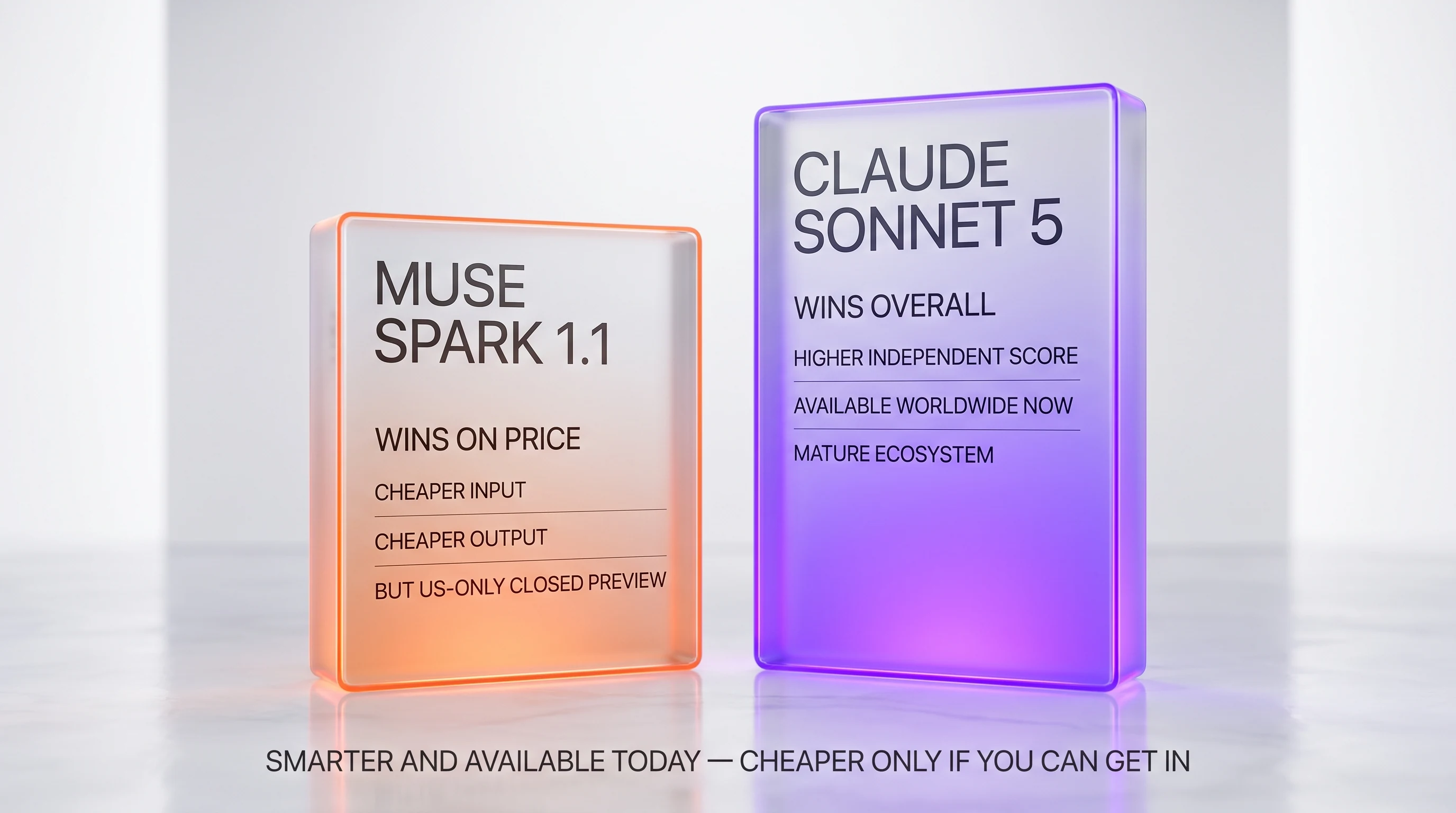
Claude Sonnet 5 is our overall pick, and it is not a close call for most readers, even though Muse Spark 1.1 wins the two price rows. Sonnet is smarter on the one independent scale that measures both, it is available worldwide today, it is free to try in a browser, and it sits in a mature ecosystem with a real track record. Muse Spark 1.1 is a genuinely impressive value model and a landmark for Meta, the moment it pivoted from open weights to selling access, but its price advantage only matters if you can reach it, and at launch most of the world cannot. Choose Muse Spark 1.1 if you are a US team optimizing an output-heavy bill and can clear the waitlist. Choose Claude Sonnet 5 for everything else. Last compared: August 2026, after Anthropic made the $2 and $10 Sonnet 5 rate its standard price.
Related Comparisons
If you are weighing Claude Sonnet 5 against the rest of the field, these side-by-sides go deeper on specific rivals:
- Claude Sonnet 5 vs GPT-5.5 — Anthropic's mid-tier against OpenAI's flagship.
- Claude Sonnet 5 vs Gemini 3.1 Pro — coding leader against reasoning leader.
- Claude Sonnet 5 vs DeepSeek V4 — closed frontier against open-weight price.
- GPT-5.6 Luna vs Claude Sonnet 5 — economy tier against value tier.
- Claude Sonnet 5 vs Claude Opus 4.8 — workhorse against flagship.
For the wider landscape, see our roundup of the best AI coding tools of 2026.
Frequently Asked Questions
Which is better, Muse Spark 1.1 or Claude Sonnet 5?
For most people, Claude Sonnet 5 is the better pick. It scores higher on the independent Artificial Analysis Intelligence Index v4.1 (53 versus 51), it is generally available worldwide today, and it sits inside a mature ecosystem. Muse Spark 1.1 wins on raw token price, so it is the better pick only for cost-sensitive, high-volume workloads run by US teams that can clear its waitlist.
Is Muse Spark 1.1 cheaper than Claude Sonnet 5?
Yes, on both sides of the meter. Muse Spark 1.1 costs $1.25 per million input tokens and $4.25 per million output tokens. Claude Sonnet 5 costs $2 per million input tokens and $10 per million output tokens. On output, Muse is roughly 2.35 times cheaper, which is its single strongest advantage.
Can I use Muse Spark 1.1 outside the United States?
Not at launch. Muse Spark 1.1 is a US-only public preview behind a waitlist on the Meta Model API, so access is gated and unavailable in most regions on day one. Claude Sonnet 5 is generally available worldwide across Claude.ai, Claude Code, and the Claude API. For anyone outside the United States, that access gap usually settles the decision on its own.
What is the difference in intelligence between Muse Spark 1.1 and Claude Sonnet 5?
On the independent Artificial Analysis Intelligence Index v4.1, Claude Sonnet 5 scores 53 and Muse Spark 1.1 scores 51. That is a two-point edge to Sonnet on the same measured scale, so the gap is real but narrow. Muse Spark 1.1 is frontier-adjacent rather than frontier: it trails Claude Opus 4.8 and Claude Fable 5 on the hardest reasoning.
Do Muse Spark 1.1 and Claude Sonnet 5 have the same context window?
Yes. Both models carry a 1,000,000-token context window, so neither has an edge on how much text, code, or document context you can feed in a single request. This is the one headline specification where the two land in a genuine tie. Claude Sonnet 5 caps output at 128,000 tokens per response.
Is the Claude Sonnet 5 price of $2 and $10 permanent?
Yes. Anthropic announced $2 per million input tokens and $10 per million output tokens at launch as introductory pricing through August 31, 2026, then cancelled the scheduled increase to $3 and $15 on August 10, 2026, making the rate standard. Muse Spark 1.1 keeps a 1.6-times input and 2.35-times output advantage, and it will not widen on a calendar.
Are Muse Spark 1.1 and Claude Sonnet 5 open-weight models?
Neither is open-weight. Both are closed models available only through a hosted API, with no self-hosting and no weight download. Muse Spark 1.1 is notable because it marks Meta Superintelligence Labs pivoting away from the open-weight Llama line to a closed, paid model. Claude Sonnet 5 has always been a closed Anthropic model.
How do I try each model before paying?
Claude Sonnet 5 is the default model on the free and Pro plans of Claude.ai, so you can evaluate the exact model in a browser worldwide before spending anything on the API. Muse Spark 1.1 gives new accounts $20 in free credits on the Meta Model API, but you first need to clear the US-only waitlist to reach them.
Which model is better for agentic coding?
Claude Sonnet 5 has the stronger public agentic track record: Anthropic reports 63.2% on SWE-bench Pro and 81.2% on OSWorld-Verified computer use, and it runs inside Claude Code. Muse Spark 1.1 is also built for agentic work with tool use and computer use, and Artificial Analysis measured a 12-point Coding Index gain over the original Muse Spark, but broad real-world validation is still thin.
How much cheaper is Muse Spark 1.1 on output tokens?
Muse Spark 1.1 charges $4.25 per million output tokens against Claude Sonnet 5 at $10 per million output tokens, so Muse is roughly 2.35 times cheaper on output.
Which company builds each model?
Muse Spark 1.1 is built by Meta Superintelligence Labs and was released July 9, 2026, as the labs second model and Meta first paid API. Claude Sonnet 5 is built by Anthropic and was released June 30, 2026, as its most agentic midsize model. Both are recent 2026 releases from major labs.
When should I choose Muse Spark 1.1 over Claude Sonnet 5?
Choose Muse Spark 1.1 when you are a US team that has cleared the waitlist, you run high-volume output-heavy workloads where the roughly 2.35 times cheaper output price dominates your bill, and a 1,000,000-token context matters. Choose Claude Sonnet 5 when you need higher measured intelligence, worldwide availability, a mature ecosystem, or a proven track record.
Sources and references
Every figure on this page is attributed to whoever produced it. Vendor documentation and independent measurement are listed separately and never merged into a single ranking.
- Artificial Analysis — Claude Sonnet 5 (independent index score and cost per task)
- Artificial Analysis — Muse Spark 1.1 (independent index score)
- Artificial Analysis — Model leaderboard (Intelligence Index scores and cost per task across configurations)
Our Verdict
Claude Sonnet 5 wins overall; Muse Spark 1.1 wins on price. On the independent Artificial Analysis Intelligence Index v4.1, Sonnet scores 53 to Muse Spark 1.1’s 51, it is generally available worldwide today, and it sits in a mature ecosystem with a real track record. Muse Spark 1.1 is cheaper on both input and output — roughly 2.35 times cheaper on output — but it is a US-only public preview behind a waitlist. Pick Muse Spark 1.1 for high-volume US workloads that have cleared the waitlist; pick Claude Sonnet 5 for higher measured intelligence, worldwide availability, and maturity.
Choose Muse Spark 1.1
Meta Superintelligence Labs' closed agentic model: Artificial Analysis Intelligence Index 51 and a 1,000,000-token context, at $1.25 input and $4.25 output per million tokens — about a quarter of frontier input rates.
Try Muse Spark 1.1 →Choose Claude Sonnet 5
Anthropic's most agentic midsize model — near-Opus 4.8 coding and computer use at $2 per million input tokens.
Try Claude Sonnet 5 →Frequently Asked Questions
Is Muse Spark 1.1 better than Claude Sonnet 5?
Claude Sonnet 5 wins overall; Muse Spark 1.1 wins on price. On the independent Artificial Analysis Intelligence Index v4.1, Sonnet scores 53 to Muse Spark 1.1’s 51, it is generally available worldwide today, and it sits in a mature ecosystem with a real track record. Muse Spark 1.1 is cheaper on both input and output — roughly 2.35 times cheaper on output — but it is a US-only public preview behind a waitlist. Pick Muse Spark 1.1 for high-volume US workloads that have cleared the waitlist; pick Claude Sonnet 5 for higher measured intelligence, worldwide availability, and maturity.
Which is cheaper, Muse Spark 1.1 or Claude Sonnet 5?
Muse Spark 1.1 starts at $1.25 in / $4.25 out per M tokens. Claude Sonnet 5 starts at $2 in / $10 out per M tokens (free plan available). Check the pricing comparison section above for a full breakdown.
What are the main differences between Muse Spark 1.1 and Claude Sonnet 5?
The key differences span across 9 features we compared. For Input price (per million tokens), Muse Spark 1.1 offers $1.25 while Claude Sonnet 5 offers $2.00. For Output price (per million tokens), Muse Spark 1.1 offers $4.25 while Claude Sonnet 5 offers $10.00. For Artificial Analysis Intelligence Index v4.1, Muse Spark 1.1 offers 51 while Claude Sonnet 5 offers 53. See the full feature comparison table above for all details.