Gemini 3.1 Pro vs DeepSeek V4: Closed Frontier vs Open MIT (2026)


Gemini 3.1 Pro leads reasoning at 94.3% GPQA; DeepSeek V4 is open MIT and 9x cheaper at $0.22 input off-peak. SWE-bench ties 80.6%. Which wins for you?
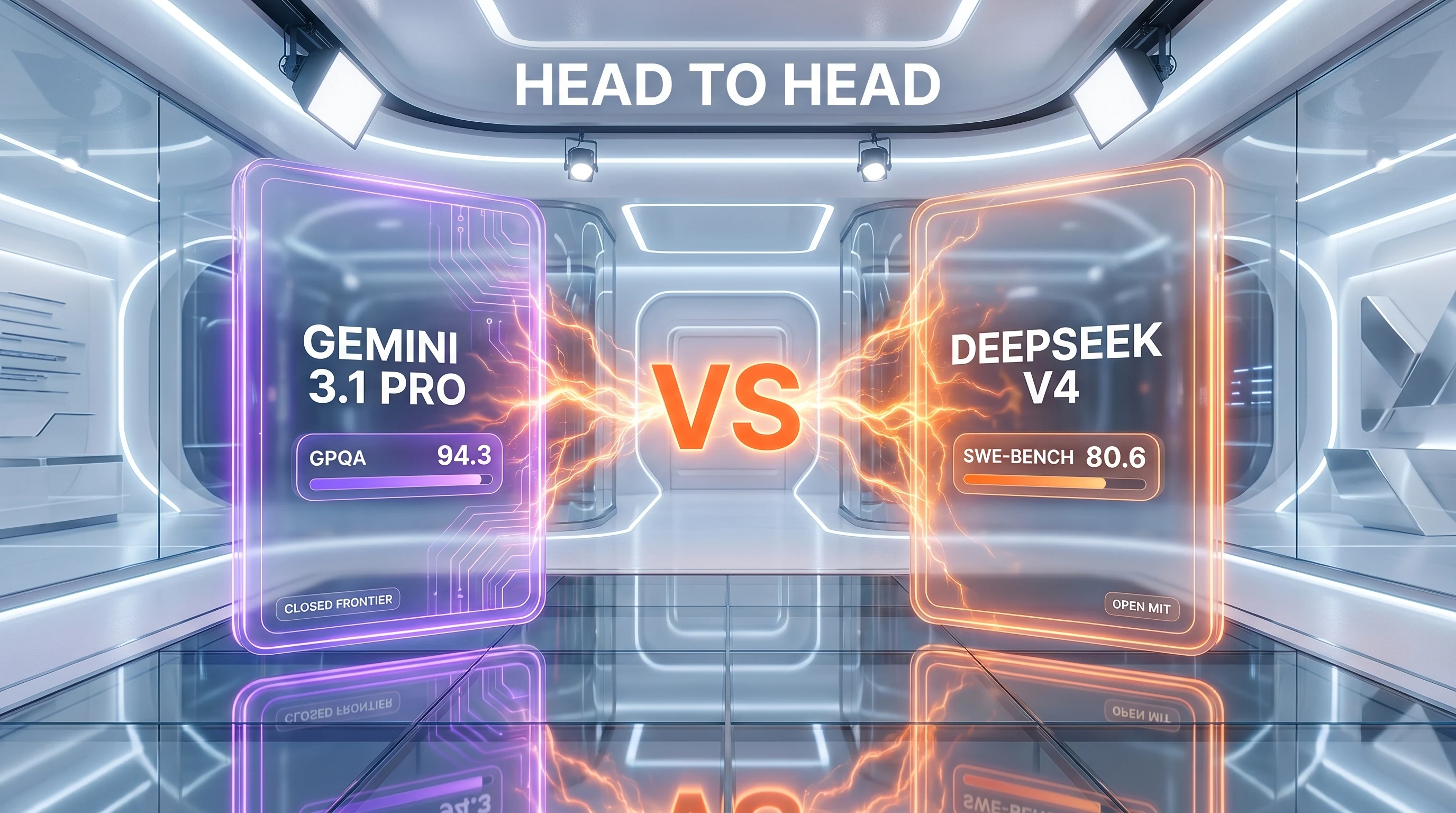
Feature Comparison
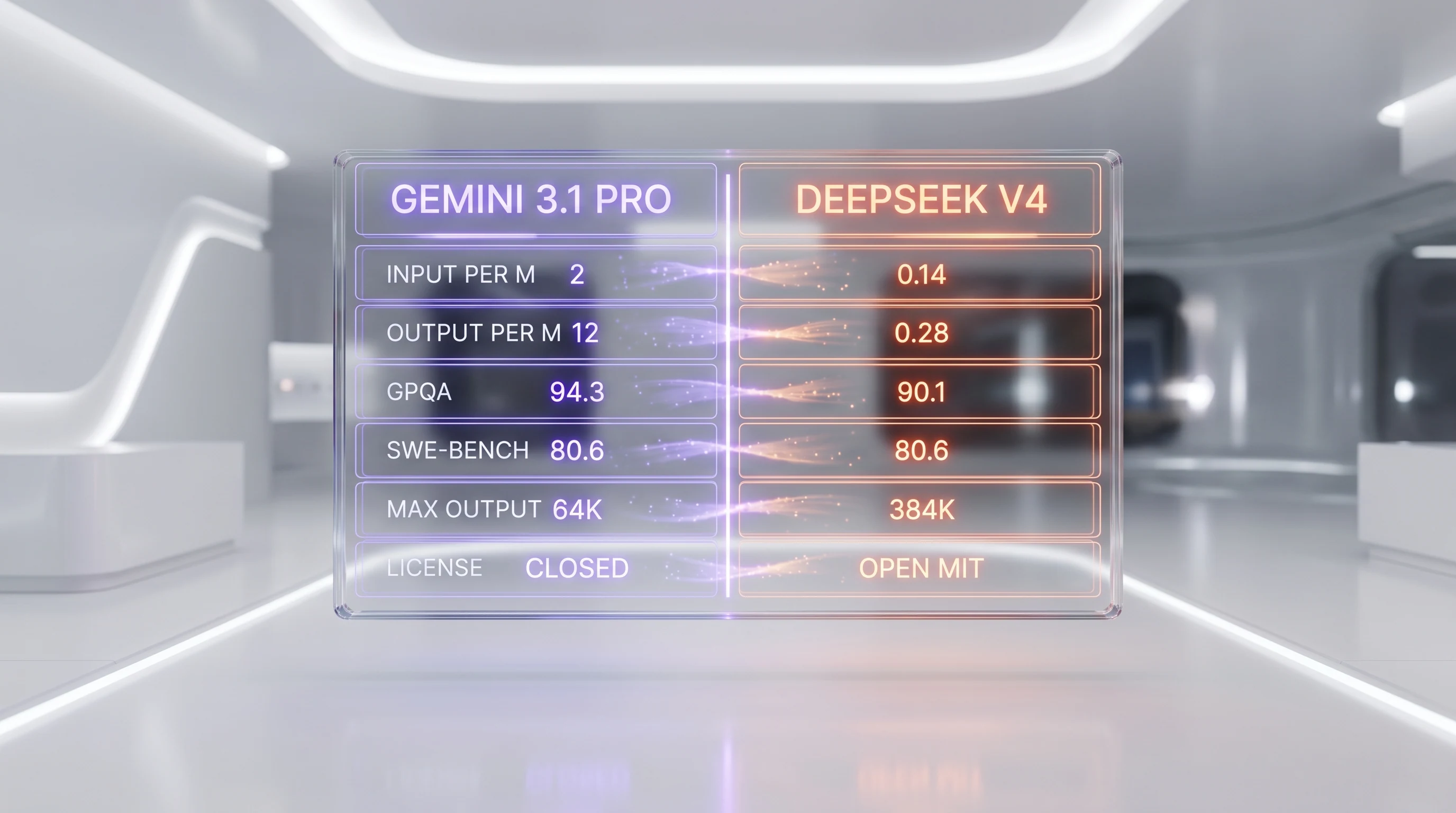
| Feature | Gemini 3.1 Pro Preview | DeepSeek V4 |
|---|---|---|
| License / openness | Closed, managed API only | Open weights under MIT (downloadable, self-hostable) |
| Standard input price (per million tokens) | $2 up to 200K, $4 above 200K | Off-peak $0.22 V4-Flash, $0.66 V4-Pro; peak $0.44 and $1.32 (cache miss) |
| Standard output price (per million tokens) | $12 up to 200K, $18 above 200K | Off-peak $0.66 V4-Flash, $1.98 V4-Pro; peak $1.32 and $3.96 |
| GPQA Diamond (reasoning) | 94.3% (no tools, model card) | 90.1% (V4-Pro, model card) |
| ARC-AGI-2 (abstract reasoning) | 77.1% (ARC Prize Verified) | Not reported for V4 |
| SWE-bench Verified (real-world coding) | 80.6% (single attempt) | 80.6% (V4-Pro) |
| Competitive coding | LiveCodeBench Pro 2887 Elo (Codeforces/ICPC/IOI, combined) | Codeforces 3206, LiveCodeBench 93.5% Pass@1 (V4-Pro) |
| Input modalities | Text, image, video, audio, PDF | Text plus tool and vision via API tiers |
| Context window | 1M input | 1M input |
| Max output | 64K tokens | 384K tokens |
| Self-hosting | Not possible (closed) | NVIDIA H100/H200 and Huawei Ascend |
| Availability status | Preview (GA expected later 2026) | Preview (open weights downloadable now) |
Pricing Comparison
Gemini 3.1 Pro Preview
DeepSeek V4
Detailed Comparison
Gemini 3.1 Pro vs DeepSeek V4 is a comparison between Google DeepMind's closed, multimodal frontier model and DeepSeek's open-weight MIT-licensed Chinese flagship. Gemini 3.1 Pro Preview costs $2 per million input tokens (up to 200K context) and $12 per million output tokens, scores 94.3% on GPQA Diamond, and accepts text, image, video, audio, and PDF in a single call. DeepSeek V4 ships its weights under an MIT license, runs as cheap as $0.22 per million input tokens off-peak (V4-Flash, cache miss) with output at $0.66, and posts 80.6% on SWE-bench Verified — the same score Gemini reports. We ran both side by side on reasoning, coding, long-context, and cost, and read the published model cards where our own testing was thin. The short answer: Gemini 3.1 Pro wins frontier reasoning, native multimodal input, and ecosystem polish; DeepSeek V4 wins price, open weights you can self-host, and longer output. There is no single winner here — the right pick depends entirely on whether you value raw capability and a managed API or cost, control, and an MIT license.
Disclosure: ThePlanetTools.ai has no affiliation with Google DeepMind or DeepSeek. We are not paid to recommend either model, and there are no affiliate links in this comparison. Last compared: June 2026. Every benchmark figure is attributed to its source, and every price was pulled directly from the vendor's own pricing page rather than a third-party summary.
Quick Verdict
We tested both models against the same prompts and compared their published numbers, and the result is a clean split. One model is a closed, polished frontier system; the other is an open-weight value machine. Here is the short version before the detail.
- Best for frontier reasoning: Gemini 3.1 Pro. Its model card reports 94.3% on GPQA Diamond and 77.1% on ARC-AGI-2, both ahead of DeepSeek V4-Pro's 90.1% GPQA Diamond. On hard graduate-level science and abstract reasoning, Gemini is in front.
- Best for price and open weights: DeepSeek V4. V4-Flash costs $0.22 per million input tokens and $0.66 per million output tokens off-peak, roughly 9 times cheaper than Gemini on input, and the weights ship under an MIT license you can download and self-host. Nothing closed comes close on cost.
- Tie on real-world coding: Both report 80.6% on SWE-bench Verified, the one benchmark both vendors run the same way. On competitive programming, DeepSeek posts strong published numbers (a 3206 Codeforces rating and 93.5% on LiveCodeBench Pass@1); Google reports a single combined LiveCodeBench Pro figure of 2887 Elo for Gemini rather than a separate Codeforces score, so there is no clean head-to-head here.
This is a genuine split decision, not a fence-sit. If you want the strongest documented reasoning, native multimodal input, and a managed Google-grade API, Gemini 3.1 Pro is the pick. If you want frontier-class coding at a fraction of the cost, weights you own, and the freedom to run on your own hardware, DeepSeek V4 is the pick. We crown neither overall, because the deciding factor is your constraints, not a single score.
Gemini 3.1 Pro vs DeepSeek V4 at a Glance
Before the section-by-section breakdown, here is the headline comparison. Every number is attributed to its source. Where DeepSeek quotes two model tiers (V4-Pro and the cheaper V4-Flash), we name the tier.
| Dimension | Gemini 3.1 Pro | DeepSeek V4 | Edge |
|---|---|---|---|
| Vendor | Google DeepMind (US) | DeepSeek (China) | Tie |
| License | Closed, managed API only | Open weights under MIT (downloadable) | DeepSeek |
| Standard input price (per million tokens) | $2 up to 200K, $4 above 200K | Off-peak $0.22 V4-Flash, $0.66 V4-Pro; peak $0.44 and $1.32 (cache miss) | DeepSeek |
| Standard output price (per million tokens) | $12 up to 200K, $18 above 200K | Off-peak $0.66 V4-Flash, $1.98 V4-Pro; peak $1.32 and $3.96 | DeepSeek |
| GPQA Diamond (reasoning) | 94.3% (no tools, model card) | 90.1% (V4-Pro, model card) | Gemini |
| ARC-AGI-2 (abstract reasoning) | 77.1% (ARC Prize Verified) | Not reported for V4 | Gemini (only one with a published score) |
| SWE-bench Verified (real-world coding) | 80.6% (single attempt) | 80.6% (V4-Pro) | Tie |
| Competitive coding | LiveCodeBench Pro 2887 Elo (Codeforces/ICPC/IOI, combined) | Codeforces 3206, LiveCodeBench 93.5% Pass@1 (V4-Pro) | Not directly comparable |
| Input modalities | Text, image, video, audio, PDF | Text (plus tool and vision via API tiers) | Gemini |
| Context window | 1M input | 1M input | Tie |
| Max output | 64K tokens | 384K tokens | DeepSeek |
| Self-hosting | Not possible (closed) | NVIDIA H100/H200 and Huawei Ascend | DeepSeek |
| Status | Preview (GA expected later 2026) | Preview (open weights downloadable now) | DeepSeek |
The most important rows to read together are price and reasoning. DeepSeek is cheaper by an order of magnitude; Gemini is ahead on the hardest reasoning benchmark both vendors publish. Nearly every other row reflects the deeper trade-off between a closed managed product and an open downloadable model.
Gemini 3.1 Pro in One Paragraph
Gemini 3.1 Pro is Google DeepMind's flagship reasoning and multimodal model. It confirms a 1M-token input context with 64K tokens of output, and its model card reports best-in-class reasoning scores for April 2026: 94.3% on GPQA Diamond with no tools and 77.1% on ARC-AGI-2 under ARC Prize Verified conditions. Its standout trait is native multimodal input — text, image, video, audio, and PDF in a single call — which collapses transcription, OCR, and summarization into one round-trip. It ships across Google AI Studio, Vertex AI, the Gemini API, the Gemini CLI, Android Studio, and Google Antigravity, and includes native Google Search and Maps grounding. We confirmed its pricing directly on Google's own pages: $2 per million input tokens and $12 per million output tokens up to 200K context, rising to $4 and $18 above that. The catches are that it is closed (no self-hosting), still in preview, and has no free programmatic tier — you pay from the first API call.
DeepSeek V4 in One Paragraph
DeepSeek V4 is the Chinese open-weight flagship released April 24, 2026, shipped in two Mixture-of-Experts variants: V4-Pro (1.6 trillion total parameters, 49 billion active) and the cheaper V4-Flash (284 billion total, 13 billion active). Both run a 1M-token context with a generous 384K-token max output. Its defining feature is the MIT license on the weights, which lets you download the model from Hugging Face and run it commercially on your own NVIDIA or Huawei Ascend hardware. On benchmarks, V4-Pro posts 80.6% on SWE-bench Verified (matching Gemini), 90.1% on GPQA Diamond, 93.5% on LiveCodeBench, and a 3206 Codeforces rating that leads Gemini on competitive programming. We confirmed its pricing directly on DeepSeek's API docs: V4-Flash at $0.22 input and $0.66 output per million tokens off-peak, V4-Pro at $0.66 input and $1.98 output, with cache-hit input as low as $0.007, and every one of those figures doubling during peak hours. The catches are that it is not fully open-source (training code and data are not released), the API is hosted in China, and self-hosting the larger tier needs serious GPU hardware.
Benchmarks: Where Each Model Pulls Ahead
A lazy comparison lines up every number it can find and declares a winner. We will not do that, because not every benchmark was run on both models the same way. Here is the honest breakdown of what compares cleanly and what does not.
SWE-bench Verified: a genuine tie at 80.6%
SWE-bench Verified measures how well a model resolves real software-engineering issues from open-source repositories, and it is the headline real-world coding benchmark most production teams watch. Here, both models land at 80.6% — Gemini on a single attempt per its model card, DeepSeek V4-Pro per its own card. This is the rare case where the like-for-like number is genuinely tied. On the work most engineers actually care about, applying correct patches to real GitHub issues, these two are level.
Competitive coding: strong DeepSeek scores, different metrics
When the coding task shifts from real-world patches to competitive programming, the two vendors do not report the same metric, so a clean head-to-head is not possible. DeepSeek V4-Pro publishes a 3206 Codeforces Elo rating and 93.5% on LiveCodeBench Pass@1. Google does not publish a standalone Codeforces rating for Gemini 3.1 Pro; instead it reports a single combined LiveCodeBench Pro score of 2887 Elo spanning Codeforces, ICPC, and IOI problems. DeepSeek's contest-style numbers are strong and clearly documented, but because the benchmarks differ we treat this as each vendor's chosen showcase rather than a direct win. If your workload leans toward algorithmically dense, self-contained problems, DeepSeek's published competitive-coding scores are worth a close look.
Frontier reasoning: Gemini leads where both report
On GPQA Diamond, the graduate-level science benchmark both vendors publish, Gemini 3.1 Pro reports 94.3% against DeepSeek V4-Pro's 90.1% — a clear four-point lead for Gemini on hard scientific reasoning. Gemini also reports 77.1% on ARC-AGI-2, a demanding abstract-reasoning benchmark; DeepSeek does not publish an ARC-AGI-2 figure for V4, so we cannot oppose them directly there. The honest read is that on the reasoning benchmarks where comparison is possible, Gemini is ahead, and on ARC-AGI-2 it is simply the only one with a published number.
How to read this section: SWE-bench Verified and GPQA Diamond compare both models on the same test. ARC-AGI-2 is Gemini-only on this table. Treat the non-overlapping scores as each vendor's chosen showcase, not as a head-to-head, and weigh the like-for-like numbers (a coding tie, a reasoning lead for Gemini) most heavily.
Pricing: DeepSeek Is in a Different League
Pricing is the most lopsided dimension in this comparison, and it is the cleanest because we confirmed every number directly on the vendor pages rather than trusting a summary. We fetched Google's Gemini API pricing page and DeepSeek's official API docs. The gap is not subtle.
| Tier | Gemini 3.1 Pro | DeepSeek V4 |
|---|---|---|
| Input, standard (per million tokens) | $2 up to 200K context, $4 above 200K | Off-peak $0.22 (V4-Flash), $0.66 (V4-Pro); peak $0.44 and $1.32, cache miss |
| Output, standard (per million tokens) | $12 up to 200K context, $18 above 200K | Off-peak $0.66 (V4-Flash), $1.98 (V4-Pro); peak $1.32 and $3.96 |
| Cache-hit input (per million tokens) | $0.20 up to 200K, $0.40 above 200K | Off-peak $0.007 (V4-Flash), $0.022 (V4-Pro); peak $0.014 and $0.044 |
| Cheaper bulk option | Batch tier: $1 input, $6 output up to 200K | Self-host the MIT weights — no per-token fee at all |
Compared at the cheapest like-for-like tier, DeepSeek V4-Flash at $0.22 off-peak input is roughly 9 times cheaper than Gemini's $2 input, and its $0.66 output is roughly 18 times cheaper than Gemini's $12 output. During peak hours those margins halve, to about 4.5 and 9 times. Even DeepSeek's larger V4-Pro tier, at $0.66 input and $1.98 output off-peak, undercuts Gemini on both. And the cache-hit numbers are where DeepSeek becomes almost free for stable workloads: $0.007 per million input tokens for V4-Flash off-peak means retrieval and tool-use loops with fixed system prompts still cost a rounding error. For any high-volume workload, the price difference is not a tiebreaker — it is the whole story.
We want to be explicit about one thing: earlier DeepSeek figures circulating online referenced time-limited launch discounts that have since ended. We did not rely on those. The numbers above are the standard rates currently published on DeepSeek's own API docs as of June 2026, with no promotional window applied. We never assert a price we cannot pull directly from the vendor.
One scheduling change already applied: on August 16, 2026 at 16:00 UTC DeepSeek replaced flat pricing with a peak and off-peak grid, and on August 23, 2026 it made weekends entirely off-peak. Peak hours are now 01:00 to 04:00 and 06:00 to 10:00 UTC, Monday through Friday. The off-peak tier is not the old flat rate preserved — every off-peak rate sits above the flat rate it replaced, by 1.52 to 6.07 times, and peak is double off-peak. DeepSeek retired the legacy deepseek-chat and deepseek-reasoner API names on July 24, 2026. That deadline has passed: the only identifiers the API now accepts are deepseek-v4-flash and deepseek-v4-pro.
Open Weights vs Closed API: The Real Dividing Line
The benchmark and price tables matter, but the deepest difference between these two models is structural. DeepSeek V4 ships its weights under an MIT license, which means you can download the model from Hugging Face, run it on your own hardware, fine-tune it, and deploy it commercially with no per-token fee to anyone. Gemini 3.1 Pro is a closed product: you access it only through Google's managed API, and you cannot run it on your own infrastructure under any circumstances.
That distinction cuts in opposite directions depending on who you are. For a regulated enterprise, a research lab, or any team that needs data to never leave its own walls, DeepSeek's downloadable weights are transformative — you get frontier-class capability with full control over deployment, residency, and cost. For a team that wants zero infrastructure overhead, automatic updates, and a vendor on the hook for uptime, Gemini's managed API is the easier path. One model sells you control; the other sells you convenience.
One honest caveat on the open-source claim: DeepSeek V4 is open-weights, not fully open-source. The weights are MIT-licensed and freely downloadable, but the training code and the data recipe are not published, so the community cannot fully reproduce the training run. It is a meaningful and unusually permissive release — far more open than any closed frontier model — but it is not the same as a fully reproducible open-source project, and we will not overstate it.
Multimodal Input and Output Length
Two hard specs separate these models cleanly. The first is multimodal input. Gemini 3.1 Pro natively accepts text, image, video, audio, and PDF in a single call, which makes it a genuine one-model pipeline for tasks that mix media — analyzing a video, reading a scanned document, and answering questions about both in one round-trip. DeepSeek V4's core strength is text and code; while its API tiers add tool use and some vision capability, it is not the all-in-one multimodal system Gemini is. If your workload is media-heavy, Gemini's native multimodality is a decisive advantage.
The second spec runs the other way: output length. DeepSeek V4 supports up to 384K tokens of output, against Gemini's 64K ceiling — six times more headroom. For long-form generation, large code translations, or exhaustive structured reports that would hit Gemini's limit early, DeepSeek's output window is a real practical edge. Both models share the same 1M-token input context, so the difference is entirely on what they can write back, not what they can read.
Ecosystem, Hardware, and Availability
Where and how you run each model matters as much as how it scores. Gemini 3.1 Pro is woven into Google's stack: AI Studio, Vertex AI, the Gemini API, the Gemini CLI, Android Studio, and Google Antigravity, plus native Search and Maps grounding. For a team already inside Google Cloud, adoption is nearly frictionless and the grounding features remove the need to build a retrieval pipeline. The trade-off is status — Gemini 3.1 Pro is still in preview, and Google has shut down a preview model before (it ended Gemini 3 Pro Preview on March 9, 2026 with a forced migration), so production teams with strict stability gates should plan for that risk.
DeepSeek V4 takes the opposite posture. It launched as a preview, but its open weights are downloadable today, it runs on NVIDIA H100 and H200 clusters, and Huawei has announced inference support for it on Ascend chips around launch — notable as one of the first major Chinese frontier models with that path, which loosens the NVIDIA dependency for deployments that need it. The friction here is the other direction: the hosted API is in China, which raises data-residency questions for US federal or EU healthcare buyers, and self-hosting the larger V4-Pro tier requires serious GPU hardware. The ecosystem story is a clean contrast: Gemini offers a polished managed surface inside Google Cloud; DeepSeek offers deployment freedom on hardware you choose.
Winner Per Category
Because these models are built for different priorities, the most useful way to pick is by use case rather than by an overall score.
- Best for frontier reasoning and science: Gemini 3.1 Pro. It leads on GPQA Diamond (94.3% vs 90.1%) and is the only one publishing an ARC-AGI-2 score.
- Best for cost-sensitive scale: DeepSeek V4. V4-Flash at $0.22 input and $0.66 output off-peak is still close to an order of magnitude cheaper, before you even consider self-hosting the free weights.
- Best for multimodal pipelines: Gemini 3.1 Pro. Native text, image, video, audio, and PDF input in a single call has no equal on the DeepSeek side.
- Strongest published competitive-coding scores: DeepSeek V4. A documented 3206 Codeforces rating and 93.5% LiveCodeBench Pass@1; Google reports a different combined metric for Gemini (2887 LiveCodeBench Pro Elo), so this is DeepSeek's showcase rather than a like-for-like win.
- Best for long-form output: DeepSeek V4. A 384K-token output ceiling is six times Gemini's 64K.
- Best for data control and self-hosting: DeepSeek V4. MIT-licensed weights you can download and run on your own NVIDIA or Huawei Ascend hardware.
- Best for a managed, low-friction API: Gemini 3.1 Pro. Vertex AI, native grounding, and Google-grade uptime, with no infrastructure to manage.
- Best for real-world coding: A tie. Both report 80.6% on SWE-bench Verified.
Pros and Cons of Each
Gemini 3.1 Pro
Pros
- Best-in-class published reasoning (94.3% GPQA Diamond, 77.1% ARC-AGI-2)
- Native multimodal input: text, image, video, audio, and PDF in one call
- Deep Google ecosystem with Vertex AI and native Search and Maps grounding
- Managed API with Google-grade uptime and no infrastructure to run
Cons
- Roughly 14 times more expensive than DeepSeek V4-Flash on input tokens
- Closed model: no self-hosting and no control over deployment or residency
- Still in preview, with a precedent of preview models being shut down
- 64K output ceiling, six times smaller than DeepSeek's 384K
DeepSeek V4
Pros
- MIT-licensed open weights you can download, fine-tune, and self-host
- Dramatically cheaper: V4-Flash at $0.22 input and $0.66 output per million tokens off-peak, double at peak
- Strong published competitive-coding scores (Codeforces 3206, LiveCodeBench 93.5%) and ties Gemini on SWE-bench Verified
- 384K-token max output, plus announced Huawei Ascend inference support alongside NVIDIA
Cons
- Open weights only, not fully open-source: training code and data are not released
- Hosted API is in China, raising data-residency concerns for regulated buyers
- Lower published GPQA Diamond score than Gemini (90.1% vs 94.3%)
- Not a native all-in-one multimodal system the way Gemini is
When to Pick Each Model
When to pick Gemini 3.1 Pro
Choose Gemini 3.1 Pro if you need the strongest documented reasoning scores, if your workload mixes media and you want native image, video, audio, and PDF input in one call, or if you already operate inside Google Cloud and want native Vertex AI access with built-in Search and Maps grounding. It is also the right pick when you want a fully managed API and have no appetite for running model infrastructure yourself. The trade-offs to accept are a much higher per-token bill, no ability to self-host, and preview status — so production teams with strict stability requirements should plan around its eventual general availability.
When to pick DeepSeek V4
Choose DeepSeek V4 if cost is a primary constraint and you are running high-volume workloads where an order-of-magnitude price difference compounds fast, if you need to self-host on your own NVIDIA or Huawei Ascend hardware for data-control or residency reasons, or if your coding work leans toward competitive-programming-style problems where it holds a small lead. It is also the obvious pick when you want frontier-class capability under an MIT license you can fine-tune and own. The trade-offs to accept are that it is open-weights rather than fully open-source, its hosted API runs in China, and it trails Gemini on the hardest published reasoning benchmark.
How We Compared
We ran both models side by side on our own reasoning and coding prompts to form a hands-on read, and we leaned on the official model cards for the headline benchmark figures rather than re-running full evaluation suites we could not reproduce exactly. Our hands-on use of DeepSeek V4 was through both its hosted API and a self-hosted V4-Flash deployment, and our Gemini 3.1 Pro testing was through the Gemini API and AI Studio; both gave us a direct feel for latency, output quality, and behavior under load.
For pricing, we fetched the vendor pages directly — Google's Gemini API pricing page and DeepSeek's official API docs — rather than trusting any third-party summary, and we explicitly excluded expired launch discounts from DeepSeek's numbers. For benchmarks, we attribute every figure to its source and report the like-for-like comparisons (SWE-bench Verified and GPQA Diamond, which both vendors publish) separately from the showcase numbers only one vendor reports (ARC-AGI-2 for Gemini). Where a benchmark exists for only one model, we say so rather than inventing an opponent's score. This is a transparent specs-and-published-results comparison backed by hands-on testing, not a marketing scoreboard.
A Real-World Cost Example
Per-token prices stay abstract until you run them against a real workload, so here is a concrete illustration. Imagine an agentic coding pipeline that processes 50 million input tokens and produces 10 million output tokens in a month — a realistic figure for a team running automated code-review and refactoring agents at scale.
On Gemini 3.1 Pro at the standard tier and under 200K tokens of context per call, that workload costs 50 million input tokens at $2 per million, which is $100, plus 10 million output tokens at $12 per million, which is $120 — a total of $220 for the month. On DeepSeek V4-Flash, the same volume costs 50 million input tokens at $0.22 per million off-peak, which is $11, plus 10 million output tokens at $0.66 per million, which is $6.60 — a total of $17.60 for the month. That is the same token volume for roughly 8% of the cost, or 16% if every token lands in peak hours. And if your system prompt is stable enough to hit DeepSeek's cache, the input side drops toward $0.007 per million off-peak and the bill becomes almost entirely the output charge.
Two caveats keep this honest. First, V4-Flash is DeepSeek's cheaper tier; if you need the stronger V4-Pro, input rises to $0.66 and output to $1.98 per million off-peak, which still lands well below Gemini. Second, raw price is not the same as value: Gemini's reasoning lead and native multimodality may eliminate steps or failed runs that a text-first model would stumble on, and that can be worth far more than the token savings. The point of the example is not that cheaper always wins, but that the price gap here is so large it should reshape how you think about which workloads run on which model.
Lock-In and Switching Costs
The practical friction of committing to either model is worth a hard look, because it differs in kind, not just degree. Gemini 3.1 Pro pulls you toward Google Cloud — Vertex AI for governance, the Gemini app and CLI for delivery, native grounding for retrieval. If your organization already runs on Google Cloud, that gravity is a feature and adoption is low-friction; if it does not, you are buying into Google's surfaces to get the full benefit, and you remain dependent on a closed API you cannot relocate.
DeepSeek V4 inverts the lock-in question entirely. Because the weights are MIT-licensed and downloadable, the ultimate hedge against vendor lock-in is to self-host: if DeepSeek changed its API terms or pricing tomorrow, a self-hosted deployment would keep running untouched. That portability is the open-weight model's quiet superpower. The counterweight is operational — running V4-Pro yourself means owning GPU capacity, inference tuning, and uptime, which is real work that the managed Gemini API simply removes. Neither model traps you at the API level; the genuine choice is whether you want the freedom and responsibility of self-hosting or the convenience and constraint of a managed closed service.
The Final Verdict
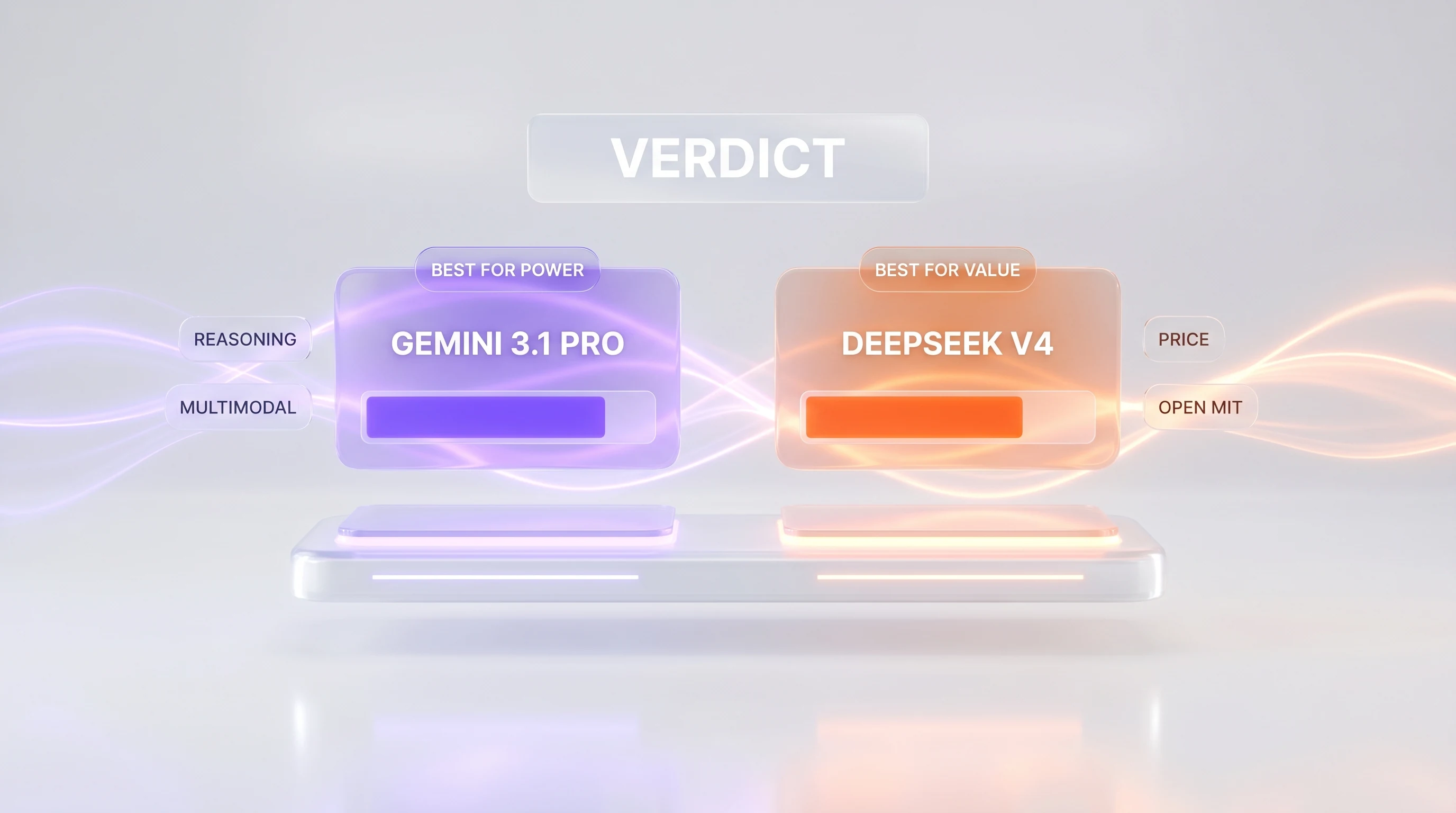
If you came for a single name, we are not going to invent one, because the honest answer is that these two models win different races. Gemini 3.1 Pro is the better choice when capability and convenience matter most; DeepSeek V4 is the better choice when cost and control matter most.
The reasoning is about what each model is built to be. Gemini 3.1 Pro wins the dimensions tied to raw frontier capability and managed polish: a 94.3% GPQA Diamond score that leads DeepSeek's 90.1%, native multimodal input across five media types, and a deeply integrated Google Cloud ecosystem with grounding built in. DeepSeek V4 wins the dimensions tied to economics and ownership: a price roughly an order of magnitude lower, MIT-licensed weights you can download and self-host, a 384K output ceiling six times Gemini's, and strong published competitive-coding scores — all while tying Gemini outright on SWE-bench Verified at 80.6%.
So the verdict is split and deliberate. Pick Gemini 3.1 Pro for the strongest documented reasoning, multimodal workloads, and a no-infrastructure managed API inside Google Cloud. Pick DeepSeek V4 for budget-sensitive scale, data control through self-hosting, long-form output, and frontier-class coding at a fraction of the cost. There is no fake tie and no invented winner here — there is a closed capability flagship and an open value flagship, and which one wins is entirely a function of whether you are optimizing for power and convenience or for price and control.
Related Reading
If you are weighing Gemini against the other closed frontier flagships, our head-to-head of Claude Opus 4.8 vs Gemini 3.1 Pro covers the coding-vs-value split among the top managed models, and our earlier Claude Opus 4.7 vs Gemini 3.1 Pro shows how the matchup shifted between generations. For a broader look at how the major assistants stack up, see our ChatGPT vs Claude comparison.
Frequently Asked Questions
What is Gemini 3.1 Pro?
Gemini 3.1 Pro is Google DeepMind's flagship closed, multimodal AI model. It confirms a 1M-token input context with 64K-token output, reports 94.3% on GPQA Diamond and 77.1% on ARC-AGI-2, and natively accepts text, image, video, audio, and PDF input. It is priced at $2 per million input tokens and $12 per million output tokens up to 200K context, available through the Gemini API, Vertex AI, and AI Studio, and is currently in preview.
What is DeepSeek V4?
DeepSeek V4 is the Chinese open-weight flagship released April 24, 2026, in two Mixture-of-Experts variants: V4-Pro (1.6 trillion total parameters, 49 billion active) and V4-Flash (284 billion total, 13 billion active). Both run a 1M-token context with 384K-token output. The weights ship under an MIT license, so you can download and self-host the model. V4-Flash costs $0.22 per million input tokens and $0.66 output outside peak hours, double that during them, and V4-Pro scores 80.6% on SWE-bench Verified.
Which model is better at coding, Gemini 3.1 Pro or DeepSeek V4?
On SWE-bench Verified, the benchmark both vendors report the same way, the two are tied at 80.6%, so on real-world patch application they are level. On competitive programming the vendors report different metrics, so there is no clean head-to-head: DeepSeek V4-Pro publishes a 3206 Codeforces rating and 93.5% on LiveCodeBench Pass@1, while Google reports a single combined LiveCodeBench Pro score of 2887 Elo for Gemini. The practical takeaway: a genuine tie on real-world coding, and strong documented contest-style scores from DeepSeek.
Which model is cheaper?
DeepSeek V4 is still much cheaper, by a narrower margin than before. We confirmed on DeepSeek's API docs that V4-Flash costs $0.22 per million input tokens and $0.66 per million output tokens outside peak hours, and $0.44 and $1.32 during them, versus Gemini 3.1 Pro's $2 input and $12 output. Off-peak that makes DeepSeek roughly 9 times cheaper on input and 18 times cheaper on output at the cheapest tier; at peak, roughly 4.5 and 9 times. DeepSeek's larger V4-Pro tier, at $0.66 input and $1.98 output off-peak, stays below Gemini on both. The two-tier grid took effect at 16:00 UTC on August 16, 2026, and peak hours are 01:00 to 04:00 and 06:00 to 10:00 UTC, Monday through Friday. Note that the off-peak tier is not the old flat rate held in place: every off-peak rate is above the flat rate it replaced.
Is DeepSeek V4 really open-source?
Not fully. DeepSeek V4 is open-weights, not open-source. The model weights are released under an MIT license and are freely downloadable from Hugging Face for commercial use, but the training code and the data recipe are not published, so the community cannot fully reproduce the training run. It is an unusually permissive release — far more open than any closed frontier model — but it is not the same as a fully reproducible open-source project.
Can I self-host either model?
You can self-host DeepSeek V4 but not Gemini 3.1 Pro. DeepSeek's MIT-licensed weights run on NVIDIA H100 and H200 clusters and, per Huawei's own announcement, on Huawei Ascend chips. Gemini 3.1 Pro is a closed model available only through Google's managed API — there is no way to run it on your own infrastructure. If self-hosting or full data control is a requirement, DeepSeek V4 is the only option of the two.
Which model has the better reasoning?
Gemini 3.1 Pro leads on the reasoning benchmarks where comparison is possible. On GPQA Diamond, the graduate-level science test both vendors publish, Gemini reports 94.3% against DeepSeek V4-Pro's 90.1% — a four-point lead. Gemini also reports 77.1% on ARC-AGI-2, a benchmark DeepSeek does not publish a figure for. On documented reasoning performance, Gemini is in front.
What is GPQA Diamond and why does it matter here?
GPQA Diamond is a benchmark of graduate-level science questions designed to be hard to answer without genuine reasoning rather than memorization. It matters in this comparison because both vendors publish a score for it, making it one of the few genuinely like-for-like reasoning numbers available. Gemini 3.1 Pro reports 94.3% with no tools, and DeepSeek V4-Pro reports 90.1%.
How much output can each model generate?
DeepSeek V4 supports up to 384K tokens of output, while Gemini 3.1 Pro caps at 64K — six times less. Both share the same 1M-token input context, so the difference is entirely in how much each can write back, not how much it can read. For long-form generation, large code translations, or exhaustive structured reports, DeepSeek's larger output window is a meaningful practical advantage.
Are there data-residency concerns with DeepSeek V4?
For the hosted API, yes. DeepSeek's API is hosted in China, which keeps some regulated buyers — such as US federal agencies or EU healthcare organizations — from adopting it directly without a Western hosted reseller. The important nuance is that because the weights are MIT-licensed and downloadable, you can sidestep the residency issue entirely by self-hosting the model on your own hardware, which is exactly why the open-weight release matters for regulated industries.
Is Gemini 3.1 Pro's preview status a risk?
It is a consideration for production teams. Gemini 3.1 Pro is still in preview, with general availability expected later in 2026, and Google has shut down a preview model before — it ended Gemini 3 Pro Preview on March 9, 2026 with a forced migration. That precedent means teams with strict stability requirements should plan around the model's eventual general availability rather than treating the preview as a permanent foundation.
Which model should most teams choose in 2026?
It depends on what you are optimizing for, and that is the honest answer rather than a dodge. Choose Gemini 3.1 Pro if you want the strongest documented reasoning, native multimodal input, and a fully managed Google Cloud API. Choose DeepSeek V4 if cost is a primary constraint, you need to self-host for data control, or you want MIT-licensed weights you can own and fine-tune. One is a closed capability flagship; the other is an open value flagship.
Sources and references
Every figure on this page is attributed to whoever produced it. Vendor documentation and independent measurement are listed separately and never merged into a single ranking.
- DeepSeek — API pricing (per-token rates for V4 Pro and V4 Flash)
- Artificial Analysis — DeepSeek V4 Pro (independent index score and cost to run the suite)
- Artificial Analysis — Model leaderboard (Intelligence Index scores and cost per task across configurations)
Our Verdict
Split decision. Gemini 3.1 Pro wins frontier reasoning (94.3% GPQA Diamond vs 90.1%), native multimodal input across text, image, video, audio, and PDF, and a polished managed Google Cloud ecosystem. DeepSeek V4 wins on price (V4-Flash at $0.22 input and $0.66 output per million tokens off-peak, close to an order of magnitude cheaper), MIT-licensed open weights you can download and self-host, a 384K output ceiling six times Gemini's 64K, and strong published competitive-coding scores (a 3206 Codeforces rating). Real-world coding is a tie at 80.6% SWE-bench Verified. Best for capability and convenience: Gemini 3.1 Pro. Best for cost and control: DeepSeek V4.
Choose Gemini 3.1 Pro Preview
Google DeepMind's flagship Gemini 3.1 Pro Preview — 94.3% GPQA Diamond, 77.1% ARC-AGI-2, 1M-token context, multimodal in/text out, vibe coding plus agentic tool use. Preview status as of April 2026.
Try Gemini 3.1 Pro Preview →Choose DeepSeek V4
Chinese open-source flagship: 1.6T MoE (49B active), 1M context, 80.6% SWE-bench Verified, MIT license — V4-Pro input costs about one-eleventh of Claude Opus 4.7
Try DeepSeek V4 →Frequently Asked Questions
Is Gemini 3.1 Pro Preview better than DeepSeek V4?
Split decision. Gemini 3.1 Pro wins frontier reasoning (94.3% GPQA Diamond vs 90.1%), native multimodal input across text, image, video, audio, and PDF, and a polished managed Google Cloud ecosystem. DeepSeek V4 wins on price (V4-Flash at $0.22 input and $0.66 output per million tokens off-peak, close to an order of magnitude cheaper), MIT-licensed open weights you can download and self-host, a 384K output ceiling six times Gemini's 64K, and strong published competitive-coding scores (a 3206 Codeforces rating). Real-world coding is a tie at 80.6% SWE-bench Verified. Best for capability and convenience: Gemini 3.1 Pro. Best for cost and control: DeepSeek V4.
Which is cheaper, Gemini 3.1 Pro Preview or DeepSeek V4?
Gemini 3.1 Pro Preview starts at $2 in / $12 out per M tokens. DeepSeek V4 starts at $0.22 in / $0.66 out per M tokens (free plan available). Check the pricing comparison section above for a full breakdown.
What are the main differences between Gemini 3.1 Pro Preview and DeepSeek V4?
The key differences span across 12 features we compared. For License / openness, Gemini 3.1 Pro Preview offers Closed, managed API only while DeepSeek V4 offers Open weights under MIT (downloadable, self-hostable). For Standard input price (per million tokens), Gemini 3.1 Pro Preview offers $2 up to 200K, $4 above 200K while DeepSeek V4 offers Off-peak $0.22 V4-Flash, $0.66 V4-Pro; peak $0.44 and $1.32 (cache miss). For Standard output price (per million tokens), Gemini 3.1 Pro Preview offers $12 up to 200K, $18 above 200K while DeepSeek V4 offers Off-peak $0.66 V4-Flash, $1.98 V4-Pro; peak $1.32 and $3.96. See the full feature comparison table above for all details.