Gemini 3.1 Pro vs Grok 4.3: Smartest vs Cheapest Frontier (2026)


Gemini 3.1 Pro leads reasoning at the frontier tier; Grok 4.3 is nearly 5x cheaper on output at $2.50 per million. Which frontier model wins for you?
Feature Comparison
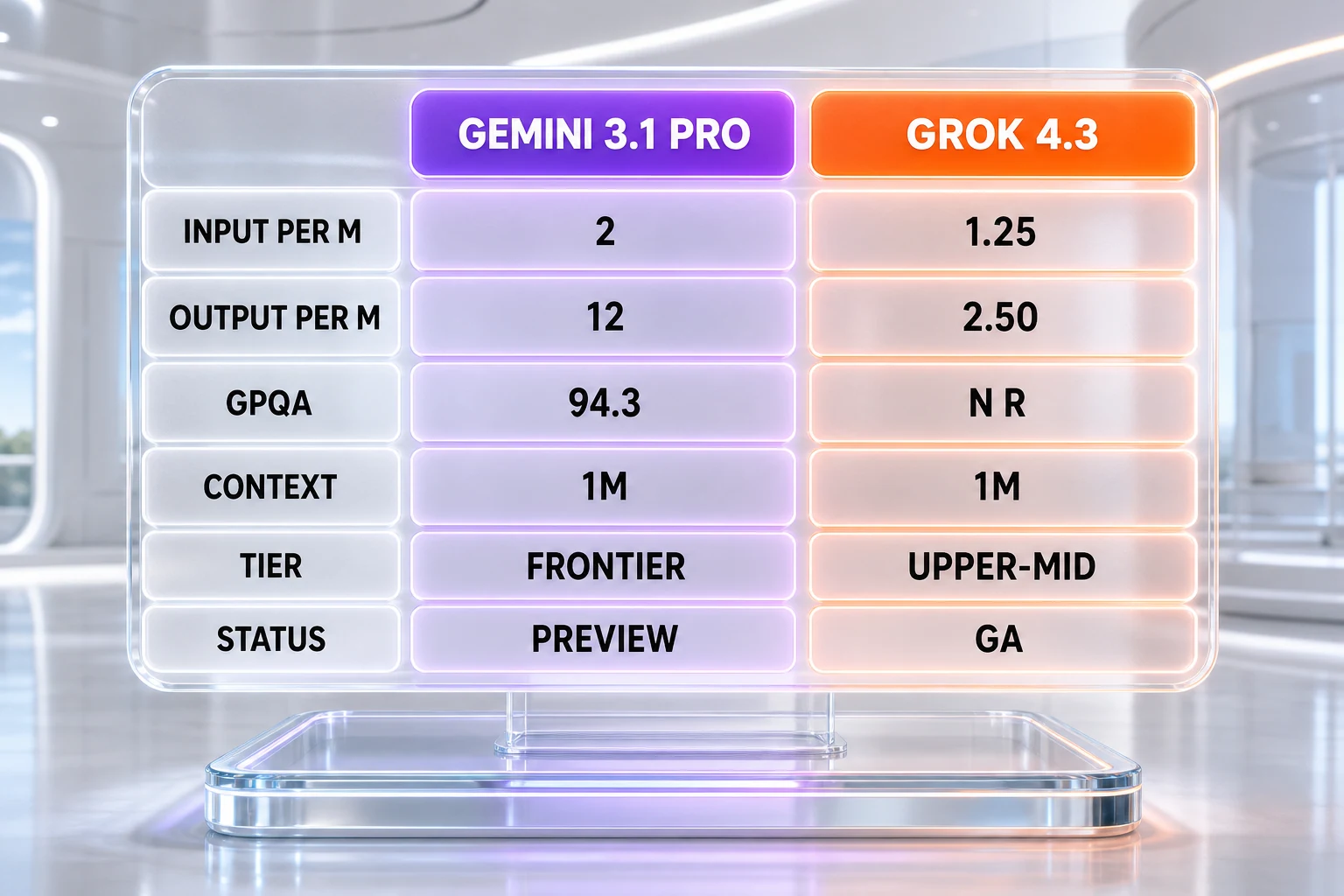
| Feature | Gemini 3.1 Pro Preview | Grok 4.3 |
|---|---|---|
| Standard input price (per million tokens) | $2 (up to 200K), $4 (above 200K) | $1.25 (flat) |
| Standard output price (per million tokens) | $12 (up to 200K), $18 (above 200K) | $2.50 (flat) |
| Artificial Analysis Intelligence Index | Frontier tier | Upper-mid tier |
| GPQA Diamond (reasoning) | 94.3% (no tools, model card) | Not published as a comparable figure |
| ARC-AGI-2 (abstract reasoning) | 77.1% (ARC Prize Verified) | Not published as a comparable figure |
| Agentic benchmarks | No comparable figure on this scale | Reports gains over Grok 4.20 |
| Context window (input) | 1M tokens input / 64K output | 1M tokens input |
| Multimodal input breadth | Text, image, video, audio, PDF | Text, image (vision) |
| Native file generation | Not native PPTX or XLSX | Native PPTX, PDF, XLSX in chat |
| Availability status | Preview (GA expected later 2026) | Generally available |
Pricing Comparison
Gemini 3.1 Pro Preview
Grok 4.3
Detailed Comparison
Gemini 3.1 Pro vs Grok 4.3 is a comparison between Google DeepMind's reasoning-and-multimodal flagship and xAI's budget-frontier model with real-time X access. Gemini 3.1 Pro (model card dated February 19, 2026) confirms a 1M-token input context with 64K-token output, reports 94.3% on GPQA Diamond and 77.1% on ARC-AGI-2, and sits at the frontier tier on Artificial Analysis's composite Intelligence Index. Its API costs $2 per million input tokens and $12 per million output tokens up to 200K context, which we confirmed directly on Google's pricing page. Grok 4.3 (released April 2026) is the cheaper of the two at $1.25 per million input tokens and $2.50 per million output, also with a 1M-token context, an upper-mid placement on that same index, text and image (vision) input, native PowerPoint and spreadsheet generation, and live access to X Corp data. If you want the strongest published reasoning and the deepest Google ecosystem, Gemini 3.1 Pro wins; if you want the lowest token bill, real-time social data, and native file output, Grok 4.3 wins. This is a split decision. We compared published benchmarks, official specs, and vendor-confirmed pricing rather than running a single controlled head-to-head.
Disclosure: ThePlanetTools.ai has no affiliation with Google DeepMind or xAI. We are not paid to recommend either model, and there are no affiliate links in this comparison. Last compared: June 2026. Benchmark figures are attributed to their source, and where a number comes from a third-party evaluator such as Artificial Analysis rather than a vendor model card, we say so.
Quick Verdict
These two models target different buyers, so a single "winner" hides more than it reveals. Here is the short version before the detail.
- Best for published reasoning: Gemini 3.1 Pro. Its official model card reports 94.3% on GPQA Diamond and 77.1% on ARC-AGI-2, and Artificial Analysis places it at the frontier tier on its Intelligence Index, a step above Grok 4.3's upper-mid placement. On documented reasoning, Gemini is ahead.
- Best for price: Grok 4.3. At $1.25 per million input tokens and $2.50 per million output, it is roughly 38% cheaper on input and almost 5 times cheaper on output than Gemini 3.1 Pro at the standard tier. For high-volume workloads, that gap compounds fast.
- Best for real-time and native output: Grok 4.3. Live X Corp data access and native PowerPoint, PDF, and spreadsheet generation are capabilities Gemini does not match in the same form.
- Best overall for most quality-first teams: Gemini 3.1 Pro. When reasoning quality and multimodal input breadth matter more than the bill, Gemini carries more proven ground and a deeper first-party ecosystem.
This is a genuine split, not a fence-sit. If your priority is documented reasoning quality and multimodal depth, Gemini 3.1 Pro is the smarter default. If your priority is cost, live social data, and native file output, Grok 4.3 is the model to beat.
Gemini 3.1 Pro vs Grok 4.3 at a Glance
Before the section-by-section breakdown, here is the headline comparison. Every number below is attributed to its source, and we mark which figures come from a vendor model card versus a third-party evaluator.
| Dimension | Gemini 3.1 Pro | Grok 4.3 | Edge |
|---|---|---|---|
| Vendor | Google DeepMind | xAI | Tie |
| Released / model card | February 19, 2026 (model card) | April 2026 | Tie |
| Standard input price (per million tokens) | $2 (up to 200K), $4 (above 200K) | $1.25 (flat) | Grok |
| Standard output price (per million tokens) | $12 (up to 200K), $18 (above 200K) | $2.50 (flat) | Grok |
| Artificial Analysis Intelligence Index | Frontier tier | Upper-mid tier | Gemini |
| GPQA Diamond (reasoning) | 94.3% (no tools, model card) | Not published as a comparable figure | Gemini |
| ARC-AGI-2 (abstract reasoning) | 77.1% (ARC Prize Verified) | Not published as a comparable figure | Gemini |
| Agentic benchmarks | No comparable figure published on this scale | Reports gains over Grok 4.20 | Grok (reports a number) |
| Context window | 1M input / 64K output | 1M input | Tie (input) |
| Multimodal input | Text, image, video, audio, PDF | Text, image (vision) | Gemini (breadth) |
| Native file generation | Not native PPTX or XLSX | Native PPTX, PDF, XLSX in chat | Grok |
| Real-time data | Google Search and Maps grounding (paid) | Live X Corp data access | Different strengths |
| Status | Preview (GA expected later 2026) | Generally available | Grok |
The rows to read most carefully are the reasoning benchmarks and the pricing. Gemini publishes top-tier reasoning scores that Grok does not report in a comparable form, while Grok is decisively cheaper, especially on output tokens. We explain both asymmetries below.
Gemini 3.1 Pro in One Paragraph
Gemini 3.1 Pro is Google DeepMind's flagship reasoning model, documented in an official model card dated February 19, 2026. It confirms a 1M-token input context with 64K tokens of output, and reports strong reasoning scores: 94.3% on GPQA Diamond with no tools, 77.1% on ARC-AGI-2 under ARC Prize Verified conditions, and 80.6% on SWE-bench Verified on a single attempt. It accepts text, image, video, audio, and PDF input in a single call, ships native Google Search and Maps grounding, and runs across the Gemini API, Vertex AI, the Gemini app, Android Studio, and Google Antigravity for vibe coding. Its pricing, which we confirmed directly on Google's pricing page, is $2 per million input tokens and $12 per million output tokens up to 200K context, rising to $4 and $18 above that. The trade-offs: it is still in preview, its knowledge cutoff is January 2025, and there is no free programmatic tier.
Grok 4.3 in One Paragraph
Grok 4.3 is xAI's frontier reasoning model and the cheaper of the two compared here, released in April 2026. It costs $1.25 per million input tokens and $2.50 per million output tokens, with a 1M-token context window. Artificial Analysis places it in the upper-mid tier on its composite Intelligence Index and rates its output speed as fast among comparable models. Its standout capabilities are practical rather than benchmark-driven: text and image (vision) input, native PowerPoint, PDF, and spreadsheet generation directly in chat, real-time access to X Corp data, and an OpenAI-compatible REST API that lets most existing SDK code run unchanged. xAI highlights strong agentic-benchmark gains over the prior Grok 4.20 generation. The trade-offs: documentation is thinner than Google's, it does not publish comparable GPQA Diamond or ARC-AGI-2 figures, and on Artificial Analysis it sits a tier below Gemini 3.1 Pro on the overall Intelligence Index.
Benchmarks: What We Can Compare, and What We Cannot
A lazy comparison would line up every number it could find and declare a winner. We will not do that, because the two vendors report different benchmarks and only one independent evaluator scores both on a common scale. Here is the honest breakdown.
Artificial Analysis Intelligence Index: the one common evaluator
The cleanest like-for-like comparison comes from Artificial Analysis, a third-party evaluator that scores both models on a single composite Intelligence Index. On that index, Gemini 3.1 Pro sits at the frontier tier while Grok 4.3 lands a step below in the upper-mid tier. This is the closest thing to an apples-to-apples reasoning-and-capability signal we have, because it is the same test suite applied to both models by the same party rather than each vendor's self-reported showcase. It points to Gemini being the more capable generalist on aggregate, though the gap is meaningful rather than enormous. Artificial Analysis re-runs its suite as models and benchmarks evolve, so treat the ranking as the durable signal, not any single point-in-time number.
Reasoning: Gemini publishes scores Grok does not report comparably
Gemini 3.1 Pro's model card reports 94.3% on GPQA Diamond (graduate-level science, no tools) and 77.1% on ARC-AGI-2 (abstract reasoning, ARC Prize Verified). These are top-tier numbers. The honest framing is that Grok 4.3 does not publish equivalent GPQA Diamond or ARC-AGI-2 figures in a directly comparable form, so we cannot oppose them head-to-head. We can only say that Gemini publishes strong, documented reasoning scores that Grok does not report — a real point in Gemini's favor for buyers who care about documented reasoning, but not proof that Grok would score lower on the same tests.
Agentic work: Grok reports a strong GDPval-AA result
The mirror image is agentic performance. xAI positions Grok 4.3 as a strong agentic worker, reporting a clear gain over the prior Grok 4.20 generation on agentic-style benchmarks. Gemini 3.1 Pro does not report a comparable agentic figure on the same scale, so again this is "where each was measured," not a head-to-head. It tells us xAI is pushing Grok hard as an agentic worker and is confident enough to publish gains — but it is not evidence that Gemini would do worse on the same benchmark.
How to read this section: only the Artificial Analysis Intelligence Index compares both models on the same scale by the same party. GPQA Diamond and ARC-AGI-2 are Gemini-only on this table; GDPval-AA is Grok-only. Treat the non-overlapping vendor scores as each lab's chosen showcase, not as a direct contest.
Pricing: Grok Is Confirmed Cheaper
Pricing is the cleanest factual win in this comparison because we confirmed every number directly on the vendor pages rather than trusting a summary. We fetched Google's Gemini API pricing page for Gemini 3.1 Pro and xAI's model documentation for Grok 4.3. We flag one thing up front: a circulating third-party summary listed Gemini at $2.50 input and $10 output, but Google's own pricing page states $2 input and $12 output up to 200K context. We use the vendor figure, not the summary.
| Tier | Gemini 3.1 Pro | Grok 4.3 |
|---|---|---|
| Input, standard (per million tokens) | $2 up to 200K context, $4 above 200K | $1.25 (flat) |
| Output, standard (per million tokens) | $12 up to 200K context, $18 above 200K | $2.50 (flat) |
| Cheaper bulk option | Batch tier at half price ($1 input, $6 output up to 200K) | No separate batch tier published; already low flat rate |
| Context caching | $0.20 per million tokens up to 200K context | Not published |
| Real-time grounding | Google Search grounding: 5,000 free prompts per month, then $14 per 1,000 queries | Live X Corp data access included |
| Free programmatic tier | None (free testing only in AI Studio UI) | None published for the paid API |
At the standard tier, Grok 4.3 is the cheaper model on both sides of the ledger. Its $1.25 input price is below Gemini's $2 even before Gemini steps up to $4 above 200K context. The output gap is the dramatic one: Grok's $2.50 output is nearly 5 times cheaper than Gemini's $12. For any workload that generates large volumes of output tokens — long reports, code generation, verbose agent traces — the difference compounds quickly and favors Grok by a wide margin. Gemini can claw some of that back with its half-price Batch tier ($1 input, $6 output up to 200K) for non-interactive bulk jobs, but Grok's flat low rate still wins on raw output cost.
We want to be explicit about one thing: we never assert a price we cannot pull from the vendor. Both pricing tables above come from the vendors' own pages — Google's Gemini API pricing and xAI's documentation — fetched directly rather than from a research summary.
Multimodal Input, Context, and Native Output
Context window is close to a tie on input: both models confirm a 1M-token input window. Gemini additionally documents a 64K-token output ceiling, which can bite on very long-form generation. Where the two diverge is the shape of their multimodal and output capabilities, and this is where buyer intent matters more than any benchmark.
Gemini 3.1 Pro accepts the broadest range of inputs in a single call: text, image, video, audio, and PDF. That breadth collapses transcription, optical character recognition, and summarization into one round-trip, which is a real workflow advantage for teams doing mixed-media analysis. Grok 4.3, by contrast, accepts text and still-image (vision) input only — it does not ingest video, audio, or PDF in a single call. At xAI, video is handled by a separate product (Grok Imagine), not the Grok 4.3 chat model, so for any video, audio, or PDF input Gemini is the only one of the two that handles it natively.
On output, the roles flip. Grok 4.3 generates native PowerPoint, PDF, and spreadsheet files directly in chat, which is a tangible time-saver for anyone producing decks or reports as a deliverable. Gemini 3.1 Pro does not offer native PPTX or XLSX generation in the same form; it produces text and code that you then render into documents yourself. If your output is a polished file rather than raw text, Grok's native generation is a genuine differentiator.
Real-Time Data and Ecosystem
Both models can reach beyond their training data, but in different directions. Gemini 3.1 Pro uses Google Search and Maps grounding — 5,000 free prompts per month, then $14 per 1,000 queries — to pull time-sensitive web and location data without you building a retrieval pipeline. Its knowledge cutoff is January 2025, so for 2025 and 2026 events, grounding is what keeps it current. Grok 4.3's real-time edge is live access to X Corp data, which makes it distinctive for trend analysis, live-event monitoring, and anything that depends on what is happening on X right now. Neither approach is strictly better; they serve different real-time use cases.
On ecosystem, Gemini 3.1 Pro has the deeper first-party story: the Gemini API, Vertex AI for enterprise governance, the Gemini consumer app, Android Studio, and Google Antigravity for vibe coding. For a team already inside Google Cloud, adoption is low-friction. Grok 4.3's ecosystem play is interoperability rather than breadth — its OpenAI-compatible REST API means most existing SDK code runs against it with minimal changes, which lowers switching cost for teams already built on the OpenAI API shape. Documentation, however, is thinner and less consistent than Google's, which can slow integration.
Winner Per Category
Because these models are built for different priorities, the most useful way to pick is by use case rather than by a single overall score.
- Best for documented reasoning and science: Gemini 3.1 Pro. With 94.3% on GPQA Diamond, 77.1% on ARC-AGI-2, and a frontier-tier placement on the Artificial Analysis Intelligence Index above Grok 4.3, it is the stronger choice where reasoning quality is the deciding factor.
- Best for cost-sensitive scale: Grok 4.3. At $1.25 input and $2.50 output per million tokens, it is meaningfully cheaper on input and nearly 5 times cheaper on output — decisive for high-volume generation.
- Best for multimodal input breadth: Gemini 3.1 Pro. Text, image, video, audio, and PDF in a single call beats Grok 4.3, which accepts text and image (vision) only.
- Best for native file output: Grok 4.3. Native PowerPoint, PDF, and spreadsheet generation in chat is something Gemini does not match in the same form.
- Best for real-time social and trend data: Grok 4.3. Live X Corp access is its signature differentiator.
- Best for Google-native teams: Gemini 3.1 Pro. Native Vertex AI, the Gemini app, Android Studio, and Antigravity are hard to beat inside Google Cloud.
- Best for production stability today: Grok 4.3. It is generally available; Gemini 3.1 Pro is still in preview.
Pros and Cons of Each
Gemini 3.1 Pro
Pros
- Top-tier documented reasoning: 94.3% GPQA Diamond and 77.1% ARC-AGI-2
- Frontier-tier Artificial Analysis Intelligence Index, above Grok 4.3
- Broadest multimodal input: text, image, video, audio, and PDF in one call
- Deep Google ecosystem: Vertex AI, Gemini app, Android Studio, Antigravity, and a half-price Batch tier
Cons
- Roughly 5 times more expensive on output tokens than Grok at standard tier
- Still in preview, with general availability expected later in 2026
- Knowledge cutoff of January 2025, older than some rivals
- No native PowerPoint or spreadsheet generation
Grok 4.3
Pros
- Cheapest of the two at $1.25 input and $2.50 output per million tokens
- Native PowerPoint, PDF, and spreadsheet generation directly in chat
- Text and image (vision) input, plus live X Corp data access
- Strong agentic-benchmark gains over Grok 4.20 and an OpenAI-compatible API
Cons
- Upper-mid Artificial Analysis Intelligence Index, a tier below Gemini 3.1 Pro
- Does not publish comparable GPQA Diamond or ARC-AGI-2 reasoning scores
- Documentation is thinner and less consistent than Google's
- Narrower multimodal input range than Gemini (no audio or PDF parity in one call)
When to Pick Each Model
When to pick Gemini 3.1 Pro
Choose Gemini 3.1 Pro if documented reasoning quality is the deciding factor — its GPQA Diamond and ARC-AGI-2 scores and its frontier-tier Artificial Analysis Intelligence Index put it ahead on aggregate capability. Pick it if you need the broadest multimodal input (audio and PDF alongside text, image, and video in a single call), if you already operate inside Google Cloud and want native Vertex AI, the Gemini app, and Antigravity, or if you can route bulk work through the half-price Batch tier to soften the cost gap. The trade-off is that it is still in preview and noticeably more expensive on output tokens, so production teams with strict stability gates and output-heavy workloads should weigh that carefully.
When to pick Grok 4.3
Choose Grok 4.3 if your bill matters and you generate a lot of output tokens — at $2.50 per million output, it is nearly 5 times cheaper than Gemini and the gap compounds at scale. Pick it if your deliverables are native files (decks, reports, spreadsheets generated directly in chat), if you need live X Corp data for trend or event monitoring, or if you want to drop it into existing OpenAI-compatible code with minimal changes. The trade-off is thinner documentation and a lower aggregate reasoning score, so for reasoning-critical work you may want to validate it against your own tasks first.
How We Compared
We did not run a controlled head-to-head benchmark of both models on identical hardware and prompts — there is no such test here, and we will not pretend there is. Instead, we compared published benchmarks, official specs, and vendor-confirmed pricing. We have hands-on experience with both models through the Gemini API and xAI's OpenAI-compatible endpoint in our own workflows, which informs our read on speed, output format, and integration friction, but for headline performance claims we lean on the official model cards and the Artificial Analysis Intelligence Index rather than our own ad hoc testing.
For pricing, we fetched the vendor pages directly: Google's Gemini API pricing page for Gemini 3.1 Pro and xAI's model documentation for Grok 4.3. Where a third-party summary disagreed with the vendor page on Gemini's output price, we used the vendor figure. For benchmarks, we attribute every figure to its source and flag where a number comes from a third-party evaluator (Artificial Analysis) rather than a vendor model card. Where only one model reports a benchmark, we say so rather than inventing an opponent's score. This is a specs-and-published-results comparison done transparently, not a marketing scoreboard.
A Real-World Cost Example
Per-token prices are abstract until you run them against a real workload, so here is a concrete illustration. Imagine a content and analysis pipeline that processes 50 million input tokens and produces 20 million output tokens in a month — a realistic figure for a team running automated research, drafting, and summarization at scale.
On Gemini 3.1 Pro at the standard tier, assuming the work stays under 200K tokens of context per call, that workload costs 50 million input tokens at $2 per million, which is $100, plus 20 million output tokens at $12 per million, which is $240 — a total of $340 for the month. On Grok 4.3, the same volume costs 50 million input tokens at $1.25 per million, which is $62.50, plus 20 million output tokens at $2.50 per million, which is $50 — a total of $112.50. That is a difference of about $227.50 a month, or roughly 67% lower spend on Grok, for the same token volume.
Two caveats keep this honest. First, the output side drives most of the gap: the more your workload generates rather than consumes tokens, the more decisively Grok wins on price. If you flip the ratio and read far more than you write, the gap narrows. Second, raw price is not the same as value: if Gemini's higher reasoning quality means fewer wrong answers and less human review on reasoning-critical tasks, the pricier model per token can end up cheaper in total cost of ownership. The point of the example is not that cheaper always wins, but that the output-price gap is large enough to matter and should be weighed against the reasoning-quality difference rather than ignored.
Switching Costs and Lock-In
If you are choosing between these two as a primary model, the practical friction of switching deserves a mention. Grok 4.3 exposes an OpenAI-compatible REST API, so if your code already targets the OpenAI request shape, you can often point it at xAI with little more than a base-URL and key change. That interoperability is a real reduction in switching cost. Gemini 3.1 Pro uses Google's own API shape, which is well documented but distinct, so adopting it means writing to Google's SDK conventions or Vertex AI rather than reusing OpenAI-style calls verbatim.
The deeper lock-in is ecosystem, not syntax. Gemini 3.1 Pro pulls you toward Google Cloud: Vertex AI for governance and deployment, the Gemini app for end users, Android Studio for mobile, and Antigravity for coding. If your organization already runs on Google Cloud, that gravity is a feature and adoption is low-friction; if not, it is a consideration. Grok 4.3's gravity is toward the X ecosystem for real-time data and toward OpenAI-compatible tooling for integration. Neither model imposes punishing switching costs at the raw API level; the decision is mostly about which ecosystem you want to lean into, and whether the confirmed price advantage and native file output of Grok outweigh the reasoning quality, multimodal breadth, and Google integration of Gemini.
The Final Verdict
If you came for a single name, we are not going to invent one, because the honest answer is split. Gemini 3.1 Pro is the better default for quality-first teams who weigh documented reasoning, multimodal breadth, and Google ecosystem integration above the bill. Grok 4.3 is the better default for cost-first and output-first teams who weigh token price, native file generation, and real-time X data above aggregate benchmark scores.
The reasoning is about priorities, not a fake tie. Gemini 3.1 Pro wins the dimensions where capability quality is the test: top-tier published reasoning scores (94.3% GPQA Diamond, 77.1% ARC-AGI-2), a frontier-tier Artificial Analysis Intelligence Index above Grok 4.3, and the broadest multimodal input of the two. Grok 4.3 wins the dimensions where cost and practical output are the test: vendor-confirmed pricing that is nearly 5 times cheaper on output tokens, native PowerPoint and spreadsheet generation, live X Corp data, and general availability today while Gemini is still in preview.
So the verdict is split and honest: pick Gemini 3.1 Pro for reasoning-critical work, mixed-media analysis, and Google-native deployments. Pick Grok 4.3 for budget-sensitive scale, native file deliverables, real-time social data, and OpenAI-compatible drop-in integration. There is no invented winner here; there is a quality-first generalist and a cost-first specialist, and which one wins is entirely a function of what you are optimizing for.
Related Reading
If you are weighing these against Anthropic's flagship, our head-to-head of Claude Opus 4.8 vs Gemini 3.1 Pro covers the coding-versus-value question, and Claude Opus 4.7 vs Grok 4.3 lines Grok up against a previous Anthropic generation. For another angle on Google's flagship, see Claude Opus 4.7 vs Gemini 3.1 Pro Preview. You can also read our full reviews of Gemini 3.1 Pro and Grok 4.3 for the per-model detail.
Frequently Asked Questions
What is Gemini 3.1 Pro?
Gemini 3.1 Pro is Google DeepMind's flagship reasoning model, documented in an official model card dated February 19, 2026. It confirms a 1M-token input context with 64K-token output, reports 94.3% on GPQA Diamond and 77.1% on ARC-AGI-2, and is priced at $2 per million input tokens and $12 per million output tokens up to 200K context. It accepts text, image, video, audio, and PDF input, runs across the Gemini API, Vertex AI, the Gemini app, and Antigravity, and is currently in preview.
What is Grok 4.3?
Grok 4.3 is xAI's frontier reasoning model, released in April 2026 and positioned as a budget-frontier option. It costs $1.25 per million input tokens and $2.50 per million output tokens, with a 1M-token context window. Artificial Analysis places it in the upper-mid tier on its composite Intelligence Index. Its standout features are native PowerPoint, PDF, and spreadsheet generation in chat, live X Corp data access, an OpenAI-compatible REST API, and text and image (vision) input.
Which model is cheaper, Gemini 3.1 Pro or Grok 4.3?
Grok 4.3 is clearly cheaper. We confirmed on the vendor pages that Grok costs $1.25 per million input tokens and $2.50 per million output, versus Gemini's $2 input and $12 output up to 200K context. That makes Grok roughly 38% cheaper on input and nearly 5 times cheaper on output at the standard tier. Gemini can narrow the gap on bulk jobs with its half-price Batch tier, but Grok's flat low rate still wins on raw output cost.
Which model is better at reasoning?
Gemini 3.1 Pro is ahead on documented reasoning. Its model card reports 94.3% on GPQA Diamond and 77.1% on ARC-AGI-2, and the third-party Artificial Analysis Intelligence Index places it at the frontier tier, a step above Grok 4.3's upper-mid placement. Grok does not publish comparable GPQA Diamond or ARC-AGI-2 figures, so the direct reasoning comparison rests on the Intelligence Index ranking and Gemini's published model-card scores, both of which favor Gemini.
What is the Artificial Analysis Intelligence Index and why does it matter here?
The Artificial Analysis Intelligence Index is a composite score from a third-party evaluator that runs the same test suite across many models, giving a single comparable capability ranking. It matters in this comparison because it is the one metric scored on both Gemini 3.1 Pro and Grok 4.3 by the same party rather than self-reported by each vendor. Gemini sits at the frontier tier and Grok lands a step below in the upper-mid tier, a meaningful edge to Gemini on aggregate capability. Because Artificial Analysis re-runs its suite as models evolve, the tier ranking is the durable takeaway rather than any single point-in-time number.
How big is each model's context window?
Both models confirm a 1M-token input context window, so they are effectively tied on input length. Gemini 3.1 Pro additionally documents a 64K-token maximum output, which can limit very long single-response generations. For most long-document or large-codebase tasks, the 1M input window on both models is the figure that matters, and on that they match.
Can Grok 4.3 generate PowerPoint and spreadsheet files?
Yes. Grok 4.3 generates native PowerPoint, PDF, and spreadsheet files directly in chat, which is a practical time-saver when your deliverable is a polished document rather than raw text. Gemini 3.1 Pro does not offer native PPTX or XLSX generation in the same form; it produces text and code that you then render into documents yourself. If file output is part of your workflow, this is a clear Grok advantage.
Which model has better real-time data access?
They take different approaches. Grok 4.3 has live access to X Corp data, which makes it distinctive for trend analysis and live-event monitoring on X. Gemini 3.1 Pro uses Google Search and Maps grounding — 5,000 free prompts per month, then $14 per 1,000 queries — to pull general web and location data. For social and trending topics, Grok's X access is the edge; for broad web and location grounding, Gemini's Google integration is the edge.
Which model handles video and multimodal input better?
Gemini 3.1 Pro handles it clearly better. It accepts the broadest range — text, image, video, audio, and PDF in a single call — which is ideal for mixed-media analysis. Grok 4.3 accepts text and image (vision) input only; it does not ingest video natively (at xAI, video is handled by the separate Grok Imagine product, not the Grok 4.3 chat model). So for any video, audio, or PDF input, Gemini 3.1 Pro is the model to choose.
Is Gemini 3.1 Pro generally available or still in preview?
Gemini 3.1 Pro is still in preview, with general availability expected later in 2026. Grok 4.3 is generally available now. If a generally available model is a hard requirement for your procurement or stability gates, Grok 4.3 clears that bar today and Gemini 3.1 Pro does not yet, so production teams with strict stability needs should factor that in.
Is Grok 4.3 easy to integrate if I already use the OpenAI API?
Generally yes. Grok 4.3 exposes an OpenAI-compatible REST API, so most existing SDK code built for the OpenAI request shape can run against it with little more than a base-URL and key change. That lowers switching cost meaningfully for teams already on OpenAI-style tooling. The main friction is that xAI's documentation is thinner and less consistent than Google's, which can slow more advanced integrations.
Which model should most teams choose in 2026?
It depends on what you optimize for, and this is a genuine split. For quality-first teams that weigh documented reasoning, multimodal breadth, and Google ecosystem integration above cost, Gemini 3.1 Pro is the better default. For cost-first and output-first teams that weigh token price, native file generation, and real-time X data above aggregate benchmark scores, Grok 4.3 is the better default. Match the model to your priority rather than chasing a single overall winner.
Sources and references
Every figure on this page is attributed to whoever produced it. Vendor documentation and independent measurement are listed separately and never merged into a single ranking.
- Artificial Analysis — Grok 4.3 (independent index score)
- Artificial Analysis — Gemini 3.1 Pro Preview (independent index score)
- Artificial Analysis — Model leaderboard (Intelligence Index scores and cost per task across configurations)
Our Verdict
Split decision. Gemini 3.1 Pro is the better default for quality-first teams: it leads documented reasoning (94.3% GPQA Diamond, 77.1% ARC-AGI-2), sits at the frontier tier on the Artificial Analysis Intelligence Index a step above Grok 4.3, and accepts the broadest multimodal input (text, image, video, audio, PDF). Grok 4.3 is the better default for cost-first and output-first teams: vendor-confirmed pricing of $1.25 input and $2.50 output per million tokens is nearly 5 times cheaper on output, and it adds native PowerPoint, PDF, and spreadsheet generation, live X Corp data, and general availability today while Gemini is still in preview. Best for reasoning, multimodal breadth, and Google-native deployment: Gemini 3.1 Pro. Best for price, native file output, and real-time X data: Grok 4.3.
Choose Gemini 3.1 Pro Preview
Google DeepMind's flagship Gemini 3.1 Pro Preview — 94.3% GPQA Diamond, 77.1% ARC-AGI-2, 1M-token context, multimodal in/text out, vibe coding plus agentic tool use. Preview status as of April 2026.
Try Gemini 3.1 Pro Preview →Choose Grok 4.3
xAI's cheapest frontier reasoning model — $1.25/$2.50 per 1M tokens, 1M context, real-time X data and slide gen.
Try Grok 4.3 →Frequently Asked Questions
Is Gemini 3.1 Pro Preview better than Grok 4.3?
Split decision. Gemini 3.1 Pro is the better default for quality-first teams: it leads documented reasoning (94.3% GPQA Diamond, 77.1% ARC-AGI-2), sits at the frontier tier on the Artificial Analysis Intelligence Index a step above Grok 4.3, and accepts the broadest multimodal input (text, image, video, audio, PDF). Grok 4.3 is the better default for cost-first and output-first teams: vendor-confirmed pricing of $1.25 input and $2.50 output per million tokens is nearly 5 times cheaper on output, and it adds native PowerPoint, PDF, and spreadsheet generation, live X Corp data, and general availability today while Gemini is still in preview. Best for reasoning, multimodal breadth, and Google-native deployment: Gemini 3.1 Pro. Best for price, native file output, and real-time X data: Grok 4.3.
Which is cheaper, Gemini 3.1 Pro Preview or Grok 4.3?
Gemini 3.1 Pro Preview starts at $2 in / $12 out per M tokens. Grok 4.3 starts at $1.25 in / $2.5 out per M tokens (free plan available). Check the pricing comparison section above for a full breakdown.
What are the main differences between Gemini 3.1 Pro Preview and Grok 4.3?
The key differences span across 10 features we compared. For Standard input price (per million tokens), Gemini 3.1 Pro Preview offers $2 (up to 200K), $4 (above 200K) while Grok 4.3 offers $1.25 (flat). For Standard output price (per million tokens), Gemini 3.1 Pro Preview offers $12 (up to 200K), $18 (above 200K) while Grok 4.3 offers $2.50 (flat). For Artificial Analysis Intelligence Index, Gemini 3.1 Pro Preview offers Frontier tier while Grok 4.3 offers Upper-mid tier. See the full feature comparison table above for all details.