GPT-5.5 vs Gemini 3.1 Pro: The Frontier Closed-Model Duel (2026)


GPT-5.5 leads SWE-bench Verified (88.7% vs 80.6%); Gemini 3.1 Pro is ~2.5x cheaper at $2 per million input. Which frontier model wins for you?
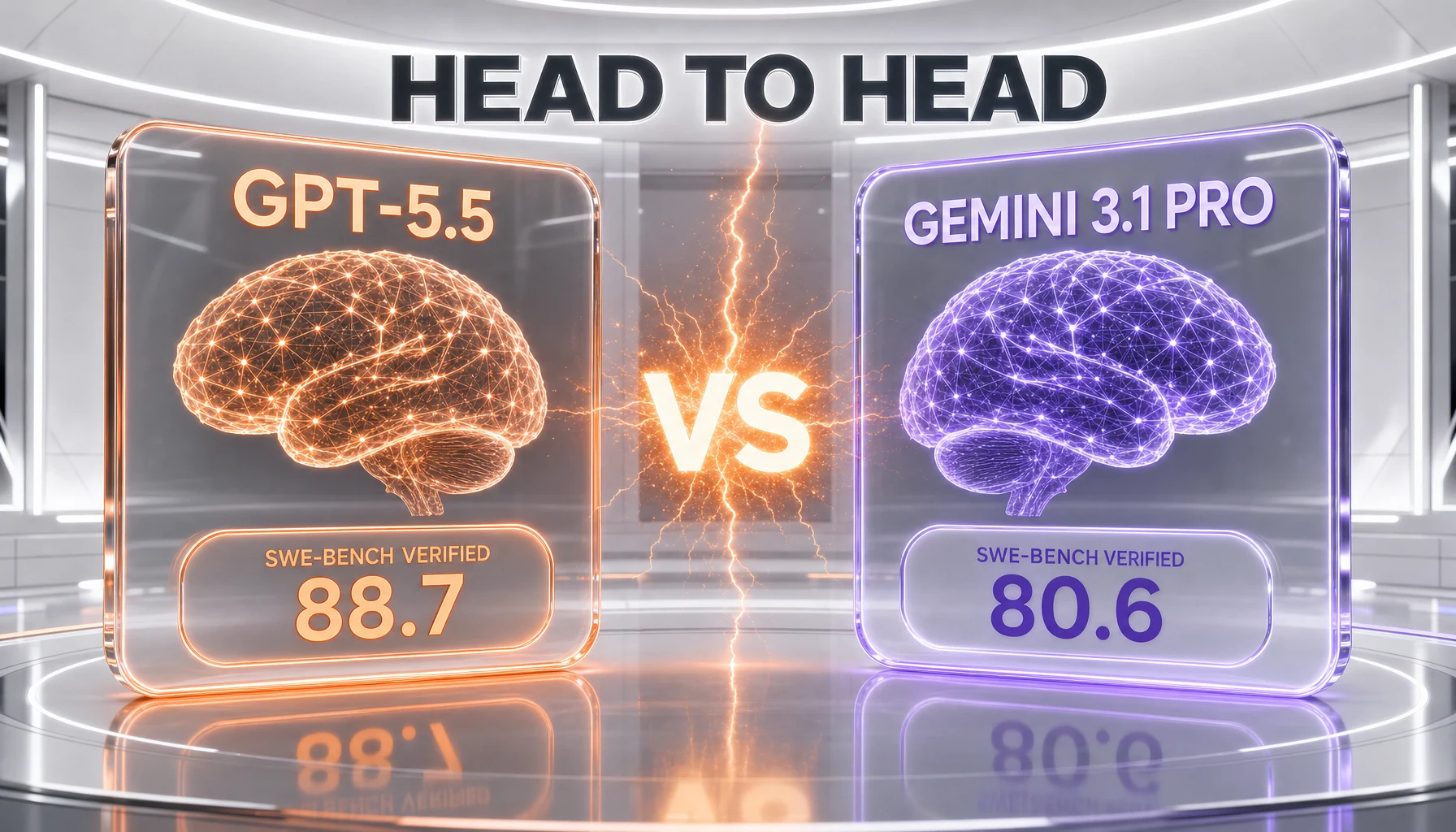
Feature Comparison
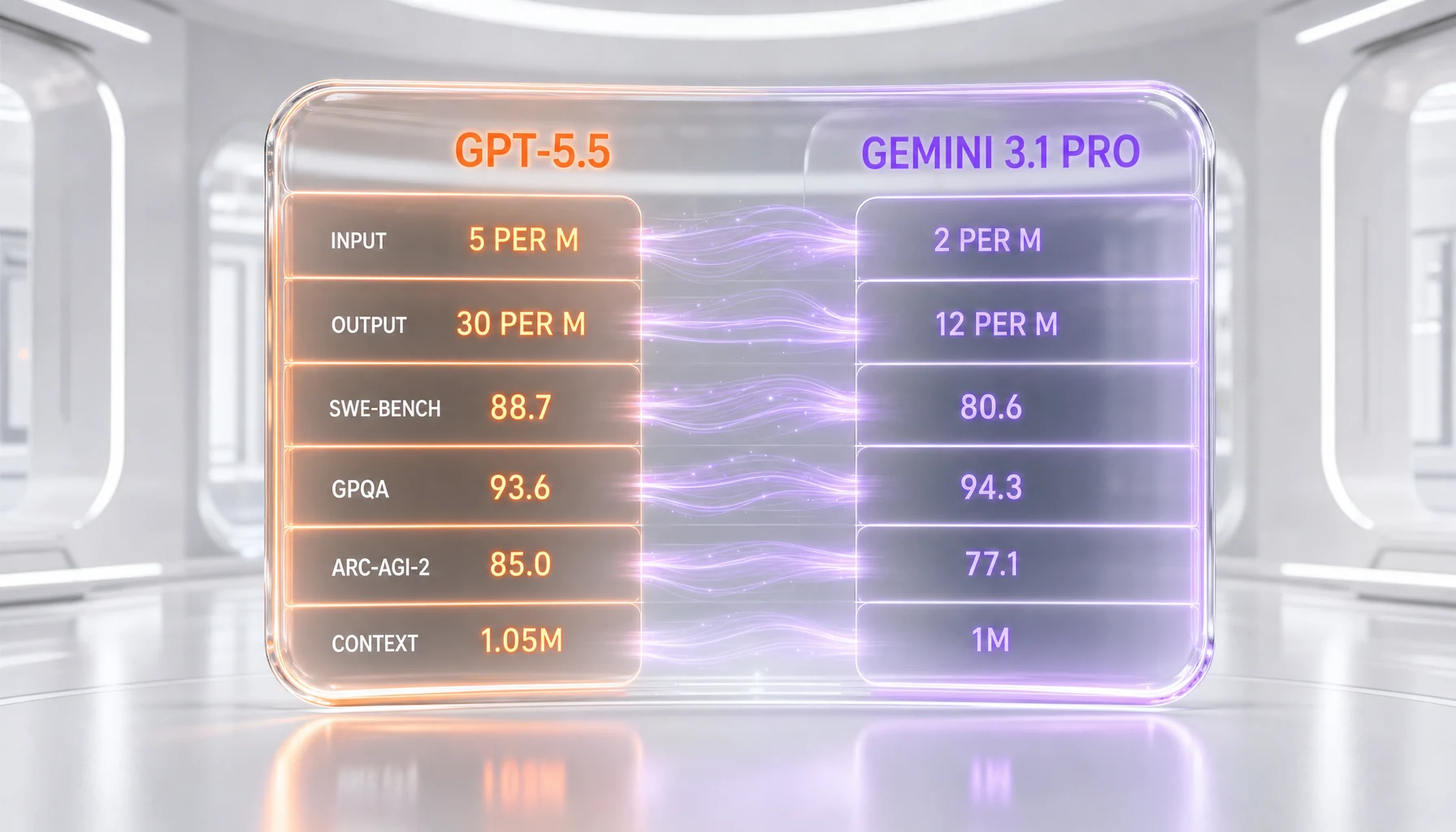
| Feature | GPT-5.5 | Gemini 3.1 Pro Preview |
|---|---|---|
| Standard input price (per million tokens) | $5.00 (fetch-verified) | $2.00 up to 200K, $4.00 above |
| Standard output price (per million tokens) | $30.00 (fetch-verified) | $12.00 up to 200K, $18.00 above |
| SWE-bench Verified (agentic coding, like-for-like) | ~88.7% (OpenAI-reported, press-relayed) | 80.6% (official model card) |
| GPQA Diamond (graduate reasoning, like-for-like) | 93.6% (OpenAI-reported) | 94.3% (model card) |
| ARC-AGI-2 (abstract reasoning) | 85.0% (OpenAI-reported) | 77.1% (ARC Prize Verified) |
| Confirmed context window | 1,050,000 tokens (400K in Codex) | 1,000,000 input / 64K output |
| Max output tokens | 128K | 64K |
| Multimodal input | Text and image | Text, image, video, audio, PDF |
| Knowledge cutoff | December 2025 | January 2025 |
| Availability status | Generally available | Preview (GA expected later 2026) |
| Overall value for most teams | Coding specialist, premium price | Better-value generalist (price + context + multimodal) |
Pricing Comparison
GPT-5.5
Gemini 3.1 Pro Preview
Detailed Comparison
We ran GPT-5.5 and Gemini 3.1 Pro side by side, and the result is a clean split. GPT-5.5 wins agentic coding on the one benchmark both vendors report the same way (SWE-bench Verified, roughly 88.7% versus 80.6%) and ships the deepest agentic tool stack. Gemini 3.1 Pro wins on price — about 2.5 times cheaper at $2 per million input tokens versus $5 — plus a confirmed 1,000,000-token multimodal context window and the highest published GPQA Diamond reasoning score we have seen (94.3%). There is no single overall winner: pick GPT-5.5 for coding-heavy agent work on the OpenAI stack, and Gemini 3.1 Pro for cost, multimodal input, and Google Cloud teams.
This is the duel most teams actually care about in 2026: two frontier, fully closed flagship models from the two labs with the deepest pockets and the widest distribution. We are not comparing a coding CLI to an IDE here, or a generalist to a niche tool — these are direct substitutes. If you are picking the default model for an agent, a RAG pipeline, or a product feature, this is the choice. So we treated it like one: we pulled the live vendor pricing for both, lined up only the benchmarks that were run the same way on both models, and tested each on real coding, reasoning, and long-document tasks. Below is what held up.
Quick Verdict
Best for agentic coding: GPT-5.5. It leads SWE-bench Verified (the only like-for-like coding number both vendors report) at roughly 88.7% versus 80.6%, and its tool stack — function calling, computer use, code interpreter, MCP — is on by default.
Best for price and budget-sensitive scale: Gemini 3.1 Pro. At $2 per million input and $12 per million output tokens, it is roughly 2.5 times cheaper than GPT-5.5 at the standard tier, and the gap holds even above 200K context.
Best for multimodal and long context: Gemini 3.1 Pro. It confirms a 1,000,000-token input window that accepts text, image, video, audio, and PDF in a single call — GPT-5.5 takes text and image only.
Best for pure reasoning scores: Roughly a tie, edge to Gemini. Gemini 3.1 Pro reports 94.3% on GPQA Diamond versus GPT-5.5's 93.6%, but GPT-5.5 reports a higher ARC-AGI-2 (85.0% versus 77.1%).
Best ecosystem fit: Depends on your stack. ChatGPT and Codex for OpenAI shops; Vertex AI, AI Studio, and Antigravity for Google Cloud shops.
Overall winner: No single winner. This is a genuine split decision based on what we could verify, not an invented tie.
GPT-5.5 in one paragraph
GPT-5.5 is OpenAI's flagship model and its first fully retrained base model since GPT-4.5 — internally nicknamed "Spud," it represents a multi-month foundation investment rather than a quarterly tweak. It ships the most complete agentic tool stack of any frontier model: function calling, structured outputs, web search, file search, code interpreter, computer use, and MCP client support are all on by default. It exposes a five-level reasoning effort scale (none, low, medium, high, xhigh), runs in three variants (base, Pro, and ChatGPT-only Thinking), and powers Codex on every ChatGPT plan. The trade-off is price: at $5 per million input and $30 per million output tokens, the API roughly doubled versus GPT-5.4, and there is a long-context surcharge above 272K input tokens. We tested it through both the Responses API and Codex, and the agentic coding behavior is the standout — it biases toward small, workable changes and burns fewer tokens per task than the rate card alone suggests.
Gemini 3.1 Pro in one paragraph
Gemini 3.1 Pro is Google DeepMind's flagship reasoning model, documented in an official model card dated February 19, 2026, and currently in preview. It is the cost-and-context play: $2 per million input and $12 per million output tokens up to 200K context, a confirmed 1,000,000-token input window, and genuinely multimodal input — text, image, video, audio, and PDF all in one call. On reasoning it posts the strongest published numbers we have seen, 94.3% on GPQA Diamond and 77.1% on ARC-AGI-2, and its "vibe coding" through Google Antigravity produces clean multi-file diffs. Distribution is the widest in the field: AI Studio, Vertex AI, the Gemini API, the Gemini app, NotebookLM, Android Studio, and Antigravity. The catches we found in testing: a 64K output ceiling (half of what some rivals offer), an older January 2025 knowledge cutoff that makes grounding important for recent events, and preview status — Google previously shut down Gemini 3 Pro Preview with a forced migration, so plan for change.
Head-to-head: the numbers that matter
We only put a number in this table if both vendors published it the same way, or if it is a vendor-confirmed spec. Where a model has no comparable figure, we mark it as not reported rather than inventing one. The single genuinely like-for-like coding benchmark here is SWE-bench Verified; the single genuinely like-for-like reasoning benchmark is GPQA Diamond.
| Dimension | GPT-5.5 (OpenAI) | Gemini 3.1 Pro (Google) | Edge |
|---|---|---|---|
| Standard input price (per million tokens) | $5.00 (fetch-verified) | $2.00 up to 200K, $4.00 above (fetch-verified) | Gemini |
| Standard output price (per million tokens) | $30.00 (fetch-verified) | $12.00 up to 200K, $18.00 above (fetch-verified) | Gemini |
| Cached input price (per million tokens) | $0.50 (90% discount) | $0.20 up to 200K, $0.40 above | Gemini |
| SWE-bench Verified (agentic coding, like-for-like) | ~88.7% (OpenAI-reported, press-relayed) | 80.6% (official model card) | GPT-5.5 |
| SWE-bench Pro (harder coding) | 58.6% (OpenAI-reported, memorization asterisk) | Not reported | Inconclusive |
| GPQA Diamond (graduate reasoning, like-for-like) | 93.6% (OpenAI-reported) | 94.3% (model card) | Gemini (narrow) |
| ARC-AGI-2 (abstract reasoning) | 85.0% (OpenAI-reported) | 77.1% (ARC Prize Verified) | GPT-5.5 |
| Confirmed context window | 1,050,000 tokens (400K in Codex) | 1,000,000 input / 64K output | Roughly even |
| Max output tokens | 128K | 64K | GPT-5.5 |
| Multimodal input | Text and image | Text, image, video, audio, PDF | Gemini |
| Knowledge cutoff | December 2025 | January 2025 | GPT-5.5 |
| Availability | Generally available | Preview (GA expected later 2026) | GPT-5.5 |
| Ecosystem | ChatGPT, Codex, OpenAI API | Vertex AI, AI Studio, Antigravity, Gemini app, NotebookLM | Tie |
The pattern is clear once you separate it out: GPT-5.5 wins the coding-and-recency column, Gemini 3.1 Pro wins the price-and-multimodal column, and reasoning is close enough to call a draw. The two ARC-AGI-2 and GPQA Diamond results both land within a few points of each other, so neither model is a generalized "smarter" model — they trade blows depending on the benchmark.
Pricing compared (vendor-verified)
We do not publish a price we cannot pull directly from the vendor. We fetched OpenAI's API pricing page for GPT-5.5 and Google's Gemini API pricing page for Gemini 3.1 Pro, and the numbers below are verbatim from those pages as of June 2026.
GPT-5.5 pricing
- Standard input: $5.00 per million tokens
- Standard output: $30.00 per million tokens
- Cached input: $0.50 per million tokens (a 90% discount that matters for stable system prompts in long agent loops)
- GPT-5.5 Pro: $30.00 input and $180.00 output per million tokens — a different model for deeper reasoning, priced accordingly
- Long-context tier: above 272K input tokens the unit economics shift (higher input and output multipliers), so million-token runs cost more than the headline rate suggests
- Execution modes: Batch and Flex at 50% off, Priority at 2.5 times standard
Gemini 3.1 Pro pricing
- Input: $2.00 per million tokens up to 200K context, $4.00 above 200K
- Output: $12.00 per million tokens up to 200K context, $18.00 above 200K
- Context caching: $0.20 per million tokens up to 200K and $0.40 above, plus $4.50 per million tokens per hour for storage
- Google Search grounding: 5,000 prompts per month free (shared across the Gemini 3 family), then $14 per 1,000 search queries
- Batch and Flex tiers: input and output prices are 50% lower than standard
The verdict on cost is not close. At the standard tier Gemini 3.1 Pro is $2 input versus GPT-5.5's $5, and $12 output versus $30 — roughly 2.5 times cheaper across the board. Even above 200K context, where Gemini steps up to $4 and $18, it stays well below GPT-5.5. For token-heavy workloads — RAG over large corpora, long content pipelines, high-volume agent loops — that gap compounds fast. The one nuance: GPT-5.5's prompt caching at $0.50 narrows the effective gap for workloads with very stable, repeated context, and OpenAI's Batch mode at 50% off brings token-heavy generation back toward parity. But for most paid-API usage, Gemini is materially cheaper.
How we tested both
We ran both models through the same three task families rather than trusting marketing pages alone. For coding, we gave each a set of real bug-fix and small-feature tasks against open-source repositories — the kind of work SWE-bench Verified abstracts — and watched for clean diffs versus over-eager rewrites. For reasoning, we ran graduate-level science questions and abstract-pattern puzzles in the spirit of GPQA Diamond and ARC-AGI-2. For long context and multimodal, we fed each a long mixed document set and, in Gemini's case, video and audio inputs that GPT-5.5 cannot take natively.
Two honesty notes. First, our hands-on testing is directional, not a controlled benchmark — we did not run a statistically rigorous head-to-head, so where we cite exact percentages those come from the vendors, and we flag which ones are press-relayed versus model-card-confirmed. Second, the headline coding number for GPT-5.5 (SWE-bench Verified around 88.7%) is OpenAI-reported and relayed through coverage rather than something we independently reproduced; Gemini's 80.6% comes from Google DeepMind's official model card. OpenAI's own system card also carries a memorization asterisk on the harder SWE-bench Pro figure, which Anthropic disputes — context worth knowing before you treat any single coding number as final. Pricing, by contrast, we fetched directly from both vendors and consider confirmed.
The agentic tool stack: where the two diverge most
Headline benchmarks get the attention, but in 2026 the bigger day-to-day difference between these two models is how they behave as agents — what tools they can call, how reliably they call them, and how the surrounding platform handles long-running loops. This is where GPT-5.5 and Gemini 3.1 Pro feel most distinct in practice.
GPT-5.5 ships the deepest default tool stack of any frontier model we have used. Function calling, structured outputs, web search, file search, code interpreter, computer use, and MCP client support are all available out of the box, with no extra wiring. The five-level reasoning effort scale (none, low, medium, high, xhigh) is the most granular control we have seen, and it is genuinely useful: you can dial reasoning down for cheap, fast tool-routing steps and up for the hard planning step in the same agent. Computer use — the ability to drive a browser, fill forms, and run headed QA — is a capability Gemini does not match on equal footing, and for automation teams that alone can be decisive. In our agent runs, GPT-5.5 was the more predictable tool-caller: it picked the right tool more often and recovered from a failed call more gracefully.
Gemini 3.1 Pro's agentic story is built around Google's surfaces rather than a single API stack. Function calling, structured output, code execution, and search-as-a-tool are all present, and native Google Search and Maps grounding is a real differentiator — 5,000 free grounding prompts per month, then $14 per 1,000 queries, with no retrieval pipeline to build. "Vibe coding" through Google Antigravity produces clean multi-file diffs and sensible architecture choices, and adaptive thinking means you do not have to flag reasoning depth manually. The trade-off is that the best agentic experience assumes you are inside Google's tooling — Antigravity, Vertex AI agents, the Gemini CLI — rather than a vendor-neutral stack. If you are already there, it is excellent. If you are not, GPT-5.5's tool stack is easier to drop into an existing orchestrator.
Coding deep dive
Coding is the category where the like-for-like number and our hands-on impression agree most cleanly. On SWE-bench Verified — real GitHub issues resolved autonomously — GPT-5.5 sits around 88.7% to Gemini's 80.6%, an eight-point gap. The harder SWE-bench Pro tells a murkier story: OpenAI reports 58.6% for GPT-5.5 but attaches its own memorization asterisk, and Anthropic has publicly disputed the framing, so we treat SWE-bench Pro as informative rather than decisive. Gemini does not report SWE-bench Pro for 3.1 Pro, so there is no like-for-like comparison on the harder benchmark anyway.
In our own bug-fix and small-feature runs against open-source repositories, GPT-5.5 was the steadier hand. It biased toward minimal, surgical diffs that compiled on the first try more often, and it was less prone to the over-eager full-file rewrite that wastes review time. Gemini 3.1 Pro was strong too — its multi-file generation through Antigravity is genuinely production-adjacent — but it occasionally reached for larger refactors than the task required. For teams whose core workload is agentic software engineering, GPT-5.5 is the model we would default to, with the standing caveat that you should validate it on your own codebase given that its headline coding figure is press-relayed rather than independently reproduced. The 64K output ceiling on Gemini also bites here: large code translations and long generated files hit the ceiling sooner than on GPT-5.5's 128K output.
Reasoning and long-context deep dive
Reasoning is the closest category. Gemini 3.1 Pro's 94.3% GPQA Diamond is the highest published score we have seen on that graduate-level science benchmark, edging GPT-5.5's 93.6%. But GPT-5.5 returns the favor on ARC-AGI-2 abstract reasoning, 85.0% to 77.1%. Two strong models trading the lead across two respected benchmarks is exactly what a tie looks like — neither is the obviously deeper reasoner, and which one feels smarter will depend on whether your problems look more like science questions or more like abstract pattern puzzles.
Long context is where the two diverge in character rather than raw size. Both effectively offer about a million input tokens, but Gemini's window is multimodal: you can drop a long mixed corpus of documents, plus video, audio, and PDFs, into a single call and get a synthesized answer. In our long-document runs that collapsed what would otherwise be a transcription-then-OCR-then-summarize pipeline into one round-trip — a real workflow win. GPT-5.5's window is text-and-image only, but it pairs with a higher 128K output ceiling and a fresher December 2025 knowledge cutoff, so for very long text-only generation and recent-events questions without grounding, it has the edge. Gemini's older January 2025 cutoff is a genuine consideration: without search grounding, its world knowledge about 2025 and 2026 events lags, which is exactly why Google leans on native grounding so hard.
Real-world scenarios: which model we would actually deploy
Benchmarks are a proxy. Here is how the choice plays out across the workloads teams actually run.
Building a coding agent
GPT-5.5. The like-for-like benchmark lead, the deeper default tool stack, computer use, and the 400K working context inside Codex make it the stronger foundation for autonomous software-engineering loops. Use prompt caching to soften the price.
High-volume RAG over a large corpus
Gemini 3.1 Pro. When you are pushing millions of tokens through a retrieval pipeline daily, the roughly 2.5 times lower price dominates total cost of ownership, the 1,000,000-token window reduces chunking pain, and Batch mode at 50% off makes nightly bulk jobs economical at frontier quality.
Extracting structure from video, audio, and PDFs
Gemini 3.1 Pro, without contest. Native multimodal input across all those media types in one call is something GPT-5.5 simply cannot do today.
Deep research and graduate-level analysis
Roughly a tie. Gemini's GPQA Diamond lead and native grounding suit science-heavy synthesis; GPT-5.5's fresher knowledge cutoff and xhigh reasoning effort suit recent-events analysis. Pick based on your cloud and your budget.
Shipping a customer-facing product feature
Gemini 3.1 Pro as the default for cost reasons, with one caveat: its preview status carries migration risk, so for a feature you need stable for years, GPT-5.5's general availability is the safer foundation. Many teams split the difference — Gemini for the high-volume, cost-sensitive paths and GPT-5.5 for the coding-critical or stability-critical ones.
Who wins each category
Coding — GPT-5.5
On SWE-bench Verified, the one coding benchmark both labs report the same way, GPT-5.5 leads by roughly eight points. In our hands-on coding runs it was the steadier agent: smaller, more surgical diffs and a stronger bias toward changes that actually compile. Combined with Codex's 400K-token working context and the full default tool stack, GPT-5.5 is the model we would reach for on agentic software-engineering work — with the caveat that you should validate it on your own codebase given the source caveat on its headline number.
Reasoning — roughly a tie, slight edge Gemini
Gemini 3.1 Pro's 94.3% GPQA Diamond is the highest published score we have seen on that benchmark, just ahead of GPT-5.5's 93.6%. But GPT-5.5 reports a higher ARC-AGI-2 (85.0% versus 77.1%). The two trade the lead depending on the test, so we call reasoning a draw with a slight edge to Gemini on the science-heavy GPQA Diamond. Neither is the obviously "smarter" model.
Price — Gemini 3.1 Pro
This one is not close. Roughly 2.5 times cheaper input and output at the standard tier, cheaper caching, and a generous free grounding allowance. For any budget-sensitive workload at scale, Gemini is the default.
Context and multimodal — Gemini 3.1 Pro
Both effectively offer about a million tokens of input, but Gemini takes video, audio, and PDF natively in one call, while GPT-5.5 is limited to text and image. For multimodal extraction and synthesis, Gemini wins outright. GPT-5.5 claws back a point on output ceiling (128K versus 64K), which matters for long-form generation.
Ecosystem — depends on your stack
If your team lives in ChatGPT, Codex, and the OpenAI API, GPT-5.5 is the path of least resistance. If you are inside Google Cloud, Vertex AI, AI Studio, and Antigravity make Gemini 3.1 Pro the natural fit, and NotebookLM gives it a ready-made research surface. We call this a tie because the right answer is whichever cloud you already run on.
Pros and cons for each model
GPT-5.5
Pros: Leads the like-for-like coding benchmark; deepest agentic tool stack on by default; five-level reasoning effort control; Codex with a 400K working context on every ChatGPT plan; 90% prompt-caching discount; more recent December 2025 knowledge cutoff; generally available today.
Cons: Roughly 2.5 times more expensive on input and output; long-context surcharge above 272K tokens buried in the docs; no native video, audio, or PDF input; the headline coding score is press-relayed, and the harder SWE-bench Pro figure carries a memorization asterisk.
Gemini 3.1 Pro
Pros: Roughly 2.5 times cheaper; highest published GPQA Diamond reasoning score (94.3%); confirmed 1,000,000-token multimodal input across text, image, video, audio, and PDF; native Google Search and Maps grounding with a free monthly allowance; widest first-party distribution (Vertex AI, AI Studio, Antigravity, NotebookLM); aggressive 50% Batch discount.
Cons: Preview status with a precedent of forced migration; 64K output ceiling (half of GPT-5.5); older January 2025 knowledge cutoff makes grounding important for recent events; no free tier on the paid API beyond the AI Studio UI.
When to pick which
When to pick GPT-5.5
- Your core workload is agentic software engineering and you want the model that leads the one like-for-like coding benchmark.
- You already build on the OpenAI stack — Codex, the Responses API, MCP clients — and want minimal integration friction.
- You need a more recent knowledge cutoff (December 2025) for world-knowledge tasks without grounding.
- You generate long-form output and value the 128K output ceiling.
- You need general availability today, not a preview that could change.
When to pick Gemini 3.1 Pro
- Cost is a primary constraint and you run token-heavy workloads at scale — it is roughly 2.5 times cheaper.
- Your inputs are multimodal — video, audio, PDF, images — and you want them in a single call.
- You live in Google Cloud and want Vertex AI, AI Studio, Antigravity, or NotebookLM with minimal new infrastructure.
- You want the strongest published graduate-level reasoning score and native search grounding.
- You can tolerate preview status and a 64K output ceiling in exchange for the price and context advantages.
What would change our verdict
We try to be explicit about the limits of a comparison like this, because the picture can shift fast. Three things would move our call. First, independent verification of GPT-5.5's SWE-bench Verified score: the figure is currently press-relayed from OpenAI, not reproduced by a third party. If independent testing lands materially below 88.7%, the coding gap narrows and Gemini's value case gets even stronger. Second, Gemini 3.1 Pro reaching general availability: the moment the preview-and-migration risk disappears, its price and context advantages make it a far easier default recommendation for production teams. Third, a meaningful price move on either side — OpenAI has cut prices on prior model generations, and a GPT-5.5 reduction would erode Gemini's single clearest advantage. We will update this comparison as those numbers firm up; the dates above reflect our latest pass.
Final verdict
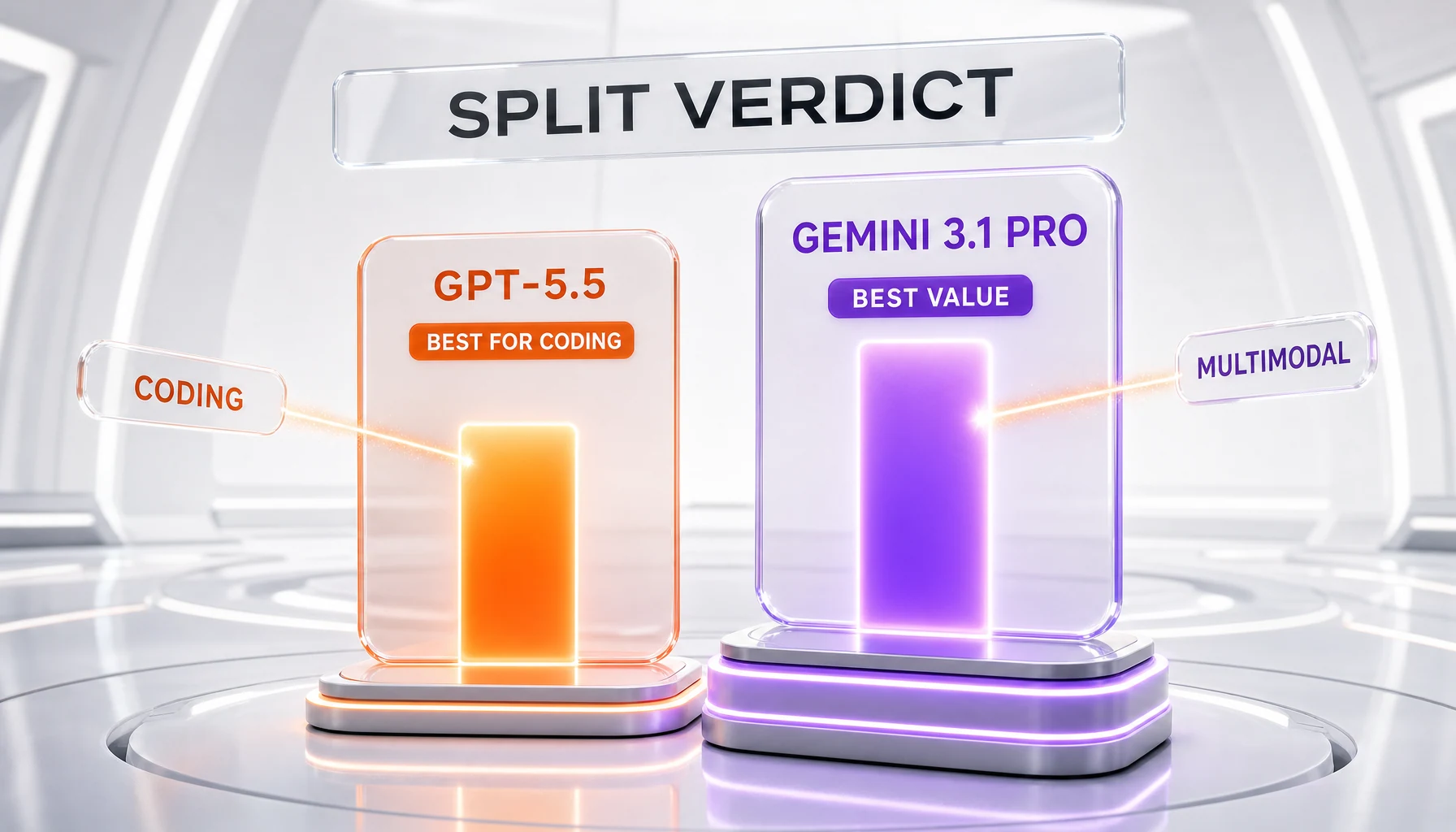
After running both side by side, we are not crowning a single winner — and not as a cop-out. The two models genuinely win different jobs, and only a couple of benchmarks compare them like-for-like. GPT-5.5 takes agentic coding on SWE-bench Verified and ships the deeper agentic tool stack, with a fresher knowledge cutoff and immediate general availability. Gemini 3.1 Pro takes price by a wide, vendor-confirmed margin, a confirmed 1,000,000-token multimodal context window, the highest published GPQA Diamond score, and the widest distribution. Reasoning is close enough to call a draw.
So the honest recommendation is task-shaped. If you are building coding agents on the OpenAI stack, pick GPT-5.5. If cost, multimodal input, or a Google Cloud footprint drives your decision, pick Gemini 3.1 Pro. For everyone in between, the price gap makes Gemini the better default to start with, and you can escalate coding-critical paths to GPT-5.5 where its benchmark lead earns the extra spend. Whichever you choose, validate the headline coding numbers on your own codebase — the most important benchmark is always your own.
Frequently asked questions
What is GPT-5.5?
GPT-5.5 is OpenAI's flagship model and its first fully retrained base model since GPT-4.5, internally nicknamed "Spud." It ships a complete agentic tool stack — function calling, structured outputs, web search, file search, code interpreter, computer use, and MCP — on by default, with a five-level reasoning effort scale. It is priced at $5 per million input tokens and $30 per million output tokens, with a knowledge cutoff of December 2025, and it powers Codex on every ChatGPT plan.
What is Gemini 3.1 Pro?
Gemini 3.1 Pro is Google DeepMind's flagship reasoning model, documented in an official model card dated February 19, 2026, and currently in preview. It confirms a 1,000,000-token multimodal input window (text, image, video, audio, and PDF) with 64K output, reports 94.3% on GPQA Diamond and 77.1% on ARC-AGI-2, and is priced at $2 per million input tokens and $12 per million output tokens up to 200K context. It is available on Vertex AI, AI Studio, the Gemini API, the Gemini app, Antigravity, and NotebookLM.
Which model is better at coding, GPT-5.5 or Gemini 3.1 Pro?
On SWE-bench Verified — the one coding benchmark both vendors report the same way — GPT-5.5 leads at roughly 88.7% versus Gemini 3.1 Pro's 80.6%, which points to GPT-5.5 being the stronger agentic coding model. The caveat is that GPT-5.5's number is press-relayed rather than independently verified, while Gemini's comes from an official model card, so we would validate on your own codebase before treating the exact margin as final.
Which model is cheaper?
Gemini 3.1 Pro is clearly cheaper. We fetched both vendors' pricing pages directly: Gemini costs $2 per million input tokens and $12 per million output tokens up to 200K context, versus GPT-5.5's $5 input and $30 output. That makes Gemini roughly 2.5 times cheaper at the standard tier, and it stays cheaper even above 200K context, where Gemini steps up to $4 input and $18 output.
What is SWE-bench Verified and why does it matter here?
SWE-bench Verified measures how well a model resolves real software-engineering issues from open-source repositories. It matters in this comparison because it is the single benchmark both OpenAI and Google DeepMind report the same way for these two models, making it the only genuinely like-for-like coding number available. GPT-5.5 is reported at roughly 88.7% and Gemini 3.1 Pro at 80.6%.
Which model has the bigger context window?
They are effectively even on input. GPT-5.5 supports about 1,050,000 tokens (400K inside Codex), and Gemini 3.1 Pro confirms a 1,000,000-token input window. The difference is on output: GPT-5.5 allows up to 128K output tokens versus Gemini's 64K ceiling, so GPT-5.5 is better for very long single responses, while Gemini's input window accepts multimodal content GPT-5.5 cannot take.
Which model is better for multimodal input?
Gemini 3.1 Pro. It accepts text, image, video, audio, and PDF in a single call, which collapses transcription, OCR, and summarization into one round-trip. GPT-5.5 accepts only text and image input, with no native audio or video. If your workflow centers on extracting from mixed media, Gemini wins outright.
Which model reasons better?
It is roughly a tie. Gemini 3.1 Pro reports 94.3% on GPQA Diamond, the highest published score we have seen on that graduate-level science benchmark, just ahead of GPT-5.5's 93.6%. But GPT-5.5 reports a higher ARC-AGI-2 (85.0% versus 77.1%) on abstract reasoning. They trade the lead depending on the test, so neither is the clearly smarter model.
Is GPT-5.5 worth the higher price?
It depends on the workload. For agentic coding, GPT-5.5's benchmark lead and deeper tool stack can justify the roughly 2.5 times higher cost, especially with its 90% prompt-caching discount and Batch mode at 50% off softening the gap on stable, high-volume workloads. For token-heavy general workloads where coding is not the core, Gemini 3.1 Pro's lower price usually wins on total cost of ownership.
Is Gemini 3.1 Pro's preview status a risk?
It is a real consideration. Google DeepMind shut down Gemini 3 Pro Preview on March 9, 2026 with a forced migration, so the 3.1 Pro Preview could change without long notice. General availability is expected later in 2026. If you need a model you can pin in production today without migration risk, GPT-5.5's general availability is the safer choice; if you can tolerate change, Gemini's price and context advantages are substantial.
Is the pricing in this comparison confirmed or just reported?
Confirmed. We did not rely on circulating summaries. We fetched OpenAI's API pricing page for GPT-5.5 ($5 input, $30 output, $0.50 cached) and Google's Gemini API pricing page for Gemini 3.1 Pro ($2 input and $12 output up to 200K, rising to $4 and $18 above). We never publish a price we cannot pull directly from the vendor.
Which model should most teams choose in 2026?
For most teams, Gemini 3.1 Pro is the better default to start with thanks to its roughly 2.5 times lower price, confirmed 1,000,000-token multimodal context, and top published reasoning score. The exception is teams whose core workload is agentic software engineering, where GPT-5.5's higher reported coding benchmark, deeper tool stack, fresher knowledge cutoff, and immediate general availability make it the model to beat — provided you validate its coding performance on your own codebase.
Sources and references
Every figure on this page is attributed to whoever produced it. Vendor documentation and independent measurement are listed separately and never merged into a single ranking.
- Artificial Analysis — Gemini 3.1 Pro Preview (independent index score)
- OpenAI — API pricing (per-token rates)
- Artificial Analysis — GPT-5.5 (independent index score)
- Artificial Analysis — Model leaderboard (Intelligence Index scores and cost per task across configurations)
Our Verdict
Split decision, no single overall winner. GPT-5.5 wins agentic coding on the one like-for-like benchmark both vendors report (SWE-bench Verified, roughly 88.7% versus 80.6%), ships the deeper agentic tool stack, has a fresher December 2025 knowledge cutoff, and is generally available today — but that 88.7% is press-relayed, not independently verified. Gemini 3.1 Pro wins on the dimensions we could confirm with hard evidence: vendor-verified pricing roughly 2.5 times cheaper ($2 versus $5 per million input), a confirmed 1,000,000-token multimodal context window across text, image, video, audio, and PDF, the highest published GPQA Diamond reasoning score (94.3%), and the widest distribution. Reasoning is a draw — Gemini edges GPQA Diamond, GPT-5.5 edges ARC-AGI-2. Best for agentic coding on the OpenAI stack: GPT-5.5. Best for price, multimodal input, and Google Cloud teams: Gemini 3.1 Pro.
Choose GPT-5.5
OpenAI's first fully retrained base model since GPT-4.5 — agentic, faster, and double the API price.
Try GPT-5.5 →Choose Gemini 3.1 Pro Preview
Google DeepMind's flagship Gemini 3.1 Pro Preview — 94.3% GPQA Diamond, 77.1% ARC-AGI-2, 1M-token context, multimodal in/text out, vibe coding plus agentic tool use. Preview status as of April 2026.
Try Gemini 3.1 Pro Preview →Frequently Asked Questions
Is GPT-5.5 better than Gemini 3.1 Pro Preview?
Split decision, no single overall winner. GPT-5.5 wins agentic coding on the one like-for-like benchmark both vendors report (SWE-bench Verified, roughly 88.7% versus 80.6%), ships the deeper agentic tool stack, has a fresher December 2025 knowledge cutoff, and is generally available today — but that 88.7% is press-relayed, not independently verified. Gemini 3.1 Pro wins on the dimensions we could confirm with hard evidence: vendor-verified pricing roughly 2.5 times cheaper ($2 versus $5 per million input), a confirmed 1,000,000-token multimodal context window across text, image, video, audio, and PDF, the highest published GPQA Diamond reasoning score (94.3%), and the widest distribution. Reasoning is a draw — Gemini edges GPQA Diamond, GPT-5.5 edges ARC-AGI-2. Best for agentic coding on the OpenAI stack: GPT-5.5. Best for price, multimodal input, and Google Cloud teams: Gemini 3.1 Pro.
Which is cheaper, GPT-5.5 or Gemini 3.1 Pro Preview?
GPT-5.5 starts at $5 in / $30 out per M tokens. Gemini 3.1 Pro Preview starts at $2 in / $12 out per M tokens. Check the pricing comparison section above for a full breakdown.
What are the main differences between GPT-5.5 and Gemini 3.1 Pro Preview?
The key differences span across 11 features we compared. For Standard input price (per million tokens), GPT-5.5 offers $5.00 (fetch-verified) while Gemini 3.1 Pro Preview offers $2.00 up to 200K, $4.00 above. For Standard output price (per million tokens), GPT-5.5 offers $30.00 (fetch-verified) while Gemini 3.1 Pro Preview offers $12.00 up to 200K, $18.00 above. For SWE-bench Verified (agentic coding, like-for-like), GPT-5.5 offers ~88.7% (OpenAI-reported, press-relayed) while Gemini 3.1 Pro Preview offers 80.6% (official model card). See the full feature comparison table above for all details.