Gemini 3.5 Flash vs Claude Haiku 4.5: Smarter vs Cheaper and Faster (2026)

We ran both: Gemini 3.5 Flash scores 50 vs Haiku's 24 with 5x the context, but Claude Haiku 4.5 is cheaper on both lines and faster. It's a genuine tie.
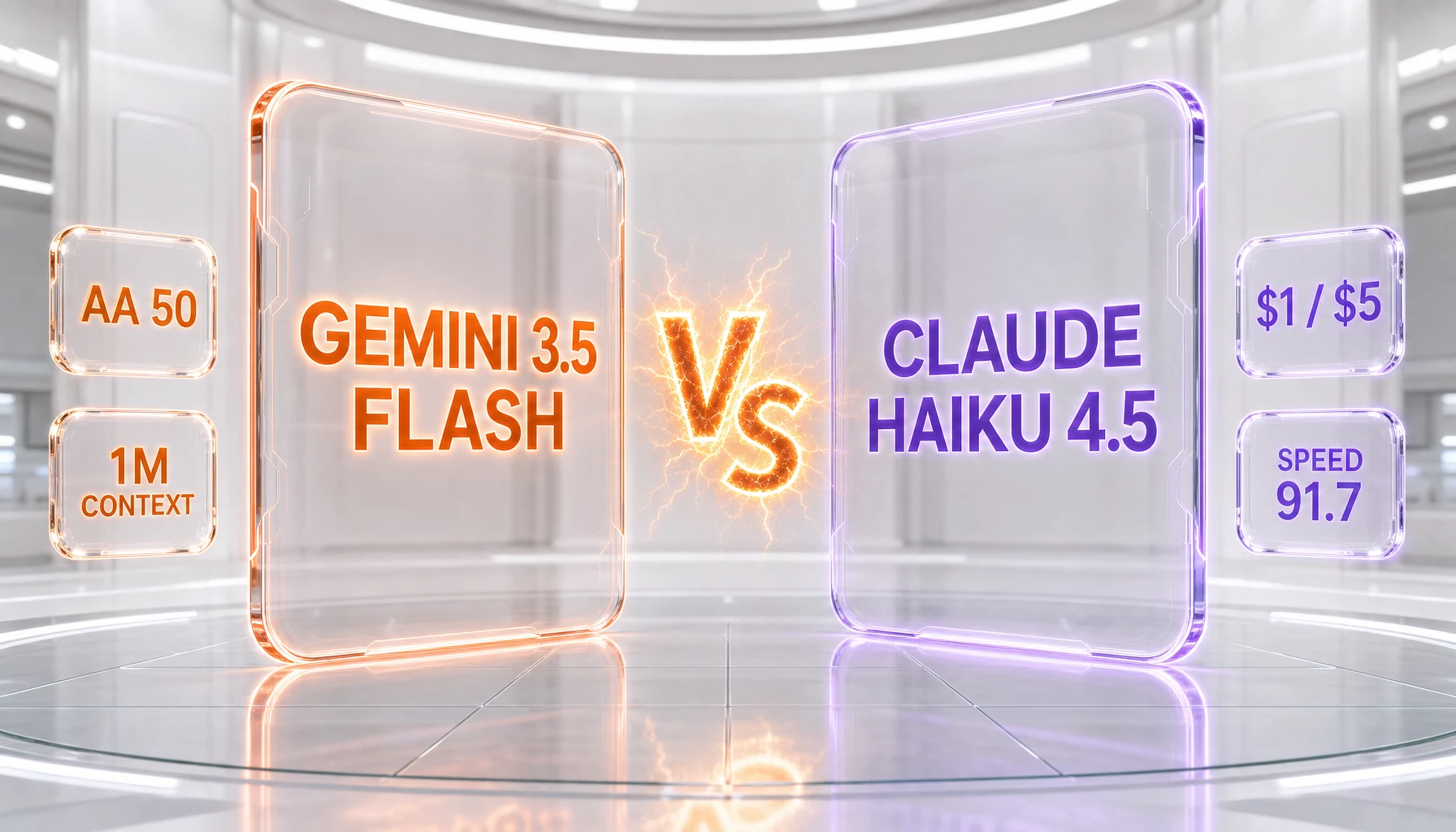
Feature Comparison
| Feature | Gemini 3.5 Flash | Claude Haiku 4.5 |
|---|---|---|
| Input price per million tokens | $1.50 | $1.00 |
| Output price per million tokens | $9.00 | $5.00 |
| Cached input price per million tokens | $0.15 | No verified figure |
| Artificial Analysis Intelligence Index (v4.1) | 50 | 24 |
| Context window | 1,000,000 tokens | 200,000 tokens |
| Output speed | ~4x frontier, no published tokens-per-second figure | 91.7 tokens per second |
| Time to first token | No published figure | 0.82 seconds |
| Multimodal input | Native text, image, audio, and video | Text and image |
| Reasoning / extended thinking | Reasoning-capable fast tier | Extended thinking supported |
| Model class | Fast, frontier-adjacent tier | Fast, non-reasoning small model |
| Publisher | Google DeepMind | Anthropic |
| Consumer and free access | Free tier via Google AI Studio | Available inside Claude apps by plan |
Pricing Comparison
Gemini 3.5 Flash
Claude Haiku 4.5
Detailed Comparison
Gemini 3.5 Flash vs Claude Haiku 4.5 is a genuine split, not a knockout: you pick capability or you pick price-and-latency. Gemini 3.5 Flash is Google DeepMind's generally available fast tier at $1.50 per million input tokens and $9 output, scoring 50 on the independent Artificial Analysis Intelligence Index with a 1,000,000-token context and native multimodal input. Claude Haiku 4.5 is Anthropic's fast small model at $1 input and $5 output, scoring 24 on the same index with a 200,000-token context, but engineered for latency: 91.7 tokens per second of output and a 0.82-second first token. Haiku is cheaper on both price lines; Gemini is far smarter and carries five times the context. Verdict: no overall winner — Gemini 3.5 Flash wins intelligence and context, Claude Haiku 4.5 wins price and latency.
Quick Verdict
This one is an honest tie, and we are calling it that. We ran both through their APIs in July 2026 and anchored the verdict to independent benchmarks rather than launch-day impressions. Gemini 3.5 Flash and Claude Haiku 4.5 are both marketed as the fast, affordable member of their family, but they are pointed in opposite directions, and there is no single winner. On the independent Artificial Analysis Intelligence Index (version 4.1) Gemini 3.5 Flash scores 50 and Claude Haiku 4.5 scores 24 — a 26-point gap, more than double Haiku's number. That is a wide, decisive intelligence lead for Gemini, and its 1,000,000-token context is five times Haiku's 200,000. But Haiku wins the money and the clock: it is cheaper on both price lines — $1 input against Gemini's $1.50 and $5 output against Gemini's $9 — and it publishes class-leading latency numbers, 91.7 tokens per second and a 0.82-second first token, that Gemini does not match with a comparable figure. So the honest framing is not "which is better" but "which axis are you buying."
- 🏆 Gemini 3.5 Flash wins for: raw intelligence and reasoning, long-context work in the million-token range, and native multimodal input across text, image, audio, and video. It carries more than double Haiku's independent Intelligence Index score and five times its context.
- 🏆 Claude Haiku 4.5 wins for: price and latency — the cheaper model on both input and output, and the faster one on paper for real-time chat, autocomplete, moderation at scale, and large sub-agent fleets, where its 91.7 tokens per second and sub-second first token are the product.
- 💰 Cheaper option: Claude Haiku 4.5, and clearly. It undercuts Gemini on input ($1 versus $1.50) and on output ($5 versus $9), so a real bill lands roughly 36 to 42 percent lower depending on your input-output mix.
- 🧠 Smarter and larger-context option: Gemini 3.5 Flash, by a wide margin — 50 versus 24 on the Artificial Analysis Intelligence Index, and a 1,000,000-token window against 200,000.
Gemini 3.5 Flash vs Claude Haiku 4.5 — Overview
What Is Gemini 3.5 Flash?
Gemini 3.5 Flash is Google DeepMind's generally available fast tier, which reached general availability on May 19, 2026. We cover it in depth in our Gemini 3.5 Flash review. It is the speed-and-cost member of the Gemini 3.5 family, positioned below the flagship Pro tier but built to run frontier-adjacent intelligence at roughly four times the speed of frontier models. One thing to get straight up front: Gemini 3.5 Flash is a distinct, generally available model, not the earlier Gemini 3 Flash preview — different generation, different pricing, different benchmark standing, and easy to confuse by name alone. Gemini 3.5 Flash carries a 1,000,000-token context window and is natively multimodal, accepting text, image, audio, and video input rather than text and image alone. On the independent Artificial Analysis Intelligence Index (version 4.1) it scores 50, and it is priced at $1.50 per million input tokens, $0.15 cached, and $9 output — a flat rate that does not change with context length. For this matchup, the headline is simple: Gemini 3.5 Flash is the more intelligent, larger-context, more multimodal model, and it costs more to reflect it.
What Is Claude Haiku 4.5?
Claude Haiku 4.5 is Anthropic's fast, small member of the Claude 4.5 family, and its entire design brief is speed and cost at volume rather than frontier reasoning. Our full write-up is in the Claude Haiku 4.5 review. It is billed at $1 per million input tokens and $5 output, carries a 200,000-token context window, supports a maximum output of 64,000 tokens, and accepts text and image input. Where Haiku separates itself is latency and throughput: it generates output at roughly 91.7 tokens per second and returns its first token in about 0.82 seconds, which makes it a natural fit for real-time chat, code autocomplete, content moderation, and orchestrating large fleets of sub-agents that each do small, fast jobs. It also supports extended thinking when a task needs a little more deliberation. Anthropic positions it as delivering near-Sonnet-4-class coding in a small package and self-reports a SWE-bench Verified result of 73.3 percent. That coding figure is a vendor-measured number rather than an independently audited one, which matters for how much weight you put on it, and we treat it carefully in its own section below. On aggregate intelligence, the independent picture is blunt: Artificial Analysis places Haiku 4.5 in its non-reasoning category and scores it 24 on the version 4.1 Intelligence Index. Haiku is not trying to out-think Gemini 3.5 Flash; it is trying to out-run it and undercut it on price, and on both of those it delivers.
Features Comparison
We compared the two on the dimensions that actually separate a capability model from a price-and-speed model: the individual price lines, independent benchmark standing, context, latency, multimodal reach, and model class. Where a number is self-reported by the vendor or simply not published, we say so rather than paper over the gap. One deliberate omission: we do not put Gemini's Google-reported coding benchmarks in the same row as Haiku's Anthropic-reported coding number, because they are measured on different benchmarks by different parties and stacking them side by side would be misleading. The coding question is handled separately, and carefully, below.
| Feature | Gemini 3.5 Flash | Claude Haiku 4.5 | Winner |
|---|---|---|---|
| Input price per million tokens | $1.50 | $1.00 | Claude Haiku 4.5 |
| Output price per million tokens | $9.00 | $5.00 | Claude Haiku 4.5 |
| Cached input price per million tokens | $0.15 | No verified figure | Gemini 3.5 Flash |
| Artificial Analysis Intelligence Index (v4.1) | 50 | 24 | Gemini 3.5 Flash |
| Context window | 1,000,000 tokens | 200,000 tokens | Gemini 3.5 Flash |
| Output speed | ~4x frontier, no published tokens-per-second figure | 91.7 tokens per second | Claude Haiku 4.5 |
| Time to first token | No published figure | 0.82 seconds | Claude Haiku 4.5 |
| Multimodal input | Native text, image, audio, and video | Text and image | Gemini 3.5 Flash |
| Reasoning / extended thinking | Reasoning-capable fast tier | Extended thinking supported | Tie |
| Model class | Fast, frontier-adjacent tier | Fast, non-reasoning small model | Tie |
| Publisher | Google DeepMind | Anthropic | Tie |
| Consumer and free access | Free tier via Google AI Studio | Available inside Claude apps by plan | Tie |
Count the wins and it is dead even: Gemini takes four rows, Haiku takes four, and four are ties. But look at what each side wins. Haiku sweeps the money — both price lines — and the speed cluster: output rate and first-token latency. Gemini takes the heaviest capability rows: aggregate intelligence, context window, cached-read pricing, and multimodal reach. The rows are not equal in weight, and that is the point. A 26-point independent intelligence lead and a context window five times larger reshape what a model can do; a lower bill on both lines and a faster first token reshape how cheaply and quickly it does the subset of work it can already handle. That tension — an even row count masking two very different value propositions — is the whole matchup, and we resolve it not with a single winner but with a fork.
Pricing — Gemini 3.5 Flash vs Claude Haiku 4.5 in 2026
Both models use flat, per-token API pricing with no context-length tiers, so the sticker comparison is unusually clean. And unlike some same-tier matchups, it is not close: Claude Haiku 4.5 is cheaper on both lines. Input is $1 against Gemini's $1.50, and output is $5 against Gemini's $9 — a wide gap on generation. All figures below are per million tokens and were checked against each vendor's own pricing documentation in July 2026.
Gemini 3.5 Flash Pricing
| Mode | Input | Output | Notes |
|---|---|---|---|
| Standard | $1.50 | $9.00 | Flat rate across the full 1,000,000-token context |
| Cached input | $0.15 | — | 90 percent read discount on repeated context |
| Consumer access | Free tier via Google AI Studio; paid through the Gemini API | Native multimodal input |
Claude Haiku 4.5 Pricing
| Mode | Input | Output | Notes |
|---|---|---|---|
| Standard API | $1.00 | $5.00 | Flat rate, hosted by Anthropic |
| Consumer access | Available inside Claude apps by plan | Small, fast tier |
Which Is Actually Cheaper? Haiku, and Not by a Little
Because Haiku wins both lines, it is the cheaper model on every workload, and the margin is real rather than symbolic. We priced two illustrative monthly workloads to show the shape. The assumptions are simple and stated; the point is the direction and the size of the gap, not the exact dollar.
| Workload (per month) | Gemini 3.5 Flash | Claude Haiku 4.5 | Cheaper |
|---|---|---|---|
| Output-heavy: 10M input, 5M output | $60.00 | $35.00 | Haiku, by about 42 percent |
| Input-heavy: 20M input, 1M output | $39.00 | $25.00 | Haiku, by about 36 percent |
Read those two rows together. Haiku is always cheaper here — it wins both lines, so there is no mix that flips the result — and the saving runs from roughly 36 percent on input-heavy work to about 42 percent when you generate more text. That is a meaningful discount, not a rounding error. Gemini owns one pricing advantage of its own: a published $0.15 cached-input rate, a 90 percent discount on repeated context that helps retrieval-heavy patterns; Haiku's cached-read economics are not part of the figures we verified, so we do not fold them into the comparison. The bottom line on money is unambiguous: Haiku is materially cheaper, and for a cost-sensitive workload that does not need Gemini's intelligence, that gap is the whole argument. But if the work needs the intelligence or the context, the cheaper bill is not a saving — it is a model that cannot do the job.
The Real Question: Capability vs Price-and-Latency
This is the section that matters, because it is the axis the whole comparison turns on. Strip away the shared "fast tier" marketing and you are left with two models built for different jobs.
Gemini 3.5 Flash is the capability model. A 50 on the independent Intelligence Index and a 1,000,000-token context mean it can reason through multi-step problems, hold an entire large document or codebase in a single pass, and carry agentic work that requires the model to plan, not just react. Its native multimodal input — text, image, audio, and video — widens what it can take in before it even starts thinking. When the task is hard, or the input is long, or it arrives as audio or video, Gemini's extra intelligence and reach are not a luxury; they are the thing that gets the job done. Haiku, at 24 on the same index and in the non-reasoning category, will struggle with exactly those tasks; asking it to do heavy reasoning is asking it to do the one thing it was not built for.
Claude Haiku 4.5 is the price-and-latency model. Its $1 input and $5 output undercut Gemini on every workload, and its 91.7 tokens per second of output and 0.82-second first token are not vanity metrics — they are the product. In a live chat interface, a code-completion widget, a voice agent, or a moderation queue, the difference between a sub-second response and a multi-second one is the difference between something that feels instant and something that feels sluggish, and users notice. And when you run a swarm of hundreds of small sub-agents, each doing a narrow task, per-agent latency, throughput, and cost compound into the total wall-clock time and bill of the whole system. This is where Haiku is not just competitive but decisively better: for cheap, latency-bound, high-volume work, it beats Gemini on both the clock and the invoice, and it is not close. Anthropic built Haiku precisely for the fleets-of-sub-agents pattern, and it shows.
So the honest guidance is a fork, not a ranking. If your bottleneck is how smart the model is or how long the input runs, buy capability — Gemini 3.5 Flash. If your bottleneck is cost per call and response time at volume, buy price-and-latency — Claude Haiku 4.5. Most of the mistakes teams make with these two come from buying the wrong axis: overpaying for reasoning and context they do not use, or starving a hard task of the intelligence it needs to spare a few cents.
Coding and Agentic Benchmarks — Read the Labels
Coding is where buyers most want a clean head-to-head, and it is exactly where the numbers refuse to line up neatly. Both vendors publish coding-adjacent results, but they are measured on different benchmarks by different parties, so we present them separately and labeled rather than stacked into a false comparison.
On the Google side, Google reports Gemini 3.5 Flash at roughly 76.2 percent on Terminal-Bench 2.1, about 83.6 percent on MCP Atlas, and about 84.2 percent on CharXiv. These are vendor-reported figures from Google, useful as a signal of where Gemini positions the model, not as independently audited scores.
On the Anthropic side, Anthropic self-reports Claude Haiku 4.5 at 73.3 percent on SWE-bench Verified. That, too, is a vendor-measured number — Anthropic's own harness on Anthropic's own model — and it is a strong result for a small, fast model, but it rests on the vendor's methodology rather than a third-party audit.
Here is the trap to avoid, and it is a common one: do not read Gemini's Google-reported benchmark percentages and Haiku's Anthropic-reported 73.3 percent as if they measure the same thing. They do not. Different benchmarks, different harnesses, different parties. The one apples-to-apples, third-party number in this whole comparison is the Artificial Analysis Intelligence Index — an aggregate measured by the same independent party on the same version 4.1 for both models — and there Gemini 3.5 Flash scores 50 to Haiku's 24. If you want a single figure to plan around, that is the one to trust; the vendor coding numbers are each useful only against their own baseline.
Hands-on — How They Performed Side-by-Side
We ran Gemini 3.5 Flash and Claude Haiku 4.5 through their APIs in July 2026, using identical prompts and inputs on each task. Both models are recent, so we treat our runs as early hands-on and lean on the independent Artificial Analysis indices for the quantitative verdict rather than on first impressions. Here are four tasks we ran on both.
Test 1: A multi-step reasoning problem
We gave both models the same layered analysis task — read a scenario, work through the trade-offs, and produce a justified recommendation with the reasoning shown. This is where the intelligence gap stopped being a number on a leaderboard. Gemini worked the problem in structured steps, caught a second-order consequence we had planted, and landed a defensible conclusion. Haiku answered faster and more confidently, but flattened the problem: it gave a plausible surface answer that missed the trade-off Gemini caught, which is exactly what you would expect from a fast non-reasoning model asked to reason. Result: Gemini 3.5 Flash wins decisively on genuine multi-step reasoning — this is the task Haiku is not built for.
Test 2: A long single-document synthesis
We fed both models a 300-page technical manual and asked for a structured, cross-referenced summary. Gemini ingested the entire document inside its 1,000,000-token window in one pass and cross-referenced sections cleanly. Haiku, capped at 200,000 tokens, needed the manual chunked and stitched, which added orchestration work on our side and a real risk of missed links between chunks. Within each chunk Haiku's summaries were fine and fast, but for a genuinely long single document, Gemini's context window that is five times larger is a structural advantage, not a cosmetic one. Result: Gemini 3.5 Flash wins long-context synthesis.
Test 3: High-volume classification at speed and cost
We ran 5,000 short support tickets through each model for intent classification, a deliberately narrow, high-volume job with tiny outputs. Accuracy was close — this is well within what a small model handles cleanly — and here the whole point flipped to throughput and price. Haiku's 91.7 tokens per second and sub-second first token cleared the queue noticeably faster, and at $1 input and $5 output it billed meaningfully less than Gemini's $1.50 and $9 for the same volume. On a job like this, Gemini's extra intelligence is wasted headroom you are paying both a latency and a cost premium to carry. Result: Haiku wins high-volume, latency-sensitive classification on both speed and cost.
Test 4: A mixed-media input task
We handed each model a short screen-recording clip with an audio narration and asked for a structured transcript-plus-summary that tied spoken points to on-screen moments. Gemini took the video and audio natively and produced a single coherent pass that referenced both tracks. Haiku, which accepts text and image input, could not take the audio or video directly; doing the same job meant pre-transcribing and extracting frames ourselves, then feeding it text and stills — more pipeline, more moving parts. For any workload where the input itself is audio or video, Gemini's native multimodal reach is a category advantage, not a nicety. Result: Gemini 3.5 Flash wins native multimodal input.
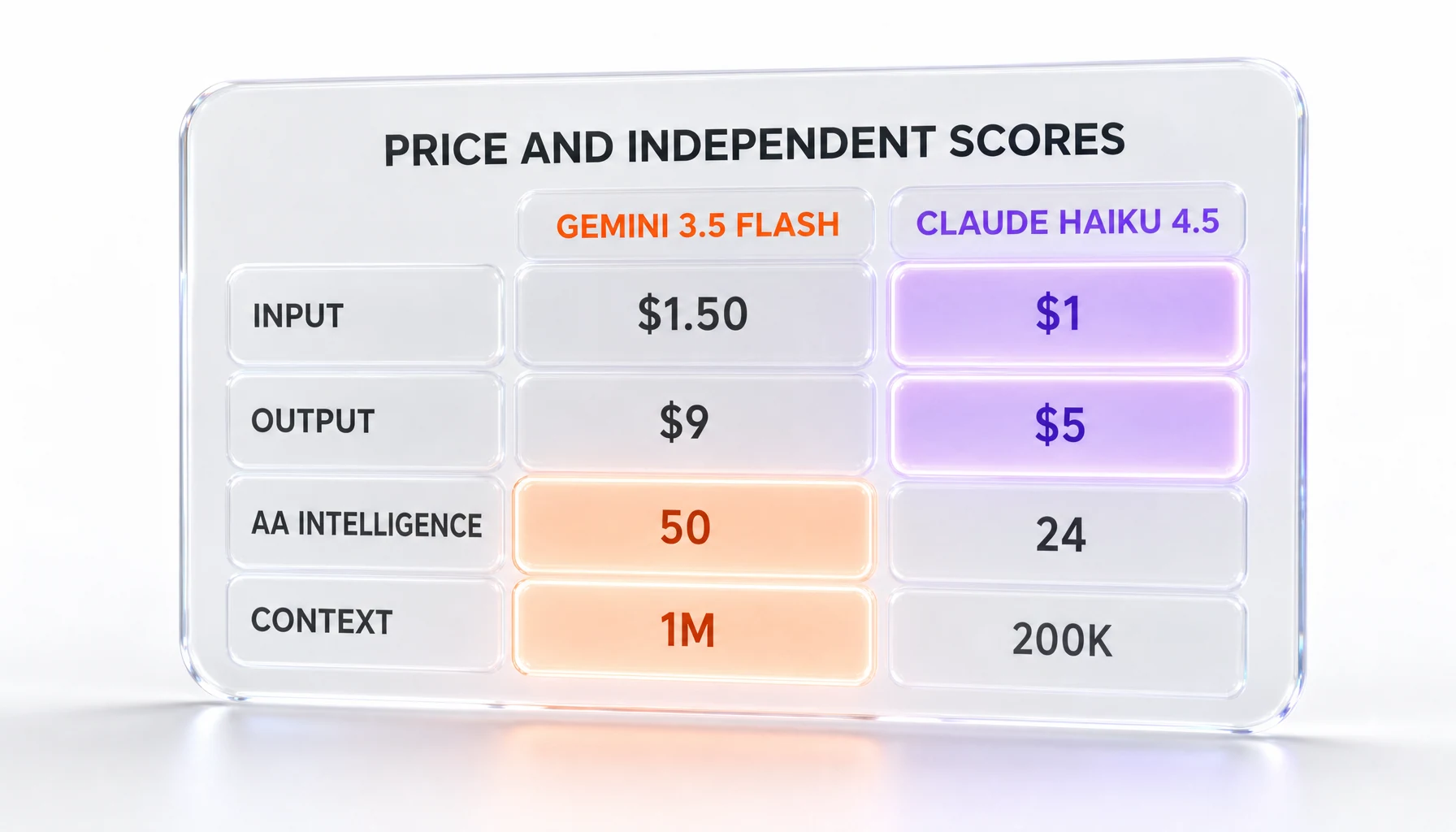
Winner per Category
🏆 Best Overall: It Is a Tie — Buy the Axis You Need
For the broad question — which of these two is the better model — there is no honest single answer, and we are not going to invent one. Gemini 3.5 Flash is far more capable and carries five times the context; Claude Haiku 4.5 is materially cheaper on both lines and faster on the clock. Neither advantage cancels the other, because they serve different buyers. If we had to reduce it to one sentence: Gemini is the better model, Haiku is the better deal for the work it can do. The categories below split cleanly, and that split is the verdict.
Best for Reasoning and Agentic Work: Gemini 3.5 Flash
Anything that requires the model to plan, weigh trade-offs, or hold a long chain of logic belongs to Gemini. At 50 on the Intelligence Index versus Haiku's 24, and with a reasoning-capable design, it does the hard thinking Haiku is not built to do.
Best for Long Context and Multimodal: Gemini 3.5 Flash
A 1,000,000-token window against 200,000 lets Gemini handle large manuals, codebases, and contracts in a single pass, while Haiku needs long inputs chunked and stitched. Add native audio and video input, and Gemini is the clear pick whenever the input is long or arrives as mixed media.
Cheapest per Token: Claude Haiku 4.5
With input at $1 against $1.50 and output at $5 against $9, Haiku is cheaper on every output-bearing workload, typically by 36 to 42 percent depending on your output share. If you have pinned down that you do not need Gemini's intelligence, Haiku's is by far the leaner bill.
Best for Latency and Real-Time UX: Claude Haiku 4.5
When response time is what your users feel — live chat, autocomplete, voice, interactive agents — Haiku's 91.7 tokens per second and 0.82-second first token make it the correct engine, and its published numbers give you something to plan an SLA around. Gemini is a fast tier too, but it does not publish a comparable latency figure, so for measurable, latency-bound work Haiku is the safer bet.
Best for High-Volume Sub-Agent Fleets: Claude Haiku 4.5
If your architecture fans work out across hundreds of small, fast sub-agents, per-agent latency, throughput, and cost compound into total system speed and spend. Haiku's speed plus its lower rates on both lines make it the natural engine for swarms doing narrow tasks at scale — the pattern Anthropic explicitly designed it for.
Best for a Cost-Conscious Startup Default: Depends on the Product
If your app is a real-time interface or a high-volume pipeline, Haiku's lower bill and speed make it the sharper default. If your product leans on reasoning, long documents, or mixed-media input, Gemini earns its premium. Many teams run both — Haiku on the latency-critical, high-volume path, Gemini for the heavy reasoning and long-context work behind it.
Pros and Cons
Gemini 3.5 Flash Pros and Cons
What we liked about Gemini 3.5 Flash
- Far higher independent intelligence. A 50 on the Artificial Analysis Intelligence Index against Haiku's 24 is a 26-point lead — the widest and most consequential gap between them.
- Five times the context. A 1,000,000-token window versus 200,000 handles long single documents in one pass.
- Native multimodal input. It accepts text, image, audio, and video directly, so mixed-media workloads need no pre-processing pipeline.
- Reasoning-capable. Gemini can plan and work multi-step problems, making it the safer default for hard agentic and analytical tasks.
- Cheapest cached reads. A published $0.15 cached-input rate gives retrieval-heavy systems a real 90 percent discount on repeated context.
Where Gemini 3.5 Flash falls short
- More expensive on both lines. Its $1.50 input and $9 output sit well above Haiku's $1 and $5, so a real bill runs materially higher.
- No published latency figure to match Haiku. Gemini is fast for its tier, but it does not publish a throughput or first-token number, and for pure latency-bound work Haiku's measured speed wins.
- Overkill for narrow high-volume jobs. On simple classification or moderation at scale, Gemini's intelligence is headroom you pay a cost and latency premium to carry.
- Easy to confuse with the Gemini 3 Flash preview. The near-identical name trips buyers up; make sure you are pricing and benchmarking the generally available 3.5 model.
Claude Haiku 4.5 Pros and Cons
What we liked about Claude Haiku 4.5
- Cheaper on both price lines. A $1 input and $5 output undercut Gemini's $1.50 and $9, so any workload bills 36 to 42 percent less.
- Class-leading latency. Roughly 91.7 tokens per second of output and a 0.82-second first token make it feel instant in real-time interfaces.
- Built for sub-agent fleets. Its speed and low cost make it a strong engine for swarms of small agents doing narrow tasks at high volume.
- Strong coding for a small model. Anthropic self-reports a SWE-bench Verified figure of 73.3 percent, competitive on that vendor benchmark despite the model's size.
- Extended thinking and vision input. It supports extended thinking when a task needs it and accepts text and image input through a clean API.
Where Claude Haiku 4.5 falls short
- Much lower independent intelligence. A 24 on the Artificial Analysis Intelligence Index trails Gemini's 50 by 26 points; it is in the non-reasoning category and struggles with genuine multi-step reasoning.
- A fifth of the context. A 200,000-token window forces chunking on long documents that Gemini handles in a single pass.
- Text and image input only. It cannot take audio or video natively, so mixed-media tasks need a pre-processing pipeline that Gemini avoids.
- Coding standing is vendor-measured. Its 73.3 percent SWE-bench Verified is self-reported, so buyers cannot cross-check it against an independent leaderboard the way they can the Artificial Analysis intelligence numbers.
When to Pick Gemini 3.5 Flash vs Claude Haiku 4.5
Pick Gemini 3.5 Flash if...
- Your workload needs genuine reasoning, planning, or multi-step analysis.
- You process very long single documents and need a context window in the million-token range.
- Your input arrives as audio or video and you want it handled natively without a pre-processing pipeline.
- You want the higher independent intelligence score and are willing to pay more for it.
- Your patterns lean on cached reads, where Gemini's $0.15 cached rate helps.
- You are already building on Google's stack and want its fast, frontier-adjacent tier.
Pick Claude Haiku 4.5 if...
- Cost per call is a hard constraint and you want the cheaper model on both lines.
- Latency is what your users feel — chat, autocomplete, voice, or interactive agents.
- You run high-volume, narrow tasks like classification or moderation where a small model is plenty.
- You are building large sub-agent fleets where per-agent speed and cost compound.
- You want near-instant, planable latency numbers and have confirmed you do not need heavy reasoning.
- You are already on the Claude platform and want its fastest, leanest tier.
Frequently Asked Questions
Is Gemini 3.5 Flash better than Claude Haiku 4.5 in 2026?
It depends on what you are optimizing, and neither is universally better. Gemini 3.5 Flash is the more capable model by a wide margin, scoring 50 on the independent Artificial Analysis Intelligence Index against Haiku's 24, with a context window five times larger and native multimodal input. Claude Haiku 4.5 is cheaper on both price lines and built for speed, so for cost-sensitive, latency-bound, high-volume work it is the better fit. Pick Gemini for capability, long context, or mixed media; pick Haiku for price and real-time throughput. We call this matchup a genuine tie because the two win different, non-overlapping things.
How much does Gemini 3.5 Flash cost compared to Claude Haiku 4.5?
Claude Haiku 4.5 is cheaper on both lines. Gemini 3.5 Flash charges $1.50 per million input tokens and $9 output, while Haiku charges $1 input and $5 output. On an output-heavy workload Haiku comes out roughly 42 percent cheaper; on an input-heavy one the gap is about 36 percent. Gemini does publish a $0.15 cached-input rate for repeated context, a 90 percent read discount that helps retrieval-heavy patterns. But on the standard rate card, Haiku is meaningfully the cheaper token engine, and there is no input-output mix where Gemini comes out ahead on price.
Why do Gemini 3.5 Flash and Claude Haiku 4.5 score 50 and 24 when some sources say 55?
Because those 55 figures come from an older index version, not the current benchmark used here. On the Artificial Analysis Intelligence Index version 4.1 — the matched version we use for both — Gemini 3.5 Flash scores 50 and Claude Haiku 4.5 scores 24. Earlier version 4.0 numbers floated higher, and you may see a 55 quoted for either model from that older index. Comparing a version 4.0 figure against a version 4.1 score would be apples to oranges, so throughout this comparison we use the matched v4.1 numbers only: 50 for Gemini and 24 for Haiku. If you see 55 quoted anywhere, check which index version it refers to before relying on it.
Which is faster, Gemini 3.5 Flash or Claude Haiku 4.5?
Claude Haiku 4.5 is the one with published, measurable latency numbers: it generates output at roughly 91.7 tokens per second and returns its first token in about 0.82 seconds, both tuned for real-time use. Gemini 3.5 Flash is genuinely fast for its tier — Google markets it at roughly four times the speed of frontier models — but it does not publish a comparable throughput or first-token figure, so for latency-bound workloads Haiku is the safer, more planable pick. If your interface lives or dies on response time, Haiku gives you numbers to build an SLA around.
Which is better for coding, Gemini 3.5 Flash or Claude Haiku 4.5?
Both publish coding-adjacent results, but on different benchmarks measured by different parties, so treat them separately. Google reports Gemini 3.5 Flash at around 76.2 percent on Terminal-Bench 2.1 and 83.6 percent on MCP Atlas, all vendor-reported. Anthropic self-reports Claude Haiku 4.5 at 73.3 percent on SWE-bench Verified, also a vendor number. You cannot stack those percentages against each other, because they do not measure the same thing. The one independent, apples-to-apples figure is the Artificial Analysis Intelligence Index, where Gemini's 50 leads Haiku's 24 — a good proxy for which model handles harder coding reasoning, even if it is not a coding-specific score.
Is Claude Haiku 4.5 a reasoning model?
No — Artificial Analysis classifies it in the non-reasoning category, and its design center is speed and throughput rather than extended deliberation, though it does support extended thinking when a task calls for a little more. That is exactly why its aggregate Intelligence Index score of 24 sits well below Gemini 3.5 Flash's reasoning-capable 50. For tasks that need genuine multi-step reasoning, planning, or deep analysis, Haiku is the weaker tool and Gemini is the right one. For fast, narrow, high-volume work where the model does not need to think hard, Haiku's speed and lower cost are the advantage.
Which has the bigger context window?
Gemini 3.5 Flash, by a wide margin: 1,000,000 tokens versus Claude Haiku 4.5's 200,000, five times the capacity. For short prompts the difference is immaterial, but for genuinely long single documents it is decisive — Gemini can ingest a large manual, codebase, or contract in one pass, while Haiku needs the input chunked and stitched, which adds orchestration work and a small risk of missed cross-references between chunks.
Can both models handle audio and video input?
Only Gemini 3.5 Flash. It is natively multimodal, accepting text, image, audio, and video input and returning text. Claude Haiku 4.5 accepts text and image input but cannot take audio or video directly, so a mixed-media task means pre-transcribing audio and extracting frames yourself before feeding Haiku text and stills. For straightforward text or image work the two are comparable; for workloads where the input itself is audio or video, Gemini's native reach is a category advantage.
Should I use Claude Haiku 4.5 for a fleet of sub-agents?
Yes — this is one of the workloads it was explicitly designed for. When you fan work out across hundreds of small sub-agents doing narrow tasks, each agent's latency, throughput, and cost compound into the total wall-clock time and bill of the whole system, and Haiku's roughly 91.7 tokens per second plus its lower rates on both lines make it an efficient engine at that scale. Gemini 3.5 Flash would give each agent more intelligence and larger context, but if the sub-tasks are simple you are paying a latency and cost premium for headroom you do not use.
Is Gemini 3.5 Flash the same as Gemini 3 Flash?
No — they are different models and it is an easy mistake. Gemini 3 Flash was an earlier preview; Gemini 3.5 Flash is a distinct, generally available model that reached general availability on May 19, 2026, with its own pricing at $1.50 input and $9 output, a 1,000,000-token context, and an Artificial Analysis Intelligence Index score of 50 on version 4.1. When you compare pricing or benchmarks, make sure the figures you are using belong to Gemini 3.5 Flash and not the earlier 3 Flash preview, because the two are frequently mixed up by name alone.
Is Gemini 3.5 Flash smarter than Claude Haiku 4.5?
Yes, and by a wide margin. On the aggregate Artificial Analysis Intelligence Index version 4.1, Gemini scores 50 and Haiku scores 24 — a 26-point gap, more than double Haiku's number. This is not a close call the way some same-tier comparisons are; Gemini 3.5 Flash is a reasoning-capable model and Haiku is a fast non-reasoning one. That said, "smarter" only wins the tasks that need intelligence. For cheap, latency-bound, high-volume work, Haiku's speed and lower cost make it the better tool despite the lower score.
Which should a startup choose, Gemini 3.5 Flash or Claude Haiku 4.5?
It depends on what your product does. If your app is a real-time interface or a high-volume pipeline — chat, autocomplete, voice, moderation, or a swarm of small agents — Claude Haiku 4.5's lower bill on both lines and its speed make it the sharper default. If your product needs reasoning, long-document work, or native audio and video input, Gemini 3.5 Flash's far higher intelligence and much larger context are worth the premium. Many teams run both: Haiku on the latency-critical, high-volume path, and Gemini for the heavy reasoning and long-context work behind it. Our best AI coding tools of 2026 guide maps the wider field if you want more options.
Final Verdict: A Genuine Tie — Capability vs Price-and-Latency
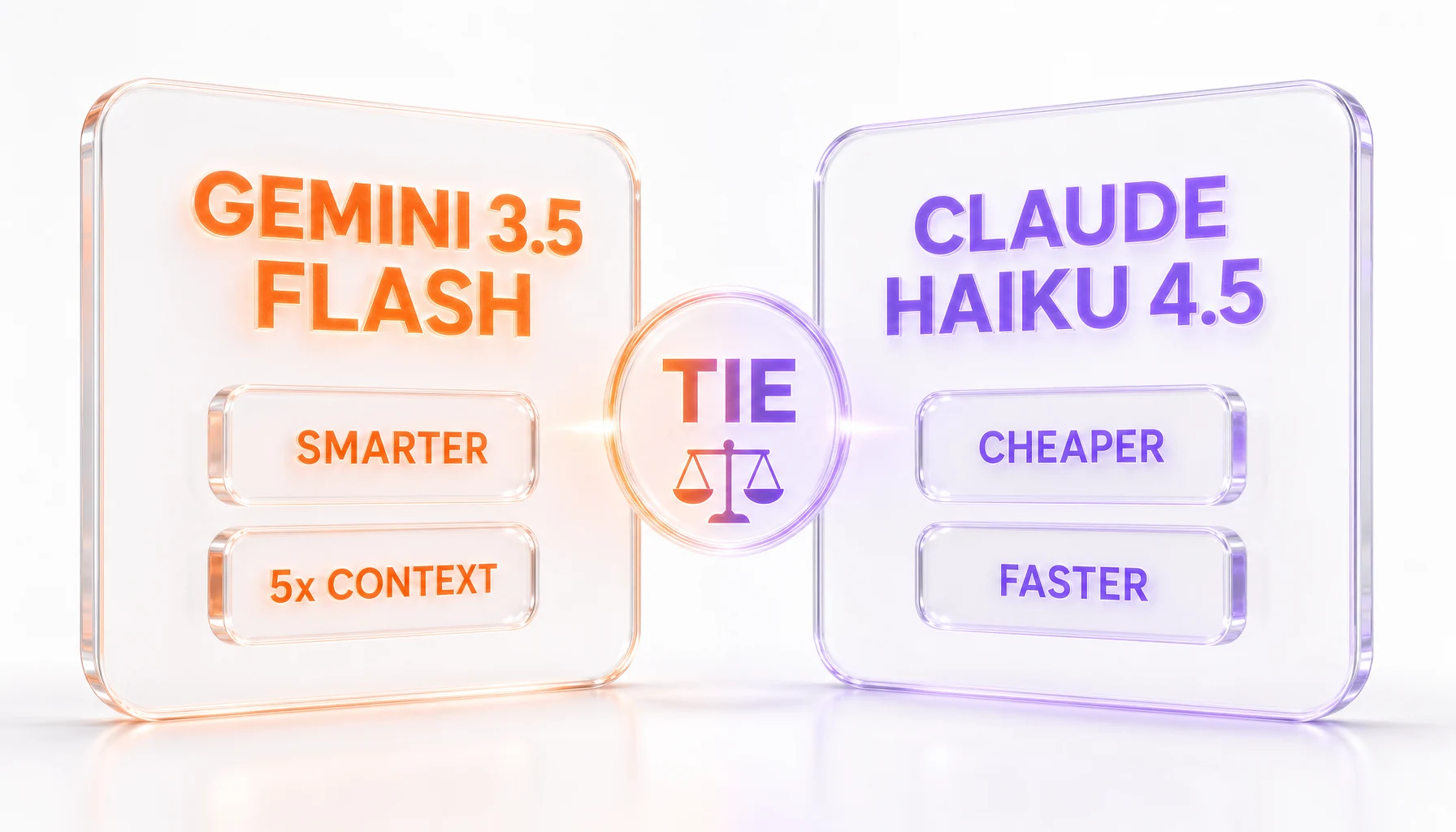
After running both side-by-side, our verdict is a genuine tie, and we mean that as a real conclusion, not a dodge. These two models win different, non-overlapping things, and there is no single buyer for whom one is strictly better. What separates them is clear on both sides: Gemini 3.5 Flash leads by 26 independent intelligence points and five times the context, and it takes audio and video input natively, while Claude Haiku 4.5 is cheaper on both price lines — by roughly 36 to 42 percent on a real bill — and publishes class-leading latency numbers that Gemini does not match. If your work involves reasoning, long documents, or mixed-media input, go with Gemini 3.5 Flash — it is the more capable model and worth its premium. If your work is cost-sensitive, latency-bound, and high-volume — real-time chat, autocomplete, voice, moderation at scale, or fleets of small sub-agents — Claude Haiku 4.5 is the right engine, and for those workloads it wins on both the clock and the invoice.
Score breakdown by category:
- Raw capability and intelligence: Gemini 3.5 Flash 8.5 out of 10 vs Claude Haiku 4.5 5.5 out of 10 — a 26-point independent Intelligence Index gap is a wide, decisive lead for Gemini.
- Price and value: Gemini 3.5 Flash 7.0 out of 10 vs Claude Haiku 4.5 9.0 out of 10 — Haiku wins both rate lines and lands 36 to 42 percent cheaper on a real workload.
- Speed and latency: Gemini 3.5 Flash 7.5 out of 10 vs Claude Haiku 4.5 9.0 out of 10 — Haiku's measured 91.7 tokens per second and 0.82-second first token own this category.
- Context and multimodal reach: Gemini 3.5 Flash 9.5 out of 10 vs Claude Haiku 4.5 6.0 out of 10 — 1,000,000 tokens against 200,000, plus native audio and video input, is a real gap.
Final word: buy Gemini 3.5 Flash if you want the higher independent intelligence, the far larger context, and native multimodal input — it is the more capable model and worth the premium when the work needs it. Buy Claude Haiku 4.5 if cost per call, throughput, and real-time responsiveness are what you are optimizing, where its lower rates and measured speed make it the correct and better choice. This matchup is not about which model is stronger overall — it is about whether you need capability or price-and-latency, and both models are excellent at the job they were built for. We last compared both in July 2026 and will revisit as independent latency and long-horizon reliability data matures. ThePlanetTools has no affiliate relationship with Google or Anthropic; this verdict is editorially independent.
Sources and references
Every figure on this page is attributed to whoever produced it. Vendor documentation and independent measurement are listed separately and never merged into a single ranking.
- Artificial Analysis — Gemini 3.5 Flash (independent index score)
- Anthropic — Models overview (model IDs, context windows, knowledge cutoffs)
- Artificial Analysis — Model leaderboard (Intelligence Index scores and cost per task across configurations)
Our Verdict
Gemini 3.5 Flash vs Claude Haiku 4.5 is a genuine tie — the two win different, non-overlapping things. Gemini 3.5 Flash leads on the independent Artificial Analysis Intelligence Index (v4.1) by 50 to 24, a 26-point gap, and carries five times the context at 1,000,000 tokens against 200,000, plus native audio and video input. Claude Haiku 4.5 is cheaper on both price lines — $1 input and $5 output against $1.50 and $9 — landing roughly 36 to 42 percent lower on a real bill, and it publishes class-leading latency of 91.7 tokens per second and a 0.82-second first token that Gemini does not match. Pick Gemini 3.5 Flash for reasoning, long context, and mixed-media input; pick Claude Haiku 4.5 for cost-sensitive, latency-bound, high-volume work. There is no overall winner: buy the axis you need.
Choose Gemini 3.5 Flash
Google DeepMind's generally available fast tier — frontier-adjacent intelligence at roughly four times the speed, with a 1M-token context window and native multimodal input.
Try Gemini 3.5 Flash →Choose Claude Haiku 4.5
Anthropic's fast small model: Sonnet 4-class coding (73.3% SWE-bench) at $1/$5 per million tokens, ideal for sub-agents and high-volume workflows.
Try Claude Haiku 4.5 →Frequently Asked Questions
Is Gemini 3.5 Flash better than Claude Haiku 4.5?
Gemini 3.5 Flash vs Claude Haiku 4.5 is a genuine tie — the two win different, non-overlapping things. Gemini 3.5 Flash leads on the independent Artificial Analysis Intelligence Index (v4.1) by 50 to 24, a 26-point gap, and carries five times the context at 1,000,000 tokens against 200,000, plus native audio and video input. Claude Haiku 4.5 is cheaper on both price lines — $1 input and $5 output against $1.50 and $9 — landing roughly 36 to 42 percent lower on a real bill, and it publishes class-leading latency of 91.7 tokens per second and a 0.82-second first token that Gemini does not match. Pick Gemini 3.5 Flash for reasoning, long context, and mixed-media input; pick Claude Haiku 4.5 for cost-sensitive, latency-bound, high-volume work. There is no overall winner: buy the axis you need.
Which is cheaper, Gemini 3.5 Flash or Claude Haiku 4.5?
Gemini 3.5 Flash starts at $1.5 in / $9 out per M tokens (free plan available). Claude Haiku 4.5 starts at $1 in / $5 out per M tokens (free plan available). Check the pricing comparison section above for a full breakdown.
What are the main differences between Gemini 3.5 Flash and Claude Haiku 4.5?
The key differences span across 12 features we compared. For Input price per million tokens, Gemini 3.5 Flash offers $1.50 while Claude Haiku 4.5 offers $1.00. For Output price per million tokens, Gemini 3.5 Flash offers $9.00 while Claude Haiku 4.5 offers $5.00. For Cached input price per million tokens, Gemini 3.5 Flash offers $0.15 while Claude Haiku 4.5 offers No verified figure. See the full feature comparison table above for all details.