Gemini 3.5 Flash vs GLM-5.2: Speed vs Open Value (2026)
We ran Gemini 3.5 Flash and GLM-5.2 side-by-side. GLM is cheaper and scores 51 vs 50; Gemini is ~4x faster and multimodal. Which wins for you?
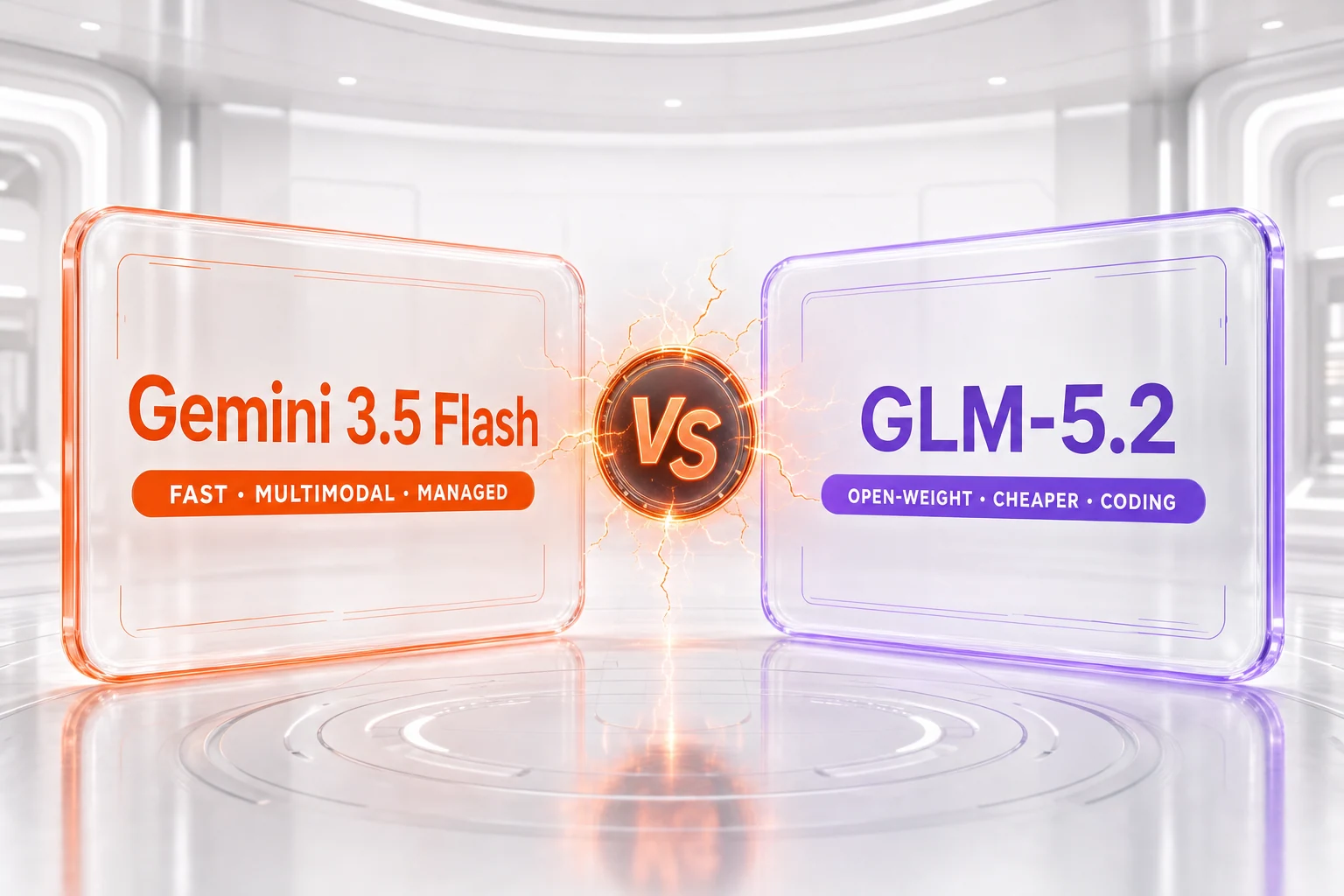
Feature Comparison
| Feature | Gemini 3.5 Flash | GLM-5.2 |
|---|---|---|
| Vendor / origin | Google DeepMind (United States) | Zhipu AI (China) |
| Weights / openness | Closed, managed API only | Open-weight, MIT license, on Hugging Face |
| Zero-ops managed access | Instant hosted API, no infrastructure | Self-host or z.ai API / subscription |
| Input price (per 1M tokens) | $1.50 | $1.40 |
| Output price (per 1M tokens) | $9.00 | $4.40 |
| Artificial Analysis Intelligence Index (v4.1) | 50 | 51 |
| Context window | 1,000,000 tokens | 1,000,000 tokens |
| Multimodal input | Native text, image, audio, video | Text (coding-focused) |
| Speed / latency | ~4x faster than frontier models | Standard flagship speed |
| Coding specialization | General-purpose fast model | Coding-first (SWE-bench Pro ~62%, vendor) |
| Architecture | Not disclosed (managed) | 753B MoE (~40B active), MIT weights |
Pricing Comparison
Gemini 3.5 Flash
GLM-5.2
Detailed Comparison
Gemini 3.5 Flash and GLM-5.2 are both current 2026 models with a 1,000,000-token context, but they are built for different jobs. Gemini 3.5 Flash is Google DeepMind’s fast, closed, fully managed flash model — generally available since May 19, 2026, priced at $1.50 per million input tokens and $9.00 per million output tokens (flat across the full context), with native multimodal input and roughly four-times-frontier speed. GLM-5.2 is Zhipu AI’s open-weight coding flagship — released June 13, 2026 as a 753B-parameter Mixture-of-Experts model (about 40B active per token) under an MIT license, priced at $1.40 per million input tokens and $4.40 per million output tokens. On the numbers, GLM-5.2 is cheaper on input and output and edges Gemini on the independent Artificial Analysis Intelligence Index (51 versus 50). Gemini answers back with speed, native multimodality, and a zero-ops managed API. We ran both side-by-side to map exactly where each one wins.
Quick Verdict
We ran both models side-by-side across coding, long-context, and general reasoning prompts. Here is the short version before the detail.
- Best for lowest token cost: GLM-5.2. It is cheaper on input ($1.40 versus $1.50 per million) and much cheaper on output ($4.40 versus $9.00 per million) — roughly half the output price.
- Best for speed and high-volume traffic: Gemini 3.5 Flash. Google positions it at roughly four times the speed of frontier-class models, which matters for latency-sensitive and real-time apps.
- Best independent intelligence score: GLM-5.2, narrowly — 51 versus 50 on the v4.1 Artificial Analysis Intelligence Index, both from the same independent source.
- Best for multimodal input: Gemini 3.5 Flash. It natively accepts text, image, audio, and video; GLM-5.2 is a text-first, coding-focused model.
- Best for open-weight freedom and self-hosting: GLM-5.2. MIT-licensed weights on Hugging Face let you download, fine-tune, and self-host. Gemini 3.5 Flash is closed and managed-only.
- Best for zero operational burden: Gemini 3.5 Flash. An instant managed API with no GPUs or inference to run, and flat pricing across the whole 1M-token context.
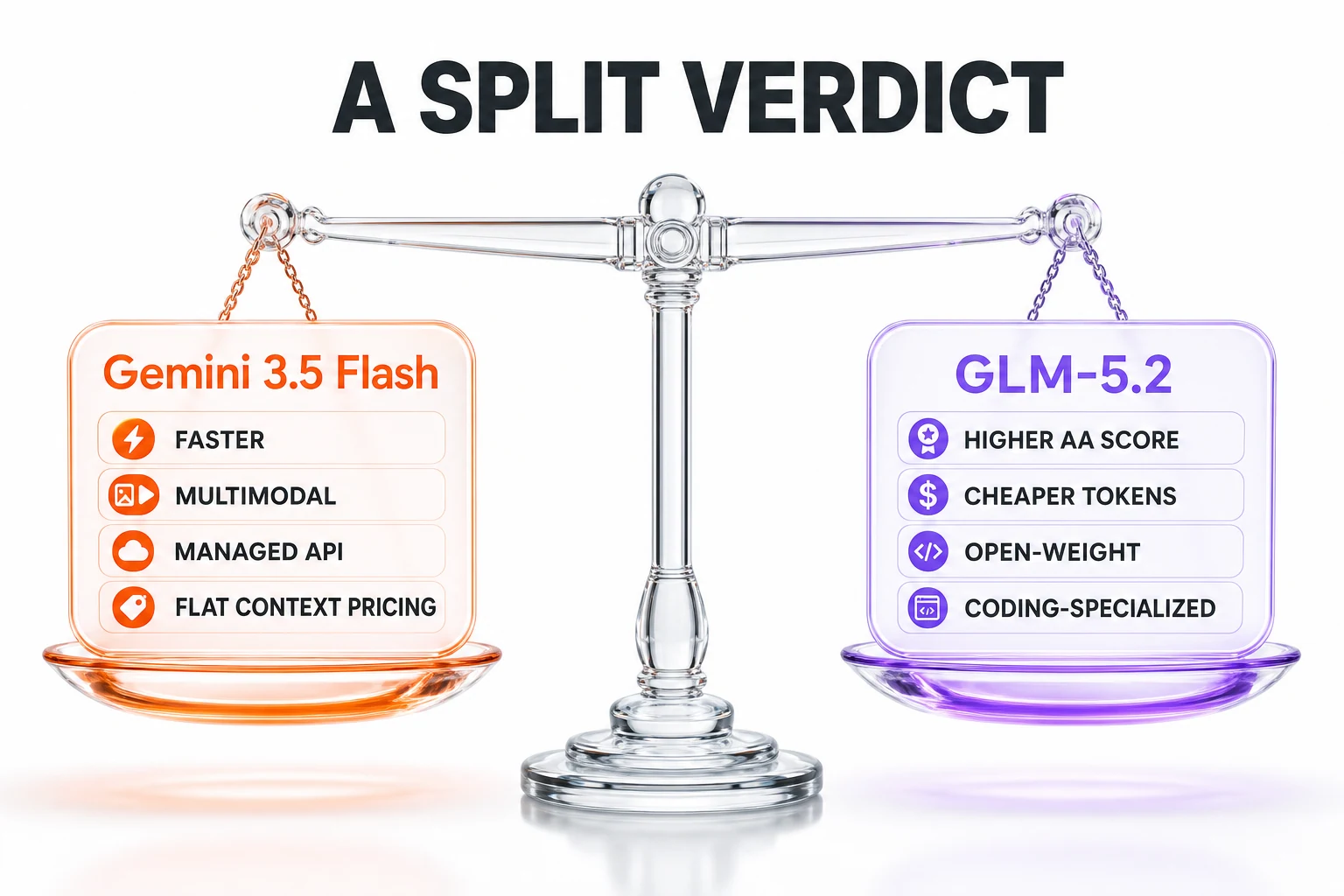
Our verdict: there is no single winner, because these two models are shaped for different problems. If the question is how do I get the lowest token cost and the option to own my stack, GLM-5.2 is the better pick, and it wins the raw numbers table. If the question is how do I ship a fast, multimodal, fully managed product without running any infrastructure, Gemini 3.5 Flash earns its place. Pick GLM-5.2 to minimize cost and self-host; pick Gemini 3.5 Flash for speed, multimodality, and zero ops.
Gemini 3.5 Flash and GLM-5.2 at a Glance
Gemini 3.5 Flash is Google DeepMind’s fast, general-purpose flash model, generally available since May 19, 2026. Its identity is speed and reach: Google positions it at roughly four times the throughput of frontier-class models, it accepts text, image, audio, and video input natively, and it ships as a closed, fully managed model through the Google AI API — there is nothing to download or self-host. Pricing is flat at $1.50 per million input tokens and $9.00 per million output tokens across the entire 1,000,000-token context, with cached input at $0.15 per million. On Google’s own reported agentic benchmarks it posts strong figures (Terminal-Bench 2.1 around 76.2 percent and MCP Atlas around 83.6 percent), though those are vendor numbers. You can read our full write-up on the Gemini 3.5 Flash tool page.
GLM-5.2 is the flagship coding model from Zhipu AI (z.ai), released June 13, 2026 as an open-weight Mixture-of-Experts model with roughly 753 billion total parameters and about 40 billion active per token. Its pitch is a coding-first, long-horizon model with a usable 1,000,000-token context and output generation up to 131,072 tokens. The weights are published on Hugging Face under an MIT license — unusually permissive for a model this size — so you can download, fine-tune, and self-host it commercially. API access is available directly from z.ai at $1.40 per million input tokens and $4.40 per million output tokens, or bundled into a GLM Coding Plan starting around $18 per month. Zhipu self-reports a SWE-bench Pro score of about 62 percent, a vendor figure we treat with the usual caution. See the full GLM-5.2 tool page for more.
Feature-by-Feature Comparison
Here is the side-by-side on the specifications and prices that actually drive the decision. The "Edge" column marks which model wins each row, or "Tie" where they are even.
| Feature | Gemini 3.5 Flash (Google) | GLM-5.2 (Zhipu) | Edge |
|---|---|---|---|
| Vendor / origin | Google DeepMind, United States | Zhipu AI (z.ai), China | Tie |
| Release / availability | GA May 19, 2026 | Released June 13, 2026 | Tie |
| Weights / openness | Closed, managed API only | Open-weight, MIT license, on Hugging Face | GLM-5.2 |
| Deployment | Google AI API only | Self-host or z.ai API / subscription | Split |
| Zero-ops managed access | Instant hosted API, no infrastructure | Requires z.ai API or self-hosted GPUs | Gemini 3.5 Flash |
| Input price (per 1M tokens) | $1.50 | $1.40 | GLM-5.2 |
| Output price (per 1M tokens) | $9.00 | $4.40 | GLM-5.2 |
| Cached input (per 1M tokens) | $0.15 | Not published | Gemini 3.5 Flash |
| Pricing shape | Flat across full context | Flat metered; $18 per month plan option | Tie |
| Artificial Analysis Intelligence Index (v4.1) | 50 | 51 | GLM-5.2 |
| Context window | 1,000,000 tokens | 1,000,000 tokens | Tie |
| Max output tokens | Not emphasized | 131,072 | GLM-5.2 |
| Multimodal input | Native text, image, audio, video | Text (coding-focused) | Gemini 3.5 Flash |
| Speed / latency | ~4x faster than frontier models | Standard flagship speed | Gemini 3.5 Flash |
| Coding specialization | General-purpose fast model | Coding-first | GLM-5.2 |
| Architecture | Not disclosed | 753B MoE (~40B active per token) | Tie |
Pricing Compared
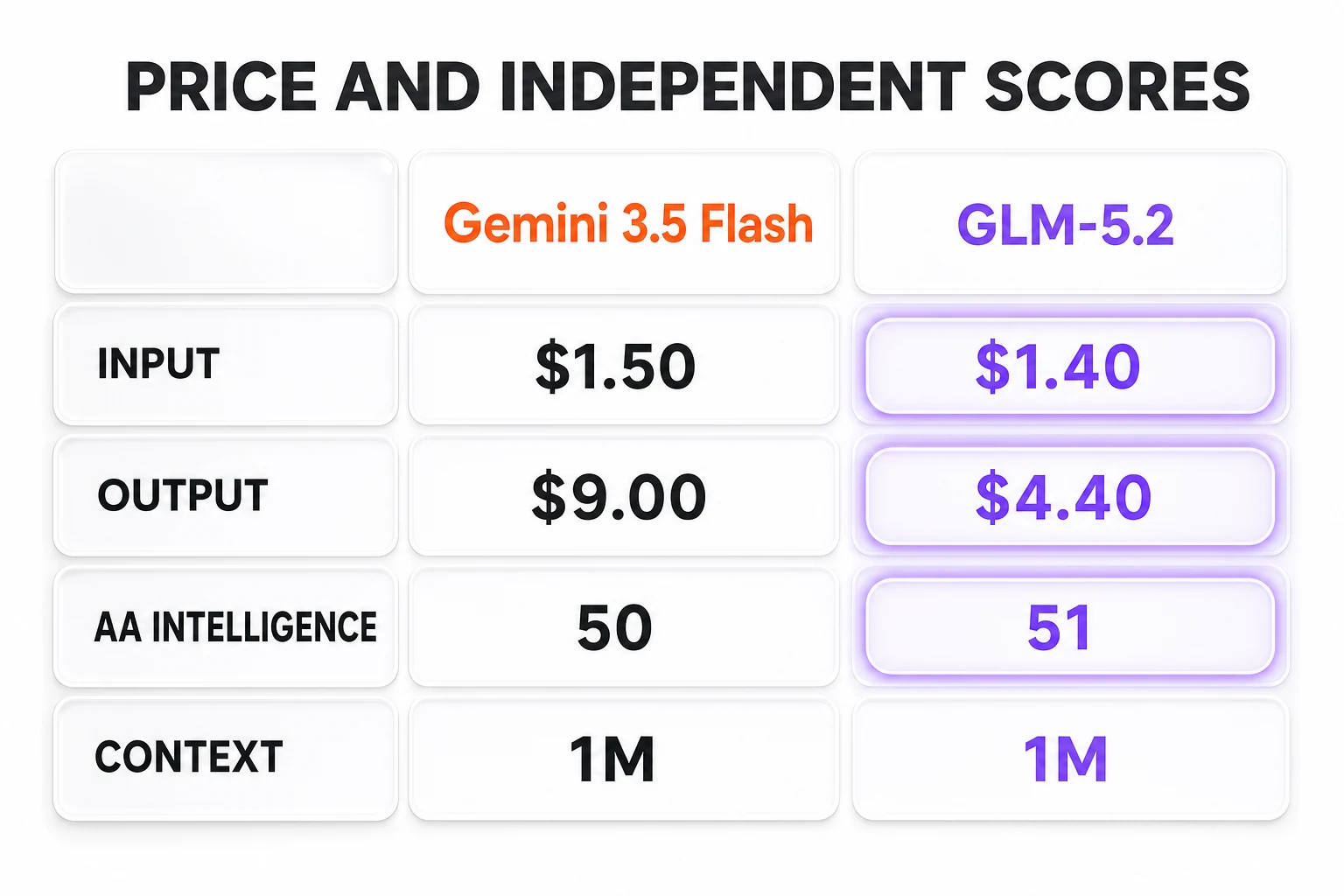
On the price sheet, GLM-5.2 is the cheaper model, and the gap widens on output tokens — the ones that dominate coding and agentic workloads.
- Gemini 3.5 Flash: $1.50 per million input tokens, $9.00 per million output tokens, and $0.15 per million cached input tokens. Pricing is flat across the full 1,000,000-token context, so there is no long-context surcharge to model. Access is metered through the Google AI API only.
- GLM-5.2: $1.40 per million input tokens and $4.40 per million output tokens through the z.ai API. Zhipu also offers a GLM Coding Plan starting around $18 per month for developers who prefer a subscription. Because the weights are MIT-licensed, a third option exists: self-host and pay only for your own compute.
The headline is output cost. At $4.40 versus $9.00 per million output tokens, GLM-5.2 is roughly half the price of Gemini 3.5 Flash on the tokens you generate most. On input the two are nearly level ($1.40 versus $1.50). If your workload is output-heavy — code generation, long agentic runs, verbose reasoning — GLM-5.2 will cost meaningfully less. Where Gemini 3.5 Flash answers back is predictability and reach: flat pricing across the entire context window and a cheap $0.15 cached-input rate make costs easy to forecast for high-volume, cache-friendly traffic.
A Cost Scenario
Because the input prices are nearly level and the output prices are not, the gap between these two models shows up on output-heavy work. Take a workload that generates 10 million output tokens in a month. Gemini 3.5 Flash bills $90.00 for that output (10 times $9.00 per million), while GLM-5.2 bills $44.00 (10 times $4.40 per million) — a $46.00 monthly difference on output alone, with GLM-5.2 costing roughly half. Now add 20 million input tokens to the same month: input runs $30.00 on Gemini 3.5 Flash (20 times $1.50) versus $28.00 on GLM-5.2 (20 times $1.40), a difference of just $2.00. The pattern is clear — input cost is close to a wash, and almost all of GLM-5.2’s savings come from cheaper output tokens. The more your application generates rather than reads, the more GLM-5.2’s price advantage compounds.
Speed and Throughput in Practice
Speed is the reason Gemini 3.5 Flash exists. Google built the Flash line for high-volume, latency-sensitive work, and positions 3.5 Flash at roughly four times the throughput of frontier-class models. In practice that shows up as snappier interactive responses, higher request ceilings before you hit rate limits, and lower tail latency on long generations. For a chat assistant, an autocomplete backend, a live agent that calls tools in a tight loop, or any product where a user is waiting on the response, that speed is a feature customers feel.
GLM-5.2 runs at standard flagship speed. It is not slow, but it does not claim a throughput advantage, and its design goal is depth on coding tasks rather than raw responsiveness. If your workload is batch-oriented — overnight code generation, offline document processing, asynchronous agent runs — speed matters far less and GLM-5.2’s lower token price becomes the dominant factor. The rule of thumb: the more a human is waiting in real time, the more Gemini 3.5 Flash’s speed earns its premium; the more the work happens in the background, the more GLM-5.2’s price wins.
Openness, Licensing, and Deployment
This is the starkest divide between the two. GLM-5.2 is open-weight under an MIT license, with the weights published on Hugging Face. That license is genuinely permissive: you can download the model, fine-tune it on your own data, and deploy it commercially without a separate negotiation. For teams with strict data-residency requirements, an air-gapped environment, or a desire to avoid per-token vendor lock-in, that freedom is decisive — you can run every token of inference inside your own network. The catch is operational: GLM-5.2 is a 753-billion-parameter Mixture-of-Experts model, and self-hosting it well requires serious GPU capacity and MLOps maturity. Many teams will therefore use z.ai’s hosted API or the GLM Coding Plan instead, keeping the open-weight option as insurance rather than the default path.
Gemini 3.5 Flash sits at the opposite end. It is closed and managed-only: there is no weight download and no self-hosting, and every request flows through Google’s API. What you give up in control you get back in convenience — no GPUs to provision, no inference stack to maintain, no model files to secure. For teams that would rather ship features than run infrastructure, that trade is often worth it. The one hard constraint to weigh on GLM-5.2’s side is provenance: some organizations operate under procurement or compliance rules that rule out a Chinese-lab model regardless of its quality or license, and where that rule applies, it settles the decision before performance ever enters the conversation.
Multimodality: What Gemini Unlocks
Gemini 3.5 Flash accepts text, image, audio, and video as input natively, in a single model, without bolting on a separate vision or speech pipeline. That unlocks whole categories of product that GLM-5.2 cannot serve on its own: analyzing screenshots or diagrams, transcribing and reasoning over audio, summarizing video, or building an agent that reads a user’s uploaded document images and acts on them. When multimodal input is part of the job, Gemini 3.5 Flash is not just the better choice — it is frequently the only one of the two that can do it.
GLM-5.2 is deliberately text- and code-centric. That focus is part of why it does well on coding tasks and keeps its pricing low, but it means image, audio, and video inputs are outside its lane. If your application is purely textual — code generation, document reasoning, chat over written content — you lose nothing by choosing GLM-5.2. The moment pixels or audio enter the workflow, the comparison stops being close.
Ecosystem, Tooling, and Support
Gemini 3.5 Flash arrives inside Google’s broad developer ecosystem: the Google AI and Vertex AI platforms, first-party SDKs, and integrations across Google’s tooling. For a team already building on Google Cloud, or one that values a single well-documented managed surface, that maturity lowers the cost of adoption and the risk of hitting an unsupported edge case. Support and documentation come from a large vendor with a long track record of shipping developer APIs.
GLM-5.2’s ecosystem is younger but growing quickly, and its openness is its own kind of ecosystem: because the weights are on Hugging Face under an MIT license, the model shows up across community tooling, inference frameworks, and third-party hosts, and you are never dependent on a single provider staying online. The trade is that first-party documentation and enterprise support are thinner than Google’s, and some integration work falls to you. For teams comfortable in the open-weight world, that is a familiar and acceptable trade; for teams that want a single vendor to call, Gemini 3.5 Flash’s managed ecosystem is the smoother road.
How We Compared Them
We ran Gemini 3.5 Flash and GLM-5.2 side-by-side on the same prompts — code generation and refactoring, long-context document reasoning, tool-use and agentic sequences, and general question answering — and cross-checked the quantitative claims against primary sources. Pricing figures were taken directly from Google’s official API pricing page and z.ai’s pricing documentation, not from third-party summaries. The intelligence scores (50 and 51) come from the independent Artificial Analysis Intelligence Index at version 4.1, which is the only apples-to-apples comparison we make on that axis.
One rule shaped this whole comparison: we never stack an independent score against a vendor score. Gemini 3.5 Flash’s agentic benchmark figures (Terminal-Bench and MCP Atlas) and GLM-5.2’s SWE-bench Pro figure are each self-reported by their own vendor, on different benchmarks, so we keep them apart and label them as vendor numbers. The one head-to-head number we trust as directly comparable is the v4.1 Artificial Analysis index, because it comes from the same independent source at the same version for both models.
Winner by Use Case
Because the two models diverge so cleanly, the honest answer is a set of category winners rather than one champion.
- Best for a cost-sensitive coding backend: GLM-5.2. Half the output-token price, a coding-first design, and the option to self-host make it the value pick for teams generating a lot of code.
- Best for latency-sensitive production apps: Gemini 3.5 Flash. Roughly four-times-frontier speed and a managed API keep real-time and high-volume traffic responsive.
- Best for multimodal products: Gemini 3.5 Flash. Native text, image, audio, and video input in one model is something GLM-5.2 does not match.
- Best for teams that want to own their stack: GLM-5.2. MIT-licensed weights on Hugging Face allow full self-hosting and fine-tuning.
- Best for zero-ops teams and predictable billing: Gemini 3.5 Flash. No infrastructure to run and flat pricing across the entire context window.
- Best raw intelligence per dollar: GLM-5.2. It leads on the independent index (51 versus 50) while costing less per token.
Three Teams, Three Choices
A startup shipping a real-time coding assistant. Users type and expect instant completions, and the product may need to read images of error screens. Here Gemini 3.5 Flash’s speed and native multimodality are the deciding factors; the higher output price is a cost the team accepts in exchange for responsiveness and zero infrastructure. Gemini 3.5 Flash is the pick.
A scale-up running large offline code-generation jobs. Millions of output tokens per day, mostly batch, no human waiting in the loop, and a finance team watching the API bill. GLM-5.2’s roughly half-price output tokens translate directly into a lower monthly invoice, and the batch nature means speed barely matters. If the team can self-host, the savings grow further. GLM-5.2 is the pick.
An enterprise with strict data-residency rules. Every token must stay inside the company’s own network, and procurement has opinions about model provenance. If a Chinese-lab model is permitted, GLM-5.2’s MIT-licensed weights let the team self-host and keep data in-house — a capability Gemini 3.5 Flash simply cannot offer. If provenance rules rule GLM-5.2 out, the calculus flips entirely and a managed model like Gemini 3.5 Flash becomes the only viable path. Here the constraint, not the benchmark, decides.
Pros and Cons
Gemini 3.5 Flash
Pros
- Very fast — roughly 4x the speed of frontier-class models
- Native multimodal input: text, image, audio, and video
- Fully managed API with zero operational burden
- Flat pricing across the entire 1M-token context, plus cheap $0.15 cached input
- Backed by Google’s ecosystem and tooling
Cons
- Roughly double the output-token price of GLM-5.2 ($9.00 versus $4.40 per million)
- Closed and managed-only — no weight download or self-hosting
- Slightly behind on the independent Artificial Analysis index (50 versus 51)
- General-purpose rather than coding-specialized
- Architecture and parameter counts are not disclosed
GLM-5.2
Pros
- Cheaper on both input and output tokens ($1.40 and $4.40 per million)
- Open-weight under a permissive MIT license on Hugging Face
- Full self-hosting and fine-tuning possible
- Leads the independent Artificial Analysis Intelligence Index (51 versus 50)
- Coding-specialized, with output up to 131,072 tokens
Cons
- Not multimodal — text and code focused, no native image, audio, or video input
- Standard speed; no throughput advantage over Gemini 3.5 Flash
- Chinese-lab origin may be blocked by some procurement or compliance policies
- Self-hosting a 753B MoE model requires serious GPU resources
- SWE-bench Pro figure is vendor self-reported, not independently verified
When to Pick Which
Pick Gemini 3.5 Flash when your product is latency-sensitive or high-volume, when you need native multimodal input across text, image, audio, and video, or when you want a fully managed model with no infrastructure to run and flat, predictable pricing. It is the pragmatic default for teams that value speed and zero operational overhead over squeezing out the last cent per token, and for any workload where images, audio, or video sit alongside text.
Pick GLM-5.2 when your priority is the lowest possible token cost, a coding-first model, or the freedom to download the weights and own your inference stack. It is the value and control pick: cheaper output tokens, a marginally higher independent intelligence score, and an MIT license that lets you self-host and fine-tune. The main caveats are that it is text-focused rather than multimodal, and that some organizations cannot deploy a Chinese-lab model regardless of quality. If either of those is a hard constraint, that alone decides the choice.
Frequently Asked Questions
Is GLM-5.2 cheaper than Gemini 3.5 Flash?
Yes, on both input and output tokens. GLM-5.2 costs $1.40 per million input tokens and $4.40 per million output tokens on the z.ai API, while Gemini 3.5 Flash costs $1.50 per million input tokens and $9.00 per million output tokens. The gap is small on input but large on output, where GLM-5.2 is roughly half the price. Because coding and agentic workloads are output-heavy, GLM-5.2 is the cheaper model in most real-world usage.
Which scores higher on the Artificial Analysis Intelligence Index?
GLM-5.2 scores 51 and Gemini 3.5 Flash scores 50 on the v4.1 Artificial Analysis Intelligence Index. Both numbers come from the same independent index and the same version, so they are directly comparable. The one-point gap is narrow enough that neither model is meaningfully smarter than the other on this composite measure.
Is Gemini 3.5 Flash faster than GLM-5.2?
Yes. Speed is the core of Gemini 3.5 Flash’s identity: Google positions it as running roughly four times faster than frontier-class models, which makes it well suited to latency-sensitive and high-volume workloads. GLM-5.2 runs at standard flagship speeds. If your application needs fast responses at scale, Gemini 3.5 Flash has the clear edge.
Can I self-host GLM-5.2?
Yes. Zhipu AI publishes GLM-5.2’s weights on Hugging Face under an MIT license, so you can download, fine-tune, and run it on your own GPUs. It is a Mixture-of-Experts model with roughly 753 billion total parameters and about 40 billion active per token, so self-hosting requires serious GPU resources. Gemini 3.5 Flash cannot be self-hosted at all — it is a closed, managed model available only through Google’s API.
Is Gemini 3.5 Flash multimodal?
Yes, natively. Gemini 3.5 Flash accepts text, image, audio, and video input in a single managed model, which is a genuine advantage for building multimodal applications. GLM-5.2 is a coding-first, text-centric model. If your product needs to reason over images, audio, or video alongside text, Gemini 3.5 Flash is the better fit.
What is the context window of each model?
Both models have a 1,000,000-token context window, so they are tied on raw capacity. GLM-5.2 additionally supports output generation of up to 131,072 tokens in a single response. In practice both comfortably handle large codebases, long documents, and extended agentic sessions, so context size is not a meaningful differentiator between them.
Is GLM-5.2 better for coding than Gemini 3.5 Flash?
GLM-5.2 is a coding-specialized model, and Zhipu self-reports a SWE-bench Pro score of about 62 percent (a vendor number, not independently verified). Gemini 3.5 Flash is a general-purpose fast model rather than a coding specialist. For dedicated coding and agentic-engineering work, GLM-5.2 is built for the job; Gemini 3.5 Flash is the stronger pick when coding is only one part of a broader, latency-sensitive or multimodal workload.
Does Gemini 3.5 Flash charge more for long context?
No. Gemini 3.5 Flash uses a flat rate of $1.50 per million input tokens and $9.00 per million output tokens across the full 1,000,000-token context, with no tiered long-context surcharge. Cached input is billed at $0.15 per million tokens. That predictable, flat pricing is convenient for long-context and high-volume applications where per-request token counts are hard to forecast.
When did each model launch?
Gemini 3.5 Flash became generally available on May 19, 2026. GLM-5.2 was released on June 13, 2026, with its MIT-licensed weights posted to Hugging Face shortly after. Both are current 2026 releases, so this is a comparison of two contemporaries rather than a new model against an older one.
Are the benchmark numbers independently verified?
Partly. The Artificial Analysis Intelligence Index scores (50 for Gemini 3.5 Flash, 51 for GLM-5.2) come from an independent third party on the same v4.1 index, so we compare them directly. The task-specific benchmark figures — GLM-5.2’s SWE-bench Pro and Gemini 3.5 Flash’s Terminal-Bench and MCP Atlas numbers — are self-reported by each vendor. We keep those vendor numbers separate and never stack an independent score against a vendor score, because that comparison would be misleading.
Which should I pick for a latency-sensitive production app?
Gemini 3.5 Flash. Its roughly four-times-faster throughput, native multimodal input, and fully managed API with no infrastructure to run make it the more practical choice for real-time or high-volume production traffic. GLM-5.2 can match it on intelligence and beat it on token price, but you would be trading away speed and managed convenience to get there.
Which is the better value overall?
It depends on what you are optimizing for. On pure token cost and independent intelligence, GLM-5.2 is the better value: it is cheaper on input and output and edges Gemini 3.5 Flash on the Artificial Analysis index. On total cost of ownership — factoring in speed, native multimodality, and zero operational burden — Gemini 3.5 Flash can be the better value for teams that cannot or will not run their own inference. There is no single winner; the value question resolves differently for a cost-driven coding backend than for a managed, latency-sensitive product.
Final Verdict
Gemini 3.5 Flash and GLM-5.2 are close in raw capability and far apart in shape, which is why there is no single winner. On the numbers table, GLM-5.2 wins: it is cheaper on input ($1.40 versus $1.50 per million) and roughly half the price on output ($4.40 versus $9.00 per million), it edges Gemini on the independent v4.1 Artificial Analysis Intelligence Index (51 versus 50), it ships open-weight under an MIT license for full self-hosting, and it is built for coding. That is a real, factual advantage, and we are not going to soften it.
But the numbers table is not the whole product. Gemini 3.5 Flash wins on the axes that decide many real deployments: it runs roughly four times faster than frontier-class models, it accepts text, image, audio, and video natively, it removes all operational burden with a managed API, and it charges a flat rate across the entire 1M-token context. For a latency-sensitive, multimodal, or zero-ops product, those advantages outweigh a lower per-token price.
Our bottom line: pick GLM-5.2 to minimize token cost and own your stack; pick Gemini 3.5 Flash for speed, multimodality, and a fully managed product. Cross-shopping the wider field is worth it too — GLM-5.2 also faces off against closed flagships in GLM-5.2 vs GPT-5.5 and GPT-5.6 Sol vs GLM-5.2, against Anthropic in Claude Sonnet 5 vs GLM-5.2, and another open model in GLM-5.2 vs DeepSeek V4. For the broader shortlist, see our best AI coding tools of 2026.
Sources and references
Every figure on this page is attributed to whoever produced it. Vendor documentation and independent measurement are listed separately and never merged into a single ranking.
- Hugging Face — zai-org/GLM-5.2 (published weights and license)
- Artificial Analysis — GLM-5.2 (independent index score and cost per task)
- Artificial Analysis — Gemini 3.5 Flash (independent index score)
- Artificial Analysis — Model leaderboard (Intelligence Index scores and cost per task across configurations)
Our Verdict
There is no single winner — Gemini 3.5 Flash and GLM-5.2 answer different questions. GLM-5.2 wins the numbers table: it is cheaper on both input and output tokens ($1.40 and $4.40 per million versus $1.50 and $9.00), edges Gemini on the independent Artificial Analysis Intelligence Index (51 versus 50), ships open-weight under an MIT license for full self-hosting, and is coding-specialized. Gemini 3.5 Flash wins on speed (roughly 4x faster than frontier models), native multimodal input across text, image, audio, and video, an instant fully managed API with zero operational burden, and flat pricing across the entire 1M-token context. Pick GLM-5.2 to minimize token cost and own your stack; pick Gemini 3.5 Flash for latency-sensitive, multimodal, or zero-ops production workloads.
Choose Gemini 3.5 Flash
Google DeepMind's generally available fast tier — frontier-adjacent intelligence at roughly four times the speed, with a 1M-token context window and native multimodal input.
Try Gemini 3.5 Flash →Choose GLM-5.2
Zhipu AI open-weight coding flagship: 753B MoE (~40B active), 1M context, MIT license, headline SWE-bench Pro 62.1 (vendor self-reported); GLM Coding Plan from around $18 per month or $1.40 in / $4.40 out per million tokens.
Try GLM-5.2 →Frequently Asked Questions
Is Gemini 3.5 Flash better than GLM-5.2?
There is no single winner — Gemini 3.5 Flash and GLM-5.2 answer different questions. GLM-5.2 wins the numbers table: it is cheaper on both input and output tokens ($1.40 and $4.40 per million versus $1.50 and $9.00), edges Gemini on the independent Artificial Analysis Intelligence Index (51 versus 50), ships open-weight under an MIT license for full self-hosting, and is coding-specialized. Gemini 3.5 Flash wins on speed (roughly 4x faster than frontier models), native multimodal input across text, image, audio, and video, an instant fully managed API with zero operational burden, and flat pricing across the entire 1M-token context. Pick GLM-5.2 to minimize token cost and own your stack; pick Gemini 3.5 Flash for latency-sensitive, multimodal, or zero-ops production workloads.
Which is cheaper, Gemini 3.5 Flash or GLM-5.2?
Gemini 3.5 Flash starts at $1.5 in / $9 out per M tokens (free plan available). GLM-5.2 starts at $1.4 in / $4.4 out per M tokens. Check the pricing comparison section above for a full breakdown.
What are the main differences between Gemini 3.5 Flash and GLM-5.2?
The key differences span across 11 features we compared. For Vendor / origin, Gemini 3.5 Flash offers Google DeepMind (United States) while GLM-5.2 offers Zhipu AI (China). For Weights / openness, Gemini 3.5 Flash offers Closed, managed API only while GLM-5.2 offers Open-weight, MIT license, on Hugging Face. For Zero-ops managed access, Gemini 3.5 Flash offers Instant hosted API, no infrastructure while GLM-5.2 offers Self-host or z.ai API / subscription. See the full feature comparison table above for all details.