Gemini 3.5 Flash vs Muse Spark 1.1: Better on Paper vs Available Now (2026)
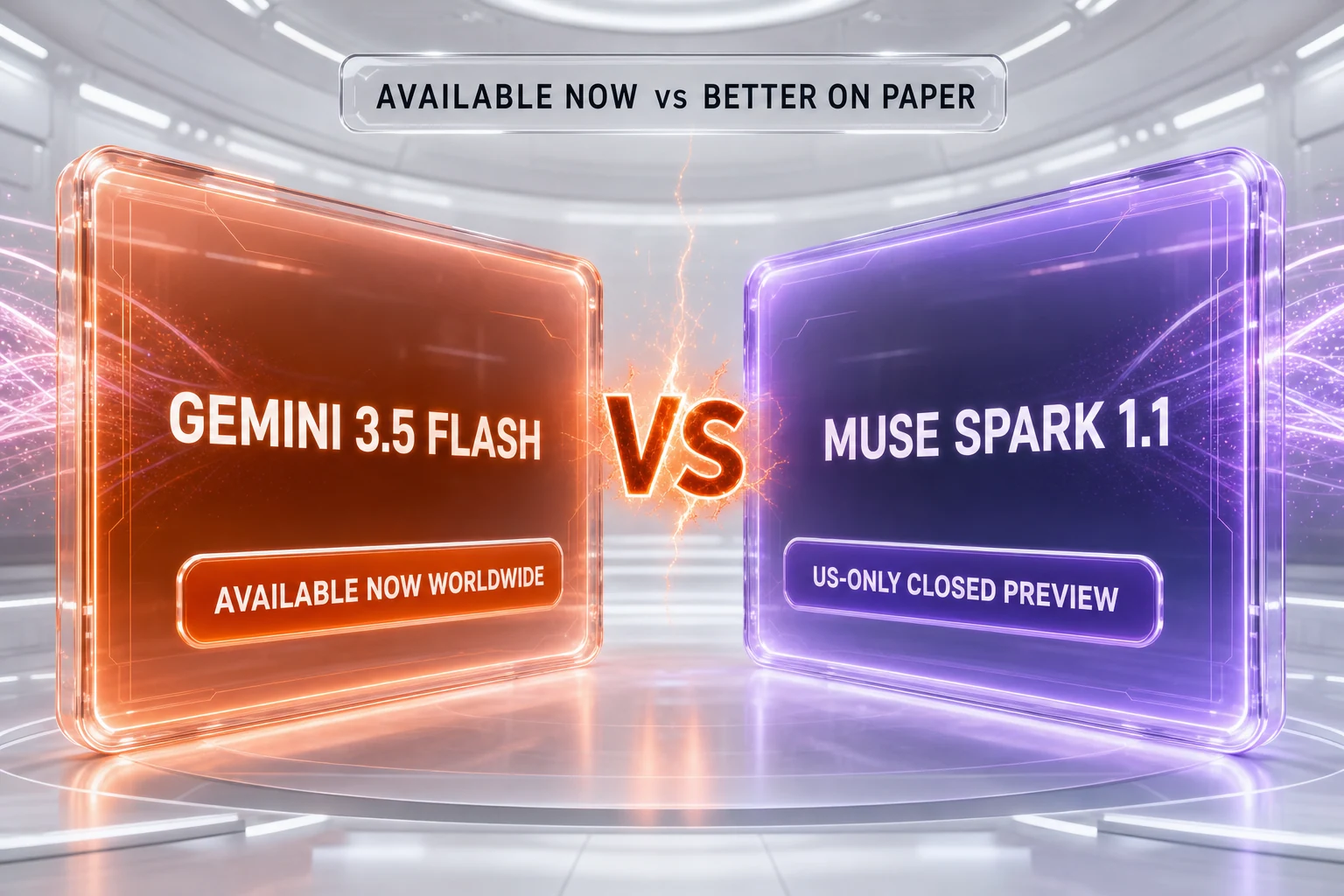
Muse Spark 1.1 scores higher (51 to 50) and costs less, but it is a US-only closed preview. Gemini 3.5 Flash is worldwide and fast. Our split 2026 verdict.
Feature Comparison
| Feature | Gemini 3.5 Flash | Muse Spark 1.1 |
|---|---|---|
| API input price (per million tokens) | $1.50 (verified) | $1.25 (verified) |
| API output price (per million tokens) | $9.00 (verified) | $4.25 (verified) |
| Cached input price (per million tokens) | $0.15 (verified, 90% discount) | Not published |
| AA Intelligence Index v4.1 (independent, head-to-head) | 50 | 51 |
| Free access on signup | Free tier in the Gemini app and AI Studio | $20 in free credits (US waitlist) |
| Context window | 1,048,576 tokens | 1,000,000 tokens |
| Max output tokens | 65,536 (published) | Not published |
| Public availability | Generally available worldwide, day one | US-only public preview, waitlist |
| Model weights | Closed, hosted API only | Closed, hosted API only |
| Speed positioning | ~4x flagship throughput (fast tier; Google-stated) | No throughput figure in our sources |
| Native input modalities | Text, image, audio, video, files | Multimodal reasoning (modalities not fully enumerated) |
| Agentic tooling | Function calling, structured output, Search grounding | Tool use, computer use, parallel tool calling, OpenAI-compatible |
| Distribution surfaces | Gemini API, AI Studio, Vertex AI, Gemini app, AI Mode in Search | Meta Model API only |
| Platform maturity / track record | Established Google and Vertex platform, production service level | Meta's first paid API, no track record yet |
| Vendor-reported benchmarks (Google) | Terminal-Bench 2.1 76.2%, MCP Atlas 83.6%, CharXiv 84.2% (Google-reported) | Not reported on these suites |
| Independent deltas vs prior model (Artificial Analysis) | New model line (no prior-model delta) | SciCode 52% to 58%, HLE 40% to 45%, +12 Coding Index (AA, vs original) |
Pricing Comparison
Gemini 3.5 Flash
Muse Spark 1.1
Detailed Comparison
Gemini 3.5 Flash and Muse Spark 1.1 are the two models compared here, and the honest answer is a split. Gemini 3.5 Flash is Google DeepMind's generally available fast tier, launched worldwide at Google I/O on May 19, 2026, priced at $1.50 per million input tokens and $9.00 per million output tokens, with a 1,048,576-token context window and a design built for roughly four times flagship speed. Muse Spark 1.1 is Meta Superintelligence Labs' second model, released July 9, 2026, priced lower at $1.25 per million input and $4.25 per million output tokens, with a 1,000,000-token context window. On the one independent head-to-head number, the Artificial Analysis Intelligence Index v4.1, Muse Spark 1.1 scores 51 to Gemini 3.5 Flash's 50 — a single point. Muse also wins the rate card on both input and output. But Muse Spark 1.1 is a US-only public preview behind a waitlist, while Gemini 3.5 Flash is generally available worldwide across Google's platforms today. Best on paper — a point higher and cheaper: Muse Spark 1.1. Best you can actually deploy now, everywhere, and fast: Gemini 3.5 Flash.
Quick Verdict
This is a split verdict, and the split is unusual: Muse Spark 1.1 wins almost every number on the page — a point higher on the independent intelligence index and cheaper on both input and output — yet Gemini 3.5 Flash is the model most readers can actually use today, because Muse Spark 1.1 is a US-only closed preview behind a waitlist and Gemini 3.5 Flash is generally available worldwide. We treat these two very differently on evidence, and we say so up front. Gemini 3.5 Flash has been generally available since May 19, 2026, so we have run it hands-on through the Gemini API. Muse Spark 1.1 launched July 9, 2026 as a gated US-only preview, so we could not test it at the depth we tested Gemini; our read on Muse is research-led, built from the independent Artificial Analysis benchmarks, Meta's own documentation, and limited preview access. Every figure below carries its source, and we keep independent numbers and vendor-reported numbers strictly apart. Here is the short version.
- Best on the one independent head-to-head score: Muse Spark 1.1, by a single point. It scores 51 on the Artificial Analysis Intelligence Index v4.1 to Gemini 3.5 Flash's 50 — close enough that we treat it as an edge, not a gap.
- Best token price: Muse Spark 1.1, on both sides. At $1.25 per million input and $4.25 per million output tokens it undercuts Gemini 3.5 Flash's $1.50 and $9.00 — and the output gap is the big one, at roughly half.
- Best for agentic tooling by design: Muse Spark 1.1. It is purpose-built for tool use, computer use, and coding through an OpenAI-compatible API with parallel tool calling; Gemini 3.5 Flash offers function calling, structured output, and Search grounding.
- Best availability, by a wide margin: Gemini 3.5 Flash. It is generally available worldwide across the Gemini API, AI Studio, Vertex AI, the Gemini app, and AI Mode in Search. Muse Spark 1.1 is a US-only preview with a waitlist.
- Best for speed: Gemini 3.5 Flash. Its entire design goal is roughly four times flagship throughput at the fast tier — the one thing Muse Spark 1.1 makes no comparable claim about.
- Best input breadth: Gemini 3.5 Flash. It takes native text, image, audio, video, and files; Muse Spark 1.1 is described as multimodal reasoning without a fully enumerated modality list.
- Best distribution and maturity: Gemini 3.5 Flash. It runs on Google's established Vertex and AI Studio stack with a production service level; Muse Spark 1.1 is Meta's first paid API and has no track record yet.
- Best cached-input economics: Gemini 3.5 Flash. It documents a 90 percent cached-input discount at $0.15 per million tokens; Muse Spark 1.1 publishes no cached rate in our sources.
The honest caveats up front: the two models are not measured on equal footing here, and pretending otherwise would mislead you. Gemini 3.5 Flash is a mature, generally available product we have used directly. Muse Spark 1.1 is a week-old, US-only closed preview we could not put through the same paces, so our Muse assessment leans on attributed third-party benchmarks and Meta's documentation rather than deep hands-on. We only call a benchmark winner where both models were measured on the same independent suite — which, in practice, is the Artificial Analysis Intelligence Index and little else. We do not stack a vendor's self-reported benchmark against an independent one, and we flag the access gap as the single most important practical fact in this matchup, because for most readers it decides the choice before any score does.
Gemini 3.5 Flash vs Muse Spark 1.1 — Overview
What Is Gemini 3.5 Flash?
Gemini 3.5 Flash is the generally available fast tier of Google DeepMind's Gemini line, launched at Google I/O on May 19, 2026 and available to build on the same day, as we covered in our Gemini 3.5 Flash launch report. In Google's lineup, Flash is the tier tuned for speed and cost rather than peak reasoning: it aims to deliver frontier-adjacent intelligence at roughly four times flagship throughput, which is its whole reason to exist. Per Google's Gemini API documentation, it runs a 1,048,576-token input context window with up to 65,536 output tokens, takes native multimodal input across text, image, audio, video, and files, and supports function calling, structured output, and Google Search grounding. API pricing is $1.50 per million input tokens and $9.00 per million output tokens, with a 90 percent cached-input discount at $0.15 per million. It is important not to confuse it with the cheaper Gemini 3 Flash Preview, a separate and less capable model priced at $0.50 input and $3.00 output per million tokens; the 3.5 Flash reviewed here is the pricier, more capable general-availability model. On the independent Artificial Analysis Intelligence Index v4.1, Gemini 3.5 Flash scores 50 — a figure worth pinning down, because an older 55 from a prior version of that index still circulates. We test native computer use and its place in the agentic field in our Gemini 3.5 Flash computer-use analysis.
What Is Muse Spark 1.1?
Muse Spark 1.1 is the second model from Meta Superintelligence Labs and its first paid API, released July 9, 2026 as an upgrade to the original Muse Spark from April, as we detailed in our Muse Spark launch coverage. It matters as much for what it represents as for what it scores: Muse Spark is Meta's pivot to closed weights after abandoning the open-weight Llama line, a reversal we unpacked in our explainer on Meta ending open-source Llama. Per Meta's Meta Model API documentation, Muse Spark 1.1 runs a 1,000,000-token context window, is built for agentic work — tool use, computer use, and coding — and is exposed through an OpenAI-compatible endpoint with structured output and parallel tool calling. API pricing is $1.25 per million input tokens and $4.25 per million output tokens, with $20 in free credits for new accounts. On the independent Artificial Analysis Intelligence Index v4.1 it scores 51 in xhigh mode, a clear jump from the original Muse Spark's 43, and Artificial Analysis reports meaningful gains over that original — a 12-point higher Coding Index, SciCode up from 52 to 58 percent, and Humanity's Last Exam up from 40 to 45 percent. The one hard limitation sits outside the spec sheet: Muse Spark 1.1 is a US-only public preview behind a waitlist at launch, so most of the world cannot use it yet, and its weights are closed, so there is no self-hosting path either.
How We Compared Them — and the Access Gap We Have to Disclose
Method transparency matters more than usual here, because the two models are not equally testable and the benchmark discourse mixes independent and vendor numbers freely. Here is exactly what we did, what we could not do, and why.
- The access asymmetry, stated plainly: Gemini 3.5 Flash has been generally available worldwide since May 19, 2026, so we have run it hands-on through the Gemini API on our own workloads. Muse Spark 1.1 is a US-only public preview behind a waitlist, released July 9, 2026, so we could not subject it to the same depth of testing. Our Muse Spark assessment is therefore research-led: it draws on independent benchmarks, Meta's documentation, and limited preview access rather than the sustained hands-on we have with Gemini. We would rather tell you that than imply a symmetry that does not exist.
- Pricing: both rate cards are vendor-verified from primary sources. Gemini 3.5 Flash's $1.50 input, $9.00 output, and $0.15 cached input per million tokens come from Google's Gemini API documentation; Muse Spark 1.1's $1.25 input and $4.25 output per million tokens come from Meta's Meta Model API documentation. No relayed figures. Our AI model pricing explainer breaks down how input, output, and cached-token rates turn into real bills.
- Independent benchmarks: we lean on Artificial Analysis, and we use its Intelligence Index v4.1 as the one head-to-head number where both models were measured on the same version of the same suite — 50 for Gemini 3.5 Flash, 51 for Muse Spark 1.1. We deliberately version-match: an older Gemini figure of 55 comes from a prior release of that index and is not comparable to a v4.1 score, so we do not use it.
- Self-reported and one-sided figures: Google's Terminal-Bench 2.1, MCP Atlas, and CharXiv numbers for Gemini 3.5 Flash are vendor-reported and labeled as such; Muse Spark 1.1's SciCode, Humanity's Last Exam, and Coding Index gains are Artificial Analysis figures measured against the original Muse Spark, not against Gemini. Because these sets cover different suites from different sources, we present them separately and do not treat either as head-to-head evidence. Our agentic coding model explainer covers why agent scores and chatbot scores measure different things.
- Disclosure: we have no affiliate relationship with Google or Meta, and there are no sponsored links on this page. We flag Muse Spark 1.1's US-only preview status prominently because it is a hard gate for most readers, not a footnote.
Features and Benchmarks Comparison
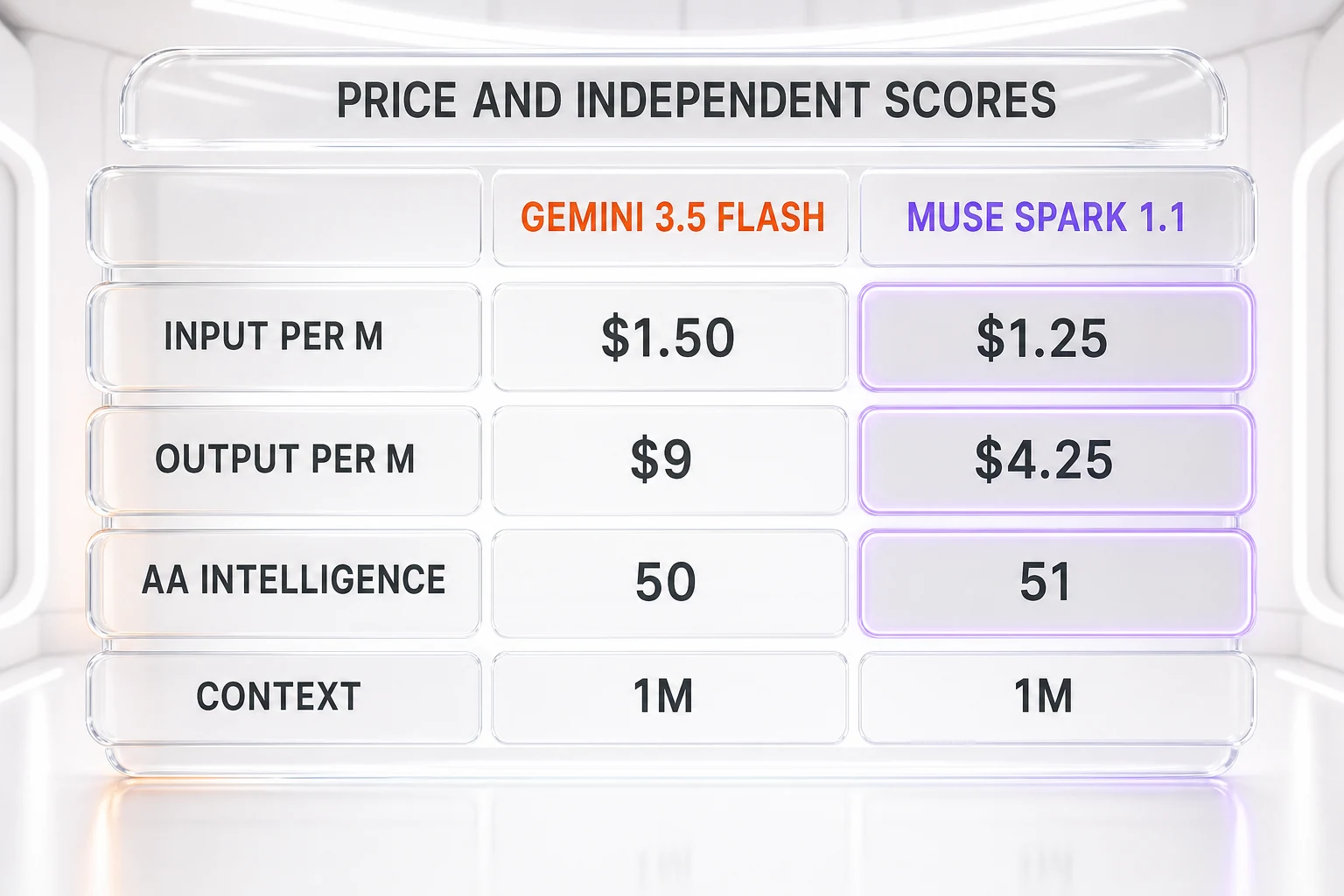
The table below lists every dimension we could verify or attribute. Read the Winner column carefully: it distinguishes vendor-verified pricing, the one independent head-to-head score, and one-sided or vendor-reported figures, and it flags where a result is genuinely tied or not comparable. The single independent head-to-head number is the Artificial Analysis Intelligence Index v4.1; the source for it is Artificial Analysis.
| Feature | Gemini 3.5 Flash | Muse Spark 1.1 | Winner |
|---|---|---|---|
| API input price (per million tokens) | $1.50 (verified) | $1.25 (verified) | Muse Spark 1.1 |
| API output price (per million tokens) | $9.00 (verified) | $4.25 (verified) | Muse Spark 1.1 |
| Cached input price (per million tokens) | $0.15 (verified, 90% discount) | Not published | Gemini 3.5 Flash (where published) |
| AA Intelligence Index v4.1 (independent, head-to-head) | 50 | 51 | Muse Spark 1.1 (by 1 point) |
| Free access on signup | Free tier in the Gemini app and AI Studio | $20 in free credits (US waitlist) | Tie |
| Context window | 1,048,576 tokens | 1,000,000 tokens | Tie |
| Max output tokens | 65,536 (published) | Not published | Gemini 3.5 Flash (where published) |
| Public availability | Generally available worldwide, day one | US-only public preview, waitlist | Gemini 3.5 Flash |
| Model weights | Closed, hosted API only | Closed, hosted API only | Tie |
| Speed positioning | ~4x flagship throughput (fast tier; Google-stated) | No throughput figure in our sources | Gemini 3.5 Flash (design goal) |
| Native input modalities | Text, image, audio, video, files | Multimodal reasoning (modalities not fully enumerated) | Gemini 3.5 Flash |
| Agentic tooling | Function calling, structured output, Search grounding | Tool use, computer use, parallel tool calling, OpenAI-compatible | Muse Spark 1.1 |
| Distribution surfaces | Gemini API, AI Studio, Vertex AI, Gemini app, AI Mode in Search | Meta Model API only | Gemini 3.5 Flash |
| Platform maturity / track record | Established Google and Vertex platform, production service level | Meta's first paid API, no track record yet | Gemini 3.5 Flash |
| Vendor-reported benchmarks (Google) | Terminal-Bench 2.1 76.2%, MCP Atlas 83.6%, CharXiv 84.2% (Google-reported) | Not reported on these suites | Not comparable (vendor-reported) |
| Independent deltas vs prior model (Artificial Analysis) | New model line (no prior-model delta) | SciCode 52% to 58%, HLE 40% to 45%, +12 Coding Index (AA, vs original) | Not comparable (different baseline) |
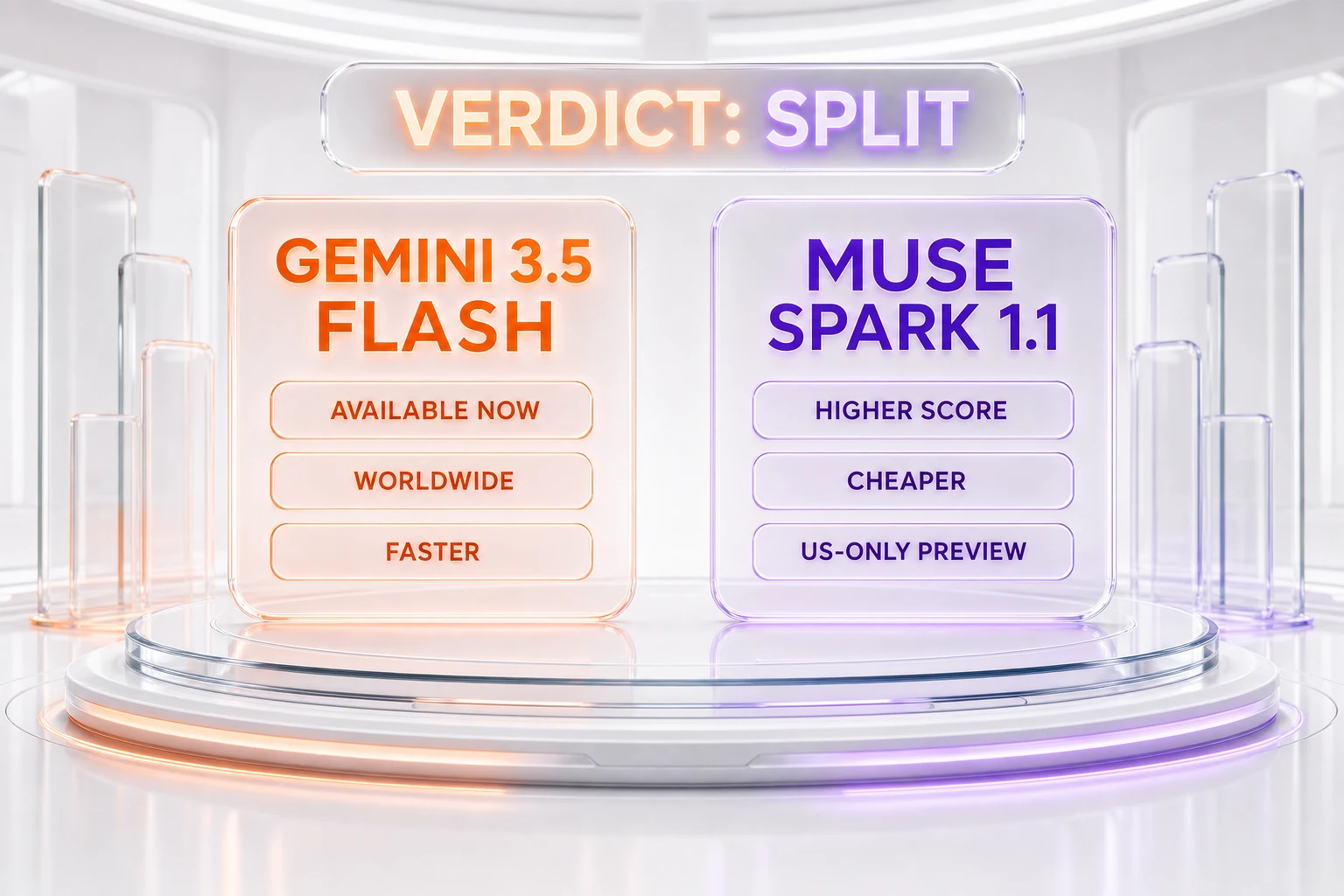
Synthesis: the number-by-number read tilts to Muse Spark 1.1, and the infographic above shows it honestly — it wins the input rate, the output rate, and the single independent head-to-head score, with context a dead tie at one million tokens each. But two structural facts sit outside the priced rows and can decide the whole thing on their own. First, Gemini 3.5 Flash is generally available worldwide today, while Muse Spark 1.1 is a US-only closed preview behind a waitlist — a difference between a model you can ship on this afternoon and one most teams cannot access at all. Second, speed is Gemini 3.5 Flash's entire design premise at roughly four times flagship throughput, a dimension Muse Spark 1.1 makes no comparable claim about. This is not a case of one model that wins everything against one that wins nothing; it is a better-on-paper contender you may not be able to use against a fast, worldwide, deployable-today workhorse that scores a point lower and costs a little more.
Pricing — Gemini 3.5 Flash vs Muse Spark 1.1 in 2026
Pricing favors Muse Spark 1.1 on the rate card, clearly and on both sides — but the rate card only matters if you can get access, and Muse Spark 1.1's US-only waitlist means many readers cannot. Both rate cards below come straight from the vendors' own documentation, and our pricing explainer covers how input, output, and cached rates translate into real spend.
Gemini 3.5 Flash Pricing
| Tier | Input (per million tokens) | Output (per million tokens) | Notes |
|---|---|---|---|
| Standard API | $1.50 | $9.00 | Verified on Google's Gemini API documentation |
| Cached input | $0.15 | — | 90 percent discount, verified |
| Free tier | $0.00 | $0.00 | Rate-limited access in the Gemini app and AI Studio |
Gemini 3.5 Flash bills at a flat per-token rate with no long-context surcharge, so a 900,000-token request costs the same per token as a short one. The consumer-facing free tier through the Gemini app and AI Studio is genuinely useful for evaluation before you touch the paid API.
Muse Spark 1.1 Pricing
| Tier | Input (per million tokens) | Output (per million tokens) | Notes |
|---|---|---|---|
| Standard API | $1.25 | $4.25 | Verified on Meta's Meta Model API documentation |
| New-account credits | $20 in free credits | For new accounts (US waitlist) | |
| Availability | US-only public preview, waitlist | Meta Model API only |
Pricing verdict: Muse Spark 1.1 wins the rate card on both sides, and the output side is where it hurts. On a representative agentic call of 50,000 input tokens and 5,000 output tokens, Muse Spark 1.1 costs about $0.084 at the rate card ($1.25 times 0.05 input plus $4.25 times 0.005 output) versus about $0.12 for Gemini 3.5 Flash ($1.50 times 0.05 plus $9.00 times 0.005) — roughly 30 percent cheaper on that mix, and the gap widens as output share grows because Muse Spark 1.1's $4.25 output is a little under half of Gemini's $9.00. Gemini 3.5 Flash claws back some ground for workloads with heavy prompt reuse: its documented 90 percent cached-input discount at $0.15 per million tokens has no published Muse counterpart, so long-running agents with stable system prompts narrow the input-side gap. The decisive caveat is not arithmetic, it is access: Muse Spark 1.1's cheaper card is only spendable if you are in the US and off the waitlist, whereas Gemini 3.5 Flash's card is available to anyone, worldwide, today. Model the bill on your own token mix before assuming the cheaper card wins — and confirm you can actually reach the cheaper model at all.
Hands-On With Gemini, Research-Led on Muse — Why the Notes Differ
We owe you precision about what this section is, because it is deliberately lopsided. Gemini 3.5 Flash has been generally available since May 19, 2026, so we have run it directly through the Gemini API on real workloads over weeks. Muse Spark 1.1 launched July 9, 2026 as a US-only closed preview behind a waitlist, so we could not test it at anything like the same depth; what follows on Muse is research-led, grounded in the independent Artificial Analysis benchmarks and Meta's documentation, with only limited preview exposure. We flag that gap rather than paper over it.
What Gemini 3.5 Flash does well in our hands-on: speed and breadth. On high-volume, shallow calls — classification, extraction, short rewrites, multimodal parsing of images and audio — it is quick and cheap, and the roughly four-times-flagship throughput it is designed for is felt rather than merely claimed. Its 1,048,576-token window swallowed whole document sets and long histories in one pass, and native multimodal input across text, image, audio, video, and files meant we rarely had to bolt on a separate parser. Search grounding and structured output made it a comfortable fit for agent scaffolding where latency matters more than topping a reasoning chart. Where it shows its tier is the very hardest single reasoning problems, where the flagship Gemini and the frontier Claude and GPT tiers still pull ahead — Flash is fast and frontier-adjacent, not frontier.
What the evidence says about Muse Spark 1.1: on paper it is the stronger reasoner of the two by a hair, scoring 51 to Gemini 3.5 Flash's 50 on the Artificial Analysis Intelligence Index v4.1, and Artificial Analysis measures real gains over the original Muse Spark — SciCode up from 52 to 58 percent, Humanity's Last Exam from 40 to 45 percent, and a 12-point higher Coding Index. Its OpenAI-compatible API with parallel tool calling and its explicit computer-use and coding focus suggest a model built for agentic pipelines. But we have not been able to confirm any of that at scale under our own load, and Meta publishes no independent throughput figure, so we cannot tell you how it feels in production, how its rate limits behave, or whether its early benchmark standing holds across messy real-world workloads. Treat our Muse read as a well-sourced projection, not a verdict from sustained use.
What we cannot tell you yet: for Muse Spark 1.1, essentially everything that requires broad access — latency under load, real per-task token economics, reliability on adversarial prompts, and whether the US-only preview will open up, stay gated, or shift pricing. For Gemini 3.5 Flash, the open questions are narrower: how the fast tier holds up as Google iterates the Gemini line and whether its intelligence index moves in future versions. We will update this comparison as Muse Spark 1.1 access widens and as independent harnesses publish more results for both.
Winner per Category
Best on the Independent Score: Muse Spark 1.1, by a Point
On the one number both models share on the same version of the same suite, Muse Spark 1.1 edges it. The Artificial Analysis Intelligence Index v4.1 puts Muse Spark 1.1 at 51 and Gemini 3.5 Flash at 50 — a one-point margin that we read as a genuine edge but not a category the way a five-point gap would be. For context, both sit below the frontier tiers on that index, where Claude Fable 5 leads at 60 and Claude Opus 4.8 sits at 56; Muse Spark 1.1 is level with the value tier, matching GPT-5.6 Luna and GLM-5.2 at 51. One caution worth repeating: an older 55 for Gemini 3.5 Flash comes from a previous version of the index and is not comparable to these v4.1 numbers, so ignore it in any head-to-head. If the aggregate independent intelligence score is your tiebreaker, Muse Spark 1.1 is the marginal pick — assuming you can get access to it.
Best for Token Price: Muse Spark 1.1
Muse Spark 1.1 is cheaper on both sides of the rate card: $1.25 per million input tokens against Gemini 3.5 Flash's $1.50, and $4.25 per million output against $9.00 — both verified on the vendors' own documentation. The output side is the meaningful one, because output dominates most real bills, and there Muse Spark 1.1 is a little under half the price. Gemini 3.5 Flash narrows the input-side gap for prompt-reuse-heavy workloads with its 90 percent cached-input discount at $0.15 per million, which Muse Spark 1.1 does not match in our sources. But on raw sticker price for output-heavy generation, Muse Spark 1.1 wins clearly — with the same asterisk that runs through this whole comparison: the cheaper card is only useful if you are inside its US-only preview.
Best for Agentic Tooling by Design: Muse Spark 1.1
Muse Spark 1.1 is built for agentic work in a way Gemini 3.5 Flash's fast tier is not primarily aimed at. Per Meta's documentation, it exposes tool use, computer use, and coding through an OpenAI-compatible endpoint with structured output and parallel tool calling, which makes it a low-friction drop-in for teams already pointing code at OpenAI-style APIs. Gemini 3.5 Flash supports function calling, structured output, and Search grounding, which covers standard agent scaffolding well, but Muse Spark 1.1's explicit computer-use and parallel-tool-calling design gives it the edge on paper for agent pipelines. Our agentic coding model explainer covers why this design orientation matters. We flag this as a design-and-documentation judgment, not a benchmarked one, since we could not stress-test Muse Spark 1.1's agent loop under load.
Best for Availability and Reach: Gemini 3.5 Flash
This is the category that reframes the whole comparison. Gemini 3.5 Flash is generally available worldwide across the Gemini API, AI Studio, Vertex AI, the Gemini app, and AI Mode in Search — you can start building on it anywhere, today, on a mature Google platform with a production service level. Muse Spark 1.1 is a US-only public preview behind a waitlist, exposed only through Meta's brand-new Meta Model API, with no track record on uptime, rate limits, or pricing stability. For the large majority of readers outside the US, or inside it but off the waitlist, Muse Spark 1.1's superior numbers are unreachable and Gemini 3.5 Flash wins by default. Availability is not a soft preference here; it is the hard gate that decides the matchup for most teams.
Best for Speed and Input Breadth: Gemini 3.5 Flash
Speed is Gemini 3.5 Flash's founding premise. As a fast tier it is engineered for roughly four times flagship throughput, which is exactly the trade it makes for sitting a point below Muse Spark 1.1 on the intelligence index — you give up a sliver of peak reasoning for a large gain in tokens per second. Muse Spark 1.1 makes no comparable speed claim in our sources, and Meta publishes no throughput figure, so on latency-sensitive, high-volume work Gemini 3.5 Flash is the safer pick. It also wins input breadth: native text, image, audio, video, and file input against Muse Spark 1.1's less fully enumerated multimodal reasoning. For real-time assistants, bulk multimodal parsing, and any pipeline where responsiveness is the product, Gemini 3.5 Flash is the model of the two built for the job.
Best for Production Maturity: Gemini 3.5 Flash
Gemini 3.5 Flash runs on Google's established Vertex AI and AI Studio stack, with the regional coverage, quotas, and support structure that a generally available Google product carries. Muse Spark 1.1 is Meta Superintelligence Labs' first paid API, a week old at the time of writing, with no public track record for uptime, rate-limit behavior, or long-term pricing stability, and its closed weights mean there is no self-hosting fallback if the hosted preview changes terms. For anything headed toward production rather than experimentation, that maturity gap weighs heavily, and Gemini 3.5 Flash is the lower-risk choice of the two by a wide margin.
Pros and Cons
Gemini 3.5 Flash Pros and Cons
What we like about Gemini 3.5 Flash
- Generally available worldwide, today. Live across the Gemini API, AI Studio, Vertex AI, the app, and AI Mode in Search — the one of these two you can ship on right now.
- Built for speed. Roughly four times flagship throughput at the fast tier, the dimension Muse Spark 1.1 makes no comparable claim about.
- Broad native multimodal input. Text, image, audio, video, and files, with function calling, structured output, and Search grounding.
- Documented cached-input discount. 90 percent off cached input at $0.15 per million tokens, with no published Muse counterpart.
- Mature platform. Google and Vertex production service levels, regional coverage, and a real support structure.
Where Gemini 3.5 Flash falls short
- A point lower on the independent index. 50 to Muse Spark 1.1's 51 on the Artificial Analysis Intelligence Index v4.1 — narrow, but the wrong side of it.
- More expensive on output. $9.00 per million output tokens is roughly double Muse Spark 1.1's $4.25, the side that dominates most bills.
- Not a frontier reasoner. The fast tier trails flagship Gemini, Claude, and GPT tiers on the hardest single problems.
- Roughly three times the price of its own Preview sibling. The cheaper Gemini 3 Flash Preview undercuts it for teams that do not need the extra capability.
- Speed narrows on very large contexts. The throughput advantage compresses as requests approach the one-million-token ceiling.
Muse Spark 1.1 Pros and Cons
What we like about Muse Spark 1.1
- Highest independent score of the two. 51 to Gemini 3.5 Flash's 50 on the Artificial Analysis Intelligence Index v4.1, and a jump from the original Muse Spark's 43.
- Cheaper on both sides of the card. $1.25 input and $4.25 output per million tokens, with $20 in free credits for new accounts.
- Purpose-built for agentic work. Tool use, computer use, and parallel tool calling through an OpenAI-compatible API that is a low-friction drop-in.
- Real measured gains over its predecessor. Artificial Analysis reports SciCode up from 52 to 58 percent, Humanity's Last Exam from 40 to 45 percent, and a 12-point higher Coding Index.
- Matched million-token context. One million tokens, level with Gemini 3.5 Flash for long documents and repository-scale work.
Where Muse Spark 1.1 falls short
- US-only closed preview behind a waitlist. Most of the world cannot use it at launch, which neutralizes its on-paper wins for the majority of readers.
- Closed weights, no self-hosting. A sharp reversal of Meta's open-weight Llama heritage — hosted Meta Model API only.
- No track record. Meta's first paid API, with no public data on uptime, rate limits, or pricing stability.
- No independent speed figure. Meta publishes no throughput number, and speed is Gemini 3.5 Flash's headline strength.
- Thinly validated in the wild. Independent benchmarks exist, but broad third-party testing across diverse real-world workloads is limited a week after launch.
When to Pick Gemini 3.5 Flash vs Muse Spark 1.1
Pick Gemini 3.5 Flash if...
- You need to ship now, anywhere — it is generally available worldwide while Muse Spark 1.1 is a US-only waitlisted preview.
- Speed is the product: real-time assistants, high-volume classification and extraction, or any latency-sensitive pipeline where the fast tier's throughput matters more than a one-point index gap.
- Your inputs are multimodal in the broad sense — native text, image, audio, video, and files in a single model.
- You want a mature platform with Vertex-grade quotas, regional coverage, and support, plus a documented 90 percent cached-input discount for prompt-reuse-heavy work.
- You want to evaluate for free first through the Gemini app or AI Studio before committing to the paid API.
Pick Muse Spark 1.1 if...
- You are in the US and can get off the waitlist — access is the precondition for everything else it offers.
- Output-heavy generation dominates your bill and you want the cheaper card: $4.25 per million output tokens is roughly half of Gemini 3.5 Flash's $9.00.
- You want the marginally higher independent intelligence score of the two, at 51 to 50 on the Artificial Analysis Intelligence Index v4.1.
- You are building agent pipelines and value a purpose-built, OpenAI-compatible API with parallel tool calling and explicit computer-use support.
- You are comfortable running on a brand-new, closed-weight preview without a production track record, and want to test on the $20 of free credits.
Frequently Asked Questions
Is Gemini 3.5 Flash better than Muse Spark 1.1 in 2026?
It depends on whether you weigh the numbers or the access, and we will not fake a single overall winner. On paper, Muse Spark 1.1 is the marginal pick: it scores 51 to Gemini 3.5 Flash's 50 on the Artificial Analysis Intelligence Index v4.1, and it is cheaper on both input ($1.25 versus $1.50 per million tokens) and output ($4.25 versus $9.00). In practice, Gemini 3.5 Flash is the model most people can actually use, because it is generally available worldwide while Muse Spark 1.1 is a US-only public preview behind a waitlist. Gemini 3.5 Flash is also built for roughly four times flagship speed. Best on paper: Muse Spark 1.1. Best you can deploy today, everywhere, and fast: Gemini 3.5 Flash.
How much do Gemini 3.5 Flash and Muse Spark 1.1 cost?
Gemini 3.5 Flash costs $1.50 per million input tokens and $9.00 per million output tokens, with cached input discounted 90 percent to $0.15 per million — we confirmed this on Google's Gemini API documentation, and there is a free tier through the Gemini app and AI Studio. Muse Spark 1.1 costs $1.25 per million input tokens and $4.25 per million output tokens, with $20 in free credits for new accounts — we confirmed this on Meta's Meta Model API documentation. Muse Spark 1.1 is cheaper on both sides, and its output rate is a little under half of Gemini's. The catch is access: Muse Spark 1.1's cheaper card is only spendable inside its US-only preview, while Gemini 3.5 Flash's is available worldwide.
Is Muse Spark 1.1 available outside the US?
No. At the time of writing, Muse Spark 1.1 is a US-only public preview behind a waitlist, exposed only through Meta's new Meta Model API. That is the single most important practical fact in this comparison: for the large majority of readers outside the US, or inside it but not yet off the waitlist, Muse Spark 1.1's higher independent score and cheaper rate card are simply unreachable. Gemini 3.5 Flash, by contrast, is generally available worldwide across the Gemini API, AI Studio, Vertex AI, the Gemini app, and AI Mode in Search. We flag the restriction prominently rather than as a footnote because it decides the choice for most teams before any benchmark does.
Which scores higher, Gemini 3.5 Flash or Muse Spark 1.1?
On the one independent number both models share on the same version of the same suite, Muse Spark 1.1 scores higher by a single point: 51 to Gemini 3.5 Flash's 50 on the Artificial Analysis Intelligence Index v4.1. We read that as a genuine edge but not a wide gap — a one-point difference near the middle of the field. Both sit below the frontier tiers, where Claude Fable 5 leads at 60 and Claude Opus 4.8 sits at 56; Muse Spark 1.1 is level with the value tier at 51, matching GPT-5.6 Luna and GLM-5.2. Note that an older figure of 55 for Gemini 3.5 Flash comes from a prior version of the index and is not comparable to these v4.1 scores, so it should not be used in a head-to-head.
Why does Gemini 3.5 Flash score 50, not 55?
Because the two numbers come from different versions of the Artificial Analysis Intelligence Index. The 55 that still circulates for Gemini 3.5 Flash is from an earlier release of that index (version 4.0), while the current, version-matched figure on index v4.1 is 50. Benchmark indices get recalibrated as new models and harder tasks are added, and scores from different versions are not directly comparable — a recurring trap with fast-moving 2026 model launches. For this comparison we hold both models to the same v4.1 index, which is why Gemini 3.5 Flash is 50 and Muse Spark 1.1 is 51. Any head-to-head that pits a 55 for Gemini against a v4.1 score for another model is mixing index versions and should be treated as unreliable.
Which is cheaper, Gemini 3.5 Flash or Muse Spark 1.1?
Muse Spark 1.1, on both sides of the rate card. It costs $1.25 per million input tokens against Gemini 3.5 Flash's $1.50, and $4.25 per million output tokens against $9.00 — the output gap is the meaningful one, since output dominates most real bills, and there Muse Spark 1.1 is a little under half the price. Gemini 3.5 Flash narrows the input-side gap for prompt-reuse-heavy workloads with a 90 percent cached-input discount at $0.15 per million tokens, which Muse Spark 1.1 does not match in our sources. On sticker price, Muse Spark 1.1 wins; on real cost, remember its cheaper card is only available inside its US-only preview, so for most readers Gemini 3.5 Flash is the only one of the two they can actually pay for.
Which is faster, Gemini 3.5 Flash or Muse Spark 1.1?
Gemini 3.5 Flash, by design, though we cannot put an independent head-to-head number on it. Gemini 3.5 Flash is a fast tier engineered for roughly four times flagship throughput — speed is its founding premise and the trade it makes for scoring a point below Muse Spark 1.1 on the intelligence index. Muse Spark 1.1 makes no comparable speed claim in our sources, and Meta publishes no throughput figure, so there is no third-party tokens-per-second comparison to cite. For latency-sensitive, high-volume work — real-time assistants, bulk extraction, streaming responses — Gemini 3.5 Flash is the safer choice of the two. If speed is your deciding factor and you can reach both, benchmark them on your own traffic before committing.
Is Muse Spark 1.1 open source like Meta's Llama models?
No, and that is a deliberate reversal. Muse Spark is Meta Superintelligence Labs' pivot to closed weights after abandoning the open-weight Llama line, so there is no model download and no self-hosting path — access is through the hosted Meta Model API only. This matters for teams that chose Llama specifically for on-premises deployment, data control, or fine-tuning freedom: Muse Spark 1.1 offers none of that. Gemini 3.5 Flash is also closed and hosted-only, so on the weights question the two models are actually tied — both are API-only. If open weights are a hard requirement, neither of these is your model, and you would look instead to open-weight options like DeepSeek V4, GLM-5.2, or MiniMax M3.
Which is better for coding, Gemini 3.5 Flash or Muse Spark 1.1?
There is no clean head-to-head coding number, so we will not pretend one exists. Muse Spark 1.1's coding evidence comes from Artificial Analysis, which reports a 12-point higher Coding Index and SciCode up from 52 to 58 percent — but those gains are measured against the original Muse Spark, not against Gemini 3.5 Flash. Gemini 3.5 Flash's coding-related figures (Terminal-Bench 2.1 at 76.2 percent, MCP Atlas at 83.6 percent) are Google-reported and cover different suites. Because the two sets come from different sources and different baselines, we do not stack them as a head-to-head result. What we can say: Muse Spark 1.1 is designed for agentic coding with parallel tool calling, and it scores a point higher on aggregate intelligence, while Gemini 3.5 Flash brings speed and broad availability. For serious coding work, test whichever you can access on your own repositories.
Did you test both Gemini 3.5 Flash and Muse Spark 1.1 hands-on?
Not equally, and we disclose that plainly. Gemini 3.5 Flash has been generally available worldwide since May 19, 2026, so we have run it hands-on through the Gemini API on real workloads over weeks. Muse Spark 1.1 launched July 9, 2026 as a US-only closed preview behind a waitlist, which meant we could not test it at anything like the same depth. Our Muse Spark 1.1 assessment is therefore research-led: it is built from the independent Artificial Analysis benchmarks, Meta's own documentation, and limited preview access rather than sustained hands-on. We would rather tell you exactly where our evidence is strong and where it is thinner than imply a symmetry that does not exist, and we will deepen the Muse Spark 1.1 notes as its access widens.
How big are the context windows on Gemini 3.5 Flash and Muse Spark 1.1?
They are effectively tied at one million tokens. Gemini 3.5 Flash runs a 1,048,576-token input context window with up to 65,536 output tokens, per Google's documentation. Muse Spark 1.1 runs a 1,000,000-token context window, per Meta's documentation, though it does not publish a maximum output figure in our sources. The roughly 48,000-token difference on input is a rounding-level gap that will not affect real workloads, so for long documents, large codebases, and agents that accumulate long histories, both models fit the same class of job. If your context needs routinely exceed a million tokens, neither model helps, and you would need a different architecture regardless of which you pick.
What are the alternatives to Gemini 3.5 Flash and Muse Spark 1.1?
Several sit close by. For the cheaper Gemini option, the Gemini 3 Flash Preview undercuts 3.5 Flash at $0.50 input and $3.00 output per million tokens, trading capability for price. On the same value tier as Muse Spark 1.1 at 51 on the Artificial Analysis Intelligence Index, GPT-5.6 Luna and GLM-5.2 are direct rivals, with GLM-5.2 offering open weights. For a frontier step up, Claude Opus 4.8 sits at 56 and Claude Fable 5 leads at 60. If open weights are the priority, MiniMax M3 is worth a look. Our best AI coding tools guide ranks the current field, and adjacent value-tier matchups like our GPT-5.6 Luna versus Claude Sonnet 5 comparison cover the same economy-versus-value tension in more detail.
Final Verdict — Better on Paper vs Available Now, a True Split
After running Gemini 3.5 Flash hands-on for weeks, building our Muse Spark 1.1 read from independent benchmarks and Meta's documentation, verifying both rate cards on the vendors' own pages, and holding capability claims to the one independent head-to-head number, our verdict is a genuine split — and an unusual one. Muse Spark 1.1 is the better model on paper: it scores 51 to Gemini 3.5 Flash's 50 on the Artificial Analysis Intelligence Index v4.1, costs less on both input and output, and is purpose-built for agentic work with an OpenAI-compatible API. Gemini 3.5 Flash is the model you can actually deploy: it is generally available worldwide today, engineered for roughly four times flagship speed, native across text, image, audio, video, and files, and backed by Google's mature Vertex platform — while Muse Spark 1.1 remains a US-only closed preview behind a waitlist with no production track record. We disclose plainly that we have no affiliate relationship with either vendor and that our evidence on the two is asymmetric by necessity.
We did not crown a single overall winner because the honest evidence does not support one: Muse Spark 1.1's numbers are real, but so is the wall that keeps most readers from using it, and a model you cannot access does not win a practical comparison. If you are outside the US, off the waitlist, need to ship now, or care most about speed and worldwide reach — pick Gemini 3.5 Flash. If you are inside Muse Spark 1.1's US-only preview and want the marginally higher score and the cheaper output rate for agentic work — pick Muse Spark 1.1 and bank the savings. For many teams the rational move is to build on Gemini 3.5 Flash today and re-evaluate Muse Spark 1.1 when — or if — it opens up beyond the US preview. For the tiers and neighbors around this matchup, see our Gemini 3.5 Flash review, our Muse Spark 1.1 review, our GPT-5.6 Luna review, our Claude Opus 4.8 review, and our Claude Opus 4.8 vs Gemini 3.1 Pro comparison for a nearby Gemini matchup.
Sources
Every figure in this comparison is attributed to a primary or independent source. Pricing and specifications come from the vendors' own documentation; the one head-to-head capability score comes from an independent third party; vendor-reported and prior-model figures are labeled as such throughout.
- Google — Gemini API documentation, pricing, and specifications
- Google DeepMind — Gemini Flash model page
- Meta — Meta Model API documentation and Muse Spark 1.1 pricing
- Artificial Analysis — Intelligence Index v4.1 and model benchmarks
Last compared: July 2026. Gemini 3.5 Flash reached general availability on May 19, 2026; Muse Spark 1.1 was released July 9, 2026 as a US-only public preview. Muse Spark 1.1 is new and access-limited, so we will revise this comparison as its availability widens and as independent benchmark coverage for both models matures.
Our Verdict
Split verdict, no single overall winner. Muse Spark 1.1 wins on paper: it scores a point higher on the Artificial Analysis Intelligence Index v4.1 (51 to 50) and is cheaper on both sides of the card (input $1.25 versus $1.50 and output $4.25 versus $9.00 per million tokens). But Muse Spark 1.1 is a US-only closed preview behind a waitlist, while Gemini 3.5 Flash is generally available worldwide today and engineered for roughly four times flagship speed with broad native multimodal input. Best on paper: Muse Spark 1.1. Best you can deploy now, everywhere, and fast: Gemini 3.5 Flash.
Choose Gemini 3.5 Flash
Google DeepMind's generally available fast tier — frontier-adjacent intelligence at roughly four times the speed, with a 1M-token context window and native multimodal input.
Try Gemini 3.5 Flash →Choose Muse Spark 1.1
Meta Superintelligence Labs' closed agentic model: Artificial Analysis Intelligence Index 51 and a 1,000,000-token context, at $1.25 input and $4.25 output per million tokens — about a quarter of frontier input rates.
Try Muse Spark 1.1 →Frequently Asked Questions
Is Gemini 3.5 Flash better than Muse Spark 1.1?
Split verdict, no single overall winner. Muse Spark 1.1 wins on paper: it scores a point higher on the Artificial Analysis Intelligence Index v4.1 (51 to 50) and is cheaper on both sides of the card (input $1.25 versus $1.50 and output $4.25 versus $9.00 per million tokens). But Muse Spark 1.1 is a US-only closed preview behind a waitlist, while Gemini 3.5 Flash is generally available worldwide today and engineered for roughly four times flagship speed with broad native multimodal input. Best on paper: Muse Spark 1.1. Best you can deploy now, everywhere, and fast: Gemini 3.5 Flash.
Which is cheaper, Gemini 3.5 Flash or Muse Spark 1.1?
Gemini 3.5 Flash starts at $1.5 in / $9 out per M tokens (free plan available). Muse Spark 1.1 starts at $1.25 in / $4.25 out per M tokens. Check the pricing comparison section above for a full breakdown.
What are the main differences between Gemini 3.5 Flash and Muse Spark 1.1?
The key differences span across 16 features we compared. For API input price (per million tokens), Gemini 3.5 Flash offers $1.50 (verified) while Muse Spark 1.1 offers $1.25 (verified). For API output price (per million tokens), Gemini 3.5 Flash offers $9.00 (verified) while Muse Spark 1.1 offers $4.25 (verified). For Cached input price (per million tokens), Gemini 3.5 Flash offers $0.15 (verified, 90% discount) while Muse Spark 1.1 offers Not published. See the full feature comparison table above for all details.