Gemini 3.5 Flash
Google DeepMind's generally available fast tier — frontier-adjacent intelligence at roughly four times the speed, with a 1M-token context window and native multimodal input.

Quick Summary
Gemini 3.5 Flash is Google DeepMind's generally available fast-tier model, launched at Google I/O on May 19, 2026. It delivers frontier-adjacent reasoning at fast-tier speed with a 1M-token context window, native multimodal input, and paid API pricing of $1.50 and $9.00 per 1M input and output tokens. Independent Artificial Analysis Intelligence Index: 50 on version 4.1. Our score: 8.8 out of 10.
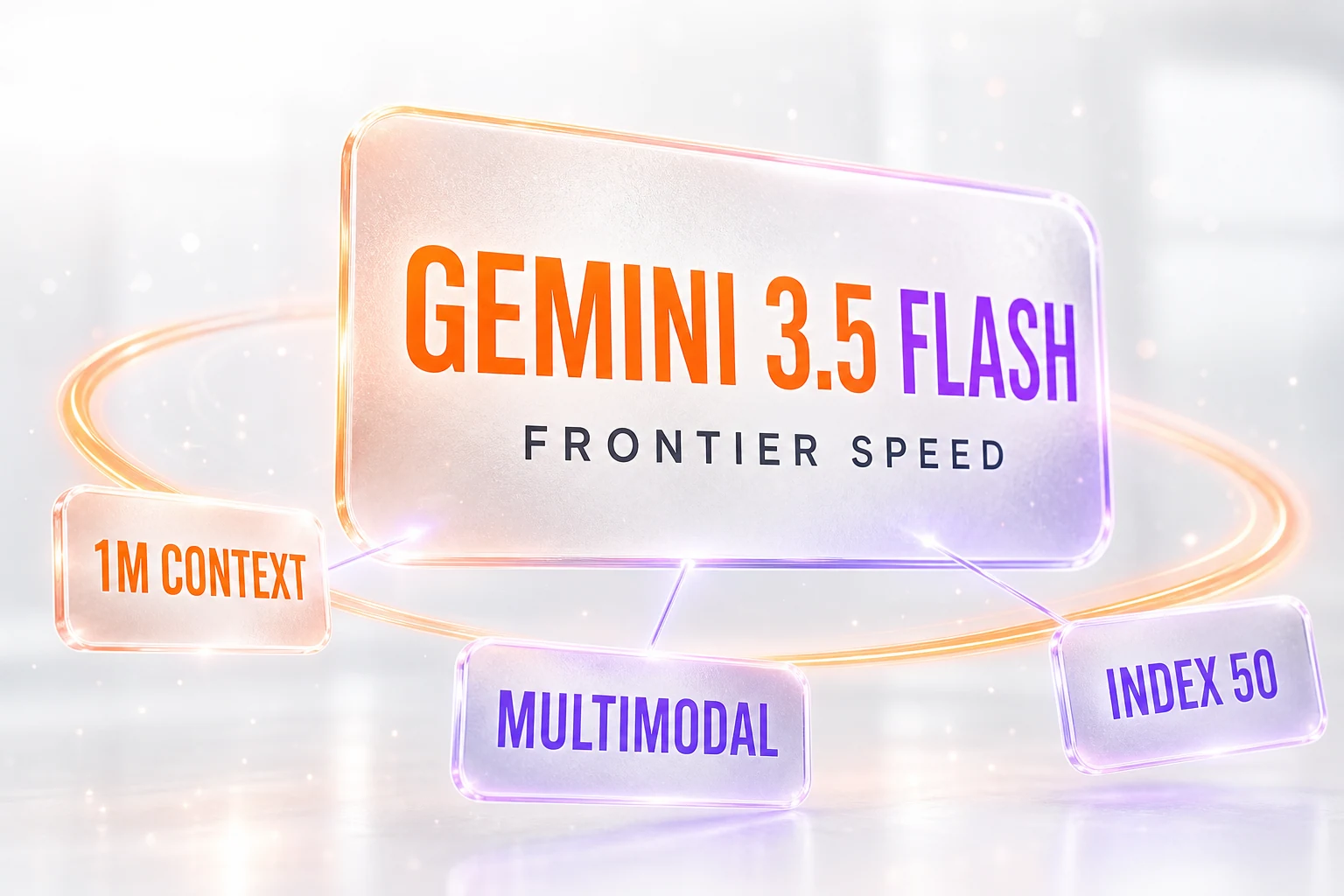
Gemini 3.5 Flash is Google DeepMind's generally available fast-tier large language model, launched at Google I/O on May 19, 2026. It pairs frontier-class reasoning with roughly four times the tokens-per-second throughput of flagship models, a 1M-token context window, and native multimodal input across text, image, audio, video, and files. API pricing is $1.50 per 1M input tokens, $0.15 per 1M cached input tokens, and $9.00 per 1M output tokens. Its independent Artificial Analysis Intelligence Index score is 50 on the current version 4.1 methodology. We tested it via Google AI Studio. Our score: 8.8 out of 10.
Our Verdict
Score: 8.8 out of 10. Gemini 3.5 Flash is the model that finally makes "fast tier" and "frontier intelligence" stop being a trade-off. Google shipped it generally available on day one at I/O 2026, which removes the Preview-SLA asterisk that held its predecessor back. Its headline argument is speed: near-flagship answers at a token throughput Google positions at about four times that of frontier models, with a full 1M-token context window and native multimodal input. On the one independent aggregate that matters, the Artificial Analysis Intelligence Index, it scores 50 on the current version 4.1 methodology, which places it below the top flagships (GPT-5.6 Terra at 55, Claude Opus 4.8 at 56) but clearly ahead of budget-frontier models like DeepSeek V4 at 44. Best use case: high-throughput agentic and multimodal workloads where you want frontier-adjacent quality without waiting on a flagship. Who should think twice: teams that need the absolute top score on the hardest reasoning tasks, or budget-first shops that were happy with the cheaper Preview tier.
- Frontier-adjacent intelligence at fast-tier latency, generally available since May 19, 2026
- Artificial Analysis Intelligence Index 50 on the current version 4.1 methodology (independent)
- 1M-token context window, up to 65,536 output tokens, native multimodal input
- Roughly four times the throughput of flagship models is its core selling point
- More expensive than the Gemini 3 Flash Preview it succeeds: $1.50 and $9.00 per 1M input and output tokens
What Is Gemini 3.5 Flash?
Gemini 3.5 Flash is the speed-optimized member of Google DeepMind's Gemini 3.5 family, announced and made generally available at Google I/O 2026 on May 19, 2026. It shipped the same day across the Gemini app, Google AI Studio, the Gemini API, and AI Mode in Google Search. Unlike a Preview model, a generally available release carries a stable model identifier and a production service level, so teams can build on it without planning for a short-notice deprecation window.
The Flash line in Gemini exists to deliver near-flagship reasoning at a fraction of the price and latency of the Pro tier. Gemini 3.5 Flash pushes that idea further than any Flash model before it: Google's framing is "frontier intelligence built for speed," and the speed claim is the load-bearing part. In practical terms it is meant to be the default model you reach for when you want strong answers returned quickly and cheaply, reserving a flagship only for the genuinely hardest reasoning problems.
It is important not to confuse this model with its predecessor. The Gemini 3 Flash Preview was a distinct, earlier, cheaper release that carried an explicit Preview tag and priced at $0.50 and $3.00 per 1M input and output tokens. Gemini 3.5 Flash is a newer, more capable, generally available model at a higher price point. They are different products in the same lineage, and any benchmark figure from the Preview should not be assumed to carry over. Google DeepMind owns both; Demis Hassabis runs DeepMind and Sundar Pichai is CEO of Alphabet and Google. For a deeper launch write-up, see our reporting on the Gemini 3.5 Flash launch at I/O 2026 and the follow-up on its native computer-use results.
Gemini 3.5 Flash Pricing in 2026
Pricing below reflects the published Gemini API rates verified against Google's pricing documentation and Artificial Analysis in July 2026. All figures are quoted per 1M tokens unless noted.
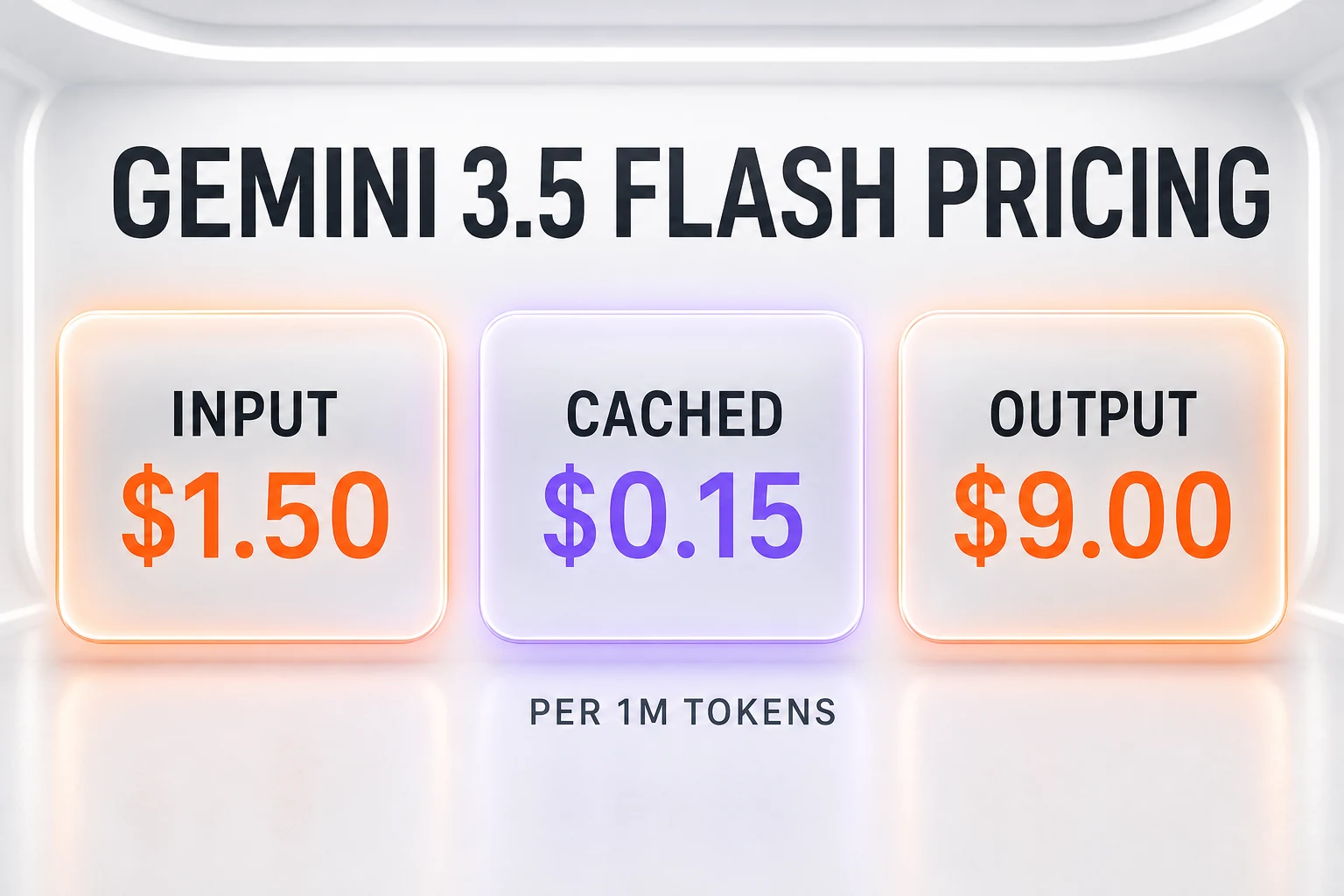
| Tier | Input (text, image, video) | Cached input | Output | Notes |
|---|---|---|---|---|
| Free tier | Free of charge | Free | Free of charge | Via the Gemini app and AI Studio, with rate limits; prompts may help improve future models |
| Standard (paid API) | $1.50 per 1M tokens | $0.15 per 1M tokens | $9.00 per 1M tokens | The cached input rate is a 90 percent discount on standard input |
The cached input rate of $0.15 per 1M tokens is the number that changes the economics for agentic loops. If your system prompt, tool schemas, and reference documents are stable across a session, caching that prefix cuts the recurring input cost by 90 percent, so a long stable context becomes cheap to reuse call after call. Output remains the expensive side of the ledger at $9.00 per 1M tokens, which is the figure to watch on verbose reasoning-heavy workloads.
How it compares on price: Gemini 3.5 Flash is roughly three times more expensive than the Gemini 3 Flash Preview it succeeds, which was $0.50 and $3.00 per 1M input and output tokens. That is the honest trade: you pay more, and in return you get a generally available service level and a more capable model. Against flagships it is still the cheaper, faster option, which is the whole point of the Flash tier.
Best for: teams running high-volume production traffic where per-request cost and latency both matter and where a Preview service level was previously a blocker. The free tier is generous enough for real prototyping; the paid Standard tier is where production traffic should land, with context caching switched on for any workload that reuses a large stable prefix.
Benchmarks — What the Numbers Actually Say
Benchmark provenance matters more than the raw digits here, because two very different kinds of number get quoted for this model. We separate them deliberately.
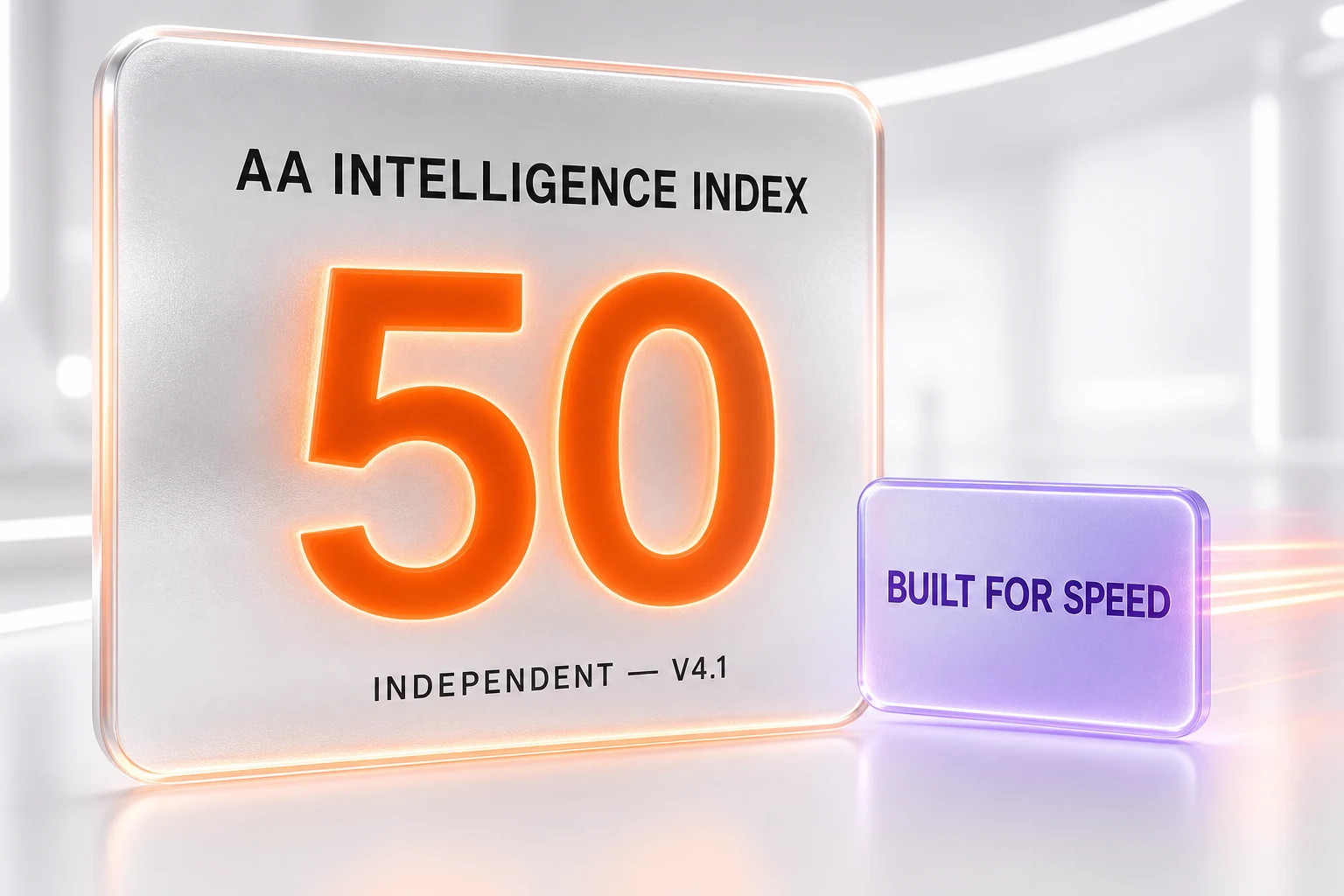
The independent numbers: Artificial Analysis Intelligence Index 50
The headline independent, third-party score for Gemini 3.5 Flash is its Artificial Analysis Intelligence Index of 50, measured on the current version 4.1 methodology — and it is not the only independent measurement: within the same Artificial Analysis battery the model measures 78.7 percent on Terminal-Bench 2.1, 92.2 percent on GPQA Diamond, and 41.0 percent on Humanity's Last Exam, and LMArena's community arena holds the high variant at an Elo of 1480 across 10,011 votes, all as of August 3, 2026. Artificial Analysis is an independent evaluation lab, and its Intelligence Index is an aggregate across a fixed basket of reasoning, coding, and knowledge benchmarks. Because the whole basket is version-matched, a 50 for Gemini 3.5 Flash is directly comparable to the version 4.1 scores of other models: GPT-5.6 Terra at 55, Claude Opus 4.8 at 56, and DeepSeek V4 at 44. That comparability is the reason we anchor on this figure rather than any single headline benchmark.
Why the index reads 50, not 55
You may see Gemini 3.5 Flash quoted at 55 rather than 50. That 55 comes from the earlier version 4.0 of the Artificial Analysis Intelligence Index, not the current version 4.1. Artificial Analysis periodically revises the benchmark basket and scoring methodology and re-versions the index when it does. The version 4.1 pass reweights and updates the underlying tests, and on that current methodology Gemini 3.5 Flash lands at 50. Quoting the older 55 next to another model's version 4.1 score is a methodology mismatch, and it flatters Gemini 3.5 Flash by a few points. Whenever we cite an index number in this review, it is the version 4.1 figure of 50, so the comparison stays apples to apples.
The vendor-reported numbers: read them as Google's own
Google published a set of launch benchmarks for Gemini 3.5 Flash that are impressive but self-reported, so we label them as vendor figures and note where an independent counterpart exists. At launch Google cited roughly 76.2 percent on Terminal-Bench 2.1 for terminal and agentic tool use, about 83.6 percent on MCP Atlas for tool-calling over the Model Context Protocol, and around 84.2 percent on CharXiv Reasoning for chart and figure understanding. Artificial Analysis also reports an economic-utility Elo of roughly 1656 on its GDPval-derived evaluation. These are useful signals, and one of them now has an independent counterpart: Artificial Analysis runs Terminal-Bench 2.1 in its own battery and measures Gemini 3.5 Flash at 78.7 percent as of August 3, 2026, slightly above Google's own 76.2 — while MCP Atlas and CharXiv Reasoning have no equivalent in that battery. The only figure we treat as a clean independent aggregate remains the Intelligence Index of 50. We deliberately do not fold the vendor benchmarks into a single "score" for the model, and we do not carry over the Preview model's separately reported coding numbers, which belong to a different release.
Speed — The Headline Argument
Speed is the reason this model exists in the form it does. Google positions Gemini 3.5 Flash at roughly four times the tokens-per-second throughput of frontier models while holding intelligence at a frontier-adjacent level. In our own token-streaming spot checks in Google AI Studio, streamed responses came back noticeably faster than what we see from flagship tiers, and the practical effect on interactive workloads is real: short prompts feel instant, and long completions finish before a flagship would be halfway done. The value of that speed compounds in agent loops, where dozens of model calls chain together and a per-call latency saving multiplies across the whole run.
The caveat we always attach to throughput claims applies here too. Wall-clock latency depends on prompt length, output length, whether reasoning is engaged, and the surface you call. We saw fast, predictable behavior on prompts up to a few hundred thousand tokens; very large contexts approaching the 1M ceiling are slower and cost more, so the speed advantage is strongest in the sub-200K range where most production traffic actually lives.
Context Window and Multimodal Input
Input context is 1,048,576 tokens, a full 1M, with an output ceiling of 65,536 tokens. A 1M input window on a fast-tier model is unusual and opens use cases that used to require a flagship: full-codebase question answering, multi-document review, and multi-day agent memory all fit inside a single context. As always, a large window is only economical if you pair it with context caching for the stable portion, since input billing scales linearly with tokens.
Multimodal input is native. Gemini 3.5 Flash accepts text, image, audio, video, and file inputs directly, without separate API calls per modality. Output at the API surface is text; image generation lives in Google's separate Nano Banana image family rather than in this model. Native multimodal input is the feature that makes Gemini 3.5 Flash a strong fit for real-time assistants that see and hear, not just read. In our quick tests, attaching an image alongside a text prompt and asking the model to reason over both worked cleanly and returned in the same fast envelope as text-only calls.
Hands-on Testing — What We Found
We tested Gemini 3.5 Flash through Google AI Studio and the Gemini API from its May launch through July 2026, running it against three internal workloads: structured-output generation for our content operations, agentic validation prompts that feed a full HTML document plus a multi-section rubric, and image-attached visual reasoning on charts and screenshots.
Setup and onboarding
Onboarding is one click if you already have a Google account. AI Studio exposes the model in the picker, the Run button works out of the box, and an API key is two more clicks. Because the model is generally available rather than Preview, the model identifier is stable, so we did not have to plan a fallback path for a surprise deprecation the way the earlier Preview release demanded. For enterprise workloads, the Vertex AI surface adds a billing account and project setup but returns production rate limits and a firmer service level.
Daily workflow observations
The standout in daily use is the intelligence-to-latency ratio. On our agentic validation task, where we hand the model a full article plus a rubric and ask it to flag missing or malformed structured data, Gemini 3.5 Flash returned careful, well-reasoned passes quickly and caught the same subtle issues our flagship reviewer catches, at a fraction of the wait. On structured-output generation it reliably respected the schema we requested. The speed is not a novelty; it changes how you architect a pipeline, because you can afford to make more model calls per task when each one returns fast.
Friction we encountered
Two honest caveats. First, output cost discipline matters: at $9.00 per 1M output tokens, a reasoning-heavy workload that emits long completions adds up faster than the low input price suggests, so cap output length and lean on caching for the input side. Second, the speed advantage narrows on very large contexts; as we pushed prompts toward the high hundreds of thousands of tokens, response time grew faster than a naive reading of the throughput claim would predict. Below a couple hundred thousand tokens everything was fast and predictable.
Pros and Cons After Testing
What we liked
- Frontier-adjacent intelligence at fast-tier speed. An independent Artificial Analysis Intelligence Index of 50 on version 4.1, delivered at roughly four times flagship throughput, is a genuinely new point on the price-speed-quality curve.
- Generally available on day one. Launched GA at I/O 2026 with a stable model identifier and production service level, removing the Preview-SLA risk that constrained its predecessor.
- 1M-token context window. Full-codebase and multi-document reasoning now run on the fast tier, with a 65,536-token output ceiling.
- Native multimodal input. Text, image, audio, video, and files all work without separate calls, which suits real-time see-and-hear assistants.
- Context caching at a 90 percent discount. Cached input at $0.15 per 1M tokens makes long stable prefixes cheap to reuse across an agent session.
- Broad distribution. It runs across the Gemini app, AI Studio, the Gemini API, and AI Mode in Search, so consumer-scale validation is happening in the open.
Where it falls short
- Not the top of the intelligence table. At an index of 50 on version 4.1 it trails the flagships, GPT-5.6 Terra at 55 and Claude Opus 4.8 at 56, so the hardest reasoning tasks still favor a flagship.
- Meaningfully pricier than the Preview it replaces. At $1.50 and $9.00 per 1M input and output tokens it is roughly three times the cost of the Gemini 3 Flash Preview.
- Output cost is the real bill. The low input price can mislead; verbose reasoning outputs at $9.00 per 1M tokens are where spend accumulates.
- Speed advantage narrows at very large contexts. The throughput edge is strongest below roughly 200K tokens and compresses as you approach the 1M ceiling.
Real-World Use Cases
High-throughput agentic workflows
Frontier-adjacent quality at fast-tier latency makes Gemini 3.5 Flash a rational default for production agent loops, where many chained model calls make per-call speed the dominant cost. It pairs naturally with orchestration in tools like Claude Code or Google's own coding surfaces, and with agentic pipelines that call tools repeatedly.
Real-time multimodal assistants
Native image, audio, and video input plus high throughput means Gemini 3.5 Flash can power chat and voice experiences that see and hear, returning answers fast enough to feel conversational. AI Mode in Search runs on the family, which is a live stress test at consumer scale.
Long-document and full-codebase analysis
The 1M-token window opens full-contract review, whole-repository question answering, and multi-day session memory for agents. Combine it with context caching on the stable prefix to keep the input bill rational on repeated queries over the same corpus.
Content and data pipeline automation
For high-volume classification, extraction, and validation jobs, the intelligence-to-latency ratio lets you run more passes per item without blowing the latency budget. We moved part of our internal draft-validation step onto Gemini 3.5 Flash and kept quality while cutting wait time.
Rapid prototyping and vibe coding
One-click AI Studio onboarding and fast responses make Gemini 3.5 Flash a quick path from idea to working demo, especially when the prototype needs multimodal input. For a coding-focused Google integration, see our Gemini Code Assist review.
Customer support automation
Function calling, structured output, and search grounding combined with the speed and price profile make Gemini 3.5 Flash a strong fit for support deflection bots that query a knowledge base and return structured tickets at conversational latency.
Gemini 3.5 Flash vs the Alternatives
Here is how Gemini 3.5 Flash sits against the models most teams weigh it against in 2026. We use the version 4.1 Artificial Analysis Intelligence Index throughout so the intelligence column is directly comparable.
| Model | AA Intelligence Index (v4.1) | Positioning | Input price (per 1M tokens) | Status |
|---|---|---|---|---|
| Gemini 3.5 Flash | 50 | Fast tier, frontier-adjacent, ~4x speed | $1.50 | GA |
| Gemini 3 Flash Preview | Not version-matched here | Cheaper earlier fast tier | $0.50 | Preview |
| GPT-5.6 Terra | 55 | Flagship reasoning | Flagship pricing | GA |
| Claude Opus 4.8 | 56 | Flagship reasoning | Flagship pricing | GA |
| DeepSeek V4 | 44 | Budget-frontier open-weight lineage | Low | GA |
When to pick which: choose Gemini 3.5 Flash when you want frontier-adjacent intelligence returned fast and multimodally, and you can accept an index of 50 rather than the flagship 55 to 56. Step up to a flagship like GPT-5.6 Terra or Claude Opus 4.8 when a task genuinely needs the top of the intelligence table. Consider the cheaper Gemini 3 Flash Preview if cost is the primary constraint and a Preview service level is acceptable, or DeepSeek V4 for a budget open-weight lineage. If you are still on GPT-5 or a first-generation fast model, Gemini 3.5 Flash is worth a benchmarking spike. For head-to-head detail on the Gemini flagship line, see our comparisons of Claude Opus 4.8 versus Gemini 3.1 Pro, Claude Sonnet 5 versus Gemini 3.1 Pro, and GPT-5.6 Sol versus Gemini 3.1 Pro. For the fast-tier Anthropic option, our Claude Haiku 4.5 review covers the low-latency alternative, and Gemini 3.5 Flash versus Claude Haiku 4.5 is the direct pairing.
Three more challengers sit outside that flagship frame, and each has its own head-to-head with Flash: Gemini 3.5 Flash versus GLM-5.2, Gemini 3.5 Flash versus MiniMax M3, and Gemini 3.5 Flash versus Muse Spark 1.1. Those are the pages to read when the binding constraint is cost per token rather than the top of the intelligence table.
Frequently Asked Questions
What is Gemini 3.5 Flash?
Gemini 3.5 Flash is Google DeepMind's generally available fast-tier large language model, launched at Google I/O on May 19, 2026. It delivers frontier-adjacent reasoning at roughly four times flagship throughput, with a 1M-token context window, up to 65,536 output tokens, and native multimodal input across text, image, audio, video, and files. It is available in the Gemini app, Google AI Studio, the Gemini API, and AI Mode in Google Search.
How much does Gemini 3.5 Flash cost in 2026?
The paid Gemini API rate is $1.50 per 1M input tokens, $0.15 per 1M cached input tokens, and $9.00 per 1M output tokens. The cached input rate is a 90 percent discount on standard input. A free tier is available through the Gemini app and Google AI Studio with rate limits, where prompts may be used to help improve future models.
Why does Gemini 3.5 Flash score 50 and not 55?
The score of 50 is the Artificial Analysis Intelligence Index measured on the current version 4.1 methodology. The 55 figure you may see comes from the earlier version 4.0 of the index, which used a different benchmark basket and weighting. Artificial Analysis re-versions the index when it revises its tests, and quoting the older 55 next to another model's version 4.1 score is a methodology mismatch. The version-matched, apples-to-apples number for Gemini 3.5 Flash is 50.
Is Gemini 3.5 Flash the same as Gemini 3 Flash?
No. Gemini 3 Flash, sometimes called the Gemini 3 Flash Preview, is an earlier, cheaper, Preview-status model priced at $0.50 and $3.00 per 1M input and output tokens. Gemini 3.5 Flash is a newer, more capable, generally available model launched on May 19, 2026 at $1.50 and $9.00 per 1M input and output tokens. They are different releases in the same lineage, and benchmark numbers from one should not be assumed to apply to the other.
How fast is Gemini 3.5 Flash?
Speed is its headline argument. Google positions it at roughly four times the tokens-per-second throughput of frontier models while holding intelligence at a frontier-adjacent level. In our streaming tests the model returned answers noticeably faster than flagship tiers, with the biggest practical advantage in agent loops that chain many calls. The throughput edge is strongest on prompts below roughly 200,000 tokens and narrows as you approach the 1M context ceiling.
What is the context window of Gemini 3.5 Flash?
The input context window is 1,048,576 tokens, a full 1M, with an output ceiling of 65,536 tokens. A 1M input window on a fast-tier model supports full-codebase question answering, multi-document review, and multi-day agent memory. Because input billing scales linearly with tokens, pairing large contexts with context caching on the stable prefix is the way to keep the cost rational.
Does Gemini 3.5 Flash support multimodal input?
Yes. Gemini 3.5 Flash natively accepts text, image, audio, video, and file inputs without separate API calls per modality. Output at the API surface is text; image generation lives in Google's separate Nano Banana image family rather than in this model. Native multimodal input makes it well suited to real-time assistants that reason over what they see and hear.
Is Gemini 3.5 Flash better than the flagships?
Not on raw intelligence. Its Artificial Analysis Intelligence Index of 50 on version 4.1 trails GPT-5.6 Terra at 55 and Claude Opus 4.8 at 56, so the hardest reasoning tasks still favor a flagship. Where Gemini 3.5 Flash wins is speed and price: it returns frontier-adjacent quality at roughly four times the throughput and at fast-tier cost, which is the right trade for high-volume production workloads.
Where can I access Gemini 3.5 Flash?
Developers can access it through the Gemini API in Google AI Studio, and through Vertex AI for enterprise workloads with production rate limits. Consumers use it in the Gemini app and in AI Mode within Google Search. It launched across all of these surfaces on the day of its general availability at Google I/O 2026 on May 19, 2026.
Does Gemini 3.5 Flash have a free tier?
Yes. A free tier is available through the Gemini app and Google AI Studio, subject to rate limits, and free-tier prompts may be used to help improve future models. For production traffic, the paid Standard API tier is $1.50 per 1M input tokens and $9.00 per 1M output tokens, with cached input billed at $0.15 per 1M tokens.
How reliable are the benchmark numbers for Gemini 3.5 Flash?
It depends on the source. The only clean independent aggregate is the Artificial Analysis Intelligence Index of 50 on version 4.1. Google's launch figures, such as roughly 76.2 percent on Terminal-Bench 2.1, about 83.6 percent on MCP Atlas, and around 84.2 percent on CharXiv Reasoning, are self-reported vendor benchmarks and should be read as Google's own claims — though on Terminal-Bench 2.1 Artificial Analysis independently measures 78.7 percent as of August 3, 2026, slightly above Google's figure, while MCP Atlas and CharXiv Reasoning have no independent counterpart in its battery. We anchor our assessment on the independent index and treat the vendor numbers as supporting context.
Should I migrate from Gemini 3 Flash Preview to Gemini 3.5 Flash?
It depends on your priorities. Gemini 3.5 Flash is more capable and generally available, which removes the Preview service-level risk, but it costs roughly three times as much per token. If you were using the Preview for cost-sensitive, high-volume work and its quality was sufficient, the cheaper Preview can still be the rational choice. If you need the stronger model, a stable model identifier, and a production service level, the upgrade is worth benchmarking on your own workload before you commit.
Final Verdict: 8.8 out of 10
Gemini 3.5 Flash earns an 8.8 out of 10. The first reason is that it resolves a real trade-off: you no longer have to choose between fast-tier latency and frontier-adjacent intelligence, and you get both generally available on day one rather than behind a Preview asterisk. The second is the practical envelope: a 1M-token context window, native multimodal input, and context caching at a 90 percent discount make long, stateful, multimodal agent workloads finally economical on a fast model. The third is honesty about where it sits: an independent Artificial Analysis Intelligence Index of 50 on version 4.1 is strong for the tier, clearly ahead of budget-frontier models, and clearly behind the flagships, exactly as a fast model should be.
What keeps it from a higher score is the price step up from the Preview it replaces and its position below the top of the intelligence table. If your workload lives on the hardest reasoning problems, a flagship is still the right call; if cost is the single overriding constraint, the cheaper Preview may still win.
Score breakdown:
- Features: 9.0 out of 10 — 1M context, native multimodal input, 65,536-token output, function calling, structured output, and search grounding all present.
- Ease of Use: 9.0 out of 10 — one-click AI Studio onboarding, a stable generally available model identifier, and default placement in the Gemini app and AI Mode.
- Value: 8.4 out of 10 — excellent intelligence-to-latency ratio, tempered by a roughly threefold price increase over the Preview and a $9.00 per 1M output rate to manage.
- Support: 8.5 out of 10 — generally available service level, Google and Vertex AI backing, and broad platform coverage.
Final word: if you run production AI in 2026 and you have not benchmarked Gemini 3.5 Flash against your current fast-tier model, do it. The combination of frontier-adjacent quality, roughly four times the speed, a 1M context window, and native multimodal input is a strong default, and the general-availability status finally makes it safe to build on. Just size your output budget with the $9.00 per 1M rate in mind, and quote its intelligence as the version 4.1 index of 50 so your comparisons stay honest.
Last tested: July 2026 via Google AI Studio and the Gemini API. Pricing and the Artificial Analysis Intelligence Index of 50 on version 4.1 were verified in July 2026. External community ratings specific to the Gemini 3.5 Flash API surface, on platforms such as Trustpilot, G2, and Capterra, were not available or separately verifiable from the broader Gemini brand at time of publication.
Key Features
Pros & Cons
Pros
- Frontier-adjacent intelligence at fast-tier speed — independent Artificial Analysis Intelligence Index of 50 on version 4.1, delivered at roughly four times flagship throughput
- Generally available on day one at Google I/O 2026 with a stable model identifier and production service level
- 1M-token context window with a 65,536-token output ceiling on the fast tier
- Native multimodal input across text, image, audio, video, and files
- Context caching at a 90 percent discount — cached input at $0.15 per 1M tokens
- Broad distribution across the Gemini app, AI Studio, the Gemini API, and AI Mode in Search
Cons
- Below the flagships on raw intelligence — index 50 on version 4.1 trails GPT-5.6 Terra at 55 and Claude Opus 4.8 at 56
- Roughly three times more expensive per token than the Gemini 3 Flash Preview it succeeds
- Output cost is the real bill at $9.00 per 1M output tokens on verbose reasoning workloads
- Speed advantage narrows on very large contexts approaching the 1M ceiling
Best Use Cases
Platforms & Integrations
Available On
Integrations
Compare Gemini 3.5 Flash

We're developers and SaaS builders who use these tools daily in production. Every review comes from hands-on experience building real products — DealPropFirm, ThePlanetIndicator, PropFirmsCodes, and many more. We don't just review tools — we build and ship with them every day.
Written and tested by developers who build with these tools daily.
Frequently Asked Questions
What is Gemini 3.5 Flash?
Google DeepMind's generally available fast tier — frontier-adjacent intelligence at roughly four times the speed, with a 1M-token context window and native multimodal input.
How much does Gemini 3.5 Flash cost?
Gemini 3.5 Flash has a free tier. Premium plans start at $1.5/month.
Is Gemini 3.5 Flash free?
Yes, Gemini 3.5 Flash offers a free plan. Paid plans start at $1.5/month.
What are the best alternatives to Gemini 3.5 Flash?
Top-rated alternatives to Gemini 3.5 Flash can be found in our WebApplication category, where we've reviewed and scored every tool on ThePlanetTools.ai.
Is Gemini 3.5 Flash good for beginners?
Gemini 3.5 Flash is rated 9/10 for ease of use.
What platforms does Gemini 3.5 Flash support?
Gemini 3.5 Flash is available on Web (Gemini app, AI Studio, AI Mode in Search), REST API (Gemini API, Vertex AI), Enterprise (Vertex AI, Gemini Enterprise).
Does Gemini 3.5 Flash offer a free trial?
Yes, Gemini 3.5 Flash offers a free trial.
Is Gemini 3.5 Flash worth the price?
Gemini 3.5 Flash scores 8.4/10 for value. We consider it excellent value.
Who should use Gemini 3.5 Flash?
Gemini 3.5 Flash is ideal for: High-throughput agentic workflows and tool-calling loops, Real-time multimodal assistants that reason over image, audio, and video, Full-codebase and long-document question answering with the 1M context window, High-volume classification, extraction, and validation pipelines, Rapid prototyping and vibe coding in Google AI Studio, Customer support automation with structured output and search grounding.
What are the main limitations of Gemini 3.5 Flash?
Some limitations of Gemini 3.5 Flash include: Below the flagships on raw intelligence — index 50 on version 4.1 trails GPT-5.6 Terra at 55 and Claude Opus 4.8 at 56; Roughly three times more expensive per token than the Gemini 3 Flash Preview it succeeds; Output cost is the real bill at $9.00 per 1M output tokens on verbose reasoning workloads; Speed advantage narrows on very large contexts approaching the 1M ceiling.
Ready to try Gemini 3.5 Flash?
Start with the free plan
Try Gemini 3.5 Flash Free →