GPT-5.6 Sol vs GLM-5.2: Premium Flagship vs Open-Weight Value (2026)

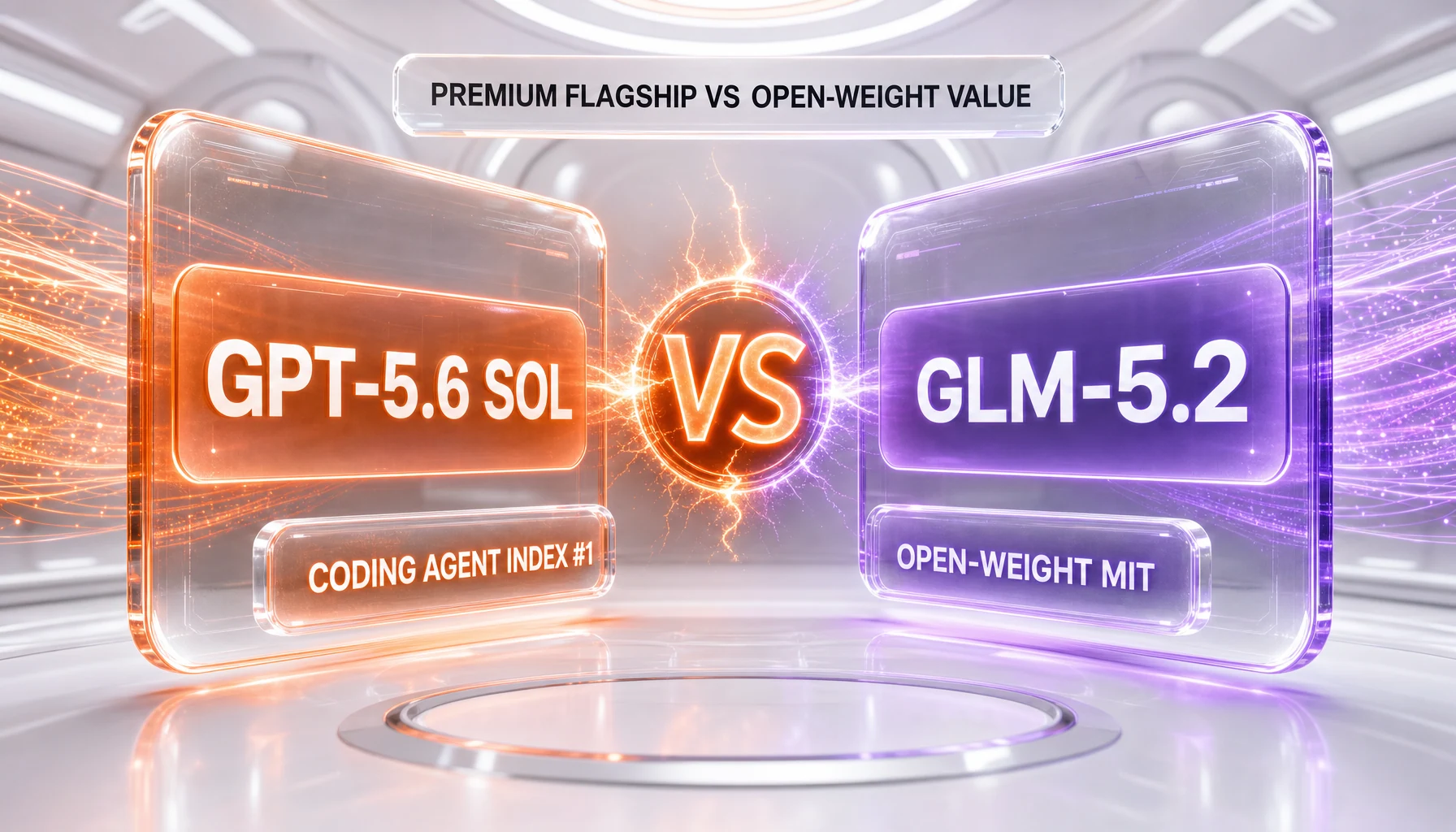
GPT-5.6 Sol vs GLM-5.2 compared: OpenAI's No.1 coding flagship versus Zhipu's open-weight MIT model at a fifth of the API price. Our split verdict.
Feature Comparison
| Feature | GPT-5.6 Sol | GLM-5.2 |
|---|---|---|
| Model type | Closed, API-only | Open-weight, MIT license |
| API input price (per million tokens) | $4.00 (verified) | $1.40 (verified) |
| API output price (per million tokens) | $20.00 (verified) | $4.40 (verified) |
| Cached input price (per million tokens) | $0.40 (verified) | $0.26 (verified) |
| Flat subscription option | None on the API (metered only) | GLM Coding Plan from around $18 per month |
| Independent benchmark coverage | AA Intelligence 59, AA Coding Agent Index v1.3 66.57 (2nd of 52), LMArena 1486 | AA Coding Agent Index v1.3 43.18 (Claude Code harness); no Intelligence Index or LMArena entry |
| SWE-bench Pro (both vendor self-reported, separate runs) | 64.6% (OpenAI disputes benchmark) | 62.1% |
| Terminal-Bench 2.1 (both vendor self-reported) | 88.8% (91.9% ultra) | 81.0% (82.7% best harness) |
| SWE-bench Verified (independent) | N/A — not submitted | N/A — not submitted |
| Context window | 1,050,000 tokens | 1,000,000 tokens |
| Max output tokens | 128,000 tokens | 131,072 tokens |
| Reasoning control | low to xhigh, plus max and ultra multi-agent | High and Max |
| Programmatic Tool Calling | Yes (isolated V8 sandbox, ZDR-compatible) | Not a first-party feature |
| Fine-tuning | Not supported | Supported (self-host the MIT weights) |
| Data residency | OpenAI, US-hosted, ZDR-compatible | Production API hosted in China (self-host to mitigate) |
Pricing Comparison
GPT-5.6 Sol
GLM-5.2
Detailed Comparison
GPT-5.6 Sol and GLM-5.2 answer two different questions. GPT-5.6 Sol is OpenAI's closed flagship, generally available July 9, 2026, priced at $4 per million input tokens and $20 per million output tokens after OpenAI's promotional cut of August 21, 2026, and it leads the one independent measurement that covers both models: Artificial Analysis charts it second of 52 on its Coding Agent Index v1.3 at 66.57, against 43.18 for GLM-5.2, and scores it 59 on its Intelligence Index. GLM-5.2 is Zhipu AI's open-weight, MIT-licensed coding model, released June 13, 2026, priced at $1.40 per million input tokens and $4.40 per million output tokens, with a flat GLM Coding Plan from around $18 per month and weights you can download and self-host. GLM-5.2's headline scores — SWE-bench Pro 62.1, Terminal-Bench 2.1 81.0 — are all vendor self-reported and not yet independently verified. We ran both through their APIs side by side. The result is a split: pick GPT-5.6 Sol for independently validated capability and a US-hosted stack, pick GLM-5.2 for roughly a third of Sol's input rate and under a quarter of its output rate, open weights, and self-hosting freedom.
Quick verdict: a clean split
We are not going to fake a single overall winner here, because the honest answer is that these two models optimize for different things. GPT-5.6 Sol is the premium, closed, independently-benchmarked flagship. GLM-5.2 is the open-weight, self-hostable value play. One of them is measured on public leaderboards you can check yourself; the other undercuts it on price by a factor of roughly three on input and four and a half on output, and hands you the weights. Neither of those advantages cancels the other out.
Pick GPT-5.6 Sol if you want the higher of the two scores a neutral third party has actually measured (66.57 against GLM-5.2's 43.18 on the Artificial Analysis Coding Agent Index v1.3), the new ultra multi-agent reasoning tier, Programmatic Tool Calling, a first-party home inside ChatGPT and Codex, a US-hosted stack, and you can absorb premium token pricing.
Pick GLM-5.2 if price dominates your decision (its API runs just under three times cheaper on input and about four and a half times cheaper on output), you want open MIT weights to self-host, fine-tune, and avoid regional lock-in, and you are comfortable trusting vendor self-reported benchmarks plus a China-hosted API — or you plan to self-host and sidestep the hosting question entirely.
In our own hands-on review GPT-5.6 Sol scored 8.8 out of 10; GLM-5.2 scored 8.5 out of 10. Those numbers are close, but they measure two very different value propositions, which is exactly why the comparison below matters more than the scores.
GPT-5.6 Sol at a glance
GPT-5.6 Sol is the flagship tier of OpenAI's GPT-5.6 generation, generally available since July 9, 2026 across ChatGPT, Codex, and the API after a gated partner preview that opened June 26. In OpenAI's naming system the number 5.6 is the generation and Sol is a "durable capability tier" — the top tier aimed at the hardest coding, agentic, and research problems — sitting above the Terra and Luna tiers. It is not "GPT-6," and there is no model by that name; OpenAI's own launch materials use GPT-5.6 throughout.
Sol carries a 1,050,000-token context window, produces up to 128,000 output tokens, and has a knowledge cutoff of February 16, 2026. It accepts text and image input and returns text output; there is no native audio or native image generation, though image generation is available as a callable tool. The standout feature set is the reasoning ladder — low through xhigh, then the new max and ultra levels — where ultra spins up a built-in multi-agent orchestration layer, four sub-agents by default and configurable up to sixteen. Alongside it, Programmatic Tool Calling lets the model write and run JavaScript in an isolated, Zero Data Retention-compatible V8 sandbox to orchestrate tool calls in code. Standard API pricing is $4 per million input tokens, $0.40 per million cached input tokens, and $20 per million output tokens, verified on OpenAI's API pricing documentation; above 272,000 input tokens a long-context tier of $8 input and $30 output applies to the whole request. OpenAI cut that rate by over 20 percent on August 21, 2026 and labels the reduction promotional. Fine-tuning is not supported.
GLM-5.2 at a glance
GLM-5.2 is Zhipu AI's open-weight flagship coding model, released June 13, 2026 under the international Z.ai brand, with MIT-licensed weights landing on Hugging Face around June 17. It is a Mixture-of-Experts design with roughly 753 billion total parameters and about 40 billion active per token, which keeps inference cheap through sparse activation while competing near the frontier on long-horizon coding. The context window is 1,000,000 tokens with a maximum output of 131,072 tokens (about 128K), and it exposes two reasoning modes, High and Max.
The pricing story is the headline. Metered API access, verified on Zhipu's developer pricing page, is $1.40 per million input tokens, $4.40 per million output tokens, and $0.26 per million cached input tokens. On top of that there is the GLM Coding Plan, a flat subscription from around $18 per month for the entry tier, though the higher Pro, Max, and Team tiers are unpublished and the plan can draw quota at up to three times the normal rate during peak hours. The single biggest structural difference from Sol is openness: because the weights ship under MIT, you can self-host, fine-tune, and ship commercial products on top of them. Every headline benchmark Zhipu published is vendor self-reported and not yet independently verified — though GLM-5.2 does carry one independent result Zhipu did not produce: Artificial Analysis charts it at 43.18 on its Coding Agent Index v1.3, run under the Claude Code harness. Both caveats matter, and we return to them below.
The core tension: validated premium vs open-weight value
The cleanest way to frame this matchup is that you are choosing between two things that are hard to have at once: measured capability and price. GPT-5.6 Sol brings the measured capability. It sits across the public leaderboards that neutral third parties run, so when OpenAI says Sol is elite at agentic coding, you can go check the number yourself on the Artificial Analysis Coding Agent Index v1.3, where it is charted second of 52 at 66.57. GLM-5.2 brings price. Its API costs a fraction of Sol's, it offers a flat monthly plan, and the weights are free to download. GLM-5.2 is charted on that same board too, at 43.18 under the Claude Code harness — so the gap between them is measured, not merely asserted, and it is wide: 23.39 points. What GLM-5.2 still lacks is independent confirmation of its own headline figures, which remain self-reported by Zhipu.
That trade sits on top of a second, structural one: closed versus open. Sol is a closed model you rent through an API hosted by OpenAI in the United States. GLM-5.2 is an open-weight model you can rent through Zhipu's China-hosted API or run entirely on your own infrastructure. For a solo developer the hosting question may be irrelevant; for a regulated enterprise it can be the entire decision, in either direction. This is the same closed-versus-open fork we walk through in our guide to choosing between closed and open-weight models, and GLM-5.2 versus Sol is close to a textbook case of it. Neither posture is "better" in the abstract — they are answers to different constraints.
It is also worth being precise that these two are not perfect like-for-like products. GLM-5.2 is specifically a coding-and-agentic model; Sol is a broader flagship that happens to top a coding leaderboard while also targeting research, cyber, computer use, and science. On the narrow ground where they overlap — agentic coding — the fight is real and close. Off that ground, they drift apart, and we flag where that matters.
Head-to-head: the full comparison
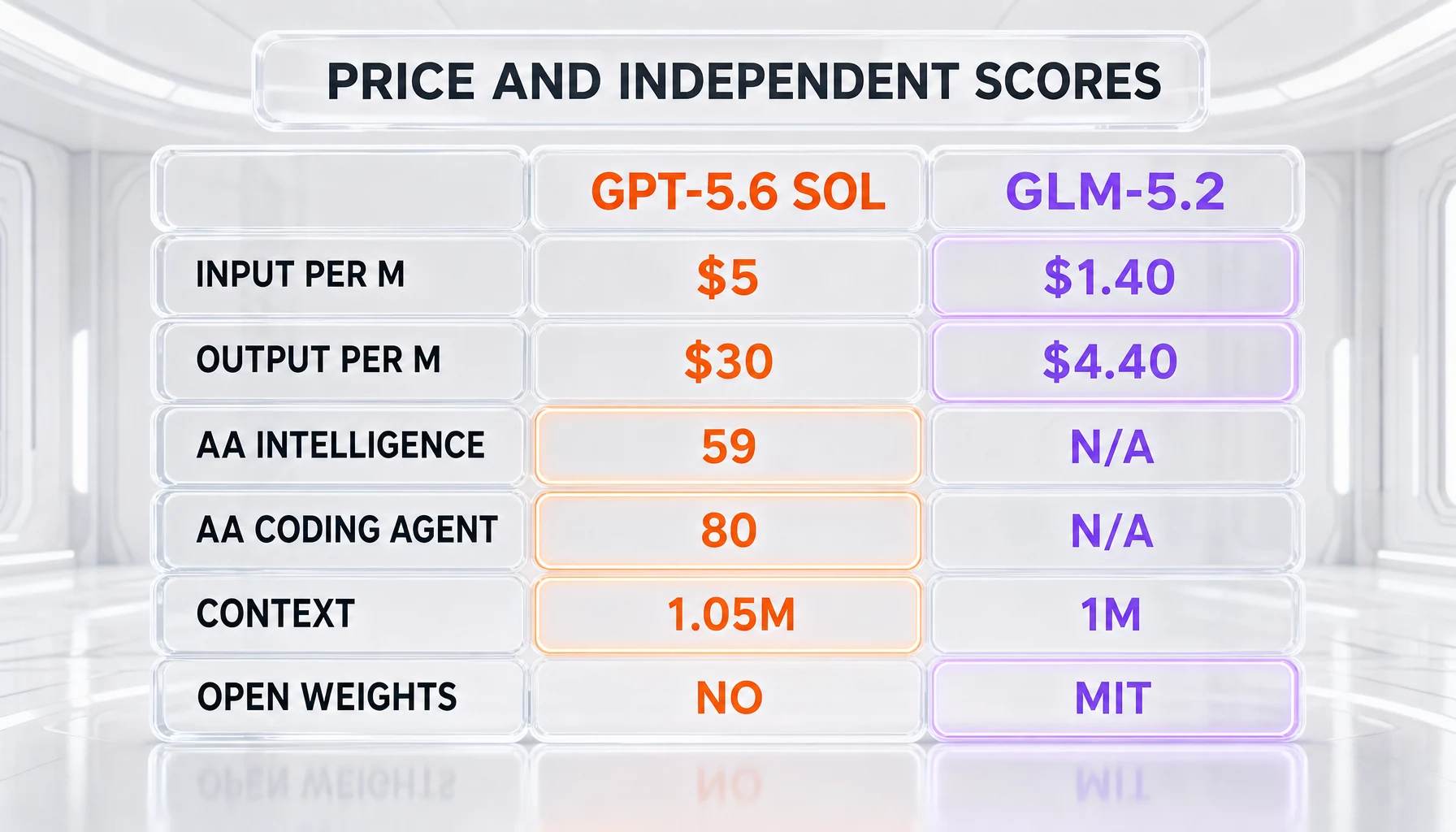
Here is the side-by-side we built while testing both. Read the "winner" column with the attribution in mind: where one model has an independent score and the other has none, that is a difference in verification, not necessarily a difference in raw capability.
| Dimension | GPT-5.6 Sol | GLM-5.2 | Edge |
|---|---|---|---|
| Vendor | OpenAI (US) | Zhipu AI / Z.ai (China) | Depends on buyer |
| Model type | Closed, API-only | Open-weight, MIT license | GLM-5.2 |
| Input price (per million tokens) | $4.00 | $1.40 | GLM-5.2 |
| Output price (per million tokens) | $20.00 | $4.40 | GLM-5.2 |
| Cached input (per million tokens) | $0.40 | $0.26 | GLM-5.2 |
| Flat subscription | None on the API (metered only) | GLM Coding Plan from around $18 per month | GLM-5.2 |
| Context window | 1,050,000 tokens | 1,000,000 tokens | Sol (marginal) |
| Max output | 128,000 tokens | 131,072 tokens | GLM-5.2 (marginal) |
| Independent benchmark coverage | AA Intelligence 59, AA Coding Agent Index v1.3 66.57 (2nd of 52), LMArena 1486 | AA Coding Agent Index v1.3 43.18 (Claude Code harness); no Intelligence Index or LMArena entry in our sources | Sol (+23.39 on the shared board) |
| SWE-bench Pro (both vendor self-reported) | 64.6% (OpenAI disputes the benchmark) | 62.1% | Too close to call |
| Terminal-Bench 2.1 (both vendor self-reported) | 88.8% (91.9% in ultra) | 81.0% (82.7% best harness) | Sol |
| SWE-bench Verified (independent) | N/A — not submitted | N/A — not submitted | Neither |
| Reasoning control | low to xhigh, plus max and ultra multi-agent | High and Max | Sol |
| Programmatic Tool Calling | Yes (isolated V8 sandbox, ZDR-compatible) | Not a first-party feature | Sol |
| Fine-tuning | Not supported | Supported (self-host the MIT weights) | GLM-5.2 |
| Data residency | OpenAI, US-hosted, ZDR-compatible | Production API hosted in China (self-host to mitigate) | Depends on buyer |
| Availability | GA July 9, 2026 | Released June 13, 2026 | Tie |
The pattern is clear once you step back: GLM-5.2 sweeps the cost and openness rows, Sol takes the validated-capability and advanced-reasoning rows, and the two head-to-head benchmarks that both vendors happen to publish are close enough — and measured separately enough — that we would not stake a decision on them. That is a split, and we score it as one.
Pricing: where the gap is widest
Cost is the most decisive, least ambiguous difference between these two models, so it is worth being concrete. GLM-5.2 lists $1.40 per million input tokens against Sol's $4.00, and $4.40 per million output tokens against Sol's $20.00. Both prices were verified this month at the primary source: Sol on OpenAI's pricing page and GLM-5.2 on Zhipu's pricing page. If you want a refresher on why input, output, and cached rates are billed separately, our explainer on how AI model pricing actually works lays it out.
Put a real job through both and the gap compounds. A task that consumes one million input tokens and generates one million output tokens costs $24.00 on GPT-5.6 Sol and $5.80 on GLM-5.2 — roughly four times more on Sol. Output tokens drive that gap, because output is where the two prices diverge most: about four and a half to one. For an agent that reads a large codebase and writes long diffs all day, output volume is exactly what dominates the bill, so this is not a rounding error. Over a billing cycle, a team running an agent full time is looking at a very different invoice depending on which model it routes to.
There are two more levers that only GLM-5.2 offers. The first is the flat GLM Coding Plan from around $18 per month, which trades metered billing for predictable cost — attractive for steady, agent-driven workloads, with the caveat that peak-hour quota can draw down at up to three times the normal rate, so an off-peak-generous plan can throttle under load. The second is self-hosting: because the MIT weights are downloadable, a team with the infrastructure can run GLM-5.2 on its own compute and turn per-token cost into a fixed hardware bill. Sol has no equivalent — it is metered API access only, with Batch mode (half price) as the main discount lever for non-urgent jobs. On raw price-per-token and on billing flexibility, GLM-5.2 wins decisively, and it is not close. We break the money question down further in our dedicated GLM-5.2 vs GPT-5.5 comparison, where GPT-5.5 still carries the $5 and $30 rates Sol has now dropped below.
The counterweight, and the reason price does not simply end the argument, is that Sol's higher rate buys you the higher of the two independently verified capability figures, and that a cheaper rate card does not automatically mean a cheaper job. On the Coding Agent Index v1.3 — the one evaluation that ran both models — Artificial Analysis measured the mean cost per task at about $7.08 for Sol against about $6.51 for GLM-5.2 — figures it computed on Sol's pre-August rate card, so Sol's side of the pair falls with the price cut. The point survives the change and is the one worth keeping: the rate-card ratio badly overstates the real gap on agentic coding work, because the two models burn very different token volumes to finish a task. GLM-5.2's low sticker price is only a bargain if its capability holds up on your workload; the one independent run that exists places it well below Sol, and its stronger self-reported figures have not been reproduced by a neutral harness.
Benchmarks: independent scores vs vendor self-reported
This is the section where neutrality matters most, so we will be blunt about it: there is exactly one neutral leaderboard that scores both of these models, and it is not the one either vendor leads with. GPT-5.6 Sol carries independent third-party scores across three trackers; GLM-5.2 appears on one of them, and everything else it claims comes from numbers Zhipu published itself. Any "head-to-head" that blends the two kinds of evidence is misleading, and plenty online do.
On the independent side, Artificial Analysis puts GPT-5.6 Sol at 59 on its Intelligence Index and second of 52 on its Coding Agent Index v1.3 at 66.57, and LMArena places it eighth on human-preference voting at an Elo of 1486. GLM-5.2 has no entry on the Intelligence Index or LMArena in our sources, but it is charted on the Coding Agent Index v1.3 at 43.18, run under the Claude Code harness. So there is one neutral measurement covering both models, and on it Sol leads by 23.39 points. Beyond that board, GLM-5.2's capability still rests on Zhipu's own reporting. When and if an external rerun lands, we will weight it far more heavily than either vendor's launch table.
The two benchmarks both vendors happen to report are SWE-bench Pro and Terminal-Bench 2.1, and even these come with heavy caveats. On SWE-bench Pro, OpenAI self-reports 64.6% for Sol and Zhipu self-reports 62.1% for GLM-5.2 — but OpenAI itself questions that benchmark's validity, arguing a meaningful share of its tasks are broken, and the two figures were produced on separate runs rather than a shared harness. A two-and-a-half-point gap under those conditions is not something we would call a win for either side; we score it too close to call. On Terminal-Bench 2.1, Sol self-reports 88.8% (rising to 91.9% in ultra mode) against GLM-5.2's 81.0% (82.7% with the best harness) — a wider gap that tilts toward Sol, but again with both numbers self-reported and separately measured. Critically, neither model is on SWE-bench Verified, the independent coding tracker: OpenAI did not submit Sol, and GLM-5.2 is not listed either. That shared gap is worth sitting with — it means the single most-cited independent coding benchmark cannot arbitrate this matchup at all. If you want to understand why SWE-bench Pro and SWE-bench Verified are not interchangeable, our explainer on why these two coding scores do not compare is the background.
The bottom line on benchmarks: Sol's advantage is twofold — a higher score on the one shared test that exists, and far broader independent coverage beyond it. For a buyer who needs verifiable numbers to justify a purchase, that is a real and decisive edge. For a buyer who trusts a vendor table or plans to run their own evaluation, it matters much less, and GLM-5.2's self-reported profile is genuinely strong.
Capabilities: reasoning, agents, and tool calling
Beyond raw scores, the two models expose different machinery for hard problems. GPT-5.6 Sol has the deeper toolkit here. Its reasoning effort scale runs from low through xhigh and then into two new levels, max and ultra, where ultra activates multi-agent orchestration — four sub-agents by default and up to sixteen — so a single request can decompose work, delegate it, and reconcile the results internally. That is aimed squarely at long-horizon, decomposition-heavy tasks, the kind of work our explainer on what an agentic coding model actually is describes. Sol pairs that with Programmatic Tool Calling: the model writes and executes JavaScript in an isolated, ephemeral V8 runtime to loop, branch, and aggregate tool results in code before answering, and the sandbox is Zero Data Retention-compatible. In practice that moves glue-code orchestration logic that normally lives in your application into the model itself.
GLM-5.2's reasoning surface is simpler by design: two modes, High for responsive day-to-day work and Max for deliberate, cross-file reasoning on the harder refactors. It has no first-party equivalent to Sol's ultra multi-agent tier or Programmatic Tool Calling. What it has instead is ecosystem reach as an open model: Zhipu advertises drop-in compatibility with the coding agents developers already run — Claude Code, Cline, Kilo Code, OpenClaw, Goose, and Roo — so you point an existing agent at the GLM endpoint, change the model name, and keep your workflow. In our testing that swap was genuinely a config edit rather than a project.
On context, the two are effectively tied: Sol's 1,050,000 tokens edge GLM-5.2's 1,000,000, and GLM-5.2's 131,072-token output ceiling edges Sol's 128,000 — differences small enough that neither should decide anything. Both held coherence deep into a large prompt in our runs. The meaningful capability split is not context size; it is that Sol offers advanced orchestration primitives out of the box, while GLM-5.2 offers openness and broad agent compatibility. If your workloads lean on multi-agent decomposition or in-model tool orchestration, Sol has features GLM-5.2 does not. If they lean on running inside your existing agent stack cheaply, GLM-5.2's compatibility is the stronger card.
Open vs closed: licensing, deployment, and data residency
The distribution model is the difference that will decide this for a lot of buyers regardless of benchmarks. GLM-5.2 ships its weights under a permissive MIT license, which grants commercial use, redistribution, modification, fine-tuning, and self-hosting. That is open-weight rather than fully open-source — Zhipu did not release the training code or data recipe — but for most teams what matters is the right to run, modify, and commercialize the model, and the MIT weights grant all three. GPT-5.6 Sol grants none of them: it is closed, API-only, and does not support fine-tuning, so a team with custom-trained production variants cannot bring them to Sol at all.
Deployment follows from that. GLM-5.2 can be consumed through Zhipu's hosted API or run entirely on your own compute, which is the escape hatch for the model's biggest operational drawback: the production API is hosted in China, a real data-residency concern for regulated Western buyers in finance, healthcare, legal, or government work. For those buyers, self-hosting the MIT weights keeps source code inside their own environment while still capturing the model's upside. GPT-5.6 Sol runs on OpenAI's US-hosted infrastructure and is Zero Data Retention-compatible through its sandbox, which is the posture many Western compliance teams already accept — but it offers no self-host path if your policy requires the model to run on your own hardware.
So the residency question cuts both ways rather than favoring one model. If your policy forbids sending code to an API hosted in China, Sol's US hosting is an advantage and GLM-5.2's mitigation is "run it yourself." If your policy requires the model to run inside your own environment, GLM-5.2's downloadable weights are the only option on the table and Sol is disqualified. This is the same axis that separates GLM-5.2 from other Western flagships in our Claude Sonnet 5 vs GLM-5.2 comparison, and it usually decides the matchup before capability does.
Winner by category
Since there is no single overall winner, here is where each model actually takes the point.
Best for independently validated capability: GPT-5.6 Sol. On the one board that scores both, the Artificial Analysis Coding Agent Index v1.3, it is charted second of 52 at 66.57 against GLM-5.2's 43.18 — a 23.39-point gap — and it carries independent Intelligence Index and LMArena results that GLM-5.2 has no equivalent for.
Best for price and billing flexibility: GLM-5.2. Roughly a fifth of Sol's output cost, a flat coding plan from around $18 per month, and a self-host path that removes per-token cost entirely.
Best for advanced reasoning and orchestration: GPT-5.6 Sol. The ultra multi-agent tier and Programmatic Tool Calling have no first-party equivalent on GLM-5.2.
Best for openness and control: GLM-5.2. MIT weights you can self-host and fine-tune, with no regional lock-in.
Best for regulated US enterprises: GPT-5.6 Sol if the policy is "US-hosted API is fine," or GLM-5.2 self-hosted if the policy is "the model must run on our hardware." The China-hosted GLM API is the one option that is often ruled out.
Best first-party ecosystem: GPT-5.6 Sol for a native home in ChatGPT and Codex; GLM-5.2 for drop-in reach across third-party agents like Claude Code and Cline. Call this one a tie decided by where you already work.
Pros and cons
The honest balance sheet after running both, model by model.
GPT-5.6 Sol
Strengths:
- The higher independently verified score on the one board that ranks both — 66.57 against 43.18 on the Artificial Analysis Coding Agent Index v1.3, second of 52.
- Ultra multi-agent reasoning tier (up to sixteen sub-agents) plus Programmatic Tool Calling in a ZDR-compatible sandbox.
- Marginally larger 1,050,000-token context and a recent February 16, 2026 knowledge cutoff.
- US-hosted stack and a native first-party home in ChatGPT and Codex.
Weaknesses:
- Premium pricing — just under three times GLM-5.2 on input and about four and a half times on output.
- Closed and API-only, with no self-hosting and no fine-tuning.
- Absent from SWE-bench Verified because OpenAI did not submit it — a real data gap under a coding-first pitch.
GLM-5.2
Strengths:
- Dramatically cheaper API — $1.40 input and $4.40 output per million tokens — plus a flat GLM Coding Plan from around $18 per month.
- Open MIT weights you can self-host, fine-tune, and ship commercial products on.
- Strong self-reported coding profile (SWE-bench Pro 62.1) and drop-in compatibility with Claude Code, Cline, and more.
- Marginally higher 131,072-token output ceiling.
Weaknesses:
- Its own headline scores are vendor self-reported and not yet independently verified, and its one neutral result is a distant 43.18 on the Artificial Analysis Coding Agent Index v1.3 (43.18 against Sol's 66.57).
- Production API is hosted in China, a data-residency blocker for some regulated buyers absent self-hosting.
- Higher GLM Coding Plan tiers are unpublished and peak-hour quota can draw down at up to three times the normal rate.
When to pick each model
Pick GPT-5.6 Sol when your purchase has to be justified with verifiable numbers, when the work leans on multi-agent decomposition or in-model tool orchestration, when you need a US-hosted stack for compliance, or when you want the newest knowledge cutoff and a native home inside ChatGPT and Codex. It is the safer choice for an organization that cannot adopt a model on a vendor's word alone, and the stronger choice for the most demanding agentic and long-horizon coding.
Pick GLM-5.2 when cost is the dominant variable, when you want to own your stack through open MIT weights, when you need to fine-tune on proprietary code, or when data-residency rules force the model to run on your own hardware. It is the standout value play for an agent-driven team watching its token bill, and the only one of the two you can run fully private. If you are cross-shopping open-weight coding models specifically, our GLM-5.2 vs DeepSeek V4 comparison and the reviews of DeepSeek V4 and Kimi K2.7 Code are the natural next stops; if you are weighing Sol against the rest of the Western frontier, our Claude Fable 5 and GPT-5.5 reviews cover the field.
Frequently asked questions
Is GPT-5.6 Sol or GLM-5.2 cheaper?
GLM-5.2 is dramatically cheaper. Its API lists $1.40 per million input tokens and $4.40 per million output tokens, against GPT-5.6 Sol's $4.00 and $20.00 — just under three times cheaper on input and about four and a half times cheaper on output. GLM-5.2 also offers a flat GLM Coding Plan from around $18 per month and downloadable MIT weights you can self-host, neither of which Sol has. A job using one million input and one million output tokens costs about $5.80 on GLM-5.2 versus $24.00 on Sol.
Which is better for coding, GPT-5.6 Sol or GLM-5.2?
It depends on what "better" means to you. GPT-5.6 Sol is charted second of 52 on the independent Artificial Analysis Coding Agent Index v1.3 at 66.57, against 43.18 for GLM-5.2 — the one head-to-head a neutral third party has actually run. GLM-5.2 self-reports a strong 62.1 on SWE-bench Pro, but that number and all its others are vendor-reported by Zhipu and not yet independently confirmed. For verifiable coding capability, Sol has the edge; for coding capability per dollar, GLM-5.2 is far ahead if its self-reported numbers hold.
Can I self-host GLM-5.2 but not GPT-5.6 Sol?
Yes. GLM-5.2's weights are released under a permissive MIT license, so you can download them and run the model on your own compute, fine-tune it, and ship commercial products on top. GPT-5.6 Sol is closed and API-only — there is no self-hosting option and no fine-tuning support. If your requirement is to run the model inside your own environment, GLM-5.2 is the only one of the two that qualifies.
Do GPT-5.6 Sol and GLM-5.2 have independent benchmark scores?
Both do, but not to the same extent. Artificial Analysis scores GPT-5.6 Sol 59 on its Intelligence Index and charts it second of 52 on its Coding Agent Index v1.3 at 66.57, and LMArena ranks it eighth on human preference at 1486. GLM-5.2 is charted on that same Coding Agent Index at 43.18, run under the Claude Code harness, but has no Intelligence Index or LMArena entry in our sources, so the rest of its capability profile rests on Zhipu's self-reported figures. That is a difference in verification, not proof that either model is stronger — but for buyers who need checkable numbers it matters a lot.
What is the context window on each model?
They are effectively tied. GPT-5.6 Sol has a 1,050,000-token context window with up to 128,000 output tokens. GLM-5.2 has a 1,000,000-token context window with up to 131,072 output tokens. Sol's input window is marginally larger and GLM-5.2's output ceiling is marginally higher, but the differences are small enough that neither should decide your choice. Both stayed coherent deep into a large prompt in our testing.
Is GLM-5.2 open source?
GLM-5.2 is open-weight, not fully open-source. Its weights are released under a permissive MIT license — free to download, use commercially, fine-tune, and self-host — but Zhipu did not release the training code or the data recipe. For most teams the distinction is academic, because what you usually want is the right to run, modify, and commercialize the model, and the MIT weights grant all three. GPT-5.6 Sol, by contrast, is fully closed.
Where is each model hosted, and does data residency matter?
GPT-5.6 Sol runs on OpenAI's US-hosted infrastructure and is Zero Data Retention-compatible through its sandbox. GLM-5.2's production API is hosted in China, which is a real data-residency concern for regulated Western buyers in finance, healthcare, legal, or government work. The mitigation for GLM-5.2 is self-hosting the MIT weights so code never leaves your environment. Whether residency matters depends entirely on your compliance requirements — for a solo developer it may be irrelevant; for a regulated enterprise it can be the whole decision.
Does GPT-5.6 Sol support fine-tuning like GLM-5.2?
No. Fine-tuning is not supported on GPT-5.6 Sol, and OpenAI has not announced a timeline for it. GLM-5.2 supports fine-tuning through its open MIT weights: you download the model and fine-tune it on your own proprietary codebase, which is legitimate to ship commercially under the license. If custom-trained variants are central to your workflow, GLM-5.2 is the model that allows it and Sol is not.
What is the difference between SWE-bench Pro and SWE-bench Verified here?
SWE-bench Pro is the benchmark both vendors self-report — Sol at 64.6% (OpenAI questions the benchmark's own validity) and GLM-5.2 at 62.1% — measured on separate runs rather than a shared harness. SWE-bench Verified is the independent tracker, and neither model is on it: OpenAI did not submit Sol, and GLM-5.2 is not listed. That means the most-cited neutral coding benchmark cannot arbitrate this matchup, so any SWE-bench comparison between these two should be read as directional, not settled.
Which model should a solo developer on a budget pick?
For most budget-conscious solo developers, GLM-5.2 is the stronger fit. Its API costs a fraction of Sol's, the flat GLM Coding Plan from around $18 per month makes spend predictable, and it drops into Claude Code, Cline, and other agents you may already use. The trade-off is trusting vendor self-reported benchmarks and, if you use the hosted API, a China-hosted endpoint. If you need capability you can independently verify or want a native ChatGPT and Codex experience, Sol is worth its premium — otherwise GLM-5.2 delivers frontier-class coding for far less.
Can GLM-5.2 run inside Claude Code and Codex like GPT-5.6 Sol?
Partly. GLM-5.2 advertises drop-in compatibility with Claude Code, Cline, Kilo Code, OpenClaw, Goose, and Roo — you point the agent at the GLM endpoint, change the model name, and keep working. GPT-5.6 Sol is the native model inside OpenAI's own Codex and ChatGPT, and is also available through the API for third-party tools. So GLM-5.2 reaches across many third-party agents as an open model, while Sol owns its first-party surface; which matters depends on where you already work.
Is GPT-5.6 Sol the same as GPT-6?
No. There is no model called "GPT-6." The correct name is GPT-5.6 Sol. In OpenAI's naming system the number 5.6 is the generation and Sol is a "durable capability tier" — the flagship tier for the hardest problems — alongside the Terra and Luna tiers in the same generation. Any listing that refers to "GPT-6" is inaccurate.
Final verdict
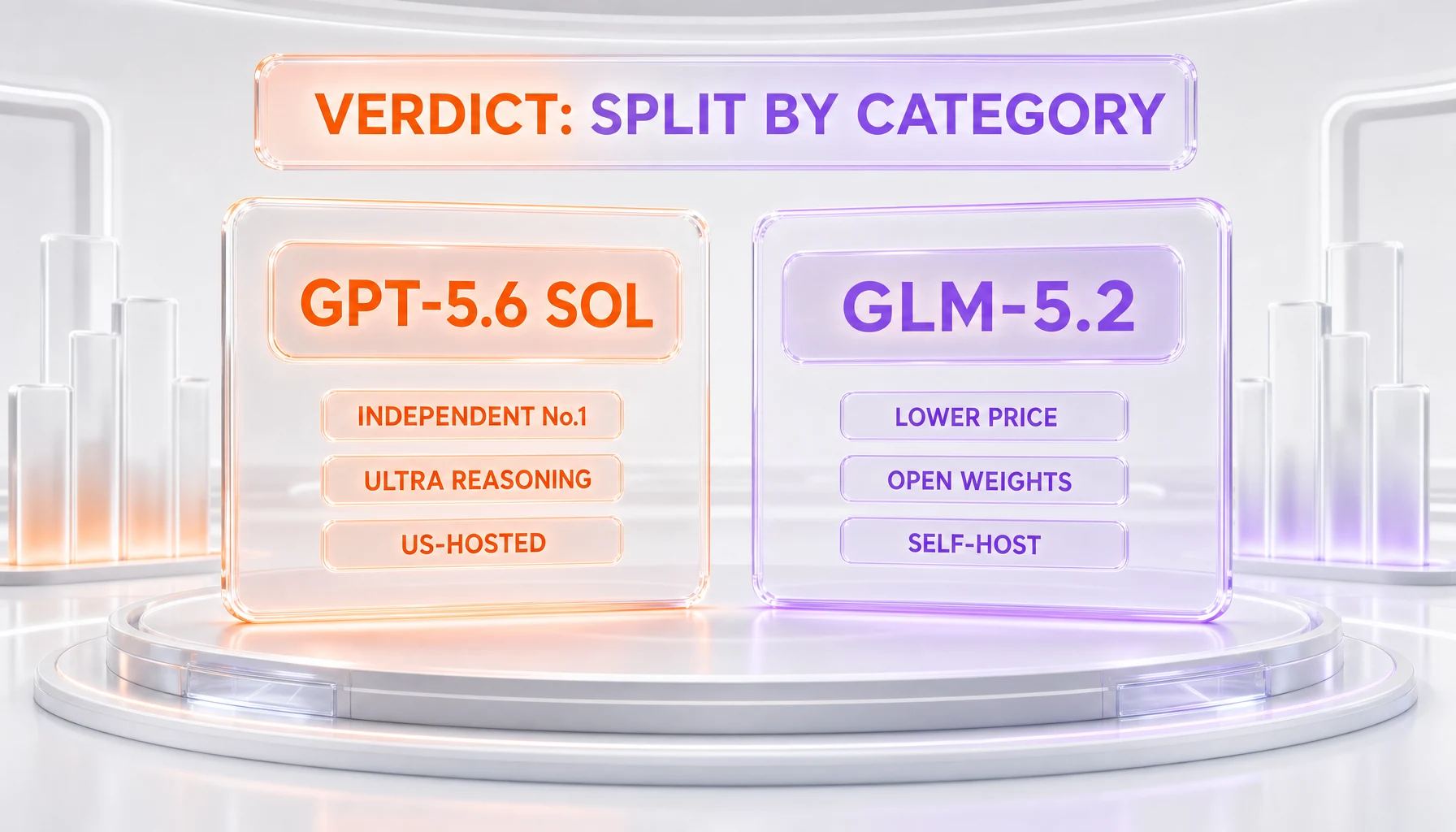
There is no single winner, and inventing one would misrepresent what these two models are. GPT-5.6 Sol and GLM-5.2 are not competing to be the same product — Sol is the premium, closed, independently-validated flagship, and GLM-5.2 is the open-weight, self-hostable value challenger that undercuts it on price by roughly four to one. The decision is not "which is better" but "which trade fits your constraints."
Route to GPT-5.6 Sol when you need capability a neutral party has actually measured, the ultra multi-agent tier and Programmatic Tool Calling, a US-hosted stack, or a native ChatGPT and Codex experience — and you can pay the premium. Route to GLM-5.2 when price dominates, when you want open weights to self-host and fine-tune, or when data-residency rules force the model onto your own hardware — and you are comfortable trusting Zhipu's self-reported numbers until an independent rerun confirms them. The two head-to-head benchmarks both vendors publish are too close, and too separately measured, to break the tie. So we do not: this is a split verdict, and the right pick is the one whose constraints match yours. For the full picture on each, read our hands-on reviews of GPT-5.6 Sol and GLM-5.2.
Sources
- OpenAI — GPT-5.6 announcement
- OpenAI — API pricing (Sol input, cached, and output rates)
- OpenAI — model specifications (context, output, cutoff)
- Zhipu AI / Z.ai — GLM-5.2
- Zhipu AI — GLM-5.2 API pricing
- Hugging Face — GLM-5.2 MIT-licensed weights (zai-org)
- Artificial Analysis — Intelligence Index and Coding Agent Index
- LMArena — human-preference leaderboard
- SWE-bench — independent coding leaderboard
Last compared: July 2026. Pricing and specifications for both models were verified at their primary sources in July 2026, and GPT-5.6 Sol's rate was re-verified on August 28, 2026 after OpenAI's August 21 promotional cut. GLM-5.2's SWE-bench Pro and Terminal-Bench 2.1 figures are vendor self-reported by Zhipu AI and not yet independently verified; its Coding Agent Index score (43.18) and GPT-5.6 Sol's Intelligence Index, Coding Agent Index (66.57), and LMArena figures are independent third-party results, the Coding Agent Index read on version 1.3 on August 2, 2026, while its SWE-bench Pro and Terminal-Bench 2.1 figures are self-reported by OpenAI.
Our Verdict
A clean split between a premium closed flagship and an open-weight value challenger, and we will not invent a single overall winner. GPT-5.6 Sol leads the one independent board that scores both — Artificial Analysis charts it second of 52 on its Coding Agent Index v1.3 at 66.57 against GLM-5.2's 43.18, and scores it 59 on its Intelligence Index — and it adds an ultra multi-agent reasoning tier, Programmatic Tool Calling, a marginally larger 1,050,000-token context, and a US-hosted stack. GLM-5.2 answers with price and openness: $1.40 per million input tokens and $4.40 per million output tokens against Sol's $4.00 and $20.00, roughly a fifth of the cost on output, plus a flat GLM Coding Plan from around $18 per month and MIT-licensed weights you can self-host and fine-tune. Every GLM-5.2 benchmark is Zhipu self-reported and not yet independently verified, and its production API is hosted in China; the two benchmarks both vendors publish, SWE-bench Pro at 64.6% for Sol against 62.1% for GLM-5.2 and Terminal-Bench 2.1 at 88.8% against 81.0%, are self-reported on each side and measured separately, too close and too differently run to break the tie. Best for independently validated capability, advanced reasoning, and US hosting: GPT-5.6 Sol. Best for price, open weights, and self-hosting freedom: GLM-5.2. No single overall winner — route verifiable, orchestration-heavy, compliance-bound work to GPT-5.6 Sol, and cost-sensitive, self-hosted, or fine-tuning work to GLM-5.2.
Choose GPT-5.6 Sol
OpenAI's flagship GPT-5.6 capability tier, with Programmatic Tool Calling and a 1.05M-token context.
Try GPT-5.6 Sol →Choose GLM-5.2
Zhipu AI open-weight coding flagship: 753B MoE (~40B active), 1M context, MIT license, headline SWE-bench Pro 62.1 (vendor self-reported); GLM Coding Plan from around $18 per month or $1.40 in / $4.40 out per million tokens.
Try GLM-5.2 →Frequently Asked Questions
Is GPT-5.6 Sol better than GLM-5.2?
A clean split between a premium closed flagship and an open-weight value challenger, and we will not invent a single overall winner. GPT-5.6 Sol leads the one independent board that scores both — Artificial Analysis charts it second of 52 on its Coding Agent Index v1.3 at 66.57 against GLM-5.2's 43.18, and scores it 59 on its Intelligence Index — and it adds an ultra multi-agent reasoning tier, Programmatic Tool Calling, a marginally larger 1,050,000-token context, and a US-hosted stack. GLM-5.2 answers with price and openness: $1.40 per million input tokens and $4.40 per million output tokens against Sol's $4.00 and $20.00, roughly a fifth of the cost on output, plus a flat GLM Coding Plan from around $18 per month and MIT-licensed weights you can self-host and fine-tune. Every GLM-5.2 benchmark is Zhipu self-reported and not yet independently verified, and its production API is hosted in China; the two benchmarks both vendors publish, SWE-bench Pro at 64.6% for Sol against 62.1% for GLM-5.2 and Terminal-Bench 2.1 at 88.8% against 81.0%, are self-reported on each side and measured separately, too close and too differently run to break the tie. Best for independently validated capability, advanced reasoning, and US hosting: GPT-5.6 Sol. Best for price, open weights, and self-hosting freedom: GLM-5.2. No single overall winner — route verifiable, orchestration-heavy, compliance-bound work to GPT-5.6 Sol, and cost-sensitive, self-hosted, or fine-tuning work to GLM-5.2.
Which is cheaper, GPT-5.6 Sol or GLM-5.2?
GPT-5.6 Sol starts at $4 in / $20 out per M tokens. GLM-5.2 starts at $1.4 in / $4.4 out per M tokens. Check the pricing comparison section above for a full breakdown.
What are the main differences between GPT-5.6 Sol and GLM-5.2?
The key differences span across 15 features we compared. For Model type, GPT-5.6 Sol offers Closed, API-only while GLM-5.2 offers Open-weight, MIT license. For API input price (per million tokens), GPT-5.6 Sol offers $4.00 (verified) while GLM-5.2 offers $1.40 (verified). For API output price (per million tokens), GPT-5.6 Sol offers $20.00 (verified) while GLM-5.2 offers $4.40 (verified). See the full feature comparison table above for all details.