GPT-5.6 Luna vs Kimi K2.6: Closest Price Duel in the Value Tier (2026)

GPT-5.6 Luna vs Kimi K2.6: after OpenAI's price cut Luna wins every price line, plus intelligence (51 vs 44) and 4x the context. K2.6 keeps open weights.
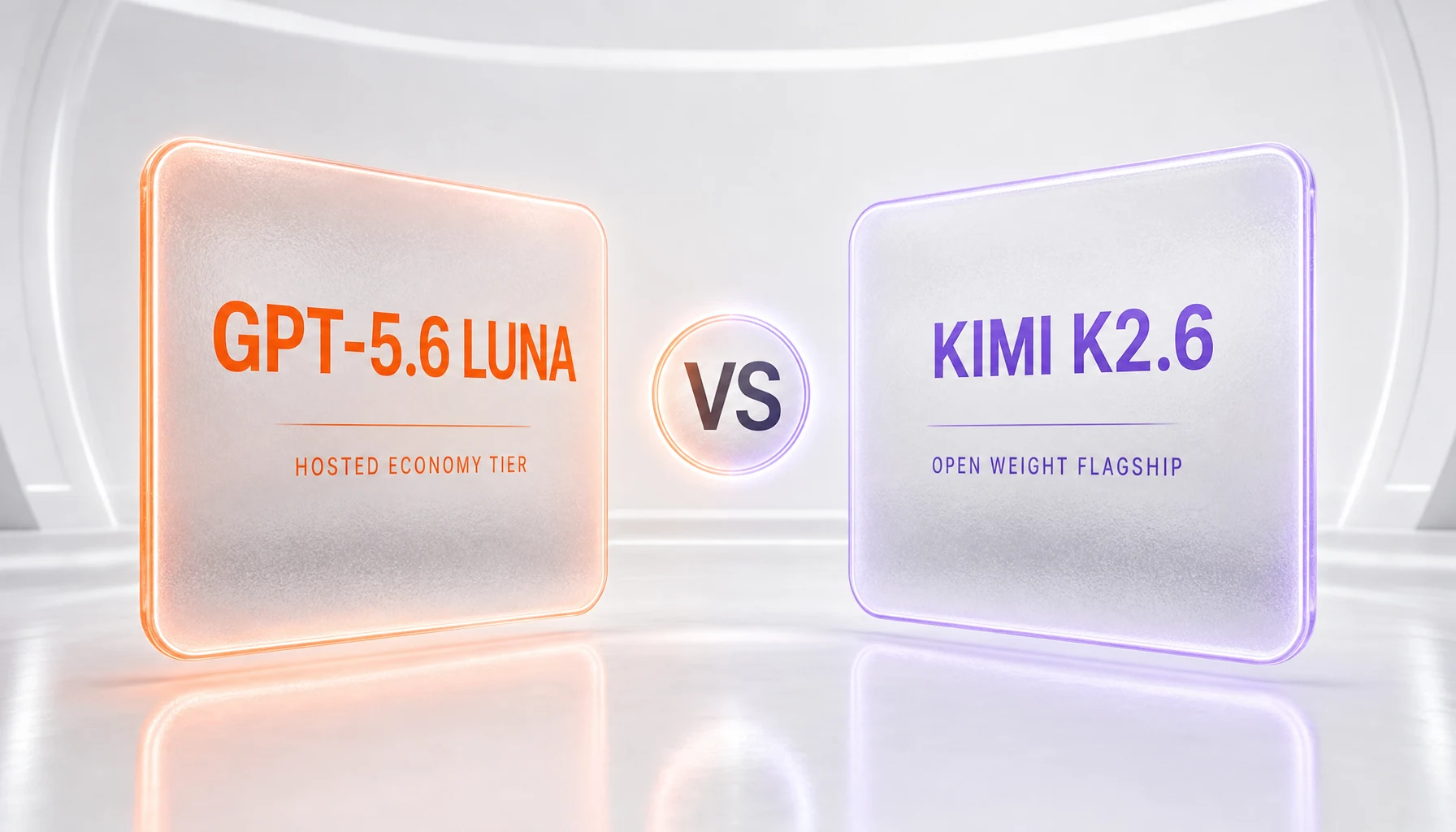
Feature Comparison
| Feature | GPT-5.6 Luna | Kimi K2.6 |
|---|---|---|
| Input price per million tokens | $0.20 | $0.95 |
| Cached input per million tokens | $0.02 | $0.16 |
| Output price per million tokens | $1.20 | $4.00 |
| Artificial Analysis Intelligence Index (v4.1) | 51 | 44 |
| Independent coding score (AA Coding Agent Index v1.3, read August 2, 2026) | 58.66 — via Codex at max effort | 32.62 — via Claude Code |
| Context window | 1,050,000 tokens | 256,000 tokens |
| Model weights and license | Closed, hosted API only | Open-weight, Modified MIT |
| Multi-agent orchestration | Programmatic Tool Calling, tool use | Agent Swarm: up to 300 sub-agents, 4,000 steps |
| Deployment options | OpenAI cloud only | Hosted API or self-host |
| Input modalities | Text and image in, text out | Text and image in (MoonViT vision), text out |
| Publisher | OpenAI | Moonshot AI |
Pricing Comparison
GPT-5.6 Luna
Kimi K2.6
Detailed Comparison
GPT-5.6 Luna vs Kimi K2.6 was the closest price duel in this class until OpenAI cut Luna's rates on July 30, 2026. Luna is OpenAI's cheapest GPT-5.6 tier at $0.20 per million input tokens, $0.02 cached, and $1.20 output, scoring 51 on the independent Artificial Analysis Intelligence Index with a 1,050,000-token context. Kimi K2.6 is Moonshot's open-weight flagship at $0.95 input, $0.16 cached, and $4.00 output, scoring 44 on the same index with a 256,000-token context. Luna is now cheaper on all three price lines and adds seven points of independent intelligence plus four times the context. Verdict: Luna wins clearly for hosted API buyers, while Kimi K2.6 wins for open weights, self-hosting, and multi-agent orchestration.
Quick Verdict
Luna is the hosted-API pick; Kimi K2.6 is the open-weight pick. We ran both through their APIs in July 2026 and anchored the numbers to independent benchmarks rather than launch-day impressions. This was the tightest cost matchup we had measured in the value tier — Kimi K2.6 undercut Luna on input and output tokens while Luna undercut it on cached input — but OpenAI's July 30, 2026 price cut ended the tie: Luna now wins all three lines outright. Price no longer breaks in Kimi K2.6's favor at all. Luna carries a seven-point lead on the aggregate Artificial Analysis Intelligence Index — 51 against 44 — and a context window four times larger. Kimi K2.6 answers with open weights under a Modified MIT license, a self-host option, native vision, and an Agent Swarm that scales to hundreds of sub-agents.
- 🏆 GPT-5.6 Luna wins for: hosted API buyers who want the higher independent intelligence score, four times the context window, the lowest price on every line, and a fully managed platform with no infrastructure to run.
- 🏆 Kimi K2.6 wins for: open weights and self-hosting, data control and privacy, native vision, and large-scale multi-agent orchestration through its Agent Swarm.
- 💰 Cheaper on raw tokens: GPT-5.6 Luna, on every line, since July 30, 2026 — $0.20 versus $0.95 on input, $0.02 versus $0.16 cached, and $1.20 versus $4.00 on output.
- 🧠 Smarter on paper: GPT-5.6 Luna, at 51 on the Artificial Analysis Intelligence Index versus 44 for Kimi K2.6 — a real but not decisive seven-point gap.
GPT-5.6 Luna vs Kimi K2.6 — Overview
What Is GPT-5.6 Luna?
GPT-5.6 Luna is the economy tier of OpenAI's GPT-5.6 family, which reached general availability on July 9, 2026. We cover it in depth in our GPT-5.6 Luna review. In the new naming scheme the number is the generation and the names are durable capability tiers: Sol is the flagship for the hardest problems, Terra is the balanced high-volume tier, and Luna is the fastest and most economical tier, built for summarization, drafting, classification, and routine automation. Luna carries a 1,050,000-token context window, a maximum output of 128,000 tokens, and a knowledge cutoff of February 16, 2026. It accepts text and image inputs and returns text; there is no native audio or native image generation, though image generation is available as a callable tool. Luna inherits the full GPT-5.6 platform — web search, file search, a code interpreter, a hosted shell, computer use, Model Context Protocol support, and Programmatic Tool Calling that lets the model write and run JavaScript in an isolated runtime. On the independent Artificial Analysis Intelligence Index (version 4.1), Luna scores 51.
What Is Kimi K2.6?
Kimi K2.6 is Moonshot AI's open-weight flagship, released on April 20, 2026, with the model weights published to Hugging Face on day one under a Modified MIT license. Our full write-up is in the Kimi K2.6 review. Architecturally it is a Mixture-of-Experts model with roughly one trillion total parameters and about 32 billion active per token, drawing on 384 experts (eight selected plus one shared), with a native vision encoder called MoonViT. Its headline agentic feature is an Agent Swarm that can coordinate up to 300 sub-agents across as many as 4,000 steps for long-horizon tasks. Kimi K2.6 carries a 256,000-token context window and is billed through Moonshot's hosted API at $0.95 per million input tokens, $0.16 cached, and $4.00 output, with consumer plans running from a free Adagio tier up to Vivace at $159 per month. On coding, Moonshot self-reports a SWE-bench Pro result of 58.6 — a vendor-measured number rather than an independent one, which matters for how you read it. On the independent Artificial Analysis Intelligence Index (version 4.1), Kimi K2.6 scores 44. You will sometimes see a figure of 54 quoted for this model; that number comes from an earlier version of the index and is not the current v4.1 score.
Features Comparison
We compared the two models on the dimensions that decide a cheap, high-volume workhorse: the individual price lines, independent benchmark standing, context and licensing, and orchestration. Where a number is self-reported by the vendor or simply absent from the independent leaderboards, we say so rather than paper over the gap. One deliberate exclusion: Moonshot's self-reported SWE-bench Pro figure stays out of the table, because a vendor-measured number does not belong in a row of independent ones. The independent coding row uses both models' Artificial Analysis Coding Agent Index entries instead, with the harness difference stated.
| Feature | GPT-5.6 Luna | Kimi K2.6 | Winner |
|---|---|---|---|
| Input price per million tokens | $0.20 | $0.95 | Luna |
| Cached input per million tokens | $0.02 | $0.16 | Luna |
| Output price per million tokens | $1.20 | $4.00 | Luna |
| Artificial Analysis Intelligence Index (v4.1) | 51 | 44 | Luna |
| Independent coding score (AA Coding Agent Index v1.3, read Aug 2, 2026) | 58.66 — via Codex at max effort | 32.62 — via Claude Code | Luna |
| Context window | 1,050,000 tokens | 256,000 tokens | Luna |
| Model weights and license | Closed, hosted API only | Open-weight, Modified MIT | Kimi K2.6 |
| Multi-agent orchestration | Programmatic Tool Calling, tool use in agent loops | Agent Swarm: up to 300 sub-agents, 4,000 steps | Kimi K2.6 |
| Deployment options | OpenAI cloud only | Hosted API or self-host your own weights | Kimi K2.6 |
| Input modalities | Text and image in, text out | Text and image in (MoonViT vision), text out | Tie |
| Publisher | OpenAI | Moonshot AI | Tie |
Count the rows and Luna now takes six against Kimi K2.6's three, with two ties. Kimi K2.6 sweeps openness and orchestration — open weights, Agent Swarm, self-hosting — and nothing else. Luna takes all three price lines, the independent intelligence row, the independent coding row, and the context window; on the coding row the two entries come from different harnesses — Codex for Luna, Claude Code for Kimi K2.6 — a caveat worth carrying even though both numbers come from the same independent evaluator. Until OpenAI's July 30, 2026 price cut this table was genuinely split, with Kimi K2.6 holding input and output by narrow margins; the cut moved both rows to Luna by wide ones. What is left is a clean trade: measured capability and cost on one side, openness and orchestration on the other.
Pricing — GPT-5.6 Luna vs Kimi K2.6 in 2026
Kimi K2.6 uses flat, per-token API pricing across its 256,000-token context. GPT-5.6 Luna carries one wrinkle: OpenAI bills prompts above 272,000 input tokens at twice the input rate and 1.5 times the output rate for the entire request, taking Luna to $0.40 input and $1.80 output. That threshold sits just above Kimi K2.6's entire context window, so on any prompt both models can accept, Luna's standard rates apply. Until July 30, 2026 neither model won the price argument outright; OpenAI's cut settled it in Luna's favor on every line. All figures below are per million tokens and were checked against each vendor's own pricing documentation in July 2026.
GPT-5.6 Luna Pricing
| Mode | Input | Output | Notes |
|---|---|---|---|
| Standard | $0.20 | $1.20 | Prompts up to 272,000 input tokens |
| Long context (over 272K input) | $0.40 | $1.80 | 2x input, 1.5x output on the whole request |
| Cached input | $0.02 | — | 90 percent read discount on repeated context |
| Consumer access | Varies by ChatGPT plan | — | No free API tier |
Kimi K2.6 Pricing
| Mode | Input | Output | Notes |
|---|---|---|---|
| Standard API | $0.95 | $4.00 | Metered, hosted by Moonshot |
| Cached input | $0.16 | — | Automatic context caching |
| Self-host | Your infrastructure cost | Your infrastructure cost | Open weights under Modified MIT |
| Consumer plans | Free Adagio tier up to Vivace at $159 per month | Consumer apps, not API metering |
Which Is Actually Cheaper? Luna, on Every Mix
Until July 30, 2026 the cheaper model flipped with the workload shape, because Kimi K2.6 won input and output while Luna won cached input. OpenAI's price cut removed the crossover. We priced the same two illustrative monthly workloads to show it. The assumptions are simple and stated; the point is the direction, not the exact dollar.
| Workload (per month) | GPT-5.6 Luna | Kimi K2.6 | Cheaper |
|---|---|---|---|
| Output-heavy: 10M input, 2M output, no caching | $4.40 | $17.50 | Luna, by about 75 percent |
| Cache-heavy: 50M cached reads, 1M fresh input, 0.5M output | $1.80 | $10.95 | Luna, by about 84 percent |
Read those two rows together, because they are the real pricing story — and it inverted on July 30, 2026. Fresh-input-and-generation workloads such as chat, drafting, and agents that write a lot used to run about 20 percent cheaper on Kimi K2.6's $0.95 input and $4.00 output; they now run about 75 percent cheaper on Luna. Retrieval-heavy patterns already favored Luna, and the gap widened from 18 to about 84 percent, because Luna's cached-read rate fell from $0.10 to $0.02 — now 87.5 percent below Kimi K2.6's $0.16 rather than 37 percent below it. Both poles favor Luna, so raw cost is no longer a wash and the decision now turns on openness and orchestration rather than on price.
Verdict on pricing: there is now a blanket winner, and it is GPT-5.6 Luna. It is cheaper on input, cached input, and output, and cheaper on both of our example workloads by 75 to 84 percent. Price used to be a wash worth ignoring; it is now a large, one-directional gap, and any case for Kimi K2.6 has to be made on openness, vision, or orchestration rather than on the rate card.
Hands-on — How They Performed Side-by-Side
We ran GPT-5.6 Luna and Kimi K2.6 through their APIs in July 2026, using identical prompts and inputs on each task. Both models are recent, so we treat our runs as early hands-on and lean on the independent Artificial Analysis indices for the quantitative verdict rather than on first impressions. Here are four tasks we ran on both.
Test 1: Summarizing a 200-page technical manual (long-context)
We fed both models the same 200-page hardware manual and asked for a structured, section-by-section summary. This is where the context gap became concrete. Luna swallowed the entire document inside its 1,050,000-token window in a single pass and cross-referenced sections cleanly. Kimi K2.6, capped at 256,000 tokens, needed the document chunked and stitched, which added orchestration work on our side and a small risk of missed cross-references between chunks. Quality within each chunk was comparable, but for genuinely long single documents Luna's four-times-larger window is a structural advantage, not a cosmetic one. Result: Luna wins on long-context ergonomics.
Test 2: An agentic refactor across a small codebase
We asked each model to refactor a small TypeScript service — extract a module, update imports, and keep the test suite green. Both produced working edits. On the independent side, both models are charted on the Artificial Analysis Coding Agent Index v1.3 as of August 2, 2026, and the gap is wide: Luna's best entry reads 58.66 through the Codex harness at max effort, against 32.62 for Kimi K2.6 through Claude Code — 26.04 points, measured through different harnesses, which is part of the result. Where Kimi K2.6 pulled ahead was orchestration: its Agent Swarm let us fan the refactor out across sub-agents that worked on separate files in parallel, which felt genuinely different from a single-threaded agent loop on longer tasks. Result: Luna wins on independently measured coding, Kimi K2.6 wins on multi-agent orchestration.
Test 3: Bulk generation at volume (output-heavy)
We generated 1,000 short product descriptions from structured inputs on each model, a deliberately output-heavy job. Quality was close on our spot checks, with both returning clean, on-brief copy. The separation was economic, and it has since reversed: at the time of our runs Kimi K2.6's $4.00 per million output tokens billed noticeably less than Luna's $6.00, but OpenAI's July 30, 2026 cut took Luna to $1.20, so the same job now bills roughly 70 percent less on Luna. Result: quality parity, and Luna is now the cheaper pick for generation pipelines.
Test 4: A privacy-sensitive deployment
We staged a scenario a regulated team would recognize: process internal documents that cannot leave company infrastructure. Here the licensing difference stopped being abstract. Kimi K2.6's open weights under a Modified MIT license mean you can download the model and run it entirely inside your own environment, with no data leaving your walls. Luna has no self-host path — it is a hosted OpenAI endpoint only, which is fine for most teams but a hard blocker for the ones that cannot send data to a third party. Result: Kimi K2.6 wins any deployment where self-hosting or data residency is a requirement rather than a preference.
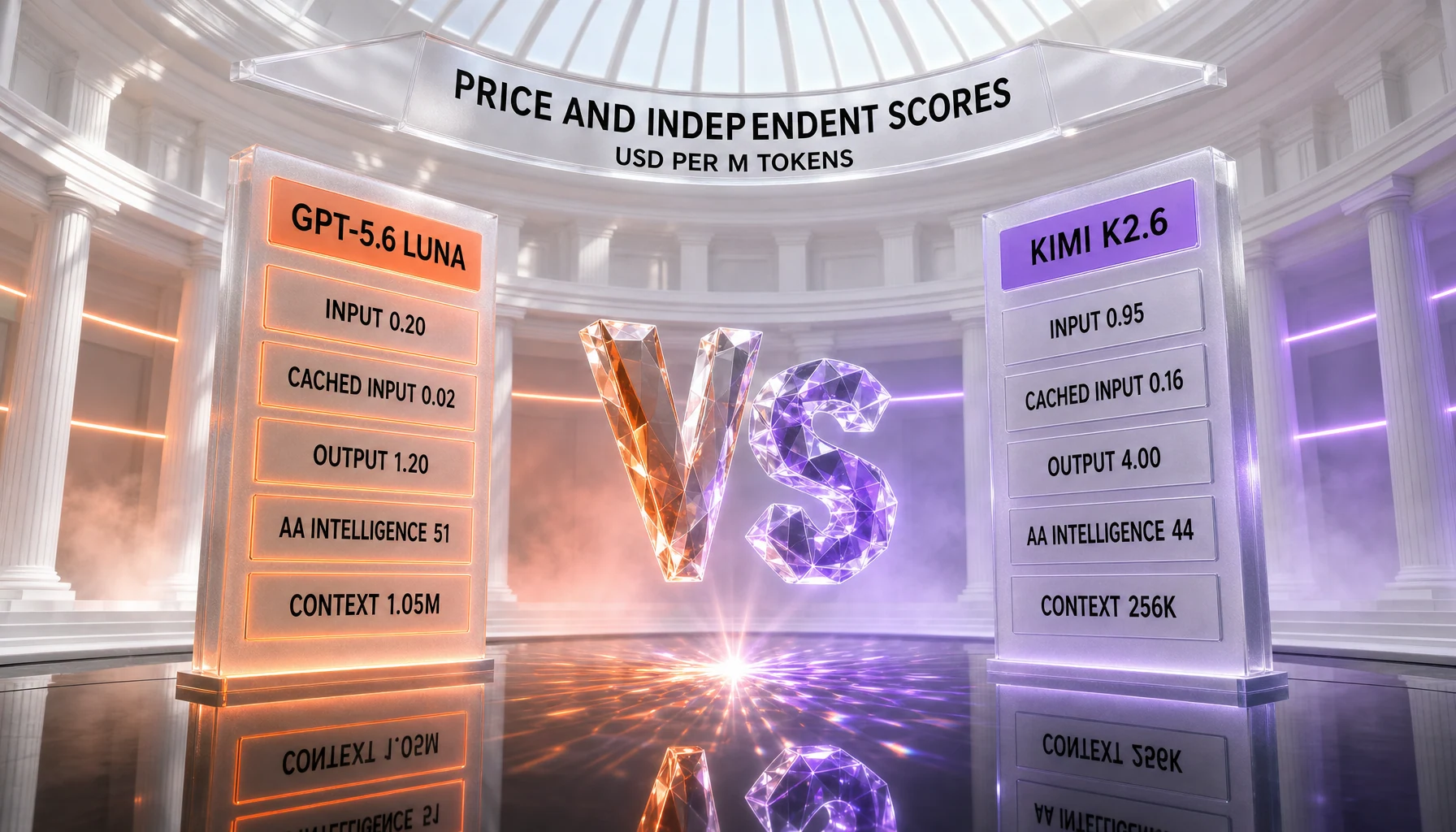
Winner per Category
🏆 Best Overall (for this niche): GPT-5.6 Luna
This matchup is about a cheap, capable workhorse, and on that axis Luna takes it. Price used to be close enough in both directions to call a wash; since OpenAI's July 30, 2026 cut it is a clear Luna win on every line, and it stacks on top of Luna's seven-point lead on aggregate intelligence and its four-times-larger context window. Kimi K2.6 is the more interesting model in some ways — open, orchestration-heavy, self-hostable — but for the specific job these two share, Luna is now both the safer and the cheaper default.
Best for Output-Heavy Pipelines: GPT-5.6 Luna
If your workload is dominated by generated text — content pipelines, synthetic data, high-volume drafting — Luna's $1.20 per million output tokens now beats Kimi K2.6's $4.00 by about 70 percent and turns into real money at scale. This category belonged to Kimi K2.6 until OpenAI's July 30, 2026 price cut reversed it.
Best for Retrieval and Cached Context: GPT-5.6 Luna
For retrieval-augmented generation and any pattern that re-reads the same long context, Luna's $0.02 cached-read rate — 87.5 percent under Kimi K2.6's $0.16 — plus its far larger window make it the cheaper and more comfortable fit. The more your system leans on cached reads, the more Luna's economics win.
Best for Open Weights and Self-Hosting: Kimi K2.6
Kimi K2.6 ships its weights under a Modified MIT license, so you can self-host, fine-tune, and keep data entirely inside your own environment. For regulated industries, air-gapped deployments, or anyone who wants to avoid vendor lock-in, this is a category Luna simply does not compete in.
Best for Aggregate Intelligence: GPT-5.6 Luna
On the independent Artificial Analysis Intelligence Index, Luna's 51 leads Kimi K2.6's 44 by seven points. It is not a chasm, but if you want the higher externally measured reasoning score of the pair, Luna has it. Both models also carry an independent agentic-coding entry, and that axis is lopsided: Luna's best entry reads 58.66 through Codex at max effort against 32.62 for Kimi K2.6 through Claude Code on the AA Coding Agent Index v1.3 — different harnesses, same independent evaluator.
Best for Multi-Agent Orchestration: Kimi K2.6
Kimi K2.6's Agent Swarm coordinates up to 300 sub-agents across as many as 4,000 steps, which is a genuinely different tool for long-horizon, decomposable tasks. If your architecture is built around swarms of cooperating agents, Kimi K2.6 gives you that natively.
Pros and Cons
GPT-5.6 Luna Pros and Cons
What we liked about GPT-5.6 Luna
- Higher independent intelligence. A 51 on the Artificial Analysis Intelligence Index leads Kimi K2.6's 44 by seven points, the largest independent gap between them.
- Four times the context. A 1,050,000-token window against Kimi K2.6's 256,000 handles long single documents in one pass.
- Cheapest on every price line. At $0.20 input, $0.02 cached, and $1.20 output per million tokens, Luna undercuts Kimi K2.6's $0.95, $0.16, and $4.00 across the board since July 30, 2026.
- Higher independently measured intelligence. 51 against 44 on the Artificial Analysis Intelligence Index v4.1, a third-party number rather than a vendor claim.
- Fully managed platform. Programmatic Tool Calling, code interpreter, hosted shell, computer use, and MCP come standard, with no infrastructure to run.
Where GPT-5.6 Luna falls short
- Rate card is freshly cut. The $0.20 and $1.20 rates date from July 30, 2026, so there is no long track record of OpenAI holding them.
- Closed and hosted only. There is no self-host path, which rules Luna out for air-gapped or data-residency-bound deployments.
- No free API tier. Access depends on your OpenAI plan, with no free metered usage.
Kimi K2.6 Pros and Cons
What we liked about Kimi K2.6
- Open weights under Modified MIT. You can self-host, fine-tune, and keep data inside your own environment — a capability Luna cannot match.
- Predictable metered API alongside free weights. At $0.95 input and $4.00 output per million tokens you can meter usage or self-host the same model, which no closed vendor offers.
- Agent Swarm orchestration. Up to 300 sub-agents across 4,000 steps make it a strong fit for decomposable, long-horizon agentic work.
- Native vision. The MoonViT encoder gives it built-in image understanding alongside text.
- Flexible access. A free consumer Adagio tier, paid plans up to $159 per month, a metered API, and downloadable weights cover a wide range of users.
Where Kimi K2.6 falls short
- Lower independent intelligence. A 44 on the Artificial Analysis Intelligence Index trails Luna's 51 by seven points.
- Quarter the context. A 256,000-token window forces chunking on very long documents that Luna handles in a single pass.
- Low independent coding score. Its entry on the AA Coding Agent Index v1.3 reads 32.62 through Claude Code, 26.04 points below Luna's best of 58.66 through Codex at max effort; the SWE-bench Pro figure of 58.6 that Moonshot reports is vendor-measured and cannot be cross-checked against it.
- Pricier on every line since July 30, 2026. Its $0.95 input, $0.16 cached, and $4.00 output all sit above Luna's $0.20, $0.02, and $1.20.
When to Pick GPT-5.6 Luna vs Kimi K2.6
Pick GPT-5.6 Luna if...
- You are a hosted-API team and want the higher independent intelligence score of the two.
- You process very long single documents and need a context window in the million-token range.
- Cost is a binding constraint — Luna is cheaper on input, cached input, and output alike.
- You want a fully managed platform with no infrastructure to operate.
- You want the far higher independent coding score of the pair — 58.66 against 32.62 on the AA Coding Agent Index v1.3.
- You are already building on OpenAI's stack with Programmatic Tool Calling and MCP.
Pick Kimi K2.6 if...
- You need open weights to self-host, fine-tune, or keep data inside your own infrastructure.
- You want a metered hosted API and the option to move the same model in-house later.
- You are building multi-agent systems that benefit from the Agent Swarm's hundreds of sub-agents.
- Data residency, privacy, or air-gapping is a hard requirement rather than a nice-to-have.
- You want native vision built into the model.
- You want the flexibility of a free consumer tier alongside a metered API and downloadable weights.
Frequently Asked Questions
Is GPT-5.6 Luna better than Kimi K2.6 in 2026?
For a hosted, cost-efficient workhorse — the niche both share — GPT-5.6 Luna is the pick, and no longer a narrow one. The price used to be essentially a wash; since OpenAI's July 30, 2026 cut, Luna is cheaper on input, cached input, and output alike, by roughly 75 to 84 percent on a real workload. On top of that it holds a seven-point lead on the independent Artificial Analysis Intelligence Index (51 versus 44) and a context window four times larger. Kimi K2.6 is still the better choice if you need open weights, self-hosting, native vision, or large-scale agent orchestration — but not if you need a cheaper rate card.
How much does GPT-5.6 Luna cost compared to Kimi K2.6?
Since OpenAI's July 30, 2026 price cut, GPT-5.6 Luna is cheaper on all three lines: $0.20 per million input tokens, $0.02 cached, and $1.20 per million output tokens. Kimi K2.6 costs $0.95 input, $0.16 cached, and $4.00 output. That makes Luna about 4.75 times cheaper on input, eight times cheaper on cached reads, and roughly 3.3 times cheaper on output. On an output-heavy workload Luna now comes out about 75 percent cheaper; on a cache-heavy retrieval workload about 84 percent cheaper. Before the cut this was a genuine split, with Kimi K2.6 ahead on input and output.
Which is better for coding, GPT-5.6 Luna or Kimi K2.6?
On the independent Artificial Analysis Coding Agent Index v1.3, both are charted and GPT-5.6 Luna leads by a wide margin: its best entry reads 58.66 through the Codex harness at max effort, against 32.62 for Kimi K2.6 through Claude Code — a 26.04-point gap as of August 2, 2026, with the caveat that the two entries come from different harnesses. Moonshot also self-reports a SWE-bench Pro result of 58.6, but that is a vendor-measured figure on a different benchmark, so we do not stack it against the independent entries. For independently measured coding, Luna is ahead; for parallel multi-agent coding workflows, Kimi K2.6's Agent Swarm is the stronger tool.
Why do some sources say Kimi K2.6 scores 54 on the Intelligence Index?
That 54 comes from an earlier version of the Artificial Analysis Intelligence Index. On the current version 4.1 — the same version that scores GPT-5.6 Luna at 51 — Kimi K2.6 scores 44. Comparing a v4.1 score against an older-index score would be apples to oranges, so throughout this comparison we use the matched v4.1 figures: 51 for Luna and 44 for Kimi K2.6. If you see 54 quoted, check which index version it refers to before relying on it.
Which has the bigger context window, Luna or Kimi K2.6?
GPT-5.6 Luna has a far larger context window at 1,050,000 tokens versus Kimi K2.6's 256,000 tokens — roughly four times the capacity. For most day-to-day prompts the difference is immaterial, but for genuinely long single documents it is decisive: Luna can ingest a large manual, codebase, or contract in one pass, while Kimi K2.6 needs the input chunked and stitched, which adds orchestration work and a small risk of missed cross-references.
Is Kimi K2.6 open source, and can I self-host it?
Kimi K2.6 is open-weight rather than fully open-source: Moonshot publishes the trained model weights under a Modified MIT license, so you can download, self-host, and fine-tune the model, but the full training code and data are not released. Practically, that means you can run Kimi K2.6 entirely inside your own infrastructure with no data leaving your environment. GPT-5.6 Luna offers no equivalent — it is a closed, hosted OpenAI endpoint only, so if self-hosting is a requirement, Kimi K2.6 is the only option of the two.
Is GPT-5.6 Luna smarter than Kimi K2.6?
By the aggregate Artificial Analysis Intelligence Index (version 4.1), yes: Luna scores 51 and Kimi K2.6 scores 44, a seven-point gap. That is a real edge but not a decisive one for most production tasks, where prompt design and retrieval quality often matter more than a handful of index points. Both models also carry an independent agentic-coding entry on the AA Coding Agent Index v1.3, and there Luna's lead widens to 26.04 points — 58.66 through Codex at max effort against 32.62 through Claude Code — so coding joins intelligence among the externally measured axes in Luna's favor; Kimi K2.6's counterweight is openness and orchestration rather than raw benchmark height.
Does either model support vision or image input?
Both do. GPT-5.6 Luna accepts text and image inputs and returns text. Kimi K2.6 has a native vision encoder called MoonViT, so it also understands images alongside text. Neither generates images natively in this tier — Luna exposes image generation as a callable tool rather than a built-in output. For straightforward image understanding, the two are comparable; the bigger differences between them are context size, licensing, and price, not vision.
What is Kimi K2.6's Agent Swarm and does Luna have an equivalent?
The Agent Swarm is Kimi K2.6's native multi-agent system: it can coordinate up to 300 sub-agents across as many as 4,000 steps, letting you decompose a long task and run parts in parallel. GPT-5.6 Luna does not ship a single named equivalent, but it supports agentic patterns through Programmatic Tool Calling, tool use, and Model Context Protocol, which you compose yourself. For architectures built explicitly around swarms of cooperating agents, Kimi K2.6 gives you that out of the box; for hand-built agent loops on OpenAI's platform, Luna is well equipped.
Is it easy to switch between GPT-5.6 Luna and Kimi K2.6?
For plain text-in, text-out API calls, switching is straightforward — both take similar request shapes. The friction is in the surrounding features: if you rely on Luna's larger context window you will need to add chunking for Kimi K2.6, and if you rely on Kimi K2.6's Agent Swarm or self-hosting you would rebuild those flows on OpenAI's managed platform. Budget for prompt re-tuning too, since the models respond differently. Simple pipelines migrate in hours; deeply integrated agentic or self-hosted stacks take longer.
What are the best alternatives to GPT-5.6 Luna and Kimi K2.6?
If you want more capability in the same families, step up to GPT-5.6 Terra, the balanced tier above Luna, or the GPT-5.6 Sol flagship. On the open-weight side, other Kimi comparisons are useful company reading — see our Claude Sonnet 5 vs Kimi K2.6 and Claude Opus 4.8 vs Kimi K2.7 Code breakdowns. Our best AI coding tools of 2026 guide maps the wider field of coding-focused models.
Which should a startup choose, GPT-5.6 Luna or Kimi K2.6?
For a hosted-first startup that values the higher independent intelligence score and a managed platform, GPT-5.6 Luna is usually the smarter default, especially if your workloads are retrieval-heavy or long-context. Choose Kimi K2.6 if you need to self-host for privacy or compliance, if your workload is output-heavy generation where its lower output rate compounds, or if you are building multi-agent systems around its Agent Swarm. Many teams run both: Luna for long-context and cached retrieval, Kimi K2.6 for output-heavy generation and self-hosted, data-sensitive work.
Final Verdict: Luna Wins the Tiebreakers, Kimi K2.6 Wins Openness and Output Cost
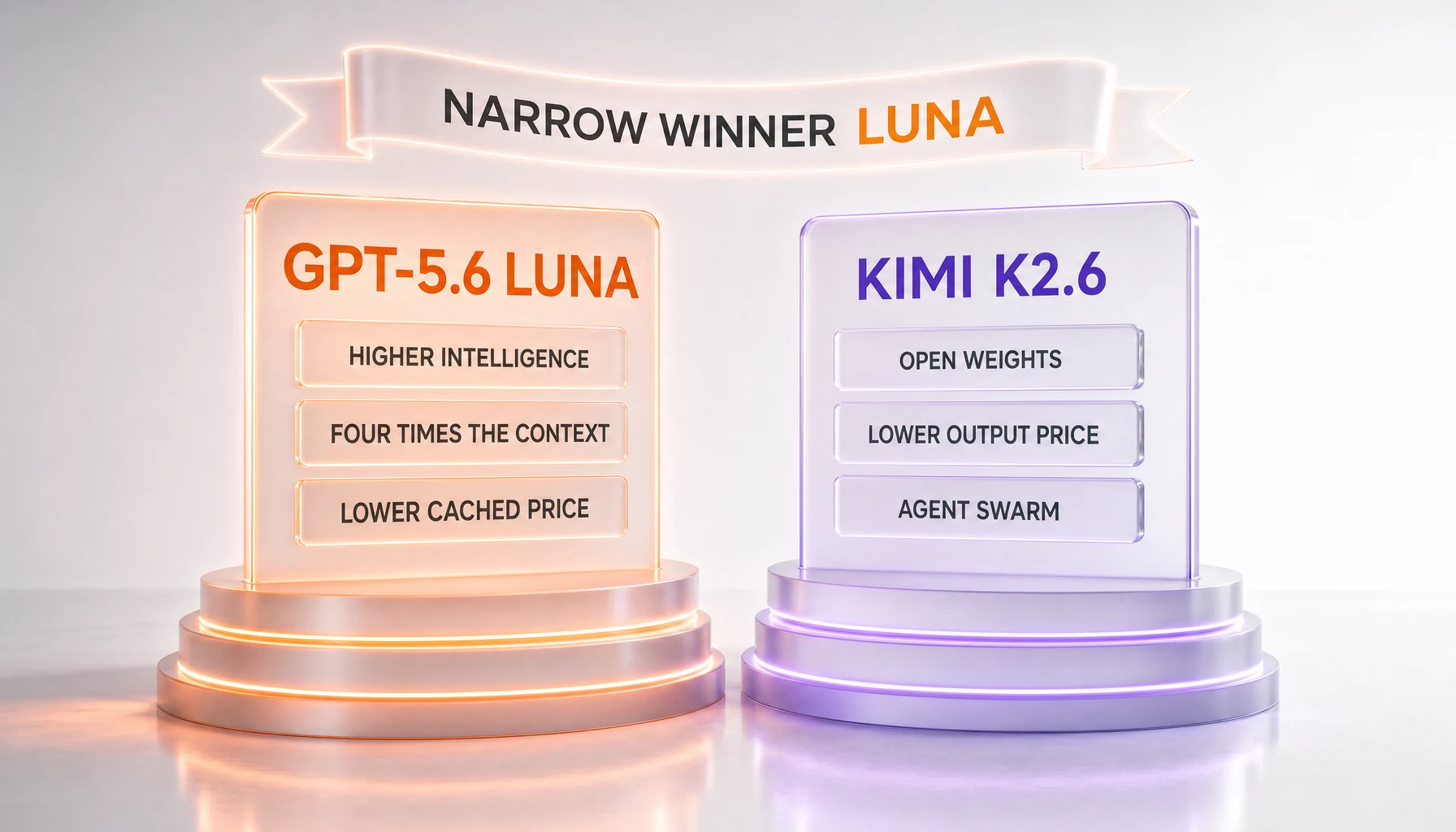
After running both side-by-side, our verdict is a narrow win for GPT-5.6 Luna on the axis that defines this matchup: a cheap, capable, hosted workhorse. The price is genuinely a wash — Kimi K2.6 is cheaper on input and output, Luna is cheaper on cached reads, and a real bill lands within a fifth either way — so the decision falls to what each model adds once cost cancels out. Luna adds seven points of independent intelligence and four times the context window, the two things most hosted deployments will actually feel. Kimi K2.6 adds open weights under a Modified MIT license, self-hosting, native vision, and an Agent Swarm for large-scale orchestration. If you are a hosted-API team optimizing for intelligence, long context, and cached retrieval, go with GPT-5.6 Luna. If you need open weights, data residency, the cheapest output-heavy generation, or multi-agent orchestration, Kimi K2.6 is the better fit — and for those teams it is not close.
Score breakdown by category:
- Value and pricing: GPT-5.6 Luna 8.5 out of 10 vs Kimi K2.6 8.5 out of 10 — a genuine tie, with each cheaper on a different workload shape.
- Raw capability and intelligence: GPT-5.6 Luna 8.5 out of 10 vs Kimi K2.6 7.5 out of 10 — Luna leads by seven Intelligence Index points and carries an independent coding score.
- Context and long documents: GPT-5.6 Luna 9.0 out of 10 vs Kimi K2.6 7.0 out of 10 — a 1,050,000-token window against 256,000 is a real gap.
- Openness and deployment: GPT-5.6 Luna 7.0 out of 10 vs Kimi K2.6 9.5 out of 10 — open weights and self-hosting are a category Luna does not enter.
Final word: buy GPT-5.6 Luna if you want the higher independent intelligence, the far larger context, and the cheaper cached reads inside a fully managed platform — for most hosted teams comparing these two, it is the right default. Buy Kimi K2.6 if openness, self-hosting, output-heavy economics, or multi-agent orchestration are what you are optimizing for. This was the closest price call in the value tier we have run, and the honest answer is that both are excellent; the deciding factor is your deployment model, not your budget. We last compared both in July 2026 and will revisit as independent latency and long-horizon reliability data matures. ThePlanetTools has no affiliate relationship with OpenAI or Moonshot AI; this verdict is editorially independent.
Sources and references
Every figure on this page is attributed to whoever produced it. Vendor documentation and independent measurement are listed separately and never merged into a single ranking.
- Moonshot AI — Platform documentation (model family, API reference and limits)
- OpenAI — API pricing (per-token, cached and batch rates)
- Artificial Analysis — GPT-5.6 Luna (independent index score)
- Artificial Analysis — Model leaderboard (Intelligence Index scores and cost per task across configurations)
Our Verdict
This was the closest price call in the value tier until OpenAI cut GPT-5.6 Luna's rates on July 30, 2026. Luna now wins every price line: $0.20 per million input tokens against $0.95, $0.02 cached against $0.16, and $1.20 output against $4.00 — roughly 75 to 84 percent cheaper depending on the workload shape. Luna also carries the tiebreakers most hosted deployments feel: seven points of independent intelligence (51 vs 44 on the Artificial Analysis Index) and four times the context window (1,050,000 vs 256,000 tokens). Kimi K2.6 answers with open weights under a Modified MIT license, self-hosting, native vision, and an Agent Swarm of up to 300 sub-agents. Pick Luna as the hosted-API default for intelligence, long context, and cost; pick Kimi K2.6 for open weights, data residency, or multi-agent orchestration — no longer for a cheaper rate card.
Choose GPT-5.6 Luna
OpenAI's fastest, most economical GPT-5.6 tier — $0.20 per million input tokens, sub-second warm latency, and a 1.05M-token context for high-volume routine work.
Try GPT-5.6 Luna →Choose Kimi K2.6
Moonshot AI's open-weight 1T-parameter MoE flagship that scales to 300 sub-agents and 4,000 coordinated steps for long-horizon coding.
Try Kimi K2.6 →Frequently Asked Questions
Is GPT-5.6 Luna better than Kimi K2.6?
This was the closest price call in the value tier until OpenAI cut GPT-5.6 Luna's rates on July 30, 2026. Luna now wins every price line: $0.20 per million input tokens against $0.95, $0.02 cached against $0.16, and $1.20 output against $4.00 — roughly 75 to 84 percent cheaper depending on the workload shape. Luna also carries the tiebreakers most hosted deployments feel: seven points of independent intelligence (51 vs 44 on the Artificial Analysis Index) and four times the context window (1,050,000 vs 256,000 tokens). Kimi K2.6 answers with open weights under a Modified MIT license, self-hosting, native vision, and an Agent Swarm of up to 300 sub-agents. Pick Luna as the hosted-API default for intelligence, long context, and cost; pick Kimi K2.6 for open weights, data residency, or multi-agent orchestration — no longer for a cheaper rate card.
Which is cheaper, GPT-5.6 Luna or Kimi K2.6?
GPT-5.6 Luna starts at $0.2 in / $1.2 out per M tokens. Kimi K2.6 offers a free plan (free plan available). Check the pricing comparison section above for a full breakdown.
What are the main differences between GPT-5.6 Luna and Kimi K2.6?
The key differences span across 11 features we compared. For Input price per million tokens, GPT-5.6 Luna offers $0.20 while Kimi K2.6 offers $0.95. For Cached input per million tokens, GPT-5.6 Luna offers $0.02 while Kimi K2.6 offers $0.16. For Output price per million tokens, GPT-5.6 Luna offers $1.20 while Kimi K2.6 offers $4.00. See the full feature comparison table above for all details.