GPT-5.6 Terra vs MiniMax M3: 11 Independent Points Against an 8-12x Price Gap (2026)

GPT-5.6 Terra scores 55 to MiniMax M3's 44 on one independent index — but MiniMax is 6.7-10x cheaper and open-weight. A genuine split, decoded.
Feature Comparison
| Feature | GPT-5.6 Terra | MiniMax M3 |
|---|---|---|
| Independent intelligence score (Artificial Analysis Intelligence Index v4.1) | 55 (independent) | 44 (independent, same version of the index) |
| Independent coding score (Artificial Analysis Coding Agent Index v1.3, read August 2, 2026) | 62.28 (Codex harness, max reasoning effort) | Not charted |
| Maximum context window | 1,050,000 tokens, priced flat across the whole window | 1,000,000 tokens; rates double above 512,000 tokens |
| Managed ecosystem and tooling | Full OpenAI ecosystem, Programmatic Tool Calling, managed hosted service | Standalone API plus self-host; no managed ecosystem at that scale |
| Input price (per million tokens) | USD 2.00 | USD 0.30 — roughly 6.7 times cheaper |
| Output price (per million tokens) | USD 12.00 | USD 1.20 — roughly 10 times cheaper |
| Independently measured intelligence per dollar of output | About 4.6 index points per USD of output | About 37 index points per USD of output — roughly ten times better |
| Model weights and self-hosting | Closed; API only, no weights released, no self-hosting | Open weights, downloadable, self-hostable, data stays in your jurisdiction |
| Native multimodality and computer use | Part of the multimodal GPT-5.6 family; text-first in this comparison | Native text, image, and video in one model, plus computer use |
| Vendor self-reported coding claim | Not the basis of its coding case — its coding figure is independently charted | SWE-bench Pro 59, self-reported by MiniMax on its own harness and not reproduced by a third party |
| Architecture transparency | Not disclosed by OpenAI | Published: mixture-of-experts, 428 billion parameters total with 23 billion active, MiniMax Sparse Attention |
Pricing Comparison
GPT-5.6 Terra
MiniMax M3
Detailed Comparison
GPT-5.6 Terra vs MiniMax M3 in 2026: GPT-5.6 Terra is OpenAI's balanced tier, priced at USD 2.00 per million input tokens, USD 0.20 cached, and USD 12 per million output tokens, with a 1,050,000-token context window. It scores 55 on the independent Artificial Analysis Intelligence Index. MiniMax M3 is MiniMax's open-weight flagship, released on June 1, 2026, priced at USD 0.30 per million input tokens and USD 1.20 per million output tokens at its standard rate, with a 1,000,000-token context and downloadable mixture-of-experts weights of 428 billion parameters total and 23 billion active. It scores 44 on the same independent index. That is an eleven-point capability gap measured by the same evaluator on the same scale, against a price gap of roughly 6.7 times on input and 10 times on output. There is no single winner here: Terra takes measured intelligence, context, and ecosystem; MiniMax M3 takes price on every line, open weights, self-hosting, and native multimodality. Pick Terra if quality per token matters more than dollars; pick MiniMax M3 if you are scaling volume, need to self-host, or want native image and video in the same model.
Quick Verdict
This is the cleanest kind of comparison to run and the hardest kind to call. Both models are scored on the Artificial Analysis Intelligence Index, by the same evaluator, on the same version of the index. So for once the capability question has a straight answer instead of a marketing one.
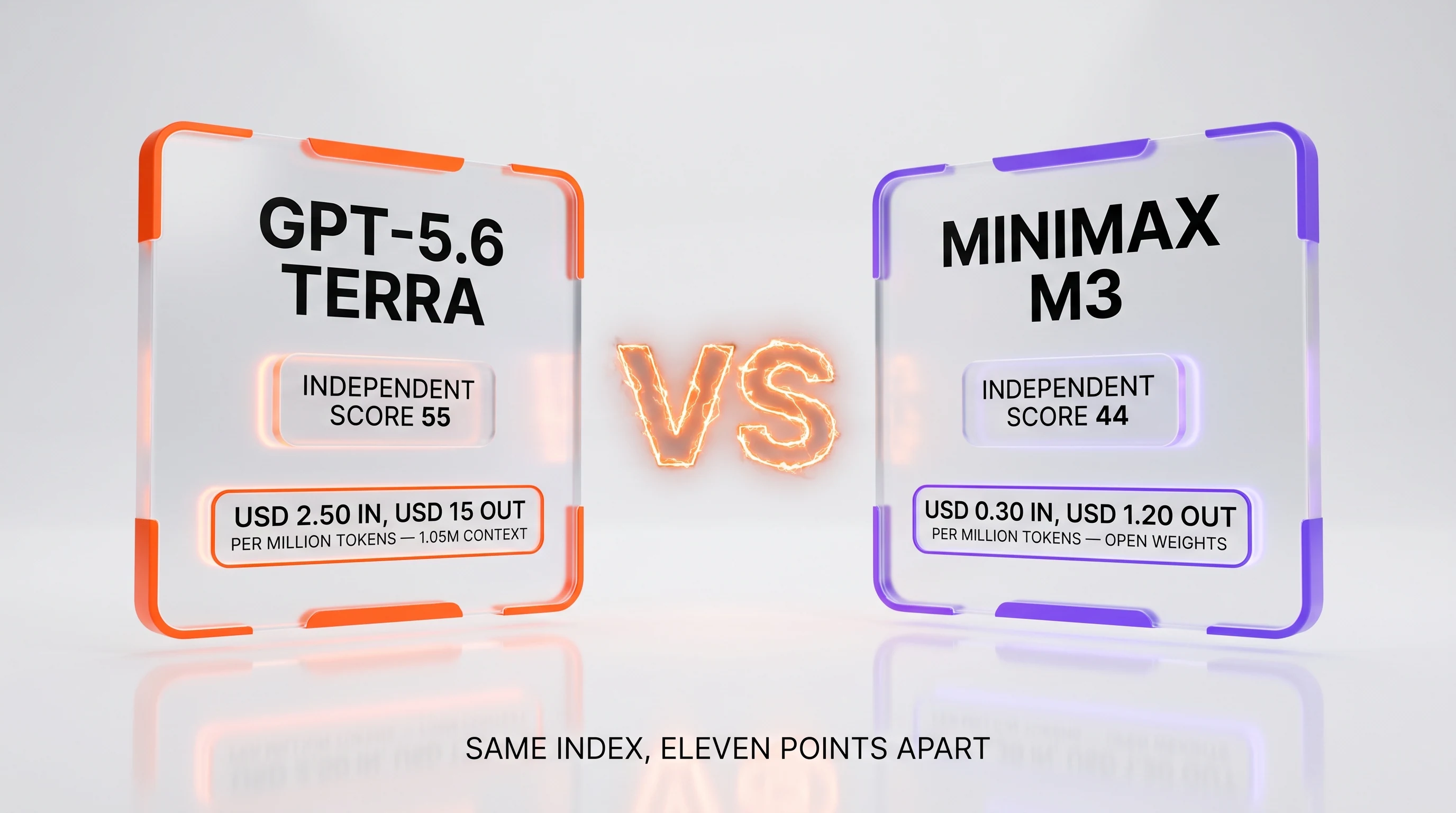
The numbers: Terra scores 55. MiniMax M3 scores 44. Eleven points, measured externally, on identical terms. And MiniMax charges roughly 6.7 times less on input (USD 0.30 against USD 2.00) and roughly 10 times less on output (USD 1.20 against USD 12).
So the real question is not "which one is better" — it is "is eleven points of independently measured intelligence worth paying eight to twelve times more?" And the honest answer is: it depends entirely on what you are building, which is why we are not forcing a single trophy onto this page.
This one is a genuine split, and we mean that as a finding, not a dodge. Eleven points is not cosmetic on this scale — the highest score anyone has posted on this index to date is 60, so 55 sits inside the leading group and 44 sits at the head of the strong open-weight tier. That gap shows up on long, unsupervised agent chains as tasks that finish versus tasks that need a human. But an eight-to-twelve-times price difference is not cosmetic either. At serious volume it is the difference between a line item and a budget meeting.
Here is the split, stated plainly:
- GPT-5.6 Terra wins measured capability. It is eleven points ahead on the one benchmark that scores both models identically — the intelligence index; on the AA Coding Agent Index v1.3 only Terra is charted, at 62.28 through the Codex harness at max reasoning effort, so that board adds evidence rather than a head-to-head.
- GPT-5.6 Terra wins context, narrowly. 1,050,000 tokens against 1,000,000 — a real 50,000-token margin, though not one most workloads will ever feel.
- MiniMax M3 wins price, on every single line. USD 0.30 against USD 2.00 on input, USD 1.20 against USD 12 on output. Nothing about that is close.
- MiniMax M3 wins control. Open weights you can download and run on your own hardware, in your own jurisdiction. Terra cannot do this at any price.
- MiniMax M3 wins breadth of modality. It handles text, image, and video natively in one model, plus computer use, where Terra's headline strength is the OpenAI tooling stack around it.
The rule we would give a team: if your binding constraint is quality — you are shipping agents that run for a long time without supervision, or your output is going in front of users unedited — pick GPT-5.6 Terra. If your binding constraint is cost, control, or data residency — you are processing hundreds of millions of tokens a month, you need the weights on your own machines, or you want image and video in the loop — pick MiniMax M3. Both are correct answers to different questions.
What This Matchup Actually Is
It helps to name what these two models are before lining them up, because they come from opposite ends of the market and were built to win different arguments.
GPT-5.6 Terra is the middle child of OpenAI's GPT-5.6 family. The family splits into three tiers by cost and capability: Sol at the top, Terra in the balanced middle, and Luna at the economy end. Terra is the one OpenAI positions as GPT-5.5-competitive quality at roughly half the price of the previous generation — a general-purpose workhorse with the full agentic toolbox, Programmatic Tool Calling, and a 1,050,000-token context. It is a closed, hosted model: you reach it through OpenAI's API, and the weights never leave OpenAI's data centers. If you already build on the OpenAI stack, Terra is the tier most teams land on when Sol is overkill and Luna is not quite enough.
MiniMax M3 is an open-weight frontier model from MiniMax, the Shanghai lab, released on June 1, 2026. It is a mixture-of-experts design with 428 billion parameters in total and 23 billion active on any given token, which is what lets it price so aggressively — you pay for the active slice, not the whole. It uses MiniMax Sparse Attention (MSA) to keep a full 1,000,000-token context affordable, it is multimodal natively across text, image, and video, and it can drive a computer. And because the weights are downloadable, you can run it on your own infrastructure instead of renting it by the token. It is the current co-leader of the open-weight field on the independent intelligence index, tied with the strongest open models of the moment.
So the trade is structural, not incidental. One model sells measured quality and an ecosystem; the other sells price, ownership, and modality. Everything below is an attempt to price that trade honestly.
Intelligence: 55 Against 44 On The Same Scale
The single most useful fact in this comparison is that both models are graded by the same independent evaluator. Most closed-versus-open matchups collapse here, because the open model has no third-party score and you end up comparing a verified number against a vendor slide. Not this time.
On the Artificial Analysis Intelligence Index, version 4.1, GPT-5.6 Terra scores 55 and MiniMax M3 scores 44. Same evaluator, same version of the index, same terms. Eleven points apart.
What does eleven points buy? On this scale, quite a lot. The Intelligence Index is a composite across reasoning, knowledge, math, and multi-step problem-solving, and the ceiling is real — the best score posted on the current version to date is 60. Terra at 55 sits with the leading group of frontier models. MiniMax M3 at 44 sits at the very top of the open-weight tier, alongside the strongest downloadable models available, but a clear step below the closed frontier. The gap is not a rounding error and it is not marketing; it is measured, and it is the same size no matter who is quoting it.
Where does that gap actually bite? On short, well-specified tasks — a summary, a classification, a single function — you may never see it. Both models will clear the bar. It shows up on the long stuff: agent runs that chain twenty or forty steps without a human checking each one, ambiguous problems where the model has to notice it is on the wrong track and correct, and knowledge-heavy work where being right the first time matters. On those, the higher-scoring model finishes more often, and an unfinished agent task does not just fail quietly — it gets retried, which spends the tokens the cheaper model was supposed to save you. That is the hidden cost that makes this call closer than the price sticker suggests.
Pricing: The Widest Gap We Have Measured
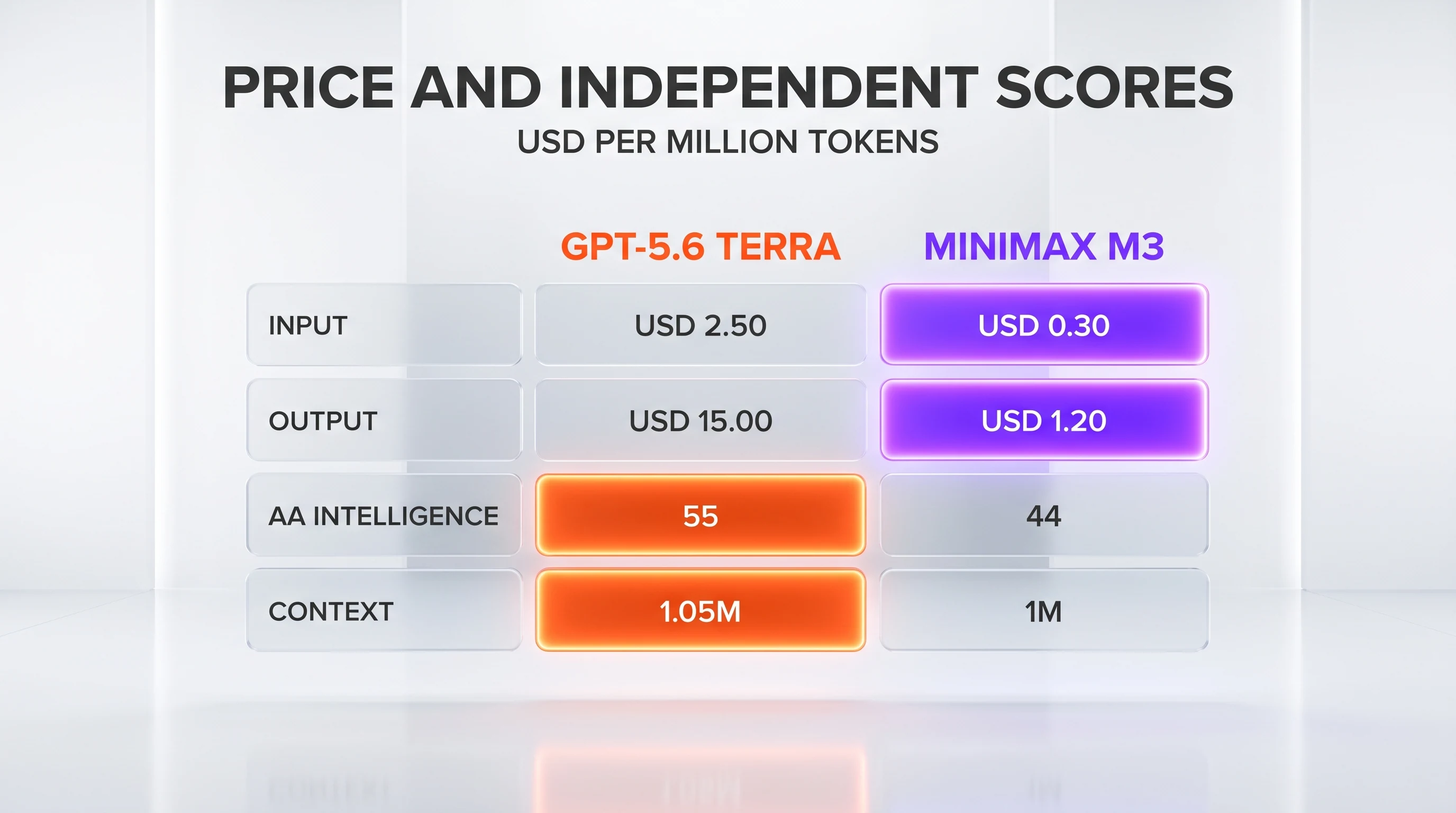
We pulled both prices from the vendors' own pricing pages rather than trusting a summary, because token pricing is where these comparisons most often go wrong. Here is where they land, per million tokens.
GPT-5.6 Terra: USD 2.00 input, USD 0.20 cached input, USD 12 output. That is OpenAI's standard balanced-tier pricing, flat across the full context window.
MiniMax M3: USD 0.30 input, USD 1.20 output at its standard rate, which applies to prompts up to 512,000 tokens. That is roughly 6.7 times cheaper on input and 10 times cheaper on output than Terra. It is the widest price gap we have measured between two models scored on the same intelligence index.
One honest caveat on MiniMax's pricing, because it matters at long context. The USD 0.30 and USD 1.20 rates hold for prompts up to 512,000 tokens. Above that threshold — for the top half of MiniMax's 1,000,000-token window — the rates double, to USD 0.60 on input and USD 2.40 on output. That is not a gotcha; it is standard for sparse-attention models that get more expensive to run as the context fills. But it means the eye-watering discount is at its widest on ordinary prompts and narrows on very long ones. Even doubled, though, MiniMax stays far below Terra: USD 0.60 against USD 2.00 on input is still roughly three times cheaper, and USD 2.40 against USD 12 on output is still five times cheaper. The price argument survives the caveat comfortably.
Now put price next to the measured intelligence. If you divide the index score by the output price, Terra returns about 3.7 index points per dollar of output; MiniMax returns about 37. On raw intelligence per dollar, MiniMax wins by a factor of roughly ten, and both sides of that ratio are independently sourced. Terra is more capable. MiniMax is far more efficient. Whether the extra capability is worth ten times the intelligence-per-dollar is the whole ballgame, and it is genuinely a function of your workload, not a universal truth.
Coding: One Vendor Number and Nothing to Match It
Coding is where buyers most want a single head-to-head figure, and it is exactly where this comparison refuses to give you a clean one — for a good reason we want to spell out.
GPT-5.6 Terra has an independently charted coding score. Artificial Analysis runs an agentic-coding index alongside the intelligence index it scores Terra on, and Terra is charted on it at 62.28 through the Codex harness at max reasoning effort (checked August 2, 2026, version 1.3). That index scores a harness paired with a model at a given reasoning effort, so the figure travels with all three — Codex, Terra, max — rather than standing as a bare model score.
MiniMax's coding evidence is a different animal, and it is important to be precise about it. MiniMax has not been charted on that independent coding index. What MiniMax publishes instead is a result on SWE-bench Pro, and that figure comes from MiniMax's own evaluation, on its own harness, and has not been reproduced by an independent third party. On that benchmark, MiniMax reports a mid-to-high result that it says beats the previous generation of frontier closed models and approaches the leaders. It is a genuinely strong claim from a genuinely strong model. It is also a vendor self-reported number on a different benchmark entirely.
So we will not stack those two figures against each other, and you should be wary of anyone who does. One is independently verified on one methodology; the other is self-reported on another. Lining them up as if they were the same measurement would be exactly the kind of apples-to-oranges the rest of this page is trying to avoid. What we can say cleanly is this: on independently verified coding, neither model has a number, so no part of the coding argument can be settled by a third party here. On MiniMax's own testing, its coding is strong enough to be taken seriously and to make it the open-weight coding model to beat. Both statements are true, and they do not contradict each other.
If independently verified coding capability is the axis you are buying on, neither model can satisfy it today, and the closest available proxy is the intelligence index Terra leads by eleven points. If you want a capable, open, self-hostable coding model and you are comfortable validating it on your own tasks — which, with open weights, you can actually do — MiniMax is the standout in its class. For a broader field, our roundup of the best AI coding tools of 2026 puts both in context against the rest of the market.
Context Window: A Narrow, Real Edge For Terra
Both models carry very large context windows, and both are in the seven-figure club that used to belong to a single frontier model. Terra offers 1,050,000 tokens; MiniMax M3 offers 1,000,000. Terra's window is genuinely larger, by 50,000 tokens — call it a real edge that most workloads will never touch.
Where the difference gets interesting is cost behavior at length, not raw capacity. Terra's price is flat across its whole window: the millionth token costs the same as the first. MiniMax's price steps up past 512,000 tokens, as covered above. So if your work genuinely lives at extreme context — feeding entire codebases, long document sets, or multi-hour transcripts in a single prompt — Terra is both slightly larger and simpler to reason about on cost, while MiniMax is dramatically cheaper up to the half-million mark and merely much cheaper beyond it. For the vast majority of prompts, which sit well under 512,000 tokens, neither the size gap nor the pricing step matters, and MiniMax's discount is at full strength.
Openness, Architecture, And Self-Hosting
This is the axis where the two models stop being comparable products and become different categories, and it is the strongest thing MiniMax has that Terra structurally cannot match.
MiniMax M3 ships its weights. It is an open-weight mixture-of-experts model — 428 billion parameters total, 23 billion active per token — that you can download and run on your own hardware. That single fact unlocks a set of things a hosted API never can: you can run it inside your own network with no data leaving your walls, satisfy data-residency rules by choosing where it runs, fine-tune it on your own material, and keep it running unchanged for years without depending on a vendor's roadmap or a price change. The architecture also uses MiniMax Sparse Attention, which is the trick that keeps a full million-token context affordable to serve, and the model is natively multimodal — text, image, and video in one set of weights — with computer-use capability on top.
GPT-5.6 Terra is closed and hosted. OpenAI does not release the weights, does not publish the architecture, and serves the model only through its API. In exchange you get the things a managed frontier service does well: no infrastructure to run, immediate access to the latest version, the surrounding OpenAI tooling and ecosystem, and a higher measured intelligence score. For most teams that is a perfectly good trade — until it is not, and the moment it stops being a good trade is usually about data control, cost at scale, or the need to own the thing outright. Those are precisely the moments MiniMax is built for.
There is no winner to declare here in the abstract. If you will never need to self-host and you value a managed, higher-scoring service, Terra's closed model is a feature, not a limitation. If control is a hard requirement — regulatory, strategic, or financial — then open weights are not a nice-to-have, and Terra is simply disqualified at any capability score. This is the axis most likely to decide the whole comparison for you before any benchmark does.
How We Compared Them
A word on method, because it shapes how much weight to put on each claim above. We lined these two models up on the ground where they can be compared honestly: the independent Artificial Analysis Intelligence Index, which grades both on the same version of the same test, and the vendors' own published pricing pages, which we read directly rather than taking from a summary. Those two sources carry the load of the verdict — the eleven-point capability gap and the eight-to-twelve-times price gap are both externally sourced, not our impressions.
Where a number is vendor self-reported — MiniMax's SWE-bench Pro coding result is the main example — we have labeled it as such and kept it out of the head-to-head, rather than laundering it into a comparison it does not belong in. And where the two models are structurally different rather than merely differently scored — closed versus open, hosted versus self-hostable, text-first versus natively multimodal — we have described the trade instead of pretending a single score settles it. That is why this page ends in a split rather than a trophy: the honest reading of the evidence is that these two models win different arguments, and the right choice is the one that matches your constraint.
Winner By Category
Here is the split broken down by what you might actually be optimizing for.
Best for maximum measured capability: GPT-5.6 Terra. Eleven points ahead on the shared independent intelligence index; on the independent coding index only Terra is charted, at 62.28 through the Codex harness at max reasoning effort. If you want the most capable of the two and the bill is secondary, this is the pick.
Best for cost at scale: MiniMax M3. Roughly 6.7 times cheaper on input and 10 times cheaper on output at standard rates. If you are metering hundreds of millions of tokens a month, the math is not close, and the intelligence-per-dollar advantage is roughly tenfold.
Best for control and compliance: MiniMax M3. Open weights, self-hostable, data stays where you put it. Terra cannot compete on this axis because the option does not exist at any price.
Best for native multimodality: MiniMax M3. Text, image, and video in one model, plus computer use. If your pipeline needs vision or video generation in the loop, this is the broader tool.
Best for teams already on the OpenAI stack: GPT-5.6 Terra. The ecosystem, tooling, Programmatic Tool Calling, and a managed service that just works, at a tier priced for everyday production rather than flagship prices.
Best all-round value for a mixed workload: it is genuinely a tie, and which way it tips depends on whether your marginal task is quality-bound or cost-bound. That is the split this whole comparison keeps returning to.
Pros And Cons
GPT-5.6 Terra
Strengths:
- Higher independent intelligence score — 55 against 44 on the shared index, an eleven-point measured lead.
- Its capability case rests on the intelligence index it leads 55 to 44 — neither model has a coding-specific score from an independent evaluator.
- Slightly larger context window at 1,050,000 tokens, priced flat across the whole window.
- Managed, hosted service with the full OpenAI tooling ecosystem and Programmatic Tool Calling.
- Balanced-tier pricing — GPT-5.5-class quality at roughly half the prior generation's cost.
Weaknesses:
- Eight to twelve times more expensive than MiniMax per token — a large gap at volume.
- Closed weights: no self-hosting, no fine-tuning on your own infrastructure, no data residency control.
- Undisclosed architecture — you cannot inspect or own what you are running.
- Roughly a tenth of MiniMax's measured intelligence per dollar of output.
MiniMax M3
Strengths:
- Dramatically cheaper on every line — USD 0.30 input and USD 1.20 output at standard rate.
- Open weights: downloadable, self-hostable, fine-tunable, with full data-residency control.
- Co-leader of the open-weight field on the independent intelligence index at 44.
- Natively multimodal across text, image, and video, plus computer use.
- Full 1,000,000-token context served affordably via MiniMax Sparse Attention.
- Roughly eight times more measured intelligence per dollar of output than Terra.
Weaknesses:
- Eleven points behind Terra on the shared independent intelligence index.
- Its coding case rests on a vendor self-reported benchmark, unreproduced by any third party — though no independent coding score exists for Terra either.
- Pricing doubles above 512,000 tokens, narrowing (though not erasing) the discount at very long context.
- Self-hosting the weights means running real infrastructure — a cost and a skill set, not free.
When To Pick Which
Pick GPT-5.6 Terra when quality is the binding constraint. You are shipping long-running agents that need to finish tasks without a human babysitting each step; your output goes in front of customers unedited; you are doing knowledge-heavy or reasoning-heavy work where being right the first time is cheaper than retrying; or you are already invested in the OpenAI ecosystem and want the balanced tier rather than the flagship. In those cases the eleven-point capability edge earns its price, because the failure mode of a cheaper, less capable model — retries, corrections, human review — quietly costs more than the token savings.
Pick MiniMax M3 when cost, control, or modality is the binding constraint. You are processing very high volumes where an eight-to-twelve-times price difference dominates every other consideration; you need to self-host for regulatory, security, or data-residency reasons; you want to fine-tune on your own material; or your workload needs native image and video, not just text. In those cases MiniMax is not a compromise — it is the better-engineered answer, and at 44 on the independent index it is capable enough that the quality gap is a manageable trade rather than a dealbreaker for most production work.
If you are choosing across a wider field than these two, it is worth seeing where each sits relative to its own family and its direct rivals. Terra's siblings, the flagship GPT-5.6 Sol and the economy GPT-5.6 Luna, bracket it on price and capability, and on the open side DeepSeek V4 is MiniMax's closest peer on the independent index — a useful third data point when open weights are on your shortlist.
Frequently Asked Questions
Is GPT-5.6 Terra better than MiniMax M3?
On measured intelligence, yes: Terra scores 55 on the independent Artificial Analysis Intelligence Index against MiniMax M3's 44, an eleven-point lead by the same evaluator on the same version of the index. But "better" depends on your constraint. MiniMax M3 is roughly 6.7 times cheaper on input and 10 times cheaper on output, ships open weights you can self-host, and is natively multimodal. Terra is the more capable model; MiniMax is the more affordable and more controllable one. There is no single winner — it is a genuine split by use case.
How much cheaper is MiniMax M3 than GPT-5.6 Terra?
At standard rates, MiniMax M3 costs USD 0.30 per million input tokens against Terra's USD 2.00 (about 6.7 times cheaper), and USD 1.20 per million output tokens against Terra's USD 12 (about 10 times cheaper). One caveat: MiniMax's rates double above 512,000 tokens of context, to USD 0.60 input and USD 2.40 output. Even doubled, MiniMax stays roughly four times cheaper on input and more than six times cheaper on output than Terra.
Which model is better for coding, GPT-5.6 Terra or MiniMax M3?
On independently verified coding, only one side has a result: as of August 2, 2026 the Artificial Analysis Coding Agent Index v1.3 charts GPT-5.6 Terra at 62.28, through the Codex harness at max reasoning effort, and carries no MiniMax M3 entry. MiniMax M3's coding evidence is instead a vendor self-reported SWE-bench Pro result on its own harness, which is strong but not third-party-verified. Because those two figures come from different benchmarks and different evaluators, they should not be stacked directly, and Terra's number is not a win over a model nobody has measured. If independently verified coding evidence is what you need, Terra is the only one of the two that carries any. If you want an open, self-hostable coding model you can validate on your own tasks, MiniMax is the standout in its class.
Can I self-host MiniMax M3? Can I self-host GPT-5.6 Terra?
You can self-host MiniMax M3: it is an open-weight model, so you can download the weights — 428 billion parameters total, 23 billion active — and run them on your own hardware, keeping all data inside your network. You cannot self-host GPT-5.6 Terra: it is a closed model available only through OpenAI's API, with weights that never leave OpenAI's data centers. If self-hosting or data residency is a hard requirement, MiniMax is the only option of the two.
What is the difference in context window between the two?
GPT-5.6 Terra offers a 1,050,000-token context window; MiniMax M3 offers 1,000,000 tokens. Terra's is larger by 50,000 tokens and priced flat across the whole window. MiniMax's pricing steps up past 512,000 tokens. For the large majority of prompts, which sit well under half a million tokens, the difference is academic and MiniMax's discount is at full strength.
Are the intelligence scores independent or vendor-reported?
The intelligence scores are independent. Both Terra's 55 and MiniMax M3's 44 come from the Artificial Analysis Intelligence Index, version 4.1 — a third-party evaluator that grades both models on the same test. That is what makes the eleven-point gap trustworthy: it is not either vendor's claim. By contrast, MiniMax's coding figure on SWE-bench Pro is vendor self-reported, which is why we keep it separate from the independent numbers.
What is MiniMax M3's architecture?
MiniMax M3 is an open-weight mixture-of-experts model with 428 billion parameters in total and 23 billion active on any given token. It uses MiniMax Sparse Attention (MSA) to serve a full 1,000,000-token context affordably, and it is natively multimodal across text, image, and video, with computer-use capability. Because it activates only a fraction of its parameters per token, it can price far below dense models of similar capability. GPT-5.6 Terra's architecture, by contrast, is not disclosed by OpenAI.
Is MiniMax M3 multimodal? Is GPT-5.6 Terra?
MiniMax M3 is natively multimodal: text, image, and video are handled in one set of weights, and it can also drive a computer. GPT-5.6 Terra is part of OpenAI's multimodal GPT-5.6 family, but its headline strengths in this comparison are its higher measured intelligence and the OpenAI tooling ecosystem around it. If native image and video generation in a single model is central to your workload, MiniMax is the broader tool.
Does the eleven-point intelligence gap actually matter in practice?
It depends on the task. On short, well-specified jobs — a summary, a classification, a single function — both models will usually clear the bar and you may never notice the gap. It shows up on long, unsupervised agent chains, ambiguous problems that require self-correction, and knowledge-heavy work where being right the first time matters. On those, the higher-scoring model finishes more often, and a failed agent task gets retried — which spends the tokens the cheaper model was supposed to save. That hidden retry cost is why the price gap overstates the real savings for quality-bound work.
When was MiniMax M3 released, and who makes it?
MiniMax M3 was released on June 1, 2026, by MiniMax, an AI lab based in Shanghai. It is the lab's open-weight flagship and currently one of the co-leaders of the open-weight field on the independent Artificial Analysis Intelligence Index. GPT-5.6 Terra is made by OpenAI and is the balanced middle tier of its GPT-5.6 family, sitting between the flagship Sol and the economy Luna.
Which model gives more intelligence per dollar?
MiniMax M3, by a wide margin. Dividing the independent intelligence score by the output price, Terra returns about 3.7 index points per dollar of output while MiniMax returns about 37 — roughly ten times more, with both the score and the price independently sourced. Terra is the more capable model in absolute terms; MiniMax is far more efficient per dollar. Which one wins for you depends on whether your workload is quality-bound or cost-bound.
Should I switch from GPT-5.6 Terra to MiniMax M3 to save money?
Only if your workload is cost-bound rather than quality-bound. If you run high volumes of well-specified tasks where both models clear the bar, switching to MiniMax can cut your token bill by roughly eight to twelve times, and the open weights let you validate quality on your own tasks first. But if you rely on long unsupervised agent runs or unedited customer-facing output, factor in the retry and review cost of an eleven-point lower intelligence score before switching — the cheaper model can cost more once failed tasks are re-run. The safe path is to A/B a real slice of your traffic on both.
Final Verdict
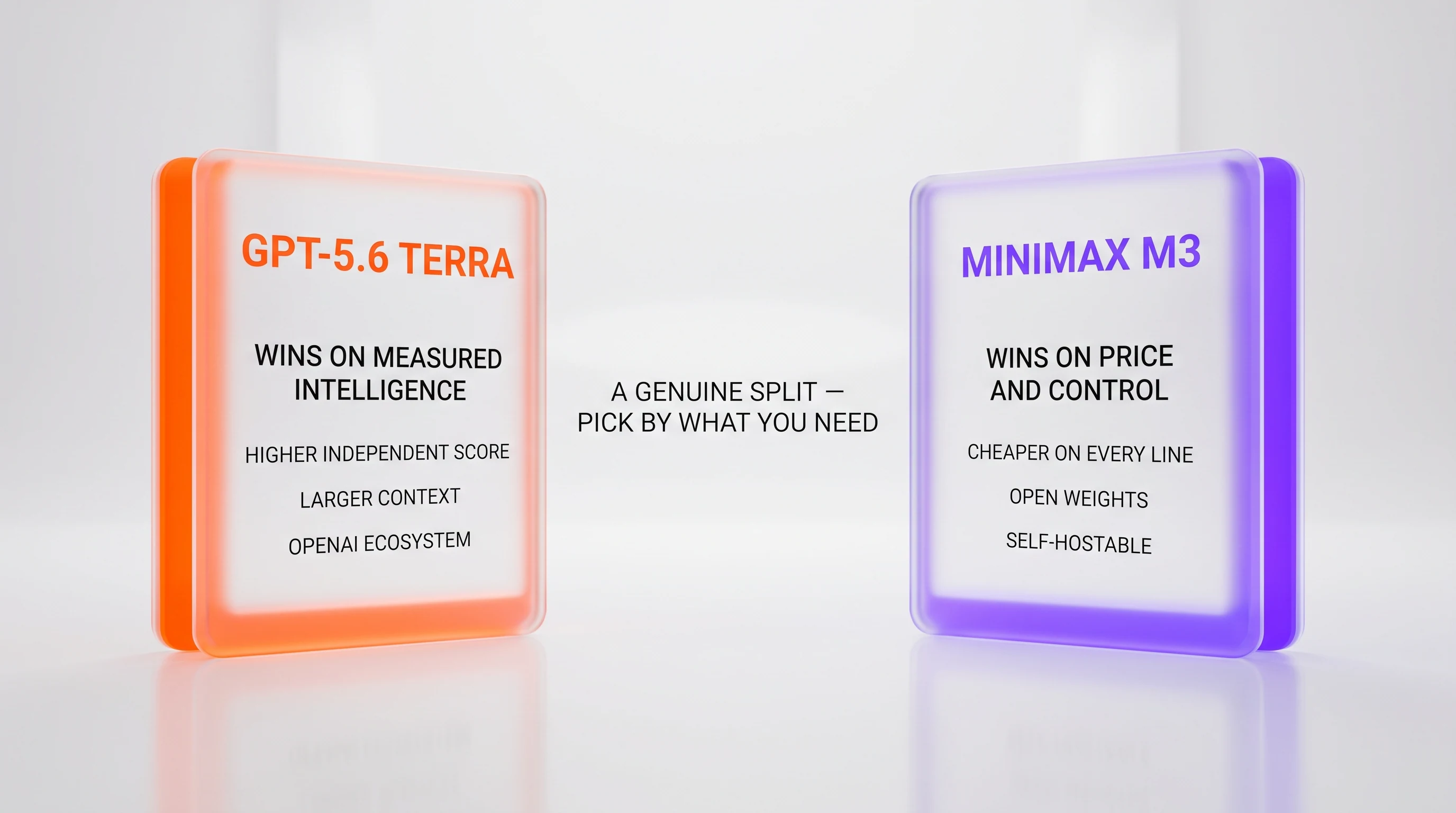
There is no single winner here, and that is the finding. GPT-5.6 Terra and MiniMax M3 are both scored on the same version of the same independent intelligence index — Terra 55, MiniMax 44 — so the eleven-point capability gap is real, measured, and the same size no matter who quotes it. Terra also carries a slightly larger context window at 1,050,000 tokens. Those are genuine advantages, and for quality-bound work they justify the price. Terra is additionally the only one of the two with an entry on the independent AA Coding Agent Index v1.3 — 62.28 through the Codex harness at max reasoning effort — which is a difference in available evidence, not a measured coding win.
But the price is the other half of the story, and it is a chasm, not a gap. MiniMax M3 is roughly 6.7 times cheaper on input and 10 times cheaper on output at standard rates, wins measured intelligence per dollar by about eightfold, and adds the things a hosted API structurally cannot: open weights, self-hosting, data residency, and native multimodality across text, image, and video. Its one honest asterisk — rates that double above 512,000 tokens — still leaves it several times cheaper than Terra even at extreme context.
So the rule is simple, even if the choice is not. If quality is your binding constraint — long unsupervised agents, unedited customer output, reasoning-heavy work — pick GPT-5.6 Terra and treat the price as the cost of finishing more tasks unaided. If cost, control, or modality is your binding constraint — high volume, self-hosting, compliance, or native image and video — pick MiniMax M3 and treat the eleven-point gap as a manageable trade for a model you can own and run for a fraction of the price. Both are correct answers. The only wrong move is to pick on the price sticker or the benchmark alone without asking which one your own workload is actually bound by.
Pricing and independent benchmark scores were verified against the vendors' published pricing pages and the Artificial Analysis Intelligence Index (version 4.1) as of July 2026, with the Artificial Analysis Coding Agent Index v1.3 read on August 2, 2026. MiniMax M3's SWE-bench Pro coding figure is vendor self-reported and is not directly comparable to independently charted coding scores. Model capabilities and prices change; check the source pages before committing to a decision.
Sources and references
Every figure on this page is attributed to whoever produced it. Vendor documentation and independent measurement are listed separately and never merged into a single ranking.
- OpenAI — API pricing (per-token, cached and batch rates)
- Artificial Analysis — GPT-5.6 Terra (independent index score)
- Hugging Face — MiniMaxAI/MiniMax-M3 (published weights and license)
- Artificial Analysis — MiniMax M3 (independent index score)
- Artificial Analysis — Model leaderboard (Intelligence Index scores and cost per task across configurations)
Our Verdict
There is no single winner here, and the split is the finding. GPT-5.6 Terra and MiniMax M3 are both scored on the same version of the same independent index — Terra 55, MiniMax 44 — so the eleven-point capability gap is real and externally measured, not either vendor's claim. Terra also carries a slightly larger 1,050,000-token context, and for quality-bound work that advantage earns its price; on the independent AA Coding Agent Index v1.3 Terra is charted at 62.28 through the Codex harness at max reasoning effort while MiniMax M3 has no entry, so that axis yields evidence on one side rather than a head-to-head. But the price gap is a chasm: MiniMax M3 is roughly 6.7 times cheaper on input and 10 times cheaper on output at standard rates, wins measured intelligence per dollar by about eightfold, and adds open weights, self-hosting, data residency, and native multimodality across text, image, and video — things a hosted API cannot offer at any price. Its one honest asterisk, rates that double above 512,000 tokens, still leaves it several times cheaper than Terra even at extreme context. The rule: if quality is your binding constraint — long unsupervised agents, unedited customer output, reasoning-heavy work — pick GPT-5.6 Terra. If cost, control, or modality is your binding constraint — high volume, self-hosting, compliance, or native image and video — pick MiniMax M3. Both are correct answers to different questions; the only wrong move is choosing on the price sticker or the benchmark alone without asking which constraint your own workload is actually bound by.
Choose GPT-5.6 Terra
OpenAI's balanced GPT-5.6 tier — GPT-5.5-competitive quality at 40 percent of the GPT-5.5 rate, with a 1.05M-token context and the full agentic toolbox.
Try GPT-5.6 Terra →Choose MiniMax M3
Open-weight frontier model from MiniMax combining near-frontier coding, a 1M token context window, and native multimodality — from $0.30 per million input tokens.
Try MiniMax M3 →Frequently Asked Questions
Is GPT-5.6 Terra better than MiniMax M3?
There is no single winner here, and the split is the finding. GPT-5.6 Terra and MiniMax M3 are both scored on the same version of the same independent index — Terra 55, MiniMax 44 — so the eleven-point capability gap is real and externally measured, not either vendor's claim. Terra also carries a slightly larger 1,050,000-token context, and for quality-bound work that advantage earns its price; on the independent AA Coding Agent Index v1.3 Terra is charted at 62.28 through the Codex harness at max reasoning effort while MiniMax M3 has no entry, so that axis yields evidence on one side rather than a head-to-head. But the price gap is a chasm: MiniMax M3 is roughly 6.7 times cheaper on input and 10 times cheaper on output at standard rates, wins measured intelligence per dollar by about eightfold, and adds open weights, self-hosting, data residency, and native multimodality across text, image, and video — things a hosted API cannot offer at any price. Its one honest asterisk, rates that double above 512,000 tokens, still leaves it several times cheaper than Terra even at extreme context. The rule: if quality is your binding constraint — long unsupervised agents, unedited customer output, reasoning-heavy work — pick GPT-5.6 Terra. If cost, control, or modality is your binding constraint — high volume, self-hosting, compliance, or native image and video — pick MiniMax M3. Both are correct answers to different questions; the only wrong move is choosing on the price sticker or the benchmark alone without asking which constraint your own workload is actually bound by.
Which is cheaper, GPT-5.6 Terra or MiniMax M3?
GPT-5.6 Terra starts at $2 in / $12 out per M tokens. MiniMax M3 starts at $0.3 in / $1.2 out per M tokens. Check the pricing comparison section above for a full breakdown.
What are the main differences between GPT-5.6 Terra and MiniMax M3?
The key differences span across 11 features we compared. For Independent intelligence score (Artificial Analysis Intelligence Index v4.1), GPT-5.6 Terra offers 55 (independent) while MiniMax M3 offers 44 (independent, same version of the index). For Independent coding score (Artificial Analysis Coding Agent Index v1.3, read August 2, 2026), GPT-5.6 Terra offers 62.28 (Codex harness, max reasoning effort) while MiniMax M3 offers Not charted. For Maximum context window, GPT-5.6 Terra offers 1,050,000 tokens, priced flat across the whole window while MiniMax M3 offers 1,000,000 tokens; rates double above 512,000 tokens. See the full feature comparison table above for all details.