GPT-5.6 Terra vs Qwen 3.6: 15 Independent Points Against a 7.7x Price Gap (2026)

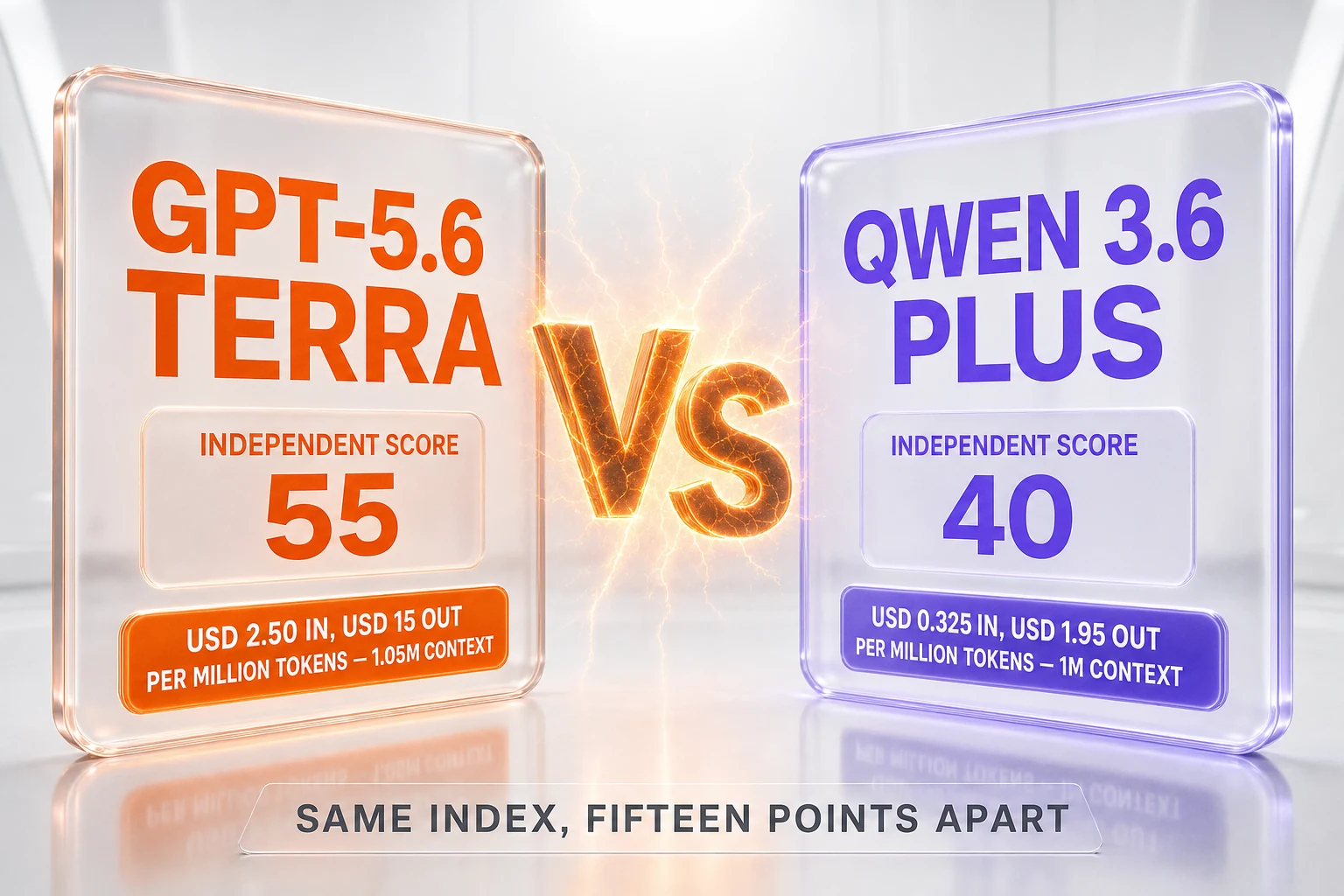
GPT-5.6 Terra vs Qwen 3.6 Plus: 55 vs 40 on the same independent index, but Qwen runs ~6.2x cheaper. Terra wins capability, Qwen wins value. Full verdict.
Feature Comparison
| Feature | GPT-5.6 Terra | Qwen 3.6 |
|---|---|---|
| Independent intelligence score (Artificial Analysis Intelligence Index v4.1) | 55 (independent) | 40 (independent, same index version — this is the Qwen 3.6 Plus flagship, not the open-weight variants) |
| Independent coding score (Artificial Analysis Coding Agent Index v1.3, read August 2, 2026) | 62.28 (Codex harness, max reasoning effort) | Not charted |
| Maximum context window | 1,050,000 tokens | 1,000,000 tokens |
| Input price (per million tokens) | USD 2.00 | USD 0.325 — roughly 6.2 times cheaper |
| Output price (per million tokens) | USD 12.00 | USD 1.95 — roughly 6.2 times cheaper |
| Independently measured intelligence per dollar of output | About 4.6 index points per USD of output | About 20 index points per USD of output — more than five times better |
| Multimodal input | Text-focused in this pairing | Native text, image, and video input |
| Flagship weights and licensing | Closed, proprietary; API only | Qwen 3.6 Plus is also closed and proprietary; API only |
| Open-weight variants in the family | None — OpenAI ships no open-weight GPT-5.6 model | Yes — Qwen3.6-27B and Qwen3.6-35B-A3B under an Apache 2.0 license (separate from Plus; not independently scored) |
| Hosted metered API | Available from OpenAI | Available from Alibaba (Model Studio) |
Pricing Comparison
GPT-5.6 Terra
Qwen 3.6
Detailed Comparison
GPT-5.6 Terra vs Qwen 3.6 Plus in 2026: GPT-5.6 Terra is OpenAI's balanced tier, priced at USD 2.00 per million input tokens, USD 0.20 cached, and USD 12 per million output tokens, with a 1,050,000-token context window. It scores 55 on the independent Artificial Analysis Intelligence Index. Qwen 3.6 Plus is Alibaba's proprietary flagship, released on April 2, 2026, priced at USD 0.325 per million input tokens and USD 1.95 per million output tokens, with a 1,000,000-token context window and native multimodal input. It scores 40 on the same independent index. That is a fifteen-point capability gap measured by the same evaluator on the same scale, against a price that is roughly 6.2 times cheaper on both input and output. GPT-5.6 Terra takes the verdict on measured intelligence and context. Qwen 3.6 Plus wins price on every line, measured intelligence per dollar, multimodality, and access to an Apache 2.0 open-weight family — and the price gap here is the widest in this matchup series.
Quick Verdict
This is the value-versus-capability question in its purest form, and for once neither side has to be taken on faith. Both GPT-5.6 Terra and Qwen 3.6 Plus have been measured by Artificial Analysis, the same independent evaluator, on the same version of the same index. No vendor harness, no asterisk. The numbers line up honestly.
The result: Terra scores 55. Qwen 3.6 Plus scores 40. Fifteen points, measured externally, on identical terms. And Qwen 3.6 Plus charges roughly 6.2 times less on input (USD 0.325 against USD 2.00) and roughly 6.2 times less on output (USD 1.95 against USD 12).
So the question is stark: is fifteen points of independently measured intelligence worth paying nearly eight times more?
Our answer is that GPT-5.6 Terra takes the overall verdict on capability — but this is the largest price gap and the largest capability gap in this family at the same time, and for a great deal of real work Qwen 3.6 Plus is the correct pick. Fifteen points on this scale is not cosmetic: the best score any model has posted on this index to date is 60, so Terra at 55 sits in the leading group while Qwen 3.6 Plus at 40 sits squarely in the capable mid-tier. That gap shows up on long, unsupervised work as tasks that finish versus tasks that need a human. But nearly eight times cheaper is a genuinely different order of magnitude from anything else in this series.
Here is what each model wins, stated plainly:
- Qwen 3.6 Plus wins price, on every line. USD 0.325 against USD 2.00 on input, USD 1.95 against USD 12 on output — roughly 6.2 times cheaper both ways.
- Qwen 3.6 Plus wins measured intelligence per dollar. Divide the independent index score by the output price and Qwen returns about 20 points per dollar against Terra's roughly 4.6. It is beaten on capability and still wins the efficiency argument by more than four times.
- Qwen 3.6 Plus wins multimodality. It accepts text, image, and video input natively.
- Qwen 3.6 Plus gives you access to an open-weight family. The Plus tier itself is closed, but Alibaba ships open-weight siblings under an Apache 2.0 license — the most permissive terms on the market. That is optionality Terra has no answer to.
- Terra wins independently measured intelligence. 55 against 40 on the same index.
- Independently measured coding is one-sided evidence here, not a win. The AA Coding Agent Index v1.3 charts GPT-5.6 Terra at 62.28 through the Codex harness at max reasoning effort and carries no Qwen 3.6 Plus entry at all — so that axis has no head-to-head, which we handle carefully below rather than paper over.
- Terra wins context, marginally. 1,050,000 tokens against 1,000,000 — about five percent more room.
How We Compared Them, and Two Rules We Hold To
We ran both models side by side on their respective APIs — the same refactoring passes, the same long-document work, the same agentic tool-calling loops — to get a feel for how each behaves in practice. That hands-on time informs the judgment calls on this page: how a model holds a long context, how it recovers when a tool call fails, how much supervision it needs before you can leave it running unattended.
What it does not do is produce benchmark numbers. We do not publish our own scores, because a handful of prompts run by one team is not a benchmark. Every figure on this page comes either from a named independent evaluator or from the vendor, and we label which is which, every single time.
- Independent means measured by a third party with no stake in the result — here, Artificial Analysis. Those numbers are comparable across models, because the same harness ran them all under the same conditions.
- Vendor self-reported means the company that built the model ran the benchmark itself, on its own harness, and published the outcome. That is useful signal. It is not verification, it is not comparable to an independent score, and it is not reliably comparable to another vendor's self-reported number either, because no two vendor harnesses are alike.
Two rules follow, and both are specific to this pairing.
First, Qwen 3.6 is a family, not a model. Alibaba ships several things under the Qwen 3.6 name, and they are not interchangeable. The independent index score of 40 belongs to Qwen 3.6 Plus — the proprietary, closed, hosted flagship, and the only Qwen 3.6 model with a measured Artificial Analysis result. There are also open-weight variants in the family, and they are genuinely interesting, but they are different models with different capabilities, and the 40 does not transfer to them. Every "Qwen 3.6" number in our comparison table and infographic is a Plus number. We never quietly borrow a figure from one family member to flatter another.
Second, the independent coding evidence covers one side only, so we never stack anything. The Artificial Analysis Coding Agent Index v1.3 charts GPT-5.6 Terra at 62.28, through the Codex harness at max reasoning effort, and carries no entry for Qwen 3.6 Plus. A number with nothing beside it does not settle an axis, and an unmeasured model is not a beaten one. The only coding figures in the Qwen orbit are vendor self-reported results attached to the open-weight variants — a different evidentiary regime and a different set of models — and setting those against Terra's independent figure would manufacture a like-for-like measurement that does not exist. So we never do it — not in a table row, not in a sentence, not in the infographic, not in the FAQ. Any page that lines those numbers up is telling you a lie by layout.
GPT-5.6 Terra and Qwen 3.6 Plus at a Glance
GPT-5.6 Terra is the middle tier of OpenAI's GPT-5.6 family — the balanced model, positioned beneath GPT-5.6 Sol and above GPT-5.6 Luna. It is priced at USD 2.00 per million input tokens, USD 0.20 per million cached input tokens, and USD 12 per million output tokens, with a 1,050,000-token context window. It is a closed model: no weights, no self-hosting, no published architecture. What OpenAI offers instead of transparency is external measurement — Terra carries a score of 55 on the independent Artificial Analysis Intelligence Index, produced by an evaluator with no commercial stake in the outcome.
Qwen 3.6 Plus is the proprietary flagship of Alibaba's Qwen 3.6 family, released on April 2, 2026. It is priced at USD 0.325 per million input tokens and USD 1.95 per million output tokens through Alibaba's direct Model Studio endpoint, with a 1,000,000-token context window, a maximum output of 65,536 tokens, and native multimodal input across text, image, and video. Like Terra, the Plus tier is closed — no downloadable weights, API access only. But it has been independently measured: 40 on the same Artificial Analysis Intelligence Index that scores Terra at 55. And the family it belongs to includes open-weight siblings under an Apache 2.0 license, which changes the strategic picture even though it does not change what Plus itself is.
That combination is what makes this pairing worth your time. Qwen 3.6 Plus is not a model asking you to take a vendor's word for it. It walked onto the same scoreboard as the closed Western field, posted a real number, and then asked why you are paying almost eight times more.
| Specification | GPT-5.6 Terra | Qwen 3.6 Plus |
|---|---|---|
| Vendor | OpenAI | Alibaba (Qwen team) |
| Positioning | Balanced tier of the GPT-5.6 family | Proprietary flagship of the Qwen 3.6 family, released April 2, 2026 |
| Input, per million tokens | USD 2.00 | USD 0.325 |
| Cached input, per million tokens | USD 0.20 | Not published as a separate rate |
| Output, per million tokens | USD 12.00 | USD 1.95 |
| Context window | 1,050,000 tokens | 1,000,000 tokens |
| Independent intelligence score | 55 on the Artificial Analysis Intelligence Index | 40 on the Artificial Analysis Intelligence Index |
| Multimodal input | Text | Text, image, and video |
| Weights and licensing (flagship) | Closed, API only | Closed, API only |
| Open-weight variants in the family | None | Qwen3.6-27B and Qwen3.6-35B-A3B, released under an Apache 2.0 license (separate models, not Plus) |
The Fifteen Points: One Index, Two Flagships, No Excuses
Here is the part that separates this comparison from most closed-versus-cheap pages: both numbers are honest and both are comparable.
Artificial Analysis Intelligence Index, version 4.1 — the same index, the same version, the same evaluator:
- GPT-5.6 Terra: 55 (independent).
- Qwen 3.6 Plus: 40 (independent).
No asterisk, no vendor harness, no "self-reported" caveat. Both models were run by a third party under the same conditions and both came back with a number. This is what an honest comparison looks like, and it is rarer than it should be.
Fifteen points on this scale is a large gap. To calibrate it: the highest score any model has posted on this index to date is 60. Terra at 55 sits inside the leading group, a handful of points off the top. Qwen 3.6 Plus at 40 sits in the capable mid-tier — genuinely useful, clearly a step below the frontier. This is a wider gap than most of the closed-versus-cheap matchups we run, and anyone telling you those two numbers are close is selling something.
What fifteen points buys you in practice is completion. On single-shot work — draft this, summarize that, answer a question — the difference is often invisible, and a well-prompted 40 will do the job cleanly. The gap opens on long, unsupervised chains: multi-file refactors, agentic loops that run for an hour, tasks where an error in step 3 quietly corrupts step 40. The stronger model needs fewer interventions and fails less often, and on agentic work a failure is not free — it gets retried, and the retry burns the tokens the cheaper model was supposed to save you.
The 40 belongs to Plus — and only to Plus
This is the single most misread thing about Qwen 3.6, so it is worth being explicit. The independent score of 40 is Qwen 3.6 Plus, the closed proprietary flagship — not the open-weight variants. Alibaba releases open-weight models in the same family (we cover them below), and you will see people quote a Plus benchmark next to an open-weight model's name, or an open-weight self-reported figure under the "Qwen 3.6" banner as though it described Plus. Both moves are wrong. The open-weight variants have not been placed on the Artificial Analysis Intelligence Index at all, so they have no comparable independent score, and the 40 does not describe them. On this page, "Qwen 3.6 Plus" always means the specific model that Artificial Analysis measured at 40, and nothing else wears that number.
Pricing: Nearly Six Times Cheaper, Both Directions
These are the published metered rates, per million tokens:
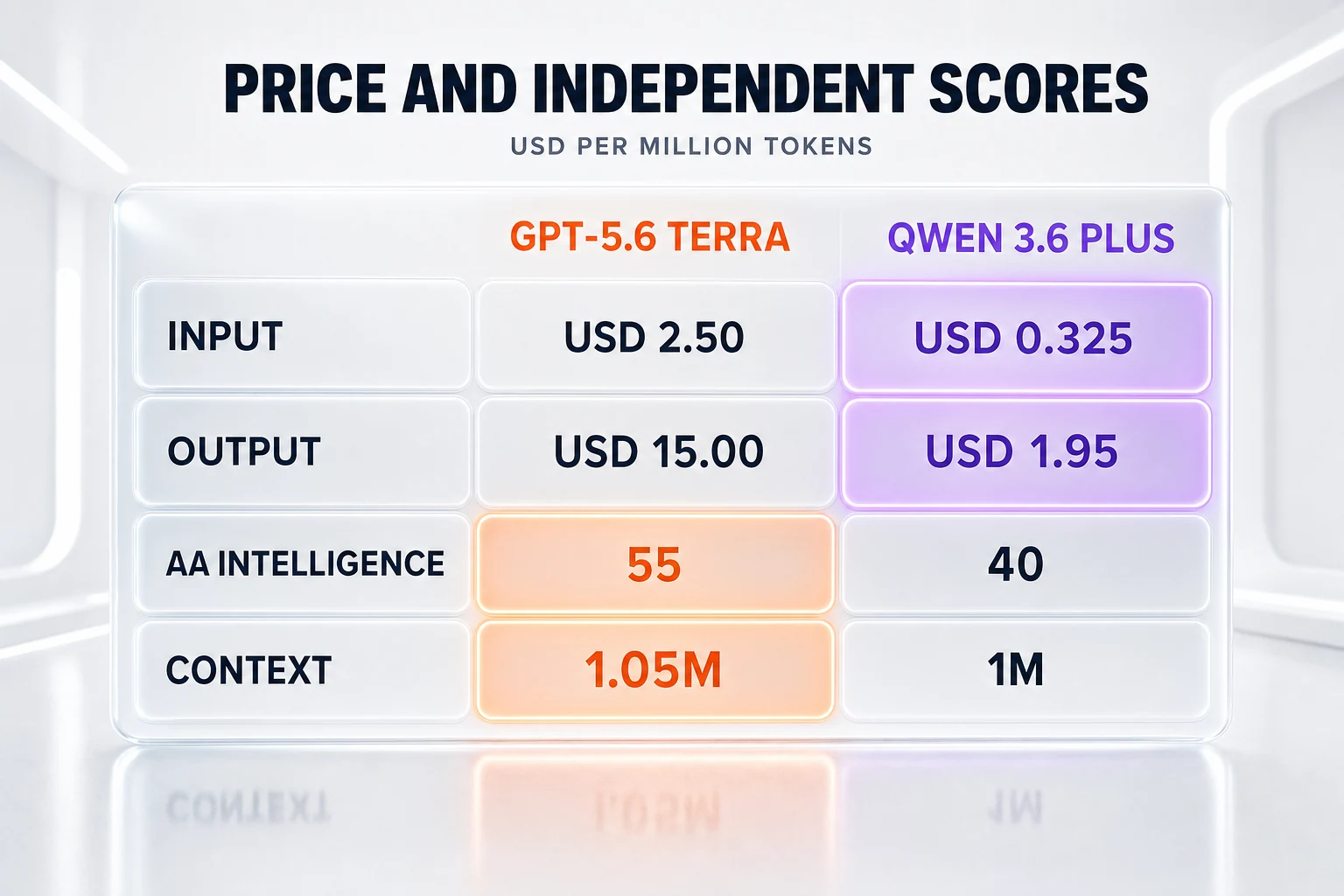
| Metered rate (per million tokens) | GPT-5.6 Terra | Qwen 3.6 Plus |
|---|---|---|
| Input | USD 2.00 | USD 0.325 |
| Cached input | USD 0.20 | Not published separately |
| Output | USD 12.00 | USD 1.95 |
Qwen 3.6 Plus is roughly 6.2 times cheaper on input and roughly 6.2 times cheaper on output — an unusually symmetric gap, and a very large one. It wins both metered lines outright, and nothing below takes that away.
One note on sourcing, because the number varies by where you buy. Artificial Analysis lists Qwen 3.6 Plus at a higher rate, around USD 0.50 per million input and USD 3.00 per million output, reached through a third-party aggregator. The direct Alibaba Model Studio rate is USD 0.325 input and USD 1.95 output, which is the figure we use throughout and the one that matches the published tool page. Even at the aggregator's higher rate Qwen would still be roughly five times cheaper than Terra, so the conclusion does not change — but you should buy from the direct endpoint if you want the price we quote.
Put a number on it. A workload burning 50 million output tokens in a month — not extreme for a team running coding agents continuously — costs USD 750 on Terra and USD 97.50 on Qwen 3.6 Plus. That is a gap of about USD 652 a month. Multiply the workload by ten and the gap becomes roughly USD 6,525 a month, and at that scale the arithmetic argues very loudly for Qwen. Run your own volume through it before you take our word for anything.
The argument Qwen 3.6 Plus wins on the numbers alone
Here is the calculation that should worry OpenAI's pricing team. Take each model's independently measured index score and divide it by its output price. Terra returns roughly 4.6 index points per dollar. Qwen 3.6 Plus returns about 20. On measured intelligence per dollar, the cheaper model wins by more than four times — and both sides of that ratio come from a third party, so it is not a marketing claim.
That ratio is the honest case for Qwen 3.6 Plus, and we are not going to bury it. Terra wins on the ceiling. Qwen wins on the exchange rate, and it wins it by a wider margin than any other model we have set against a GPT-5.6 tier. Which of those two facts governs your decision depends entirely on whether your workload is bounded by capability or by budget — and most teams know perfectly well which one they are.
Coding: Two Empty Columns
Both companies want to sell you a coding model, but neither has an independent coding result, and this section exists to say so plainly rather than to quietly fill the gap.
GPT-5.6 Terra, independently measured. Artificial Analysis runs an agentic-coding index alongside its intelligence index, and Terra is charted on it at 62.28 through the Codex harness at max reasoning effort (read August 2, 2026, version 1.3). That index scores a harness paired with a model at a given reasoning effort, so the figure travels with all three — Codex, Terra, max — rather than standing as a bare model score.
There is no entry on the other side: Qwen 3.6 Plus has no independently charted coding score. That is the whole of the independent coding evidence here — one side measured, the other not. No third party has published a coding result for the Plus flagship, and we are not going to invent one, borrow one from an open-weight sibling, or dress a vendor figure up as though it were an external one. Nor does Terra's 62.28 become a coding win by default: a model nobody has measured is not a model that lost. The only coding numbers anywhere in the Qwen 3.6 family are vendor self-reported results attached to the open-weight variants — a separate matter, covered in the next-but-one section, and deliberately kept away from Terra's independent figure.
So there is no coding row in our comparison table and no coding row in the infographic. Placing an independent score for one model beside a vendor score for a different model in the same family would manufacture a measurement that does not exist. It is the single most common way comparison pages mislead people, and it is usually done by accident, which does not make the reader any less misled.
What we can say honestly is this: on the one capability axis where both flagships have been externally measured — general intelligence, which correlates strongly with coding performance — Terra leads by fifteen points. That is real coding-relevant signal, and it does not require stacking two incompatible numbers to make its point.
Context Window: 1.05M Against 1M
Terra carries a 1,050,000-token context window. Qwen 3.6 Plus carries 1,000,000 tokens. Terra's edge is real but marginal — about five percent more room, roughly 50,000 extra tokens — and for once this is a row where the two models are close enough that it rarely decides anything.
A one-million-token window is already enormous: a substantial repository slice, a long design document plus the code it describes, a full day of agent scrollback, with room to spare. Terra's extra fifty thousand tokens is a genuine advantage only at the very largest end — whole-monorepo reasoning, or document work at the scale of full legal or research corpora that lands right at the boundary. For almost everyone, both windows are effectively "large enough," and the context row should not carry much weight in your decision either way. It is worth noting Qwen's maximum output is capped at 65,536 tokens per response, which is generous but worth checking against your longest single-response needs.
Open Weights, Apache 2.0, and the Family Qwen 3.6 Plus Belongs To
This is where Qwen 3.6 stops being just a cheaper API and starts being a strategic hedge — with one important caveat that most coverage skips.
The caveat first: Qwen 3.6 Plus, the model this whole comparison is about, is closed. It is a proprietary, hosted, API-only flagship, exactly like Terra in that respect. You cannot download its weights or self-host it. If you want the 40-scoring model, you rent it from Alibaba's endpoint.
What is genuinely different is the family around it. Alibaba also ships open-weight models under the Qwen 3.6 name, released under an Apache 2.0 license — the most permissive terms in wide use, with no monthly-active-user ceiling and no bespoke restrictions. Two are worth naming. Qwen3.6-27B is a dense model that Alibaba self-reports at 77.2 percent on SWE-bench Verified. Qwen3.6-35B-A3B is a sparse mixture-of-experts design with roughly 3 billion active parameters that Alibaba self-reports at 73.4 percent on the same benchmark. Both of those figures are vendor self-reported, both belong to the open-weight variants rather than to Plus, and neither has an independent evaluation behind it — so they are context for the ecosystem, not a substitute for the independent 40 that describes the flagship.
Why does the open-weight family matter to a comparison that is nominally about the closed Plus tier? Because it gives you an escape hatch that Terra structurally cannot match:
- You can prototype on Plus and deploy on open weights. Start with the hosted flagship, then move a workload to a self-hostable Apache 2.0 sibling when data residency, fixed-cost inference, or air-gapping becomes a hard requirement. It is not a like-for-like swap — you are trading down in capability — but the option exists, entirely inside one vendor's ecosystem.
- You are not locked to a metered API for the whole family. The open-weight variants convert a per-token bill into hardware amortization for the parts of your workload that can tolerate a smaller model. OpenAI publishes no open-weight GPT-5.6 model at all, so this route is simply unavailable on the Terra side.
- Apache 2.0 is unusually clean. No monthly-active-user threshold, no acceptable-use carve-outs that surprise you at scale. For teams that have been burned by more restrictive "open" licenses, that clarity has real value.
Be clear-eyed about the limit, though. The open-weight variants are weaker than Plus, they have no independent score, and swapping to them is a capability downgrade, not a free lunch. And the hosted Plus and open-weight APIs are operated by Alibaba, which carries its own compliance considerations — self-hosting an open-weight sibling avoids that entirely, using the hosted Plus endpoint does not. The family is a real advantage over Terra's all-or-nothing closed API. It is not a reason to pretend Plus is something it is not.
Winner by Category
| Category | Winner | Why |
|---|---|---|
| Best independently measured intelligence | GPT-5.6 Terra | 55 against 40 on the same version of the Artificial Analysis Intelligence Index. |
| Best independently measured coding | No head-to-head | The Artificial Analysis Coding Agent Index v1.3 charts GPT-5.6 Terra at 62.28 through the Codex harness at max reasoning effort and carries no Qwen 3.6 Plus entry — one side measured, the other not, which settles nothing about coding ability. |
| Best cost per token | Qwen 3.6 Plus | Roughly 6.2 times cheaper on both input and output. It wins both metered lines. |
| Best measured intelligence per dollar | Qwen 3.6 Plus | About 20 index points per dollar of output against roughly four. More than five times better. |
| Best for multimodal input | Qwen 3.6 Plus | Native text, image, and video input. |
| Best for very long context | GPT-5.6 Terra | 1,050,000 tokens against 1,000,000 — a marginal edge, close enough to rarely decide anything. |
| Best for unsupervised long-horizon work | GPT-5.6 Terra | Fifteen index points is where completion rates on long chains live, and retries are not free. |
| Best ecosystem optionality | Qwen 3.6 Plus | An Apache 2.0 open-weight family to fall back on. OpenAI publishes no open-weight GPT-5.6 model. |
| Best for a tight budget at scale | Qwen 3.6 Plus | At hundreds of millions of output tokens a month the price gap runs to thousands of dollars. |
Pros and Cons
GPT-5.6 Terra
Pros
- Scores 55 on the independent Artificial Analysis Intelligence Index — fifteen points clear of Qwen 3.6 Plus on the same version of the same index, measured by an evaluator with no stake in the result.
- Its coding case rests on the intelligence index it does lead, 55 to 40, rather than on a coding-specific score — neither model has one from an independent evaluator.
- A 1,050,000-token context window, marginally larger than Qwen's one million.
- Managed API with no infrastructure to run, and a clear ladder to Sol above it or Luna below it if your needs shift.
- The strongest completion rates in the pairing for long, unsupervised, high-stakes work.
Cons
- Roughly 6.2 times more expensive on both input and output — the widest price disadvantage we have recorded for a GPT-5.6 tier against a scored rival.
- Loses the measured-intelligence-per-dollar argument by more than four times, and both sides of that ratio are independently sourced.
- Closed weights, no self-hosting, and no open-weight sibling anywhere in the GPT-5.6 line to fall back on.
- Text-focused where Qwen 3.6 Plus takes native image and video input.
Qwen 3.6 Plus
Pros
- Independently measured, which many cheaper models cannot claim: 40 on the Artificial Analysis Intelligence Index, on the same version that scores Terra at 55.
- Roughly 6.2 times cheaper than Terra on both input and output — the largest price advantage in this matchup series.
- More than four times the measured intelligence per dollar of output that Terra delivers.
- Native multimodal input across text, image, and video, with a one-million-token context window.
- Belongs to a family with Apache 2.0 open-weight siblings, giving you a self-hosting and data-residency escape hatch that Terra has no equivalent for.
Cons
- Fifteen index points behind Terra on the same independent scale, and on long unsupervised chains that gap shows up as tasks that do not finish.
- No independent coding score of any kind; the only coding figures in the family are vendor self-reported and belong to the open-weight variants, not to Plus.
- The Plus flagship itself is closed and API-only — the open-weight advantage requires downgrading to a weaker, unscored sibling.
- Frequently misdescribed by conflating Plus with its open-weight relatives, which makes it hard to evaluate from coverage alone.
- The hosted API is operated by Alibaba, which carries compliance considerations that self-hosting an open-weight sibling avoids and the hosted Plus endpoint does not.
When to Pick GPT-5.6 Terra
- Your work is long-horizon and unsupervised. Multi-hour agentic runs, multi-file refactors, chains where a mistake at step 3 poisons step 40. Fifteen index points is exactly where completion rates live, and a retry costs more than the tokens you saved.
- You need independently measured capability you can cite. Terra leads the one index that measured both models, 55 to 40, and for regulated or client-facing work that provenance matters — though neither model is charted on a coding-specific index.
- Your volume is moderate. At tens of millions of output tokens a month the price gap is in the hundreds of dollars. The stronger model for that is an easy call.
- You are already inside the OpenAI ecosystem. If your tooling, evals, and prompts are built around GPT-5.6, Terra is the balanced tier that keeps you there without the frontier price of Sol.
- Capability is your binding constraint, not budget. When an unfinished task is more expensive than the tokens it burns, fifteen measured points is worth paying for.
When to Pick Qwen 3.6 Plus
- Budget is your binding constraint, not capability. If a 40 on the index does the job you actually have — and for a great deal of real work it does — then paying nearly eight times more for a 55 is buying headroom you may never use.
- Your volume is high. At hundreds of millions of output tokens a month the gap runs to thousands of dollars, and this is where Qwen's case gets loud.
- You need multimodal input. Native text, image, and video handling is built in, where Terra is text-focused.
- You want an eventual self-hosting path. Prototype on the Plus flagship, then move suitable workloads to an Apache 2.0 open-weight sibling when data residency or fixed-cost inference becomes a requirement. Terra offers no such route.
- You want maximum intelligence per dollar. On that specific metric Qwen 3.6 Plus wins by more than four times, and both sides of the ratio are independently sourced.
Final Verdict
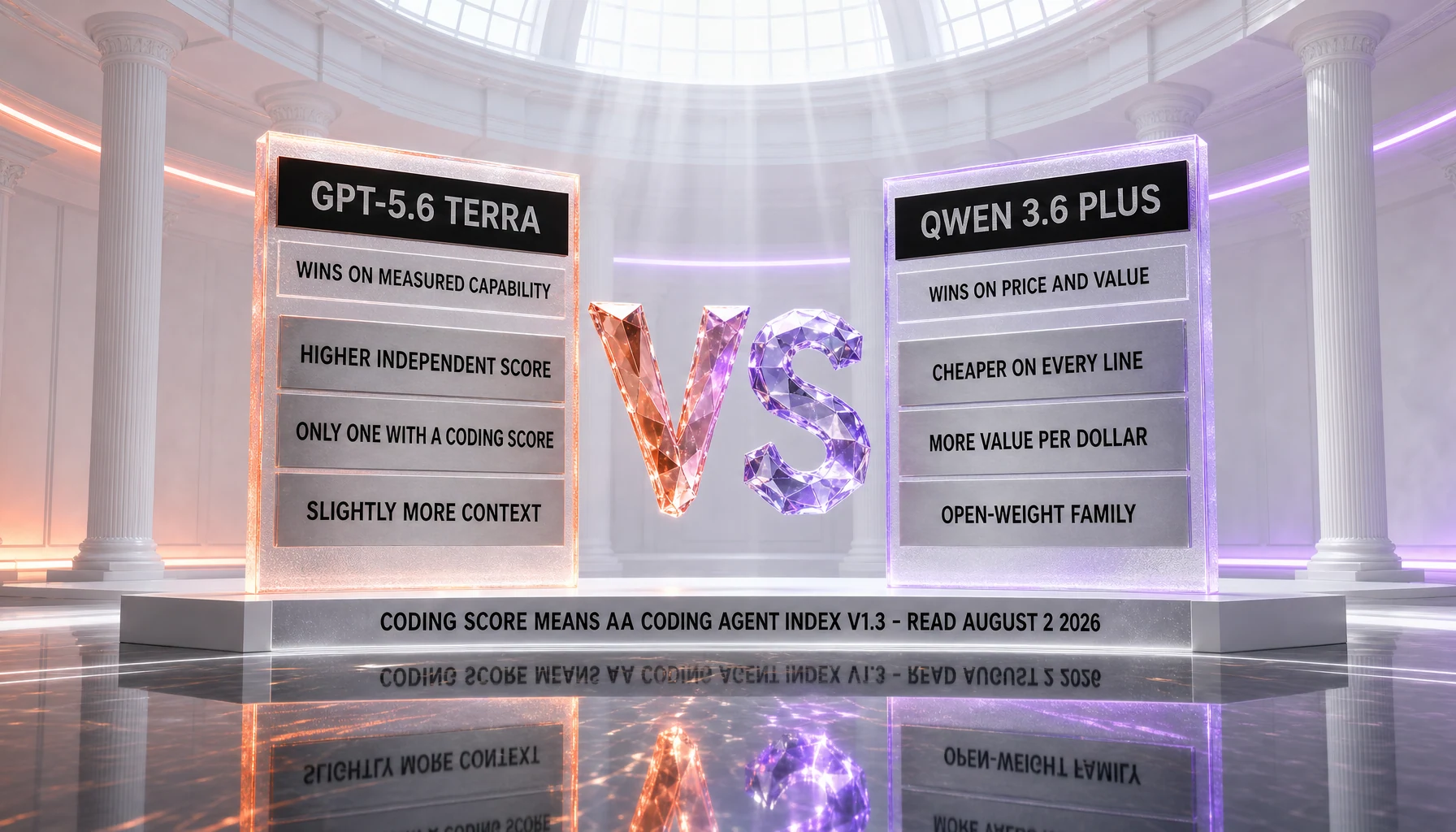
GPT-5.6 Terra wins this comparison on measured capability — but it is the most lopsided price gap we have run against a GPT-5.6 tier, and that makes the value case for Qwen 3.6 Plus the strongest in the family.
Qwen 3.6 Plus takes more rows in our category table than Terra does, and we still call it for Terra, so we owe you the reasoning rather than a shrug.
Several of Qwen's row wins — cost per token, intelligence per dollar, budget at scale — are the same axis counted three ways. It is one advantage, price, and it is a very large one. Multimodality and the open-weight family are two more genuine, separate wins. Qwen 3.6 Plus's case, honestly stated, is that it is nearly eight times cheaper, it takes images and video, it has an Apache 2.0 escape hatch, and it has the independent receipts to prove it is a capable model. That last clause is what makes this more than a race to the bottom on price. Qwen 3.6 Plus is not asking for the benefit of the doubt. It went and got measured.
Terra's win rests on a single fact the price cannot argue with: on the one axis where both flagships were measured by the same evaluator under the same conditions, Terra is fifteen points ahead — 55 against 40 — and on this scale, where the very top is 60, fifteen points is not a rounding error. It is the difference between a model in the leading group and a model in the capable middle. On short tasks you will not feel it. On the long, unsupervised, high-stakes work that people actually buy frontier tiers for, you feel it as tasks that finish versus tasks that need you. Terra also holds a marginally larger context window, and a marginal edge on context.
But be honest about the trade. This is not the narrow call that Terra faces against models priced close to it. Qwen 3.6 Plus is not close to it — it is a fraction of the price, on every line, by the widest margin in this series. Fifteen measured points is a lot, and nearly eight times the cost is also a lot, and which one wins depends entirely on your workload.
So the rule we would give you. If budget is your binding constraint, or your volume runs to hundreds of millions of output tokens a month, or you need native multimodal input, pick Qwen 3.6 Plus — it is a genuinely capable model with a genuinely independent score, it costs about an eighth as much, and nobody should apologize for that trade. Otherwise, if capability is what bounds your work and you need the strongest completion rates and the only independent coding evidence in the pairing, pick GPT-5.6 Terra.
Where our verdict is wrong: if your workload lives entirely in the range where a 40 is sufficient — and a great deal of production work does — then we have just talked you into paying nearly eight times more for capability you will never call on. That risk is larger here than in any comparison we have run against a GPT-5.6 tier, precisely because the price gap is so wide. The only honest way to settle it is to run both models on your tasks. The index is a proxy. Your workload is the benchmark.
To see how each model fares against the rest of the field, compare the tiers directly on their tool pages — GPT-5.6 Terra against its siblings GPT-5.6 Sol and GPT-5.6 Luna, and Qwen 3.6 for the full picture of Alibaba's family. For the wider field, see our roundup of the best AI coding tools in 2026.
Frequently Asked Questions
Is GPT-5.6 Terra or Qwen 3.6 Plus cheaper?
Qwen 3.6 Plus, by a wide margin, on both metered lines. It charges USD 0.325 per million input tokens against Terra's USD 2.00, which is roughly 6.2 times cheaper, and USD 1.95 per million output tokens against USD 12, also roughly 6.2 times cheaper. That symmetric, almost sixfold gap is the widest we have recorded between a GPT-5.6 tier and an independently scored rival. One sourcing note: Artificial Analysis lists Qwen 3.6 Plus higher, around USD 0.50 input and USD 3.00 output, through an aggregator; the direct Alibaba Model Studio rate is USD 0.325 and USD 1.95, which is what we quote.
What does Qwen 3.6 Plus score on the Artificial Analysis Intelligence Index?
It scores 40 on version 4.1 of the index, which is the current version and the same one that scores GPT-5.6 Terra at 55. This is an independent measurement, not a vendor claim. It is important to attach the number to the right model: the 40 belongs specifically to Qwen 3.6 Plus, the closed proprietary flagship, and not to the open-weight variants in the family, which have not been placed on the index and have no comparable independent score.
Is a fifteen-point gap on the index actually significant?
Yes, on this scale. The highest score any model has posted on this index to date is 60, so the whole leading group is compressed into a narrow band near the top. Terra at 55 sits inside that group; Qwen 3.6 Plus at 40 sits in the capable mid-tier. In practice the gap is invisible on short single-shot tasks and becomes very visible on long, unsupervised chains — multi-file refactors, hour-long agentic loops — where the stronger model needs fewer interventions and fails less often. On agentic work a failure is not free: it gets retried, and the retry spends the tokens you saved.
Why is there no coding row in your comparison table?
Because only one side has an independently charted coding score. Artificial Analysis runs an agentic-coding index, and as of August 2, 2026 it charts GPT-5.6 Terra at 62.28 through the Codex harness at max reasoning effort while carrying no Qwen 3.6 Plus entry. A row needs two comparable values, and a model nobody has measured is not a model that lost. The only coding figures anywhere in the Qwen 3.6 family are vendor self-reported results attached to the open-weight variants — a different evidence type and a different set of models. Putting those next to Terra's independent number would manufacture a like-for-like measurement that does not exist, so you will not find them side by side anywhere on this page.
Which model won your overall verdict, and why?
GPT-5.6 Terra, on measured capability. On the one axis where both flagships were measured by the same independent evaluator on the same version of the same index, Terra leads 55 to 40 — a fifteen-point gap on a scale whose top is 60, which is not a rounding error. The AA Coding Agent Index v1.3 charts Terra at 62.28 and carries no Qwen 3.6 Plus entry, so that axis produces evidence on one side rather than a coding verdict; context is Terra's remaining measured edge, and it is marginal. Qwen 3.6 Plus still wins price on every line, measured intelligence per dollar, multimodality, and access to an Apache 2.0 open-weight family. It is a capability-versus-value split, and the price gap here is the widest in this series.
Which model gives more intelligence per dollar?
Qwen 3.6 Plus, by more than four times, and this is its strongest argument. Divide each model's independently measured index score by its output price: Terra returns roughly 4.6 index points per dollar, Qwen 3.6 Plus returns about 20. Both sides of that ratio come from a third party, so it is not a marketing claim. Terra wins on the capability ceiling; Qwen wins on the exchange rate, by the widest margin of any model we have set against a GPT-5.6 tier. Which of those governs your choice depends on whether your workload is bounded by capability or by budget.
Can I self-host Qwen 3.6 Plus?
No — Qwen 3.6 Plus itself is a closed, proprietary, API-only model, exactly like GPT-5.6 Terra in that respect. What you can self-host are the open-weight siblings in the Qwen 3.6 family, released under an Apache 2.0 license. That gives you an eventual escape hatch: prototype on the hosted Plus flagship, then move suitable workloads to a downloadable Apache 2.0 sibling when data residency or fixed-cost inference becomes a hard requirement. Be clear that it is a capability downgrade, not a free swap, because the open-weight variants are weaker than Plus and have no independent score.
What is the context window on each model?
GPT-5.6 Terra offers a 1,050,000-token context window. Qwen 3.6 Plus offers 1,000,000 tokens. Terra's edge is real but marginal — about five percent more room — and both windows are large enough for the overwhelming majority of work, so this row rarely decides anything. It only becomes a factor at the very largest end, such as whole-monorepo reasoning or corpus-scale document work that lands right at the boundary. Note that Qwen 3.6 Plus caps a single response at 65,536 output tokens, which is worth checking against your longest single-response needs.
Is Qwen 3.6 open source?
Partly, and the distinction matters. Qwen 3.6 Plus — the flagship this comparison is about — is closed and proprietary, API-only. But the Qwen 3.6 family also includes open-weight models, released under an Apache 2.0 license, which is one of the most permissive licenses in wide use: no monthly-active-user ceiling and no bespoke restrictions. Those open-weight variants are separate, weaker models with no independent score, so they are an ecosystem advantage rather than a substitute for the flagship. Open-weight is also not the same as fully open-source: you get the weights, not necessarily the training data or code.
Is Qwen 3.6 Plus multimodal?
Yes. Qwen 3.6 Plus accepts native multimodal input across text, image, and video, which is one of its clear advantages in this pairing. GPT-5.6 Terra is the text-focused choice here. If your workload involves reasoning over images or video alongside text, that capability is built into Qwen 3.6 Plus and does not require bolting on a separate model, which for some pipelines is a meaningful simplification on top of the price advantage.
What is the difference between Qwen 3.6 Plus and the open-weight Qwen 3.6 models?
They are different models with different licenses, capabilities, and evidence. Qwen 3.6 Plus is the closed, proprietary, hosted flagship, and it is the one with an independent Artificial Analysis score of 40. The open-weight variants — such as Qwen3.6-27B and Qwen3.6-35B-A3B — are released under an Apache 2.0 license and can be downloaded and self-hosted, but they are separate, generally weaker models, and their only benchmark figures are vendor self-reported. Do not carry the Plus score onto them, and do not read an open-weight figure as if it described Plus.
How does GPT-5.6 Terra compare to the other models in its family?
Terra is the balanced middle tier of the GPT-5.6 family. GPT-5.6 Sol sits above it, priced higher and scoring higher on the independent Artificial Analysis indexes; GPT-5.6 Luna sits below it as the cheaper, lighter option. Terra is the tier we would point most teams at for this particular matchup, because it is the balanced model whose capability lead over Qwen 3.6 Plus is large enough to matter while keeping you well below the frontier price of Sol.
Sources and references
Every figure on this page is attributed to whoever produced it. Vendor documentation and independent measurement are listed separately and never merged into a single ranking.
- OpenAI — API pricing (per-token, cached and batch rates)
- Artificial Analysis — GPT-5.6 Terra (independent index score)
- Alibaba — Qwen (model family and availability)
- Hugging Face — Qwen (published open-weight variants and licenses)
- Artificial Analysis — Model leaderboard (Intelligence Index scores and cost per task across configurations)
Our Verdict
GPT-5.6 Terra wins this comparison on measured capability, but the value case for Qwen 3.6 Plus is the strongest we have set against a GPT-5.6 tier. Both flagships are scored on the same version of the same independent index by the same evaluator: Terra 55, Qwen 3.6 Plus 40. Fifteen points on a scale whose highest posted score to date is 60 is not a rounding error; it is the difference between the leading group and the capable middle, and it shows up on long unsupervised chains as tasks that finish versus tasks that need you. Terra also holds a marginally larger context window and a marginal edge on context (1,050,000 tokens against 1,000,000). What makes the trade so sharp is the price. Qwen 3.6 Plus is roughly 6.2 times cheaper on both input and output — USD 0.325 against USD 2.00, USD 1.95 against USD 12 — the widest price gap in this series, and it wins measured intelligence per dollar by more than four times, with both sides of that ratio independently sourced. It is also natively multimodal (text, image, video) and belongs to a family with Apache 2.0 open-weight siblings, giving a self-hosting escape hatch Terra cannot match — though the Plus flagship itself is closed, API-only, exactly like Terra. The rule: if budget binds, or your volume runs to hundreds of millions of output tokens a month, or you need multimodal input, pick Qwen 3.6 Plus. Otherwise, if capability bounds your work and you need the only independent coding evidence in the pairing, pick GPT-5.6 Terra. One caution on the data: the independent 40 describes Qwen 3.6 Plus specifically, not the open-weight variants, which have no comparable independent score.
Choose GPT-5.6 Terra
OpenAI's balanced GPT-5.6 tier — GPT-5.5-competitive quality at 40 percent of the GPT-5.5 rate, with a 1.05M-token context and the full agentic toolbox.
Try GPT-5.6 Terra →Choose Qwen 3.6
Alibaba's flagship LLM family — Plus and Max Preview proprietary plus Apache 2.0 open-weight 27B and 35B-A3B.
Try Qwen 3.6 →Frequently Asked Questions
Is GPT-5.6 Terra better than Qwen 3.6?
GPT-5.6 Terra wins this comparison on measured capability, but the value case for Qwen 3.6 Plus is the strongest we have set against a GPT-5.6 tier. Both flagships are scored on the same version of the same independent index by the same evaluator: Terra 55, Qwen 3.6 Plus 40. Fifteen points on a scale whose highest posted score to date is 60 is not a rounding error; it is the difference between the leading group and the capable middle, and it shows up on long unsupervised chains as tasks that finish versus tasks that need you. Terra also holds a marginally larger context window and a marginal edge on context (1,050,000 tokens against 1,000,000). What makes the trade so sharp is the price. Qwen 3.6 Plus is roughly 6.2 times cheaper on both input and output — USD 0.325 against USD 2.00, USD 1.95 against USD 12 — the widest price gap in this series, and it wins measured intelligence per dollar by more than four times, with both sides of that ratio independently sourced. It is also natively multimodal (text, image, video) and belongs to a family with Apache 2.0 open-weight siblings, giving a self-hosting escape hatch Terra cannot match — though the Plus flagship itself is closed, API-only, exactly like Terra. The rule: if budget binds, or your volume runs to hundreds of millions of output tokens a month, or you need multimodal input, pick Qwen 3.6 Plus. Otherwise, if capability bounds your work and you need the only independent coding evidence in the pairing, pick GPT-5.6 Terra. One caution on the data: the independent 40 describes Qwen 3.6 Plus specifically, not the open-weight variants, which have no comparable independent score.
Which is cheaper, GPT-5.6 Terra or Qwen 3.6?
GPT-5.6 Terra starts at $2 in / $12 out per M tokens. Qwen 3.6 offers a free plan (free plan available). Check the pricing comparison section above for a full breakdown.
What are the main differences between GPT-5.6 Terra and Qwen 3.6?
The key differences span across 10 features we compared. For Independent intelligence score (Artificial Analysis Intelligence Index v4.1), GPT-5.6 Terra offers 55 (independent) while Qwen 3.6 offers 40 (independent, same index version — this is the Qwen 3.6 Plus flagship, not the open-weight variants). For Independent coding score (Artificial Analysis Coding Agent Index v1.3, read August 2, 2026), GPT-5.6 Terra offers 62.28 (Codex harness, max reasoning effort) while Qwen 3.6 offers Not charted. For Maximum context window, GPT-5.6 Terra offers 1,050,000 tokens while Qwen 3.6 offers 1,000,000 tokens. See the full feature comparison table above for all details.