Seedance 2 vs Veo 3.1: Best-Looking Video vs Best Audio (2026)


Seedance 2 tops the video arena at a sixth of the price; Veo 3.1 wins on native lip-sync and true 4K. We compared both, verified pricing inside.
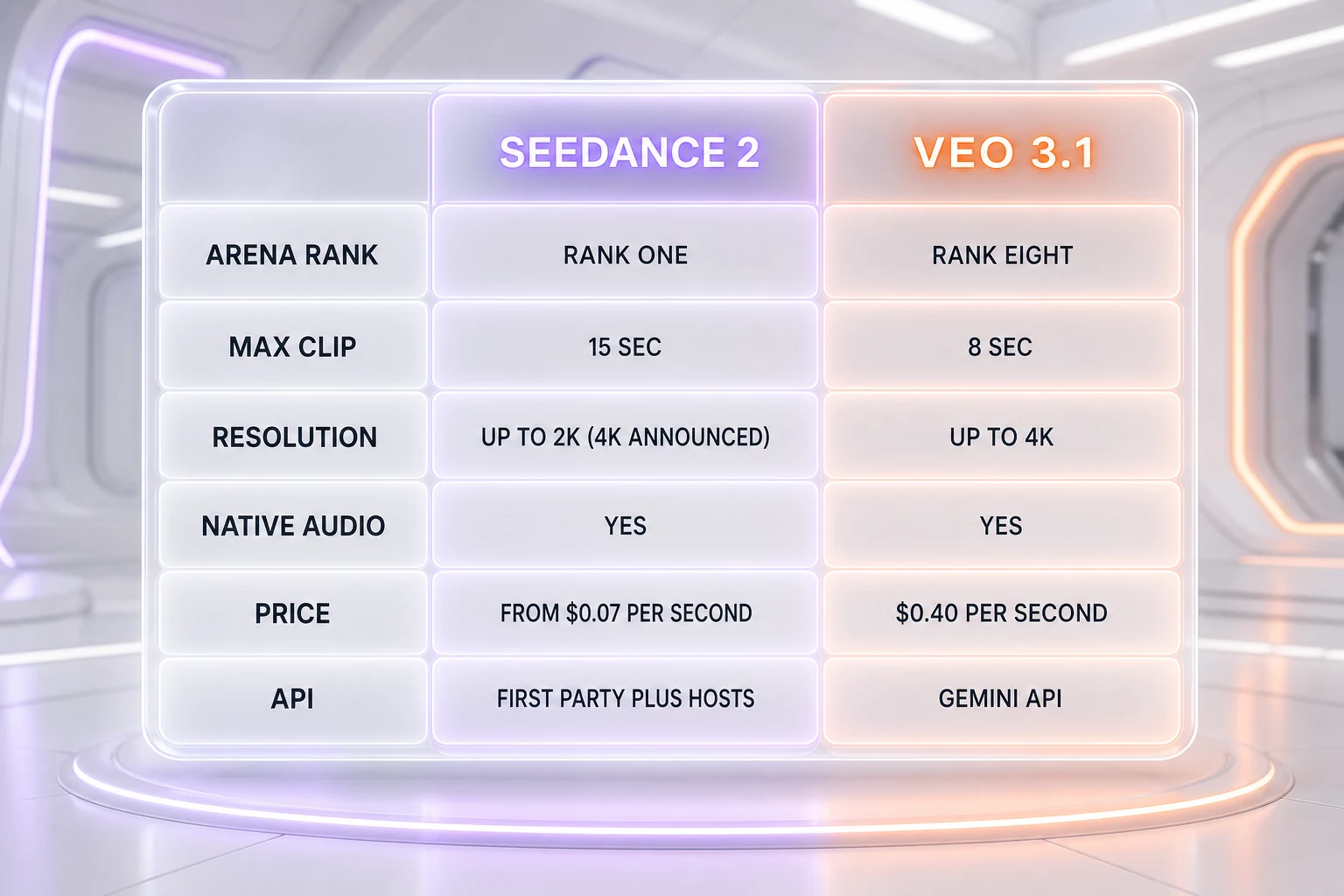
Feature Comparison
| Feature | Seedance 2.0 | Veo 3.1 |
|---|---|---|
| Vendor | ByteDance | Google DeepMind |
| Video Arena Elo (text-to-video, with audio) | 1,215 (rank 1) | 1,093 (rank 8) |
| Max clip duration (single pass) | 15 seconds | 8 seconds (extendable to ~2 min) |
| Max resolution | Up to 2K (Dreamina, BytePlus Pro); native 4K announced June 23, 2026 (international API unconfirmed) | 720p, 1080p, and true 4K |
| Native audio | Yes (synced audio, no extra charge on fal) | Yes (most mature lip-sync in category) |
| Multi-modal reference input | Up to 12 files (images, video, audio, text) | Up to 3 reference images |
| Price per second | About $0.067 to $0.22 (third-party hosts) | $0.40 (720p and 1080p), $0.60 (4K) |
| First-party public API | Opened April 2026 (Volcengine Ark, BytePlus ModelArk); newer, less battle-tested | Generally available (Gemini API, Vertex AI) |
| Text-to-video and image-to-video | Both, plus video reference | Both, plus scene extension |
| Aspect ratios | 21:9, 16:9, 4:3, 1:1, 3:4, 9:16 | 16:9 and 9:16 |
Pricing Comparison
Seedance 2.0
Veo 3.1
Detailed Comparison
Seedance 2 vs Veo 3.1 is a comparison between ByteDance's frontier video model and Google DeepMind's flagship. Seedance 2 (Seedance 2.0) currently leads the Artificial Analysis Text-to-Video Arena for models with audio at an Elo of 1,215, generates clips up to 15 seconds, and is sold by third-party API hosts from roughly $0.067 to $0.22 per second depending on provider and resolution. Veo 3.1 sits at an Elo of 1,093 in the same arena but ships Google-confirmed pricing of $0.40 per second for 720p and 1080p with audio and $0.60 per second for 4K, plus the most mature native audio lip-sync of any video model. If you want the highest raw visual fidelity and the lowest per-second cost, Seedance 2 wins; if you want production-grade synchronized dialogue, verified 4K delivery, and a stable enterprise API, Veo 3.1 wins. ByteDance announced a native-4K upgrade for Seedance 2.0 on June 23, 2026, but it is not yet confirmed on the international BytePlus API, so Veo keeps the verified-4K edge for now. We researched both against vendor pricing pages and the public Video Arena rather than running a single controlled head-to-head, and we flag every number's source below.
Disclosure: ThePlanetTools.ai has no affiliation with ByteDance or Google DeepMind. We are not paid to recommend either model, and there are no affiliate links in this comparison. Last compared: June 2026. Pricing is taken from Google's official Gemini API pricing page and from Seedance 2 API hosts (fal, OpenRouter, Replicate, PiAPI). ByteDance has since opened its own first-party API through Volcengine Ark and the international BytePlus ModelArk, but pricing there is tier-dependent, so we quote the widely used third-party hosts for a like-for-like per-second range. Seedance 2 numbers below are researched and attributed, not from a controlled internal benchmark. Benchmark figures are attributed to the Artificial Analysis Video Arena and to vendor model cards, and where a number is provider-specific or contested we say so.
Quick Verdict
We compared two video models that win on different axes, so a single overall winner would hide the decision that actually matters for your project. Here is the short version before the section-by-section detail.
- Best for raw visual quality and motion: Seedance 2. It holds the number-one spot on the Artificial Analysis Text-to-Video Arena (with audio) at an Elo of about 1,218, ahead of Veo 3.1 at 1,093. Blind voters consistently prefer its fidelity, complex motion, and hand rendering.
- Best for synchronized dialogue and 4K production: Veo 3.1. Its native audio lip-sync is the most proven in the category, it offers verified true 4K output at $0.60 per second through a stable international API, and Google reported that Veo ranked best on overall human preference against OpenAI's Sora in its internal study on Meta's MovieGenBench dataset across 1,003 prompts. ByteDance announced a native-4K upgrade for Seedance 2.0 on June 23, 2026, but that output is not yet verifiable outside China, so Veo 3.1 holds this category for now.
- Best for cost per second: Seedance 2. Across third-party hosts it runs from roughly $0.067 per second (OpenRouter token billing) to about $0.22 per second (Replicate 720p with video input), well under Veo 3.1's $0.40 per second standard rate.
- Best for a stable, first-party API and enterprise access: Veo 3.1. It is generally available through the Gemini API and Vertex AI with mature, documented parameters and enterprise contracts. Seedance 2 now has a first-party API too (Volcengine Ark and BytePlus ModelArk, opened in April 2026), but it is newer and less battle-tested for enterprise workflows.
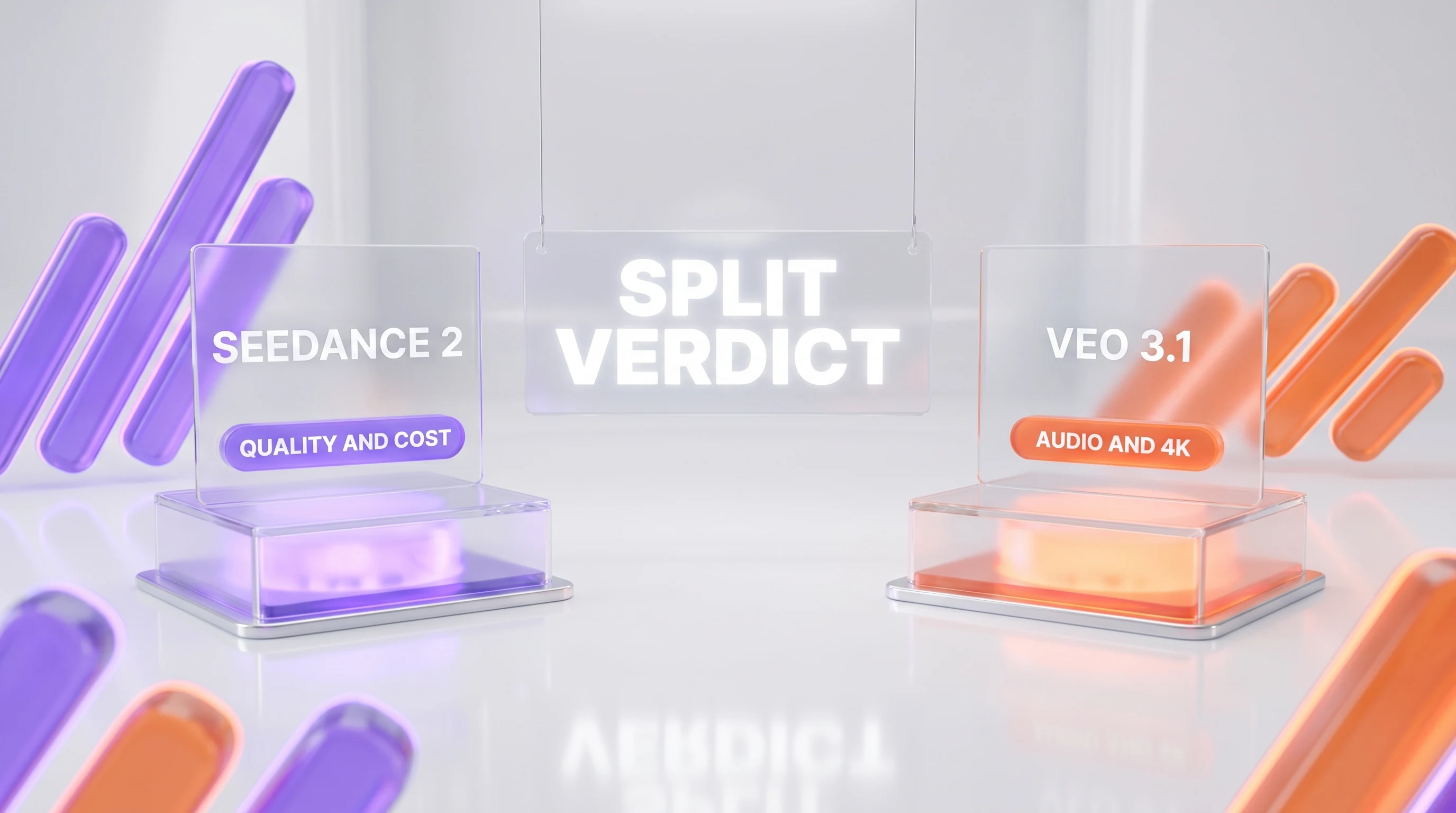
This is a genuine split, not a fence-sit. If your priority is the best-looking video at the lowest price, Seedance 2 is the model to beat. If you need dependable spoken dialogue, 4K delivery, and the most mature enterprise-grade API, Veo 3.1 is the safer production choice. We left it without an overall winner because the honest answer depends on the job.
Seedance 2 vs Veo 3.1 at a Glance
Before the deep dive, here is the headline comparison. Every number is attributed to its source, and we mark the cases where a figure is provider-specific or contested rather than vendor-confirmed.
| Dimension | Seedance 2 (ByteDance) | Veo 3.1 (Google) | Edge |
|---|---|---|---|
| Vendor | ByteDance | Google DeepMind | Tie |
| Launched | February 2026 | October 2025 (4K added January 2026) | Tie |
| Video Arena Elo (text-to-video, with audio) | 1,215 (rank 1) | 1,093 (rank 8) | Seedance 2 |
| Max clip duration (single pass) | 15 seconds | 8 seconds (extendable to about 2 minutes) | Seedance 2 |
| Output resolution | Up to 1080p via standard API hosts; up to 2K (BytePlus Pro and Dreamina); native 4K announced June 23, 2026 (international API unconfirmed) | 720p, 1080p, and true 4K | Veo 3.1 |
| Native audio | Yes (synced audio at no extra price on fal) | Yes (most mature lip-sync in the category) | Veo 3.1 |
| Multi-modal reference input | Up to 12 files (images, video, audio, text) | Up to 3 reference images | Seedance 2 |
| Price per second | About $0.067 to $0.22 (third-party hosts) | $0.40 (720p and 1080p), $0.60 (4K) | Seedance 2 |
| First-party public API | Yes, since April 2026 (Volcengine Ark, BytePlus ModelArk), plus third-party hosts | Generally available (Gemini API, Vertex AI) | Veo 3.1 |
| Text-to-video and image-to-video | Both, plus video reference | Both, plus scene extension | Tie |
Two Different Bets on the Same Problem
Seedance 2 and Veo 3.1 are both frontier text-to-video and image-to-video models that generate cinema-grade footage with synchronized sound, but they come from very different places and make very different bets.
Seedance 2 in one paragraph
Seedance 2.0 is ByteDance's multi-modal video model, launched in February 2026 by the company behind TikTok, CapCut, and the Dreamina creative platform. Its signature is breadth of input: it accepts up to 12 reference files at once, combining images, video, audio clips, and text into a single coherent multi-shot generation of up to 15 seconds. It generates synchronized audio natively, and it currently sits at the top of the Artificial Analysis Text-to-Video Arena for models with audio. The catch is access maturity. After cease-and-desist letters from Disney, Paramount, Warner Bros., and the Motion Picture Association in February 2026, ByteDance briefly paused the Dreamina rollout, then resumed it globally in late March 2026 with a permanent ban on uploading real-person face images. It opened a first-party API in April 2026 through Volcengine Ark in China and BytePlus ModelArk internationally. Many developers still reach Seedance 2 through third-party hosts such as fal, OpenRouter, Replicate, and PiAPI, which often price it more cheaply per second than the first-party route. The model is still moving: at its Volcano Engine FORCE conference on June 23, 2026, ByteDance announced a native-4K upgrade for Seedance 2.0 — confirmed on the China-side Volcano Engine platform, with international BytePlus API availability still unconfirmed at the time of writing — and previewed Seedance 2.5, an enterprise-beta successor with 30-second single-pass generation, up to 50 multimodal references, native 10-bit 4K, and local editing, expected to reach Dreamina in early July, CapCut in mid-July, and the API by late July 2026.
Veo 3.1 in one paragraph
Veo 3.1 is Google DeepMind's flagship video model, the premium tier above Veo 3.1 Fast and Veo 3.1 Lite. It evolved through Veo 1 in 2024, Veo 2, Veo 3 in May 2025, and Veo 3.1 in October 2025, with true 4K output added in January 2026. Its defining feature is the most mature native audio lip-sync in the category: the model jointly produces video frames and audio waveforms in a single pass, aligning spoken dialogue to mouth movements without any post-processing. Veo 3.1 is generally available through the Gemini API and Vertex AI with documented parameters, deep Google ecosystem integration through Flow, and Google-confirmed per-second pricing. Where Seedance 2 wins on raw arena votes, Veo 3.1 wins on production reliability, 4K, and the proven quality of its spoken audio.
How We Compared Them (Honest Methodology)
We owe you a straight answer on what is tested versus researched here, because it changes how much weight each claim deserves.
We have spent extended hands-on time with Veo 3.1 through Google AI Studio and the Vertex AI API over several weeks, generating dialogue clips, product explainers with scene extension, and 4K shots. Those observations are first-hand. For Seedance 2, the situation is different: through much of this period ByteDance's Dreamina rollout was paused and the first-party API had not yet opened, so our access has been limited to third-party hosts and the public, blind-voted Artificial Analysis Video Arena rather than a controlled internal test of the full 2K Dreamina pipeline. So for Seedance 2 we researched and attributed: every Seedance number below comes from a vendor-adjacent source (a fal or OpenRouter model page, the Artificial Analysis arena, or ByteDance's own positioning), not from a private benchmark we ran end to end.
That is why this comparison leans on two anchors that are hard to fake: Google's official Gemini API pricing page for Veo, and the public Artificial Analysis Video Arena, which ranks models by Elo from blind user votes on identical prompts. Where a Seedance price is provider-specific (fal versus Replicate versus PiAPI charge differently), we give the range and name the provider. Where audio quality is contested, we say which side the evidence favors. We did not invent a single score or price.
Feature-by-Feature Comparison
Here is the detailed matrix. Read the "Edge" column as our call on who wins that specific row, not the overall verdict.
| Feature | Seedance 2 | Veo 3.1 | Edge |
|---|---|---|---|
| Text-to-video | Yes | Yes | Tie |
| Image-to-video | Yes (first and last frame control) | Yes (up to 3 reference images) | Tie |
| Video reference (copy camera and motion) | Yes (replicates camera moves, choreography, VFX) | Partial (scene extension, object insertion) | Seedance 2 |
| Multi-modal input ceiling | Up to 12 files at once | Up to 3 reference images | Seedance 2 |
| Native synchronized audio | Yes (no extra charge on fal) | Yes (frame-level joint generation) | Veo 3.1 |
| Lip-sync maturity | Claimed multi-language lip-sync; less independently proven | Most proven lip-sync in the category | Veo 3.1 |
| Maximum resolution | Up to 1080p on standard API hosts; up to 2K (BytePlus Pro, Dreamina); native 4K announced June 23, 2026 (international API unconfirmed) | True 4K (3840 by 2160) | Veo 3.1 |
| Maximum single-pass duration | 15 seconds | 8 seconds | Seedance 2 |
| Long-form workflow | Multi-shot in one pass | Scene extension up to about 2 minutes | Tie |
| Aspect ratios | 21:9, 16:9, 4:3, 1:1, 3:4, 9:16 | 16:9 and 9:16 | Seedance 2 |
| Camera controls | Via video reference | Explicit natural-language camera moves | Veo 3.1 |
| First-party public API | Yes (Volcengine Ark, BytePlus ModelArk), plus third-party hosts | Generally available | Veo 3.1 |
| Ecosystem integration | CapCut and Dreamina | Google Flow, Vertex AI, Workspace | Veo 3.1 |
| Watermarking | Platform-dependent | SynthID on every frame | Context |
The pattern is consistent: Seedance 2 wins on creative input flexibility, clip length, and aspect-ratio range, while Veo 3.1 wins on resolution ceiling, audio maturity, and API stability. Neither sweeps.
Pricing Compared (Verified, Per Second and Per Clip)
This is where the two models diverge most sharply, and it is the section we worked hardest to verify because soldering numbers from different providers is the fastest way to mislead. Veo's prices come straight from Google's Gemini API pricing page. Seedance's prices vary by host: ByteDance opened a first-party API (Volcengine Ark, BytePlus ModelArk) in April 2026, but third-party hosts often undercut it, so we quote the third-party range for a like-for-like per-second comparison.
Veo 3.1 pricing (Google-confirmed)
| Tier | Price per second (with audio) | Resolutions | 8-second clip cost |
|---|---|---|---|
| Veo 3.1 (Full) | $0.40 (720p and 1080p), $0.60 (4K) | 720p, 1080p, 4K | $3.20 (1080p), $4.80 (4K) |
| Veo 3.1 Fast | $0.10 (720p), $0.12 (1080p), $0.30 (4K) | 720p, 1080p, 4K | $0.80 (720p) |
| Veo 3.1 Lite | $0.05 (720p), $0.08 (1080p) | 720p, 1080p | $0.40 (720p) |
Audio is bundled into Veo's quoted per-second rates by default. Blocked generations from safety filters are not charged. There are also subscription routes: Google AI Pro at $19.99 per month covers a limited amount of Veo 3.1 Lite, and the highest Veo access requires Google AI Ultra, which Google cut to $200 per month at I/O 2026 (a new $100 Ultra tier was also added), so for fewer than roughly eight premium clips a month the pay-per-second API is more economical.
Seedance 2 pricing (third-party hosts)
| Provider | Price | Notes |
|---|---|---|
| OpenRouter | About $0.067 per second | Token-based billing (resolution by duration) |
| EvoLink | From about $0.092 per second | Entry rate |
| PiAPI | $0.13 per second (standard), $0.10 per second (fast) | Per-second model tiers |
| Replicate | $0.18 per second (720p, no video input) to $0.22 per second (720p with video input) | 480p tiers are cheaper |
| Dreamina (CapCut) | $18 to $84 per month credit plans | Invite-only Creative Partner Program; 7-day trial with about 535 credits |
| Jimeng (China) | From about $9.60 per month | Requires about a $0.14 trial membership to unlock |
The takeaway: even Seedance 2's most expensive third-party rate (around $0.22 per second on Replicate with video input) is well under Veo 3.1's standard $0.40 per second, and its cheapest token billing (about $0.067 per second on OpenRouter) is roughly six times cheaper than Veo's Full tier. The trade is access and consistency, not money. Seedance prices swing by provider and across the newer first-party API tiers, while Veo's pricing is fixed, documented, and stable. If you want predictable cost per clip on an enterprise API, Veo's fixed rates are easier to budget; if you want the lowest absolute price and can pick a host, Seedance 2 wins comfortably.
Benchmarks and Quality
Two independent signals matter here, and they point in different directions, which is exactly why the verdict splits.
Artificial Analysis Video Arena (blind votes)
On the Artificial Analysis Text-to-Video Arena for models with audio output, blind voters compare two clips from the same prompt without knowing which model produced each. As of June 2026, Dreamina Seedance 2.0 holds rank one with an Elo of about 1,218, ahead of Kling 3.0 1080p Pro at about 1,105 and Veo 3.1 at 1,093 (rank 8). Newer entrants have since joined the top of the board, but Seedance 2 has kept the lead. In plain terms, when people look at two clips side by side without labels, they pick Seedance 2 more often. This is the strongest evidence for Seedance 2's lead on raw visual quality, complex motion, and hand rendering.
MovieGenBench and audio (Veo's strength)
Google's internal human-rater study on Meta's MovieGenBench dataset, across 1,003 prompts, reported that Veo ranked best on overall human preference against OpenAI's Sora, and it highlighted best-in-class physics simulation and lip-sync accuracy. That study is vendor-run, so we weight it accordingly, but Veo's native audio lip-sync is also the capability most consistently praised by independent reviewers, and it is the area where Seedance 2's claims are least independently verified. Some third-party reviews even argue that Seedance 2's audio is less reliable than its visuals suggest. So the picture is: Seedance 2 wins the blind visual arena; Veo 3.1 wins the audio-and-physics fight, especially for spoken dialogue.
One honest caveat on the arena number: the Seedance entry that tops the leaderboard is the 720p Dreamina build, while Veo 3.1 is ranked at its standard configuration. If your use case is 4K with synchronized speech, the arena ranking understates Veo's practical edge. Until late June 2026, Seedance 2 topped out at 2K (BytePlus Pro and Dreamina); on June 23, 2026, ByteDance announced a native-4K upgrade for Seedance 2.0 at its Volcano Engine FORCE conference, but that 4K output is confirmed on the China-side Volcano Engine platform and is not yet available on the international BytePlus API at the time of writing, while Veo 3.1 delivers verified true 4K today.
Winner Per Category
Rather than crown a single champion, here is who we would pick for each common job.
- Best for short-form social video (TikTok, Reels, Shorts): Seedance 2. Higher arena-voted quality, up to 15 seconds in one pass, vertical 9:16 native, and far cheaper per second. It comes from the company that built CapCut, so the output is tuned for exactly this.
- Best for video ads with voiceover and dialogue: Veo 3.1. The most proven native lip-sync means talking-head ads and product explainers come out synchronized in a single pass, no dubbing in post.
- Best for cinema-grade 4K delivery: Veo 3.1. It delivers verified true 4K output at $0.60 per second through a stable international API. Seedance 2's native-4K upgrade, announced at ByteDance's Volcano Engine FORCE conference on June 23, 2026, is confirmed on the China-side Volcano Engine platform but not yet on the international BytePlus API, so Veo 3.1 remains the production pick for 4K you can verify today.
- Best for budget-conscious, high-volume generation: Seedance 2. At roughly $0.067 to $0.22 per second across hosts, it is several times cheaper than Veo's Full tier.
- Best for developers who need a stable, documented API right now: Veo 3.1. Generally available on the Gemini API and Vertex AI with clear parameters, while Seedance 2's first-party API is still delayed.
- Best for maximum creative reference control: Seedance 2. Up to 12 reference files and a video-reference system that copies camera moves and choreography is unmatched here.
Pros and Cons, Side by Side
Seedance 2 (ByteDance)
Pros
- Number-one on the Artificial Analysis Text-to-Video Arena (with audio) at an Elo of 1,215
- Up to 15-second multi-shot clips in a single pass
- Up to 12 multi-modal reference files, plus a video-reference system
- Native synchronized audio at no extra charge on fal
- Several times cheaper per second than Veo 3.1 across third-party hosts
- Widest aspect-ratio range, including 21:9 cinematic and 1:1
Cons
- First-party API is newer and less battle-tested than Veo's (opened April 2026)
- Verified resolution still tops out at 2K (BytePlus Pro tier and Dreamina); the native-4K upgrade announced on June 23, 2026 is not yet confirmed on the international BytePlus API
- Per-second cost and resolution ceiling vary widely by host
- Copyright controversy and cease-and-desist letters from major studios
- Audio quality is less independently verified than Veo's
- Pricing varies by provider, so cost is harder to budget
Veo 3.1 (Google)
Pros
- Most mature native audio lip-sync in the category
- True 4K output at $0.60 per second
- Generally available on the Gemini API and Vertex AI with documented parameters
- Deep Google ecosystem integration through Flow and Workspace
- Google-confirmed, fixed per-second pricing that is easy to budget
- Scene extension to about two minutes and explicit camera controls
Cons
- Ranks below Seedance 2 on the blind Video Arena (Elo 1,093 vs 1,215)
- Several times more expensive per second than Seedance 2
- 8-second base clips; longer content needs extension chaining that drifts after 3 to 4 joins
- 4K and 1080p are locked to the full 8-second duration
- Generation takes 8 to 12 minutes for the Full tier
- Highest-tier subscription access requires the $200-per-month Ultra plan
When to Pick Each One
When to pick Seedance 2
Pick Seedance 2 if your top priority is the best-looking output at the lowest cost. It is the right call for social-first creators who need punchy 9:16 clips up to 15 seconds, for music-video and choreography work where the video-reference system shines, and for high-volume pipelines where a six-times-cheaper per-second rate compounds fast. If you can get into the Dreamina Creative Partner Program, the 2K output sweetens the deal further. Just plan around the access maturity: the first-party API only opened in April 2026, resolution ceilings and pricing vary by host, and the copyright situation around generated content is still unsettled.
When to pick Veo 3.1
Pick Veo 3.1 if you need dependable spoken dialogue, true 4K, or an enterprise API you can build a product on today. It is the right call for marketing teams producing ads with native voiceover, for studios doing previz with synchronized speech, and for developers who need documented parameters, stable pricing, and Vertex AI compliance. The premium per-second cost buys you the category's most proven lip-sync and the most mature, enterprise-ready API in this pair. If your work is talking-head, 4K, or API-first, the extra cost is usually worth it.
Speed, Workflow, and Generation Time
Raw quality and price are the headline numbers, but the day-to-day experience of using each model comes down to how fast it generates and how it fits into a real production pipeline. This is an area where our hands-on time with Veo 3.1 gives us a clearer read, and where Seedance 2's access situation shapes the answer as much as its technology.
Veo 3.1 is not fast. In our testing, an 8-second 1080p clip on the Full tier averaged 8 to 9 minutes, and 4K pushed toward 12 minutes. That makes iterative creative exploration painful, because every prompt tweak costs you a coffee break. The trade is that the output is production-ready when it lands: temporal consistency, fine detail, and audio alignment are immediately visible. If your workflow is plan-then-generate rather than rapidly iterate, the wait is tolerable. If you live in a tight feedback loop, Veo 3.1 Fast or a faster competitor is the more practical tool, and that is a real argument against the Full tier for early-stage ideation.
Seedance 2 is positioned as roughly 30 percent faster than the previous version, and ByteDance has tuned it for the high-throughput, social-first creator who needs many clips quickly. Because much access still runs through third-party hosts, the practical speed depends as much on the provider's queue as on the model itself, which is one more reason we treat Seedance speed claims as researched rather than independently timed. What is clear is that the multi-shot, single-pass design — up to 15 seconds with natural cuts in one generation — removes a stitching step that Veo 3.1 users have to manage through scene extension. For a creator assembling a 12-second narrative, Seedance 2 can do it in one call where Veo 3.1 needs an 8-second base plus an extension that may drift.
On workflow integration, the two could not be more different. Veo 3.1 lives inside Google's ecosystem: it is the video engine in Flow, sitting alongside Imagen 4 for stills and Gemini for prompt interpretation, and assets export straight to Drive and Slides. For a team already on Google Workspace, that removes friction end to end, and enterprise partners use it for previz, game cinematics, and promotional content. Seedance 2 lives inside ByteDance's creative stack: Dreamina internationally and Jimeng in China, both tightly coupled to CapCut. If your editing already happens in CapCut, Seedance 2 output drops in naturally. If your stack is Google, Veo 3.1 is the obvious fit. Neither wins universally; the right answer is whichever ecosystem you already work in.
Access Risk and the Copyright Cloud
We would be doing you a disservice to compare these two purely on specs without weighing the access and legal risk, because for Seedance 2 it is arguably the deciding factor for anyone building something they need to rely on.
Seedance 2's broad public rollout was briefly paused in early 2026 after Disney, Paramount, Warner Bros., and the Motion Picture Association sent cease-and-desist letters over clips that reproduced copyrighted characters. ByteDance suspended real-person image references in China, then resumed the global rollout in late March 2026 with a permanent ban on uploading real-person face images, and opened its first-party API in April 2026. For a creator, this is now mostly settled. For a company building a product or running client work, some platform risk remains: pricing and resolution ceilings still differ between providers, and the legal posture around generated content is unsettled. None of that makes Seedance 2 a bad model; it makes it a model you adopt with eyes open.
Veo 3.1 carries less of this risk. It is generally available on the Gemini API and Vertex AI with stable, documented terms; every frame is marked with an invisible SynthID watermark that supports AI-content detection; and Google's enterprise contracts give compliance teams something concrete to evaluate. It is not risk-free — safety filters can block legitimate creative prompts, and person-generation rules vary by region — but the foundation is far more predictable. For regulated industries, agencies handling client IP, or any team that needs to promise a stakeholder that the tool will still work the same way next quarter, that predictability is worth real money.
The Final Verdict
Seedance 2 and Veo 3.1 are both frontier video models, and after lining up the verified pricing and the public arena scores, the honest conclusion is that they win different races. Seedance 2 is the quality-and-price champion: it tops the blind Video Arena, generates longer clips in one pass, accepts far more reference input, and costs several times less per second. Veo 3.1 is the production-and-audio champion: the most proven native lip-sync, true 4K you can verify today, a stable first-party API, and Google-confirmed pricing you can actually budget around. Seedance 2's own native-4K upgrade, announced on June 23, 2026, is confirmed in China but not yet on the international BytePlus API, which is why the 4K crown stays with Veo for now.
If we had to hand one model to a social-first creator chasing the best frame at the lowest price, it would be Seedance 2 — provided they accept that resolution and pricing vary by host. If we had to hand one model to a marketing or product team that needs synchronized dialogue, verified 4K, and an enterprise API today, it would be Veo 3.1 without hesitation. Because those two buyers are pulling in opposite directions, we are not declaring a single overall winner. Match the model to the job: Seedance 2 for quality and cost, Veo 3.1 for audio, 4K, and reliability.
For more head-to-head context, see our Runway Gen-4.5 vs Veo 3.1 and Veo 3.1 vs Kling 3 Omni comparisons, and our standalone reviews of Kling 3 Omni and Sora 2.
Frequently Asked Questions
Which is better, Seedance 2 or Veo 3.1?
It depends on the job. Seedance 2 leads the Artificial Analysis Text-to-Video Arena at an Elo of 1,215 versus Veo 3.1 at 1,093, so blind voters prefer its raw visual quality, and it is several times cheaper per second. Veo 3.1 wins on the most proven native audio lip-sync, true 4K output, and a stable first-party API. Pick Seedance 2 for quality and cost; pick Veo 3.1 for synchronized dialogue, 4K, and reliability.
How much does Seedance 2 cost compared to Veo 3.1?
Seedance 2 has no first-party public API price, so cost varies by host: roughly $0.067 per second on OpenRouter, from about $0.092 per second on EvoLink, $0.10 to $0.13 per second on PiAPI, and $0.18 to $0.22 per second on Replicate for 720p. Veo 3.1 is Google-confirmed at $0.40 per second for 720p and 1080p with audio and $0.60 per second for 4K. Seedance 2 is several times cheaper per second.
Does Seedance 2 generate audio like Veo 3.1?
Both generate native synchronized audio. Seedance 2 produces synced audio at no extra charge on hosts like fal, and ByteDance positions it as native audio-video generation. Veo 3.1's lip-sync, however, is the more mature and independently praised: it jointly produces frames and audio waveforms in a single pass with frame-level alignment. For talking-head dialogue, Veo 3.1 is the safer choice; some reviewers find Seedance 2's audio less reliable than its visuals.
What resolutions do Seedance 2 and Veo 3.1 support?
Veo 3.1 supports 720p, 1080p, and true 4K at 3840 by 2160. Seedance 2 outputs up to 1080p on standard API hosts such as fal and PiAPI, and up to native 2K (2048 by 1080) through the BytePlus Pro tier and ByteDance's Dreamina platform. On June 23, 2026, ByteDance announced a native-4K upgrade for Seedance 2.0 at its Volcano Engine FORCE conference, confirmed on the China-side Volcano Engine platform but not yet on the international BytePlus API. For 4K delivery you can verify today, Veo 3.1 remains the clear choice.
How long can clips be on each model?
Seedance 2 generates up to 15 seconds in a single multi-shot pass. Veo 3.1 generates an 8-second base clip and uses scene extension to chain 7-second segments up to about two minutes, though quality drifts after three or four joins. For longer single-pass clips, Seedance 2 has the edge; for stitched long-form, both work with caveats.
Which model ranks higher on the video benchmarks?
On the Artificial Analysis Text-to-Video Arena for models with audio, Seedance 2.0 ranks number one at an Elo of about 1,218, while Veo 3.1 sits at rank eight with an Elo of 1,093. However, Google's internal study on Meta's MovieGenBench dataset reported that Veo ranked best on overall human preference against Sora and highlighted its lip-sync and physics. So Seedance 2 leads the blind visual arena while Veo 3.1 leads on audio and physics realism.
Can I access Seedance 2 right now?
Yes. After a brief pause in early 2026, ByteDance resumed the global Dreamina rollout in late March 2026 and opened a first-party API in April 2026 through Volcengine Ark in China and BytePlus ModelArk internationally. Many developers still use third-party hosts such as fal, OpenRouter, Replicate, and PiAPI because they often price it more cheaply per second. Veo 3.1 is generally available on the Gemini API and Vertex AI.
Does Veo 3.1 support multi-modal reference input like Seedance 2?
To a much smaller degree. Veo 3.1 accepts up to three reference images for style and character consistency. Seedance 2 accepts up to 12 reference files at once, combining images, video, audio clips, and text, and adds a video-reference system that copies camera moves, choreography, and VFX patterns from source footage. For maximum creative reference control, Seedance 2 is unmatched in this pair.
Why is Seedance 2 cheaper than Veo 3.1?
Two reasons. First, the cheapest Seedance 2 hosts run at 480p and 720p, while Veo 3.1's headline price covers up to 1080p with audio and offers 4K, so part of Veo's premium buys higher resolution and the most proven audio. Second, Seedance 2 is sold through competing third-party hosts that drive prices down, while Veo 3.1 is a first-party Google service with fixed, documented rates. The trade is lower price for more variability across providers.
Is Seedance 2 safe to use commercially given the copyright lawsuits?
Proceed with caution. In February 2026, users generated clips featuring copyrighted characters, prompting cease-and-desist letters from Disney, Paramount, Warner Bros., and the Motion Picture Association, and ByteDance suspended real-person image references in China. Commercial rights depend on the host and tier you use, and the legal landscape is unsettled. Veo 3.1 carries SynthID watermarking on every frame and clearer enterprise terms through Vertex AI, which compliance teams often prefer.
Should a developer building a video app choose Seedance 2 or Veo 3.1?
For most production apps that need reliability today, Veo 3.1 is the safer choice because it is generally available on the Gemini API and Vertex AI with documented parameters, fixed pricing, and 4K support. Seedance 2 can deliver higher arena-voted quality at a much lower per-second cost; its first-party API only opened in April 2026 and is less battle-tested, and resolution and pricing vary by host, which adds some platform risk. Prototype on Seedance 2 for cost and quality; ship on Veo 3.1 when maximum stability matters.
Do both models support text-to-video and image-to-video?
Yes, both support text-to-video and image-to-video. Seedance 2 adds first-and-last-frame control and multimodal reference-to-video. Veo 3.1 adds up to three reference images, first-and-last-frame specification, and scene extension. The core modalities are a tie; the differences are in reference flexibility (Seedance 2) and long-form extension and camera control (Veo 3.1).
Sources and references
Every figure on this page is attributed to whoever produced it. Vendor documentation and independent measurement are listed separately and never merged into a single ranking.
- Google DeepMind — Veo (model capabilities and availability)
- ByteDance Seed (model research and releases)
- Artificial Analysis — Model leaderboard (Intelligence Index scores and cost per task across configurations)
Our Verdict
Seedance 2 and Veo 3.1 win different races, so there is no single overall winner. Seedance 2 is the quality-and-price champion: it tops the Artificial Analysis Text-to-Video Arena (with audio) at an Elo of about 1,218 versus Veo 3.1 at 1,093, generates clips up to 15 seconds in one pass, accepts up to 12 reference files, and runs from roughly $0.067 to $0.22 per second across third-party hosts. Veo 3.1 is the production-and-audio champion: the most proven native lip-sync in the category, verified true 4K at $0.60 per second, Google-confirmed pricing of $0.40 per second for 720p and 1080p with audio, and a stable first-party API on Gemini and Vertex AI. Pick Seedance 2 for the best-looking output at the lowest cost if you can accept that resolution and pricing vary by host. Pick Veo 3.1 for synchronized dialogue, verified 4K delivery, and an enterprise API you can build on today; ByteDance announced a native-4K upgrade for Seedance 2.0 at its Volcano Engine FORCE conference on June 23, 2026, but it is not yet confirmed on the international BytePlus API, so Veo remains the verified-4K choice for now. Because those two buyers pull in opposite directions, winner_id is null: match the model to the job.
Choose Veo 3.1
Google DeepMind's flagship AI video model — the only one with native audio lip-sync in a single pass
Try Veo 3.1 →Frequently Asked Questions
Is Seedance 2.0 better than Veo 3.1?
Seedance 2 and Veo 3.1 win different races, so there is no single overall winner. Seedance 2 is the quality-and-price champion: it tops the Artificial Analysis Text-to-Video Arena (with audio) at an Elo of about 1,218 versus Veo 3.1 at 1,093, generates clips up to 15 seconds in one pass, accepts up to 12 reference files, and runs from roughly $0.067 to $0.22 per second across third-party hosts. Veo 3.1 is the production-and-audio champion: the most proven native lip-sync in the category, verified true 4K at $0.60 per second, Google-confirmed pricing of $0.40 per second for 720p and 1080p with audio, and a stable first-party API on Gemini and Vertex AI. Pick Seedance 2 for the best-looking output at the lowest cost if you can accept that resolution and pricing vary by host. Pick Veo 3.1 for synchronized dialogue, verified 4K delivery, and an enterprise API you can build on today; ByteDance announced a native-4K upgrade for Seedance 2.0 at its Volcano Engine FORCE conference on June 23, 2026, but it is not yet confirmed on the international BytePlus API, so Veo remains the verified-4K choice for now. Because those two buyers pull in opposite directions, winner_id is null: match the model to the job.
Which is cheaper, Seedance 2.0 or Veo 3.1?
Seedance 2.0 offers a free plan (free plan available). Veo 3.1 starts at $0.4/second. Check the pricing comparison section above for a full breakdown.
What are the main differences between Seedance 2.0 and Veo 3.1?
The key differences span across 10 features we compared. For Vendor, Seedance 2.0 offers ByteDance while Veo 3.1 offers Google DeepMind. For Video Arena Elo (text-to-video, with audio), Seedance 2.0 offers 1,215 (rank 1) while Veo 3.1 offers 1,093 (rank 8). For Max clip duration (single pass), Seedance 2.0 offers 15 seconds while Veo 3.1 offers 8 seconds (extendable to ~2 min). See the full feature comparison table above for all details.