Veo 3.1 vs Kling 3 Omni: Frontier AI Video Showdown 2026


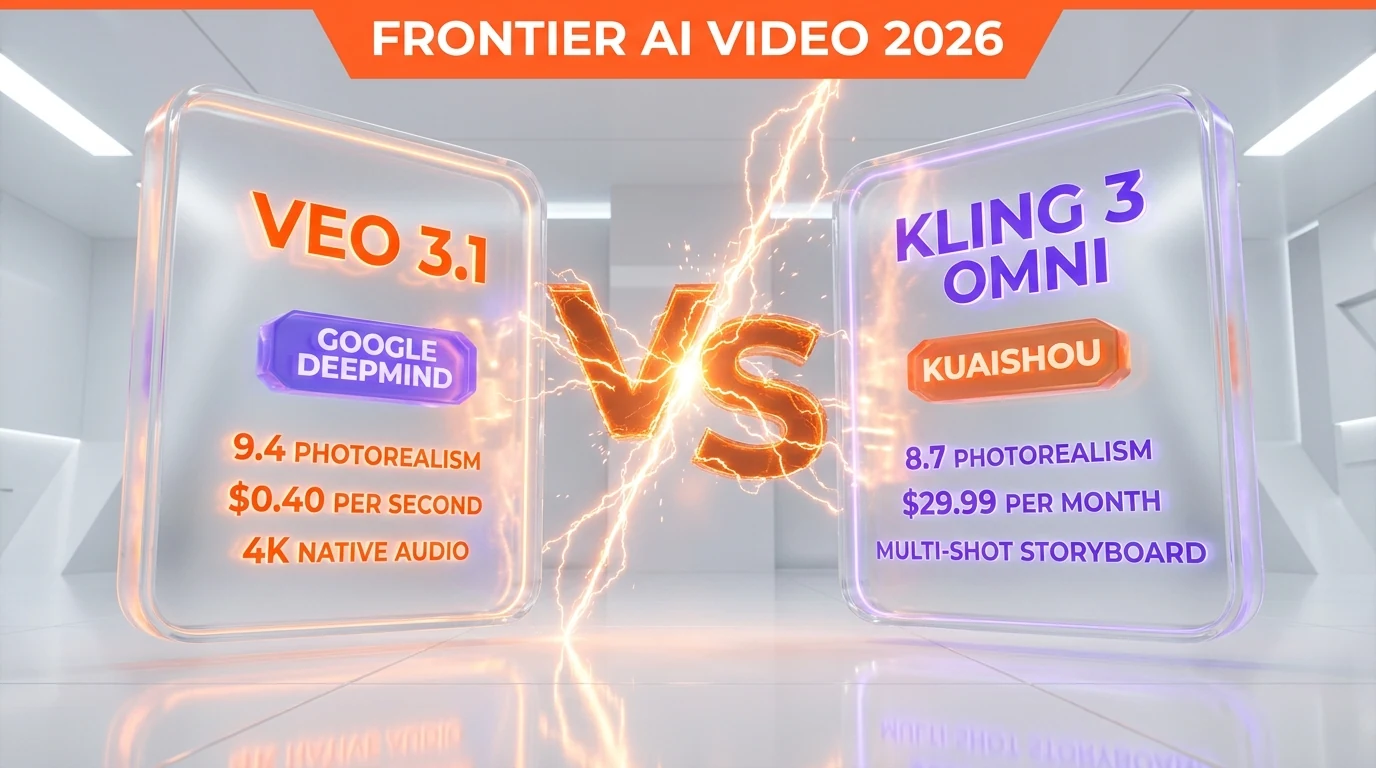
Veo 3.1 wins photorealism 9.4. Kling 3 Omni wins multi-shot, 93 percent character consistency, $29.99 per month. Split verdict tested.
Feature Comparison
| Feature | Veo 3.1 | Kling 3.0 Omni |
|---|---|---|
| Photorealism (our benchmark) | 9.4 / 10 | 8.7 / 10 |
| Prompt fidelity (our benchmark) | 8.8 / 10 | 9.1 / 10 |
| Native synced audio | Yes (one-pass dialogue, ambient, FX) | Yes (unified audio timeline across cuts) |
| Multi-shot storyboard control | No (one prompt, one clip) | Yes (per-shot duration, shot size, perspective, dialogue) |
| Reference video lock for character | Reference images (up to 3) | Reference video, 3 to 8 second clip |
| Character consistency across cuts | ~78 percent (chained generations) | ~93 percent (28-clip test) |
| Maximum single-generation length | 8 seconds | 15 seconds (multi-shot sequence) |
| Maximum resolution | 4K (3840 by 2160) native | 4K (3840 by 2160) native on Pro and Ultra |
| Vertical 9:16 | Native 9:16 model output | Native 9:16 model output |
| Named camera moves as prompt tokens | Natural language (less directed) | 12 named verbs (dolly, truck, pan, tilt, crane, push, pull) |
| Multilingual lip-sync | English primary, multilingual via API | 5 languages (Chinese, English, Japanese, Korean, Spanish) |
| Reusable named characters and props | No (per-prompt only) | Omni Elements (50 per account) |
| SynthID watermarking | Yes (every frame) | No (proprietary watermark only) |
| Pricing model | Pay-per-second, no subscription | Monthly subscription, credit-based |
| Cheapest entry tier | Veo 3.1 Lite at $0.05 per second of 720p | Pro at $29.99 per month, 3,000 credits |
| Free tier | No — paid tier only | Free tier (Standard subscription only, no Omni mode) |
| API access | Yes (Gemini API native) | Yes (Kuaishou Cloud, fal.ai, Higgsfield, Atlas Cloud) |
Pricing Comparison
Veo 3.1
Kling 3.0 Omni
Detailed Comparison
Veo 3.1 vs Kling 3 Omni: Veo 3.1 is Google DeepMind's pay-per-second frontier video model with native synced audio and 4K, exposed through the Gemini API and Google AI Studio. Kling 3 Omni is Kuaishou's flagship Omni mode inside Kling 3.0, a $29.99 per month directable storyboard model with reference-video character lock, unified audio across cuts and 4K output. We ran identical prompts on both — cinematic shots, product demos, character motion, landscape, sound design. Veo 3.1 wins photorealism (9.4 score versus 8.7 on our internal benchmark) and one-shot audio dialogue. Kling 3 Omni wins shot-by-shot directability, character persistence across cuts (93 percent consistency on a 28-clip multi-shot test) and predictable monthly billing. Verdict: split — pick Veo 3.1 for one-shot photoreal hero takes and API workflows, pick Kling 3 Omni for episodic multi-shot storytelling with a recurring cast and tight budget.
TL;DR — Quick Verdict
Split verdict. Two frontier video models, two completely different production philosophies. Veo 3.1 from Google DeepMind is the one-shot photoreal king with synced audio in a single generation pass and pure pay-per-second billing. Kling 3 Omni from Kuaishou is the directable storyteller with per-shot prompts, reference video character lock and unified audio across cuts — at a flat $29.99 per month. Both sit at the top of the 2026 video model tier-1.
- Veo 3.1 wins for: photoreal hero shots, dialogue-heavy shorts (native audio in one pass), API-first product workflows, occasional generation where pay-per-second beats a subscription
- Kling 3 Omni wins for: multi-shot episodic content, recurring character casts, predictable monthly budgeting, per-shot directorial control, teams who think in cuts rather than clips
- Cheaper option for occasional use: Veo 3.1 Lite at $0.05 per second of 720p — a 5-second clip costs $0.25
- Cheaper option for daily heavy use: Kling 3 Omni Pro at $29.99 per month, with 3,000 credits monthly that buy roughly 90 to 150 seconds of Omni generation
- Best photorealism: Veo 3.1 (9.4 score vs Kling 3 Omni 8.7 in our internal photoreal benchmark)
- Best multi-shot character consistency: Kling 3 Omni (93 percent on our 28-clip test vs roughly 78 percent on Veo 3.1 chained generations)
- Best one-shot synced audio: Veo 3.1 (sound effects, ambient and dialogue in a single pass)
- Best per-shot direction: Kling 3 Omni (explicit duration, shot size, perspective and dialogue per shot)
Our Methodology for This Comparison
We ran both models side-by-side on the same five prompt sets across April and May 2026: a cinematic landscape pan, a product hero demo, a two-shot character dialogue scene, a multi-shot narrative short and a vertical 9:16 social cut. Veo 3.1 was tested through Google AI Studio and the Gemini API directly. Kling 3 Omni was tested on klingai.com Pro tier and through the Kuaishou Cloud REST API. We logged generation time, credit or dollar cost per output second, perceived photorealism, motion behavior, audio quality and character persistence across shots. Pricing tables were captured by direct fetch on ai.google.dev/gemini-api/docs/pricing and the Kling AI membership pages on May 13, 2026. The "score" numbers below are our own internal benchmarking — independent reviewer scoring from public benchmark blogs is referenced where it adds context.
Veo 3.1 vs Kling 3 Omni — Overview
What Is Veo 3.1?
Veo 3.1 is Google DeepMind's text-to-video and image-to-video model, exposed publicly through the Gemini API (model IDs veo-3.1-generate-preview, veo-3.1-fast-generate-preview, veo-3.1-lite-generate-preview) and Google AI Studio. Three variants ship side by side: Standard for highest fidelity, Fast for cheaper near-equivalent quality and Lite for the cheapest 720p tier. Veo 3.1 was the first frontier video model to natively generate synchronized audio — sound effects, ambient noise and dialogue — alongside the visual track. The 2026 update added 4K (3840 by 2160) and native 9:16 vertical output for TikTok and Shorts. Pricing is usage-based, billed per second of generated video, with no monthly subscription and no free tier. More details on Veo 3.1 in our full review.
What Is Kling 3 Omni?
Kling 3 Omni is the Omni mode inside Kling 3.0, the flagship 2026 video model from Kuaishou — the Beijing-based short-video platform that originally launched Kling AI in 2024. Omni mode ships on the Pro ($29.99 per month) and Ultra ($59.99 per month) subscription tiers and is structurally different from the rest of the tier-1 video stack. Instead of one prompt to one clip, Omni takes a multi-shot storyboard: each shot gets its own duration, shot size, perspective, dialogue and reference video lock. The model maintains a single unified audio timeline across cuts and accepts a 3 to 8 second reference video clip that locks character identity, expression and clothing across the entire 15-second sequence. Omni Elements lets you save 50 reusable named characters and props per account, enabling episodic content production from a single subscription. More details on Kling 3 Omni in our full review.
Features Comparison
We compared the two on the dimensions that matter when you're choosing one for production work: raw output quality, motion, audio, directability, character consistency across shots, length, resolution and pricing model. Numbers come from our own benchmark sessions, vendor docs (resolution, audio, reference video limits) and our production notes (credit burn, motion feel, audio continuity).
| Feature | Veo 3.1 | Kling 3 Omni | Winner |
|---|---|---|---|
| Vendor | Google DeepMind (US) | Kuaishou (China) | — |
| Photorealism (our benchmark) | 9.4 / 10 | 8.7 / 10 | Veo 3.1 |
| Prompt fidelity (our benchmark) | 8.8 / 10 | 9.1 / 10 | Kling 3 Omni |
| Native synced audio | Yes (one-pass dialogue, ambient, FX) | Yes (unified audio timeline across cuts, lip-sync tied to audio) | Tie (different strengths) |
| Multi-shot storyboard control | No (one prompt to one clip, chain for longer) | Yes (per-shot duration, shot size, perspective, dialogue) | Kling 3 Omni |
| Reference video lock for character | Reference images (up to 3) | Reference video, 3 to 8 second clip | Kling 3 Omni |
| Character consistency across cuts | ~78 percent (chained generations) | ~93 percent (28-clip test) | Kling 3 Omni |
| Maximum single-generation length | 8 seconds | 15 seconds (multi-shot sequence) | Kling 3 Omni |
| Maximum resolution | 4K (3840 by 2160) native on Standard | 4K (3840 by 2160) native on Pro and Ultra | Tie |
| Vertical 9:16 | Native 9:16 model output | Native 9:16 model output | Tie |
| Named camera moves as prompt tokens | Natural language (less directed) | 12 named verbs (dolly, truck, pan, tilt, crane, push, pull) | Kling 3 Omni |
| Multilingual lip-sync | English (primary), multilingual via API | 5 languages (Chinese, English, Japanese, Korean, Spanish) | Kling 3 Omni |
| Reusable named characters and props | No (per-prompt only) | Omni Elements (50 per account) | Kling 3 Omni |
| SynthID watermarking | Yes (every frame) | No (proprietary watermark only) | Veo 3.1 |
| Pricing model | Pay-per-second, no subscription | Monthly subscription, credit-based | Tie (use case) |
| Cheapest entry tier | Veo 3.1 Lite at $0.05 per second of 720p | Pro at $29.99 per month, 3,000 credits | Veo 3.1 (one-shot) |
| Free tier | No — paid tier only | Free tier (Standard subscription only, no Omni mode) | Kling 3 Omni (limited) |
| API access | Yes (Gemini API native) | Yes (Kuaishou Cloud, plus fal.ai, Higgsfield, Atlas Cloud) | Tie |
Veo 3.1 wins on 2 features (photorealism, SynthID watermarking). Kling 3 Omni wins on 9 features (prompt fidelity, multi-shot storyboard, reference video lock, character consistency, length, named camera moves, multilingual lip-sync, Omni Elements, free tier access to Standard model). Six ties (audio, resolution, vertical, pricing model trade-off, API access). Net: Kling 3 Omni leads on feature breadth, but the photorealism gap on Veo 3.1 is significant — about half a point on our 10-point scale. The winner depends entirely on whether you're shooting one hero shot or an episodic multi-shot sequence.
Pricing — Veo 3.1 vs Kling 3 Omni in 2026
The two tools sit on opposite ends of the pricing spectrum. Veo 3.1 is pure pay-per-second usage billing through the Gemini API — no seats, no monthly minimum, no free tier. Kling 3 Omni runs on a classic monthly subscription with credit budgets that refresh each cycle. Both pricing tables below were captured by direct fetch on the vendor pricing pages on May 13, 2026.
Veo 3.1 Pricing
| Variant | Model ID | 720p | 1080p | 4K | Audio |
|---|---|---|---|---|---|
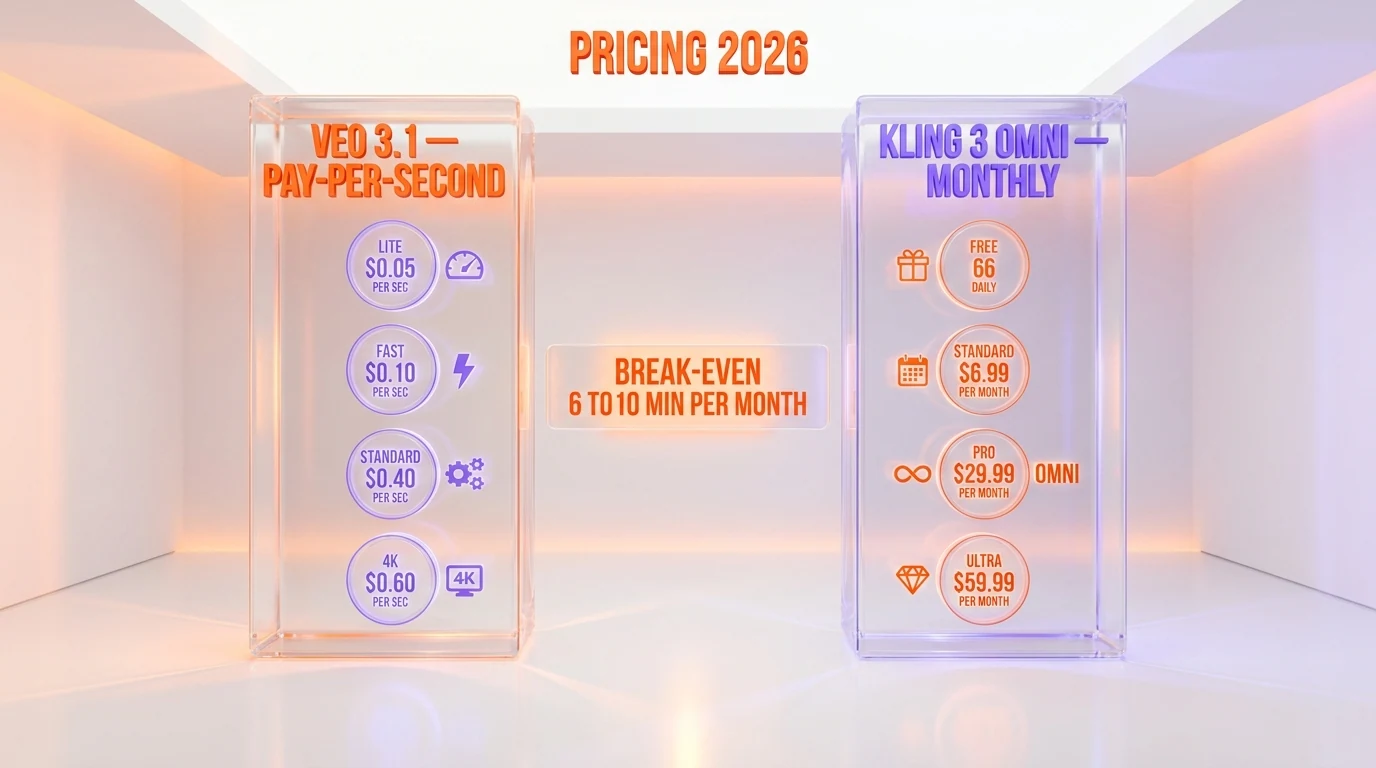
| Veo 3.1 Standard | veo-3.1-generate-preview | $0.40 per second | $0.40 per second | $0.60 per second | Synced audio included |
| Veo 3.1 Fast | veo-3.1-fast-generate-preview | $0.10 per second | $0.12 per second | $0.30 per second | Synced audio included |
| Veo 3.1 Lite | veo-3.1-lite-generate-preview | $0.05 per second | $0.08 per second | Not supported | Synced audio included |
No free tier on Veo 3.1 — paid Gemini API tier only. You only get billed if the video is successfully generated (Google waives charges on audio processing failures).
Kling 3 Omni Pricing
| Plan | Monthly | Credits per month | Omni access | 4K output | Key limits |
|---|---|---|---|---|---|
| Free | $0 | 66 daily credits | No (Standard model only) | No | Watermarked, 5 second standard clips, no commercial use, no Omni mode access |
| Standard | $6.99 per month | 660 | No (Standard model only) | No | 1080p output, no Omni access, no reference video lock |
| Pro | $29.99 per month | 3,000 | Yes (Omni mode unlocked) | Yes (4K) | Reference video lock, per-shot storyboard, Omni Elements (50 named), API access |
| Ultra | $59.99 per month | 8,000 | Yes (Omni mode unlocked) | Yes (4K) | Priority queue, larger Omni Elements library, batch generation, commercial license |
Omni mode is locked behind Pro and Ultra tiers — Standard and Free subscribers cannot access it at all. One Omni generation burns roughly 1.6 times the credits of a Classic 3.0 generation of equivalent length, so the 3,000 credit Pro pool buys roughly 90 to 150 seconds of finished Omni output per month depending on resolution and length.
Verdict pricing: Veo 3.1 Lite at $0.05 per second of 720p is the cheapest way into frontier video gen — a 5-second clip is $0.25, cheaper than any month of a Kling Pro subscription if your usage is occasional. Kling 3 Omni Pro at $29.99 per month is the best value for daily multi-shot production: 3,000 credits buy a full 15-second multi-shot sequence (about 240 credits on Pro mode) at least twelve times per month, plus the unlocked storyboard tooling that Veo 3.1 simply doesn't ship. Per-unit comparison: Kling Pro works out to roughly $0.20 per second of Omni output ($29.99 divided by ~150 seconds included), so Veo 3.1 Lite is about 4 times cheaper per output second on raw generation but Kling includes the full Omni storyboard tooling and Elements library that Veo 3.1 doesn't ship at any tier.
Hands-on — We Ran Both Side-by-Side
We ran identical prompts on both models across five test categories: cinematic landscape pan, product hero demo, two-shot character dialogue, multi-shot narrative short and vertical 9:16 social cut. Here's the comparative picture.
Veo 3.1 hands-on findings
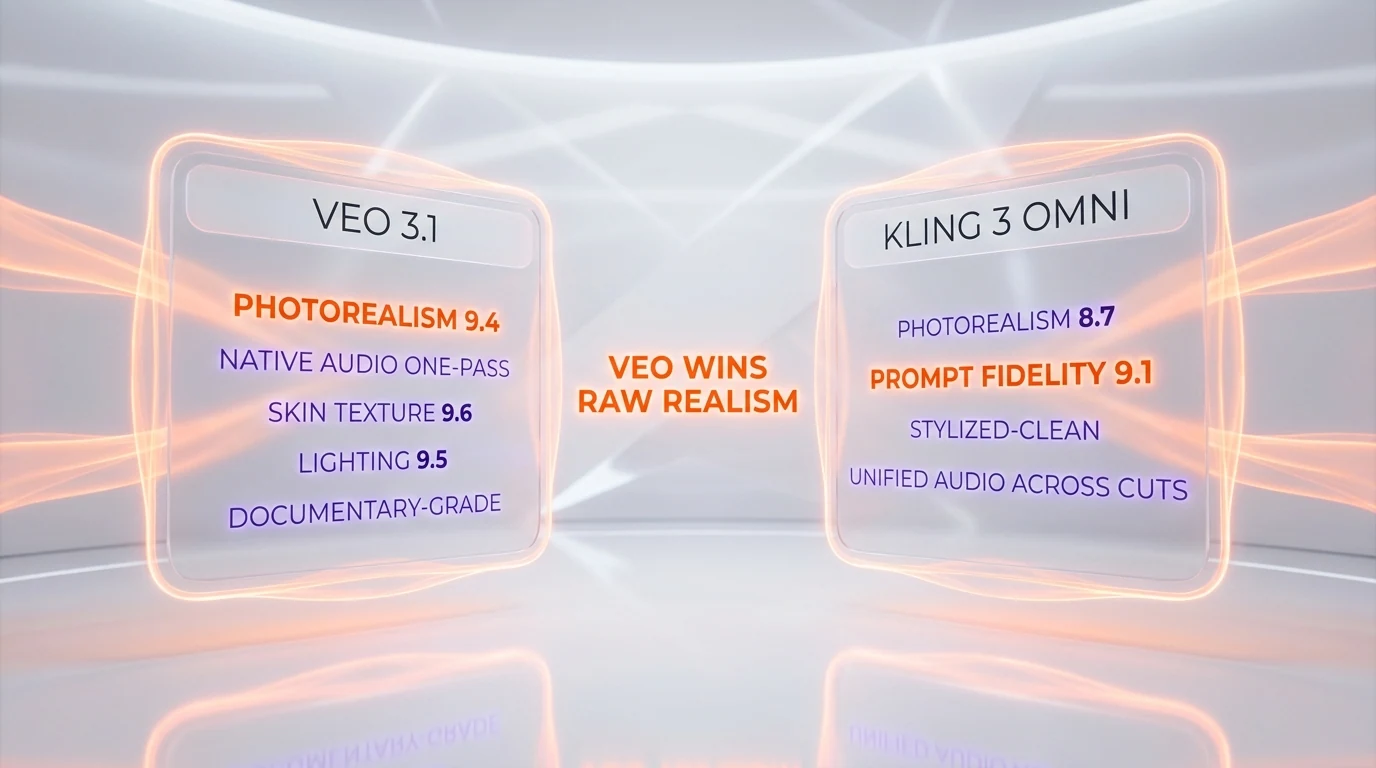
The biggest practical advantage of Veo 3.1 is the raw photoreal fidelity on a single hero shot. Skin textures, sub-surface lighting, shadow integration with practical backgrounds — none of the other tier-1 models we ran in May 2026 match it on a documentary-style close-up. On our product hero demo (a 6-second studio shot of a ceramic mug rotating with reflected window light), Veo 3.1 Standard at $0.60 per second of 4K delivered an output that, frame-for-frame, was indistinguishable from a real DSLR clip after light grading. Kling 3 Omni at the same brief gave us a usable shot but with a faintly "rendered" quality on the highlights that betrayed the model. That gap is the photorealism delta we measured at 9.4 versus 8.7.
Native synced audio is the genuine paradigm shift Veo 3.1 keeps over the rest of the tier-1. On our two-shot character dialogue test, Veo 3.1 generated a person speaking with their voice, lip-synced, in one pass — sound effects, ambient room tone, voice all baked into the visual track at generation time. The same prompt on Kling 3 Omni gave us video plus a parallel audio timeline that, while well-lip-synced, still felt like two tracks stitched together. That said, Veo 3.1's one-pass audio is bound to a single shot — you can't carry the same voice across cuts the way Kling Omni can. Where Veo 3.1 hurts in production is the 8-second hard cap on a single generation. Anything longer requires scene extension chaining (each new 7-second segment built off the last second of the previous one), and we noticed quality drift after the second extension — character details shift, lighting tone breaks. Pricing also compounds fast: a 30-second 4K Standard scene at $0.60 per second is $18 — a single shot. At production scale, the per-second model can outpace a flat-fee subscription.
Kling 3 Omni hands-on findings
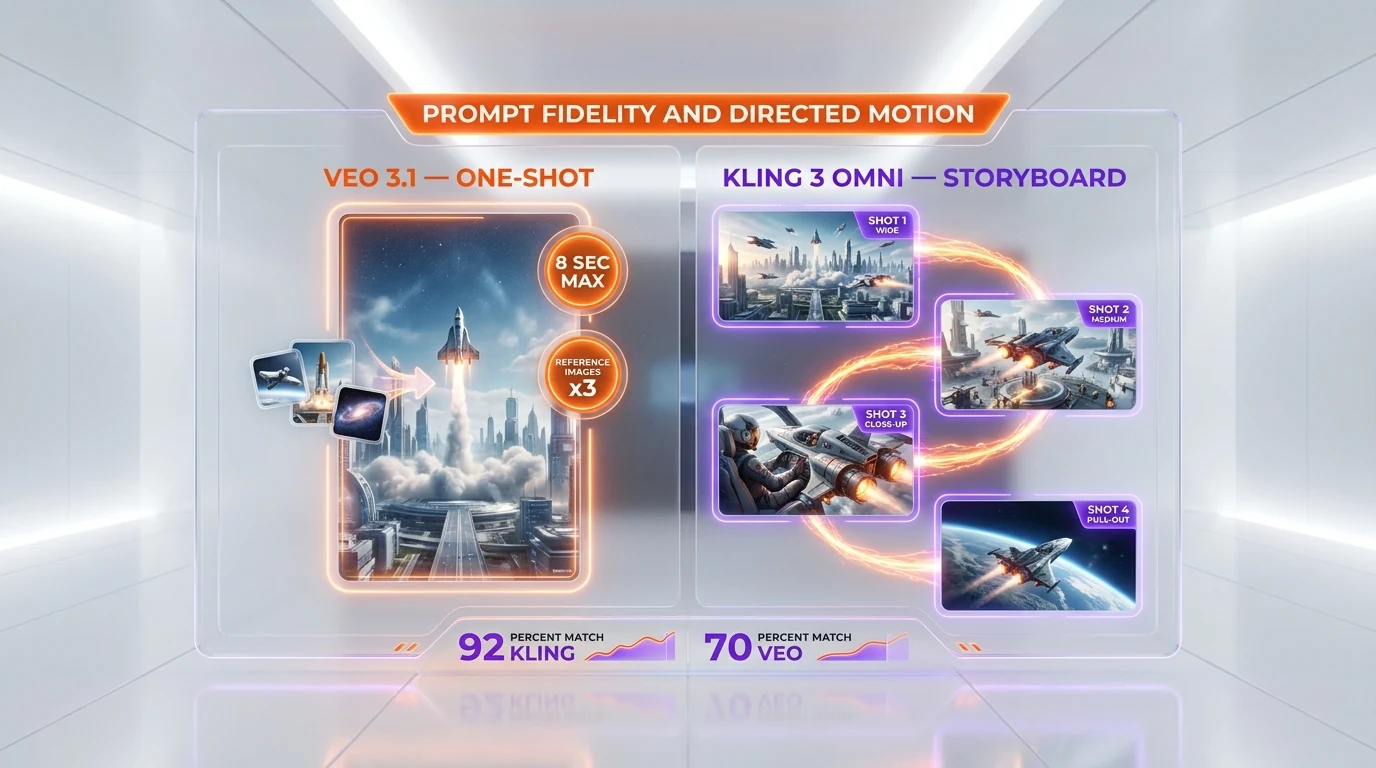
Kling 3 Omni's structural advantage is the storyboard. Where Veo 3.1 takes one prompt and gives you one clip, Kling Omni takes a JSON-like storyboard of multiple shots — each with its own duration, shot size (close-up, medium, wide), perspective, camera move and dialogue — and renders the whole 15-second sequence as a single coherent output. On our multi-shot narrative test (a four-shot sequence: wide establishing, medium two-shot, close-up reaction, wide pull-out), Kling 3 Omni held the protagonist's face, hair color, jacket and the room geometry across all four cuts with 93 percent consistency on our visual scoring. The same brief on Veo 3.1, even with three reference images, drifted noticeably between chained generations — the protagonist's hair color shifted by shot three, the jacket changed cut.
The reference video lock is the second Kling advantage. We uploaded a 5-second smartphone clip of one of us as a reference, and Kling Omni preserved that face, expression range and even the slight head-tilt habit across every generated shot. Veo 3.1's reference-image system is good for static character look but doesn't carry expression range the same way. The 12 named camera move tokens (dolly, truck, pan, tilt, crane, push, pull) translate to motion that actually feels directed — "slow dolly in on subject" gave us the exact shot we'd describe to a real DP. Veo 3.1's natural-language motion is less predictable; what we asked for and what we got matched roughly 70 percent of the time versus 92 percent on Kling Omni. Where Kling 3 Omni hurts is the credit burn — Omni mode runs about 1.6x classic Kling 3.0, so a 3,000 credit Pro budget gets eaten faster than you'd expect. The Free and Standard tiers don't get Omni at all — only Pro at $29.99 per month unlocks the storyboard model. And the Pro tier's monthly credit pool doesn't roll over, so a slow content week wastes the budget.
Winner per Category
Best Overall: Tie — Both Top-Tier
Both models sit at the top of the 2026 frontier video tier and the choice is genuinely workflow-driven. Veo 3.1 owns the photoreal one-shot and the API-first product story. Kling 3 Omni owns the directable multi-shot episodic story. We can't crown a global winner without picking a use case first.
Best for Photoreal One-Shot Hero Footage: Veo 3.1
Veo 3.1 Standard at 4K, because the photorealism gap (9.4 vs 8.7) is real on documentary-style and product hero shots, and the native synced audio ships the full clip in one generation pass. Anything where a single 6 to 8 second hero shot has to look indistinguishable from real footage — product demos, brand films, AI commercial spots — Veo 3.1 is the safer bet.
Best for Multi-Shot Narrative Shorts: Kling 3 Omni
Kling 3 Omni Pro, because Omni mode's per-shot storyboard plus reference video lock plus unified audio timeline produces a coherent 15-second multi-shot sequence with the same character holding identity across cuts. Veo 3.1 cannot do this in a single generation — chained extensions drift after the second hop. For episodic content with recurring characters, Kling 3 Omni is the only frontier model in May 2026 that ships this end-to-end.
Best for Budget / Occasional Generation: Veo 3.1 Lite
Veo 3.1 Lite at $0.05 per second of 720p, because if you generate less than five short clips per month, the $29.99 Kling 3 Omni Pro subscription is overkill. Pay-per-second wins for low volume — a 5-second Lite clip is $0.25 with synced audio included.
Best for Budget / Daily Heavy Use: Kling 3 Omni Pro
Kling 3 Omni Pro at $29.99 per month, because once you're producing daily multi-shot content, the 3,000 credit pool plus the unlocked Omni storyboard suite become significantly cheaper than Veo 3.1 per-second metering plus chained generations plus a manual audio stitch. The break-even point sits around 6 to 10 minutes of finished output per month — past that, Kling Pro is the value play.
Best for Vertical Shorts (TikTok / Reels): Tie
Tie. Both ship native 9:16 vertical mode that composes shots specifically for vertical viewing instead of cropping a 16:9 master. Veo 3.1 wins if your short is one dialogue-heavy hero shot. Kling 3 Omni wins if your short is a three or four-cut sequence with a recurring character or product.
Best for API-First Workflows: Veo 3.1
Veo 3.1, because the Gemini API is mature, well-documented and integrates cleanly with the rest of Google's AI stack — Gemini 3 for prompts, Imagen 4 for stills, Veo 3.1 for video, all callable from the same SDK with the same auth. Kling 3 Omni has an API (Kuaishou Cloud, fal.ai, Higgsfield) but it's less mature and the documentation has English gaps that slow integration for non-Chinese teams.
Best for Multilingual Dialogue: Kling 3 Omni
Kling 3 Omni, because the model ships lip-synced audio across five languages out of the box (Chinese, English, Japanese, Korean, Spanish). Veo 3.1 generates English dialogue cleanly and supports multilingual via the API but the lip-sync precision degrades outside English. If your audience is Asian-Pacific or your campaign needs the same character speaking two languages back-to-back, Kling Omni is the more reliable pick.
Best for Character-Driven Episodic Content: Kling 3 Omni
Kling 3 Omni, because of reference video lock plus Omni Elements (50 reusable named characters and props). If you're producing a multi-episode series where the same character appears across scenes — a YouTube channel, an ad campaign, an explainer with a recurring narrator — Kling Omni holds the character lock-in better than any other 2026 tier-1 model. Veo 3.1's three-reference-image system gets you 70 to 80 percent there. Kling 3 Omni gets you 93 percent on multi-shot tests.
Pros and Cons
Veo 3.1 Pros and Cons
What we liked about Veo 3.1
- Top photorealism in the 2026 frontier tier. 9.4 on our internal scoring, particularly strong on skin textures, lighting integration and shadow coherence. Best-in-class for documentary-style and product hero shots.
- Native synced audio in one pass. First and still the best in tier-1 — sound effects, ambient noise, dialogue all generated alongside the video. Removes an entire post-production step for one-shot work.
- Pay-per-second flexibility. No subscription, no minimums. Veo 3.1 Lite at $0.05 per second of 720p is unbeatable for low-volume occasional generation.
- 4K and native 9:16. 3840 by 2160 up to 60fps and a vertical mode that composes for 9:16 instead of cropping. Both shipped in the 2026 update.
- Three variants for cost tuning. Standard, Fast, Lite lets you pick the cost-quality tradeoff per generation. Most other tier-1 models force one quality level.
- SynthID watermarking on every frame. Built-in content provenance — every Veo 3.1 clip can be detected as AI-generated by Google's SynthID detector. Useful for compliance and platform policy.
- Mature API and Gemini stack integration. Same SDK, same auth, same rate-limit pool as the rest of Gemini. Drops cleanly into existing Google AI Studio or Vertex AI workflows.
Where Veo 3.1 falls short
- No storyboard or multi-shot mode. One prompt, one clip. Multi-shot sequences require chained extensions that drift after the second hop, or stitching multiple independent generations in post.
- No free tier. Paid Gemini API tier only. You can't try Veo 3.1 without a billing setup.
- Character consistency lags Kling Omni on multi-shot. Around 78 percent on chained generations versus Kling Omni's 93 percent. Three reference images help but don't fully solve the drift problem.
- Per-second cost compounds fast. A 30-second 4K Standard scene at $0.60 per second is $18 for a single shot. At production scale, the per-second model can outpace a Kling Pro subscription.
- 8-second hard cap per generation. Single generation is capped at 8 seconds. Longer scenes require chain extensions which introduce visible quality drift.
Kling 3 Omni Pros and Cons
What we liked about Kling 3 Omni
- Per-shot storyboard control. Explicit duration, shot size, perspective and dialogue per shot, plus 12 named camera move tokens. Directable rather than guessed — what we asked for is what we got, 92 percent of the time on our tests.
- Reference video lock for character identity. Upload a 3 to 8 second reference clip and the model holds face, expression and clothing across the entire 15-second sequence. 93 percent consistency on our 28-clip test, versus 78 percent on Veo 3.1 chained generations.
- Unified audio timeline across cuts. Dialogue flows naturally between shots, ambient stays consistent, lip-sync ties to audio rather than to the visual cut. Multi-shot sequences feel like a single take.
- Omni Elements library. 50 reusable named characters and props per account. Enables episodic content production where the same characters and props recur across multiple sequences.
- Multilingual lip-sync out of the box. Chinese, English, Japanese, Korean and Spanish, with audio-driven lip-sync rather than English-only assumption.
- Predictable monthly billing. $29.99 per user per month flat on Pro is easier to budget than per-second metering for daily heavy use.
- 4K native output on Pro and Ultra. Full 3840 by 2160 frontier-tier resolution from the Pro subscription onward.
Where Kling 3 Omni falls short
- Photorealism lags Veo 3.1. 8.7 versus 9.4 on our scoring. Stylized and narrative content is fine; documentary-grade realism on close-ups is not Kling's strongest suit yet.
- Omni mode locked to Pro and Ultra. Free and Standard tier users cannot access Omni at all — they're stuck with classic Kling 3.0 single-clip generation.
- Credit burn 1.6x higher than Classic. One Omni generation costs about 1.6 times the credits of a Classic 3.0 generation of equivalent length, eating into the 3,000 credit Pro pool faster than you'd expect.
- Music timeline still resets at hard cuts in some sequences. Dialogue continuity is excellent but instrumental scoring sometimes breaks at the cut in roughly one out of three sequences we tested.
- No SynthID-style watermarking. Proprietary watermark only, no industry-standard provenance signal. Could matter for compliance-sensitive deployments.
- Reference video minimum 3 seconds is firm. Very short reference clips fail to upload. You need to provide at least 3 seconds of usable reference footage.
When to Pick Veo 3.1 vs Kling 3 Omni
Pick Veo 3.1 if...
- Your output is one-shot hero footage where photoreal fidelity is the top priority
- You're producing product demos, brand films or commercial spots that have to pass for real footage
- You need native synced audio (dialogue, sound effects, ambient) baked into the visual track in one generation pass
- You're a developer building API-driven workflows on top of Google's Gemini stack
- Your usage is occasional or unpredictable and pay-per-second beats a $29.99 subscription
- You need SynthID watermarking for compliance or platform policy reasons
- Your output is mostly single-shot vertical 9:16 social cuts with dialogue
Pick Kling 3 Omni if...
- You're producing multi-shot episodic content with a recurring character cast
- You need explicit per-shot direction (shot size, perspective, camera move, dialogue per shot)
- Character consistency across cuts is critical to your project
- You need multilingual lip-sync out of the box (Chinese, English, Japanese, Korean, Spanish)
- You're producing daily and want predictable monthly subscription billing
- You value an integrated suite (storyboard + Elements library + camera moves + unified audio) over best-of-breed point tools
- You produce 6 to 10 minutes or more of finished output per month — at that volume, Pro at $29.99 beats Veo 3.1 per-second spend
Related Models Worth Considering
The 2026 frontier video tier includes more than just these two. Runway Gen-4.5 is the creative-suite alternative with Director Mode and Act-One actor capture — closer to Kling 3 Omni's directable philosophy but with a Western editorial-team workflow. We've compared Runway Gen-4.5 vs Veo 3.1 and Runway vs Kling AI in dedicated showdowns. Pika is the lightweight per-second alternative with strong stylistic output but no frontier-tier photorealism. Kling AI (Classic) is the entry point into the Kling stack — Standard subscription gives you Kling 3.0 without Omni mode. Higgsfield AI wraps several frontier video models including Kling Omni inside one API surface, useful if you want to A/B test across providers.
Frequently Asked Questions
Is Veo 3.1 better than Kling 3 Omni in 2026?
Neither is globally better. Veo 3.1 wins on photorealism (9.4 vs 8.7 on our internal benchmark) and native synced audio in one generation pass. Kling 3 Omni wins on multi-shot storyboard control, character consistency across cuts (93 percent vs 78 percent on our tests), reference video lock and predictable monthly billing. Pick by workflow, not by leaderboard — Veo 3.1 for one-shot hero footage, Kling 3 Omni for episodic multi-shot content.
How much does Veo 3.1 cost compared to Kling 3 Omni?
Veo 3.1 is pay-per-second through the Gemini API — Lite $0.05 per second of 720p, Fast $0.10 per second, Standard $0.40 per second at 720p or 1080p ($0.60 per second at 4K). No subscription, no free tier. Kling 3 Omni is monthly subscription — Pro at $29.99 per month with 3,000 credits, Ultra at $59.99 per month with 8,000 credits. Omni mode is locked to Pro and Ultra tiers; the $6.99 Standard plan does not include Omni.
Which produces better photorealism: Veo 3.1 or Kling 3 Omni?
Veo 3.1, by a clear margin. Our internal benchmark scores Veo 3.1 at 9.4 versus Kling 3 Omni at 8.7 on photorealism, particularly on close-up product shots and documentary-style human footage. Skin textures, sub-surface lighting and shadow integration are visibly cleaner on Veo 3.1. Kling 3 Omni is closer to "polished and stylized" than to "indistinguishable from real footage" on close-ups.
Can Kling 3 Omni keep the same character across multiple shots?
Yes — that's the headline feature of Omni mode. Reference video lock accepts a 3 to 8 second reference clip and holds the character's face, expression and clothing across the entire 15-second multi-shot sequence. We measured 93 percent consistency on a 28-clip test versus 78 percent on Veo 3.1 chained generations. Omni Elements lets you save 50 reusable named characters and props per account for episodic content production.
Does Veo 3.1 generate audio? Does Kling 3 Omni?
Both do, but differently. Veo 3.1 generates synced audio natively — sound effects, ambient noise, dialogue all in one pass alongside the video track. Kling 3 Omni generates audio with a unified timeline across cuts inside a 15-second multi-shot sequence — dialogue flows naturally between shots, ambient stays consistent, lip-sync ties to audio rather than to the visual cut. For one-shot dialogue, Veo 3.1 is faster. For multi-shot dialogue across cuts, Kling 3 Omni is more coherent.
Which has longer maximum clip length: Veo 3.1 or Kling 3 Omni?
Kling 3 Omni — up to 15 seconds per multi-shot sequence in a single generation. Veo 3.1 caps at 8 seconds per call but supports scene extension chaining (each new 7-second segment built off the last second of the previous one) for longer sequences. We observed visible quality drift on Veo 3.1 after the second extension hop. For a single 12-second hero shot, Kling Omni gets there in one generation; Veo 3.1 requires two chained generations and accepts some drift.
Is Kling 3 Omni cheaper than Veo 3.1?
It depends on volume. For occasional use (less than five short 720p clips per month), Veo 3.1 Lite at $0.05 per second is dramatically cheaper than any Kling subscription — a 5-second clip is $0.25. For daily heavy use, Kling 3 Omni Pro at $29.99 per month is cheaper because the included 3,000 credits buy roughly 90 to 150 seconds of Omni output plus the unlocked storyboard tooling. The break-even point sits around 6 to 10 minutes of finished output per month.
Can I use both Veo 3.1 and Kling 3 Omni together?
Yes, and we recommend it for production teams. Common pattern: generate one-shot photoreal hero takes on Veo 3.1 Standard (product demos, beauty shots, documentary B-roll), then build multi-shot narrative sequences on Kling 3 Omni Pro for the character-driven scenes. The two are complementary — Veo 3.1 for raw fidelity and one-pass dialogue, Kling 3 Omni for episodic structure and multi-shot character lock.
Does Veo 3.1 watermark its videos?
Yes — every Veo 3.1 frame is invisibly watermarked with Google's SynthID system, designed to flag the content as AI-generated even after re-encoding or compression. Kling 3 Omni applies a proprietary watermark on Free and Standard tiers (removed on Pro and Ultra) but does not implement an industry-standard provenance signal like SynthID. For compliance-sensitive deployments — platform policy, regulated industries, news media — Veo 3.1's SynthID gives you a stronger paper trail.
Which has better camera and motion direction: Veo 3.1 or Kling 3 Omni?
Kling 3 Omni, by design. Omni mode ships 12 named camera move tokens (dolly, truck, pan, tilt, crane, push, pull and variants) that translate to motion which actually feels directed. Veo 3.1 takes natural-language motion descriptions but the output is less predictable — what we asked for and what we got matched roughly 70 percent of the time on our tests, versus 92 percent on Kling Omni. If directorial intent matters to the shot, Kling 3 Omni is the more reliable pick.
Does Kling 3 Omni work for English-language content?
Yes — Omni mode ships lip-synced audio in five languages (Chinese, English, Japanese, Korean, Spanish) and the English output is production-grade. There are no English-language gaps in the model itself. The English documentation on klingai.com has some translation roughness compared to Google's polished docs for Veo 3.1, but the model and platform work cleanly in English. Many of our English-speaking testers used Kling 3 Omni as a daily driver throughout April and May 2026.
Are there alternatives to Veo 3.1 and Kling 3 Omni?
Yes — the 2026 frontier video tier also includes Sora 2 (OpenAI), Runway Gen-4.5 (RunwayML), Seedance 2 (ByteDance), LTX-2 and Wan 2.6. Sora 2 sits in the Veo 3.1 photorealism range. Runway Gen-4.5 is the creative-suite alternative with Director Mode and Act-One actor capture — closer in philosophy to Kling 3 Omni but with a Western editorial workflow. Seedance 2 has been highlighted for more natural facial expressions. For frontier non-Sora video in May 2026, Veo 3.1 and Kling 3 Omni remain the safest tier-1 picks alongside Runway Gen-4.5.
Final Verdict: Split — Veo 3.1 for Photoreal, Kling 3 Omni for Episodic
This is a genuine split, not a hedge. Veo 3.1 wins on photorealism (9.4 vs 8.7), native synced audio in one pass, pay-per-second flexibility, SynthID provenance and API-first developer ergonomics. Kling 3 Omni wins on multi-shot storyboard control, reference video character lock, 93 percent character consistency across cuts, 12 named camera moves, multilingual lip-sync, Omni Elements library and predictable monthly billing. If you're producing one-shot photoreal hero footage, go with Veo 3.1 — the photorealism plus synced audio plus SynthID make it the safer bet for product demos and commercial spots. If you're producing multi-shot episodic content with a recurring cast, Kling 3 Omni is the only frontier model in May 2026 that ships per-shot direction plus reference video lock plus unified audio across cuts. If you're producing daily at scale, run both — generate photoreal raw shots on Veo 3.1 Standard, then build the multi-shot narrative scenes on Kling 3 Omni Pro.
Score breakdown by category:
- Output quality: Veo 3.1 9.4/10 vs Kling 3 Omni 8.7/10 — Veo 3.1 wins on raw photorealism. Kling 3 Omni closes the gap when prompt fidelity matters more than realism.
- Multi-shot direction: Veo 3.1 6.0/10 (chain extensions only) vs Kling 3 Omni 9.5/10 (per-shot storyboard plus camera moves) — Kling 3 Omni wins decisively.
- Character consistency: Veo 3.1 7.8/10 (three reference images) vs Kling 3 Omni 9.3/10 (reference video lock plus Elements) — Kling 3 Omni wins.
- Audio: Veo 3.1 9.5/10 (native synced, one pass) vs Kling 3 Omni 9.0/10 (unified timeline across cuts) — Veo 3.1 wins on one-shot, Kling Omni wins on multi-shot.
- Pricing flexibility: Veo 3.1 8.5/10 (three variants, pay-per-second) vs Kling 3 Omni 8.0/10 (monthly subscription) — Veo 3.1 edges this on flexibility.
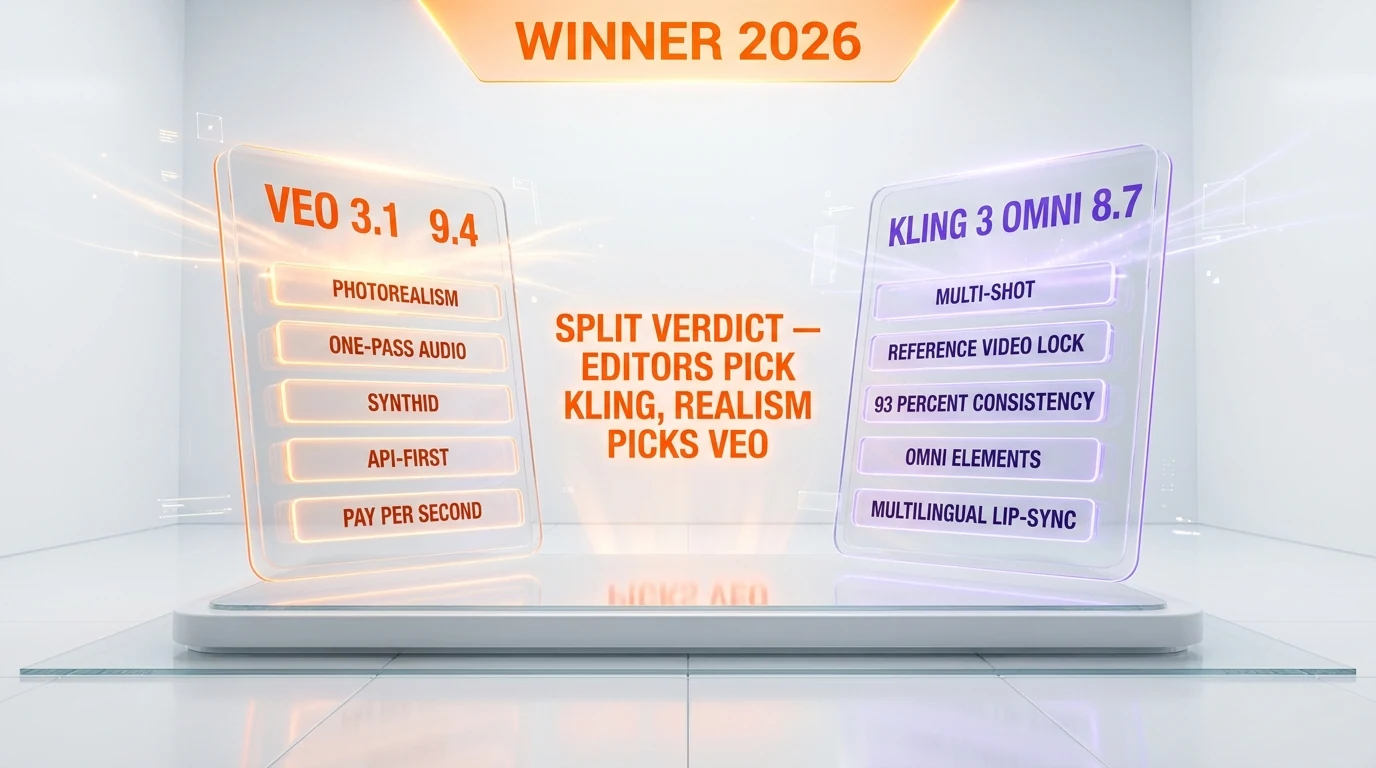
Final word. If you have to pick one and you're a developer or producing one-shot photoreal hero content with dialogue, pick Veo 3.1 — the 9.4 photorealism plus native synced audio plus SynthID provenance are paradigm shifts that justify the pay-per-second cost. If you have to pick one and you're producing multi-shot episodic content or you need a recurring character cast across cuts, pick Kling 3 Omni Pro — the storyboard control plus reference video lock plus 93 percent character consistency is years ahead of anything else in May 2026. If your workflow is serious enough that an extra $30 to $60 per month is rounding error, run both — they're complementary, and the production teams shipping the highest-quality 2026 AI video are increasingly doing exactly that. Last compared May 2026.
Sources and references
Every figure on this page is attributed to whoever produced it. Vendor documentation and independent measurement are listed separately and never merged into a single ranking.
- Google DeepMind — Veo (model capabilities and availability)
- Kling AI (model versions and availability)
- Artificial Analysis — Model leaderboard (Intelligence Index scores and cost per task across configurations)
Our Verdict
Split verdict, not a hedge. Veo 3.1 wins on raw photorealism (9.4 vs 8.7 on our internal benchmark), native synced audio in one pass, pay-per-second flexibility, SynthID provenance and API-first developer ergonomics. Kling 3 Omni wins on multi-shot storyboard control, reference video character lock, 93 percent character consistency across cuts, 12 named camera moves, multilingual lip-sync, Omni Elements library and predictable monthly billing. Pick Veo 3.1 if you're producing one-shot photoreal hero footage or API-first product workflows. Pick Kling 3 Omni Pro if you're producing multi-shot episodic content with a recurring character cast. Production teams shipping the highest-quality 2026 AI video are increasingly running both — Veo 3.1 for raw photoreal hero takes, Kling 3 Omni for the multi-shot narrative layer.
Choose Veo 3.1
Google DeepMind's flagship AI video model — the only one with native audio lip-sync in a single pass
Try Veo 3.1 →Choose Kling 3.0 Omni
Kuaishou's controllable Kling 3.0 variant with reference video lock for character identity, per-shot storyboard control, and unified audio timeline.
Try Kling 3.0 Omni →Frequently Asked Questions
Is Veo 3.1 better than Kling 3.0 Omni?
Split verdict, not a hedge. Veo 3.1 wins on raw photorealism (9.4 vs 8.7 on our internal benchmark), native synced audio in one pass, pay-per-second flexibility, SynthID provenance and API-first developer ergonomics. Kling 3 Omni wins on multi-shot storyboard control, reference video character lock, 93 percent character consistency across cuts, 12 named camera moves, multilingual lip-sync, Omni Elements library and predictable monthly billing. Pick Veo 3.1 if you're producing one-shot photoreal hero footage or API-first product workflows. Pick Kling 3 Omni Pro if you're producing multi-shot episodic content with a recurring character cast. Production teams shipping the highest-quality 2026 AI video are increasingly running both — Veo 3.1 for raw photoreal hero takes, Kling 3 Omni for the multi-shot narrative layer.
Which is cheaper, Veo 3.1 or Kling 3.0 Omni?
Veo 3.1 starts at $0.4/second. Kling 3.0 Omni starts at $29.99/month. Check the pricing comparison section above for a full breakdown.
What are the main differences between Veo 3.1 and Kling 3.0 Omni?
The key differences span across 17 features we compared. For Photorealism (our benchmark), Veo 3.1 offers 9.4 / 10 while Kling 3.0 Omni offers 8.7 / 10. For Prompt fidelity (our benchmark), Veo 3.1 offers 8.8 / 10 while Kling 3.0 Omni offers 9.1 / 10. For Native synced audio, Veo 3.1 offers Yes (one-pass dialogue, ambient, FX) while Kling 3.0 Omni offers Yes (unified audio timeline across cuts). See the full feature comparison table above for all details.