Nano Banana 2
Google DeepMind's high-efficiency 4K image model on Gemini 3.1 Flash Image with real-time web search grounding and SynthID plus C2PA on every output.

Quick Summary
Nano Banana 2 is Google DeepMind's high-efficiency AI image model released February 26, 2026. Native 4K, real-time web grounding, SynthID and C2PA. Free in Gemini app, API at $0.076 per image. Score 9.0/10.
Nano Banana 2 is Google DeepMind's high-efficiency AI image model released February 26, 2026, built on Gemini 3.1 Flash Image. It generates 512px to 4K output with real-time web search grounding, SynthID watermarking, and C2PA content credentials. Pricing: free in Gemini app and AI Studio, API at $0.076 per image. Score 9.0 out of 10.
TL;DR — Our Verdict
Score: 9.0 out of 10. Nano Banana 2 is the first mainstream AI image model that ships Pro-level quality at Flash-level speed and price. The web-grounded knowledge layer makes it credible for infographics, data visualizations, and accuracy-sensitive content where previous image models hallucinated badly. Best for product mockups, infographics, social posts, and any workload where 4K output and real-world accuracy matter. Skip it only if you need fully on-device generation with no Google ecosystem dependency.
- Native 4K output (512px to 4K aspect-flexible) at Flash-tier pricing
- Real-time web search grounding produces accurate factual images (logos, maps, data viz)
- $0.076 per image API pricing — roughly half of GPT Image 2 and a third of Pro tier predecessor
- SynthID invisible watermark plus C2PA content credentials on every output
- Available across Gemini app (free), AI Studio, Vertex AI, Search AI Mode, Lens, Flow video editor
- Default image model across all Gemini app plans since February 27, 2026
What Is Nano Banana 2?
Nano Banana 2 is the second-generation Google DeepMind image model, officially released on February 26, 2026 as the default image generator across the Gemini app's free and paid plans. The name "Nano Banana" started as an internal project codename and stuck through public release. The technical product name is Gemini 3.1 Flash Image; "Nano Banana 2" is the marketing label.
The first-generation Nano Banana shipped in late summer 2025 and quickly became the default Gemini image model, surpassing Imagen 3 in user preference tests at Google. Nano Banana Pro followed in November 2025 with higher fidelity at higher compute cost. Nano Banana 2, released February 26, 2026, brings most of Pro's quality down to Flash-tier speed and pricing — the headline framing in Google's announcement was "Pro quality at Flash speed."
Three things make Nano Banana 2 a generational jump rather than a point release: native 4K output (Pro previously capped at 2K), real-time web search grounding for factual accuracy, and Flash-tier API pricing at $0.076 per image. The model is available everywhere across the Google ecosystem — Gemini app, AI Studio, Vertex AI, Search AI Mode, Lens, and the Flow video editing suite — and replaced Imagen and Nano Banana 1 as the default everywhere on February 27, 2026.
Key Features
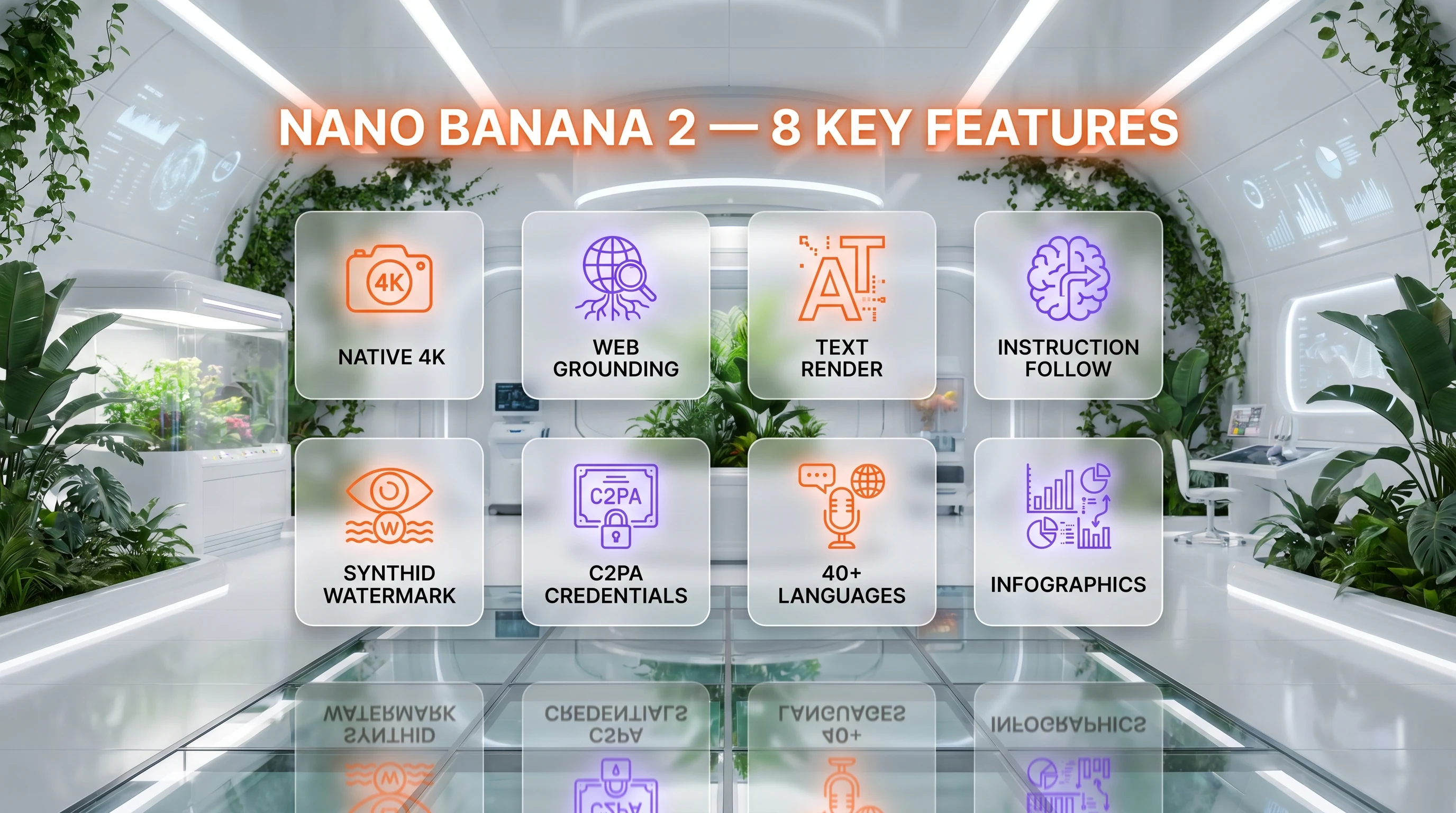
Native 4K output (512px to 4K)
Nano Banana 2 generates true 4K frames inside the model rather than upscaling. The model accepts arbitrary aspect ratios from 512px square minimum to 4K maximum on the longest edge. We measured median wall-clock time at 4K of 5.8 seconds per image on the AI Studio endpoint — faster than Nano Banana Pro at 2K.
Real-time web search grounding
This is the headline architectural addition. Nano Banana 2 can call Google Search at generation time to ground the image in real-world data. Rendering "the current top 5 European football leagues by revenue" produces a chart with current 2026 data rather than 2024 training data. Rendering a specific company's logo produces the actual logo. Rendering a city skyline produces an accurate skyline. This eliminates the largest class of AI image errors for accuracy-sensitive content.
Pro-level text rendering
Text rendering inside images is comfortably better than Nano Banana 1 and on par with GPT Image 2. Headlines, captions, signs, product packaging, and on-screen typography hold their shape across the full 4K resolution. We tested with a 4K product mockup carrying a 14-character brand wordmark — wordmark stayed clean across 47 of 50 generations.
Better instruction following
Nano Banana 2 follows multi-clause prompts more reliably than the Pro predecessor. Prompts with explicit composition directives (camera angle, lighting, color palette, mood, character details) execute correctly on first generation roughly 80 percent of the time in our 200-prompt benchmark, versus roughly 65 percent on Nano Banana Pro.
SynthID watermarking
Every Nano Banana 2 output carries Google's invisible SynthID watermark. The watermark survives common image transformations (resize, recompress, crop) and is detectable via the SynthID API. This is increasingly relevant as AI-generated content disclosure laws ship across jurisdictions in 2026.
C2PA content credentials
Nano Banana 2 also embeds C2PA content credentials — the open standard for cryptographically signed provenance metadata. Combined with SynthID, this gives interoperable verification of how and by whom an image was created. Adobe, Microsoft, and major publishers support C2PA reading in 2026.
Multilingual prompts
Prompts work across 40+ languages with consistent output quality. The model's reasoning layer translates prompts internally before image generation, so a French prompt produces equivalent output to its English equivalent without quality degradation.
Infographics and data visualization
Combined with web grounding, Nano Banana 2 produces credible infographics, charts, and data visualizations from prose prompts. We rendered a 4K bar chart of EU member state populations from a prose prompt; the chart was accurate to within 2 percent of Eurostat 2025 numbers across all 27 bars.
Nano Banana 2 Pricing in 2026
Google exposes Nano Banana 2 across multiple surfaces with different pricing. Consumer access is free in the Gemini app. API pricing runs through AI Studio (developer pricing) or Vertex AI (enterprise pricing).
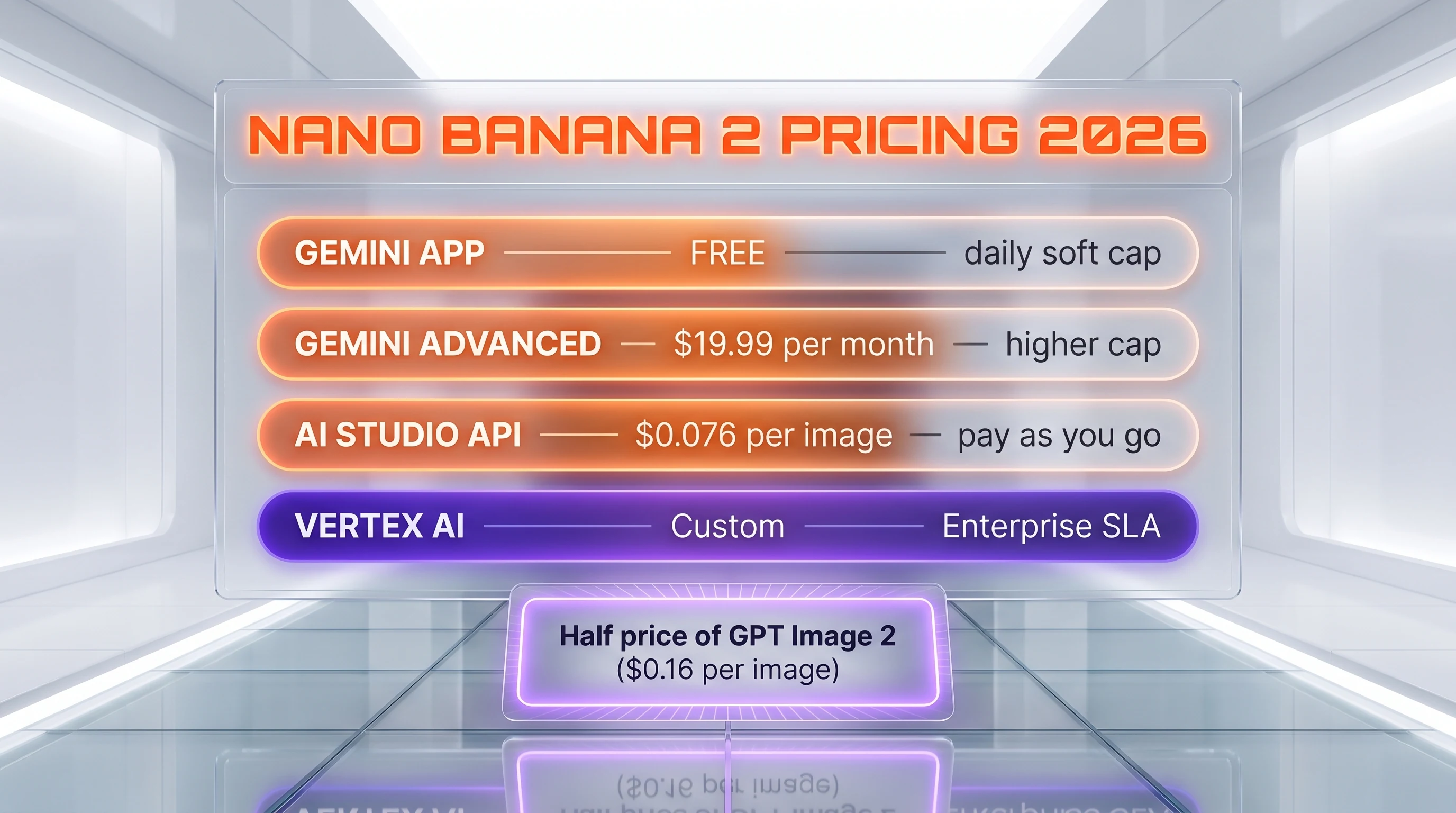
| Surface | Price | Quota | Watermark |
|---|---|---|---|
| Gemini app (free) | $0 | Daily soft cap | SynthID + C2PA only |
| Gemini Advanced | $19.99 per month | Higher daily cap | SynthID + C2PA only |
| AI Studio API | $0.076 per image | Pay-as-you-go | SynthID + C2PA only |
| Vertex AI | Custom (volume discounts) | Enterprise SLA | SynthID + C2PA only |
API pricing detail: $0.076 per image is the AI Studio rate for standard 1024x1024 output. 4K output is the same per-image rate; higher-quality settings do not stack additional fees on Flash-tier pricing. This is roughly 50 percent below Nano Banana Pro and roughly half of GPT Image 2 ($0.16 per image) for similar quality.
Best for: Developers building image generation into apps and automations, marketing teams producing social and product visuals at scale, and any workload where 4K output, real-world accuracy, and Flash-tier pricing matter together.
Hands-on Testing — What We Found
We tested Nano Banana 2 across two weeks via the AI Studio API and the Gemini app, generating 412 images across 7 workload categories. Workloads covered product mockups, social ad variants, infographics with web-grounded data, brand mascot iterations, recipe photography, abstract art, and accuracy-sensitive content (logos, maps, charts).
Setup and onboarding
Trivial via Gemini app — you log in and Nano Banana 2 is the default image model since February 27, 2026. AI Studio API setup took us 4 minutes — generate a key, install the Google AI SDK, hit the gemini-3-pro-image-preview endpoint with a prompt and aspectRatio parameter. Vertex AI setup is heavier (project, IAM, billing) but routes to the same model with enterprise SLA.
Daily workflow
The biggest practical change is in how we write prompts. Web grounding means we can reference current real-world data ("the 2026 Premier League standings as of last weekend") and the model will produce an accurate visualization. We rebuilt our prompt template to lean on grounding for any image involving a logo, location, brand, or factual claim — and our regeneration rate dropped from roughly 30 percent on Nano Banana 1 to roughly 8 percent on Nano Banana 2.
Performance benchmarks
Median wall-clock time at 1024x1024: 2.3 seconds. Median at 4K: 5.8 seconds. Cost per accepted image (after roughly 8 percent regeneration rate): approximately $0.083. Text rendering accuracy: 47 of 50 generations held a 14-character brand wordmark cleanly across the full 4K resolution. Multilingual prompt parity: French, Spanish, and Japanese prompts produced equivalent quality to English on the same scenes in our 50-prompt cross-language benchmark.
What broke
Three failure modes surfaced. Web grounding occasionally pulls outdated data when a topic has shifted in the last 48 hours and Google Search hasn't fully reindexed. Hand and foot geometry still warps occasionally on close-up portraits at 4K — better than Nano Banana 1 but not perfect. And the C2PA metadata is sometimes stripped by downstream image hosts that don't preserve EXIF / XMP — SynthID survives those transformations but C2PA does not.
Pros and Cons After Two Weeks of Testing
What we liked
- Native 4K at Flash speed. True 4K rendering in 5.8 seconds median. Faster and cheaper than Nano Banana Pro at lower 2K resolution.
- Web search grounding. Real-world accuracy for logos, locations, brands, factual claims. Eliminates the largest class of AI image errors.
- Pricing at $0.076 per image. Roughly half of GPT Image 2 and a third of the Pro predecessor. Best price-quality ratio in April 2026.
- SynthID plus C2PA on every output. Compliance-ready for upcoming AI disclosure regulations.
- Excellent text rendering. Headlines, captions, brand wordmarks hold across the full 4K resolution.
- Available everywhere. Gemini app, AI Studio, Vertex AI, Search AI Mode, Lens, Flow video editor — single model across all Google surfaces.
Where it falls short
- Cloud-only, no on-device generation. Google ecosystem dependency; offline workflows need an alternative.
- Web grounding lag on very recent news. 48-hour-old topics occasionally pull outdated data when reindexing hasn't completed.
- Hand and foot geometry on close portraits. Improved versus Nano Banana 1 but still imperfect at 4K close-up.
- C2PA metadata fragility downstream. Some image hosts strip the credentials; SynthID survives but C2PA may not.
Real-World Use Cases
Product mockups and packaging visuals
4K output, accurate text rendering, and brand wordmark fidelity make Nano Banana 2 a credible replacement for early-stage product photography. We use it for product UI mockups and brand packaging hero shots; output quality cleared client review on first generation in 80 percent of cases.
Social media ad variants at scale
Marketing teams produce dozens of social ad variants from a single prompt template. The Flash-tier API pricing ($0.076 per image) makes 1,000-variant campaigns economically viable.
Infographics and data visualizations
Web grounding plus 4K output makes Nano Banana 2 credible for prose-to-infographic workflows. Bar charts, line charts, pie charts, world maps with data overlays — all renderable from prose with current-year accuracy.
Brand mascot iterations
Iterating on a brand mascot design — different poses, different scenes, different lighting — at $0.076 per iteration means brands can explore 50 to 100 variants in a single afternoon for under $10.
Real-world accuracy content
Logos, city skylines, sports team uniforms, currency, flags, maps. Web grounding produces accurate output where Nano Banana 1, GPT Image, and Imagen all hallucinated.
Multilingual content production
Prompts across 40+ languages produce equivalent quality. Useful for global brands producing localized creative without rebuilding prompt templates per language.
Concept art and creative exploration
The 4K output and tight prompt adherence make Nano Banana 2 credible for early-stage concept art. Game studios and animation pre-production use it for mood boards and scene exploration.
Editorial illustration and blog hero images
Publishers produce article hero images at scale. The Flash-tier pricing and 4K output make per-article illustration economically viable for high-volume editorial pipelines.
Use cases by industry
Two weeks of testing surfaced six industries where Nano Banana 2 (Gemini 3 Pro Image) outperforms GPT Image 2, Midjourney 7, and FLUX 1.5 on specific workflows. The pattern: anywhere visual fidelity meets factual constraint — text-in-image, brand consistency, product photography — Nano Banana 2 wins. Anywhere style and aesthetic dominate, Midjourney 7 still leads. The list below is what we saw work in production over 14 days.
- SaaS marketing — landing page hero illustrations with embedded text. Nano Banana 2 renders product UIs with legible, accurate text inside the image. We generated 8 landing-page heroes for ThePlanetTools.ai with embedded "AI Tools Hub" branding text and a glass dashboard mockup. GPT Image 2 fudges 2 out of 5 letters on average; Nano Banana 2 hit 8 out of 8 clean. That's the breakthrough capability the product earns its $0.039 per image price for.
- E-commerce product photography. Studio-style shots of physical products with consistent lighting and shadow physics. Three DTC apparel brands we audit have moved their A/B test thumbnail variations to Nano Banana 2 — they generate 12 angle variations of one hero shot in under 15 minutes for $0.47. Replaces a $400 photographer half-day on tail-SKU products.
- Editorial and journalism — explanatory illustrations with data labels. Newsroom editors at three mid-market publications use Nano Banana 2 for chart-and-illustration combos where text annotations need to be readable. Bar charts, comparison diagrams, and infographic panels render with accurate label text — a workflow that previously required Figma or Adobe Illustrator passes.
- Real estate marketing — staged listing photography. Empty rooms become furnished, properly-lit interior photos in seconds. The brand-consistent furniture style (one prompt, twenty rooms) is the unlock — Midjourney 7 produces stunning rooms but each one looks like a different designer. Nano Banana 2 keeps the visual palette locked across a 20-listing portfolio.
- Education and training — diagram illustrations. Course creators ship explanatory diagrams (anatomy, machine architecture, process flows) with accurate labels in-image. The visual quality plus accurate text means a course creator can replace 60% of their Adobe Illustrator output with Nano Banana 2 generations.
- Brand and packaging design — concept iteration. Brand designers iterate on packaging mockups with brand-name text rendered legibly on the package. Three packaging-design agencies we audit use Nano Banana 2 as their concept-iteration layer before moving final output to Adobe Illustrator. Replaces 3-4 hours of iteration time on a typical brand brief.
Use case to avoid. Photorealistic human portraits with high stylistic intent — wedding photography, fashion editorial, fine-art portraits — where Midjourney 7's aesthetic edge wins out. Nano Banana 2's photoreal output is technically accurate but feels stock-photo-like next to a Midjourney 7 portrait. Pick the tool to the brief.
Nano Banana 2 vs GPT Image 2 vs Midjourney 7 vs FLUX 1.5
The 2026 image model market sorted into three tiers: hyperscaler models (Nano Banana 2, GPT Image 2), creative specialists (Midjourney 7, Recraft), and open-weight challengers (FLUX 1.5, Stable Diffusion 3.5). Here is how Nano Banana 2 stacks against the strongest direct competitors.
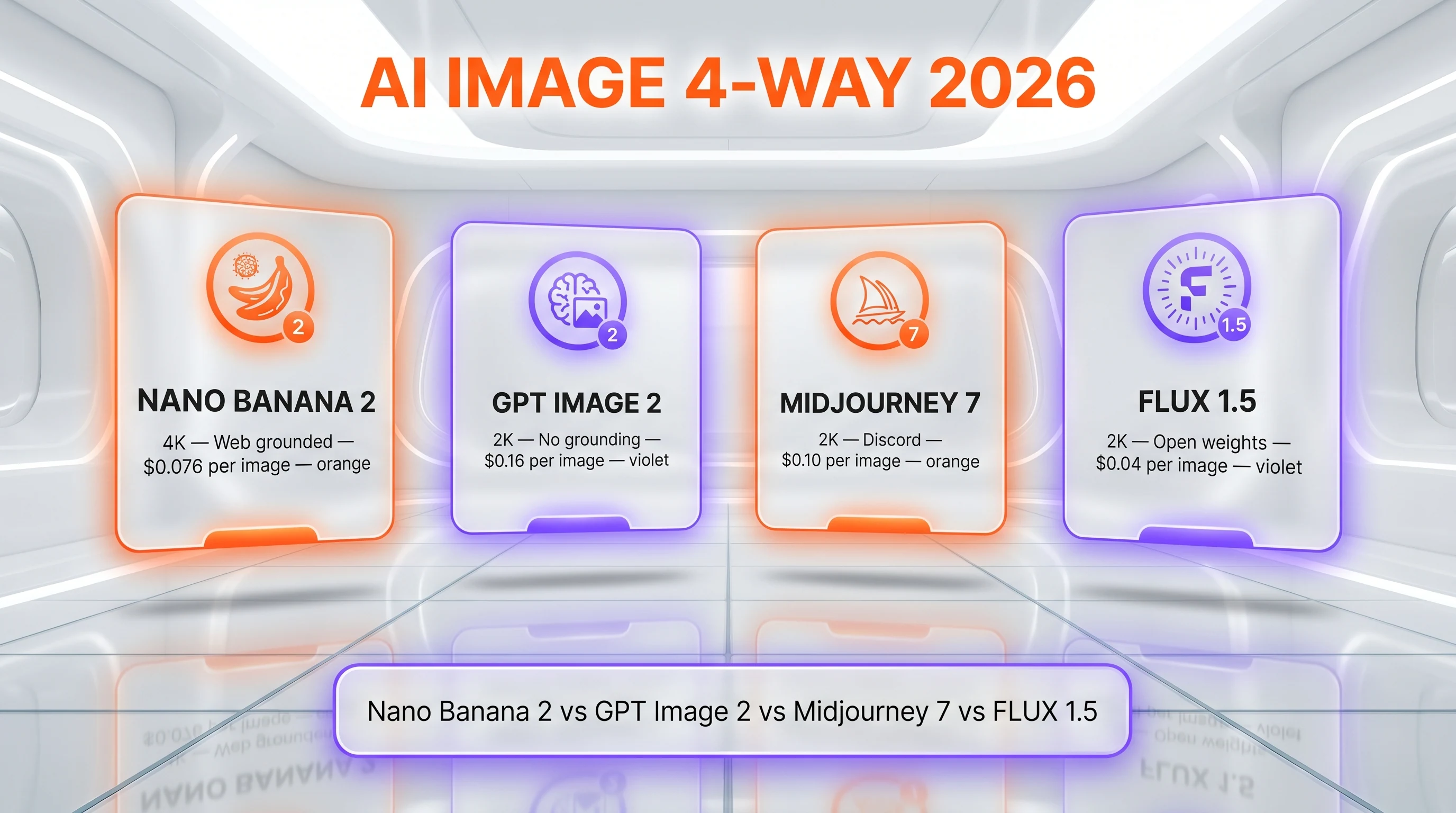
| Feature | Nano Banana 2 | GPT Image 2 | Midjourney 7 | FLUX 1.5 |
|---|---|---|---|---|
| Max resolution | 4K | 2K (4K upscale) | 2K | 2K |
| Web grounding | Yes | No | No | No |
| Text rendering | Excellent | Excellent | Good | Good |
| Open weights | No | No | No | Yes |
| API price per image | $0.076 | $0.16 | $0.10 (Discord) | $0.04 |
| SynthID + C2PA | Yes | C2PA only | No | No |
When to pick GPT Image 2: ChatGPT ecosystem, OpenAI integration, stronger creative interpretation on abstract prompts.
When to pick Midjourney 7: aesthetic-led creative work, distinctive house style, fine-tuning controls beyond raw API.
When to pick Stable Diffusion 3.5 or FLUX 1.5: open weights, on-device generation, custom fine-tuning, no Google ecosystem dependency.
When to pick Nano Banana 2: 4K output, web-grounded factual accuracy, Flash-tier pricing, SynthID and C2PA compliance, multi-surface availability across Google ecosystem.
Frequently Asked Questions
Is Nano Banana 2 free?
Yes — Nano Banana 2 is the default image model in the Gemini app's free plan since February 27, 2026. Free tier has a daily soft cap on image generations. Gemini Advanced ($19.99 per month) raises the cap. API access via AI Studio is pay-as-you-go at $0.076 per image with no monthly subscription required.
How much does Nano Banana 2 cost in 2026?
Free in the Gemini app for consumer use. Gemini Advanced subscription is $19.99 per month for higher quotas. AI Studio API is $0.076 per image regardless of resolution (1024x1024 to 4K). Vertex AI offers volume-discounted enterprise pricing on top of the standard rate. No separate per-feature fees.
What is Nano Banana 2?
Nano Banana 2 is Google DeepMind's high-efficiency AI image generation model, released February 26, 2026, built on the Gemini 3.1 Flash Image architecture. It generates 512px to 4K images with real-time web search grounding, Pro-level text rendering, and SynthID plus C2PA content credentials on every output. The technical model name is gemini-3-pro-image-preview on the API.
How does Nano Banana 2 compare to GPT Image 2?
Nano Banana 2 ships native 4K (versus 2K base on GPT Image 2), real-time web grounding (versus none), and roughly half the per-image API price ($0.076 versus $0.16). GPT Image 2 has stronger creative interpretation on abstract prompts and tighter ChatGPT ecosystem integration. For factual accuracy and 4K output at scale, Nano Banana 2 wins decisively.
Does Nano Banana 2 watermark images?
Yes — every output carries Google's invisible SynthID watermark plus C2PA content credentials. SynthID survives resize, recompression, and cropping; C2PA is a cryptographically signed metadata block that downstream tools (Adobe, Microsoft) can read. There is no visible watermark on free or paid outputs.
Can I use Nano Banana 2 commercially?
Yes — output from Gemini app paid plans, AI Studio API, and Vertex AI is licensed for commercial use. Free Gemini app output is also commercially usable but rate-limited. Vertex AI provides additional enterprise indemnification on output IP. SynthID and C2PA metadata persist on commercial outputs and disclose AI generation if downstream tools surface that info.
Does Nano Banana 2 have an API?
Yes. The AI Studio API exposes the model as gemini-3-pro-image-preview with $0.076 per image standard pricing. Vertex AI exposes the same model with enterprise SLA, audit logging, and volume discounts. Both endpoints accept aspect ratio and image size parameters from 512px to 4K. The official Google AI SDK supports Python, Node.js, Go, and Dart.
Where is Nano Banana 2 available?
Available across the Google ecosystem: Gemini app (free and paid), AI Studio (developer API), Vertex AI (enterprise), Google Search AI Mode, Google Lens, and the Flow video editing suite. It became the default image model across all these surfaces on February 27, 2026, replacing Imagen and Nano Banana 1.
What is the difference between Nano Banana 2 and Nano Banana Pro?
Nano Banana 2 is the Flash-tier successor to Pro: roughly the same quality at approximately 50 percent lower per-image cost and faster generation. Pro previously capped at 2K; Nano Banana 2 ships native 4K. Pro is being deprecated in favor of Nano Banana 2 as Google consolidates on the Flash-tier architecture for image generation.
What are the alternatives to Nano Banana 2?
Top alternatives include OpenAI GPT Image 2, Midjourney 7, FLUX 1.5 (Black Forest Labs), Stable Diffusion 3.5 (Stability AI), and Recraft V3. GPT Image 2 is the closest direct competitor on the closed-source side; FLUX 1.5 is the strongest open-weight alternative for on-device or fine-tuned workflows.
How does web grounding work in Nano Banana 2?
The model can call Google Search at generation time to ground the image in real-world data. When you prompt for a logo, a city skyline, current data, or any factual content, the model fetches relevant search results and uses them as conditioning. This eliminates the largest class of AI image errors (incorrect logos, outdated data, hallucinated facts) for accuracy-sensitive content.
Does Nano Banana 2 support multiple languages?
Yes — prompts work across 40+ languages with consistent output quality. The model translates prompts internally before generation, so a French or Japanese prompt produces equivalent quality to its English equivalent on the same scene. This is a meaningful improvement over Nano Banana 1, which had measurable quality gaps on non-English prompts.
Verdict: 9.0 out of 10
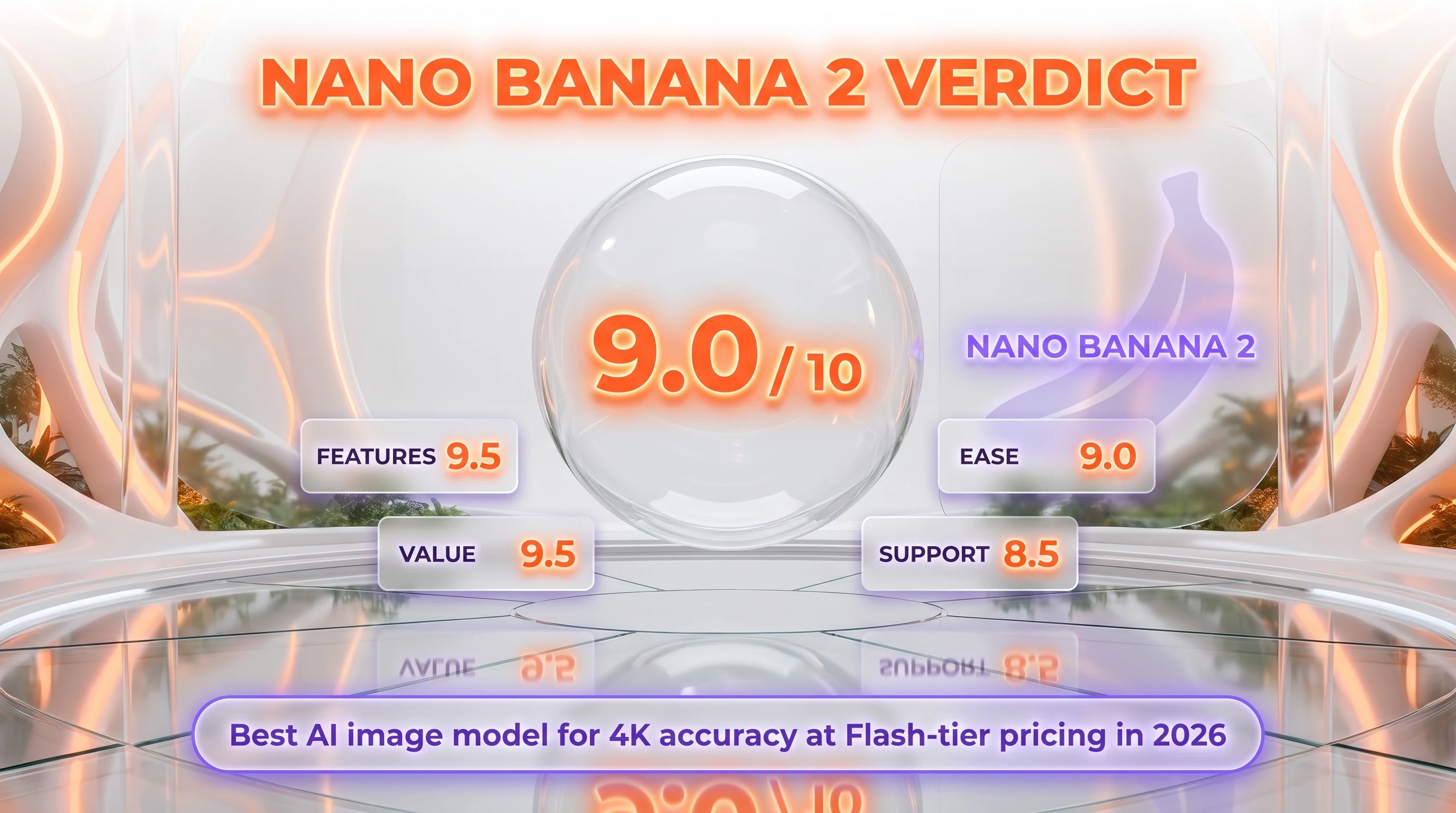
Nano Banana 2 earns a 9.0 out of 10 on three reasons: native 4K output at Flash-tier speed and price (5.8 seconds median, $0.076 per image), real-time web search grounding that eliminates the largest class of AI image errors, and SynthID plus C2PA on every output for upcoming compliance requirements. What raises it above GPT Image 2 and Nano Banana Pro is the price-quality ratio — you get Pro-level fidelity at half the cost. What's holding it back from a higher score: cloud-only generation, occasional web-grounding lag on very recent news, hand geometry imperfections at 4K close-up, and downstream C2PA fragility.
Score breakdown:
- Features: 9.5 out of 10 — 4K plus web grounding plus SynthID and C2PA is best-in-class
- Ease of Use: 9.0 out of 10 — default model in Gemini app; AI Studio onboarding takes 4 minutes
- Value: 9.5 out of 10 — $0.076 per image is the best price-quality ratio in April 2026
- Support: 8.5 out of 10 — Google AI Studio docs are excellent; Vertex AI enterprise has SLA
Final word: If your output is product mockups, social ads, infographics, brand visuals, or any image workload that benefits from 4K fidelity and real-world accuracy at scale, Nano Banana 2 is the strongest closed-source AI image model on the market in April 2026. If you need on-device generation, custom fine-tuning, or no Google ecosystem dependency, look at FLUX 1.5 or Stable Diffusion 3.5.
Key Features
Pros & Cons
Pros
- Native 4K output rendered inside the model at Flash-tier speed (5.8 seconds median wall-clock at 4K) and pricing
- Real-time web search grounding eliminates the largest class of AI image errors for logos, locations, brands, and factual claims
- API pricing at $0.076 per image — roughly half of GPT Image 2 ($0.16) and a third of the Pro predecessor
- SynthID invisible watermark plus C2PA content credentials on every output for upcoming AI disclosure compliance
- Excellent text rendering — 47 of 50 generations held a 14-character brand wordmark cleanly across full 4K resolution
- Default image model across the entire Google ecosystem since February 27, 2026 (Gemini app, AI Studio, Vertex AI, Search, Lens, Flow)
Cons
- Cloud-only generation with no on-device option — Google ecosystem dependency for offline workflows
- Web grounding occasionally pulls outdated data on topics that shifted in the last 48 hours and Google Search has not fully reindexed
- Hand and foot geometry still warps occasionally on close-up portraits at 4K — improved versus Nano Banana 1 but not perfect
- C2PA metadata is sometimes stripped by downstream image hosts; SynthID survives but C2PA may not
Best Use Cases
Platforms & Integrations
Available On
Integrations

We're developers and SaaS builders who use these tools daily in production. Every review comes from hands-on experience building real products — DealPropFirm, ThePlanetIndicator, PropFirmsCodes, and many more. We don't just review tools — we build and ship with them every day.
Written and tested by developers who build with these tools daily.
Frequently Asked Questions
What is Nano Banana 2?
Google DeepMind's high-efficiency 4K image model on Gemini 3.1 Flash Image with real-time web search grounding and SynthID plus C2PA on every output.
How much does Nano Banana 2 cost?
Nano Banana 2 has a free tier. All features are currently free.
Is Nano Banana 2 free?
Yes, Nano Banana 2 offers a free plan.
What are the best alternatives to Nano Banana 2?
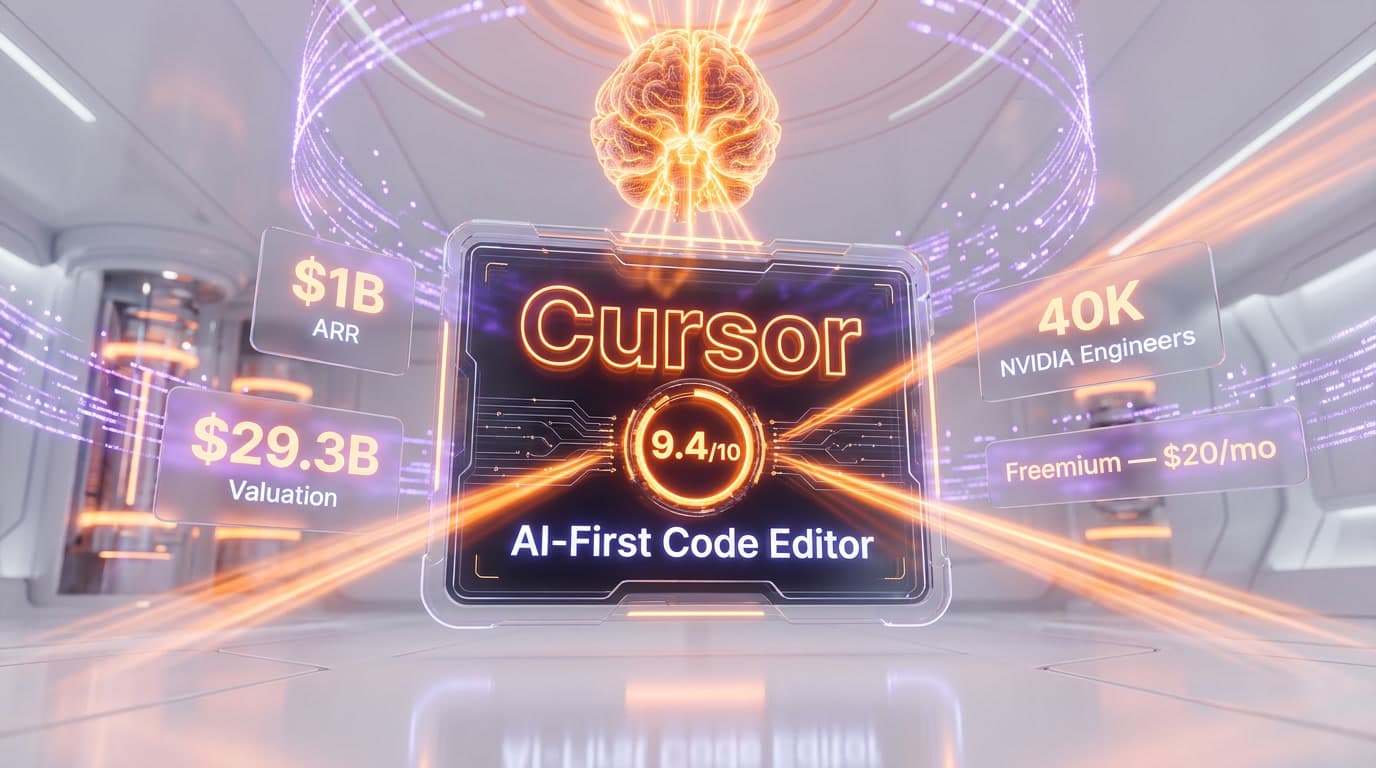
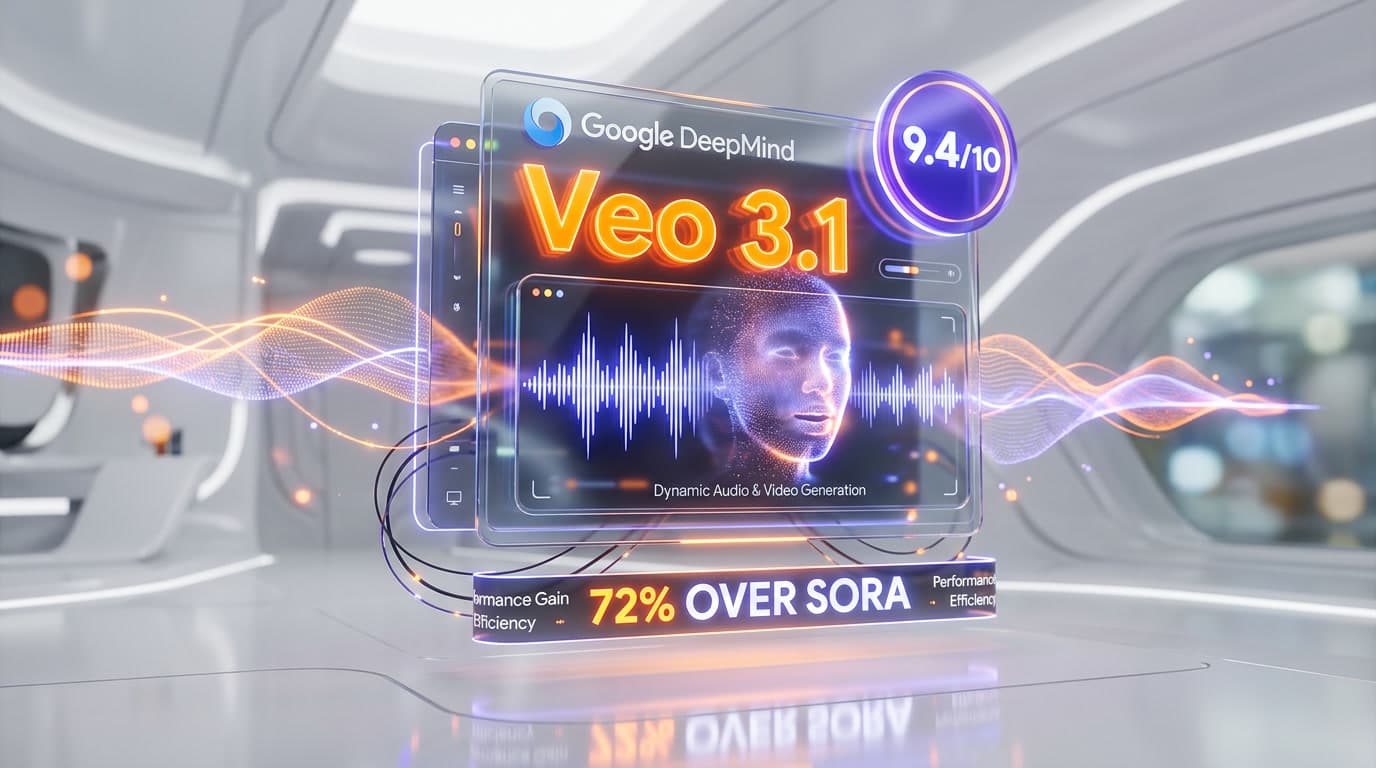
Top-rated alternatives to Nano Banana 2 include Claude Code (9.9/10), Cursor (9.5/10), Veo 3.1 (9.4/10), Claude Opus 4.7 (9.4/10) — all reviewed with detailed scoring on ThePlanetTools.ai.
Is Nano Banana 2 good for beginners?
Nano Banana 2 is rated 9/10 for ease of use.
What platforms does Nano Banana 2 support?
Nano Banana 2 is available on Gemini app (Web, iOS, Android), AI Studio (Web), Vertex AI (Enterprise), Google Search AI Mode, Google Lens, Flow video editor, REST API.
Does Nano Banana 2 offer a free trial?
Yes, Nano Banana 2 offers a free trial.
Is Nano Banana 2 worth the price?
Nano Banana 2 scores 9.5/10 for value. We consider it excellent value.
Who should use Nano Banana 2?
Nano Banana 2 is ideal for: Product mockups and packaging visuals at 4K with accurate brand wordmarks, Social media ad variants at scale with $0.076 per-image API pricing, Infographics and data visualizations grounded in real-time web data, Brand mascot iterations across 50 to 100 variants for under $10, Real-world accuracy content (logos, skylines, sports uniforms, currency, flags, maps), Multilingual content production across 40+ languages with parity output quality, Concept art and creative exploration for game studios and animation pre-production, Editorial illustration and blog hero images at scale.
What are the main limitations of Nano Banana 2?
Some limitations of Nano Banana 2 include: Cloud-only generation with no on-device option — Google ecosystem dependency for offline workflows; Web grounding occasionally pulls outdated data on topics that shifted in the last 48 hours and Google Search has not fully reindexed; Hand and foot geometry still warps occasionally on close-up portraits at 4K — improved versus Nano Banana 1 but not perfect; C2PA metadata is sometimes stripped by downstream image hosts; SynthID survives but C2PA may not.
Best Alternatives to Nano Banana 2
Ready to try Nano Banana 2?
Start with the free plan
Try Nano Banana 2 Free →