Qwen3.8-Max
Alibaba's 2.4-trillion-parameter flagship reached general availability on August 3, 2026 — 95 billion activated per token, a 1M token context window, and $2 per 1M input tokens.

Quick Summary
Qwen3.8-Max is Alibaba's flagship sparse Mixture-of-Experts model: 2.4 trillion total parameters, 95 billion activated per token, a 1M token context window, and text, image, and video input. QwenCloud list pricing is $2 per 1M input tokens and $6 per 1M output tokens. Score 8.4 out of 10.
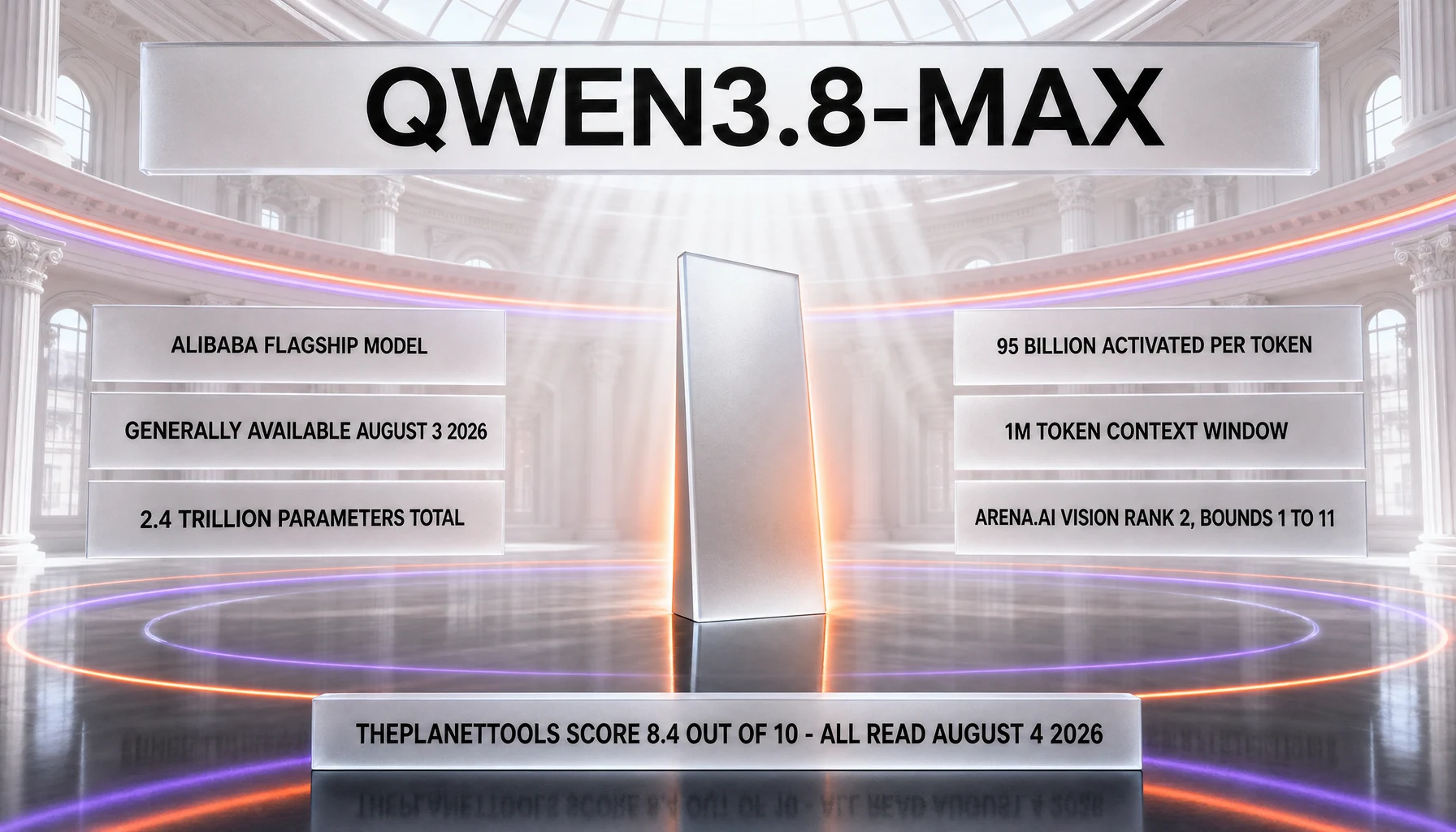
Qwen3.8-Max is Alibaba's flagship large language model, previewed in July 2026 and generally available on August 3, 2026. It uses a sparse Mixture-of-Experts architecture with 2.4 trillion total parameters and 95 billion activated per token, carries a 1M token context window, and accepts text, image, and video as input while producing text. List pricing on the QwenCloud pricing page is $2 per 1M input tokens and $6 per 1M output tokens. Our score: 8.4 out of 10.
TL;DR — Our Verdict
Score: 8.4 out of 10. Qwen3.8-Max is the most capable model Alibaba has shipped, and the first Qwen flagship whose headline price sits materially below the Western frontier while claiming a seat at the same table. It is built for long-horizon agentic work and native multimodal input, and its $2 per 1M input tokens list price makes high-volume document and video pipelines viable in a way that $5 and $10 class models do not. What holds it back is not capability but disclosure: at general availability Alibaba published no model card, the open weights it promised have not shipped, and no independent evaluator has charted it yet.
- ✅ 2.4 trillion total parameters with only 95 billion activated per token, at $2 per 1M input tokens
- ✅ Full 1M token context at a flat rate, with no long-context surcharge tier
- ✅ Native text, image, and video input, with a genuinely strong day-one Vision Arena placement
- ❌ Proprietary at launch — weights were promised for "next week" and are not out as of August 4, 2026
- ❌ No model card, and no Artificial Analysis coverage at all, so almost everything measurable comes from one blind-vote board or from Alibaba itself
What Is Qwen3.8-Max?
Qwen3.8-Max is the top-end model in Alibaba's Qwen family, served through QwenCloud under the API model id qwen3.8-max. Alibaba describes it as built upon the robust foundation of Qwen 3.5, and it uses a sparse Mixture-of-Experts design paired with hybrid attention. The two numbers that matter most sit in tension with each other: 2.4 trillion parameters in total, but only 95 billion activated for any given token. That is the whole economic argument for the model. You get the representational capacity of a very large network while paying inference costs closer to a mid-size dense one.
The name deserves a moment of care, because Alibaba has been inconsistent in the wild and the market has followed. The official designation is Qwen3.8-Max — one word for "Qwen3.8", a hyphen before "Max". The July designation was Qwen3.8-Max-Preview, and that suffix is now superseded. If you see the preview name in a benchmark table or a vendor comparison sheet dated after August 3, it is describing a build that is no longer the shipping model.
Positioning-wise, this is Alibaba's answer to a specific problem. The previous generation we reviewed, Qwen 3.6, split itself across a proprietary tier and an Apache 2.0 open-weight tier, and its reasoning topline trailed the Western frontier. Qwen3.8-Max does not hedge. It is a single flagship aimed squarely at long-horizon agentic tasks and multimodal understanding, and Alibaba is pricing it to win volume rather than prestige. Alibaba also lists it as available inside QwenWork, its workplace AI agent platform, which tells you where the company expects the revenue to come from: embedded enterprise agents, not chat subscriptions.
Key Features
Sparse Mixture-of-Experts at 2.4 trillion parameters
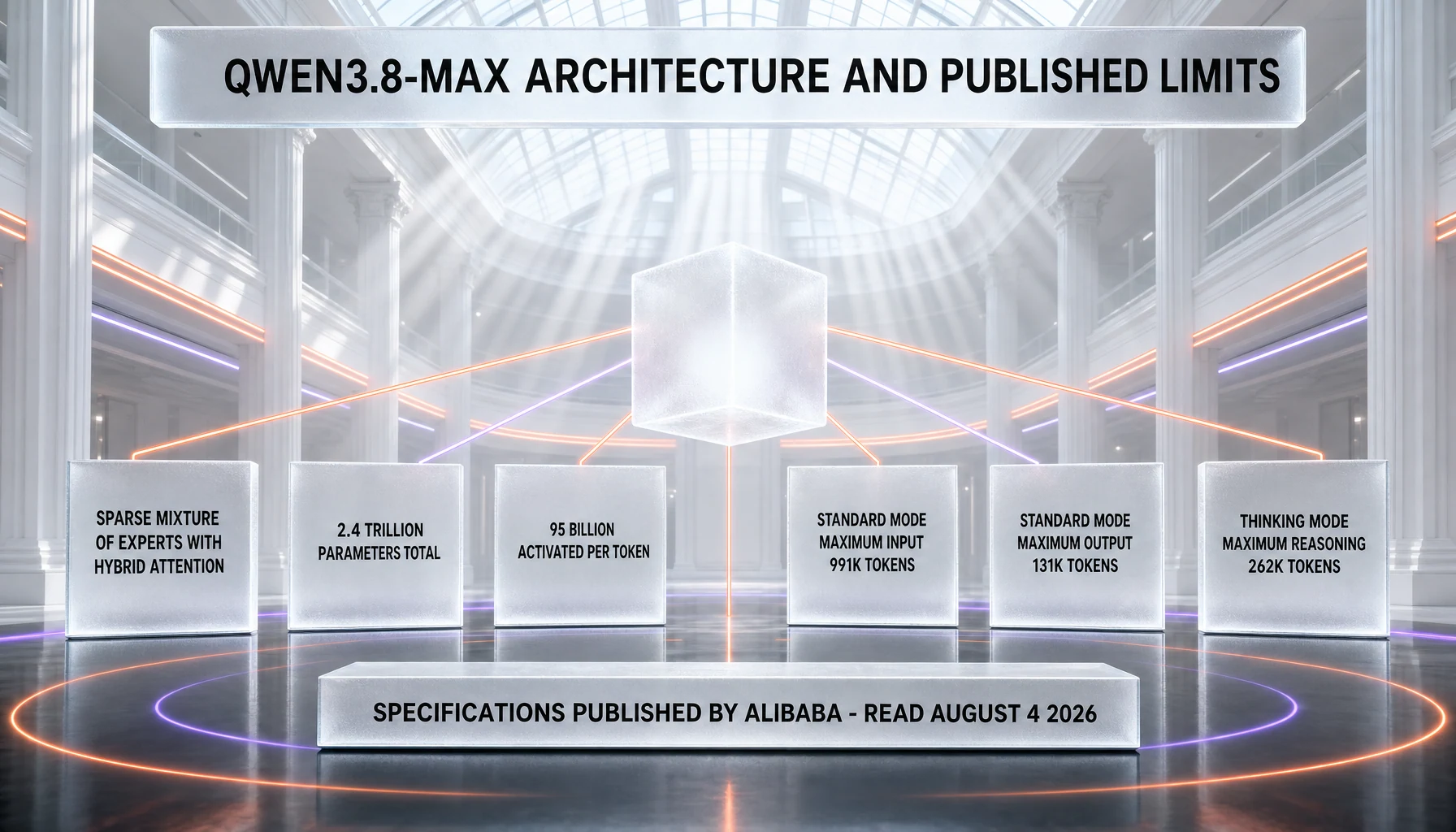
The architecture is a sparse Mixture-of-Experts with hybrid attention. Alibaba disclosed the activated-parameter count only at general availability: 95 billion parameters fire per token against a 2.4 trillion parameter total. That is an activation ratio of roughly four percent. For buyers, the practical read is that the model's cost profile is set by the 95 billion, while its knowledge and specialization ceiling is set by the 2.4 trillion. This is the same structural bet the rest of the frontier has made, executed at an unusually large total size.
1M token context, with the real numbers behind the round one
The headline context window is 1M tokens, and unlike most vendors Alibaba publishes the actual operating limits rather than only the marketing figure. In standard mode, maximum input is 991K tokens and maximum output is 131K tokens. With thinking enabled, maximum input drops slightly to 983K tokens while maximum output stays at 131K, and maximum reasoning is capped at 262K tokens. That reasoning budget is the interesting one. A 262K token reasoning allowance is what makes multi-hour agent runs plausible rather than aspirational, because the model can hold a long deliberation without the operator having to checkpoint and re-prime it every few steps.
Native text, image, and video input
Input modalities are text, image, and video; output is text. Alibaba markets this as native visual understanding rather than a bolted-on vision adapter. Video input in particular is still uncommon at the flagship tier, and it changes what a single API call can absorb — a recorded screen session, a lecture, or a physical process can go in directly instead of being decomposed into sampled frames by your own preprocessing layer.
Five built-in tools in the Responses API
Through the Responses API, Qwen3.8-Max ships with five server-side tools already wired: code_interpreter, web_extractor, web_search, t2i_search, and i2i_search. The last two are text-to-image and image-to-image search, which pair naturally with the model's visual input. The value of built-in tools is not that you could not implement them yourself; it is that they remove five separate pieces of infrastructure, five sets of credentials, and five failure modes from your agent loop.
Prefix completion, function calling, and the rest of the API surface
The supported feature list is broad and reads like a platform that expects production traffic rather than experimentation: prefix completion (marketed as Partial Mode), function calling, context cache, structured outputs, batches, web search, and fine-tuning. Prefix completion is the quiet standout for anyone building code or document tooling, because it lets you constrain the model to continue a partial response rather than restate it. Structured outputs and function calling together cover the schema-enforcement needs of most agent frameworks, and the availability of fine-tuning on a flagship this large is not a given across the market.
Qwen3.8-Max Pricing in 2026
Qwen3.8-Max is a paid, usage-based API model. There is no free plan and no free trial. All figures below come from the QwenCloud pricing tab, which is the authoritative publisher list price. Our own AI Index carries the same $2 and $6 figures sourced independently from OpenRouter market rates, so publisher list price and observed market rate agree here.
| Rate | Price | What it covers |
|---|---|---|
| Input | $2 per 1M tokens | Standard prompt tokens, flat across the full context |
| Output | $6 per 1M tokens | Generated tokens, including reasoning output |
| Implicit cache read | $0.25 per 1M tokens | Automatic cache hits, no explicit management |
| Explicit cache creation | $2.50 per 1M tokens | One-time cost to write a managed cache entry |
| Explicit cache read | $0.17 per 1M tokens | Reads against a managed cache entry |
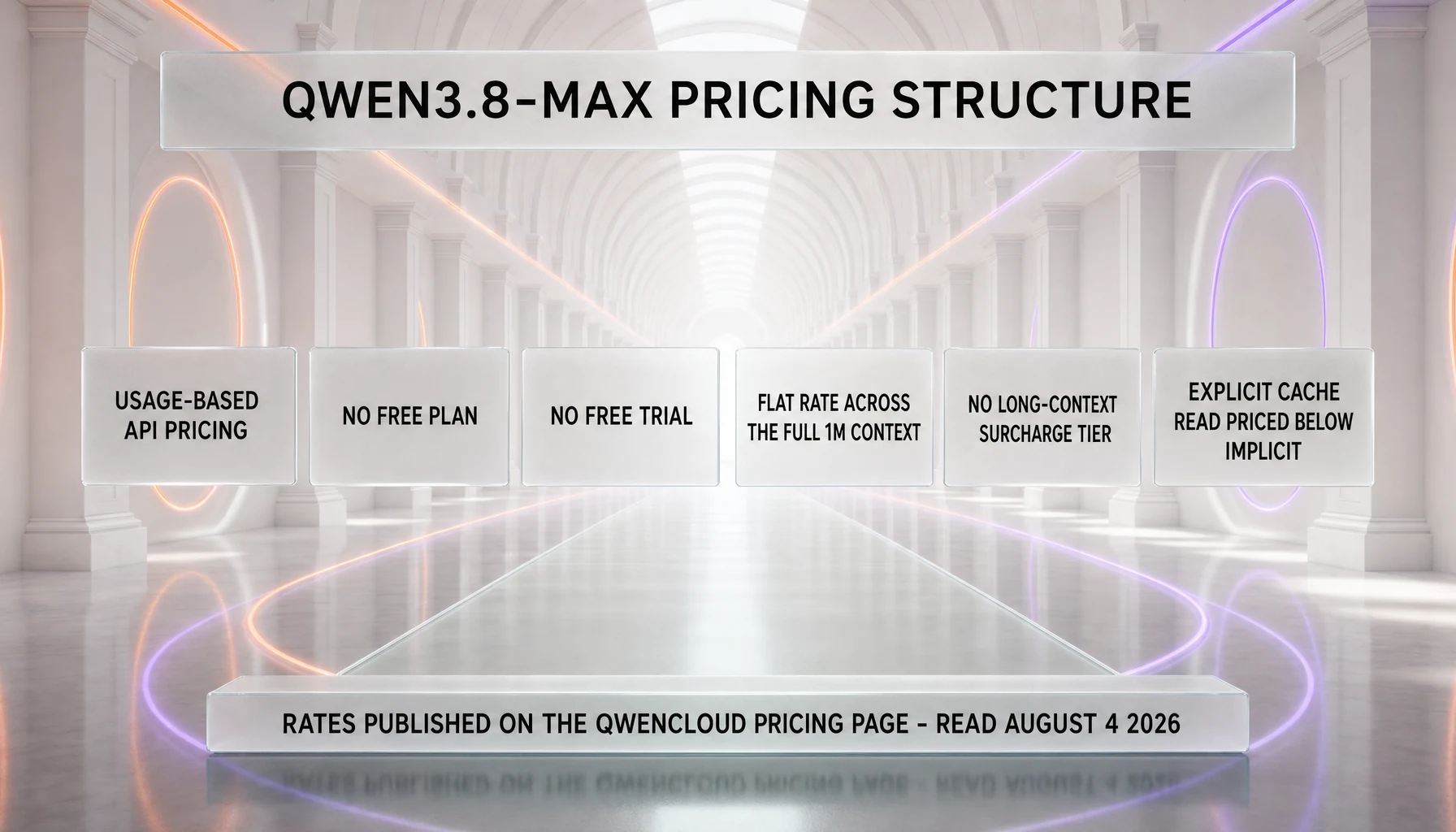
Two details in that table carry more weight than the headline rates. The first is that pricing is flat across the whole 1M context — there is no long-context surcharge tier. Here, a 900K token prompt costs exactly nine hundred thousandths of the million-token rate, and nothing changes at the boundary.
The second is the explicit cache read rate of $0.17 per 1M tokens, which is cheaper than the implicit cache read at $0.25 per 1M tokens. That inversion is deliberate and it rewards operators who do the work of managing their own cache entries. Explicit cache creation costs $2.50 per 1M tokens, slightly above the standard input rate, so the arithmetic is a straightforward break-even: writing a cache entry costs you an extra $0.50 per 1M tokens over just sending the input once, and each subsequent read saves you $1.83 per 1M tokens against list input price. If a given corpus will be read more than once, the explicit cache pays for itself on the second read and keeps paying after that.
Best for: teams running high-volume long-context or multimodal workloads where the input side dominates the bill, and who can commit engineering effort to cache management. Teams sending short, one-off prompts will see less of the advantage, because the flat-rate and cache benefits both scale with input size.
Our Methodology for This Review
We have not had hands-on production access to Qwen3.8-Max. This is a research-led review, and we want to be exact about what that means, because the model went generally available on August 3, 2026 and we are publishing one day later. Nobody outside Alibaba has meaningful production experience with this build yet, and any review claiming otherwise is describing either the July preview or something it did not run.
This review compiles the Alibaba Group announcement published on Alizila on August 3, 2026; the QwenCloud product page for qwen3.8-max, which is the source for every specification and every price quoted above; the public arena.ai leaderboards as of the August 1, 2026 vote cutoff; and our verification pass against Artificial Analysis on August 4, 2026. It also draws on our own July coverage of the preview announcement at WAIC Shanghai.
Our score weights feature completeness, pricing transparency, license terms, and the quality of available independent evidence. That last criterion is doing real work in this review. We have deliberately declined to publish any Intelligence Index, coding, or agentic score for this model, because no independent evaluator has produced one and we will not substitute a number from an adjacent source to fill the gap. Where the only available claim comes from Alibaba, we label it as Alibaba's claim in the sentence that carries it, rather than in a disclaimer at the bottom.
What Changed Since the July Preview
Qwen3.8-Max was previewed at WAIC Shanghai on July 19, 2026 as Qwen3.8-Max-Preview, and we covered that announcement at the time. It reached general availability as Qwen3.8-Max on August 3, 2026. Those are two distinct events roughly two weeks apart, and collapsing them into a single August 3 launch — as several early write-ups have done — erases the most informative part of the story, which is what Alibaba withheld in July and released now.
At the July preview, Alibaba published the 2.4 trillion total parameter count and essentially nothing else. There was no model card. There was no activated-parameter figure. There was no benchmark table. For a preview positioned as a frontier announcement, that was a conspicuously thin disclosure, and it made the model impossible to evaluate on anything but the headline number.
General availability filled in a meaningful part of that gap. The 95 billion activated-parameter count is new with GA, and it is the single most important specification Alibaba added, because it converts an abstract "2.4 trillion" into a usable cost and latency model. The full API surface — context limits, rate limits, built-in tools, caching tiers — arrived with it, along with list pricing. The vendor benchmark claims and the RecreationBench introduction also date from the GA announcement rather than the preview.
What did not change is the license. The model was proprietary in July and it is proprietary today. Alibaba stated on August 3 that weights are scheduled for release next week. As of August 4, 2026 there are no open weights and no HuggingFace repository for Qwen3.8-Max. We are recording that as a promise with a date attached, not as an open-weight release, and we would encourage anyone building a procurement case on the open-weight path to wait for the artifact rather than the announcement. A model card is still absent.
Independent Measurement: What Exists and What Does Not
Here is the complete state of independent evidence for Qwen3.8-Max as of August 4, 2026.
arena.ai — the only independent board carrying it
arena.ai, formerly lmarena.ai, is currently the sole independent evaluator with published results for this model. Its board reflects a vote cutoff of August 1, 2026, across 7,571,037 total votes and 386 models. The model appears there under the displayed name qwen3.8-max, organization Alibaba, license Proprietary.
On the text leaderboard, Qwen3.8-Max sits at rank 5 with an Arena score of 1495.8 on 3,327 votes. arena.ai publishes confidence bounds alongside that placement, and they are wide: the model's rank could be as high as 1 or as low as 17. We state the interval every time we state the rank, because at 3,327 votes the point estimate is not stable enough to defend on its own. A model that might be first and might be seventeenth has not yet been placed by this board; it has been provisionally located.
On the vision leaderboard the evidence is stronger. Qwen3.8-Max is at rank 2 with a score of 1304.68 on 5,038 votes, with bounds of 1 to 11. More votes, a tighter interval, and a higher placement all point the same direction, and it is consistent with Alibaba's emphasis on native visual understanding. The model ahead of it is Claude Fable 5 at 1317.7.
On the WebDev leaderboard, the model is registered but carries no rank. It is not ranked there, and we are not going to characterize that as a result in either direction.
One caveat governs all of the above and it is not a small one. The August 1 vote cutoff predates the August 3 general availability, and the entries ran under anonymous pre-release codenames. These are day-one co-release blind-test scores, not accumulated post-launch community voting. Blind pre-release testing is genuinely valuable — it removes brand bias from the votes — but it also means the sample is small, self-selected toward early arena users, and gathered before anyone knew what they were rating. Expect these numbers to move as real vote volume arrives.
Artificial Analysis — a verified absence
Qwen3.8-Max has no entry on Artificial Analysis. We verified this on August 4, 2026 rather than inferring it: the URL artificialanalysis.ai/models/qwen3-8-max returns a 404, the model does not appear in the models list across 85 enumerated Qwen slugs, and it is absent from the models leaderboard, where the highest-charting Qwen "Max" model remains Qwen3.7 Max. It is also not charted on the Artificial Analysis Coding Agent Index v1.3, which carries 52 harness-plus-model-plus-effort entries; the only Qwen entry on that index is "Claude Code - Qwen3.7 Plus (thinking)".
We want to be precise about what this absence means, because absences are routinely misread in both directions. It is not a defeat and it is not evidence of weak performance — a model published yesterday has not had time to be evaluated. It is equally not a neutral fact to be skipped over. For a buyer, the absence of the most widely cited independent index is a real gap in the evidence base, and it is the reason we scored support and trust at 7.5 rather than higher. We have not substituted any number in its place, and we would treat any Intelligence Index or coding score you encounter for Qwen3.8-Max this week as unattributable until Artificial Analysis publishes one.
Alibaba's own claims, labeled as such
Alibaba makes several performance claims that no third party has verified. They are worth reporting, with the attribution attached rather than implied.
Alibaba states that Qwen3.8-Max ranks fifth in Text Arena, second in Vision Arena, and fourth in Frontend Code Arena. The first two match what we independently found on arena.ai's public boards. The Frontend Code Arena placement we could not confirm on arena.ai's public boards, so we report it as an unverified vendor claim.
Alibaba also reports an internal test in which the model autonomously built "oh-my-cli", a self-evolving agent framework, over a 16-day period; the framework has since been open-sourced on GitHub. This is Alibaba's own internal result, not a reproducible benchmark. If you see a shorter duration quoted elsewhere, note that the QwenCloud product page describes the general capability as handling projects spanning 10 or more days, which is a capability statement rather than a description of this specific test.
Alibaba says the model outperformed human participants in the WWW2025 Multimodal Dialogue Intent Recognition Challenge. And alongside the GA announcement, Alibaba introduced RecreationBench, its own long-horizon application-recreation benchmark, run black-box with no internet access and no access to source code. The black-box design is methodologically sound; the fact that it is a vendor-introduced benchmark launched to showcase a vendor's own model is the standard caveat that applies to every such release, from every lab.
Finally, Alibaba describes a real-world workload span covering application design, legal document review, sports analytics, financial research, culinary concept development, rehabilitation progress visualization, and architectural 3D modeling. That list is a claim about breadth, and breadth claims are the hardest kind to falsify or confirm.
What Works
- The activation ratio is the story. 95 billion parameters activated against a 2.4 trillion total is roughly four percent, which is what lets Alibaba put a frontier-scale model at $2 per 1M input tokens instead of the $5 to $10 range its nominal size would imply.
- Flat pricing across the full context. No long-context surcharge tier means a 900K token prompt is priced linearly, and capacity planning does not involve watching for a threshold that doubles your bill.
- The vision result is the best-evidenced thing about this model. Rank 2 on arena.ai's vision board with 5,038 votes and a 1 to 11 interval is more votes and a tighter interval than its text placement, and it corroborates the native visual understanding claim.
- Five built-in tools remove real infrastructure. code_interpreter, web_extractor, web_search, t2i_search, and i2i_search ship server-side in the Responses API, which cuts credentials, plumbing, and failure modes out of the agent loop.
- The cache tiering rewards engineering effort. An explicit cache read at $0.17 per 1M tokens against a $2 per 1M tokens input rate pays back the $2.50 per 1M tokens creation cost on the second read.
Where It Falls Short
- Proprietary today, with weights promised but not shipped. Alibaba said on August 3 that weights are scheduled for release next week. As of August 4, 2026 there are no open weights and no HuggingFace repository. A dated promise is not a license, and procurement decisions should not treat it as one.
- No model card at general availability. The July preview shipped without one and GA did not fix it. For a flagship handling legal document review and multimodal enterprise workloads, the absence of documented training data provenance, evaluation methodology, and safety testing is a genuine gap.
- Almost no independent measurement exists. One blind-vote board, taken before launch, is the entire third-party evidence base. Artificial Analysis has no entry, and the Coding Agent Index does not chart it.
- The text placement is far less solid than it looks. Rank 5 sounds decisive; a confidence interval spanning rank 1 to rank 17 does not. Anyone quoting the rank without the interval is overstating what the board actually established.
- One vendor claim did not survive our check. We could not confirm the fourth-place Frontend Code Arena placement on arena.ai's public boards. That is one unconfirmed claim out of three, which is not damning, but it is a reason to treat the remaining unverified claims with the same skepticism.
Real-World Use Cases
Long-horizon autonomous agents
The combination of a 262K token maximum reasoning budget, five built-in server-side tools, function calling, and structured outputs is aimed at agents that run for hours rather than seconds. Alibaba's own strongest supporting evidence sits here: its internal 16-day test in which the model built the oh-my-cli agent framework autonomously. Treat that as a vendor result, but note that the API surface is genuinely built for the workload rather than retrofitted to it.
High-volume document and contract review
This is where the pricing structure does the most work. Feed a 900K token document corpus at $2 per 1M input tokens with no surcharge tier, cache it explicitly, and every subsequent pass reads at $0.17 per 1M tokens. Alibaba lists legal document review among the model's real-world workloads. The economics of re-reading a large corpus repeatedly are unusually favorable here compared to flagship models priced at two to five times the input rate.
Video understanding pipelines
Native video input at the flagship tier removes the frame-sampling preprocessing layer most teams currently maintain. Combined with the rank 2 vision placement — the model's best-evidenced independent result — this is the use case we would reach for first if we were running a trial.
Financial and analytical research
Alibaba lists financial research and sports analytics among target workloads. The relevant capabilities are the large context for absorbing filings and datasets, the built-in web_search and web_extractor tools for live retrieval, and code_interpreter for the arithmetic — a combination that covers the full retrieve-compute-summarize loop within one API.
Qwen3.8-Max vs the 2026 Frontier
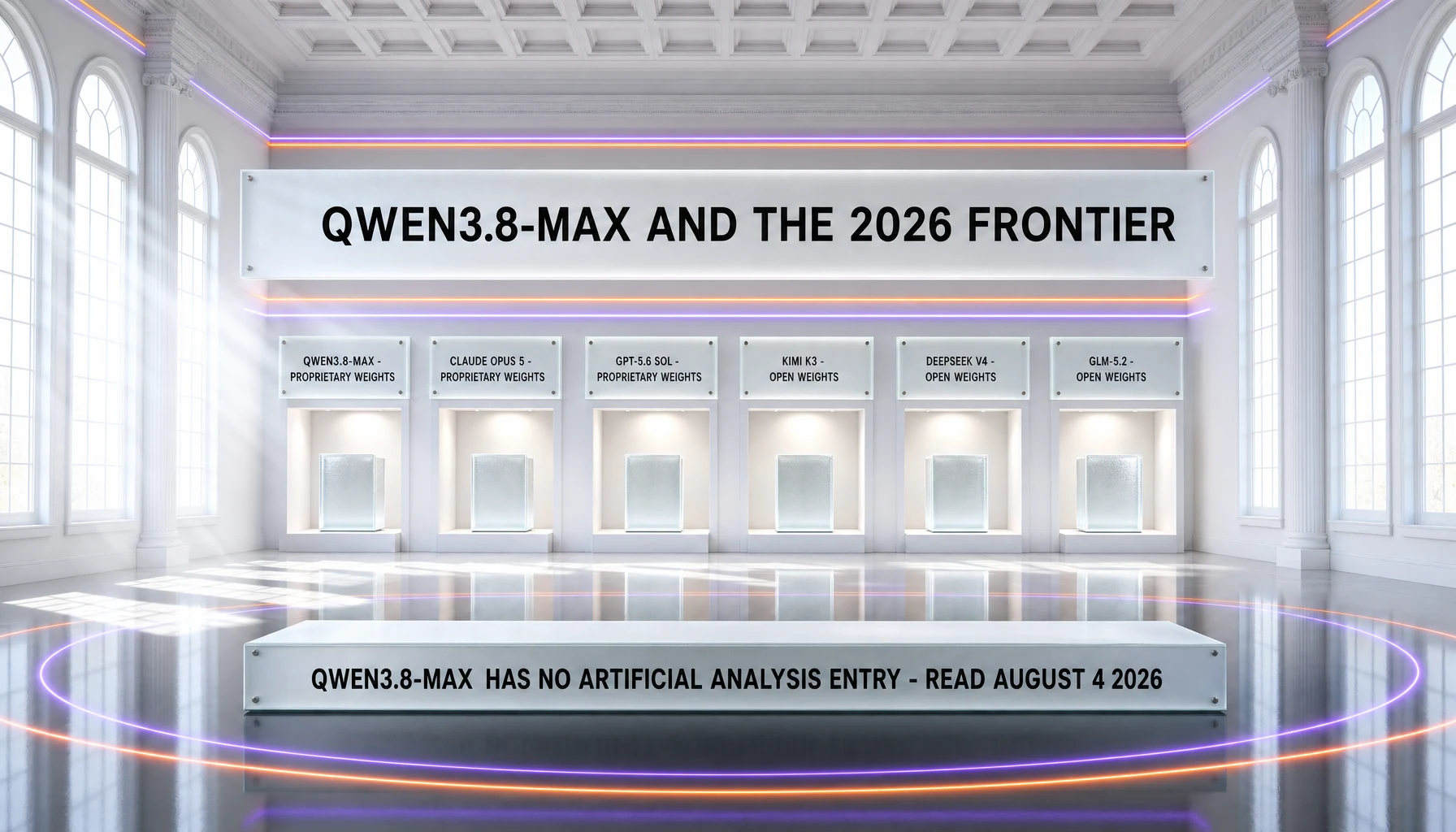
Claude Opus 5 and GPT-5.6 Sol are the direct Western frontier comparisons, and both are priced well above Qwen3.8-Max on input. If your workload is input-heavy — long documents, large codebases, video — the gap compounds quickly, and Qwen3.8-Max is the value argument. If your requirement is a documented, independently benchmarked model with a published model card, that argument does not apply yet.
Claude Fable 5 is the specific model sitting above Qwen3.8-Max on the arena.ai vision board at 1317.7 against 1304.68. That is the closest thing to a head-to-head result either model has on multimodal work, and it is close.
Kimi K3 and DeepSeek V4 are the sharpest comparisons within the Chinese frontier, and both undercut Qwen3.8-Max on price. DeepSeek V4 in particular sits at a fraction of the input rate. What Qwen3.8-Max offers against them is native video input and the 2.4 trillion parameter capacity ceiling. GLM-5.2 occupies similar territory. Anyone shortlisting Chinese frontier models should weigh open-weight availability heavily, and on that criterion Qwen3.8-Max is currently the weakest option in this group — a position that may reverse within a week if Alibaba ships the promised weights.
Our previous-generation review of Qwen 3.6 remains the useful baseline for how far Alibaba has moved in four months, particularly on the shift away from a split proprietary and open-weight strategy toward a single unhedged flagship. Current placements for all of these models live on our AI Index.
Frequently Asked Questions
What is Qwen3.8-Max?
Qwen3.8-Max is Alibaba's flagship large language model, served through QwenCloud under the API model id qwen3.8-max. It uses a sparse Mixture-of-Experts architecture with hybrid attention, built upon the foundation of Qwen 3.5, with 2.4 trillion total parameters and 95 billion activated per token. It accepts text, image, and video as input and produces text output, with a 1M token context window.
When was Qwen3.8-Max released?
It was previewed at WAIC Shanghai on July 19, 2026 under the designation Qwen3.8-Max-Preview, and reached general availability as Qwen3.8-Max on August 3, 2026, announced through Alizila, Alibaba Group's own newsroom. These are two separate events. The July preview included the 2.4 trillion parameter count but no model card, no activated-parameter figure, and no benchmark table.
How much does Qwen3.8-Max cost?
According to the QwenCloud pricing page, Qwen3.8-Max costs $2 per 1M input tokens and $6 per 1M output tokens. Caching is priced separately: implicit cache read at $0.25 per 1M tokens, explicit cache creation at $2.50 per 1M tokens, and explicit cache read at $0.17 per 1M tokens. Pricing is flat across the entire 1M token context, with no long-context surcharge tier.
Is Qwen3.8-Max open source?
No. Qwen3.8-Max is proprietary as of August 4, 2026. Alibaba stated in its August 3 general availability announcement that weights are scheduled for release the following week, but no open weights have shipped and there is no HuggingFace repository for the model. Until the artifact is actually published, it should be treated as a closed-weight proprietary model, not an open-weight one.
How large is the Qwen3.8-Max context window?
The context window is 1M tokens. Alibaba publishes the precise operating limits behind that figure: in standard mode, maximum input is 991K tokens and maximum output is 131K tokens. With thinking enabled, maximum input is 983K tokens, maximum output remains 131K tokens, and maximum reasoning is 262K tokens.
Can Qwen3.8-Max process images and video?
Yes. Qwen3.8-Max accepts text, image, and video as input, with what Alibaba describes as native visual understanding rather than an adapter-based approach. Output is text only, so the model does not generate images or video. Native video input is still uncommon among flagship models and removes the frame-sampling preprocessing layer many teams maintain.
What is Qwen3.8-Max ranked on arena.ai?
On the arena.ai text leaderboard, Qwen3.8-Max is rank 5 with an Arena score of 1495.8 on 3,327 votes, with published confidence bounds placing it as high as rank 1 or as low as rank 17. On the vision leaderboard it is rank 2 with a score of 1304.68 on 5,038 votes, bounds 1 to 11. On the WebDev leaderboard it is registered but carries no rank. The board reflects a vote cutoff of August 1, 2026.
Why are the arena.ai scores considered preliminary?
The August 1, 2026 vote cutoff predates the August 3 general availability, and the model's entries ran under anonymous pre-release codenames. These are day-one co-release blind-test scores rather than accumulated post-launch community voting. With 3,327 text votes the confidence interval is wide, spanning rank 1 to rank 17, so the point estimate should not be quoted without it.
Does Qwen3.8-Max appear on Artificial Analysis?
No. We verified on August 4, 2026 that Qwen3.8-Max has no entry on Artificial Analysis. Its model URL returns a 404, it does not appear in the models list across 85 enumerated Qwen slugs, and it is absent from the models leaderboard, where the highest-charting Qwen Max model is Qwen3.7 Max. It is also not charted on the Coding Agent Index v1.3. This is an absence of coverage for a model published one day earlier, not a performance result.
What is RecreationBench?
RecreationBench is a long-horizon application-recreation benchmark that Alibaba introduced alongside the Qwen3.8-Max general availability announcement. It is run black-box, with no internet access and no access to source code. Because it was introduced by the vendor whose model it showcases, it should be read as a vendor-designed evaluation rather than independent third-party measurement, regardless of the soundness of its black-box design.
What is oh-my-cli?
oh-my-cli is a self-evolving agent framework that Alibaba says Qwen3.8-Max built autonomously over a 16-day internal test period. Alibaba has since open-sourced it on GitHub. This is Alibaba's own internal result rather than a reproducible public benchmark. The QwenCloud product page separately describes the model's general capability as handling projects spanning 10 or more days, which is a capability statement rather than a description of this particular test.
What are the rate limits for Qwen3.8-Max?
Alibaba publishes rate limits of 2M tokens per minute and 15K requests per minute. These are generous for a launch-week flagship and are sized to make the 1M token context usable at production volume — roughly two full-context calls per minute — rather than limiting it to demonstration use.
Verdict: 8.4 out of 10
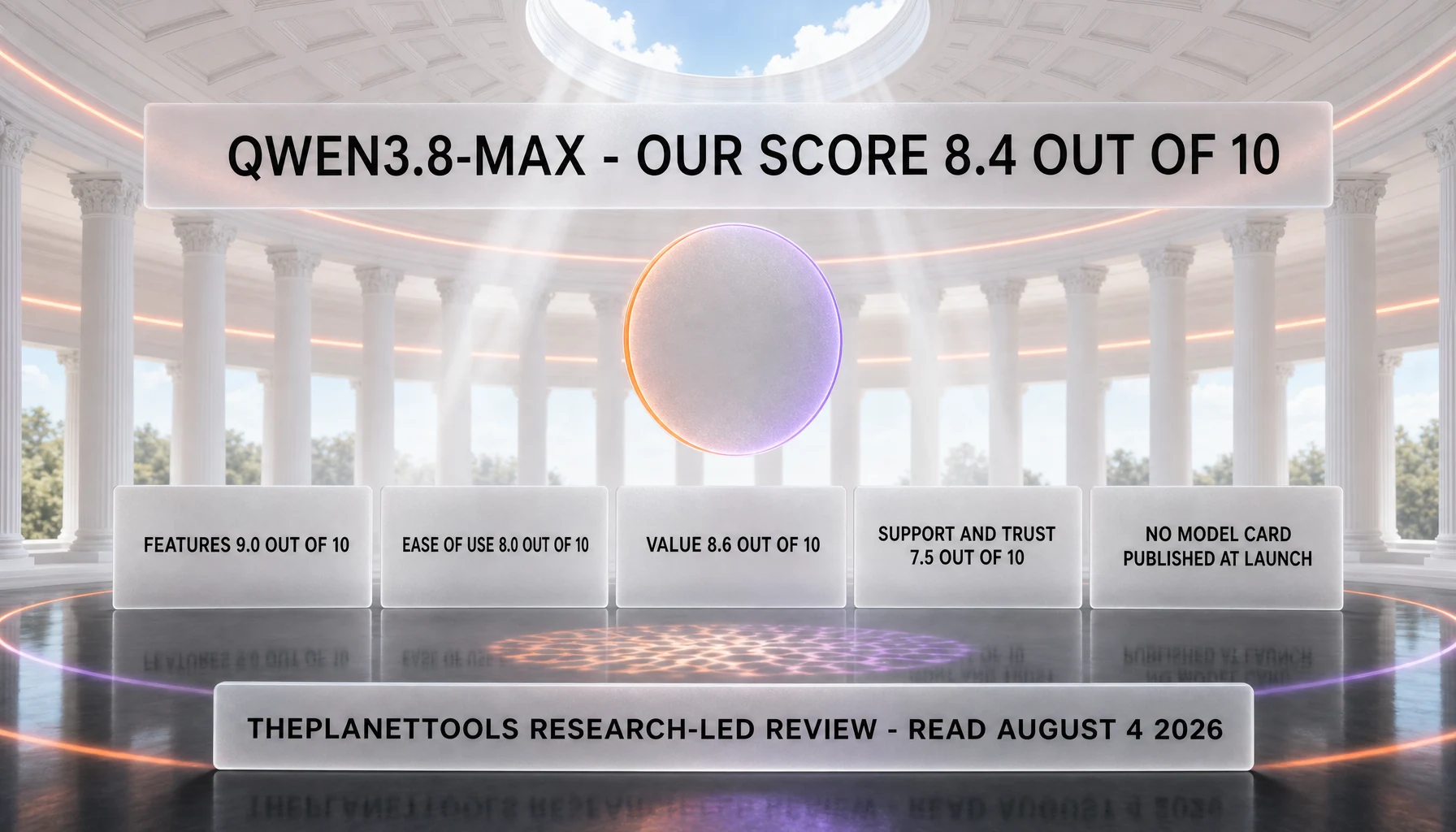
Qwen3.8-Max earns an 8.4 out of 10 on three things: an activation ratio that puts 2.4 trillion parameters of capacity at $2 per 1M input tokens, a 1M token context priced flat with no surcharge cliff, and native video input backed by the best-evidenced independent result the model has. What raises it further is an API surface that was clearly designed for production agents rather than demos — 262K tokens of reasoning budget, five server-side tools, 2M tokens per minute, and a cache tier that rewards operators who manage it. What holds it back from a nine is not capability. It is that we cannot yet check most of what Alibaba says.
Score breakdown:
- Features: 9.0 out of 10 — 1M context with published operating limits, native text, image, and video input, five built-in tools, prefix completion, function calling, structured outputs, batches, and fine-tuning. Very little is missing.
- Ease of Use: 8.0 out of 10 — a clean Responses API with server-side tooling and generous rate limits, held back by the absent model card and the engineering effort required to exploit the explicit cache tier.
- Value: 8.6 out of 10 — $2 per 1M input tokens and $6 per 1M output tokens for a 2.4 trillion parameter flagship, flat across the full context, with an explicit cache read at $0.17 per 1M tokens. Cheaper Chinese frontier options exist, but none pair that price with native video input at this scale.
- Support and Trust: 7.5 out of 10 — this is the score doing the honest work. There is no model card at general availability. The open weights Alibaba promised have not shipped. And no independent evaluator has charted the model at all beyond one blind-vote board whose ballots closed before launch. Three separate disclosure gaps, each individually forgivable at launch week, add up to a real deduction.
Final word. Buy a trial if your workload is input-heavy, multimodal, or agentic, and if a two-times to five-times reduction in input cost against the Western frontier would change what you can afford to build. The vision result is real, the pricing structure is genuinely well designed, and the rate limits mean you can actually test at scale. Wait if you need a documented model card for compliance, if your procurement case depends on open weights, or if you need independent benchmark coverage before committing — all three of those may be resolved within weeks, and none of them are resolved today. We will revisit this review when Alibaba ships the weights and when Artificial Analysis publishes an entry, and we will say plainly which way the numbers moved.
Last researched: August 2026.
Sources
Every figure on this page traces to one of the three primary sources below. Publisher specifications and list pricing come from Alibaba directly; the only independent measurement available at the time of writing comes from arena.ai.
- Alizila (Alibaba Group newsroom) — "Alibaba Unveils Qwen3.8-Max: Its Largest and Most Capable Flagship Model to Date", published August 3, 2026. Source for the general availability date, the 2.4 trillion total and 95 billion activated parameter counts, the Sparse Mixture-of-Experts architecture, the 16-day autonomous engineering test, and the open-weights schedule.
- QwenCloud — official product and pricing page for the qwen3.8-max endpoint. Source for list pricing, cache rates, context and output limits, rate limits, built-in tools, and supported modalities. Read August 4, 2026.
- arena.ai text and vision leaderboards, vote cutoff August 1, 2026. Source for the Arena scores, ranks, confidence intervals, and vote counts. Read August 4, 2026.
Key Features
Pros & Cons
Pros
- Sparse Mixture-of-Experts activates only 95 billion parameters per token against a 2.4 trillion total, roughly a four percent ratio, which is what makes frontier-scale capacity possible at $2 per 1M input tokens.
- Pricing is flat across the entire 1M token context with no long-context surcharge tier, so a 900K token prompt is priced linearly and capacity planning involves no threshold cliff.
- Alibaba publishes precise operating limits rather than only a round number: 991K maximum input and 131K maximum output in standard mode, 983K and 131K with thinking, and a 262K maximum reasoning budget.
- The vision result is the best-evidenced independent finding about this model: rank 2 on the arena.ai vision leaderboard with a score of 1304.68 on 5,038 votes and confidence bounds of 1 to 11.
- Five built-in server-side tools ship in the Responses API (code_interpreter, web_extractor, web_search, t2i_search, i2i_search), removing credentials, plumbing, and failure modes from the agent loop.
- Production-grade rate limits at launch, 2M tokens per minute and 15K requests per minute, sized so the 1M token context is usable at volume rather than being a demonstration-only capability.
- Three-tier caching rewards engineering effort: an explicit cache read at $0.17 per 1M tokens against a $2 per 1M tokens input rate pays back the $2.50 per 1M tokens creation cost on the second read.
Cons
- Proprietary as of August 4, 2026. Alibaba stated on August 3 that weights were scheduled for release the following week, but no open weights have shipped and there is no HuggingFace repository. A dated promise is not a license.
- No model card at general availability. The July preview shipped without one and GA did not fix it, leaving training data provenance, evaluation methodology, and safety testing undocumented for a model targeted at legal and enterprise workloads.
- Almost no independent measurement exists. Artificial Analysis has no entry as of August 4, 2026 and the Coding Agent Index v1.3 does not chart it, leaving a single blind-vote board as the entire third-party evidence base.
- The text leaderboard placement is far less solid than the headline rank suggests: rank 5 carries published confidence bounds spanning rank 1 to rank 17 on only 3,327 votes, gathered before general availability under anonymous codenames.
- One of Alibaba's three arena placement claims could not be confirmed. The fourth-place Frontend Code Arena claim does not appear on arena.ai's public boards, which is a reason to treat the remaining unverified vendor claims with equal caution.
Best Use Cases
Platforms & Integrations
Available On
Integrations

We're developers and SaaS builders who use these tools daily in production. Every review comes from hands-on experience building real products — DealPropFirm, ThePlanetIndicator, PropFirmsCodes, and many more. We don't just review tools — we build and ship with them every day.
Written and tested by developers who build with these tools daily.
Frequently Asked Questions
What is Qwen3.8-Max?
Alibaba's 2.4-trillion-parameter flagship reached general availability on August 3, 2026 — 95 billion activated per token, a 1M token context window, and $2 per 1M input tokens.
How much does Qwen3.8-Max cost?
Qwen3.8-Max costs $2/month.
Is Qwen3.8-Max free?
No, Qwen3.8-Max starts at $2/month.
What are the best alternatives to Qwen3.8-Max?
Top-rated alternatives to Qwen3.8-Max can be found in our WebApplication category, where we've reviewed and scored every tool on ThePlanetTools.ai.
Is Qwen3.8-Max good for beginners?
Qwen3.8-Max is rated 8/10 for ease of use.
What platforms does Qwen3.8-Max support?
Qwen3.8-Max is available on QwenCloud API, Responses API, Batch API, QwenWork.
Does Qwen3.8-Max offer a free trial?
No, Qwen3.8-Max does not offer a free trial.
Is Qwen3.8-Max worth the price?
Qwen3.8-Max scores 8.6/10 for value. We consider it excellent value.
Who should use Qwen3.8-Max?
Qwen3.8-Max is ideal for: Long-horizon autonomous agents that run for hours, using the 262K token reasoning budget with built-in server-side tools and structured outputs, High-volume legal document and contract review, where flat-rate input pricing and a $0.17 per 1M tokens explicit cache read make repeated passes over a large corpus economical, Video understanding pipelines that pass recordings directly to the model instead of maintaining a frame-sampling preprocessing layer, Visual search and retrieval workflows built on the t2i_search and i2i_search built-in tools, including catalog search and visual deduplication, Financial research and sports analytics combining large-context ingestion, live retrieval through web_search and web_extractor, and computation through code_interpreter, Embedded workplace agents deployed through QwenWork, Alibaba's workplace AI agent platform, Domain-specific fine-tuning for teams with proprietary data and enough volume to justify tuning at this parameter scale.
What are the main limitations of Qwen3.8-Max?
Some limitations of Qwen3.8-Max include: Proprietary as of August 4, 2026. Alibaba stated on August 3 that weights were scheduled for release the following week, but no open weights have shipped and there is no HuggingFace repository. A dated promise is not a license.; No model card at general availability. The July preview shipped without one and GA did not fix it, leaving training data provenance, evaluation methodology, and safety testing undocumented for a model targeted at legal and enterprise workloads.; Almost no independent measurement exists. Artificial Analysis has no entry as of August 4, 2026 and the Coding Agent Index v1.3 does not chart it, leaving a single blind-vote board as the entire third-party evidence base.; The text leaderboard placement is far less solid than the headline rank suggests: rank 5 carries published confidence bounds spanning rank 1 to rank 17 on only 3,327 votes, gathered before general availability under anonymous codenames.; One of Alibaba's three arena placement claims could not be confirmed. The fourth-place Frontend Code Arena claim does not appear on arena.ai's public boards, which is a reason to treat the remaining unverified vendor claims with equal caution..
Ready to try Qwen3.8-Max?
Get started today
Try Qwen3.8-Max Now →