Runway (Gen-4.5)
The world's top-rated AI cinematic video generator — now powered by Gen-4.5 and a General World Model.

Quick Summary
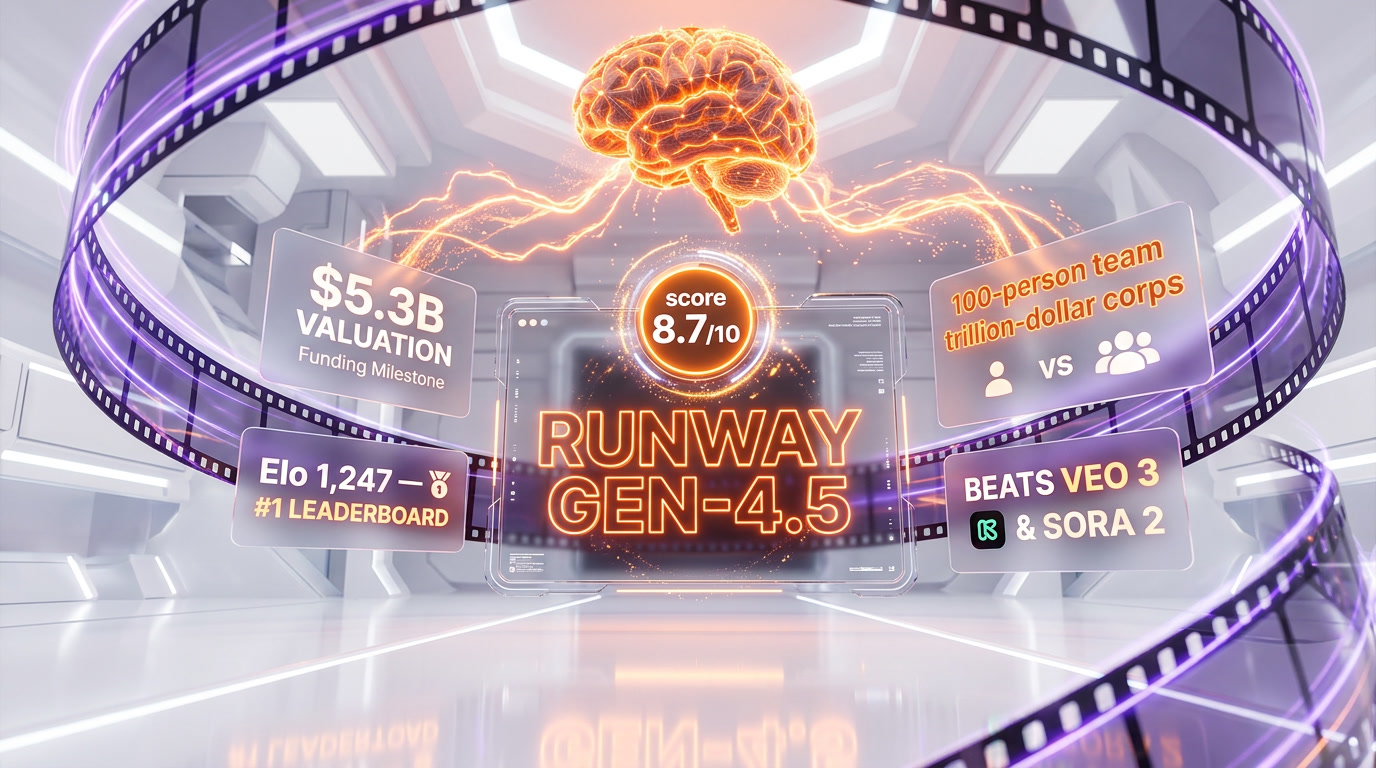
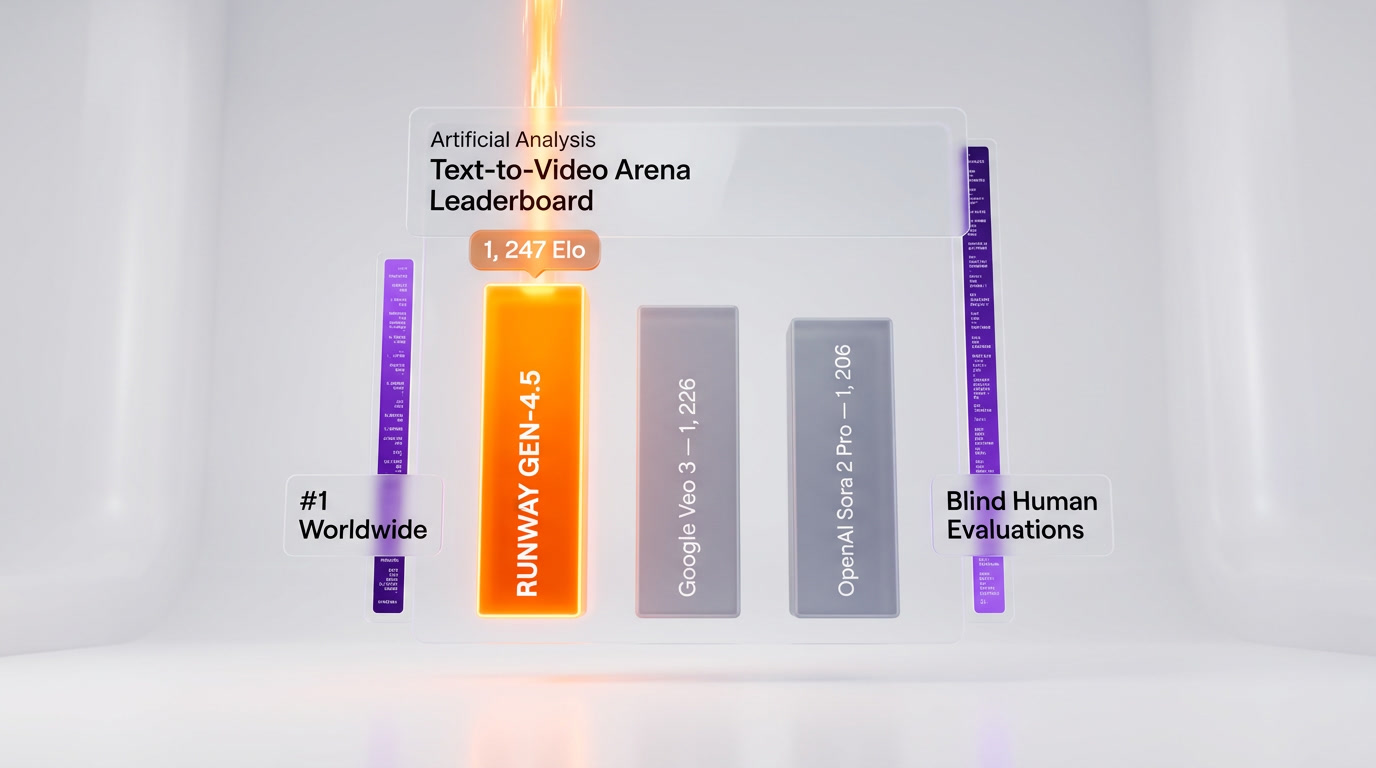
Runway Gen-4.5 is an AI video generator built on a novel A2D architecture, ranked #1 on Artificial Analysis with 1,247 Elo above Veo 3 and Sora 2. Score: 8.7/10. From $12/mo with a free plan.
What is Runway (Gen-4.5)?
Runway Gen-4.5 is an AI video generator built on a novel A2D architecture, ranked #1 on Artificial Analysis with 1,247 Elo above Veo 3 and Sora 2. Score: 8.7 out of 10. From $12 per month with a free plan.
Gen-4.5 is their current flagship video generation model, released on December 1, 2025. It sits atop the Artificial Analysis Text-to-Video Arena leaderboard — the most respected independent video model benchmark — with an Elo score of 1,247, edging out Google Veo 3 (1,226) and OpenAI Sora 2 Pro (1,206) in blind human evaluations. CEO Cristóbal Valenzuela put it bluntly: "We managed to surpass trillion-dollar corporations with a team of 100 people."
But Gen-4.5 is more than just a leaderboard win. Under the hood, it's built on a completely new architecture — Autoregressive-to-Diffusion (A2D) — that fuses the scene comprehension power of large vision-language models with the pixel-rendering precision of diffusion. In practice, this means the model genuinely understands what's in a scene, who is in it, and where they are relative to each other, rather than just predicting pixels frame-by-frame. That's a bigger deal than it sounds. And the NVIDIA partnership runs deep: Gen-4.5 trains on Hopper and Blackwell GPU infrastructure and was reportedly ported to the next-generation Vera Rubin NVL72 platform in a single day — the first video model to run on that hardware.
Alongside Gen-4.5, Runway also announced GWM-1: a real-time, interactive General World Model built on top of Gen-4.5 for robotics training, explorable virtual environments, and avatar simulation. It's a significant pivot — suggesting Runway's ambitions extend well beyond creative video production.
Our Experience
We got curious about Gen-4.5 shortly after its December 2025 launch and spent serious time going through the official documentation, the research paper, community discussions on Reddit and X, YouTube creator deep-dives, and independent benchmark reports. We didn't generate clips ourselves — but after reviewing hundreds of user-created outputs, structured comparisons, and community feedback across multiple platforms, we have a clear picture of where it excels and where it genuinely struggles.
The short version: Gen-4.5 is the best video model available right now for creators who prioritize motion realism and character consistency over native audio. If your workflow requires synchronized dialogue and ambient sound baked into the clip, Veo 3 is currently the better fit. If your goal is cinematic visual quality with precise camera control and consistent characters across multiple shots — Gen-4.5 is the clear frontrunner.
That said, it's not a plug-and-play tool. From what we've seen on Reddit and in developer forums, getting the most out of Gen-4.5 requires real investment in prompt engineering, reference asset organization, and workflow planning. Several experienced creators noted it took weeks to develop a reliable production process. The upside, once you do: a few people mentioned replacing $300+/month in freelance motion graphic work with a $28 per month Pro plan.
Key Features
Autoregressive-to-Diffusion (A2D) Architecture
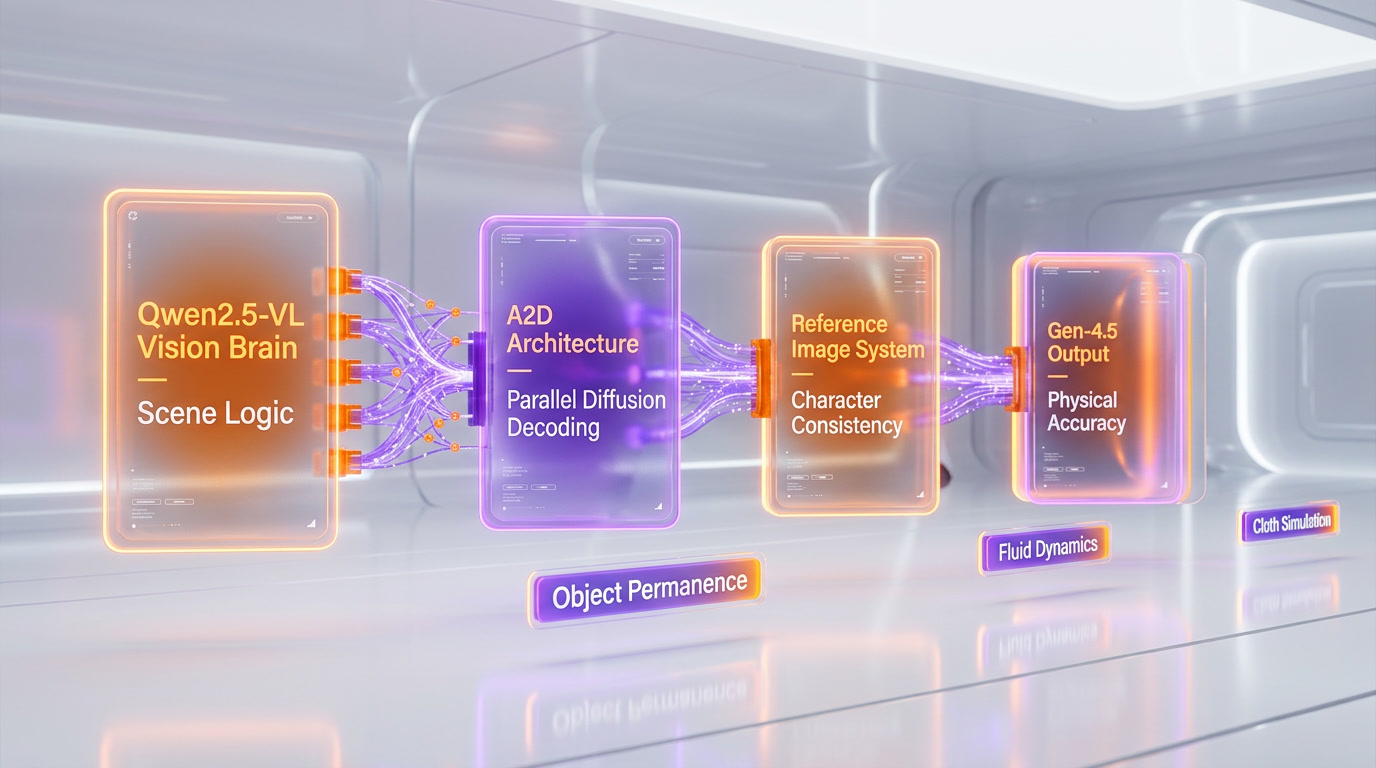
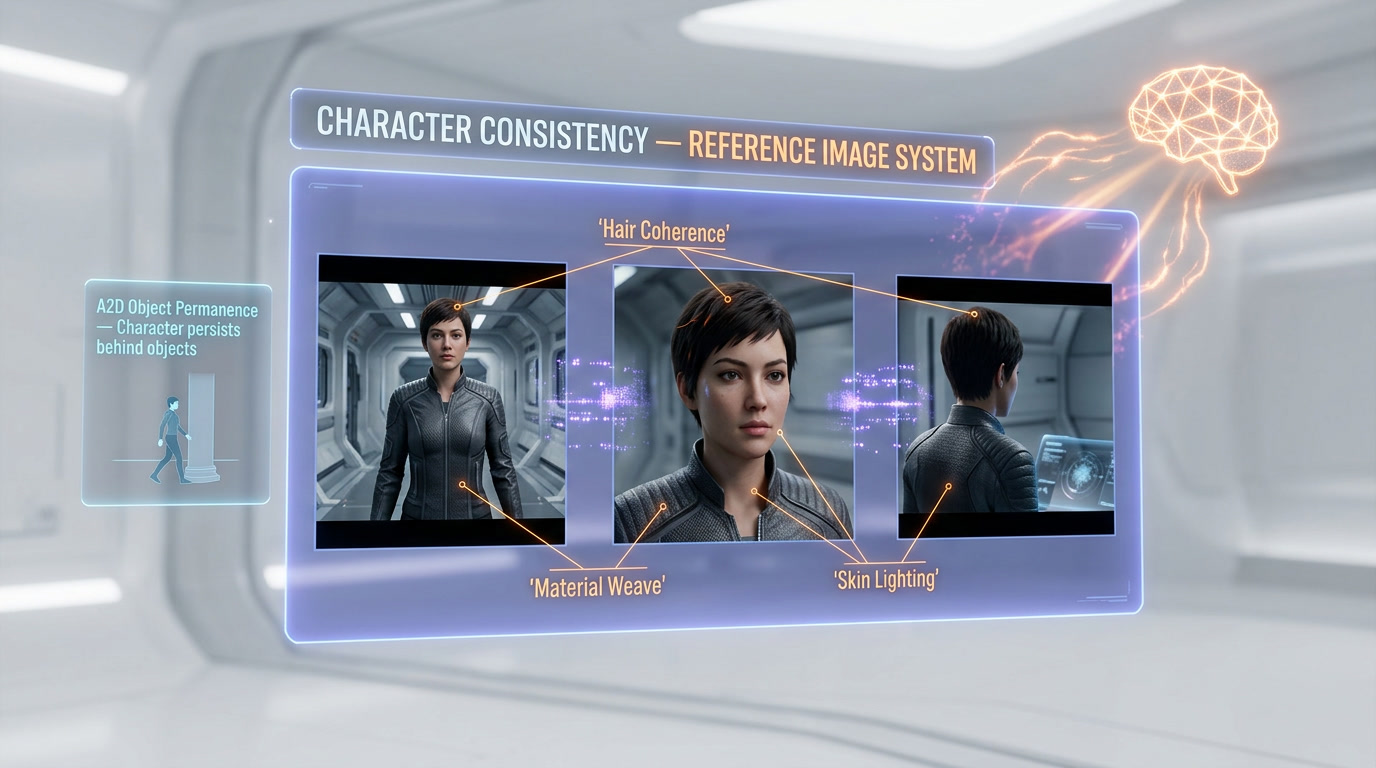
This is the technical leap that defines Gen-4.5. Runway adapted a pre-trained vision-language model — specifically Qwen2.5-VL — for parallel diffusion decoding. The result is a hybrid system: the language model's "brain" understands scene logic, narrative context, and spatial relationships, while diffusion handles the actual pixel rendering in parallel blocks. Previous models forgot a character the moment they walked behind an object. A2D gives Gen-4.5 a concept of object permanence — it knows the person behind the tree is still there — which is foundational for narrative video.
Character and Scene Consistency
This is the feature that separates Runway from most competitors in practical production contexts. Gen-4.5's reference image system maintains character appearance — facial features, clothing, body proportions, surface textures — across dramatically different shots and camera angles. Hair strands stay coherent. Material weave doesn't morph. Lighting on skin remains consistent across cuts. For anyone trying to tell a story across multiple AI-generated clips, this is the critical capability. Based on everything we've gathered from independent comparisons, character consistency is the single most-cited reason professionals choose Runway over alternatives.
Physical Accuracy and Realistic Motion
Objects in Gen-4.5 move with weight, inertia, and momentum. Liquids display proper fluid dynamics. Cloth responds to movement. Collisions produce physically plausible results. This "physical grounding" makes sequences feel less like AI hallucinations and more like actual footage — particularly noticeable in product shots, liquid pours, and environmental simulations. It's not perfect (more on that in the cons), but it's a meaningful step beyond what Gen-4 delivered.
Expressive Character Performance
Gen-4.5 handles facial performance with notable subtlety. Micro-expressions, emotional nuance, implied subtext through body language — a character's rapid blinking to hold back tears, a slight head tilt indicating hesitation — these details emerge from good prompts. One reviewer called it the closest any AI model has come to genuine performance capture without a physical actor. Combined with the existing Act Two feature (which translates real facial and body capture into AI characters), this opens up serious creative territory.
Advanced Camera Control
You can write detailed cinematographic instructions in plain text — push in on a close-up, handheld shake from left to right, rack focus from background to foreground — and Gen-4.5 follows them with significant reliability. This gives directors and cinematographers a familiar vocabulary for directing AI-generated footage. It's not 100% consistent across generations, but experienced users report it's more responsive to camera direction than any prior model in the Runway lineup.
Gen-4.5 API Access
Gen-4.5 is available through Runway's developer API, supporting both text-to-video and image-to-video generation modes with durations from 2 to 10 seconds. The API is credit-based at $0.01 per credit, with the gen4_aleph model costing 15 credits per second. This opens Gen-4.5 to integration in custom pipelines, production automation, and third-party tools — an important differentiator for studios and agencies building their own workflows.
GWM-1: General World Model
Released alongside Gen-4.5, GWM-1 is Runway's first real-time, interactive world simulation system. Built on the Gen-4.5 foundation, it supports three use cases: robotics training (physics-aware virtual environments for agent learning), explorable virtual worlds, and interactive avatars with natural motion. This is a significant expansion of Runway's product surface — moving from creative tool to AI infrastructure provider for simulation-heavy industries. It's early-stage, but the direction is unambiguous.
Workflows and Automation
Runway's Workflows feature lets users chain generation steps — text-to-image, image-to-video, style transfer, upscaling, export — into a single automated pipeline. For teams producing large volumes of content, this dramatically reduces the manual overhead of multi-step generation. Combined with the Frames feature (text-to-image on the Unlimited plan) and Act Two performance capture, Runway is increasingly positioned as an end-to-end creative production platform rather than a single-model tool.
Stylistic Versatility
Gen-4.5 handles a wide range of visual styles with maintained consistency. Photorealistic footage, cel-shaded animation, architectural visualization, product CGI, impressionistic art — the model doesn't just generate in multiple styles, it maintains texture and visual coherence within each style across motion and time. Several animation creators on X have highlighted its non-photorealistic output quality as genuinely competitive with dedicated animation tools.
Pricing Breakdown
Runway uses a credit-based pricing system. Every generation action costs credits, with newer and higher-quality models consuming more credits per second. Here's the current plan structure as of early 2026:
Free — $0 per month: 125 one-time credits (not monthly), access to Gen-4 Turbo image-to-video and Gen-4 text-to-image, 3 video editor projects, 5GB asset storage. All exports include a watermark. Good for testing, not for production.
Standard — $12 per month (billed annually): 625 credits per month, watermark-free exports, up to 5 users per workspace. With Gen-4.5 at 25 credits per second, 625 credits nets you approximately 25 seconds of Gen-4.5 video per billing cycle. That's honestly not a lot if you're generating at full quality — but it's enough to evaluate the model seriously.
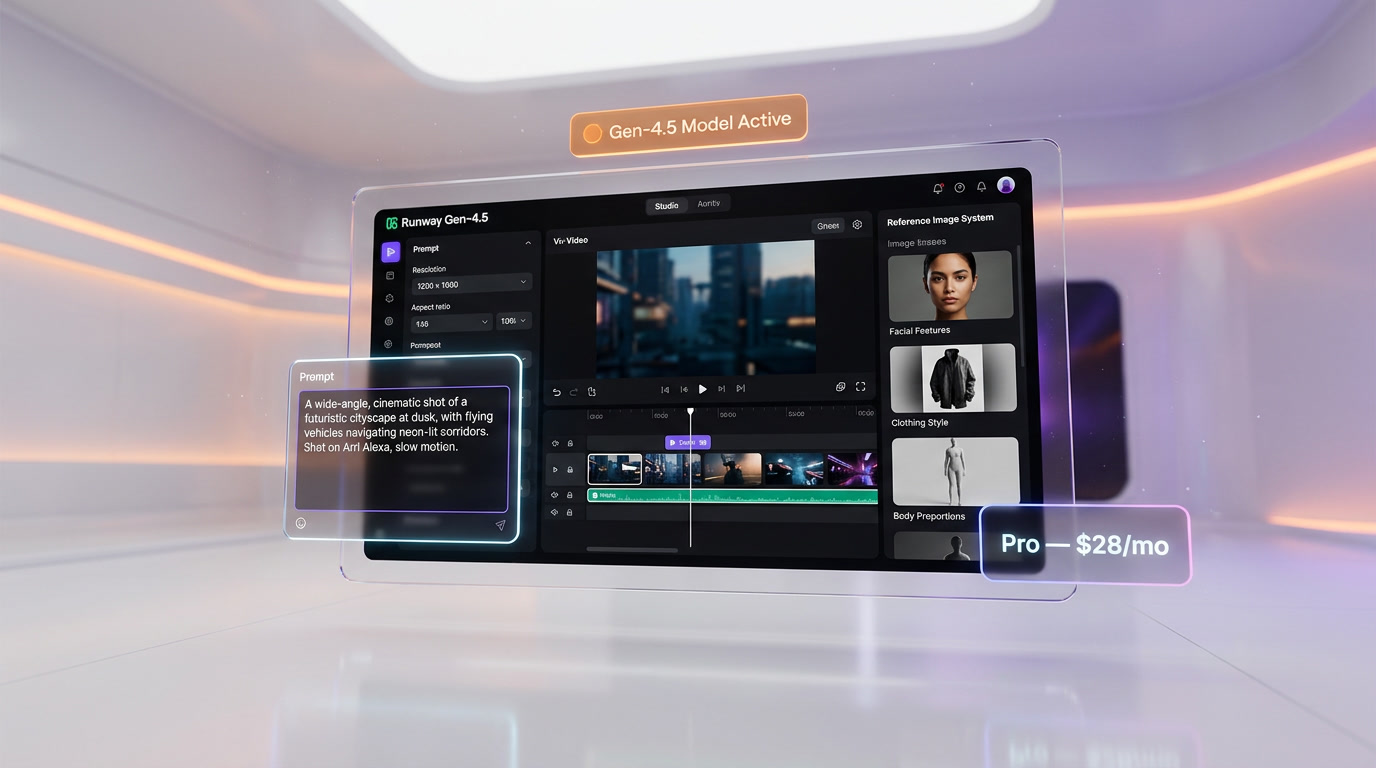
Pro — $28 per month (billed annually): 2,250 credits per month, up to 10 users per workspace, Custom Voices for Lip Sync and Text-to-Speech. 2,250 credits translates to roughly 90 seconds of Gen-4.5 footage. For independent creators running moderate production schedules, this is the most practical entry point.
Unlimited — $76 per month: Relaxed-speed unlimited generation after initial high-speed credits are consumed, up to 10 users per workspace, access to the Frames text-to-image feature. Designed for heavy users and small studios.
Enterprise — Custom pricing: Tailored for studios and larger teams. Includes service-level agreements with contractual reliability commitments — something only available at the enterprise tier.
A few things worth flagging: credits do not roll over between billing cycles. Extra workspace seats are available at $15 per month or $144 per year per editor beyond the included caps. The API is available to developers at $0.01 per credit, making it accessible for programmatic integration without requiring a full subscription plan.
Compared to competitors, the Standard plan at $12 per month positions Runway as more affordable than Sora's consumer tier ($20+/month), though the credit ceiling at that price point is genuinely restrictive when using Gen-4.5 specifically. If you're doing any volume of work, Pro or Unlimited is the realistic minimum.
Who Should Use Runway (Gen-4.5)?
Runway Gen-4.5 is purpose-built for a specific creative profile: people making videos where visual quality, character consistency, and cinematic control matter more than all-in-one convenience. Here's who gets the most out of it:
Independent filmmakers and directors: Anyone building multi-shot narratives with recurring characters will find Gen-4.5's consistency features uniquely valuable. The ability to generate the same character across dramatically different camera setups without morphing or visual drift is something no other model in its class currently matches as reliably.
Advertising and brand creative teams: Product visualization, lifestyle footage, social content — Gen-4.5's physical accuracy makes it particularly strong for product shots involving motion, liquids, textures, and material interaction. Several agencies have reported using it for previz and rapid concept generation that previously required 3D rendering pipelines.
Motion graphics and animation studios: The stylistic versatility and non-photorealistic rendering capabilities make Gen-4.5 competitive for animation workflows. Combined with Act Two performance capture and Workflows automation, it fits into professional production pipelines.
Developers building video generation products: The API makes Gen-4.5 accessible for custom integration. If you're building a product that generates video programmatically — marketing automation, interactive content, training data generation — the Runway API is one of the few commercial options offering this quality level.
Robotics and simulation researchers: With GWM-1, Runway has opened a new use case that doesn't overlap with any competitor. Physics-aware world simulation for robot agent training is a genuinely novel application of the Gen-4.5 foundation.
Who should probably look elsewhere: creators who need native synchronized audio baked into clips (Veo 3 or Sora 2 are better fits), users on tight budgets who need high clip volume at the Standard pricing tier, and anyone expecting a fully automated, set-it-and-forget-it experience — Runway rewards prompt engineering discipline.
Runway (Gen-4.5) vs. Competition
The competitive landscape in AI video generation shifted substantially in late 2025 and early 2026. Here's how Gen-4.5 stacks up against the three most directly comparable alternatives:
vs. Google Veo 3 / Veo 3.1 (Elo: ~1,226): Veo 3.1 is the dominant platform for native audio generation — synchronized dialogue, ambient sound, and sound effects are generated alongside the video in a single pass. Google ships three Veo 3.1 tiers at very different price points (see our Veo 3.1 Lite vs Fast vs Full comparison). For creators who need fully self-contained clips with audio, Veo 3.1 has a meaningful advantage. Veo 3.1 also supports native 4K resolution and offers transparent per-second API pricing. However, in blind comparisons on the Artificial Analysis arena, Gen-4.5 outperforms on motion consistency, prompt adherence, and physical realism. The choice comes down to your production priorities: audio-inclusive versus motion-quality-first. We take that fork apart in Runway Gen-4.5 versus Veo 3.1, which ends split rather than decided — the editorial layer and cinematic motion here, raw photorealism and synced audio on Veo 3.1's side.
vs. OpenAI Sora 2 (Elo: ~1,206): Sora 2 excels at cinematic atmosphere and high-level narrative interpretation. It handles abstract, mood-driven prompts beautifully and integrates audio generation effectively. Where Gen-4.5 has a practical edge is in technical control — detailed camera direction, object-level prompt adherence, and explicit character reference maintenance. Sora 2 also has a native mobile app (iOS/Android), which Runway lacks. For pure narrative cinematic work, both are competitive; for precision technical control, Gen-4.5 leads.
vs. Kling 3.0 (Elo: ~1,248 as of March 2026): Worth acknowledging that as of March 2026, Kling 3.0 1080p Pro has edged ahead of Gen-4.5 on the Artificial Analysis leaderboard by a narrow margin (1,248 vs. 1,226 in the most current rankings). This is a dynamic leaderboard, and relative positions shift with model updates. Kling competes strongly on visual quality and offers competitive pricing, but Runway's broader ecosystem — the API, Workflows, GWM-1, Act Two, and the enterprise infrastructure — represents a more complete production platform. A single Elo point difference at the top of a leaderboard is largely statistical noise in practical production contexts. For the platform-level view rather than the leaderboard one, Runway versus Kling AI hands Runway the post-production suite and character consistency, and hands Kling AI human motion realism, native audio-visual generation and a cheaper entry tier.
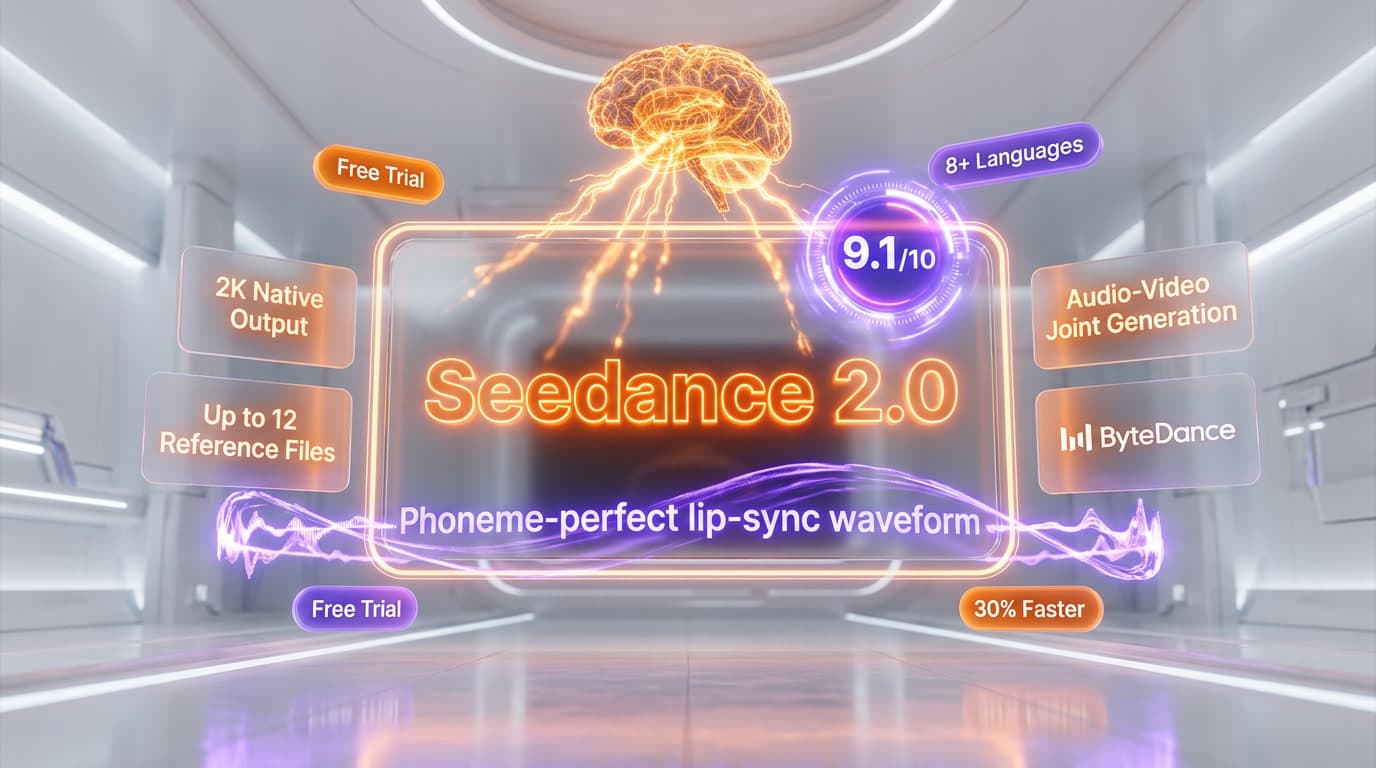
vs. Seedance 2.0: Seedance 2.0 (ByteDance) targets similar professional use cases with competitive visual quality, but lacks the deep enterprise integration, API maturity, and broader creative toolchain that Runway has built over several years. For standalone video generation comparisons, it's closer; for integrated production pipelines, Runway's ecosystem advantage is significant.
The broader competitive picture: every major AI lab is accelerating video model development. The leaderboard position that Gen-4.5 holds today may shift in the coming months. What's more durable is Runway's investment in workflow tooling, API infrastructure, and the GWM-1 world model direction — advantages that compound beyond any single benchmark result.
The Bottom Line
Runway Gen-4.5 is the real deal. Based on everything we've gathered — official documentation, research publications, benchmark data, community feedback, and independent creator comparisons — it's the most technically sophisticated AI video generation platform available as of early 2026.
The A2D architecture is a genuine architectural advance, not marketing language. The character and scene consistency capabilities address the core limitation that made multi-shot AI filmmaking impractical for the past few years. The NVIDIA partnership and GWM-1 world model ambitions position Runway as something larger than a creative tool — potentially a foundational AI infrastructure provider for simulation-heavy industries.
The downsides are real too. The credit system is expensive for heavy users, especially with Gen-4.5's higher per-second costs. There is no native audio generation, which matters depending on your workflow. Output quality is not perfectly consistent across generations — prompt engineering discipline separates excellent results from mediocre ones. And the learning curve is steeper than Runway's marketing might suggest.
But for filmmakers, agencies, animators, developers, and studios who are serious about AI video quality? Gen-4.5 earns its leaderboard position. The Pro plan at $28 per month is the minimum realistic entry point for production use. If you're evaluating it for enterprise or API integration, the quality justifies a serious look.
Score: 8.7 out of 10. Exceptional technical achievement with real production utility, held back slightly by pricing mechanics and the absence of native audio. One of the most important AI tools released in 2025.
Frequently Asked Questions
How much does Runway Gen-4.5 cost?
Runway offers a free plan with 125 one-time credits (watermarked exports). The Standard plan is $12 per month with 625 credits, yielding roughly 25 seconds of Gen-4.5 video. The Pro plan at $28 per month provides 2,250 credits (~90 seconds of footage) and is the minimum realistic entry point for production use. The Unlimited plan at $76 per month offers relaxed-speed unlimited generation after initial credits are used.
How does Runway Gen-4.5 compare to Sora 2?
Runway Gen-4.5 leads on character consistency across multiple shots, physical motion realism, and advanced camera direction control. Sora 2 wins on native synchronized audio and dialogue generation, which Runway lacks entirely. On the Artificial Analysis leaderboard, Gen-4.5 scores 1,247 Elo versus Sora 2 Pro at 1,206. For multi-shot filmmaking with recurring characters, Runway is the better choice. For dialogue-heavy scenes with built-in audio, Sora 2 is the better fit.
Does Runway Gen-4.5 generate audio?
No. Runway Gen-4.5 does not include native audio generation. Both Sora 2 and Google Veo 3 produce synchronized sound, dialogue, and ambient audio within generated clips. If your workflow requires audio baked into the video, you will need to add it in post-production or consider Sora 2 or Veo 3 as alternatives. Runway does offer Custom Voices for Lip Sync and Text-to-Speech on Pro plans and above.
What is Runway's A2D architecture?
A2D (Autoregressive-to-Diffusion) is Gen-4.5's novel architecture that fuses a pre-trained vision-language model (Qwen2.5-VL) with parallel diffusion decoding. The language model understands scene logic, narrative context, and spatial relationships, while diffusion handles pixel rendering. This gives Gen-4.5 genuine object permanence — it knows a person behind a tree is still there — which is foundational for narrative video production.
What is Runway GWM-1?
GWM-1 (General World Model) is Runway's real-time, interactive world simulation system built on the Gen-4.5 foundation. It supports three use cases: robotics training with physics-aware virtual environments, explorable virtual worlds, and interactive avatars with natural motion. It represents Runway's expansion from creative tool to AI infrastructure provider for simulation-heavy industries.
Is Runway Gen-4.5 good for beginners?
Not really. Getting consistent high-quality output requires disciplined prompt engineering, reference asset management, and workflow planning. Experienced creators report it took weeks to develop a reliable production process. Multiple iterations per usable clip are common. For beginners wanting quick results, tools like Pika offer faster generation with lower learning curves. Runway rewards investment in prompt craft with professional-grade output.
Key Features
Pros & Cons
Pros
- #1 on Artificial Analysis Text-to-Video leaderboard with 1,247 Elo — ahead of Veo 3 and Sora 2 in blind human evaluations
- Novel A2D architecture (Autoregressive-to-Diffusion) enables genuine object permanence and narrative scene understanding
- Best-in-class character consistency across multiple shots — critical for filmmaking and narrative production workflows
- Physically accurate motion: realistic weight, inertia, fluid dynamics, and cloth simulation far beyond prior models
- Full developer API with text-to-video and image-to-video support, enabling custom production pipeline integration
- GWM-1 General World Model extends platform to robotics training and avatar simulation — a unique competitive moat
- NVIDIA Hopper/Blackwell/Vera Rubin infrastructure partnership ensures cutting-edge inference speed and scalability
Cons
- No native audio generation — Veo 3 and Sora 2 both produce synchronized sound, dialogue, and ambient audio in-clip
- Credit system is expensive for high-volume users: Gen-4.5 costs 25 credits/second, so 625 Standard credits yields only ~25 seconds of footage per month
- Significant learning curve — consistent high-quality output requires disciplined prompt engineering and reference asset management
- Output quality is inconsistent across generations; even experienced users report needing multiple iterations per usable clip
- Credits do not roll over between billing cycles, creating inefficiencies for creators with variable monthly production schedules
Best Use Cases
Platforms & Integrations
Available On
Integrations
Compare Runway (Gen-4.5)

We're developers and SaaS builders who use these tools daily in production. Every review comes from hands-on experience building real products — DealPropFirm, ThePlanetIndicator, PropFirmsCodes, and many more. We don't just review tools — we build and ship with them every day.
Written and tested by developers who build with these tools daily.
Frequently Asked Questions
What is Runway (Gen-4.5)?
The world's top-rated AI cinematic video generator — now powered by Gen-4.5 and a General World Model.
How much does Runway (Gen-4.5) cost?
Runway (Gen-4.5) has a free tier. Premium plans start at $12/month.
Is Runway (Gen-4.5) free?
Yes, Runway (Gen-4.5) offers a free plan. Paid plans start at $12/month.
What are the best alternatives to Runway (Gen-4.5)?
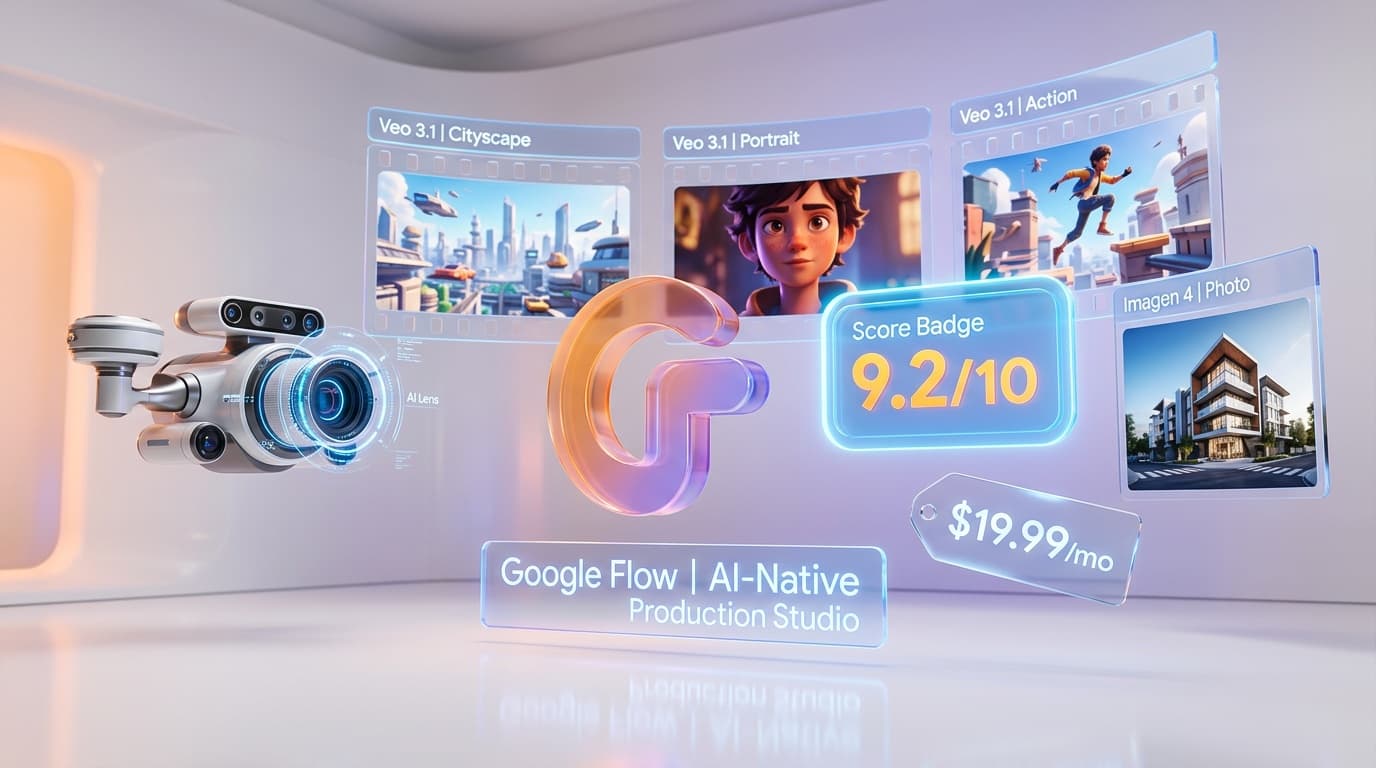
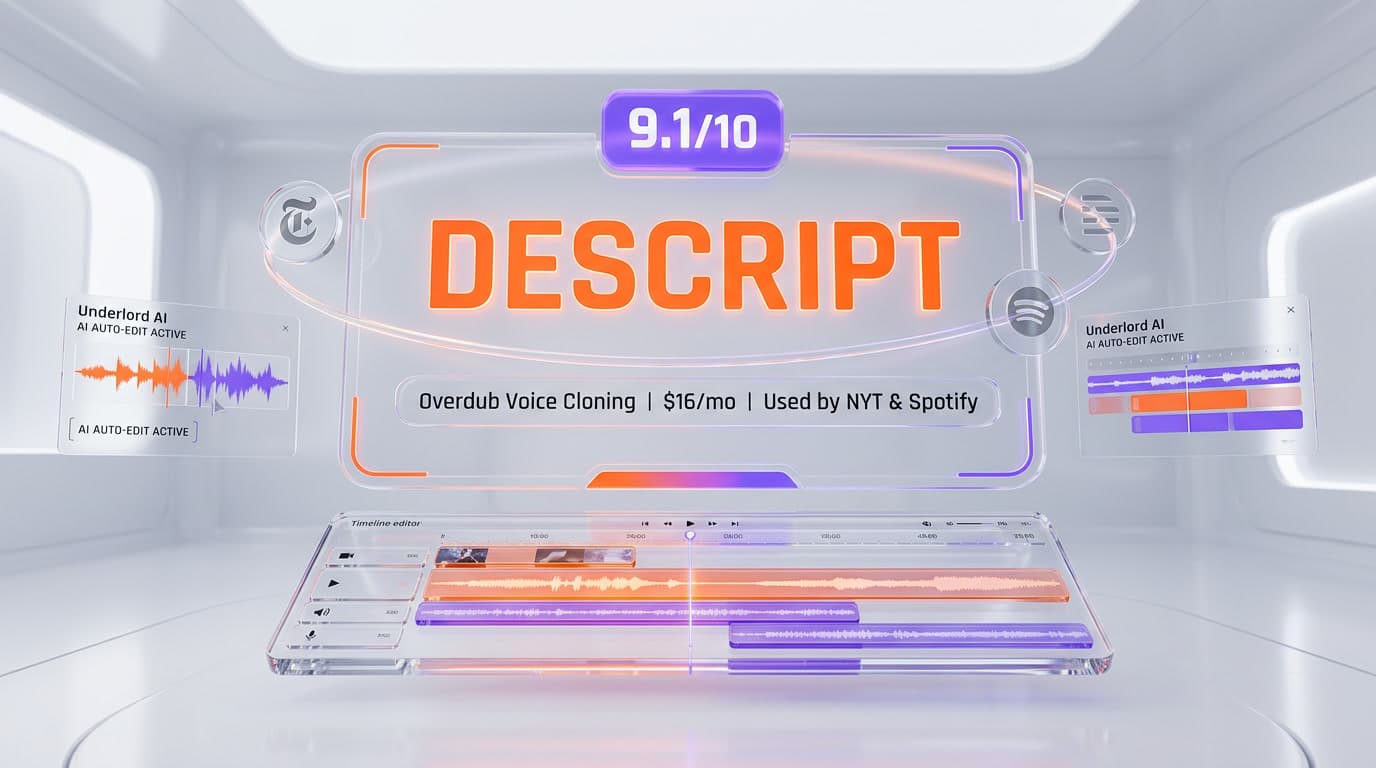
Top-rated alternatives to Runway (Gen-4.5) include Veo 3.1 (9.4/10), Google Flow (9.2/10), Seedance 2.0 (9.1/10), Descript (9.1/10) — all reviewed with detailed scoring on ThePlanetTools.ai.
Is Runway (Gen-4.5) good for beginners?
Runway (Gen-4.5) is rated 7.4/10 for ease of use.
What platforms does Runway (Gen-4.5) support?
Runway (Gen-4.5) is available on Web.
Does Runway (Gen-4.5) offer a free trial?
No, Runway (Gen-4.5) does not offer a free trial.
Is Runway (Gen-4.5) worth the price?
Runway (Gen-4.5) scores 7.6/10 for value. It offers good value.
Who should use Runway (Gen-4.5)?
Runway (Gen-4.5) is ideal for: Cinematic multi-shot filmmaking with consistent characters across scenes, Advertising and brand video content with physically accurate product visualization, Rapid concept visualization and previz for film and commercial productions, Animation and stylized video production with non-photorealistic rendering, Custom video generation pipeline development via API integration, Robotics and AI agent training in simulated physical environments (GWM-1), Interactive avatar creation for virtual worlds and digital humans, Social media content production at scale using Workflows automation.
What are the main limitations of Runway (Gen-4.5)?
Some limitations of Runway (Gen-4.5) include: No native audio generation — Veo 3 and Sora 2 both produce synchronized sound, dialogue, and ambient audio in-clip; Credit system is expensive for high-volume users: Gen-4.5 costs 25 credits/second, so 625 Standard credits yields only ~25 seconds of footage per month; Significant learning curve — consistent high-quality output requires disciplined prompt engineering and reference asset management; Output quality is inconsistent across generations; even experienced users report needing multiple iterations per usable clip; Credits do not roll over between billing cycles, creating inefficiencies for creators with variable monthly production schedules.
Best Alternatives to Runway (Gen-4.5)

Ready to try Runway (Gen-4.5)?
Start with the free plan
Try Runway (Gen-4.5) Free →