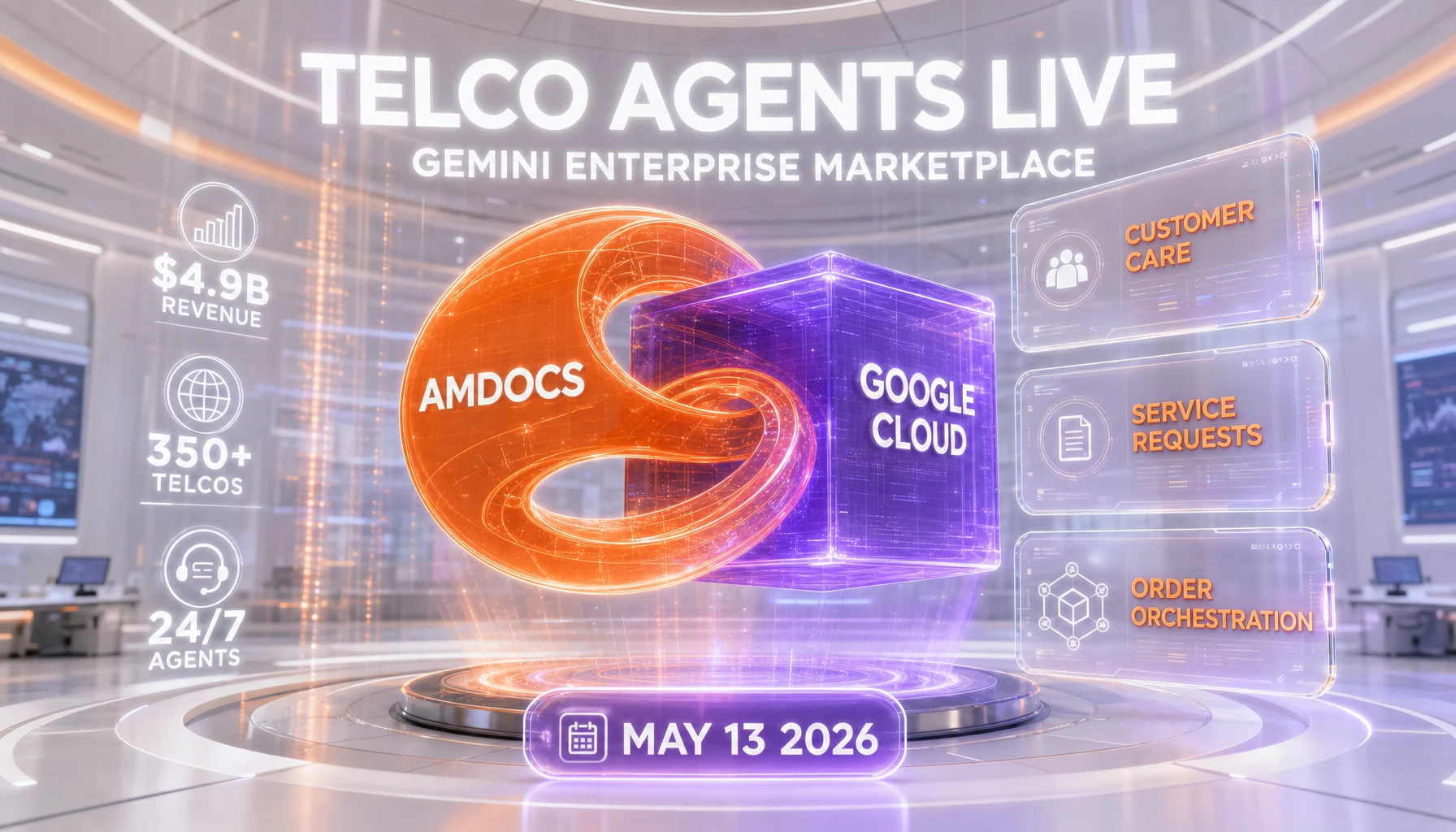
On May 13 2026, Amdocs announced availability of its Telco Agents on Google Cloud’s Gemini Enterprise Agent Marketplace — covering customer care, service requests, and order orchestration. It is the first serious telco-vertical drop on the agent marketplace pattern, and the pattern itself is the story.
The headline reads like another enterprise partnership. It is not. Amdocs touches the BSS and OSS of a large share of tier-1 telecom operators worldwide — billing, customer management, order management, network monetization. When Amdocs puts agents in Google’s marketplace, it is not promising agents that can chat. It is promising agents that can actually flip a SIM, modify a fiber order, or close a B2B contract end-to-end. That is the difference between a demo and a deployable revenue lever.
This piece breaks down what shipped, why Amdocs is the right launch partner, where this lands in the broader 2026 agent marketplace race, and what realistically happens next inside carrier operations.
What Amdocs actually announced on May 13 2026
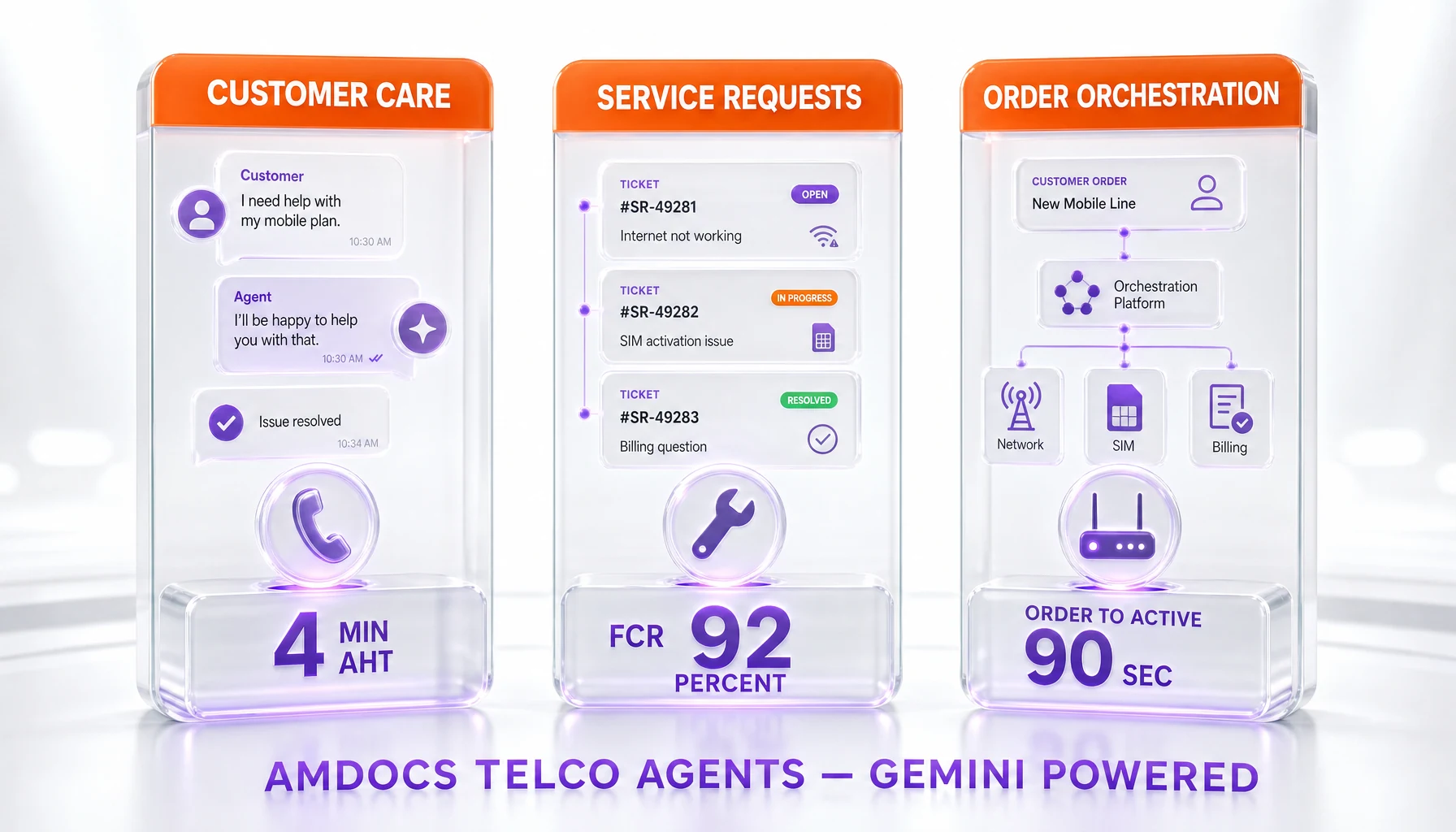
The announcement, distributed via Stocktitan and picked up by financial-news aggregators on May 13 2026, names three deployable agent clusters going live on Google Cloud’s Gemini Enterprise Agent Marketplace.
Customer care agents
Account inquiries, plan changes, billing disputes, churn deflection, plan upgrades. The classic top-of-funnel for any telco contact center. These are the calls and chats that drove the offshore BPO industry — and the calls and chats AI agents have been chipping away at since 2023.
Service request agents
Troubleshooting (no signal, slow speeds, device replacement), dispatching to field technicians, ticket lifecycle management. Heavier than care because they often involve network telemetry, equipment swaps, and physical truck rolls. The agent has to know when to escalate to a human and when to dispatch a tech.
Order orchestration agents
The most operationally heavy of the three. New line activation, plan upgrades, B2B contract orchestration, hardware shipping coordination. An order orchestration agent that actually completes is touching billing, provisioning, logistics, and fraud screens in one workflow. This is where the BSS/OSS depth of Amdocs matters most.
Why Amdocs is the right vendor to anchor this launch
Amdocs (Nasdaq: DOX) has been the quiet plumbing of telecom for three decades. Revenue around $4.9 billion annually, customers including AT&T, T-Mobile, Vodafone, BT, Bell Canada, Singtel, and dozens more. The product surface is wide — billing, customer relationship management, order management, network monetization, digital channels — and the catalog is deeply integrated into carrier-side systems.
That integration is the moat. A horizontal Gemini agent built from Vertex AI primitives can answer questions about a telco. An Amdocs agent can change a telco. The difference between “here is your bill balance” and “your plan is now upgraded, your new SIM is shipping, and the credit was applied” is the difference between a chatbot and an agent that actually closes the loop.
Google needed this for two reasons. First, telecom is one of the largest single enterprise verticals on cloud — and one of the most fragmented when it comes to AI tooling. Second, Google Cloud trails AWS and Azure in telco market share. Anchoring Amdocs on the Gemini Enterprise Marketplace is a credible move to pull carrier workloads onto Vertex AI. The marketplace becomes a wedge, the agent is the demo, the workload migration is the prize.
Anatomy of a Telco Agent — what is actually inside
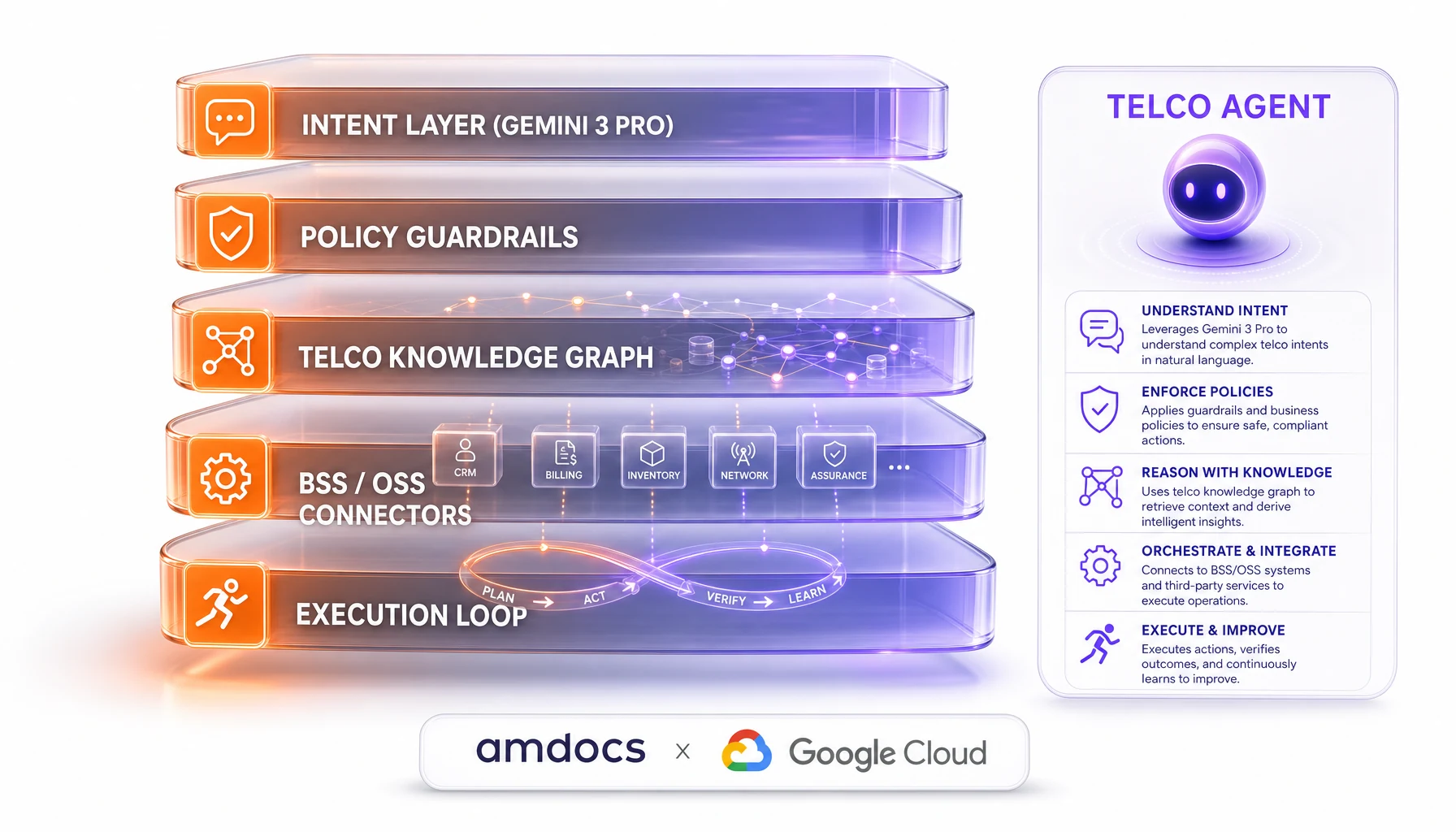
An Amdocs Telco Agent on Gemini Enterprise is not a single LLM call wrapped in marketing. It is a stack with five recognizable layers, lifted from the standard pattern Amdocs has been shipping under amAIz Agent and CES for the past few releases.
1. Intent layer (Gemini 3 Pro or Gemini 3 Flash)
The reasoning model. For high-stakes or multi-turn tasks like order orchestration, agents run on Gemini 3.1 Pro Preview for reasoning depth. For latency-sensitive care chats, agents drop to Gemini 3 Flash. The choice is configurable per agent, per use case. This is the same Pro-vs-Flash tradeoff every enterprise running on Google has had to make in 2026.
2. Policy and guardrails layer
Telco-specific rules — compliance with carrier service-level agreements, regulatory constraints in each operating country, fraud screens, churn-discount limits, escalation thresholds. The guardrails ride on top of Gemini and on top of Amdocs’ policy engine. The agent cannot offer a discount it is not authorized to offer.
3. Telco knowledge graph
Amdocs’ structured representation of products, plans, devices, network elements, customer entitlements, and operational procedures. This is where vertical depth shows. A horizontal agent has to scrape a PDF. An Amdocs agent reads the structured graph. Faster, more accurate, and traceable.
4. BSS/OSS connectors
The pipes into Amdocs’ own billing, CRM, order management, and provisioning systems — and into the operator’s broader landscape via standard integrations. This is the layer that lets the agent actually execute, not just answer.
5. Execution and reflection loop
The agentic loop. Plan, act, observe, retry on failure, escalate to a human when stuck. Patterns like Manus popularized this pattern in 2024-2025; what Amdocs adds is telco-specific recovery rules. If an activation fails on the OSS side, the agent has a runbook.
The Gemini Enterprise Marketplace context
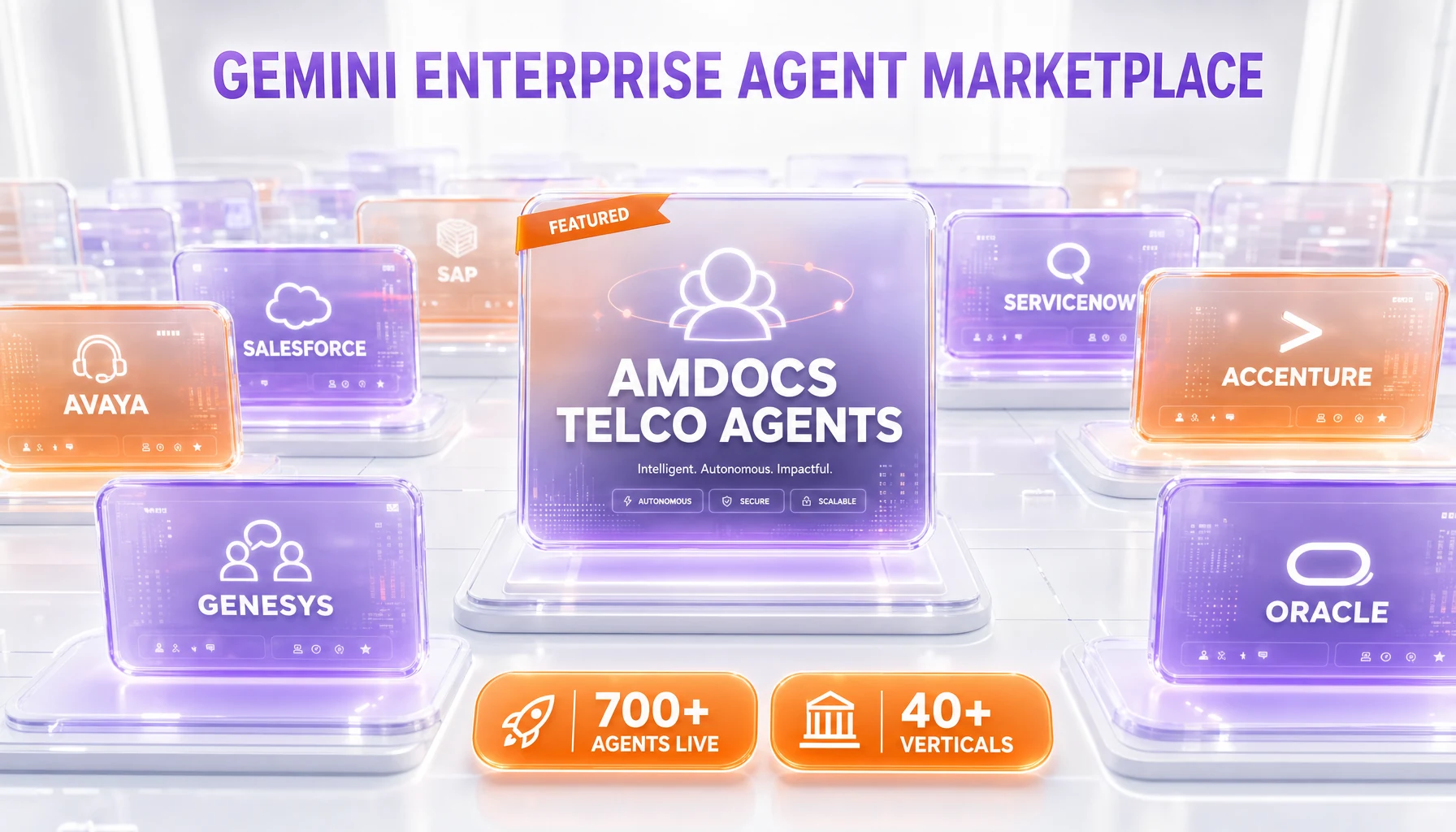
The Amdocs drop does not exist in isolation. Google’s Gemini Enterprise Agent Marketplace, broadly visible at Google Cloud Next ’26 and surfaced repeatedly since, is one of three big bets Google made this year on the agent layer. The other two were the Vertex AI pricing reset around Gemini 3.1 Flash-Lite’s $0.25 pricing tier and the cross-vendor model strategy visible in Google Cloud Next ’26 pivot.
How the marketplace works for buyers
Enterprise buyers log into the Gemini Enterprise console, browse the agent catalog, pick an agent, and configure it against their data sources. Google handles billing through the existing Google Cloud agreement — so a carrier with an enterprise commit can pull Amdocs agents under the same paper as their compute spend. That is operationally important. Procurement cycles for telcos are slow. Anything that compresses procurement is a real lever.
How the marketplace works for vendors
For vendors like Amdocs, the marketplace is distribution. Instead of selling agent by agent into carrier procurement, Amdocs gets shelf space in a catalog that any Google Cloud enterprise account can access. Revenue share with Google, but in exchange a much larger top of funnel and a credibility halo from being listed alongside Salesforce, SAP, and ServiceNow.
The agent marketplace race — Google vs AWS vs Salesforce vs Microsoft
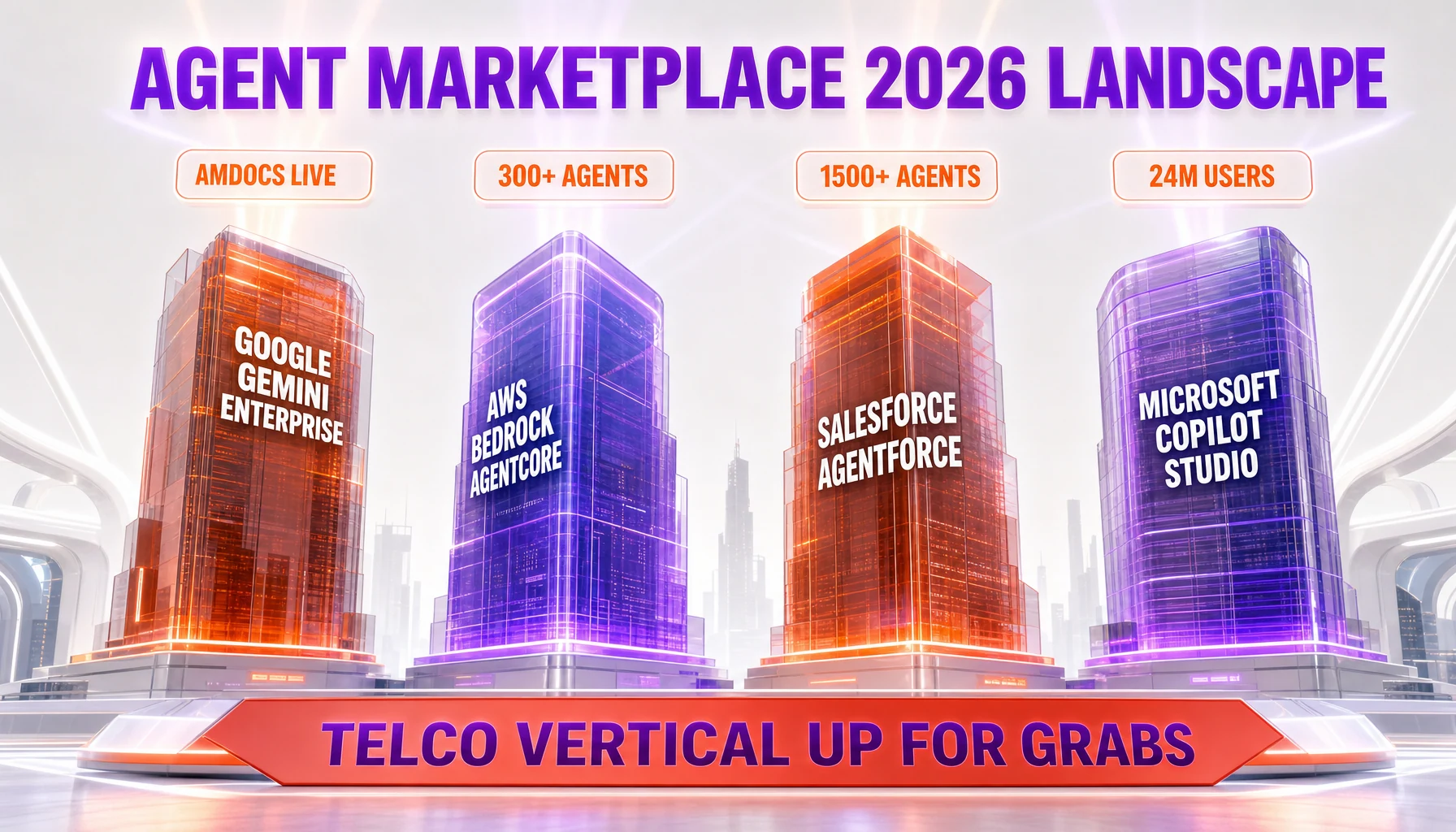
Four hyperscaler / platform vendors are racing for the same prize in 2026: become the default storefront for enterprise AI agents. Each has a different anchor.
Google Cloud — partner ecosystem play
Google’s strategy is to recruit the deep vertical vendors that already own the customer relationship — Amdocs in telco, SAP in ERP, Salesforce in CRM, ServiceNow in ITSM. Google supplies the model and the marketplace; partners supply the depth. Amdocs is the latest big anchor and arguably the most strategically important one for telecom.
AWS Bedrock AgentCore — primitives play
AWS is shipping a primitives platform — give enterprises the tools to build their own agents. More flexibility, harder to deploy. AWS has not signed equivalent telco-vertical anchor partnerships yet at the same depth. The agent marketplace inside Bedrock is growing but is still more “build it yourself” than “buy it pre-wired”.
Salesforce Agentforce — CRM play
Salesforce’s play is to be the agent layer for any business that already runs on Salesforce. That includes many telco operations groups. Agentforce is strong for customer-facing care use cases on top of Service Cloud, but weaker on deep OSS integration. Salesforce competes for care agents; Amdocs owns order orchestration.
Microsoft Copilot Cowork — Office and developer play
Microsoft Copilot Cowork shipping autonomous task execution is positioning Microsoft for the broader knowledge-worker agent market. Copilot Cowork plus Microsoft 365 plus Azure AI Foundry covers the horizontal layer. Telcos use it for back-office automation, but the OSS-deep agent market is not where Microsoft is anchoring. ServiceNow’s push from ServiceNow’s Autonomous Workforce launch also targets some of this same enterprise workflow space.
Real numbers — what AI care actually moves inside a telco
Comparable AI care deployments from 2024-2025 give us a benchmark range. Adjusted for what Amdocs is shipping with Gemini reasoning underneath, the realistic expected outcomes for a tier-1 carrier rolling out these agents look like this.
Average handle time (AHT)
AI-assisted care typically compresses AHT by 20 to 40 percent on tier-1 calls. Agents handle authentication, retrieve account context, and propose next-best action faster than human agents. For a contact center handling 50 million calls a year at an average $4 cost per call, even a 20 percent AHT reduction is meaningful operating leverage.
First-contact resolution (FCR)
FCR typically moves up 10 to 25 percent when an agent can actually execute the change the customer is asking for, not just route the request. The order orchestration agent, in particular, lifts FCR on plan changes and upgrades because the agent closes the loop without a human handoff.
Deflection from human queues
30 to 60 percent of low-complexity inbound traffic — “what is my balance”, “reset my password”, “activate this new SIM” — gets fully resolved by the agent without ever touching a human queue. Higher deflection on digital channels, lower on voice.
Order-to-active time
For digital-native orders (port-in, eSIM activation, plan change), order orchestration agents drop time-to-active from days to minutes. This is the metric carrier CFOs love because it correlates directly with revenue capture timing. Faster activation = faster billing start = lower fraud window.
What this means for telco call center jobs
We have been here before, and we will be here again. AI care automation displaces tier-1 contact resolution. The honest read is twofold.
Brutal version: the layoff cycle hitting US tech in 2025-2026 reaches telecom contact centers next. Offshore BPOs in the Philippines, India, and Latin America that staffed tier-1 telco care are exposed. Domestic call center jobs in the US and Europe contract.
Optimistic version: human agents move up the value chain. B2B retention, network advisory for SMB, high-value churn rescue, and complex edge cases stay human and get paid more. Total seats shrink but per-seat value rises.
Both happen at the same time. The transition window is brutal for the bottom and good for the top. Telco operations leaders running these rollouts have a moral obligation to plan re-skilling pathways, not just headcount reduction targets. We have seen what happens when companies do not — the public goodwill cost shows up later.
Why doesn’t a tier-1 telco just build this on Vertex AI directly?
Some will. Several large carriers run substantial internal AI teams and already have Vertex AI commitments. They will build custom agents on Gemini using their own knowledge graphs and integrations. For those operators, Amdocs is not the obvious path.
But for the majority — and especially for tier-2 operators without the in-house ML engineering depth — buying pre-wired agents from a vendor that already integrates with the BSS/OSS is faster, lower risk, and easier to sign off internally. The build vs buy math on agents looks a lot like the historical build vs buy math on BSS itself. Most carriers buy. A few build. Amdocs serves the buy side and probably picks up some of the build side too via co-development.
Pricing, procurement, and the boring part that decides actual adoption
Amdocs has not publicly disclosed per-agent or per-seat pricing for the Gemini Enterprise listing. Industry norms for vertical AI agent products in telecom typically settle at one of three pricing patterns: per agent per month flat fee (operator buys a fixed number of agent instances), per resolved interaction (pay-per-success model), or revenue-share on outcomes (most aggressive, harder to operationalize).
Best guess based on comparable vendor disclosures: the Gemini Enterprise listing will offer per-agent monthly licensing with a Vertex AI compute pass-through. Carriers with existing Google Cloud committed-use discounts pull the compute under that commit. Carriers without can buy on demand.
Procurement timelines are the real bottleneck. A tier-1 telco does not deploy a new vendor-supplied agent in two weeks. Expect 60 to 180 days from announcement to first live carrier deployment, longer for some. Pilots will run first inside existing Amdocs accounts — which is why the installed base matters so much.
Risks and failure modes the announcement does not surface
Three risks that nobody in either company is going to highlight publicly.
Risk 1 — Agent regression on edge cases
Agents trained on Gemini and Amdocs data still hallucinate on edge cases. A bad agent answer about billing can become a regulatory complaint. Carriers are heavily regulated. The guardrails and policy layer have to be production-grade from day one or the rollback risk is real.
Risk 2 — Vendor lock to Google Cloud
The deeper a carrier integrates an Amdocs agent running on Gemini, the harder it becomes to move that workload to a different cloud. This is a strategic lock-in concern many carriers are sensitive to. Some will deliberately deploy similar agents on multiple clouds to avoid single-vendor exposure. Expect Amdocs to support multi-cloud, but the launch is Google-first.
Risk 3 — Erosion of telco direct customer relationship
If the agent handles the customer interaction, who owns the relationship? Carriers have been worried about this for years with chatbots. Agents that close the loop on orders compress the human touch even further. The brands that have been pushing “personal account manager” messaging for premium tiers need a strategy that survives agent-mediated care.
What to watch in the next 90 days
Four signals worth tracking. First, copycat announcements from Ericsson, Nokia, Netcracker, or Mavenir on either Gemini Enterprise or AWS Bedrock AgentCore. Second, the first named tier-1 carrier publicly deploying Amdocs Telco Agents in production — not pilot. Third, a Salesforce Agentforce telco-specific announcement, almost certainly inbound. Fourth, AWS responding with a vertical-anchor partnership of its own.
For operators evaluating: read the Amdocs press release, ask your account team for the demo, then ask your security and compliance team about the guardrails. The technical demo will impress. The compliance review is where rollouts actually live or die.
Our take — what this actually changes
Amdocs Telco Agents going live on Gemini Enterprise Marketplace is not the biggest AI announcement of May 2026. It is one of the most operationally consequential. It marks the moment the agent marketplace pattern moved out of horizontal demos (here is an agent that books your travel) and into vertical depth (here is an agent that activates a fiber line).
The pattern wins because it solves the buy-side problem. CIOs do not want to build agents. They want to buy them, plug them in, and measure outcomes. The companies that ship pre-wired, vertical-deep agents on a credible marketplace will compound faster than the ones still demoing horizontal capabilities. Amdocs is one of those companies for telecom. SAP is one for ERP. ServiceNow is one for ITSM. The vertical-anchor pattern is the 2026 playbook.
For document workflows that have not yet caught the same agentic wave — research, knowledge management, internal wikis like Notion — the equivalent vertical-anchor moments are coming. Not in May. But within 12 months. Bet accordingly.
Sources
Frequently asked questions about Amdocs Telco Agents on Gemini Enterprise
What did Amdocs announce on May 13 2026?
Amdocs announced availability of its Telco Agents portfolio on Google Cloud's Gemini Enterprise Agent Marketplace. The agents cover customer care, service requests, and order orchestration — three of the heaviest cost lines inside a tier-1 telecom operations stack. It is the first major telecom-vertical drop on Google's agent marketplace pattern, where Amdocs functions as a flagship vertical vendor.
What is Google Cloud's Gemini Enterprise Agent Marketplace?
Gemini Enterprise Agent Marketplace is Google's catalog of pre-built AI agents that enterprise buyers can deploy on top of Vertex AI and the Gemini Enterprise control plane. It sits alongside Google's own first-party agents (Customer Engagement Suite, Data Agents) and third-party partner agents from Salesforce, SAP, ServiceNow, Accenture, and now Amdocs for telecom. Buyers pick agents, plug them into their workflows, pay per agent per seat or per call.
Why is Amdocs the right vendor to launch the first telco agents on Gemini?
Amdocs already runs the BSS and OSS — billing, customer management, order management, network monetization — for a large share of tier-1 telcos worldwide. That installed base is the moat. A Gemini agent that needs to actually orchestrate a SIM activation, a fiber install, or a B2B order has to talk to those systems anyway. Amdocs is the shortest path from agent to a real revenue-impacting action inside a carrier.
What use cases do the Amdocs Telco Agents handle on Gemini Enterprise?
Three clusters, per the May 13 2026 announcement: customer care (Q&A, account help, plan changes, churn deflection), service requests (troubleshooting, dispatching, ticket lifecycle), and order orchestration (new line activation, upgrades, B2B order flow, hardware shipping). Each cluster ships as a deployable agent that can be configured per operator.
How does this compare to Salesforce Agentforce or AWS Bedrock AgentCore for telcos?
Agentforce ships horizontal customer agents bolted onto Service Cloud — strong for CRM-driven telcos already on Salesforce. AWS Bedrock AgentCore is a primitives platform, you build the agent. Amdocs on Gemini Enterprise is the vertical play: pre-trained on telecom data models, pre-wired into BSS/OSS via Amdocs connectors, designed specifically for carriers. The pitch is faster time to value if Amdocs is already in the stack.
Does this announcement compete with or complement Amdocs' existing AI products?
It complements. Amdocs has been shipping AI-powered offerings under labels like amAIz Agent and CES (Customer Experience Suite) for several years. The Gemini Enterprise Marketplace drop puts those capabilities in Google's storefront, with Gemini as the underlying model layer. It widens distribution rather than replacing the existing channel into Amdocs customers.
Why does Google Cloud care about getting Amdocs on its marketplace?
Telecom is one of the largest enterprise verticals on cloud — and one of the stickiest. Telcos buy in nine-figure multi-year deals. Google Cloud trails AWS and Azure in telco market share, and signing the vendor that touches most tier-1 BSS stacks is a credible way to flip workloads onto Gemini and Vertex. It is also a strong demo for the agent marketplace narrative.
What kind of measurable outcomes can a telco expect from these agents?
Industry benchmarks from comparable AI care deployments suggest 20-40% reduction in average handle time, 10-25% increase in first-contact resolution, and 30-60% deflection of low-complexity tickets from human agents. Order orchestration agents that connect directly to OSS typically drop time-to-activate from days to minutes for digital-native orders. Amdocs has not published specific Gemini-version benchmarks yet.
How does an operator actually deploy an Amdocs Telco Agent?
Through the Gemini Enterprise Agent Marketplace console. Pick the agent, configure data sources (BSS/OSS endpoints, knowledge bases, policies), set guardrails, deploy into Vertex AI. The agent runs on Gemini 3 Pro or Gemini 3 Flash depending on latency vs reasoning needs. Integration with Amdocs systems is pre-wired so a carrier already running Amdocs can plug in faster than building from primitives.
What does this mean for telco call center jobs?
It accelerates the human-agent compression curve that has been underway since 2023. Tier-1 contact resolution moves to the agent. Tier-2 and exception handling stay human but with agent assist. The brutal version - the layoff cycle hitting tech in 2025-2026 reaches telecom contact centers next. The optimistic version - human agents move up into B2B retention, network advisory, and high-value churn rescue. Both happen at the same time.
Should I expect copycat announcements from competing vendors?
Yes — fast. Ericsson, Nokia, Netcracker, and Mavenir all have AI portfolios pointed at the same telco BSS/OSS market. Expect at least two of them to announce equivalent agent marketplace partnerships within 90 days, either on Gemini Enterprise or on AWS Bedrock AgentCore. Salesforce will push Agentforce harder into the same accounts. This is now a multi-front race.
Where can I read the original Amdocs announcement?
The press release was distributed via Amdocs investor relations and picked up by Stocktitan and other financial-news aggregators on May 13 2026. The Amdocs (Nasdaq: DOX) IR page typically lists the canonical version a few hours after distribution. Stocktitan archived a copy at the URL we link in the sources section of this article.