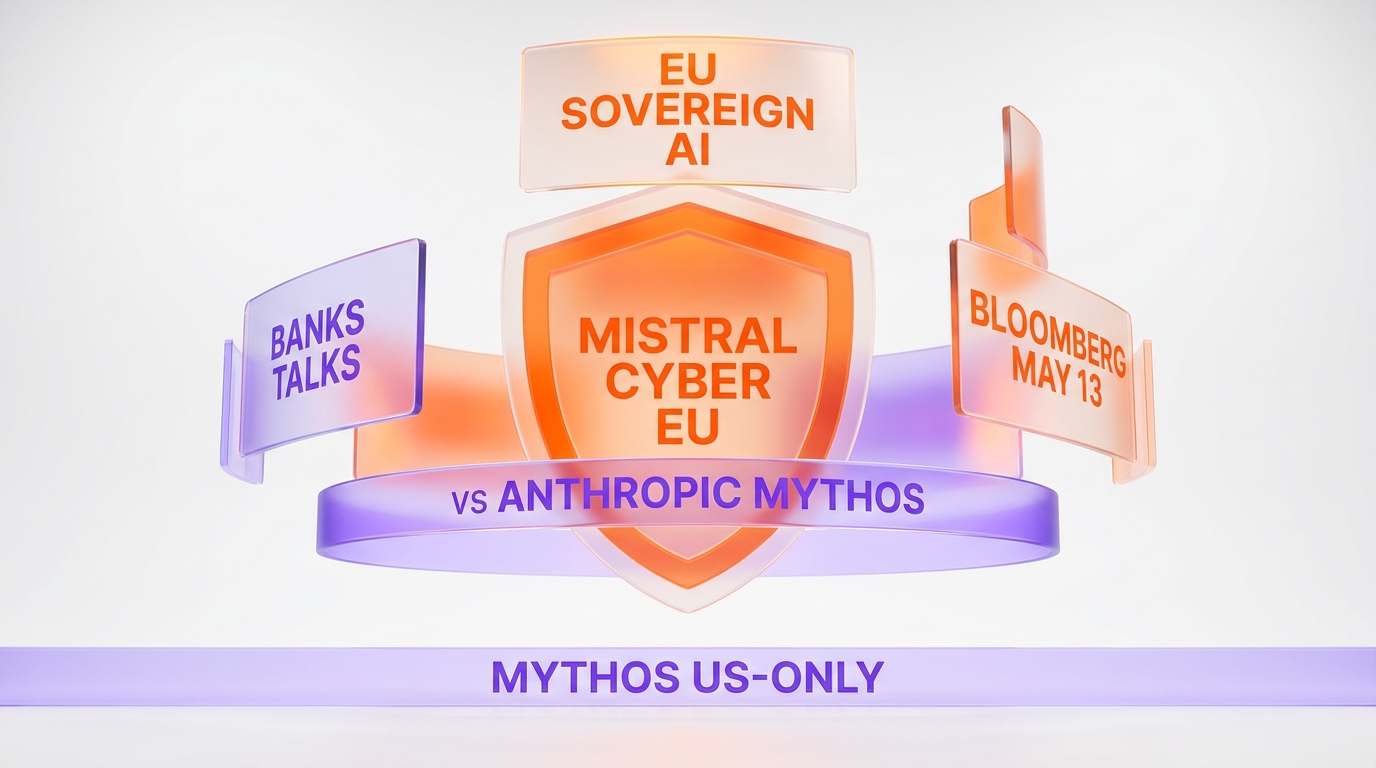
Mistral AI is in talks with European banks to develop a cybersecurity-focused AI model, building a sovereign alternative to Anthropic's Mythos, which remains restricted to US institutions like BBVA US. Bloomberg reported the discussions on May 13, 2026, citing people familiar with the matter. Existing Mistral banking clients HSBC Holdings and BNP Paribas are central to the strategy, and Mistral CEO Arthur Mensch told French parliamentarians that having "the French military's source code scanned by Mythos" creates an "irreversible dependency that we absolutely must find solutions" for. On the same day, ECB supervisory board vice-chair Frank Elderson issued a regulatory warning that European banks lacking Mythos access faces "no excuse for inaction" on AI-driven cyber threats. The release timeline for the Mistral model is not yet public.
We have been tracking the European sovereign AI thesis since the Cohere-Aleph Alpha merger in April 2026, and Mistral's cybersecurity move is the next structural piece in the same picture. The Cohere-Aleph deal produced a 20 billion dollar sovereign AI champion for enterprise procurement. Mistral's cyber model targets the most procurement-sensitive vertical in regulated Europe — banks operating under DORA, ECB supervision, and AI Act draft compliance. The framing matches what Bloomberg Law summarized as the EU-sovereign cyber response: not a friendly product launch, but the formal answer to a structural exclusion that European institutions cannot tolerate beyond the current quarter.
What Bloomberg actually reported
The headline is sovereignty, but the operational facts matter. Bloomberg's May 13 report, picked up the same day by PYMNTS, AML Intelligence, Investing.com, and Bloomberg Law, confirms four structural elements. First, Mistral is in active discussions with European banks about deploying a cybersecurity-focused AI model. Second, the company has been working on the model internally, with the release date not publicly specified. Third, existing Mistral banking clients HSBC and BNP Paribas are positioned as launch references, with the model framed as an "off-the-shelf iteration" of prior bilateral collaborations. Fourth, the strategic positioning is explicitly EU-sovereign: a localized alternative for institutions that lack access to Anthropic's Mythos.
The sovereignty framing is not a marketing afterthought. Mistral CEO Arthur Mensch had testified to France's National Assembly before the Bloomberg report, declaring that "you cannot have the French military's source code scanned by Mythos" — and dismissing some Mythos-related conversations as containing "fear-mongering." The parliamentary record makes clear that Mistral's cyber product is being positioned not as a competitive product launch but as a sovereign capability that France and the broader European Union cannot procure from US vendors without ceding strategic autonomy. That framing dramatically expands the buyer set beyond commercial banking and into defence, critical infrastructure, and government cybersecurity workloads.
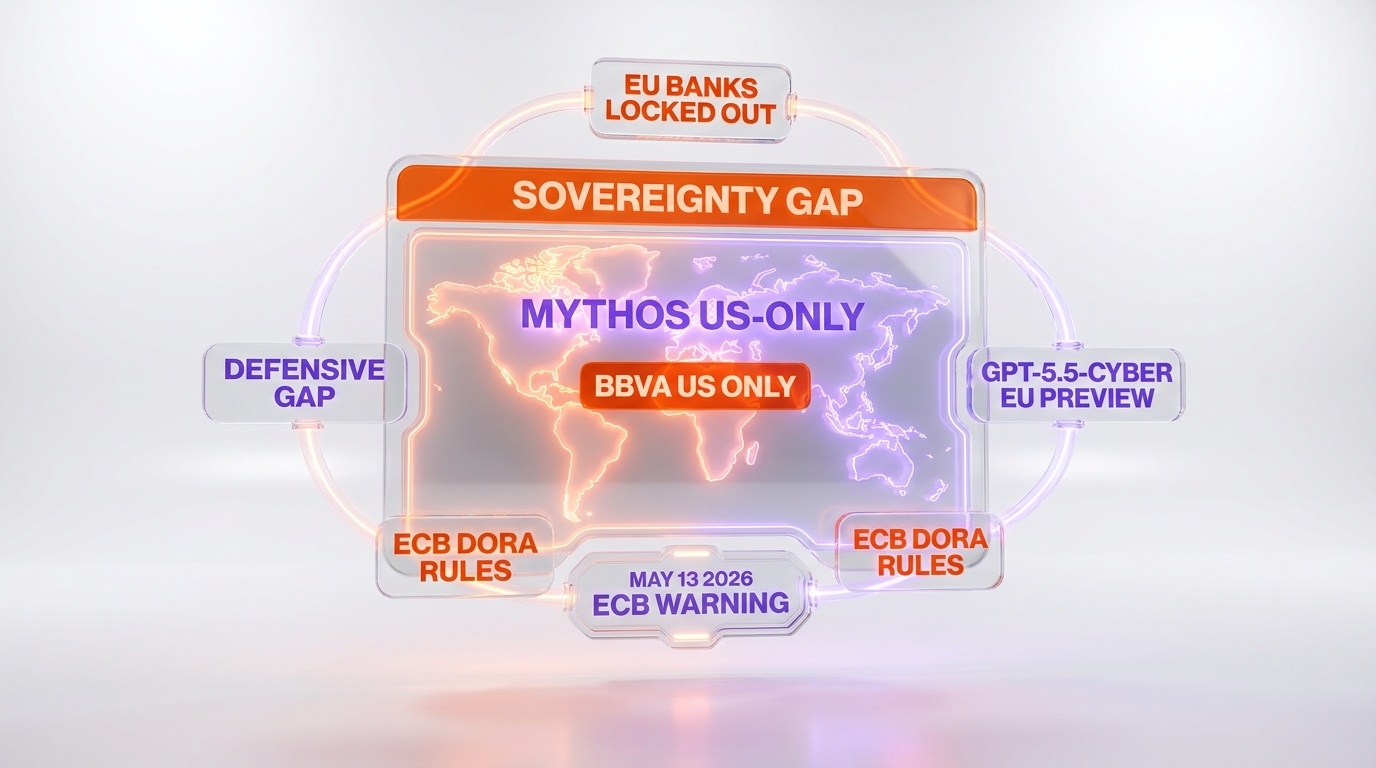
Why Mythos is restricted to US institutions
The structural reason European banks lack access to Mythos is contractual, not technical. Anthropic launched Mythos under Project Glasswing, a tightly controlled access program in which a handful of US technology firms, US banks, and US cybersecurity vendors received testing rights. BBVA US — the US subsidiary of Spanish bank BBVA — was one of the named access partners. The Glasswing program was designed to limit the threat surface created by a frontier cybersecurity model that, per Anthropic's own statements, can "identify cybersecurity weaknesses at unheard of scale and speeds."
European banks were excluded by design, not by oversight. The exclusion creates a defensive capability gap that the European Central Bank has now formally acknowledged. In a regulatory newsletter published May 13, 2026, ECB supervisory board vice-chair Frank Elderson explicitly named Anthropic's Mythos as a threat capability and told banks their lack of access was "not an excuse for inaction." Elderson called for bank-specific risk measures including aggressive patching of previously minor vulnerabilities, deployment of existing AI tools for internal vulnerability identification, and operational resilience plans updated for higher-probability severe disruptions. The framework reference is DORA, the EU's Digital Operational Resilience Act for the financial sector.
The implication is procurement-driven. EU banks are now under simultaneous pressure from a frontier US cybersecurity capability they cannot license and a regulator that has formally acknowledged the gap and demanded action anyway. The combination is exactly the procurement window that a European sovereign vendor with existing banking relationships and political backing needs to enter. Mistral's timing reads as deliberate rather than reactive.
Mistral's strategy anatomy
The Mistral approach has three structural elements that distinguish it from a generic cyber product launch.
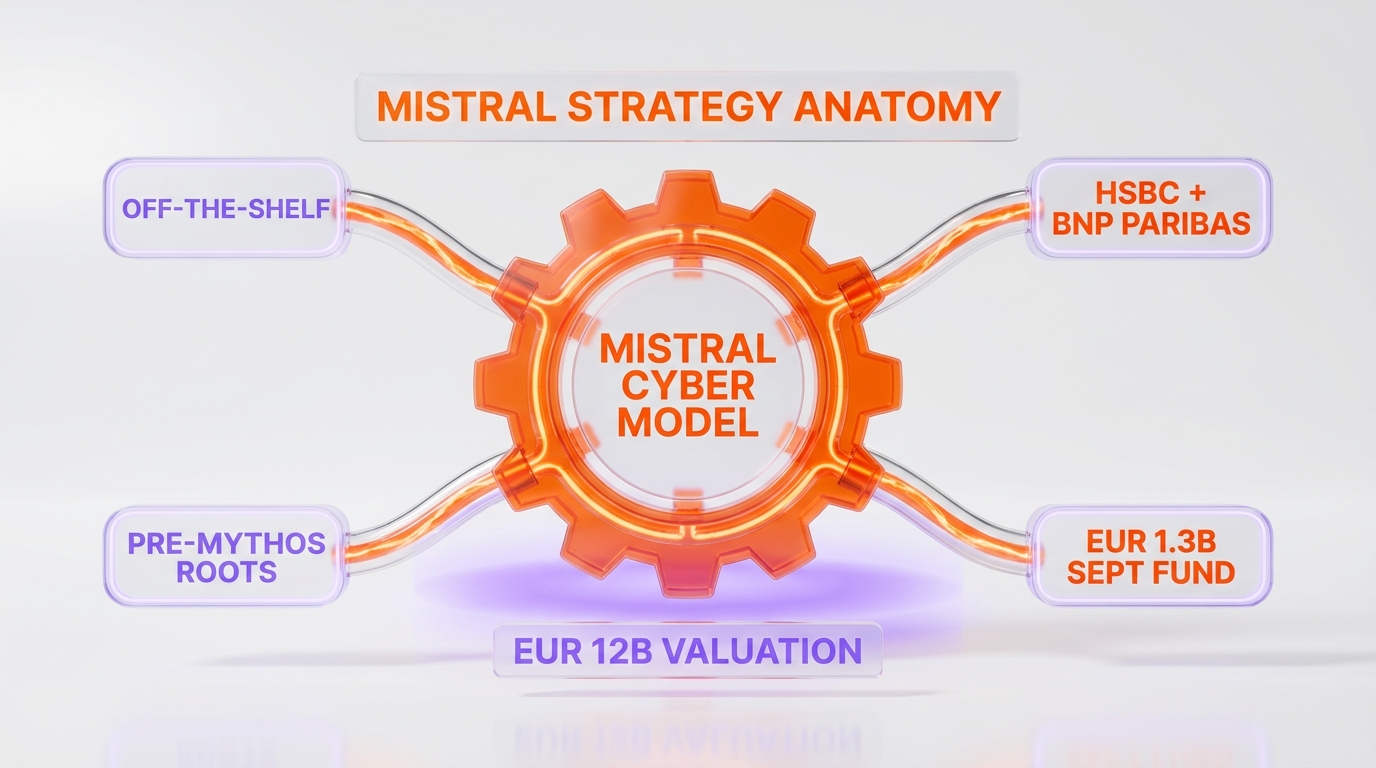
First, the existing client base does the heavy lifting. Mistral is not entering banking cybersecurity cold. HSBC and BNP Paribas have already deployed Mistral AI tooling in bilateral configurations, and the strategy is explicitly to convert those bespoke arrangements into a productized, off-the-shelf iteration for wider rollout. That sequencing matters: in regulated banking procurement, the difference between a credible vendor and an aspirational vendor is whether you have a deployed reference inside a Tier 1 European institution. Mistral has two. That is the procurement license to operate that no other EU vendor brings to this niche.
Second, the model is being framed as cyber-specific rather than as a general-purpose Mistral model with security applications. The framing aligns with how Anthropic positioned Mythos and how OpenAI is positioning GPT-5.5-Cyber for European deployment. A purpose-built cyber model carries different evaluation criteria than a general LLM — vulnerability discovery rates, false positive percentages, attack code generation success rates, and operational integration with security orchestration tooling. Mistral's product roadmap visibility on cyber-specific capabilities is limited publicly, but the parliamentary record and Bloomberg's reporting both suggest the company has been building this surface area in parallel with its Medium 3.5 frontier release in late April.
Third, the capital position supports the bet. Mistral closed a EUR 1.3 billion funding round in September 2026 led by ASML, reaching a EUR 12 billion valuation. The September round gives Mistral the balance sheet to fund a multi-year cyber model development arc, the data labeling investment that purpose-built cyber models require, and the enterprise security organization that regulated banking customers expect to interface with. None of those line items are cheap. The ASML lead also carries political weight: ASML is the most strategically important European technology company, and its investment in Mistral is a signal that the European industrial complex is aligning behind Mistral as the sovereign AI flagship.
EU banks: the buyer thesis
The buyer side of this story is more interesting than the vendor side. EU banks are not asking for Mythos. They are asking for a Mythos-equivalent capability that they can procure under European jurisdiction, deploy under DORA-compliant architectures, and audit under ECB supervisory norms. The Bloomberg report does not name the banks in active discussions with Mistral beyond the existing HSBC and BNP Paribas anchor relationships. The procurement structure, however, is foreseeable from the regulatory framework.
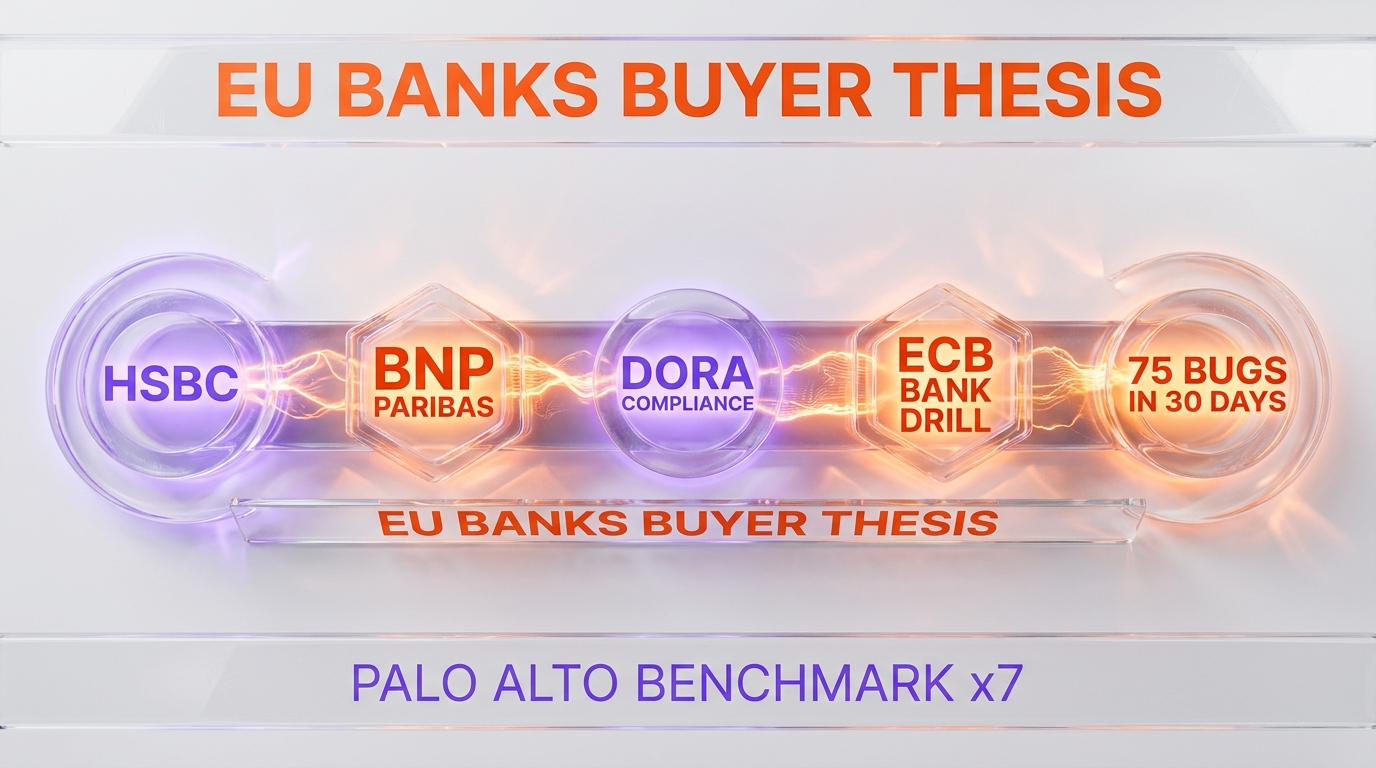
The threat data justifies the urgency. Reporting indicates Palo Alto Networks surfaced 75 vulnerabilities in a single month using Mythos and GPT-5.5-Cyber in combination — roughly seven times the typical monthly discovery rate without frontier AI assistance. The same reporting cites internal industry estimates that enterprises currently have a three to five month defensive buffer before attackers operationalize equivalent AI cyber capabilities offensively. Models in this class generate working attack code at 70 percent plus success rates, with 30 percent false positive rates that purposeful red-teaming can productively triage. The asymmetry between attacker capability and defender capability is the single largest input to the buyer thesis.
The IMF and BaFin have echoed the ECB's framing. Germany's BaFin and the International Monetary Fund both issued contemporaneous warnings on AI-enabled cyber threats to financial stability across the eurozone. The cross-regulator alignment is the procurement validation that EU bank CISOs need to write the check. When DORA enforcement, ECB supervisory expectations, BaFin national supervision, and IMF financial stability framing all converge on the same recommendation, the budget cycle moves from optional to mandated. Mistral's cyber model is launching into that mandated procurement window.
The Cohere-Aleph Alpha precedent matters here. The April 25, 2026 merger demonstrated that European procurement teams will move when a credible sovereign alternative exists. Cohere combined targets defence, energy, finance, healthcare, manufacturing, telecommunications, and the European public sector. Mistral's cyber model targets the single most procurement-active subset of that buyer base — regulated banks operating under DORA — with a purpose-built rather than general-purpose product. The vertical specialization should accelerate the procurement cycle compared to a horizontal sovereign vendor.
Cohere versus Mistral: the EU sovereign race
The European sovereign AI map has hardened over the past 30 days. The Cohere-Aleph Alpha merger on April 25 produced a 20 billion dollar combined entity anchored by Germany's Schwarz Group with a 600 million dollar Series E commitment. The combined company runs on STACKIT, the sovereign cloud operated by Schwarz Digits, and carries political backing from both Canada and Germany via the February 2026 Sovereign Technology Alliance.
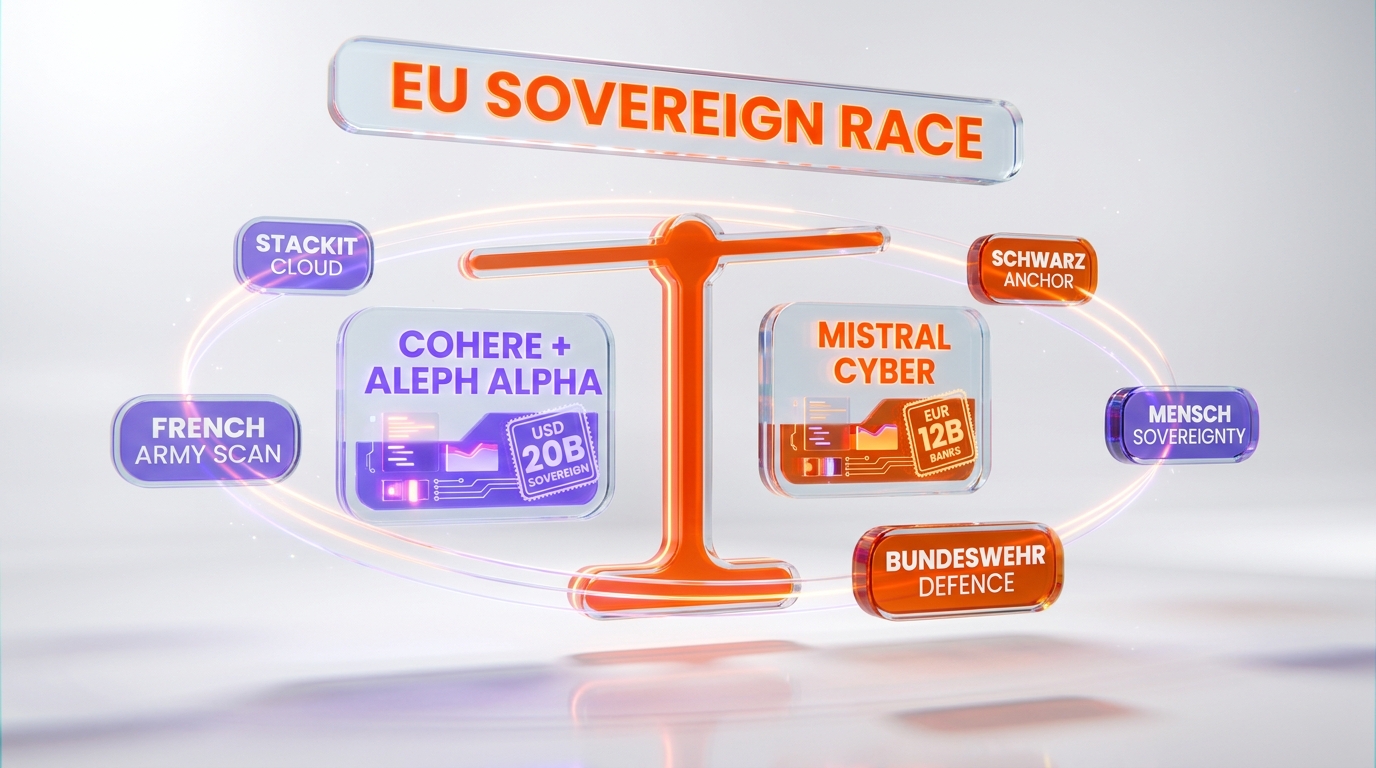
Mistral is now positioning the second anchor. The valuation gap matters less than the strategic differentiation. Cohere combined competes on horizontal enterprise distribution, sovereign cloud integration, and Canadian-German political endorsement. Mistral competes on purpose-built frontier capability, French national champion status, and a deepening vertical specialization in regulated banking cybersecurity. Both vendors target sovereignty-sensitive workloads, but the procurement paths diverge: Cohere through national champion procurement programs in Germany and Canada, Mistral through European banking and increasingly defence cybersecurity.
The competitive read for EU buyers is constructive rather than zero-sum. Banks that already run Cohere or Aleph Alpha workloads for general-purpose enterprise AI can layer a Mistral cyber model on top without architectural conflict. Banks that have not yet selected a sovereign general-purpose vendor may use the Mistral cyber procurement as the entry point that eventually expands into broader Mistral workloads. The two vendors create a credible non-US shortlist for the first time in regulated European AI procurement, and the buyer leverage that creates against US vendors is exactly the structural outcome that the EU AI Act high-risk delay framework was politically designed to enable.
Anthropic Mythos versus Mistral cyber: the head-to-head
The capability comparison is harder to read than the procurement comparison because Mistral has disclosed very little publicly about its cyber model. The structural inputs, however, allow a credible directional read.
| Dimension | Anthropic Mythos | Mistral cyber model |
|---|---|---|
| Access tier | Project Glasswing restricted — US institutions only (BBVA US named) | Active discussions with EU banks; HSBC and BNP Paribas anchor references |
| Frontier capability | State-of-the-art vulnerability discovery — Palo Alto surfaced 75 issues in 30 days using Mythos plus GPT-5.5-Cyber | Not publicly disclosed; framed as productized iteration of existing bilateral banking cyber work |
| Sovereign positioning | US-jurisdiction frontier model, restricted under Anthropic safety policy | French-jurisdiction sovereign model, framed as EU autonomy answer |
| CEO public position | Anthropic safety-first framing, restricted release | Arthur Mensch parliamentary testimony — French military source code cannot be scanned by Mythos |
| Regulatory alignment | US export and safety frameworks | DORA-compliant by design, ECB supervisory expectations addressed |
| Capital backing | Anthropic balance sheet, broad investor base | Mistral EUR 1.3 billion September round led by ASML, EUR 12 billion valuation |
| Vertical specialization | Cybersecurity general-purpose frontier model | Banking-specific cyber productization with off-the-shelf iteration plan |
| Release date | Available now to Glasswing partners | Not yet public |
The honest read is that Mistral is not racing Anthropic on absolute capability. It is racing for the European procurement window that Anthropic structurally cannot serve. The two vendors are operating in non-overlapping markets for regulatory and contractual reasons, not for competitive reasons. The Mistral cyber model does not need to be as capable as Mythos to win the EU banking procurement. It needs to be DORA-compliant, deployable in European jurisdictions, auditable under ECB supervisory norms, and good enough to materially close the asymmetry between attacker AI capability and defender AI capability. That is a meaningfully lower bar than the Mythos capability ceiling.
GPT-5.5-Cyber and the three-way EU race
OpenAI's GPT-5.5-Cyber EU action plan complicates the read. OpenAI has explicitly positioned GPT-5.5-Cyber for European deployment, including a preview tier for EU buyers that Anthropic has not matched with Mythos. The strategic logic of the OpenAI move is to capture the same EU procurement window that Mistral is now targeting, on US-vendor terms.
The competitive question is whether EU banks will accept a US-vendor cyber model as a structural substitute for a sovereign European cyber model. The political answer from Paris is clearly no — Arthur Mensch's parliamentary testimony explicitly invokes French military sovereignty as a non-negotiable variable. The procurement answer from individual banks is likely more nuanced. Banks with substantial US business may accept GPT-5.5-Cyber under appropriate contractual safeguards. Banks with primarily European operations and regulatory dependencies are more likely to converge on Mistral's sovereign positioning.
The three-way race read is therefore: Anthropic Mythos serves US institutions and locks out the European buyer base by design. OpenAI GPT-5.5-Cyber serves the global commercial buyer base including Europe under US-vendor terms with EU-preview access. Mistral serves the sovereignty-sensitive European buyer base on French-jurisdiction terms with DORA-native architecture. The market is large enough for all three to scale, and the political dynamics of European AI sovereignty make the segmentation more durable than typical competitive overlap.
Risks and execution watch points
Four risks merit explicit naming.
First, release timing. Bloomberg's report explicitly notes that the Mistral cyber model release date is not yet public. EU banks operate on quarterly procurement cycles tied to budget approvals, regulatory reporting deadlines, and audit windows. A six-month slip in Mistral's release timeline could allow OpenAI GPT-5.5-Cyber to capture the procurement window with European banking institutions that cannot wait for sovereign alternative availability. Mistral's commercial team will need to lock in pre-order commitments and pilot deployments aggressively even before general availability to defend the procurement window.
Second, capability disclosure. Mistral has disclosed almost nothing publicly about cyber model benchmarks, evaluation methodology, or red-team performance. EU bank CISOs cannot make purchase decisions on vendor positioning alone — they need vulnerability discovery rates, false positive percentages, and operational integration data. The closer Mistral can get to publishing structured capability benchmarks before general availability, the more credible the procurement conversation becomes against the established Anthropic and OpenAI benchmark profiles.
Third, defence ambition. Arthur Mensch's parliamentary testimony explicitly invokes French military source code scanning as the use case Mythos cannot serve and Mistral must address. Military and defence cybersecurity carries dramatically different procurement, certification, and security clearance requirements than commercial banking. If Mistral is genuinely targeting defence as well as banking with the same cyber model, the certification and accreditation overhead is non-trivial and may slow the banking go-to-market. The defence ambition is strategically critical for sovereignty positioning but operationally expensive.
Fourth, ECB pressure timing. The ECB warning on May 13 explicitly tells banks their lack of Mythos access is "not an excuse for inaction." That language reads as supervisory pressure to deploy whatever credible AI cyber tooling banks can procure now, not to wait for the perfect sovereign solution. If banks act on the ECB framing by procuring OpenAI GPT-5.5-Cyber as the available bridge capability, Mistral's eventual sovereign release lands into a market where many of the natural buyers are already deployed on a competing US vendor.
Our verdict
The Mistral cyber model is the most structurally significant European sovereign AI move since the Cohere-Aleph Alpha merger. Combined, the two announcements turn the EU sovereign AI thesis from an investor talking point into a procurement reality. EU banks now have a credible non-US vendor pipeline for both general-purpose enterprise AI (Cohere combined) and purpose-built cybersecurity AI (Mistral). The political backing from Paris on sovereignty and from Berlin and Ottawa on the broader Cohere axis provides procurement air cover that did not exist 30 days ago.
The win condition is straightforward. If Mistral can ship a productized cyber model in Q3 or Q4 2026, document concrete vulnerability discovery and false positive benchmarks against an independent test suite, lock in three to five EU Tier 1 banking pilot deployments beyond HSBC and BNP Paribas, and deliver a credible defence cyber adjacent capability for French military and broader EU governmental customers, the EUR 12 billion valuation reads light by mid-2027. If the release slips deeper into 2027, the procurement window narrows and OpenAI GPT-5.5-Cyber captures the available buyer leverage at Mistral's expense.
For EU bank CISOs and procurement teams, the actionable signal is to begin internal evaluation against three candidate cyber AI vendors in parallel: Anthropic Mythos for any US-domiciled subsidiary operations that can access Glasswing, OpenAI GPT-5.5-Cyber for the EU preview tier under explicit sovereignty-flagged contractual terms, and Mistral cyber under non-binding letter of intent commitments that lock in pilot priority once general availability ships. The three-vendor evaluation defends the procurement window against vendor capture and creates the cross-vendor pricing leverage that EU regulated buyers historically lack against US frontier vendors.
For developers and operators in adjacent AI sectors, the takeaway is that the European AI ecosystem is now producing purpose-built vertical specializations at frontier model adjacency. Cohere on horizontal enterprise sovereign. Mistral on banking cybersecurity sovereign. The next vertical specialization to watch is European healthcare and the EU public sector — both regulated, both sovereignty-sensitive, both under-served by US frontier vendors today. For broader context, see our coverage of Anthropic's Claude Security public beta, Mistral Large 3, Claude, and GPT-5.5.
Frequently asked questions
What is Mistral building for European banks?
Mistral AI is in discussions with European banks to develop a cybersecurity-focused AI model. Bloomberg reported the talks on May 13, 2026. The model is positioned as a sovereign European alternative to Anthropic's Mythos, which is restricted under Project Glasswing to US institutions. Mistral is converting prior bilateral cyber collaborations with banking clients into a productized off-the-shelf iteration for wider rollout, and existing customers HSBC and BNP Paribas are central anchor references.
Why are European banks locked out of Anthropic Mythos?
Anthropic launched Mythos under Project Glasswing, a tightly controlled access program limited to a handful of US technology firms, US banks, and US cybersecurity vendors. BBVA US, the US subsidiary of Spanish bank BBVA, was one of the named access partners. European institutions were excluded by design rather than by oversight, reflecting Anthropic's safety policy on a frontier cybersecurity capability that the company says can identify cybersecurity weaknesses at unheard of scale and speeds.
What did the ECB say about AI cyber threats on May 13?
ECB supervisory board vice-chair Frank Elderson published a regulatory newsletter on May 13, 2026 warning that European banks lacking Mythos access faces no excuse for inaction. Elderson called for bank-specific risk measures including aggressive patching of previously minor vulnerabilities, deployment of existing AI tools for internal vulnerability identification, and operational resilience plans updated for higher-probability severe disruptions. The framework reference is the Digital Operational Resilience Act, known as DORA.
Which banks are Mistral working with?
Existing Mistral banking clients HSBC Holdings and BNP Paribas are positioned as launch references. Bloomberg's reporting also notes that multiple major European banks are in deployment negotiations with Mistral beyond the anchor references. The bank-specific roster beyond HSBC and BNP Paribas is not yet publicly disclosed. The HSBC and BNP Paribas reference deployments provide the procurement license to operate that allows Mistral to address other Tier 1 European banking institutions credibly.
What did Arthur Mensch tell French parliamentarians?
Mistral CEO Arthur Mensch testified to France's National Assembly on technological sovereignty, declaring that you cannot have the French military's source code scanned by Mythos. He framed the dependency as one that creates an irreversible exposure that European institutions must find solutions for. Mensch dismissed some Mythos-related conversations as containing fear-mongering. The parliamentary record establishes the sovereignty framing as central to Mistral's strategic positioning rather than as marketing.
How does Mistral cyber compare to Anthropic Mythos?
Mistral is not racing Anthropic on absolute capability. The two vendors operate in non-overlapping markets for regulatory and contractual reasons, not competitive reasons. Mythos serves the US institutional buyer base under Glasswing restrictions. Mistral targets the European procurement window that Anthropic structurally cannot serve under its existing access policy. Mistral does not need to match Mythos peak capability to win EU banking procurement. It needs DORA-compliant deployment, European jurisdiction, and operational integration with bank cybersecurity tooling.
What role does OpenAI GPT-5.5-Cyber play in this race?
OpenAI is positioning GPT-5.5-Cyber for European deployment with a preview tier targeting EU buyers. The strategic logic is to capture the same EU procurement window Mistral targets, on US-vendor terms. The competitive question is whether EU banks accept a US-vendor cyber model as a structural substitute for a sovereign European cyber model. The political answer from Paris is clearly no. The individual bank procurement answer is likely more nuanced, with some European banks accepting GPT-5.5-Cyber under contractual safeguards while sovereignty-sensitive buyers converge on Mistral.
What capital does Mistral bring to this bet?
Mistral closed a EUR 1.3 billion funding round in September 2026 led by ASML, reaching a EUR 12 billion valuation. The round funds multi-year cyber model development, data labeling investment that purpose-built cyber models require, and the enterprise security organization expected by regulated banking customers. The ASML lead also carries political weight as ASML is the most strategically important European technology company, signaling that European industrial interests are aligning behind Mistral as the sovereign AI flagship.
How does this fit with the Cohere-Aleph Alpha merger?
The Cohere-Aleph Alpha merger on April 25, 2026 produced a 20 billion dollar combined entity for horizontal enterprise sovereign AI procurement. Mistral cyber adds a purpose-built vertical specialization in banking cybersecurity. Together, the two announcements turn EU sovereign AI from an investor talking point into a procurement reality. EU banks now have a credible non-US vendor pipeline for both general-purpose enterprise AI and cybersecurity AI, with political backing from Paris, Berlin, and Ottawa providing procurement air cover that did not exist 30 days ago.
What threat data justifies the urgency?
Palo Alto Networks reported surfacing 75 vulnerabilities in a single month using Mythos and GPT-5.5-Cyber in combination — roughly seven times the typical monthly rate without frontier AI assistance. Industry estimates suggest enterprises currently have a three to five month defensive buffer before attackers operationalize equivalent AI cyber capabilities offensively. Models in this class generate working attack code at 70 percent plus success rates with 30 percent false positive rates that purposeful red-teaming can productively triage. The attacker-defender asymmetry is the largest input to the buyer thesis.
When will the Mistral cyber model be available?
The release date is not publicly disclosed. Bloomberg's reporting indicates Mistral is actively in discussions with European banks, with the model framed as a productized iteration of pre-existing bilateral cyber collaborations. EU banks operate on quarterly procurement cycles, so the release timing materially affects the procurement window available before alternative vendors lock in deployments. Mistral commercial activity in Q3 and Q4 2026 will signal whether the timeline is competitive against OpenAI GPT-5.5-Cyber preview availability.
What should EU bank CISOs do now?
The actionable signal is to begin internal evaluation against three candidate cyber AI vendors in parallel: Anthropic Mythos for any US-domiciled subsidiary operations that can access Glasswing, OpenAI GPT-5.5-Cyber for the EU preview tier under explicit sovereignty-flagged contractual terms, and Mistral cyber under non-binding letter of intent commitments that lock in pilot priority once general availability ships. The three-vendor parallel evaluation defends the procurement window against vendor capture and creates cross-vendor pricing leverage that EU regulated buyers historically lack against US frontier vendors.