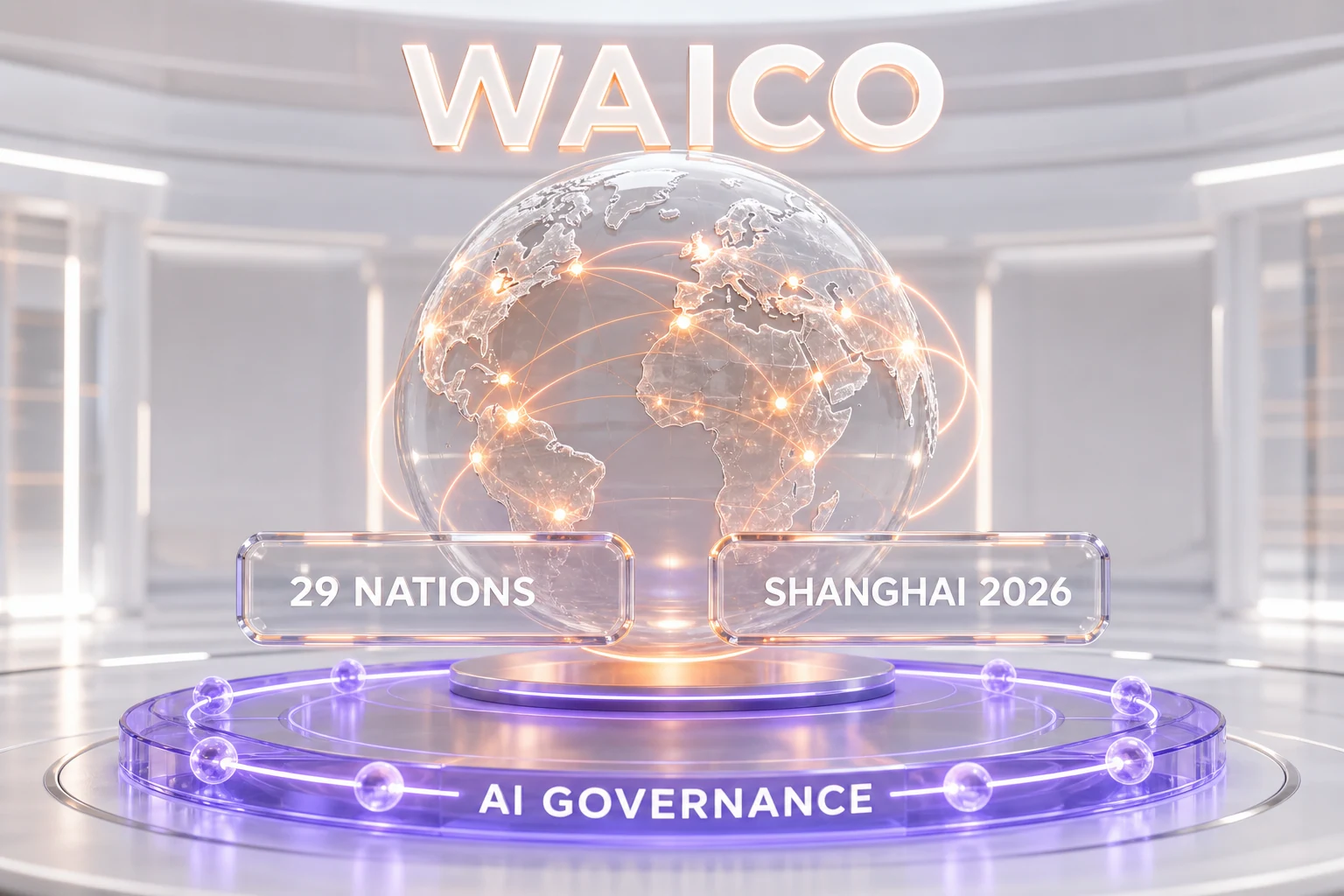
China launched the World Artificial Intelligence Cooperation Organization (WAICO) in Shanghai on July 16, 2026, and President Xi Jinping announced it a day later at the World Artificial Intelligence Conference (WAIC). Twenty-nine countries signed the founding agreement — among them Indonesia, Brazil, Malaysia, South Africa, Senegal, Russia and Pakistan — but no G7 economy and no European Union member is on the list. Chinese Foreign Minister Wang Yi signed for Beijing; UN Secretary-General António Guterres attended the conference. Xi pledged 5,000 AI training opportunities for developing countries and called for “a just and equitable system for global AI governance.” Analysts read WAICO as China’s bid to shape AI rules at the UN level — and as the clearest sign yet that AI governance is fracturing into three blocs.
Key takeaways
- A new intergovernmental body: WAICO was formally established in Shanghai on July 16, 2026 and unveiled by Xi Jinping the next day, on the opening of the 2026 World Artificial Intelligence Conference. Its headquarters will sit in Shanghai.
- 29 founding nations, tilted to the Global South: signatories include Indonesia, Brazil, Malaysia, South Africa, Senegal, Russia, Pakistan, Kazakhstan and Laos. No G7 economy and no EU member state appears on the founding roster.
- What Xi pledged: 5,000 AI training opportunities for developing countries, a call for “a just and equitable system for global AI governance,” and opposition to “overstretching the national security concept in the field of AI” — a phrase widely read as aimed at US export controls.
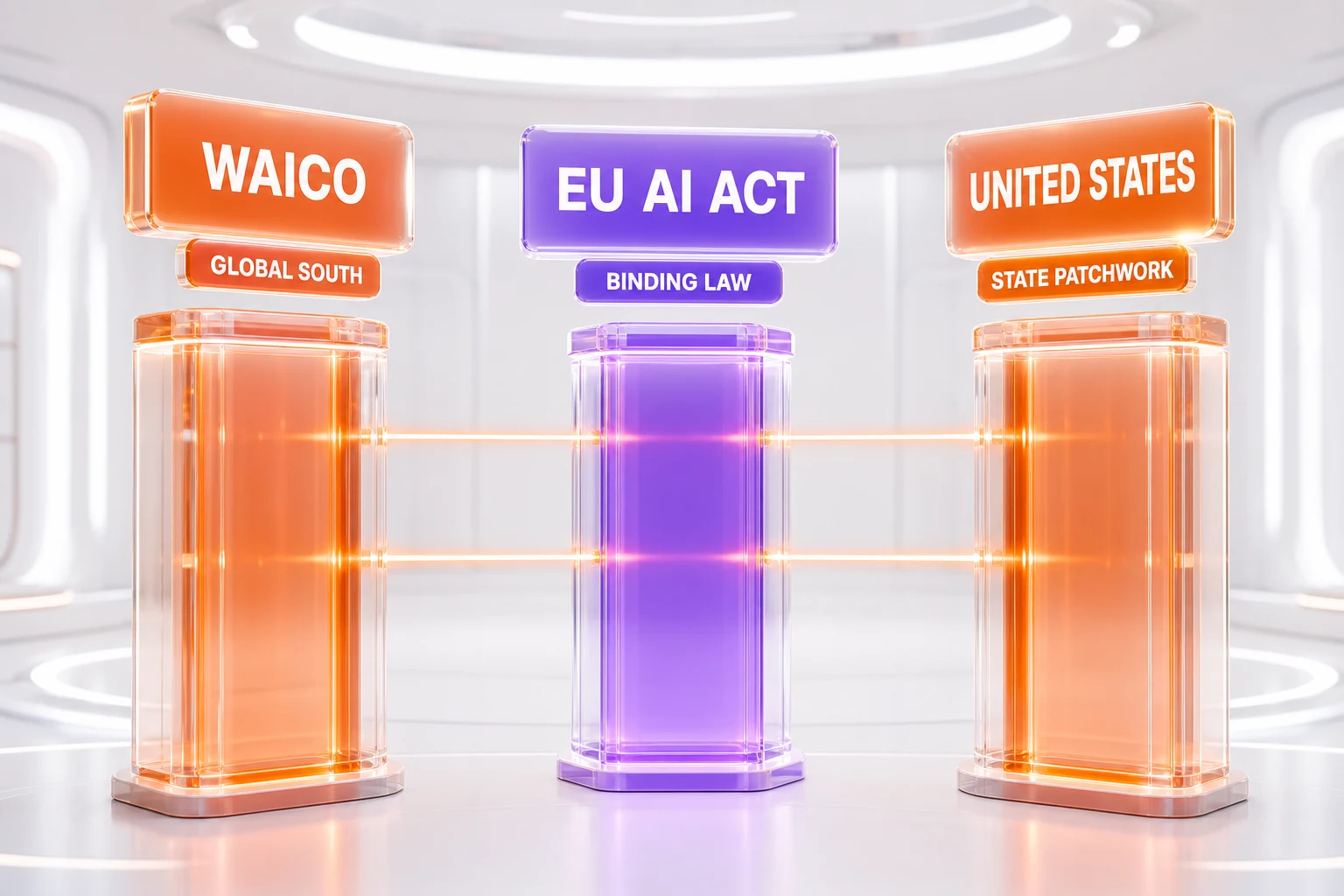
- Three blocs are forming: WAICO now sits alongside the European Union’s binding AI Act and a contested, patchwork US approach as a third pole in the fight over how AI is governed — each with a different center of gravity.
- The open question is substance: WAICO’s charter, secretariat, funding and any enforcement power are not yet public. Whether it becomes a real standards body or a diplomatic signaling platform is the test the next year will settle.
What is the World Artificial Intelligence Cooperation Organization (WAICO)?
WAICO is a new intergovernmental organization for AI cooperation and governance, headquartered in Shanghai and founded by 29 countries on July 16, 2026. Its stated goals, as described by Chinese state media and reporting from the launch, are to promote international cooperation on AI and to develop shared regulation so the technology is “beneficial and safe.” It was created on the eve of the World Artificial Intelligence Conference, the annual Shanghai showcase that ran July 17-20, 2026.
According to Al Jazeera and China’s official gov.cn portal, the body is designed as an independent, membership-based organization open to all sovereign states, with an explicit orientation toward the Global South. Xi announced it in his keynote, titled “Joining Hands to Build a Just and Equitable System for Global AI Governance,” where, per the transcript published by China’s Ministry of Foreign Affairs, he declared that “the World Artificial Intelligence Cooperation Organization (WAICO) has come into being in Shanghai.”
What WAICO is not, at least on the evidence available so far, is a treaty with binding legal force comparable to a domestic statute. Chinese officials have described it as a platform for coordination, capacity-building and consensus — language closer to a standards-and-cooperation forum than to a regulator with the power to levy penalties. That distinction matters, and we return to it below.
Who signed WAICO — and who stayed away
Twenty-nine countries signed the founding agreement, and the roster is the story. Reported founding members include Indonesia, Brazil, Malaysia, South Africa, Senegal, Russia, Pakistan, Kazakhstan and Laos, alongside a wider group of African, Latin American, Central Asian and Southeast Asian states. Chinese Foreign Minister Wang Yi signed on behalf of Beijing, and UN Secretary-General António Guterres attended the conference as a participant — a presence that lends the launch a measure of multilateral optics without implying UN endorsement.
The absence is as notable as the attendance. No member of the G7 — the United States, Japan, Germany, France, the United Kingdom, Italy or Canada — is a founding signatory, and no European Union member state appears on the list. That composition is verifiable from the published roster, and it is what turns WAICO from a generic “AI alliance” into a specific geopolitical statement: a governance body built with the Global South and without the Western democracies that host most of the world’s frontier AI labs.
Indonesia is the founding member most worth watching. As the world’s fourth-most-populous country and the largest economy in Southeast Asia, its participation gives WAICO reach into a strategically contested region and signals that the bloc is not confined to states already aligned with Beijing. Its inclusion is confirmed across multiple accounts of the signing, including Al Jazeera and Shanghai-based Sixth Tone.
What Xi Jinping actually said
Xi’s keynote leaned on the language of inclusion and shared benefit rather than confrontation. Per the Foreign Ministry transcript, he argued that “all countries should take a people-centered approach and develop AI for the positive and for good,” and that nations should “join hands to build a just and equitable system for global AI governance.” He also framed a red line on safety, saying countries should “ensure that AI is always under human control.”
The sharpest passage was aimed, without naming a country, at the logic behind export restrictions. Xi said states “must jointly oppose overstretching the national security concept in the field of AI and placing one country’s security over that of others” — a line most observers connected to US curbs on advanced chips and models. In remarks reported by Al Jazeera and gov.cn, he cast the alternative as collective: AI development, he said, “should not be a solo performance by a single country, but a symphony of international cooperation.” (That phrasing appears in state and international reporting of his speech rather than in the Foreign Ministry’s formal English transcript, so we attribute it to those accounts.)
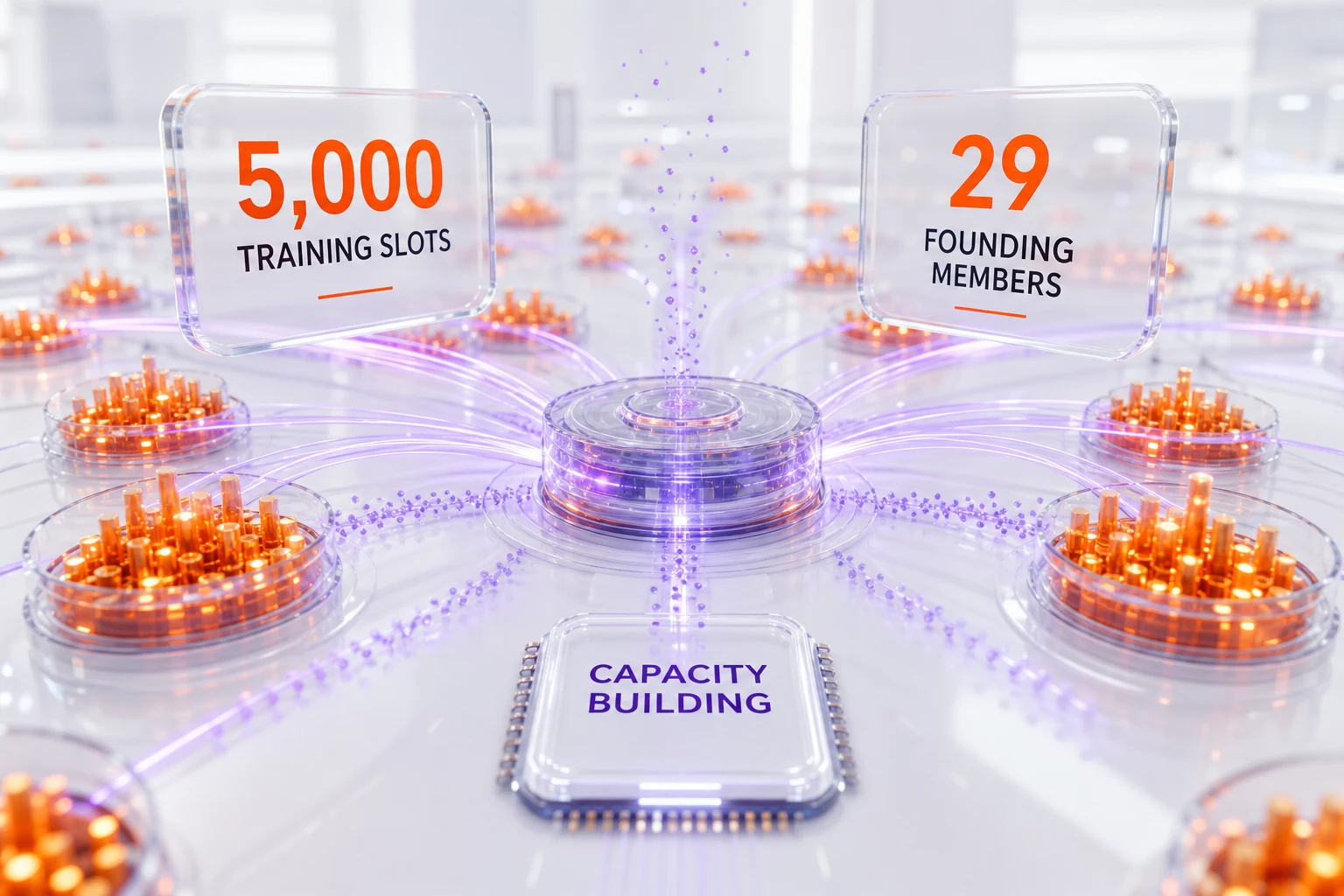
On the concrete side, Xi committed China to provide “developing countries with 5,000 opportunities in AI training and seminar programs,” a capacity-building pledge that mirrors the Global South orientation of WAICO’s membership. State media reported him describing the new organization as an important milestone for AI development. Taken together, the speech paired a values pitch — inclusion, sovereignty, safety under human control — with a material offer to nations that feel locked out of the AI frontier.
Three blocs are taking shape in AI governance
WAICO’s real significance is structural: it hardens a split that had been forming all year into three distinct approaches to governing AI. On one side is the European Union’s AI Act, the world’s first binding horizontal AI law — comprehensive, enforcement-backed, and risk-tiered, though its most demanding high-risk obligations have been pushed to December 2027. On another is the United States, where the direction of travel is the opposite of a single binding standard: a bipartisan push to preempt state AI laws in exchange for a lighter federal framework, a fight over patchwork versus preemption that remains unresolved.
WAICO stakes out a third position. Where the EU leads with binding law and the US leans toward a market-first, innovation-protective posture, Beijing’s pitch is state-centric multilateralism organized around the Global South: cooperation, capacity-building and consensus norms, with sovereignty as the organizing principle rather than either Brussels-style regulation or Washington-style deregulation. Analysts describe this as a deliberate attempt to offer developing nations a governance model that does not run through Western institutions.
None of these blocs is sealed off, and none has won. The EU and the US still coordinate at forums like the G7 — France went as far as to seat an AI CEO at the leaders’ table — and every major player is also present, in some form, at the United Nations. What WAICO changes is the number of tables. For the first time, there is a fully China-anchored governance venue with its own membership, its own launch summit, and its own stated ambition to set global norms.
Why the Global South angle matters
The center of gravity in WAICO is the Global South, and that is not an accident. Many developing countries watch the AI race from the outside: they neither host the labs building frontier models nor sit inside the two regulatory systems — the EU’s and the US’s — that currently set the de facto rules. WAICO’s offer to those states is concrete: a seat at a founding table, plus training, seminars and cooperation that Beijing frames as help closing the AI divide.
That framing has an obvious strategic dimension, and honest analysis should name it. A China-anchored bloc of 29 nations is also a coalition that can move together in other venues, above all at the UN, where numbers translate into influence over norms and standards. Al Jazeera reported that experts expect Beijing to use WAICO to shape AI policy at the United Nations and to advance a “state-centric governance vision of technology” with Global South backing. This is an interpretation, not a stated fact — but it is a well-grounded one, and it lines up with how the launch was staged.
There is a supportive reading too, and it deserves airtime for balance. Wang Tianchan of the Shanghai Institutes for International Studies argued that “an open, cooperative, and pragmatic approach is essential to answering one of the most critical questions today: where should AI go next?” From that vantage, WAICO is less a wedge than a bid to broaden the conversation beyond the handful of countries that have dominated it. Both readings can be true at once: capacity-building for developing nations and strategic positioning for Beijing are not mutually exclusive.
The UN question: whose norms win?
WAICO lands weeks after the United Nations held its first Global Dialogue on AI Governance in Geneva, a universal forum open to every member state but with no binding power of its own. That timing sharpens a live question: which venue ends up setting the world’s AI norms? The UN dialogue has universality and legitimacy but no enforcement; WAICO has a motivated core membership and a clear sponsor but excludes the West; the EU has binding law but limited global reach.
The concern some Western analysts raise is that a cohesive 29-nation bloc could effectively caucus inside UN processes, steering definitions, standards and red lines toward a more state-centric model of technology governance. Whether that materializes depends on cohesion and follow-through — a bloc announced is not a bloc that votes as one. Beijing’s broader posture this year, including its tightening controls on AI talent, shows a government treating AI as a core strategic asset, which makes the governance play consistent with the rest of its policy.
What is still unclear about WAICO
Much of the substance remains unpublished, and it would be a mistake to overstate what launched on July 16. Several things are not yet known: the full text of WAICO’s charter; how its secretariat will be staffed and funded; whether membership carries any binding obligations or is purely voluntary; what, if anything, the body can enforce; and how it will interact with existing UN structures rather than duplicate them. Xi called it a milestone, but a founding ceremony is the start of an institution, not proof of one.
The membership number itself is worth watching. Twenty-nine is a meaningful founding cohort, but it is small next to the roughly 190 states at the UN, and it currently lacks any of the largest advanced economies. If WAICO grows — especially if it pulls in additional middle powers — its claim to shape global norms strengthens. If it stalls at its founding roster, it looks more like a coalition of the already-aligned than a genuinely global governance body. Neither outcome is settled today.
What to watch next
Three signals will show whether WAICO is substance or symbolism. First, the charter and secretariat. Publication of a founding document, a headquarters build-out in Shanghai, and named staff would mark a real institution; their absence would suggest a signaling exercise. Second, the membership trajectory. Whether more countries — particularly non-aligned middle powers — sign on in the months after the launch will indicate real pull versus a fixed bloc. Third, the UN interface. The clearest test of intent is how WAICO members act inside UN AI processes: whether they coordinate positions, and toward what kind of norms.
For now, the honest summary is this. China has done something only a major power can do: convene a founding bloc, host the summit, and put a name and a headquarters on a rival vision of AI governance. It has paired that with a material offer — training and cooperation — that speaks directly to countries the current system leaves out. Whether WAICO becomes a standards-setting force or remains a diplomatic statement will be decided not by its launch, but by what its 29 members build, and how many others decide to join them.
Sources
- Al Jazeera — China’s Xi Jinping launches new AI alliance: What is it? (members, dates, analyst reading)
- Ministry of Foreign Affairs of the People’s Republic of China — Xi Jinping keynote transcript, “Joining Hands to Build a Just and Equitable System for Global AI Governance”
- gov.cn — Xi calls for equitable global AI governance, unveils new cooperation body
- Sixth Tone — China-Proposed Global AI Organization Launched at WAIC (members, analyst comment)
- World Artificial Intelligence Cooperation Organization — founding roster and overview
Frequently Asked Questions
What is WAICO?
WAICO is the World Artificial Intelligence Cooperation Organization, a new intergovernmental body for AI cooperation and governance founded in Shanghai on July 16, 2026. It groups 29 countries and is designed to promote international cooperation on AI and to develop shared regulation. China's President Xi Jinping announced it a day later at the World Artificial Intelligence Conference, and its headquarters will be in Shanghai.
How many countries founded WAICO?
Twenty-nine countries signed the founding agreement on July 16, 2026. Reported founding members include Indonesia, Brazil, Malaysia, South Africa, Senegal, Russia, Pakistan, Kazakhstan and Laos, alongside a wider group of African, Latin American, Central Asian and Southeast Asian states. Chinese Foreign Minister Wang Yi signed on behalf of Beijing.
Is the United States or the European Union a member of WAICO?
No. No member of the G7, including the United States, and no European Union member state appears on WAICO's founding roster. The bloc is oriented toward the Global South, which is what distinguishes it from the EU's binding AI Act and the United States' market-first approach.
Is Indonesia a member of WAICO?
Yes. Indonesia is confirmed as a founding member of WAICO across multiple accounts of the signing, including Al Jazeera and Sixth Tone. As Southeast Asia's largest economy, its participation gives the organization reach into a strategically contested region and signals a membership that extends beyond states already closely aligned with Beijing.
What did Xi Jinping say when he launched WAICO?
In his keynote, Xi said countries should "join hands to build a just and equitable system for global AI governance" and should "ensure that AI is always under human control." He also said states "must jointly oppose overstretching the national security concept in the field of AI," a line widely read as aimed at US export controls, and announced that "the World Artificial Intelligence Cooperation Organization (WAICO) has come into being in Shanghai."
What is the "symphony" quote attributed to Xi Jinping?
Several outlets, including Al Jazeera and China's gov.cn portal, reported Xi saying that AI development "should not be a solo performance by a single country, but a symphony of international cooperation." That exact phrasing appears in reporting of his speech rather than in the Foreign Ministry's formal English transcript, so it should be attributed to those accounts.
What did Xi pledge to developing countries?
Xi committed China to provide developing countries with 5,000 opportunities in AI training and seminar programs. The pledge fits WAICO's Global South orientation and is framed as capacity-building to help narrow the gap between countries that host frontier AI labs and those that do not.
Where is WAICO headquartered and when was it established?
WAICO was formally established on July 16, 2026 and is headquartered in Shanghai. It was created on the eve of the 2026 World Artificial Intelligence Conference, the annual Shanghai event that ran July 17-20, 2026. Xi Jinping unveiled the organization in his keynote on July 17.
How does WAICO compare to the EU AI Act and the US approach?
They represent three different models. The EU AI Act is a binding, enforcement-backed law, though its toughest high-risk rules have slipped to December 2027. The United States is moving toward a lighter federal framework and a fight over preempting state laws. WAICO is a state-centric, cooperation-focused body organized around the Global South, with capacity-building and consensus norms rather than binding penalties disclosed so far.
Did the United Nations endorse WAICO?
No formal endorsement was announced. UN Secretary-General Antonio Guterres attended the World Artificial Intelligence Conference as a participant, which gave the launch multilateral optics, but attendance is not endorsement. WAICO is a separate, China-anchored body, distinct from the UN's own first Global Dialogue on AI Governance held in Geneva earlier in 2026.
Does WAICO have binding legal power?
Not on the evidence available so far. Chinese officials have described WAICO as a platform for cooperation, capacity-building and consensus rather than a regulator that can levy penalties. Its charter, secretariat, funding and any enforcement mechanism have not been made public, so whether membership carries binding obligations remains unclear.
Why does WAICO matter for the future of AI governance?
Because it turns a two-way regulatory split into a three-way contest. For the first time there is a fully China-anchored governance venue with its own membership, launch summit and stated ambition to set global norms, sitting alongside the EU's binding law and the United States' contested approach. Its influence will depend on whether more countries join and how its members act inside UN processes.