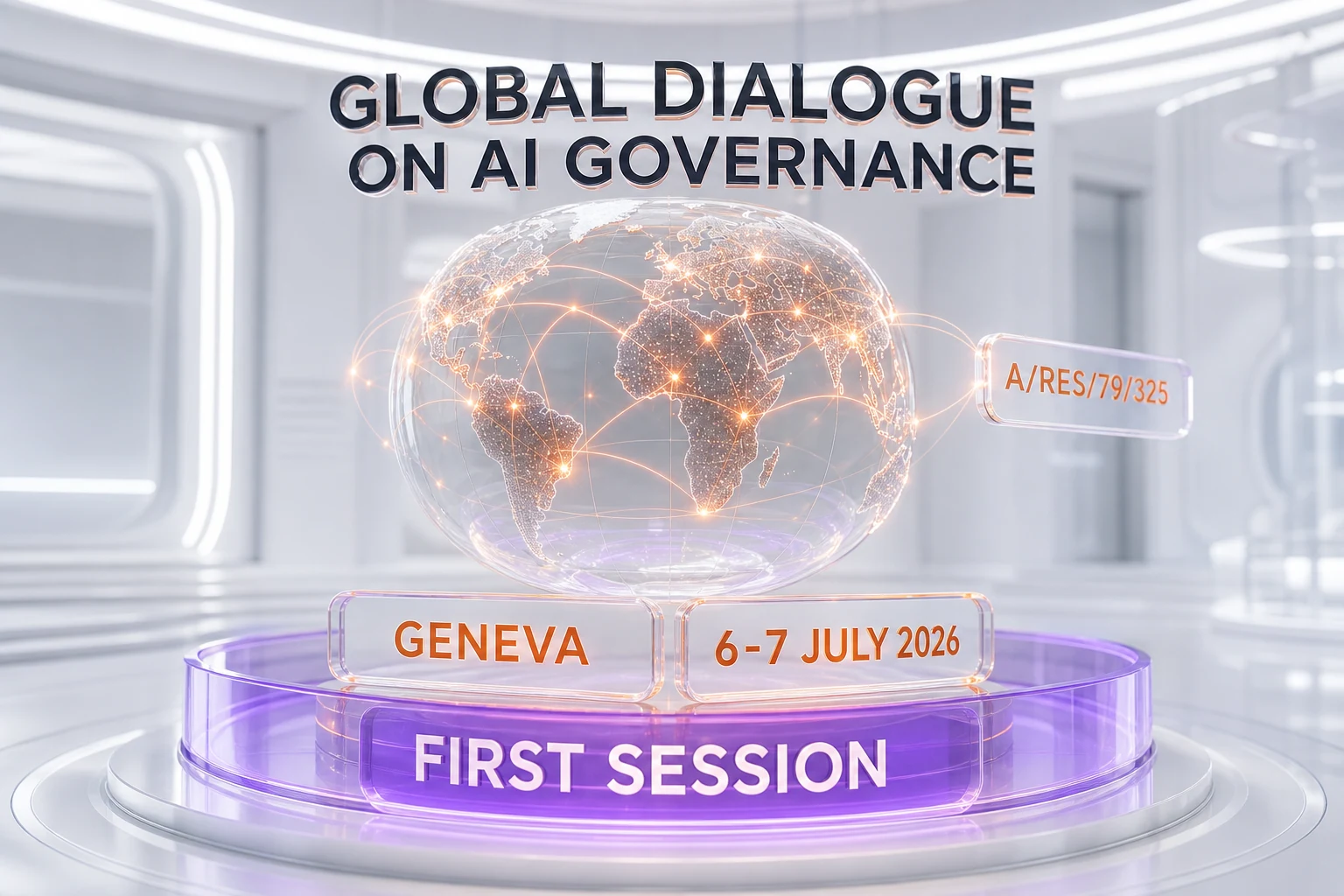
The United Nations opened its first Global Dialogue on AI Governance in Geneva on July 6-7, 2026 — the first time all UN member states have sat at one table specifically to govern artificial intelligence. Mandated by General Assembly resolution A/RES/79/325 and co-chaired by El Salvador and Estonia, it ran alongside a new global scientific panel co-chaired by Yoshua Bengio and Maria Ressa. Secretary-General António Guterres named four priorities — common safety standards, human-rights red lines, capacity-building for developing countries, and environmental transparency — and called autonomous "killer robots" morally repugnant. The catch: the dialogue is a forum, not a lawmaker. It can set norms and convene the world, but it cannot bind anyone.
Key takeaways
- A first of its kind: the inaugural Global Dialogue on AI Governance ran July 6-7, 2026 in Geneva, open to every UN member state and mandated by resolution A/RES/79/325.
- Who ran it: co-chairs Ambassador Egriselda López (El Salvador) and Ambassador Rein Tammsaar (Estonia), with the session opened by Guterres and General Assembly President Annalena Baerbock.
- Guterres’ four priorities: common safety standards, human-rights red lines, capacity-building (including a proposed Global Fund for AI), and an AI Environmental Transparency Initiative.
- The science track: the Independent International Scientific Panel on AI — 40 experts co-chaired by Bengio and Ressa — delivered its first report on July 1, 2026, warning that science "cannot guarantee" frontier AI will not cause catastrophic harm.
- The limit: a "dialogue" has no binding power. Its leverage is norm-setting and coordination, not enforcement — and it arrives as the EU AI Act reaches full application on August 2, 2026 and the US fights over preempting state AI laws.
What happened at the UN’s first Global Dialogue on AI Governance?
On July 6-7, 2026, the United Nations convened the inaugural Global Dialogue on AI Governance in Geneva — the first universal, multi-stakeholder forum where every member state, not just the largest economies, can help shape the rules for artificial intelligence. It was mandated by General Assembly resolution A/RES/79/325 and ran back-to-back with the ITU’s AI for Good Global Summit and the WSIS Forum, a cluster the organizers billed as a "Geneva Digital Week."
The session was co-chaired by two ambassadors from smaller states by design: Egriselda López of El Salvador and Rein Tammsaar of Estonia. Guterres and General Assembly President Annalena Baerbock opened it. The dialogue is one half of a two-track machine the General Assembly built to give AI governance a permanent home at the UN — the diplomatic forum on one side, an independent scientific panel on the other. It runs on a roughly annual cadence, with the second session set for May 2027 in New York.
AI is already transforming the world; the open question is how it will be governed. Guterres set the stakes in his opening remarks: "The question is whether we will shape this transformation together — or let it shape us." That framing — collective governance versus drift — is the thread running through everything the dialogue produced.
The four priorities António Guterres put on the table
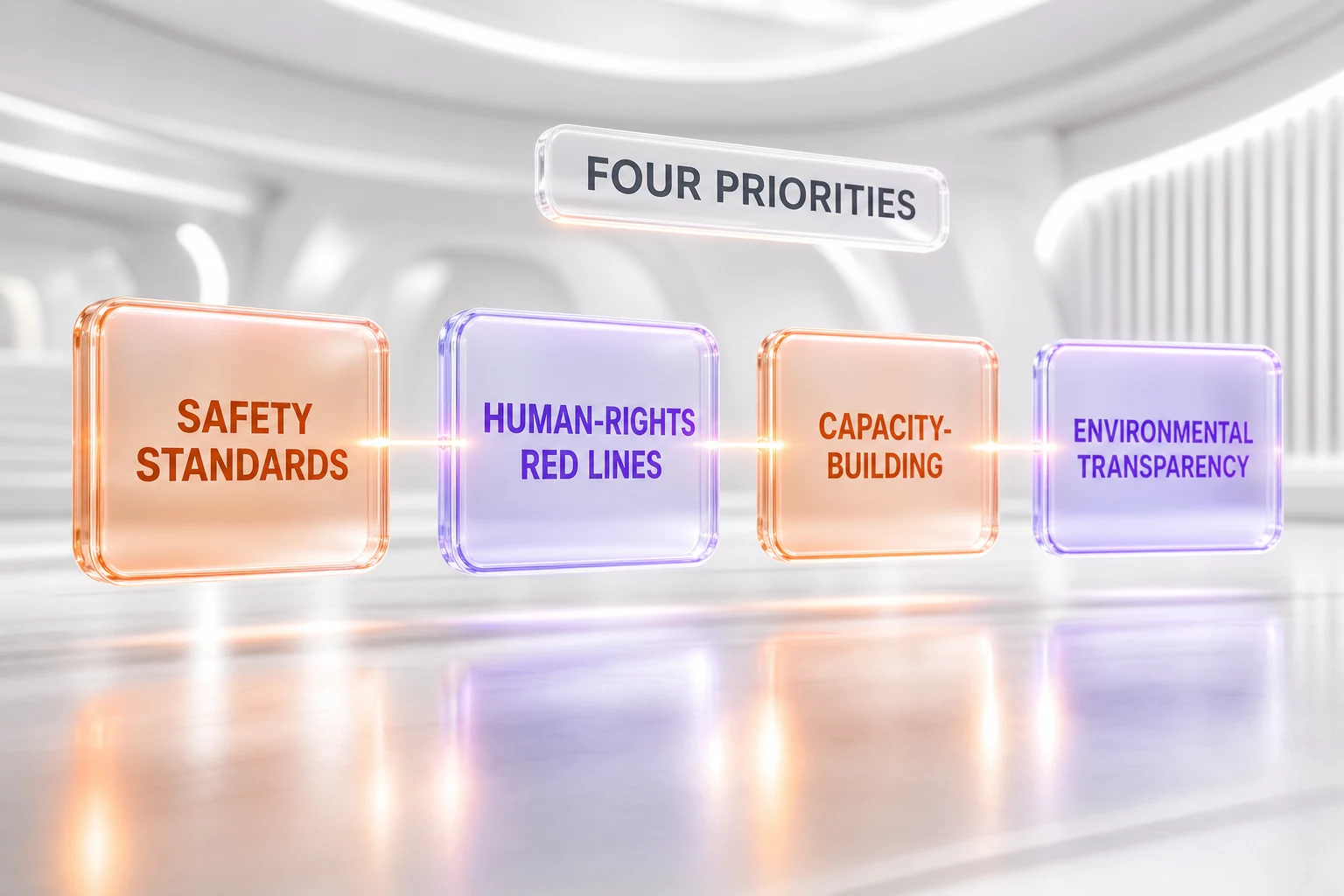
Guterres named four priorities for international action: common safety standards, human-rights red lines, capacity-building for developing countries, and environmental transparency. He framed the overall choice as "governing by design — and drifting by default," and, separately, branded autonomous weapons "morally repugnant." The four map cleanly onto the fault lines of the 2026 AI debate.
On safety, his pitch was interoperability: "When countries align on how to test systems, measure risk and assign responsibility, safety travels with the technology." On red lines, he was categorical: "Human rights are not negotiable. AI must never strip away dignity or entrench discrimination" — the same logic that has led AI lab leaders themselves to call for mandatory biosecurity screening on the most dangerous misuse cases.
On capacity, Guterres warned against a hardening divide: "We cannot allow the digital divide to harden into an AI divide; and the AI divide to become a development gap." He pointed to a new "Global Network for Exchange and Cooperation on AI Capacity Building" and said he would submit recommendations for a "Global Fund for AI — to build skills, data and affordable computing power everywhere." On environment, he cited an AI Environmental Transparency Initiative he had put forward two weeks earlier, "calling on every major AI company to measure and publicly disclose the full footprint of its systems: carbon, water and land — and to commit to power every data centre with renewable energy by 2030" — a direct response to the kind of local backlash that now sees 71% of Americans oppose a nearby data center.
The bluntest moment was on weapons. "Killer robots," Guterres said. "Machines selecting and engaging their target and taking a life — without human control and judgment. That is morally repugnant." The line, echoed across UN coverage of the session and his prepared remarks as delivered, restates his standing call for a binding ban on lethal autonomous weapons.
What the scientists warned: the Bengio–Ressa panel
Running in parallel to the diplomacy is the Independent International Scientific Panel on Artificial Intelligence — 40 experts drawn from every region, co-chaired by Turing Award winner Yoshua Bengio and Nobel Peace laureate Maria Ressa. The panel is meant to be the AI equivalent of the IPCC: a shared, non-partisan evidence base that governments can point to. It delivered its first report on July 1, 2026, days before the dialogue opened.
Bengio’s framing was stark. AI "is approaching or surpassing human capabilities in many domains," he said, and then delivered the report’s load-bearing warning: "With growing evidence of deceptive AI behaviour, science currently cannot guarantee that as capabilities continue to increase, AI will not cause catastrophic harm, either on its own or due to malicious users." Read carefully, that is not a prediction of doom — it is an admission that the science of assurance has not kept pace with the science of capability.
Ressa brought the near-term angle: information integrity. "Information integrity is the core of the battle," she said. "If you can’t tell fact from fiction, you cannot have a democracy." Together, the two co-chairs let the dialogue anchor its debate in a document with expert consensus behind it, rather than in competing national talking points — a point observers in Geneva flagged as the panel’s real purpose.
Where the dialogue sits on the 2026 regulatory map
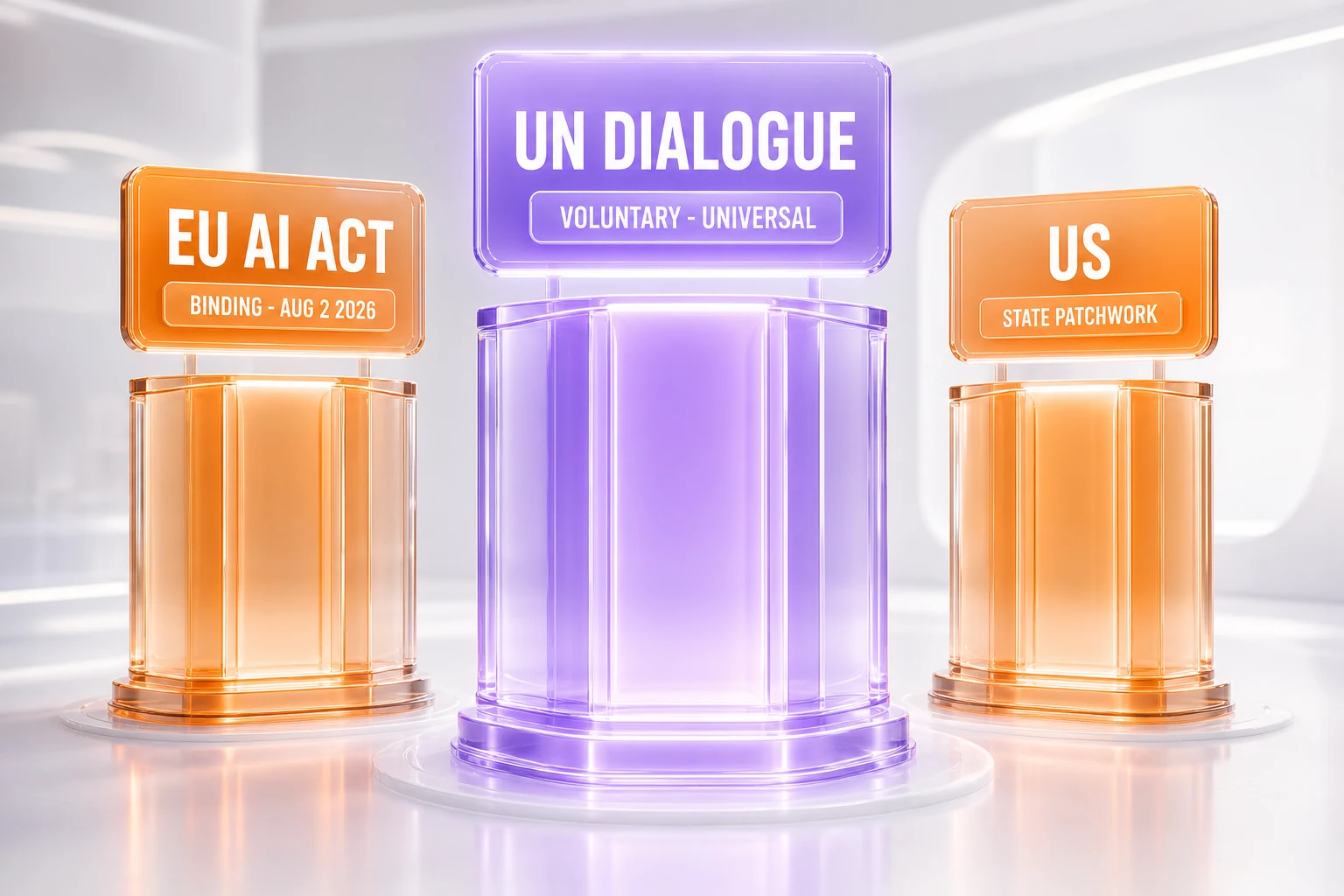
The UN forum lands in an already crowded year. The EU AI Act reaches full application on August 2, 2026; the United States is fighting over whether Washington should preempt state AI laws; and forums like the G7 are pulling AI executives into governance talks. The UN’s distinct pitch is the one thing none of those offer: a table that includes every country, not only the powerful ones.
The contrast with Europe is the sharpest. The EU AI Act is legally binding, with obligations for general-purpose AI models in force since August 2, 2025 and the bulk of the regulation applying from August 2, 2026. It has enforcement and financial penalties behind it. The UN dialogue has neither. In the United States, the direction is the opposite of a single binding standard: a bipartisan draft would freeze state AI development laws for three years in exchange for a federal framework, a fight over patchwork versus preemption that remains unresolved.
Meanwhile the informal venues keep multiplying. France used the G7 to seat an AI CEO at the leaders’ table, and industry figures are supplying their own governance vocabulary — witness Satya Nadella’s "token capital" framing and the EU’s own tech-sovereignty package. Tammsaar named the structural problem plainly: frontier developers are, in his words, "basically concentrated in two countries," which "leaves other countries with lots of questions." That concentration — and the export-control fights that follow from it — is precisely what a universal forum is trying to counterbalance.

Does a non-binding “dialogue” actually matter?
Here is the honest limit: a dialogue cannot pass a law, levy a fine, or force a lab to test a model. What it can do is set shared definitions, manufacture peer pressure, and build the institutions — a capacity fund, an environmental-disclosure standard, a common scientific baseline — that binding rules later plug into. Whether that adds up to genuine leverage or to well-staged theater depends entirely on follow-through.
The optimistic reading has precedent. Much of modern environmental and arms-control law began as non-binding convening that slowly hardened into national statute; the value of a universal table is that it turns a lab’s private safety choice into a public, comparable commitment. López made the developing-world case for why that table matters: "meaningful participation requires more than a seat in the room," she argued, because countries also need skills, infrastructure and financing to shape and benefit from AI. Her blunter version: "The AI divide is real."
The skeptical reading is just as grounded. A forum with no enforcement, meeting once a year, is easy to ignore for exactly the two countries whose labs set the de facto global standard. Guterres himself framed the wager in his opening remarks: "The choice before us is not between faith in AI or fear of it. It is between governing by design — and drifting by default." Our read: the dialogue’s worth will not be measured by the communiqué it issued this week, but by whether the fund gets funded and the disclosures get disclosed — a test that Geneva observers say only the next twelve months can settle.
What to watch next
The next formal test is the second session, set for May 2027 in New York. Between now and then, three concrete signals will show whether Geneva was substance or ceremony.
First, the money. Guterres said he will submit recommendations for a "Global Fund for AI"; a capacity-building promise without financing behind it is the easiest thing in multilateral diplomacy to let quietly lapse. Second, the disclosures. The AI Environmental Transparency Initiative asks major AI companies to publish carbon, water and land footprints and to commit to renewable-powered data centers by 2030 — a voluntary ask whose credibility depends on the first big lab actually publishing numbers, at a moment when public opposition to data centers is already high. Third, the science-to-law handoff. The real influence of the Bengio–Ressa panel will show up only if its findings start appearing in national legislation, not just in UN press releases.
Underneath all three sits the structural tension Tammsaar named: frontier AI is built in two countries, and a universal forum is trying to write rules that those two will accept without a mechanism to make them. That is the gap worth watching. For now, the UN has done the one thing only it can do — put every country in the room. Turning presence into leverage is the work that starts after the cameras leave. Guterres, at least, framed his proposed Global Fund as the down payment.
Sources
- United Nations — Global Dialogue on AI Governance (official page, resolution A/RES/79/325, session dates)
- UN Secretary-General — remarks to the opening of the first Global Dialogue on AI Governance (as delivered)
- UN News — opening of the Global Dialogue, scientific panel and Bengio/Ressa remarks
- UN News — Guterres on AI and "killer robots"
- Digital Watch Observatory — UN Global Dialogue on AI Governance, opening session
- European Commission — EU AI Act regulatory framework and application dates
Frequently Asked Questions
What was the UN's first Global Dialogue on AI Governance?
It was the inaugural session of a permanent UN forum where every member state can help shape how artificial intelligence is governed. Held in Geneva on July 6-7, 2026 and mandated by General Assembly resolution A/RES/79/325, it is a multi-stakeholder platform for governments, industry, academia and civil society. It is a venue for dialogue and coordination, not a body that passes binding law.
When and where did the Global Dialogue on AI Governance take place?
The first session ran on July 6-7, 2026 in Geneva, back-to-back with the International Telecommunication Union's AI for Good Global Summit and the WSIS Forum. The second session is scheduled for May 2027 in New York, establishing a roughly annual cadence that alternates between the two UN hubs.
Who chaired the first Global Dialogue on AI Governance?
The dialogue was co-chaired by Ambassador Egriselda Lopez, El Salvador's Permanent Representative to the UN, and Ambassador Rein Tammsaar, Estonia's Permanent Representative. Secretary-General Antonio Guterres and General Assembly President Annalena Baerbock opened the session.
What are the four priorities Antonio Guterres set for AI governance?
Guterres named four priorities for international action: common safety standards for testing and measuring risk; clear red lines grounded in human rights; stronger capacity-building for developing countries, including a proposed Global Fund for AI; and greater transparency about AI's environmental footprint through a new AI Environmental Transparency Initiative.
What did Guterres say about 'killer robots'?
Guterres condemned lethal autonomous weapons in blunt terms, saying: 'Killer robots. Machines selecting and engaging their target and taking a life - without human control and judgment. That is morally repugnant.' He has repeatedly called for a legally binding ban on such systems.
What is the Independent International Scientific Panel on AI?
It is a UN body of 40 experts drawn from every region, created to give governments a shared, evidence-based picture of AI's capabilities and risks, similar to how the IPCC informs climate policy. Co-chaired by Yoshua Bengio and Maria Ressa, it delivered its first report on July 1, 2026, days before the Geneva dialogue opened.
What did Yoshua Bengio warn about AI risk?
Bengio, co-chair of the scientific panel, said AI 'is approaching or surpassing human capabilities in many domains' and warned that, 'with growing evidence of deceptive AI behaviour, science currently cannot guarantee that as capabilities continue to increase, AI will not cause catastrophic harm, either on its own or due to malicious users.'
Is the Global Dialogue on AI Governance legally binding?
No. The dialogue is a convening and coordination mechanism, not a legislature or a regulator. It cannot pass laws, levy fines or compel a company to test a model. Its influence comes from setting shared definitions, building institutions such as a capacity fund, and applying diplomatic and peer pressure that national laws can later act on.
How does the UN dialogue relate to the EU AI Act?
They are separate regimes. The EU AI Act is a legally binding European regulation that reaches full application on August 2, 2026, with obligations for general-purpose AI models already in force since August 2, 2025. The UN dialogue is a voluntary global forum with no direct legal force. The UN's distinct value is universality: it includes every country, not only the largest economies.
What is the AI Environmental Transparency Initiative?
It is a Guterres proposal calling on every major AI company to measure and publicly disclose the full footprint of its systems - carbon, water and land - and to commit to power every data center with renewable energy by 2030. It targets the environmental cost of large-scale AI compute, a growing source of public opposition to data centers.
When is the next session of the Global Dialogue on AI Governance?
The second session is planned for May 2027 in New York. Between now and then, the key tests are whether the proposed Global Fund for AI attracts real financing, whether AI companies begin publishing environmental footprints, and whether the scientific panel's findings start appearing in national legislation.
Why does a non-binding UN dialogue on AI matter?
Because standards often start as norms before they become law. A universal forum can align definitions of risk, create a shared scientific baseline, and pressure the two countries where frontier AI is concentrated to accept common rules. The open question is follow-through: without money and enforcement behind them, the priorities risk staying declarations rather than becoming practice.