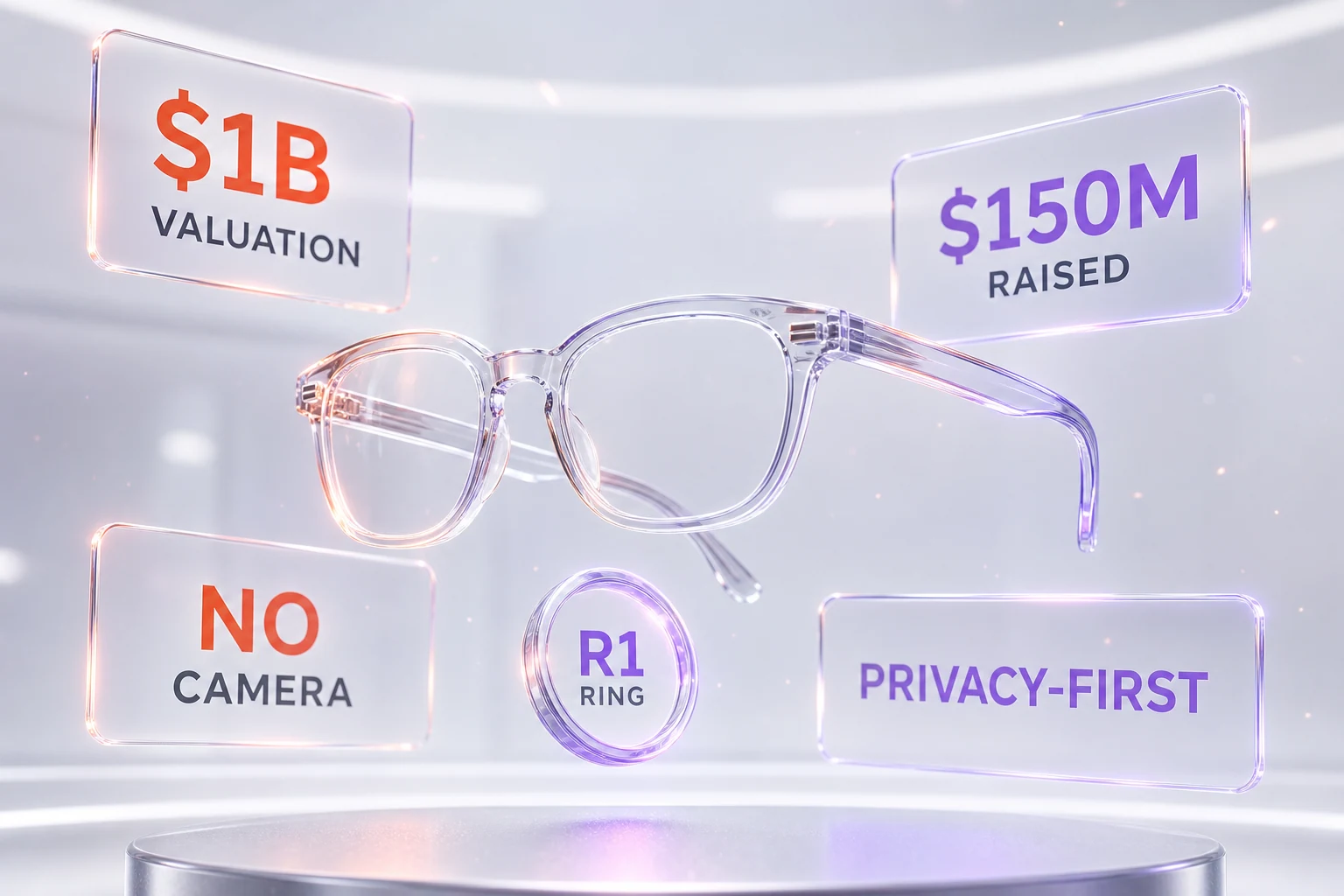
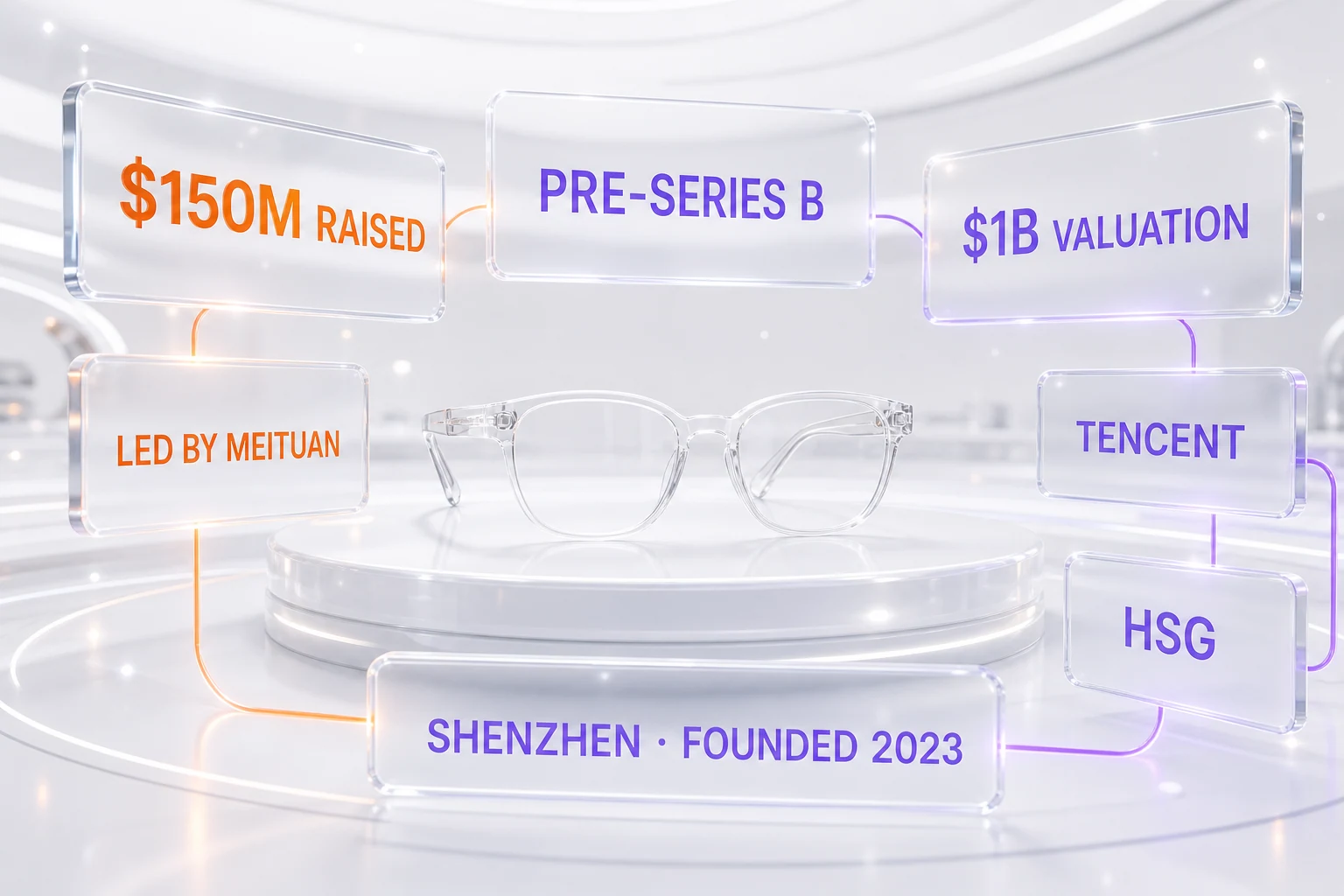
Quick Take — Even Realities, a Shenzhen-based smart-glasses startup founded in 2023, has raised $150 million in a pre-Series B round that values it at $1 billion, the company announced on July 6, 2026. The round was led by Meituan and joined by previous backer Tencent and HSG, the firm formerly known as Sequoia China. Even's pitch is the mirror image of the market leader: its flagship Even G2 has no camera at all, projecting a heads-up display into the lenses and taking commands from a companion ring rather than a lens-mounted sensor. That makes it the most credible camera-free challenger yet to Meta, which research firms place far in front — IDC put Meta at 69.2% of global smart-glasses shipments in the first quarter of 2026, while Counterpoint Research reported 82% for the second half of 2025.
Key takeaways:
- Even Realities raised $150 million at a $1 billion valuation (pre-Series B), announced July 6, 2026, led by Meituan with Tencent and HSG participating.
- The differentiator is subtraction: the Even G2 has no camera, unlike the camera-equipped Ray-Ban Meta line. Even calls its category "display-first" glasses.
- Chinese consumer-internet money is now underwriting the challenge — Meituan and Tencent bring capital, cloud, and distribution, not just a check.
- Meta's lead is enormous and independently measured: IDC 69.2% (Q1 2026) and Counterpoint 82% (H2 2025). Even has sold north of 10,000 pairs — a rounding error against Meta's quarterly millions.
- The strategic question is whether "no camera" is a durable moat or a niche — privacy-first appeals to executives, but it also removes the point-of-view capture that drives Meta's mainstream appeal.
What Happened: A $150 Million Round at a $1 Billion Valuation
Even Realities raised $150 million in a pre-Series B round that values the three-year-old company at $1 billion, according to reporting by TechCrunch and CNBC on July 6, 2026. The raise was led by Meituan — better known as China's largest food-delivery platform — with participation from Tencent, an existing investor, and HSG, the investment firm formerly branded Sequoia China.
The company says the money will fund its next-generation glasses platform, deeper AI integration, and a global scale-up. That framing matters because Even is not a lab experiment: it launched its first product in 2024 and, per TechCrunch, became the first company in its category to sell more than 10,000 pairs. Headcount has grown from roughly 30 to 40 people in 2024 to somewhere between 300 and 400 today, and SiliconANGLE confirmed the round's headline terms and the $599 price of the flagship frames.
A $1 billion valuation puts Even in the same unicorn conversation as this year's other breakout hardware and AI stories — a reminder that the capital chasing wearable computing has not cooled. It arrives the same month we covered India's Sarvam crossing into unicorn territory, and it fits a 2026 pattern of large, strategically motivated rounds rather than pure financial bets.
The No-Camera Bet: Privacy as the Product
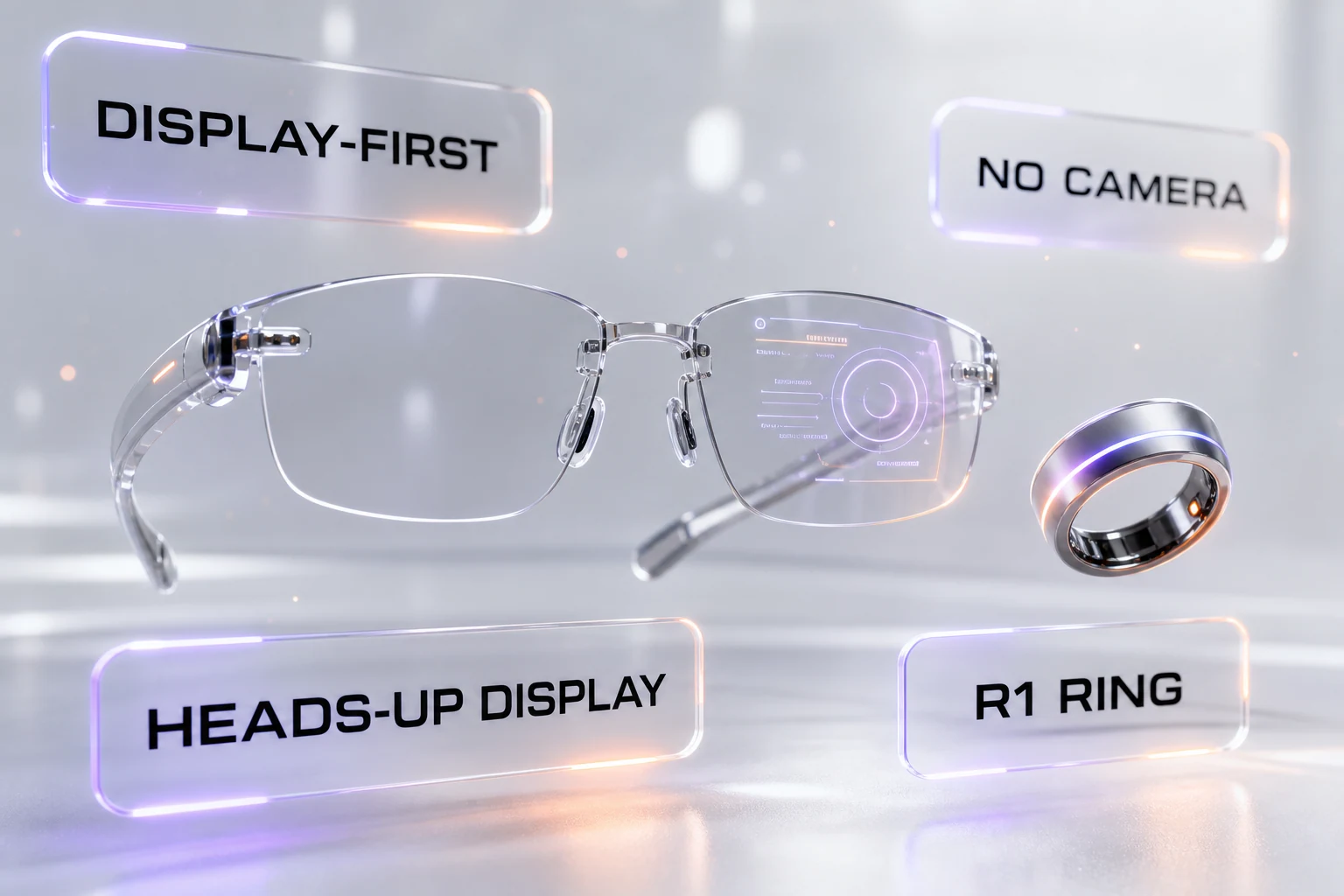
Even's entire proposition rests on a feature it deliberately left out: the camera. The flagship Even G2 is what the company calls "everyday display smart glasses" — thin frames with a dual-layer MicroLED display that projects a 3D heads-up interface into the wearer's line of sight, with no lens-mounted camera to record the world back. Control happens through the Even R1, a companion smart ring, rather than a touch bar or a camera gesture.
That is the opposite of the design that made smart glasses mainstream. The Ray-Ban Meta line built its appeal on capture — photos, video, and live point-of-view streaming — which is also exactly what makes bystanders uneasy. By removing the camera, Even removes the social friction: there is no recording light to distrust, and nothing to point at a stranger. Features such as Conversate (real-time conversation assistance), Translate, Transcribe, and Teleprompt lean into utility that never needs to film anyone.
Is subtraction a real moat, though? The honest answer is that "no camera" is a positioning bet as much as an engineering one. It is trivially easy for a rival to ship a model with the camera disabled or omitted; the harder-to-copy assets are Even's display stack and its eyewear credibility — two of its co-founders came from luxury-eyewear houses, including Lindberg. Privacy is a strong wedge, especially as scrutiny of always-on capture intensifies. We saw the backlash dynamic up close when Facebook's AI Mode turned public posts into a search engine; a face-worn camera raises the same anxieties, only in physical space.
Why Meituan and Tencent Are Writing the Checks
The investor list is the tell. Meituan leading a smart-glasses round is not obvious until you remember that China's consumer-internet giants treat frontier hardware as strategic infrastructure, not a side quest. A stake in the category's privacy-first standout gives Meituan and Tencent a hedge on where wearable computing goes next, plus a natural channel: Tencent's platforms and payments, and Meituan's enormous local-commerce footprint, are exactly the distribution rails a hardware startup cannot build alone.
It also rhymes with a broader 2026 theme of Chinese capital consolidating around category leaders. The same establishment logic drove the syndicate behind Kling AI's multibillion-dollar video round and shaped DeepSeek's first external raise: back the domestic winner, route its compute and reach through your own pipes, and avoid being locked out. HSG's presence — the rebranded Sequoia China — adds a marquee venture name to what is otherwise a strategic cap table, as TechCrunch reported and CNBC framed as an explicit bet on a Meta rival.
There is a founder story underneath the money, too. According to TechCrunch, Even was started in 2023 by CEO Will Wang, who worked on the Apple Watch and iPhone at Apple, alongside co-founders drawn from tech and luxury eyewear. That blend — Apple product discipline plus eyewear craftsmanship — is the pedigree investors are paying for.
The Meta Wall: How Big Is the Lead, Really?
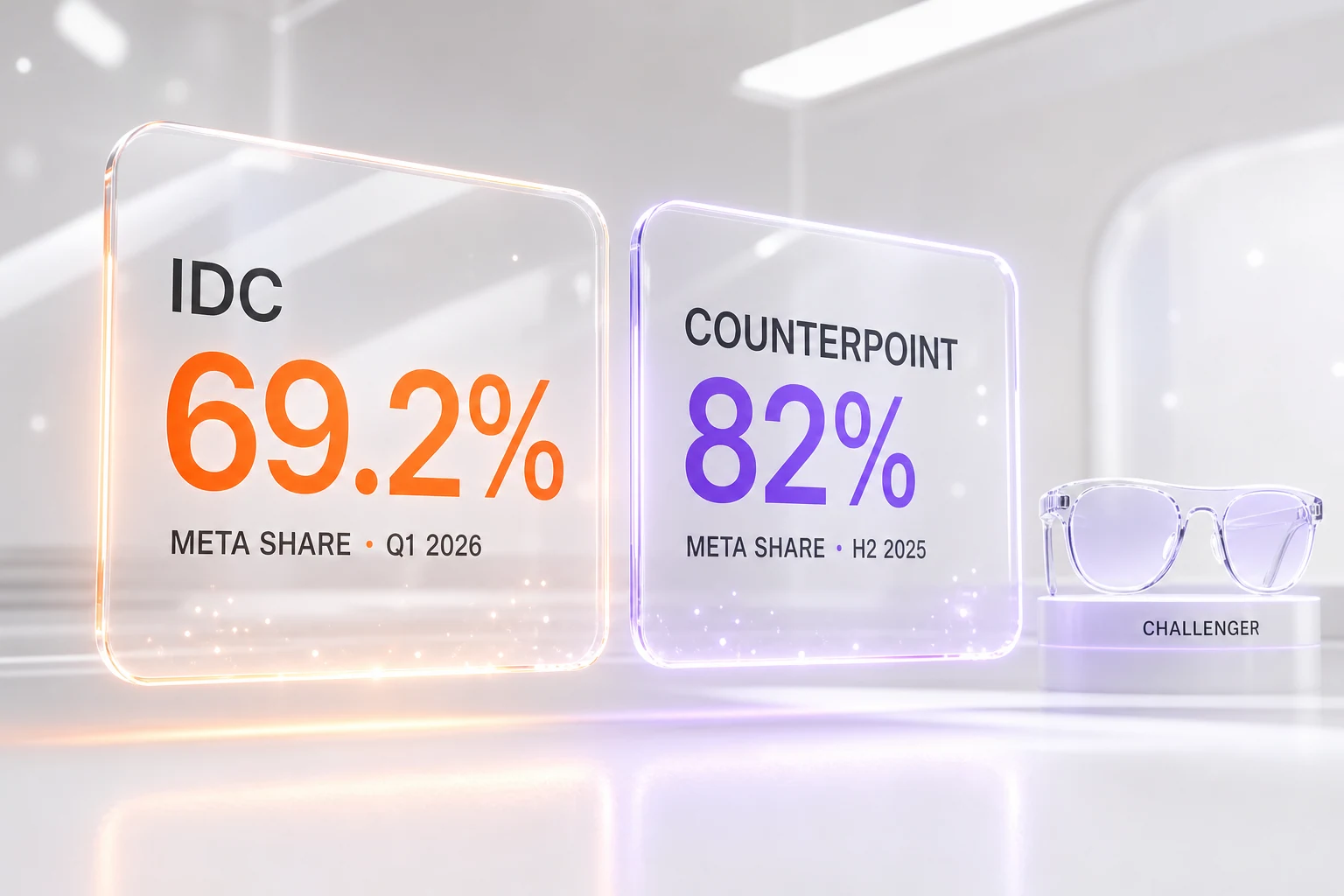
Any "Meta rival" framing has to reckon with the scoreboard, and the scoreboard is lopsided. IDC put Meta at 69.2% of global smart-glasses shipments in the first quarter of 2026, while Counterpoint Research reported an even higher 82% share for the second half of 2025. The two firms measure different windows and methodologies, so treat them as a range — but both point to the same reality: one company owns the overwhelming majority of the market.
That dominance is not an accident. Meta's EssilorLuxottica partnership hands it the Ray-Ban and Oakley brands, retail distribution, and manufacturing scale that no startup can match on day one. The category is also expanding fast, which cuts both ways: IDC tracked roughly 167% year-over-year growth in the first quarter of 2026, and Counterpoint logged 139% growth in H2 2025 with AI-enabled models making up the bulk of shipments. A market growing that quickly leaves room for challengers — but it is also a market Meta is scaling into faster than anyone, and one it is monetizing beyond hardware, as we noted when Meta put a price tag on its first AI agent.
Can It Actually Dent Meta?
Realistically, Even Realities is not going to take share from Meta in units any time soon — and that is probably the wrong scoreboard to watch. Even has sold in the tens of thousands cumulatively; using IDC's numbers, Meta ships well over a million units in a single quarter. On price, Even's $599 frames — and an average order closer to $1,000 once buyers add prescription lenses or the R1 ring — sit at the premium end, above Meta's mass-market Ray-Ban pricing. On distribution, Even has nothing resembling EssilorLuxottica's retail network. By the metrics that decide mass markets, this is not a fair fight.
The more interesting question is whether Even can own a defensible segment rather than the whole market. Its demographics hint at one: TechCrunch reports that more than half of Even's users are in the United States, that they skew toward male professionals aged 30 to 50, and that roughly a third are company executives. That is a high-value, privacy-sensitive niche — people who want a discreet teleprompter, live translation, and meeting transcription without wearing a camera into a boardroom. If Even becomes the default "serious professional's" display glasses, it can build a real business at $1,000 orders without ever touching Meta's volume.
The risk is the mirror image of the opportunity. "No camera" is a clean story today, but if the mainstream decides capture is the killer feature, Even is selling against the grain — and Meta can wall off the premium end simply by shipping a privacy mode or a camera-free SKU of its own. A challenger that wins on a single omitted component is always one product decision away from having its wedge copied. Meituan and Tencent's capital buys time to turn positioning into a durable platform; whether Even converts it is the open question.
Our Take: A Real Challenger, on a Narrower Board
Our read is that Even Realities is the first genuinely credible answer to "who can challenge Meta in smart glasses?" — with an asterisk. It is credible because it has a differentiated product people actually buy, a founder with Apple hardware pedigree, and now a war chest and strategic backers to scale. The asterisk is that "challenge" here means owning a premium, privacy-first segment, not out-shipping a company that IDC and Counterpoint both measure in the 70% to 80% range.
That is still a meaningful outcome. The smart-glasses market does not need a Meta killer to get more interesting; it needs a second design philosophy with the money to prove itself, and Even is now that. The bet worth tracking is not market share next quarter — it is whether camera-free, executive-grade glasses become a category of their own, funded by the two Chinese giants who just decided that was worth $150 million. For the full field of what smart glasses can and cannot do in 2026, the numbers from IDC's shipment tracker and SiliconANGLE's coverage are the place to start.
Frequently Asked Questions
How much did Even Realities raise and at what valuation?
Even Realities raised $150 million in a pre-Series B round that values the company at $1 billion, announced on July 6, 2026. The Shenzhen-based startup, founded in 2023, said the capital will fund its next-generation glasses platform, deeper AI integration, and a global scale-up.
Who led Even Realities' funding round?
The round was led by Meituan, China's largest food-delivery platform, with participation from Tencent — an existing backer — and HSG, the firm formerly known as Sequoia China. TechCrunch and CNBC reported the terms on July 6, 2026.
Do Even Realities glasses have a camera?
No. The flagship Even G2 has no camera at all, which is the company's core differentiator against camera-equipped rivals like the Ray-Ban Meta line. Even calls its category "display-first" and positions the absence of a camera as a privacy feature.
What is the Even G2 and how does it work without a camera?
The Even G2 is Even Realities' flagship "everyday display smart glasses." Instead of a camera, it uses a dual-layer MicroLED display to project a 3D heads-up interface into the lenses, and it is controlled by the Even R1 companion smart ring rather than by camera gestures.
How much do Even Realities glasses cost?
The Even G2 frames retail for $599 before tax. According to TechCrunch, the average order is closer to $1,000 once buyers add prescription lenses or the R1 ring, placing Even at the premium end of the smart-glasses market.
Who founded Even Realities?
According to TechCrunch, Even Realities was founded in 2023 by CEO Will Wang, who worked on the Apple Watch and iPhone at Apple. Two of his co-founders came from luxury-eyewear companies, including Lindberg, blending Apple product discipline with eyewear craftsmanship.
Why are Meituan and Tencent backing a smart-glasses startup?
China's consumer-internet giants treat frontier wearables as strategic infrastructure. Beyond capital, Meituan and Tencent bring cloud, payments, and distribution that a hardware startup cannot build alone, and a stake hedges their position in where wearable computing goes next.
How dominant is Meta in the smart-glasses market?
Meta holds the overwhelming majority of the market. IDC put Meta at 69.2% of global smart-glasses shipments in the first quarter of 2026, while Counterpoint Research reported 82% for the second half of 2025. Its EssilorLuxottica partnership supplies the Ray-Ban and Oakley brands, retail, and scale.
How is Even Realities different from Ray-Ban Meta?
The Ray-Ban Meta glasses are built around a camera for photos, video, and point-of-view streaming. The Even G2 removes the camera entirely and focuses on a heads-up display for tasks like translation, transcription, and teleprompting, targeting privacy-conscious professionals rather than capture-first consumers.
Has Even Realities sold many glasses?
Even launched its first product in 2024 and, per TechCrunch, became the first company in its category to sell more than 10,000 pairs. That is a strong start for a premium newcomer, but small next to Meta, which IDC data implies ships well over a million smart glasses in a single quarter.
Can Even Realities actually challenge Meta?
Not on units in the near term — Meta's 69.2% (IDC) to 82% (Counterpoint) share and EssilorLuxottica distribution are out of reach. Even's realistic path is owning a premium, privacy-first segment of executives and professionals, where camera-free glasses and $1,000 average orders can build a real business without matching Meta's volume.
What is Conversate on Even Realities glasses?
Conversate is Even's real-time conversation assistant, one of the software features that runs on the Even G2's heads-up display. It helps wearers follow speech in noisy environments or on stage, alongside Translate, Transcribe, and Teleprompt — utilities designed to work without ever filming anyone.
Sources
- TechCrunch — Smart glasses maker Even Realities hits $1B valuation with $150M funding led by Meituan, Tencent
- CNBC — Apple veteran's Chinese smart-glasses firm becomes unicorn as Tencent, Meituan fund rival to Meta
- SiliconANGLE — Smart glasses startup Even Realities raises $150M
- Even Realities — Official site (Even G2, Even R1, Conversate)
- IDC — Smart Glasses Market 2026 (Meta 69.2% share, Q1 2026)
- Counterpoint Research — Global Smart Glasses Shipments Grew 139% YoY in H2 2025 (Meta 82%)