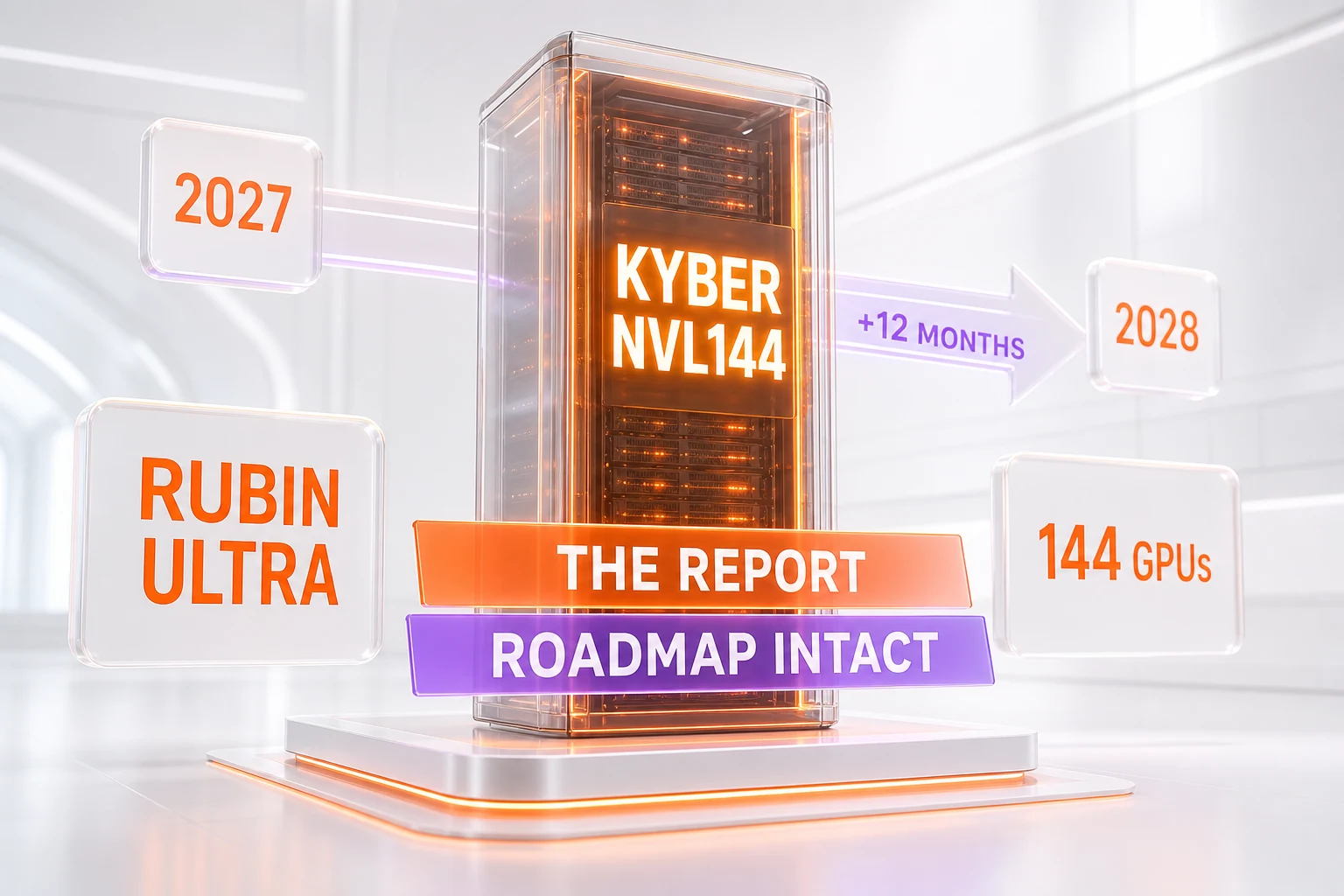
Quick Take: NVIDIA's Kyber NVL144 — the rack that packs 144 Rubin Ultra GPUs into a single NVLink domain — is at the center of a July 6, 2026 report from the research firm SemiAnalysis claiming the system has slipped more than 12 months, from 2027 to 2028, because the PCB midplane at the heart of the design is too hard to manufacture without defects. NVIDIA disputes it: a spokesperson told Bloomberg its "road map is intact," and the company says its base Rubin systems are already in full production. Both statements can be true at once, because the report targets the high-end Rubin Ultra rack, not the standard Rubin platform NVIDIA is shipping this fall. For now the delay is a credible but unconfirmed supply-chain report, not an NVIDIA-acknowledged schedule change.
Key Takeaways
- SemiAnalysis reported on July 6, 2026 that Kyber NVL144 slips more than 12 months to 2028, blaming manufacturing yield on the rack's PCB midplane.
- NVIDIA pushed back the same day, telling Bloomberg its "road map is intact" and noting existing Rubin systems are in full production, with deliveries to eight cloud customers due this fall.
- The report concerns Rubin Ultra — the 2027 high-end rack — not the base Vera Rubin platform NVIDIA is shipping in 2026, a distinction that lets both sides be technically correct.
- Asian board and substrate suppliers sold off hard: Kingboard Laminates fell 18%, Samsung Electro-Mechanics 11%, Ibiden 10%, and Elite Material 10%, after year-to-date run-ups of 470% to 600%.
- NVIDIA shares, down fractionally pre-market, turned positive after the denial — the market treated it as a supplier-specific scare rather than a demand problem.
What SemiAnalysis Actually Reported
SemiAnalysis, a semiconductor research firm, published a series of posts on X on July 6, 2026 stating that Kyber NVL144 has been pushed back more than 12 months to 2028. Jensen Huang had shown the rack on stage at GTC roughly four months earlier, so the report frames a fast reversal on a flagship product.
The stated root cause is the PCB midplane — the large printed circuit board that stitches every GPU in the cabinet into a single NVLink domain. According to SemiAnalysis, that board is "too difficult to produce reliably" at the density Kyber demands, and the yield problem is what pushes the launch into 2028. The report goes further on the silicon: it says the four-die version of Rubin Ultra was canceled, leaving a two-die part that delivers roughly half the intended performance.
There are two other design casualties in the same report. A planned alternative rack called NVL72x2 — two Oberon-style racks placed back to back — was scrapped after cloud providers pushed back on its unusual form factor and operational overhead. And larger configurations built from multiple Kyber racks are said to face their own delays. This is the same GTC roadmap we covered when NVIDIA booked roughly a trillion dollars in Blackwell and Rubin orders, which is exactly why a slip at the top of the stack draws so much attention.
Sources: The Decoder, CNBC, and SemiAnalysis.

What NVIDIA Said in Response
NVIDIA disputed the report the same day. A spokesperson told Bloomberg the company's "road map is intact," while NVIDIA declined to comment to CNBC and several other outlets. The company also stressed that its current Rubin systems have entered full production, with deliveries to eight major cloud customers scheduled to begin in the fall of 2026.
Two things stand out in how NVIDIA answered. First, the denial was selective: a clear statement to Bloomberg, but "no comment" to CNBC and others. That asymmetry is common when a company wants a single controlled quote in the record rather than an open back-and-forth. Second, the wording is precise. "Road map is intact" is not the same as "Kyber ships in 2027." It rejects the framing of a broken roadmap without committing to a specific Kyber or Rubin Ultra date, which leaves room for both the company and the report to be describing different things.
The strongest part of NVIDIA's counter is the production claim. If base Rubin systems are genuinely in volume production for fall deliveries, then the demand story the market cares about — hyperscalers buying NVIDIA racks through 2026 and 2027 — is unaffected by a Rubin Ultra timing question. That is the distinction we unpack below.
Sources: Yahoo Finance / Bloomberg, ZeroHedge, and CNBC.
Why the Midplane Is the Choke Point
The midplane is the printed circuit board that connects every GPU in a rack into one NVLink domain. At 144 GPUs, that board carries an enormous density of high-speed copper traces, and SemiAnalysis says NVIDIA cannot yet produce it at acceptable yield. When one board gates a whole rack, a single-component yield problem can move a launch date by a year.
The engineering logic is straightforward. Today's flagship, the Blackwell NVL72, links 72 GPUs. Kyber doubles that to 144 in a single domain, which roughly doubles the signal density the backbone board must carry without errors. High-layer-count boards at that density are hard to fabricate, and the substrates and laminates underneath them are a specialized supply chain of their own. That is why the report reads as a packaging and interconnect problem, not a GPU-design problem — the Rubin Ultra die can be fine while the board that connects 144 of them is not.
This is the deeper theme we keep returning to: the bottleneck in AI infrastructure is migrating away from the accelerator itself. We have argued that inference, not training, is becoming the real infrastructure war, and that the memory and packaging layers are where the money and the constraints now live — the same pressure visible in Micron's record memory quarter. A midplane yield wall fits that pattern precisely.
Sources: The Decoder and SemiAnalysis.

The Supply-Chain Sell-Off
The report hit NVIDIA's Asian supply chain harder than NVIDIA itself. On Monday, July 6, Kingboard Laminates fell 18%, Samsung Electro-Mechanics 11%, Ibiden 10%, and Elite Material 10% — all makers of the boards and substrates a Kyber rack would need. NVIDIA shares only dipped fractionally and then turned positive.
The size of the drop had as much to do with positioning as with the news. These suppliers had been among the biggest AI-supply-chain winners of the year: Bloomberg noted Kingboard Laminates was up over 470% and Samsung Electro-Mechanics more than 600% before Monday's reversal. Stocks priced for a flawless Kyber ramp are exactly the ones that fall the most when a report questions that ramp, and profit-taking after a run like that amplifies any bad headline.
The contrast with NVIDIA's own price action is the tell. If investors believed a Kyber slip meant less NVIDIA revenue, NVIDIA would have led the decline. Instead it turned green after the denial, while the component makers absorbed the hit — a market reading the story as supplier-specific timing risk, not a cut to end demand. It is a reminder that the AI trade now runs through a long chain of specialized vendors, the same dynamic behind NVIDIA's web of equity stakes across its own ecosystem.
Sources: Yahoo Finance / Bloomberg, Taipei Times, and Investing.com.
Rubin vs Rubin Ultra: The Distinction That Matters
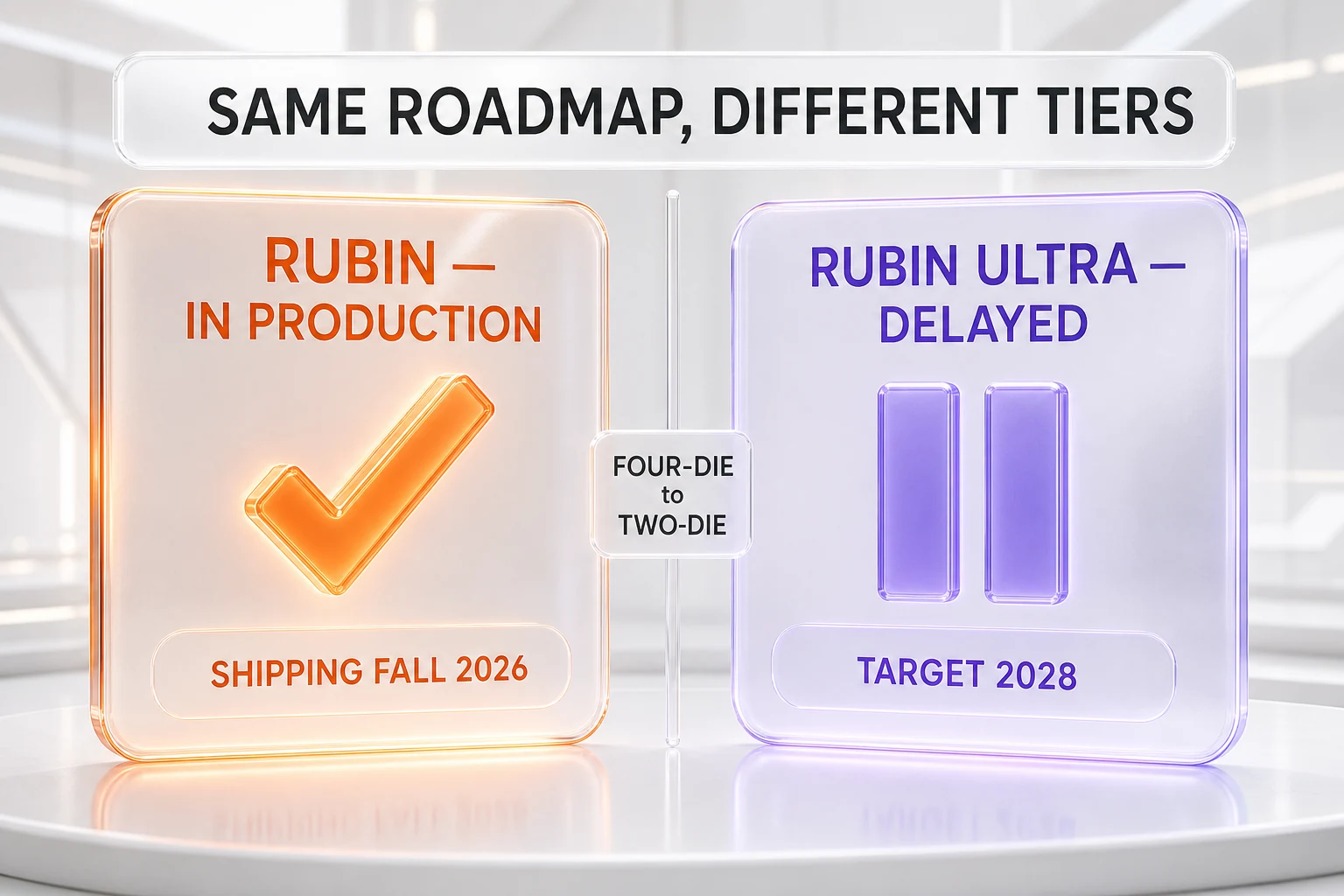
The delay report is about Rubin Ultra, not Rubin. NVIDIA's standard Vera Rubin platform is a separate 2026 product that the company says is already in full production; Kyber NVL144 and Rubin Ultra are the 2027 high-end tier now said to slip to 2028. That single distinction is why NVIDIA's denial and the report do not have to contradict each other.
NVIDIA's roadmap runs in tiers. Base Vera Rubin — Rubin GPUs paired with the new Vera CPU — is the volume platform for late 2026, and it is the one NVIDIA says is shipping to eight cloud customers this fall. Rubin Ultra, packaged into the Kyber NVL144 rack, is the halo product one step above it, originally targeted for 2027. When the report says "Kyber slips to 2028," it is talking about that halo tier, not the volume platform. We saw the base side of this roadmap hold up when the Vera CPU posted its first independent benchmarks.
This is why the strategic stakes are narrower than the headline suggests, but not trivial. A Rubin Ultra delay does not dent 2026 revenue, and it does not touch Blackwell or base Rubin. What it would dent is NVIDIA's claim to the most aggressive scale-up density on the market in 2027 — the specific bragging right that keeps the largest AI labs from designing around NVIDIA at the very top end.
Sources: CNBC and The Decoder.
What a One-Year Slip Would Mean for the AI Buildout
If the report is right, NVIDIA's most aggressive scale-up rack arrives a year later, leaving Blackwell and base Rubin systems to carry hyperscaler demand into 2027 — and giving AMD, Google's TPUs, and custom inference silicon a wider window to win top-end deployments.
The competitive read is about timing, not weakness. NVIDIA would still own the volume market in 2027; what changes is the ceiling. A delayed Kyber means the densest scale-up domain is not available on schedule, and the labs building the largest clusters have a longer runway to qualify alternatives. AMD's Instinct line, Google's in-house TPUs, and purpose-built inference chips like OpenAI's Broadcom-built silicon all compete for the same 2027 budgets, and every extra quarter of NVIDIA delay is a quarter those programs can use.
The wider context is cost. As we have written, the economics of AI increasingly hinge on where the money actually goes between training and inference, and on how far buyers will go to escape a single vendor — the motivation behind experiments like DeepSeek training a frontier model on Huawei Ascend. A Kyber delay does not change NVIDIA's dominance, but it does hand every diversification effort a little more oxygen at the exact moment those efforts are maturing.
Sources: CNBC and The Decoder.
What Could Prove This Wrong
This is a single research-firm report that NVIDIA disputes, so it could be overturned quickly. The clearest disconfirmation would be NVIDIA publishing an official Kyber and Rubin Ultra shipment calendar, a named supplier confirming on-schedule midplane orders, or SemiAnalysis revising its own posts.
We take SemiAnalysis seriously — its supply-chain work has a strong record — but "strong record" is not "always right," and reports on unreleased hardware move as fabs iterate. NVIDIA, for its part, has every incentive to defend the narrative ahead of its next earnings call, so its denial is not neutral either. The honest position is that two credible parties are describing different things and have not reconciled them in public.
The signals we would watch: an on-the-record NVIDIA timeline for Kyber and Rubin Ultra; order commentary from board and substrate suppliers on their next earnings calls; and whether the four-die-to-two-die claim shows up anywhere in NVIDIA's own technical materials. Until one of those lands, the accurate framing is the one we opened with — a credible supply-chain report, denied by NVIDIA, about the top tier of a roadmap whose base is shipping on time.
Sources: SemiAnalysis and NVIDIA Newsroom.
Frequently Asked Questions
Is NVIDIA's Kyber NVL144 rack really delayed?
It is a contested claim, not a confirmed fact. On July 6, 2026 the research firm SemiAnalysis reported that Kyber NVL144 has slipped more than 12 months to 2028. NVIDIA disputes the report, telling Bloomberg its road map is intact. As of publication there is no official NVIDIA schedule change, so treat the delay as a credible but unconfirmed supply-chain report.
What is the NVIDIA Kyber NVL144?
Kyber NVL144 is a next-generation AI server rack that packs 144 of NVIDIA's Rubin Ultra GPUs into a single NVLink domain inside one cabinet. Jensen Huang showed it on stage at GTC 2026 in March, and it was slated to ship in 2027 alongside the Rubin Ultra platform.
Why is the Kyber NVL144 reportedly delayed?
SemiAnalysis attributes the slip to manufacturing yield on the PCB midplane, the large printed circuit board that wires all 144 GPUs into one NVLink domain. The firm says the board is too difficult to produce reliably at the required density, which is a packaging and interconnect problem rather than a GPU-die problem.
What is the new timeline for Kyber NVL144?
SemiAnalysis says the rack moves from a 2027 launch to 2028, a slip of more than 12 months. NVIDIA has not confirmed any new date and maintains that its roadmap is unchanged, so the 2028 figure comes from the report, not from NVIDIA.
What did NVIDIA say about the delay report?
An NVIDIA spokesperson told Bloomberg that the company's road map is intact, while NVIDIA declined to comment to CNBC and several other outlets. NVIDIA also emphasized that its existing Rubin systems have entered full production, with deliveries to eight major cloud customers scheduled to begin in the fall of 2026.
Is the base Vera Rubin platform delayed too?
No. The report concerns Rubin Ultra and the Kyber NVL144 rack, not the standard Vera Rubin platform. NVIDIA says its current Rubin systems are already in full production for fall 2026 deliveries, which is why the company can call its roadmap intact even as the top-end Rubin Ultra rack is said to slip.
Which suppliers' stocks fell on the report?
The heaviest declines hit NVIDIA's Asian board and substrate suppliers on July 6, 2026: Kingboard Laminates fell 18%, Samsung Electro-Mechanics 11%, Ibiden 10%, and Elite Material 10%. Those stocks had run up sharply this year, with Kingboard up over 470% and Samsung Electro-Mechanics over 600%, so profit-taking amplified the drop.
What is the PCB midplane and why does it matter?
The midplane is the backbone circuit board that connects every GPU in the rack into a single NVLink domain. Scaling from 72 GPUs in the current Blackwell NVL72 to 144 in Kyber roughly doubles the trace density the board must carry, which is why yield on that one component can gate an entire rack. It highlights that the interconnect, not the GPU, is becoming the constraint.
What happened to the four-die Rubin Ultra?
SemiAnalysis reports that the four-die version of Rubin Ultra was canceled, leaving a two-die part that delivers roughly half the intended performance. NVIDIA has not confirmed this, and it should be read as part of the same unverified report rather than an official product change.
Who is SemiAnalysis and how reliable is the report?
SemiAnalysis is a well-regarded semiconductor research firm known for detailed supply-chain analysis, and it published its claims in a series of posts on X. Its track record is strong but not infallible, and single-source reports on unreleased hardware can change. NVIDIA's direct denial means the two accounts have not been reconciled.
How does this affect AMD, Google, and custom AI chips?
A one-year slip in NVIDIA's most aggressive scale-up rack would widen the window for alternatives. AMD's Instinct accelerators, Google's TPUs, and custom inference silicon such as OpenAI's Broadcom-built chip all compete for the same 2027 buildout budgets, and a delayed Kyber would give them more room while Blackwell and base Rubin carry demand.
What could prove the delay report wrong?
The clearest disconfirmation would be NVIDIA publishing an official Kyber and Rubin Ultra shipment calendar, a named supplier confirming on-schedule midplane orders, or SemiAnalysis revising its posts. Because this is a single report that NVIDIA disputes ahead of earnings, new primary evidence from either side could settle it quickly.
Sources
- The Decoder — Kyber NVL144 reportedly pushed back more than a year
- CNBC — NVIDIA next-gen rack delayed to 2028 on manufacturing snags
- Yahoo Finance / Bloomberg — supplier stocks slide, NVIDIA says roadmap intact
- ZeroHedge — NVIDIA turns green after denying the report
- Taipei Times — Asian tech stocks slide after NVIDIA server report
- SemiAnalysis
Published July 7, 2026 by Anthony Martinez, ThePlanetTools.ai. This is an editorial analysis of a developing, contested story; we present both the SemiAnalysis report and NVIDIA's denial and do not claim to resolve the dispute. ThePlanetTools.ai has no affiliate relationship tied to this article.