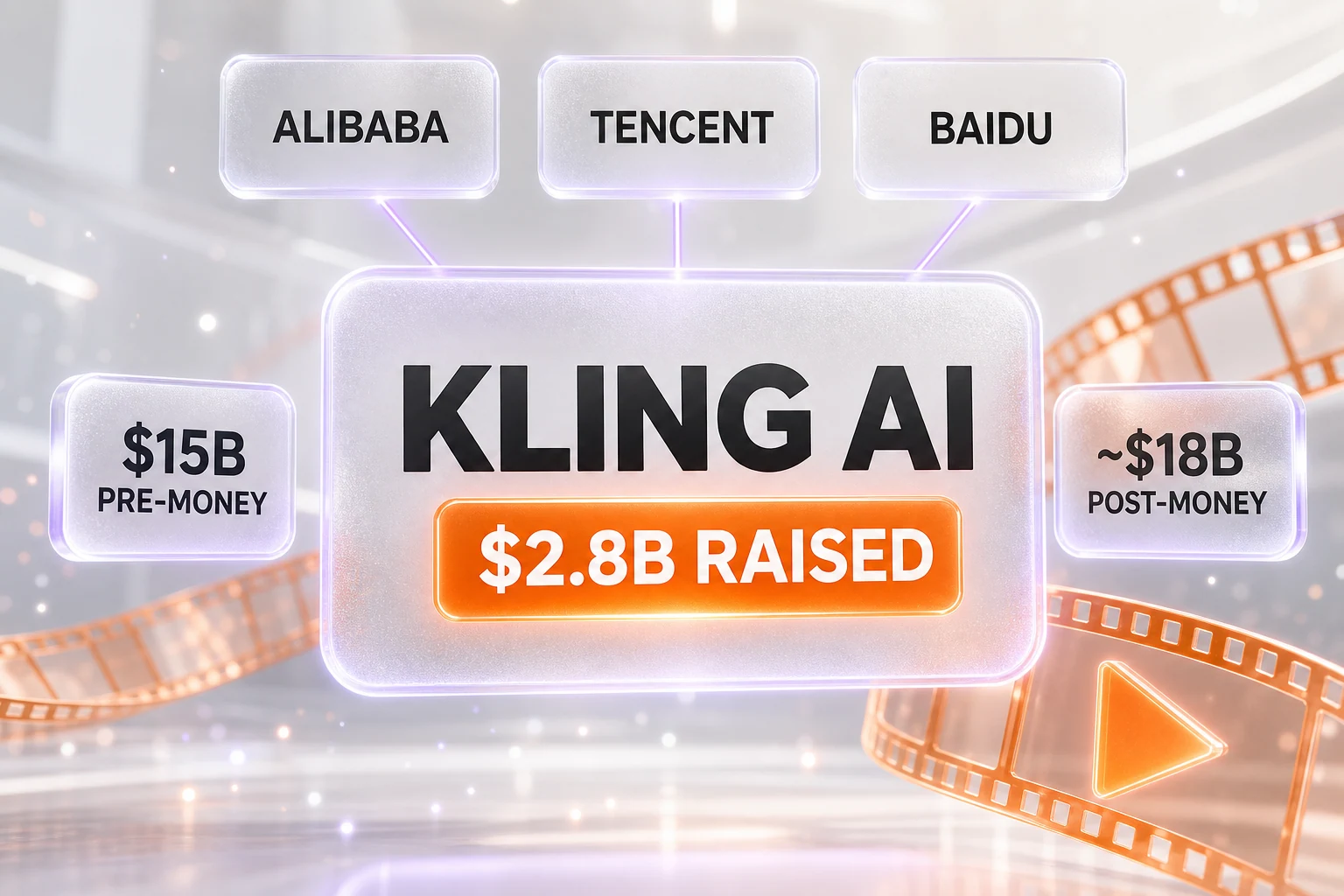
Kling AI, the generative video unit of Chinese short-video giant Kuaishou, has raised about $2.8 billion at a $15 billion pre-money valuation — roughly $18 billion post-money once the round fills to its cap — in a deal reported by Bloomberg and Reuters on July 2-3, 2026. What makes it remarkable: China's three internet superpowers, Alibaba, Tencent and Baidu, are funding the same company at once, even though each runs a competing video model of its own. The financing dilutes Kuaishou's stake from full control to about 68%, and lands as Kling's revenue jumped more than 300% year over year to roughly $96 million (¥650 million) in the first quarter of 2026.
For two years the story of AI video has been told through Western labs — OpenAI's Sora, Google's Veo, Runway. This week the money moved east. A syndicate led by Alibaba, Tencent and Baidu — the closest thing China has to a tech oligarchy — committed roughly $2.8 billion to Kling AI, the text-to-video engine Kuaishou spun out of its short-video app. It is one of the largest single financings the generative-video sector has ever seen, and the clearest signal yet that video is where the next platform war is being fought.
The deal also carries a strategic paradox that is hard to overstate: the three giants writing the checks each own a rival video model. They are, in effect, paying to strengthen a competitor. Understanding why they did it says a lot about where the market thinks this technology is heading.
What Happened: The Deal in Numbers
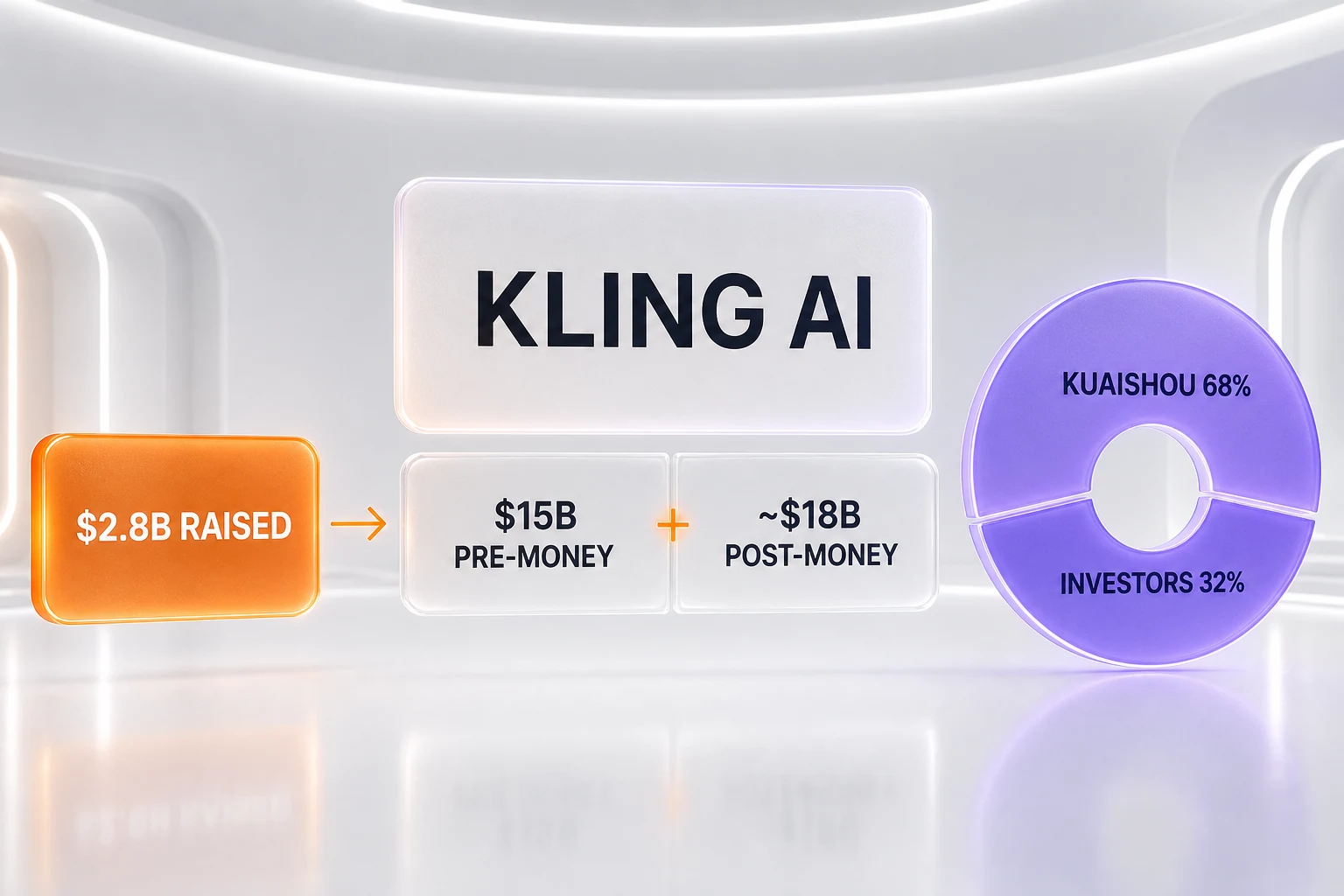
According to Bloomberg and Reuters, investors committed more than 19 billion yuan — about $2.8 billion — to Kling AI at a pre-money valuation of roughly $15 billion (about 105 billion yuan). That committed capital values the unit at approximately $17.8 billion post-money, a figure that edges toward $18 billion once the round fills to its ceiling of about 20.45 billion yuan, or roughly $3 billion, as remaining investors join over the coming weeks.
The arithmetic is clean: a $15 billion pre-money valuation plus $2.8 billion of new capital lands at $17.8 billion, and the full $3 billion cap would put it right around $18 billion. As part of the raise, Kuaishou's ownership of Kling AI falls from full control — effectively 100% — to about 68%, according to reporting on the terms.
The investor roster is what turns a large funding round into a landmark. Alongside Alibaba (through Alibaba Cloud), Tencent and Baidu, Bloomberg reported participation from Abu Dhabi's BlueFive Capital and Chinese state-linked institutions including CITIC Securities and the Industrial and Commercial Bank of China. Reports differ on the exact number of participants — accounts range from roughly two dozen to several dozen investors — but the three marquee names are consistent across every account: Alibaba, Tencent and Baidu.
Bloomberg's report was dated July 2, 2026; Reuters carried the terms on July 3. Kuaishou has said any broader restructuring of the unit is still at an early stage, so some figures may firm up as the round formally closes.
Why China's Big Three Backed a Rival They Compete With
Here is the part that should make you sit up. Alibaba builds the Wan video family. Tencent runs Hunyuan Video. Baidu has its own generative stack. Each of them just helped fund the company most likely to eat their lunch in Chinese AI video. Why?
The simplest answer is that none of them wants to be locked out of the category leader. Kling has become the default consumer video model inside China, the way Sora once was the reference point in the West. When the clear front-runner raises, incumbents face a choice: compete head-on and risk missing the winner, or buy a seat at the table. Alibaba, Tencent and Baidu chose the seat — a defensive hedge dressed up as an offensive bet.
There is also a compute-and-distribution logic. Alibaba Cloud sells the GPUs and infrastructure that a video model as hungry as Kling burns through. Tencent controls WeChat, the distribution rail every Chinese app dreams of riding. For these players, a stake in Kling is not only equity upside — it is a way to make sure the category's biggest workload and audience flow through their own pipes. That is the same playbook U.S. hyperscalers ran with the frontier language-model labs.
And then there is the geopolitical frame. With Western frontier models increasingly walled off from Chinese developers, a homegrown video champion backed by the entire domestic establishment is a national-capability story as much as a commercial one. The message to Google and to whatever remains of OpenAI's video ambitions is blunt: China intends to have its own answer, and it will fund it lavishly.
The Revenue Surge Behind the $15 Billion Price Tag
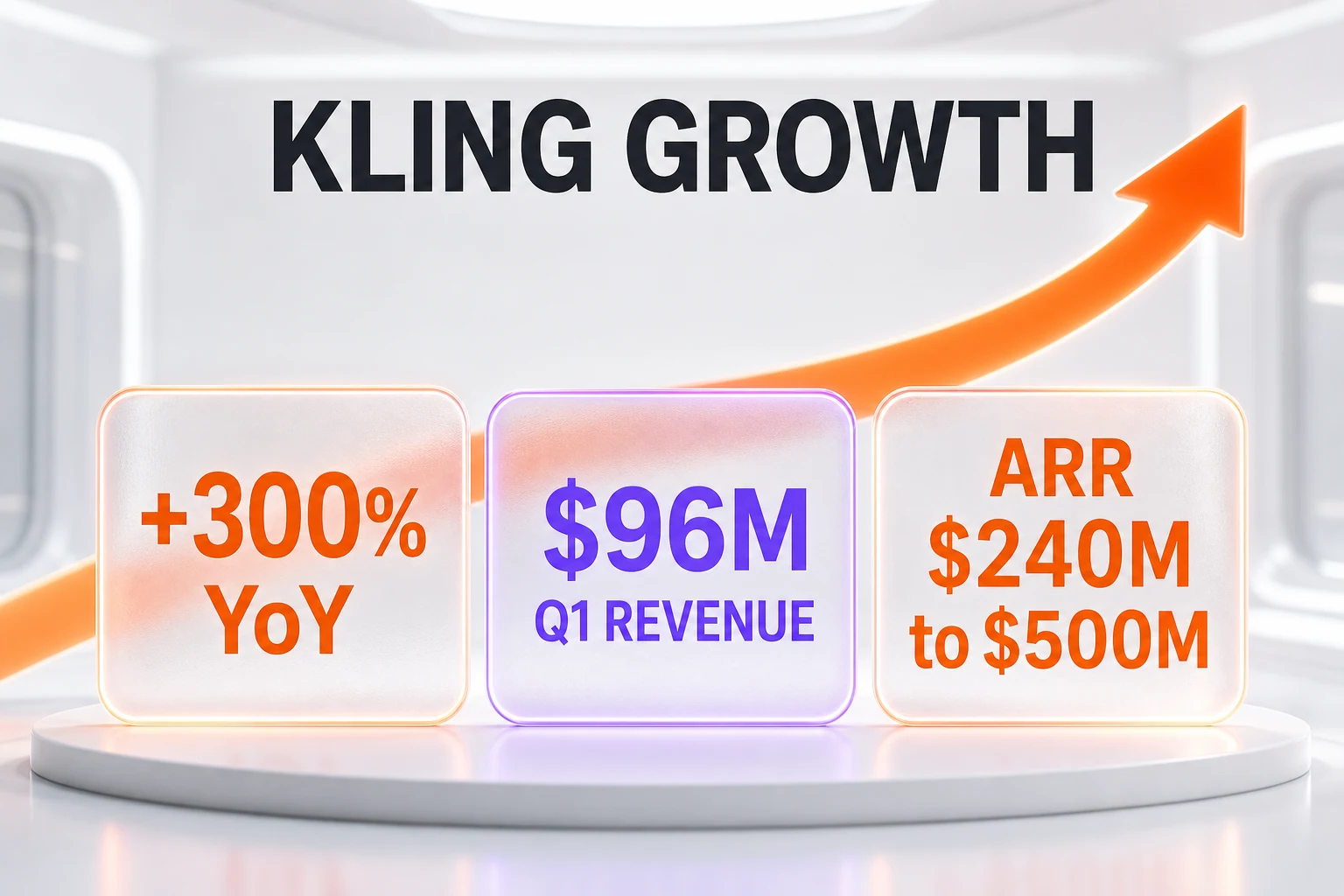
A $15 billion valuation needs numbers to justify it, and Kling has been generating them at a pace that explains the frenzy. In the first quarter of 2026, the unit booked about ¥650 million in revenue — roughly $96 million — a jump of more than 300% from the same quarter a year earlier. Put plainly, quarterly revenue more than quadrupled year over year.
The forward metric is even more eye-catching. Kling's reported annual recurring revenue — a forward run-rate, distinct from the ¥650 million it actually booked in the March quarter — climbed from about $240 million in December 2025 to roughly $500 million by March 2026, according to figures circulating with the deal. If that run-rate holds, it implies the $15 billion valuation prices Kling at roughly 30 times forward revenue: rich, but not out of line with what investors pay for a category leader growing triple digits.
Those two numbers should be read as separate signals rather than a single line. Booked quarterly revenue tells you what customers paid last quarter; the ARR run-rate tells you the exit-month pace heading into the raise. Both point the same direction — up and to the right — which is exactly why investors were willing to compete for allocation in a round that had to be capped.
The AI Video War Just Consolidated
Zoom out and the funding round reads like a status update on the entire category. Eighteen months ago, generative video was a research demo. Today it is a market with a clear top tier — and this week's capital just hardened the lines.
On the frontier, four names now matter most. Kling's own flagship, Kling 3.0 Omni, trades blows with Google's Veo 3.1, ByteDance's Seedance, and Runway's Gen-4.5. We put several of these head-to-head in our Veo 3.1 vs Kling 3 Omni and Seedance 2 vs Kling 3 Omni breakdowns, and the pattern is consistent: the quality gap between the leaders has collapsed, so the real battleground has shifted to price, speed, audio, and distribution — precisely the levers a fresh $2.8 billion war chest lets Kling pull.
The timing is pointed. ByteDance has been carpet-bombing the space, most recently with the Seedance 2.5 push we covered in its June multimodal blitz. Meanwhile the Western field has thinned rather than thickened: OpenAI wound down its Sora consumer app earlier this year, a retreat we reported when key executives left and the science team dissolved. So while U.S. attention drifted, China's champion raised nearly $3 billion. That contrast — one side consolidating capital, the other stepping back from consumer video — is the story beneath the story.
For a fuller map of where each model lands on quality, cost and control, our best AI video generators of 2026 guide tracks the whole field, from the frontier tier down to the open-source challengers and specialized players like MiniMax Hailuo.
What It Means for Creators
Funding rounds are abstract; their consequences are not. A $2.8 billion balance sheet buys Kling three things creators will feel directly. First, compute — enough GPUs to push resolution, clip length and generation speed, and to keep serving a fast-growing user base without the throttling and queue times that plague under-capitalized tools. Second, price flexibility — a well-funded leader can subsidize generous free tiers and undercut rivals to grab share, which tends to drag the whole market's pricing down. Third, feature velocity — native audio, longer coherent shots, better character consistency and editing controls are where the next round of competition happens, and Kling now has the runway to fund all of it.
The flip side is concentration. When a single model becomes the default and the entire domestic establishment is financially invested in its success, the incentive to keep it open, cheap and interoperable can fade over time. For now, though, the near-term effect for creators is the good kind: more capability, more competition on price, and a leader with every reason to keep shipping.
What Comes Next: IPO and the Compute Race
Kuaishou has signaled that it is exploring a spinoff and a potential public listing for Kling, with Hong Kong the most-discussed venue, though it has stressed those conversations are early. Reports tied to the raise point to a listing window somewhere in the next twelve months, with proceeds earmarked for compute and data-center buildout. Treat the timeline as a direction of travel rather than a fixed date.
Our read: this round is less about a single company's cash position and more about the market declaring that AI video has graduated from feature to platform. When Alibaba, Tencent and Baidu set aside their own competing models to co-fund the leader, they are betting that the winner-take-most dynamics of consumer AI will apply here too — and they would rather own a piece of the winner than watch from the sidelines. The next test is whether Kling can convert nearly $3 billion into a durable lead before Google's Veo, ByteDance's Seedance and the open-source wave close the gap. On current form, the video war is only getting more expensive.
Frequently Asked Questions
How much did Kling AI raise and at what valuation?
Kling AI, Kuaishou's generative video unit, raised about $2.8 billion (more than 19 billion yuan) at a pre-money valuation of roughly $15 billion, according to Bloomberg and Reuters. That puts the deal at approximately $17.8 billion post-money, edging toward $18 billion once the round fills to its cap of about $3 billion (20.45 billion yuan).
Who invested in Kling AI's funding round?
The round was led by China's three internet giants — Alibaba (via Alibaba Cloud), Tencent and Baidu — alongside Abu Dhabi's BlueFive Capital and state-linked institutions such as CITIC Securities and the Industrial and Commercial Bank of China. Accounts of the total number of participants vary, but those marquee backers appear in every report.
Why would Alibaba, Tencent and Baidu all back the same company?
Each of the three runs a competing video model — Alibaba's Wan, Tencent's Hunyuan and Baidu's own stack — yet all three funded Kling. The logic is defensive: none wants to be locked out of the category leader. A stake also routes Kling's massive compute and distribution needs through their own cloud and platforms, and it advances a national push for a homegrown video champion.
How does Kling AI compare to Google Veo 3.1, OpenAI Sora and ByteDance Seedance?
Kling's flagship, Kling 3.0 Omni, sits in the frontier tier with Google's Veo 3.1, ByteDance's Seedance and Runway's Gen-4.5. Quality between the leaders has largely converged, so competition now centers on price, speed, native audio and distribution. OpenAI's Sora is a diminished factor after OpenAI wound down its Sora consumer app earlier in 2026.
What is Kling AI's revenue and how fast is it growing?
Kling booked about ¥650 million (roughly $96 million) in revenue in the first quarter of 2026, more than 300% higher than a year earlier. Separately, its reported annual recurring revenue run-rate rose from about $240 million in December 2025 to roughly $500 million by March 2026. ARR is a forward run-rate and is distinct from booked quarterly revenue.
How much of Kling AI does Kuaishou still own after the deal?
After the raise, Kuaishou's ownership of Kling AI falls from effectively full control to about 68%, according to reporting on the terms. The new investors collectively take the remaining roughly 32%.
Is Kling AI planning an IPO?
Kuaishou has signaled it is exploring a spinoff and a potential public listing for Kling, with Hong Kong the most-discussed venue and a possible window within the next twelve months. It has emphasized those discussions are early, so treat the timing as a direction rather than a firm date. Proceeds are reportedly earmarked for compute and data-center buildout.
What does the Kling funding mean for AI video creators?
A $2.8 billion balance sheet lets Kling expand compute, subsidize generous pricing to win share, and accelerate features such as native audio, longer clips and better character consistency. The near-term effect for creators is more capability and downward pressure on prices across the market, though a single dominant, establishment-backed model also raises longer-term questions about concentration.