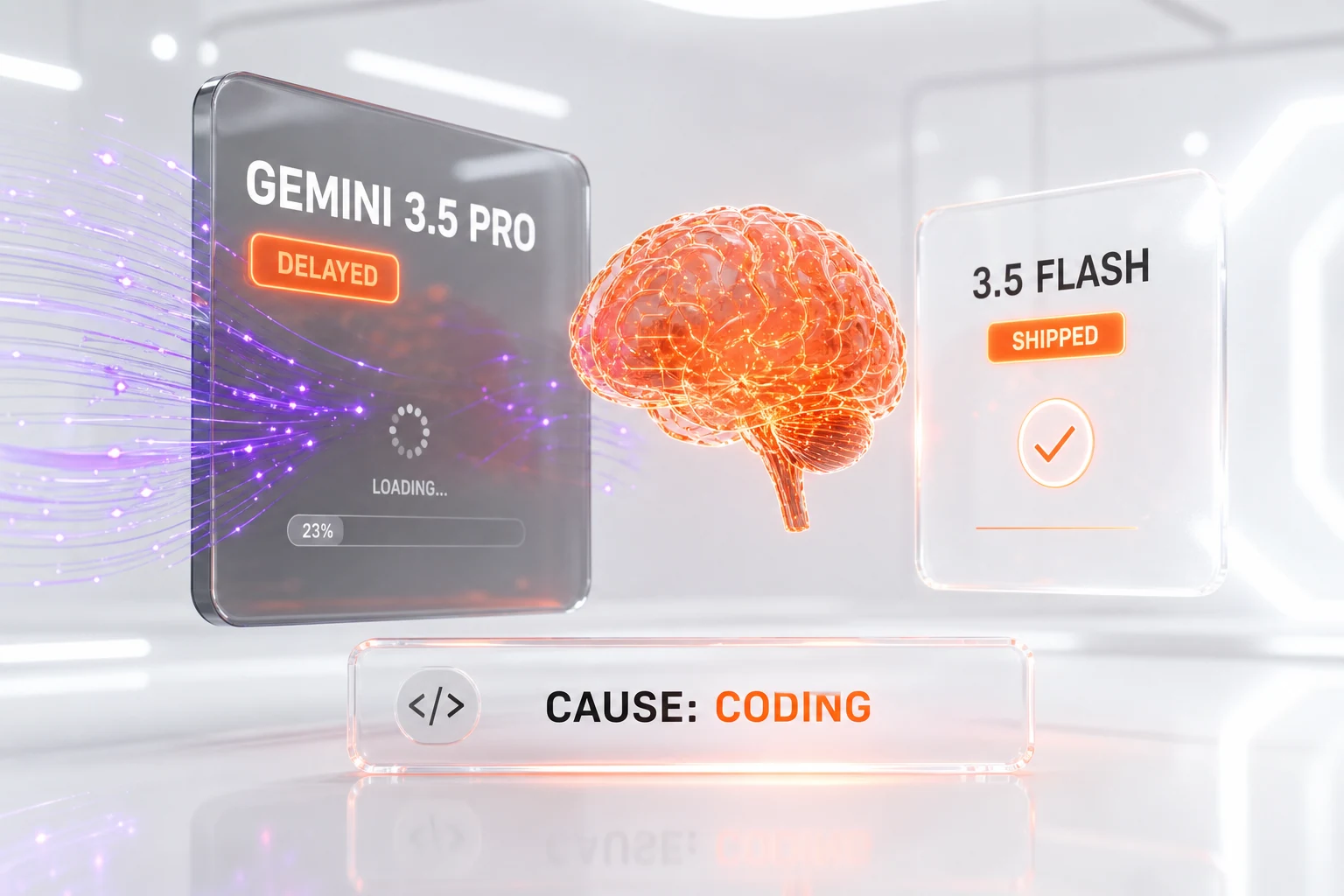
Gemini 3.5 Pro still does not exist as a shipping product. As of July 21, 2026, Google's official model catalog lists no Gemini 3.5 Pro — the Pro tier is still Gemini 3.1 Pro (Preview) and Gemini 2.5 Pro (Stable), and the only 3.5 model available is Gemini 3.5 Flash. Google promised the Pro version in June. Bloomberg reported on July 16 that the delay comes down to coding performance falling short of internal goals. Google has not announced a new date. Alphabet shares fell nearly 3% on the news.
Key Takeaways
- No Pro, only Flash. Google's live model catalog shows Gemini 3.5 exists only as Flash. The Pro tier remains Gemini 3.1 Pro Preview and Gemini 2.5 Pro as of July 21, 2026.
- The cause is coding, not hallucinations. Bloomberg, citing ten current and former employees, tied the delay to coding results below Google's internal goals — not to reliability, safety, or a "rebuilt" model.
- The June promise slipped. Google announced the 3.5 series at I/O on May 19, shipped Flash the same day, and said it would roll out Pro "next month." June passed with nothing.
- Rivals are not waiting. OpenAI shipped its coding-focused GPT-5.6 Sol on July 9, and Anthropic's Claude Opus 4.8 leads several coding evaluations. Google is behind on release cadence.
- The market reacted. Alphabet shares fell nearly 3% on July 16, the day the report landed, reading a slipped flagship coding model as a real signal.
What Happened
Google's most anticipated model of the summer is late, and the reason is unusually specific. Gemini 3.5 Pro — the large, frontier-tier version of the family Google unveiled at its developer conference — was supposed to arrive in June 2026. It has not. A check of Google's own official model catalog on July 21 confirms it: there is no Gemini 3.5 Pro listed anywhere. The Pro tier still tops out at Gemini 3.1 Pro (marked Preview) and Gemini 2.5 Pro (Stable). The only model carrying the 3.5 badge is Gemini 3.5 Flash, the fast and inexpensive tier.
The explanation went from rumor to reporting on July 16, 2026, when Bloomberg's Julia Love and Davey Alba published an account sourced to ten current and former Google employees. Their reporting, corroborated by 9to5Google and Search Engine Journal, points to one problem above all others: the model's coding ability was not clearing Google's internal targets. That is the whole story, and it is worth stating plainly because a lot of secondhand coverage has muddied it with claims Bloomberg never made.
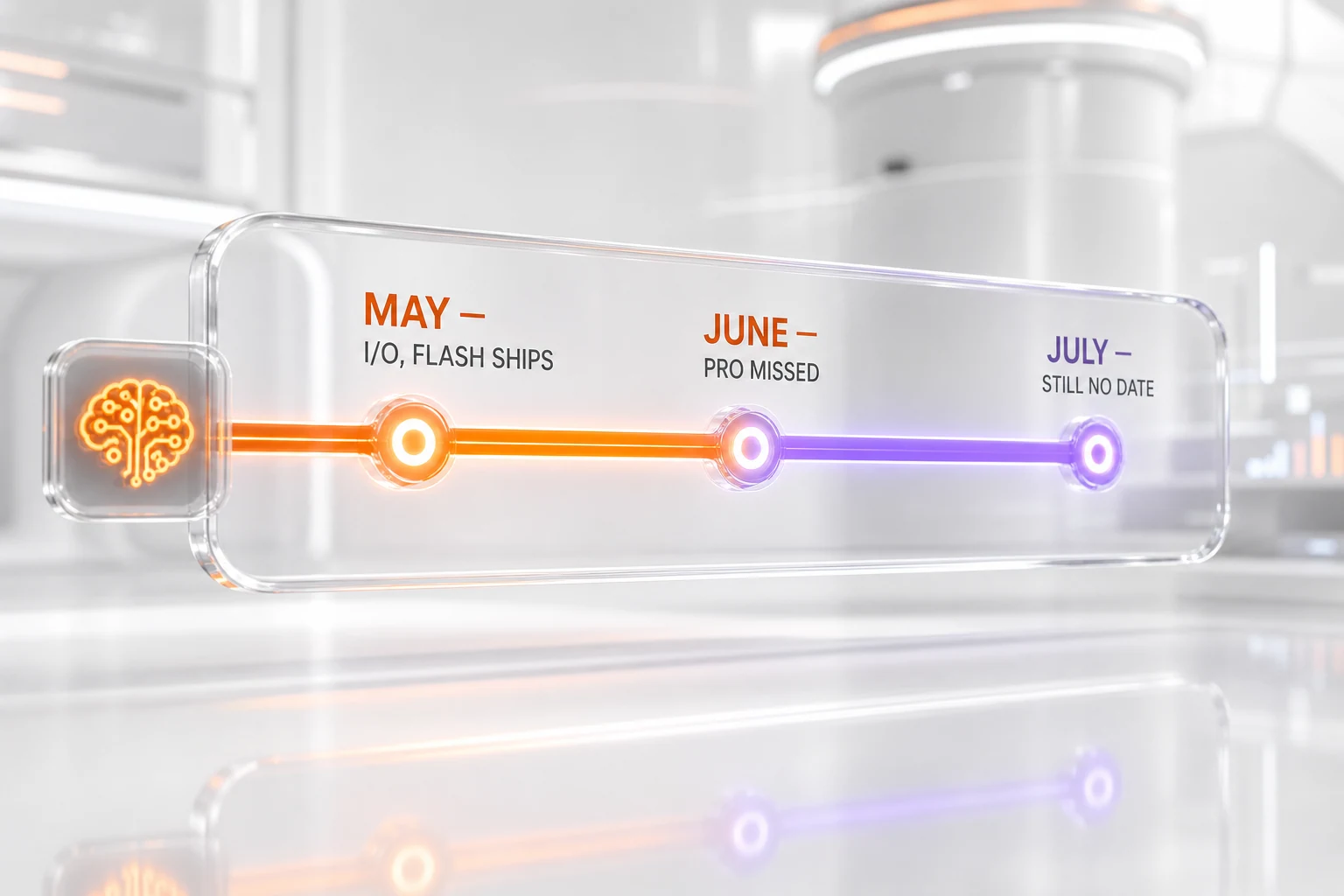
Why It's Actually Late: Coding Below Internal Goals
The delay traces back to a single capability. Google announced the Gemini 3.5 series at I/O on May 19, 2026, shipped Gemini 3.5 Flash that same day, and, according to Search Engine Journal's read of the launch blog, said it looked forward to "rolling it out next month" — the Pro model in June. That target came and went. In late June, per Bloomberg, Google updated the model's training data specifically to lift its coding skills, and the outcome was blunt: "the results were disappointing." Rather than ship a flagship that underperformed its own benchmarks, Google held it back.
Google's public posture is measured. A company spokesperson told Bloomberg it is "currently testing 3.5 Pro" with partners "along with an upgraded Flash model," and framed the pace as deliberate: "We're shipping quickly across a wide range of models while keeping them highly cost-effective for customers." Notably, the statement includes no new launch date. As Winbuzzer noted on July 20, "Google has not provided a confirmed explanation or replacement date," and the model remains under limited evaluation with partners.
It is also worth marking what this is not. Several lower-tier outlets have described a "scrapped base model," a "rebuild from scratch," or specific failures in recursive tool-calling and multi-step math. None of that appears in the tier-1 reporting. The verified cause is narrow — coding scores under internal goals — and the honest version of this story keeps it that way. For context on why "coding" is a moving target with no universal scoreboard, our explainer on why SWE-bench Pro and SWE-bench Verified scores don't compare is a useful primer.
What the Delay Says About Google
A single slipped release is not a crisis, but this one lands on a sensitive nerve: agentic coding, the exact capability where Google's rivals have pulled ahead. Per Bloomberg, CEO Sundar Pichai has acknowledged the company is "a bit behind" here — and the reported explanation is structural, not cosmetic. Google, the story goes, lacks the popular developer-facing coding products that generate the real-world usage data OpenAI and Anthropic feed back into their models. If you want to know what an agentic coding model even is and why it is different from a chatbot, we broke that down in a separate explainer.
The irony is that Google is not short on internal AI-coding adoption. Per 9to5Google, about 75% of new code at Google in April 2026 was AI-generated and engineer-approved, up from roughly 50% the previous fall. The gap is not that Google's engineers avoid AI — it is that Google has no equivalent of a mass-market coding assistant collecting the messy, real-developer signal that sharpens a frontier coder. Internal dogfooding and external product telemetry are not the same fuel.
Then there is the org chart. Reporting points to fragmentation — Google Cloud, DeepMind, and Android each building separate coding tools — which breeds duplicated work, competition for scarce compute, and extra stakeholder layers that slow launches. Winbuzzer describes "shifting mandates and duplicated work" and notes Google "is also working to unite its internal systems." Read alongside the talent story we covered — two more Gemini researchers reportedly headed to Anthropic, part of a wider DeepMind brain drain — the picture is of an organization with world-class research that keeps tripping on its own coordination.
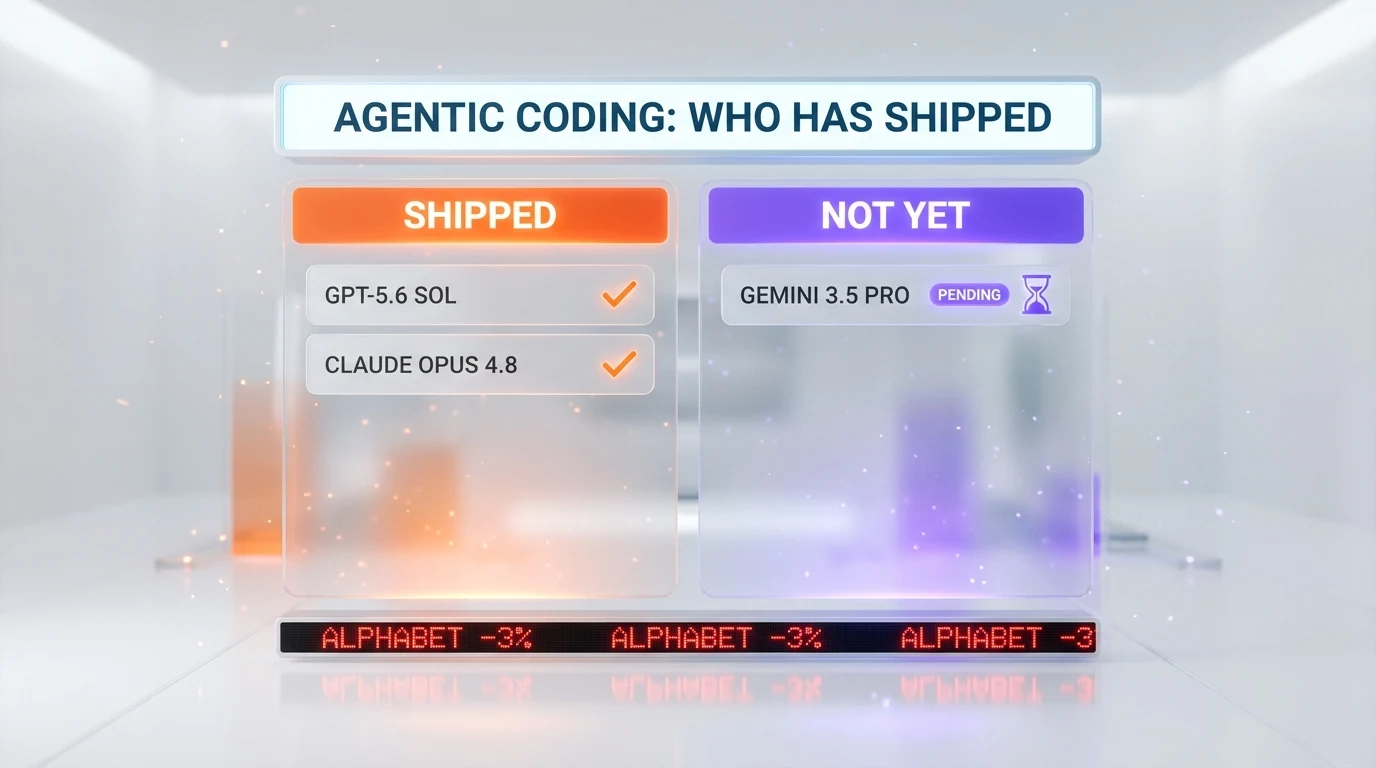
How the Timing Compares: Anthropic and OpenAI Aren't Waiting
The delay hurts more because of when it lands. On July 9, 2026, OpenAI shipped its GPT-5.6 family and its coding-focused flagship, Sol — a release Winbuzzer explicitly cites as "optimized heavily for coding." Anthropic, meanwhile, has kept Claude Opus 4.8 at or near the top of several coding evaluations since May. Both of Google's main rivals put frontier coding models in developers' hands this quarter. Google put out a Flash model and an apology-shaped statement.
We want to be precise here, because precision is the whole point. Gemini 3.5 Pro has no public benchmark scores — it is unreleased — so no one can honestly rank it against Sol or Opus 4.8 yet. What we can compare is release cadence, and on that axis the standings are clear: rivals shipped, Google slipped. If Google's own internal targets were the bar that Gemini 3.5 Pro failed to clear, and those targets are calibrated against the same rivals, then the delay is itself a quiet admission of where the frontier currently sits. For the Pro tier that does exist today, see our page on Gemini 3.1 Pro Preview.
The Market Noticed: Alphabet Shares Fell
Investors treated the delay as a signal, not noise. On July 16, the day the Bloomberg report landed, Alphabet shares fell nearly 3%, per Winbuzzer, and the move was prominent enough to draw dedicated coverage from CNBC under the headline that Alphabet stock dropped "on report its most powerful AI model Gemini 3.5 Pro is delayed." A sub-3% move is not a collapse — but for a company whose AI narrative is central to its valuation, and with earnings on the near horizon, a visibly slipped flagship coding model is exactly the kind of detail the market prices in fast.
It is a reminder that model release timing is now a financial event. A few years ago, a delayed research model would have been an engineering footnote. In 2026, with Anthropic reportedly lining up an IPO and coding agents driving enterprise budgets, the cadence of frontier releases maps directly onto competitive standing — and onto share prices.
Our Take
In our view, the most important word in this whole episode is "internal." Google did not ship a model that missed public benchmarks; it declined to ship a model that missed its own bar. That is a defensible call, and arguably the mature one — flooding the market with a weak flagship would have been worse. But it also tells you that Google's honest self-assessment of Gemini 3.5 Pro's coding put it below where Google needed it to be to compete. You do not delay a launch you are proud of.
What would change our read? A shipped Gemini 3.5 Pro that lands at or above Sol and Opus 4.8 on independent coding evaluations would reframe this as a routine polish delay rather than a structural gap — and Google has the research bench to make that happen. The DeepMind talent is real, the compute is enormous, and Flash tiers have been genuinely strong. The open question is whether Google can convert that into a frontier coder without a mass-market coding product feeding it data, and without the internal fragmentation that keeps slowing it down. We are skeptical that gets solved in a single training run; we would be glad to be proven wrong.
What's Next
There is no date to circle. As of July 21, 2026, Google says only that Gemini 3.5 Pro is testing with partners, alongside an upgraded Flash model. Watch for three things. First, whether Google attaches a real launch window rather than "soon" — the absence of one is the loudest fact in the current reporting. Second, whether the eventual Pro release leads with coding benchmarks or quietly avoids them. Third, whether Google's reported effort to unify its internal coding tools produces a public developer product that could finally supply the training signal it has been missing. We will update this article when a date, or a model, actually appears.
Sources
- Google — Gemini API model catalog (verified July 21, 2026: no Gemini 3.5 Pro listed; 3.5 available only as Flash)
- 9to5Google — Gemini 3.5 Pro delayed over coding (July 16, 2026)
- Search Engine Journal — Gemini 3.5 Pro delayed over coding, Bloomberg reports (July 16, 2026)
- Winbuzzer — Google reportedly delays Gemini 3.5 Pro over coding issues (July 20, 2026)
- CNBC — Alphabet shares fall on report Gemini 3.5 Pro is delayed (July 16, 2026)
- Bloomberg — "Google Gemini Launch Delayed as Tech Falls Short of Internal Goals," Julia Love and Davey Alba (July 16, 2026; paywalled, corroborated by the sources above)
Frequently Asked Questions
Is Gemini 3.5 Pro out yet?
No. As of July 21, 2026, Google's official model catalog lists no Gemini 3.5 Pro. The Pro tier still shows Gemini 3.1 Pro (Preview) and Gemini 2.5 Pro (Stable), and the only 3.5 model available is Gemini 3.5 Flash. Google says it is "currently testing 3.5 Pro" with partners but has not given a public release date.
Why is Gemini 3.5 Pro delayed?
Bloomberg reported on July 16, 2026, citing ten current and former employees, that the delay is driven by coding performance falling short of Google's internal goals. Google updated the model's training data in late June to improve coding, but, per the report, "the results were disappointing," so the launch was held back.
When did Google promise Gemini 3.5 Pro?
At Google I/O on May 19, 2026. Google announced the 3.5 series, shipped Gemini 3.5 Flash the same day, and its launch blog said it looked forward to rolling it out "next month" — meaning a June release for the Pro model. That June target passed without a launch.
What is Google's official statement on the delay?
A Google spokesperson told Bloomberg the company is "currently testing 3.5 Pro" with partners "along with an upgraded Flash model," and added: "We're shipping quickly across a wide range of models while keeping them highly cost-effective for customers." Google has not committed to a new date.
Is the delay because Gemini hallucinates or is unreliable?
No. The tier-1 reporting attributes the delay specifically to coding performance versus internal benchmarks, not to hallucinations, reliability, or a rebuilt model. Claims that Google "scrapped" or "rebuilt" the base model come from lower-quality outlets and are not supported by Bloomberg's reporting.
Did the delay affect Alphabet's stock?
Yes. Alphabet shares fell nearly 3% on July 16, 2026, the day the Bloomberg report landed, according to Winbuzzer and CNBC's coverage. Markets read a slipped flagship coding model as a meaningful signal ahead of Alphabet's earnings.
How does this compare to Anthropic and OpenAI?
Both rivals are shipping. OpenAI released its GPT-5.6 family and coding-focused flagship, Sol, on July 9, 2026, and Anthropic's Claude Opus 4.8 leads several coding evaluations. With no Pro-tier 3.5 release, Google is visibly behind on release cadence for agentic coding models.
What did Sundar Pichai say about agentic coding?
Per Bloomberg, Pichai has acknowledged that Google is "a bit behind" on agentic coding. The reported explanation is that Google lacks the developer-facing coding products that generate the real-world usage data rivals use to sharpen their models.
Does Google use AI for coding internally?
Yes. As of April 2026, about 75% of new code at Google was AI-generated and engineer-approved, up from roughly 50% the previous fall, per 9to5Google. The gap is not internal adoption — it is the lack of a popular external coding product feeding competitive training data.
Is Google's org structure part of the problem?
Reporting points to fragmentation: Google Cloud, DeepMind, and Android have been building separate coding tools, creating duplicated work and competition for compute. Google is said to be working to unify these internal systems, but that reorganization takes time.
What actually shipped — Gemini 3.5 Flash?
Yes. Gemini 3.5 Flash launched on May 19, 2026, and later gained native computer-use abilities. Flash is the fast, cost-efficient tier; the delayed Pro tier is the larger, more capable model meant to compete at the frontier of coding and reasoning.
When will Gemini 3.5 Pro actually launch?
There is no confirmed date. As of July 21, 2026, Google has not announced a new timeline, saying only that the model is in testing with partners. Any specific dates circulating online, such as a mid-July launch, are unverified and have already passed.