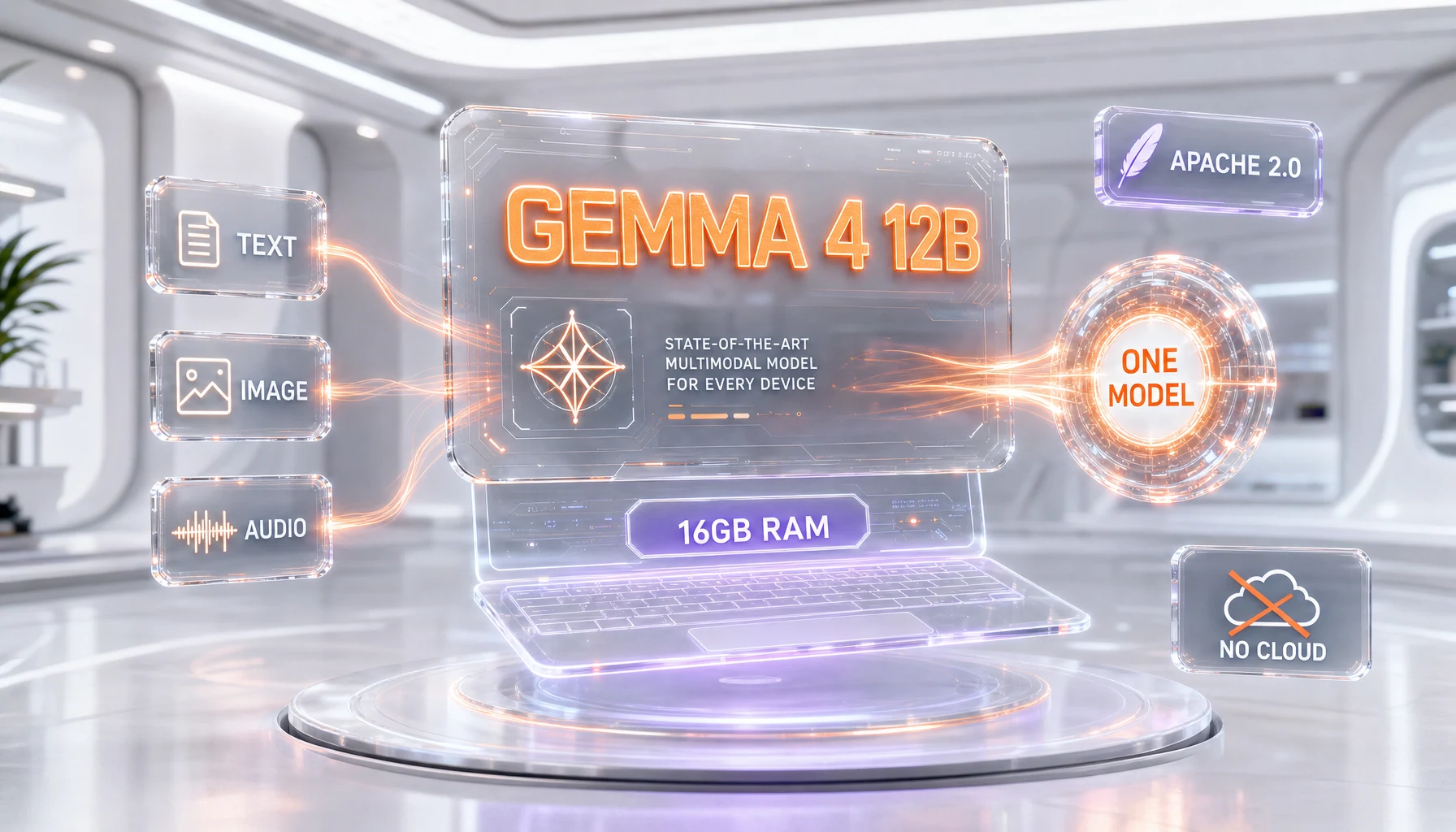
Gemma 4 12B is a 12-billion-parameter open multimodal model that Google released on June 3, 2026, built on a new encoder-free architecture and able to run locally on a consumer laptop with 16GB of RAM. It is the first mid-sized Gemma model to accept native audio input, it is published under an Apache 2.0 license with weights on Hugging Face and Kaggle, and Google says it reaches performance nearing the company's larger 26B Mixture-of-Experts model at less than half the total memory footprint. The wider Gemma 4 family has crossed 150 million downloads.
The Gemma 4 family already launched back in April under Apache 2.0, and we covered that release in depth when the open-source frontier line first arrived. This is not that story again. The interesting thing about the June 3 announcement is the specific 12B variant and the architectural decision underneath it: Google did not just ship a smaller model, it shipped a structurally different one. The encoder boxes that every mainstream multimodal model has carried for years are simply gone, and that single change is what lets a multimodal model with native audio fit on a laptop most developers already own.
This article breaks down what was actually announced, what "encoder-free" means in practice, why native audio on a mid-size model is a bigger deal than it sounds, and why the 16GB-of-RAM number reframes Gemma 4 12B as an engine for local and edge agentic workflows rather than another cloud endpoint. The facts here come from Google's official launch post on the company blog and its developer guide; this is an editorial analysis of those primary sources, not a hands-on benchmark.
What Google actually announced
On June 3, 2026, Google introduced Gemma 4 12B as, in its own words, "a unified, encoder-free multimodal model." The number in the name is literal: 12 billion parameters. The headline capabilities are three. First, it is multimodal across text, image, and audio. Second, it is the first mid-sized model in the Gemma line to feature native audio inputs. Third, it is small enough to run locally on a consumer laptop with 16GB of RAM, rather than requiring a dedicated accelerator or a cloud GPU.
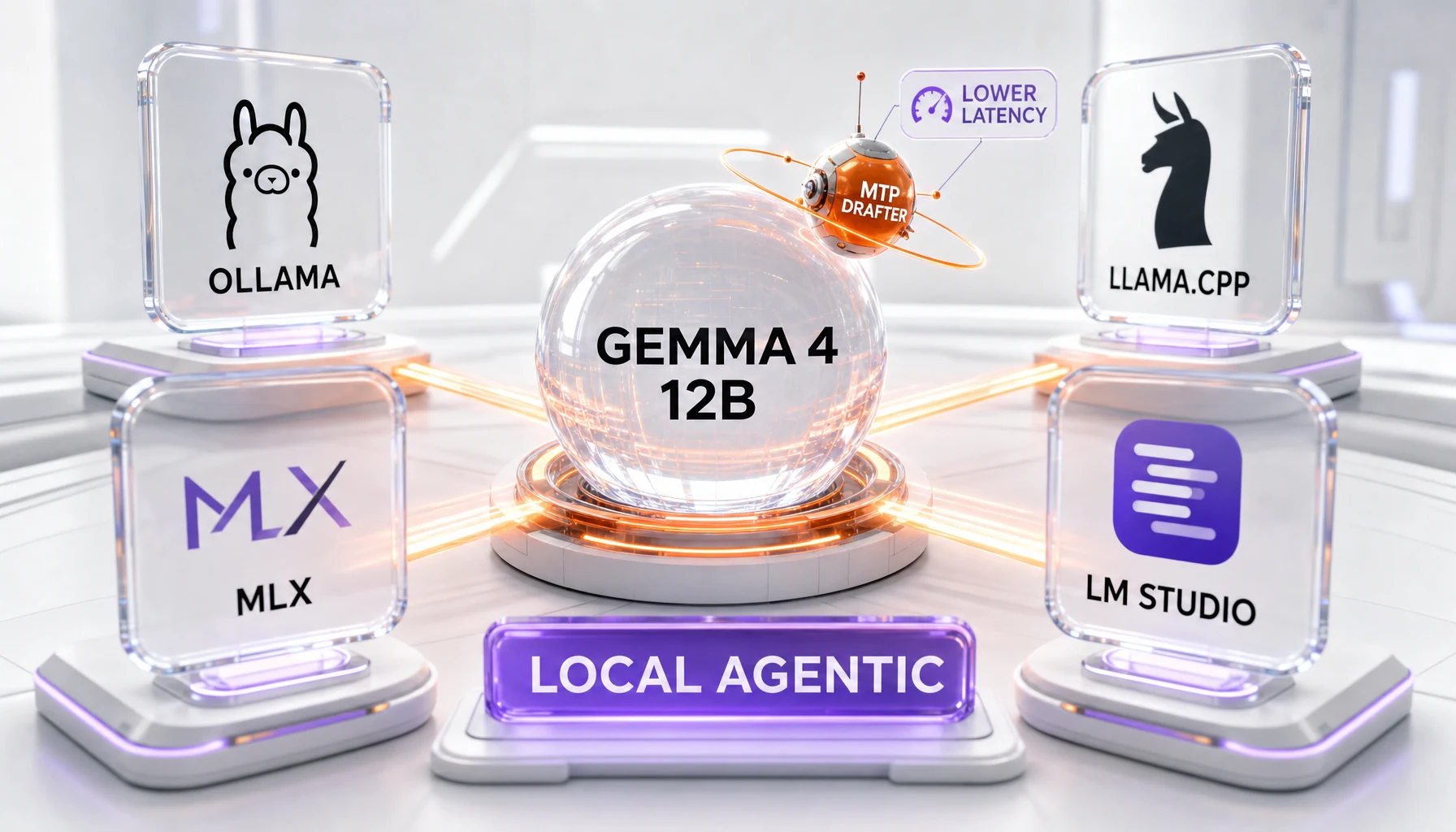
The licensing and distribution are deliberately frictionless. Gemma 4 12B ships under an Apache 2.0 license, the same permissive terms that govern the rest of the Gemma 4 family, which means commercial use, modification, and redistribution without the bespoke restrictions some "open" model licenses still carry. Pre-trained and instruction-tuned checkpoints are available for download on both Hugging Face and Kaggle. The developer guide lists support across the runtimes developers actually use day to day: Ollama, llama.cpp, Hugging Face Transformers, MLX, vLLM, SGLang, and LM Studio, with native support for Apple Silicon GPUs.
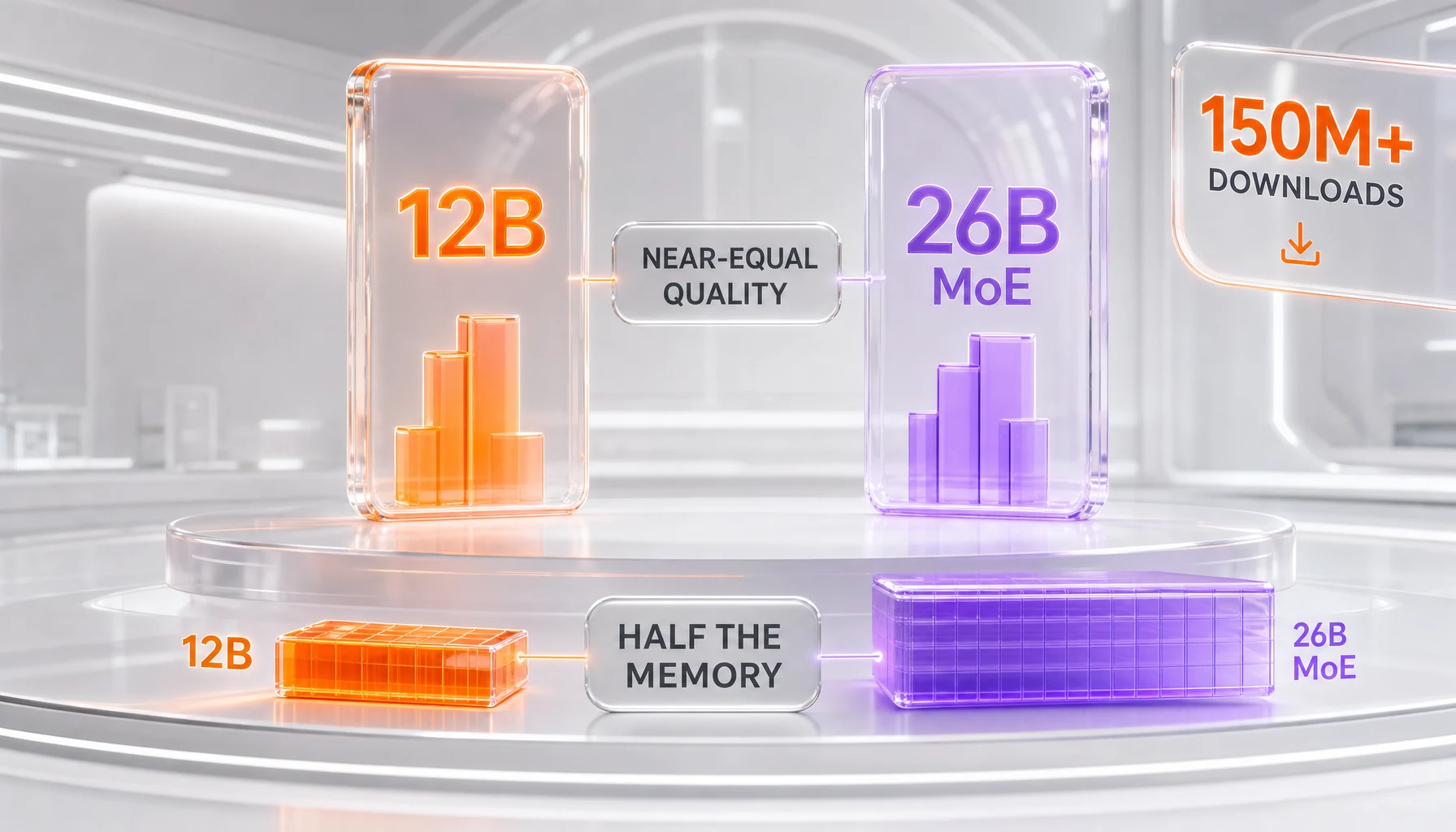
The efficiency claim is the one to anchor on. Google states that Gemma 4 12B delivers "performance nearing our larger 26B MoE model on standard benchmarks, but at less than half the total memory footprint." In plain terms: roughly the quality you would expect from a model more than twice its size, in a memory budget that fits a mainstream laptop. The company also notes the broader Gemma 4 family has crossed 150 million downloads, a distribution number that matters because an open model is only as influential as the number of machines willing to run it.
What "encoder-free" really means
To understand why this launch is structurally interesting, it helps to know what every mainstream multimodal model has done until now. The standard recipe bolts separate encoders onto a language model: a vision transformer that turns images into embeddings, an audio encoder that turns sound into embeddings, and then a projection layer that maps those embeddings into something the language backbone can read. Those encoders are heavy, they are trained somewhat independently, and they add both parameters and latency. They are also a seam — a place where the multimodal model is really two or three models taped together.
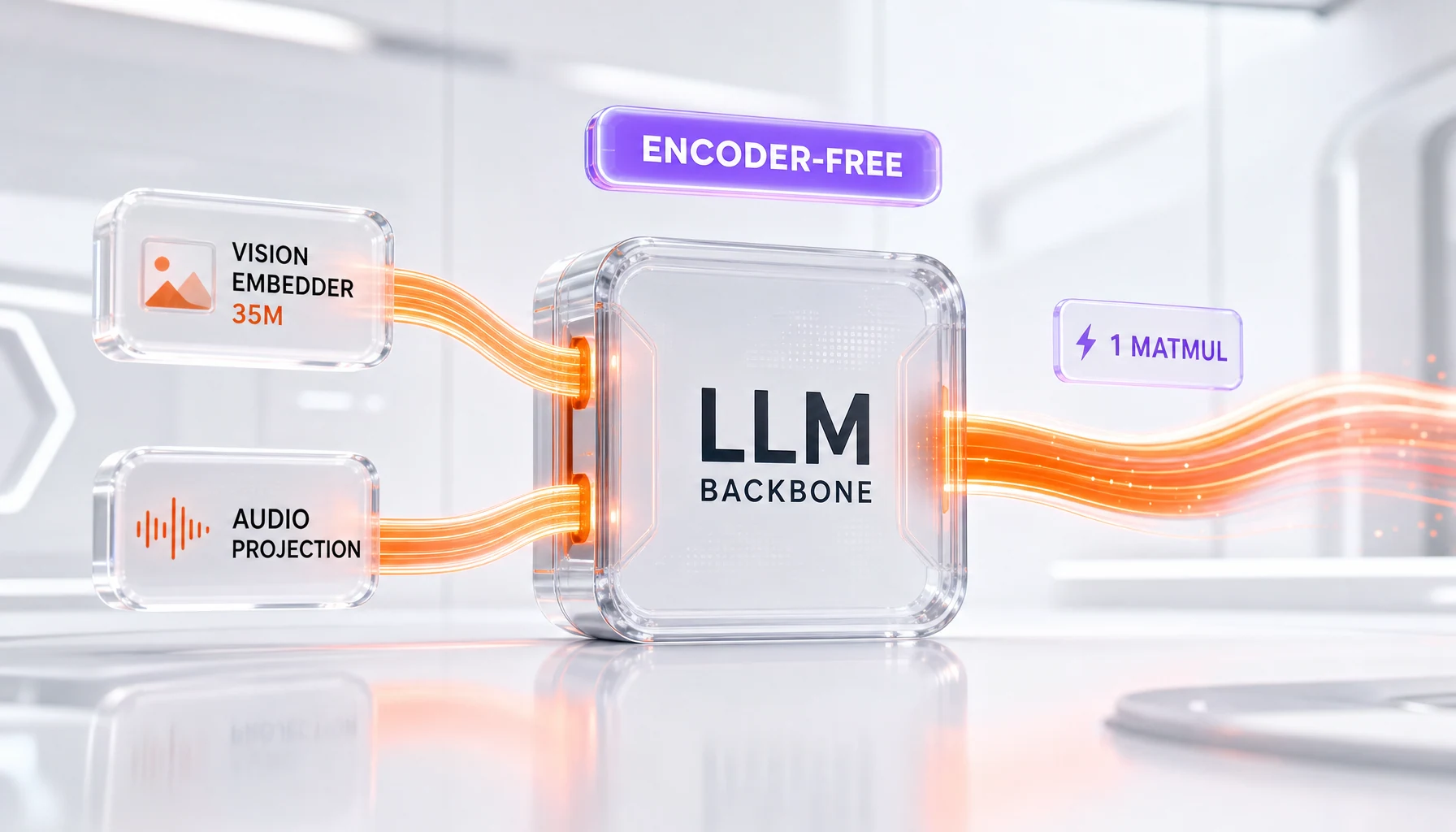
Gemma 4 12B removes that seam. Google's phrasing is direct: "No multimodal encoders. The vision and audio inputs flow directly into the LLM." For vision, the company replaced what would normally be a full vision transformer — the developer guide describes it as standing in for roughly 27 vision-transformer layers — with what it calls "a lightweight embedding module consisting of a single matrix multiplication." Raw 48-by-48 pixel patches are projected straight to the language model's hidden dimension by a vision embedder that the developer guide pegs at around 35 million parameters. That is a rounding error next to a conventional vision encoder.
The design choice cascades. By collapsing the vision path into a single matrix multiplication, Google strips out a large block of parameters and a layer of computational overhead, which is a meaningful part of how a 12B model lands "at less than half the total memory footprint" of a 26B alternative while staying close on quality. It also means there is one model to load, one model to quantize, and one model to reason about — not a backbone plus a fleet of encoders. For anyone who has fought with multimodal deployment, the appeal of a genuinely unified model is immediate.
Native audio is the quiet headline
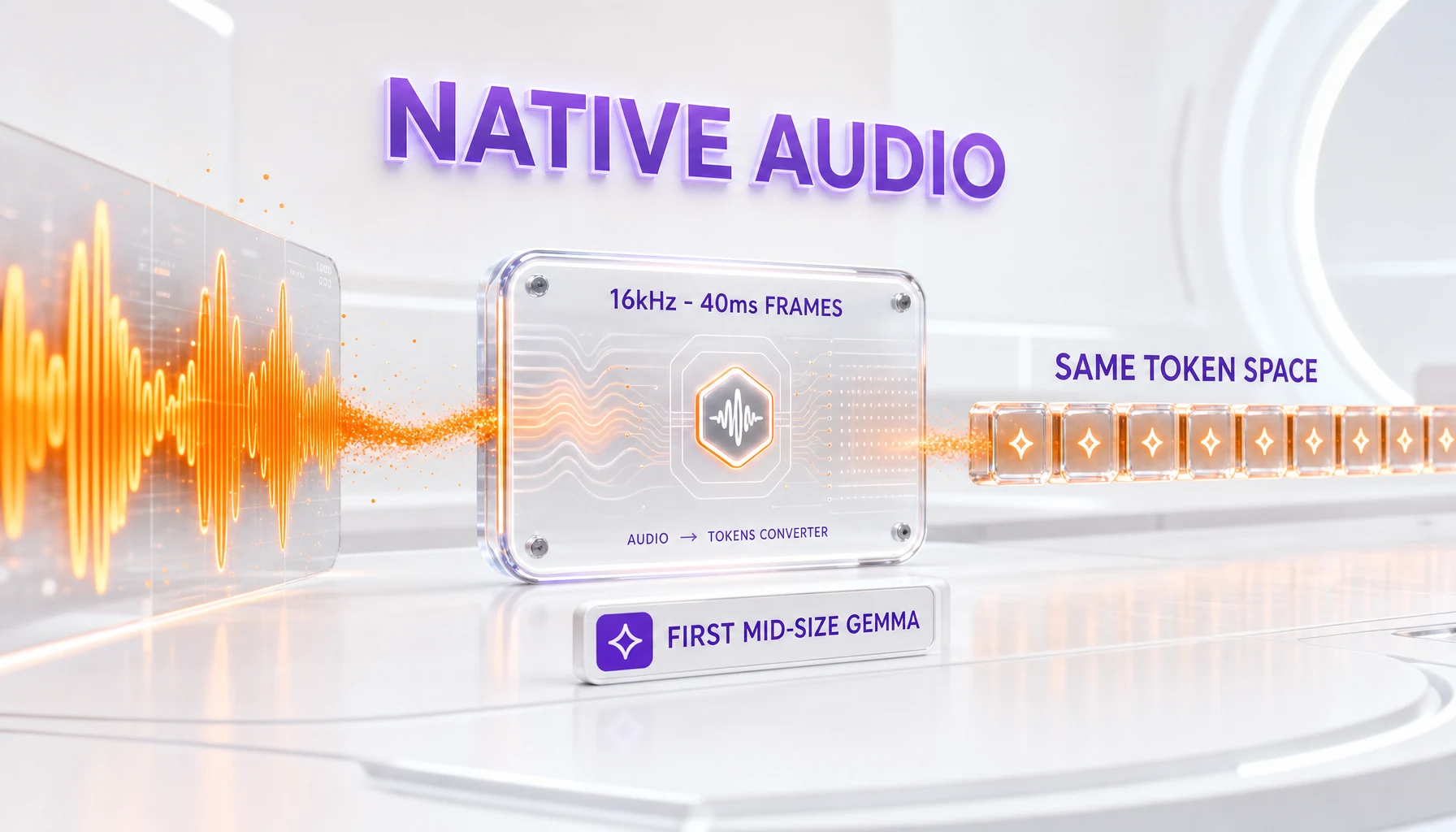
The line in the announcement that deserves more attention than it will get is this: Gemma 4 12B is Google's "first mid-sized model to feature native audio inputs." Plenty of models can process audio by routing it through a separate speech encoder first. Gemma 4 12B does something different. Google "removed the audio encoder entirely and projected the raw audio signal into the same dimensional space as text tokens." The developer guide spells out the mechanics: raw 16 kHz audio is sliced into 40-millisecond frames of 640 floats each, and those frames are projected directly into the model's token space.
The consequence is that audio is not a bolted-on capability that hands off to a transcription service before the real model sees it. Sound enters the model the same way text does, in the same representational space, which is what "native" is doing in that sentence. The developer guide lists the downstream capabilities this unlocks: automatic speech recognition, diarization — telling speakers apart — and broader audio understanding, alongside the vision and coding skills you would expect. For a model that fits on a laptop, having genuine on-device speech understanding rather than a cloud transcription dependency is a category change, not a feature bump.
This is also where the local story and the audio story fuse. We have written before about the privacy logic of keeping inference on the device, most recently when Google and Synaptics ran a tiny Gemma model on the Coralboard with no cloud connection at all. Audio is the input modality where that logic bites hardest: voice notes, meetings, calls, and ambient sound are among the most sensitive data a user generates. A mid-size multimodal model that can transcribe and reason over audio without the waveform ever leaving the machine is exactly the kind of building block on-device privacy advocates have been asking for.
Why "16GB of RAM" is the number that matters
Most model launches lead with a benchmark. This one effectively leads with a hardware requirement, and that framing is intentional. Google says Gemma 4 12B runs "locally on consumer laptops with 16GB of RAM." The wording matters: this is system RAM, including the unified memory on Apple Silicon machines, not the dedicated VRAM of a discrete GPU. A 16GB laptop is not an enthusiast rig — it is the default configuration of a mainstream MacBook Air or a mid-tier Windows ultrabook. The bar to run a capable multimodal model with native audio just dropped to hardware that hundreds of millions of people already carry.
The reason this is achievable is the same efficiency story from earlier, applied to memory rather than benchmark scores. By reaching near-26B quality "at less than half the total memory footprint," and by stripping out the encoder parameters that would otherwise inflate a multimodal model, Gemma 4 12B lands inside the memory envelope of a normal laptop once quantized. The developer guide's runtime list — Ollama, llama.cpp, MLX, LM Studio — is precisely the local-first ecosystem, and the explicit Apple Silicon GPU support signals that the unified-memory Mac is a first-class target rather than an afterthought.
It is worth being precise about scope. Sixteen gigabytes is enough to run the model with a quantized format plus the runtime and an operating system; it is not infinite headroom, and the largest context windows or the most aggressive batching will still favor more memory. But the claim being made is not that this replaces a data-center deployment. It is that the floor for serious local multimodal AI has moved from "you need a workstation GPU" to "you need a normal laptop," and that is the shift that turns a research artifact into a tool a working developer can actually adopt without a hardware purchase.
MTP drafters and the agentic angle
There is one more piece of the architecture built specifically for the local use case. Google notes that "Gemma 4 12B comes equipped with Multi-Token Prediction (MTP) drafters to reduce latency," and the developer guide describes a dedicated multi-token prediction model available to "maximize local inference speeds." Speculative decoding with a draft model is a well-understood technique — a small, fast model proposes several tokens at once and the main model verifies them — and shipping the drafter alongside the main weights means the latency optimization is available out of the box rather than something each user has to assemble.
Latency is not a vanity metric here; it is the thing that makes local agentic workflows usable. An agent that plans, calls tools, observes results, and re-plans makes many model calls per task. On a cloud endpoint, each of those calls is a network round-trip plus a metered token bill. On a laptop, each call is local and free at the margin, but only if it is fast enough that a multi-step loop does not feel like watching paint dry. MTP drafters attack exactly that bottleneck, which is why their inclusion reads as a statement about the intended use, not a footnote.
Put the pieces together and the picture is coherent. A unified multimodal model that takes text, images, and audio; that fits on a 16GB laptop; that ships with a latency optimization tuned for local inference; and that carries an Apache 2.0 license permitting commercial deployment. That is a model engineered to sit at the center of a local or edge agent — one that can listen, see, read, plan, and act without a cloud dependency or a per-query cost. It is the same direction we flagged when Apple's Mac demand surprise pointed at local AI reshaping cloud pricing, now with a Google open model purpose-built to ride that wave.
How it sits against the open-weights field
Gemma 4 12B does not land in an empty room. The open-weights mid-size tier in 2026 is crowded, with Meta's Llama 4 line, Alibaba's Qwen 3.6, Mistral's Large 3, and the broader Gemma 4 family all competing for the same developers. Some of those rivals beat Gemma on specific axes — when Qwen 3.6 shipped, the benchmarks suggested Alibaba had edged Google on coding, and we said so. Raw leaderboard position is not where Gemma 4 12B is trying to win.
Where it stakes a distinct claim is the combination. The competitors are largely text-and-vision models that route audio, if they handle it at all, through a separate pipeline. Gemma 4 12B folds native audio into a single encoder-free model that fits a mainstream laptop and ships under a clean Apache 2.0 license. That intersection — native audio, unified architecture, laptop-class memory, permissive license — is narrower than any single-axis benchmark race, and it is precisely the niche where a developer building a private, multimodal, on-device agent has the fewest alternatives. Google is not claiming the smartest open model on Earth; it is claiming the most practical one for a specific and growing class of local applications.
Why it matters
The deeper significance is what the encoder-free design says about where open multimodal models are heading. For years, "multimodal" meant "a language model with extra machinery stapled on," and that machinery was the tax that kept capable multimodal AI tethered to serious hardware. By demonstrating that vision can collapse into a single matrix multiplication and audio can project straight into the token space, Google is making the argument that the encoder tax was never fundamental — it was just the way everyone happened to build it first. If that argument holds, the next generation of open models gets lighter, more unified, and more deployable across the board.
For developers, the immediate takeaway is concrete. A capable, multimodal, audio-native, Apache 2.0 model that runs on the laptop already on your desk lowers the cost of building local AI from "provision GPUs" to "download weights." For the wider industry, the 150-million-download family number is the part that should make competitors nervous: Google is not just shipping a clever architecture, it is shipping it into an ecosystem that already runs Gemma at enormous scale. The encoder-free idea will not stay proprietary for long, but the distribution head start might be harder to copy than the architecture.
What we still do not know
A few things deserve honest flags. Google's "performance nearing our larger 26B MoE model" is a vendor claim on standard benchmarks, and independent third-party evaluations of Gemma 4 12B across reasoning, coding, and audio tasks will be the real test; we are reporting the company's figure, not certifying it. The exact context-window length and the full list of supported languages were not stated in the primary sources we reviewed, so we are not going to invent numbers for them. And while the 16GB-of-RAM claim is explicit, real-world tokens-per-second on a given laptop will depend on the quantization, the runtime, and the specific machine — the headline is that it fits and runs, not a promised speed on every device.
None of those caveats dent the core story. The architecture is novel, the native audio is real, the license is clean, and the hardware bar is genuinely low. Those are facts from Google's own announcement, and together they make Gemma 4 12B one of the more consequential open-model releases of 2026 — not because it tops a leaderboard, but because it moves capable multimodal AI onto hardware ordinary people already own.
The takeaway
Gemma 4 12B is a small model with a big structural idea. Strip out the multimodal encoders, project vision through a single matrix multiplication and raw audio straight into the token space, and you get a unified model that handles text, images, and audio, reaches near-26B quality at under half the memory, ships latency-tuned MTP drafters for local inference, and runs on a 16GB laptop under Apache 2.0. The benchmark race will keep churning, and rivals will beat Gemma on individual axes. But for a developer who wants a private, multimodal, audio-capable agent running on the device in front of them, Gemma 4 12B is the clearest answer the open-weights world has offered so far. The encoder tax, it turns out, was optional all along.
Frequently asked questions
What is Gemma 4 12B?
Gemma 4 12B is a 12-billion-parameter open multimodal model that Google released on June 3, 2026. It uses a new encoder-free architecture, accepts text, image, and audio input, and is the first mid-sized Gemma model with native audio inputs. It runs locally on a consumer laptop with 16GB of RAM, ships under an Apache 2.0 license, and is available on Hugging Face and Kaggle. Google says it reaches performance nearing its larger 26B MoE model at less than half the memory footprint.
What does "encoder-free" mean for Gemma 4 12B?
It means the model has no separate multimodal encoders. Instead of bolting a vision transformer and an audio encoder onto the language model, Google lets vision and audio flow directly into the LLM backbone. For vision, it replaced a full vision transformer with a lightweight embedding module — roughly 35 million parameters — that does a single matrix multiplication on raw 48-by-48 pixel patches. For audio, it removed the audio encoder and projected the raw signal into the same space as text tokens. This is a large part of why the model is so memory-efficient.
Can Gemma 4 12B really run on a laptop?
Yes. Google states Gemma 4 12B runs locally on consumer laptops with 16GB of RAM, including the unified memory on Apple Silicon Macs — this is system RAM, not dedicated GPU VRAM. A 16GB machine is a mainstream MacBook Air or a mid-tier Windows ultrabook, not an enthusiast rig. It runs through local-first runtimes such as Ollama, llama.cpp, MLX, and LM Studio, with native Apple Silicon GPU support. Real-world speed depends on the quantization and the specific machine, but the model fits and runs on hardware many developers already own.
How is Gemma 4 12B's native audio different from other models?
Most models process audio by routing it through a separate speech encoder before the language model sees it. Gemma 4 12B removed the audio encoder entirely and projects the raw 16 kHz audio signal — sliced into 40-millisecond frames — into the same dimensional space as text tokens. Sound enters the model the same way text does, which is what "native" audio means here. It is Google's first mid-sized model to do this, and it unlocks on-device automatic speech recognition, speaker diarization, and broader audio understanding without a cloud transcription dependency.
Is Gemma 4 12B better than Llama 4 or Qwen 3.6?
It depends on the task. On raw benchmarks, rivals can win on specific axes — when Qwen 3.6 launched, its coding scores edged Gemma 4. Where Gemma 4 12B is distinct is the combination: native audio, an encoder-free unified architecture, laptop-class 16GB memory, and a clean Apache 2.0 license. Llama 4, Qwen 3.6, and Mistral Large 3 are largely text-and-vision models that handle audio, if at all, through a separate pipeline. For a private, multimodal, audio-capable agent running on a laptop, Gemma 4 12B has the fewest direct alternatives.
How much does Gemma 4 12B cost and what license is it under?
Gemma 4 12B is released under an Apache 2.0 license, which permits commercial use, modification, and redistribution without the bespoke restrictions some open-model licenses carry. The weights are free to download from Hugging Face and Kaggle, so there is no licensing fee to self-host. Running it locally on a 16GB laptop costs nothing per query beyond your own electricity, since inference happens on-device. Hosted access through cloud providers, if you choose that route instead, would carry usage-based pricing set by the provider.
What are MTP drafters in Gemma 4 12B?
MTP stands for Multi-Token Prediction. Gemma 4 12B ships with MTP drafters — a small, fast draft model that proposes several tokens at once for the main model to verify — to reduce latency and maximize local inference speeds. This is a form of speculative decoding, and bundling the drafter with the main weights means the speedup is available out of the box. It matters most for agentic workflows, where a single task can involve many sequential model calls, and low latency is what keeps a multi-step local loop usable.
Why does Gemma 4 12B matter for local and edge AI?
It moves the floor for capable multimodal AI from a workstation GPU down to a mainstream 16GB laptop. Because the model is unified, audio-native, latency-tuned with MTP drafters, and permissively licensed, it is well suited to sit at the center of a local or edge agent that can listen, see, read, plan, and act without a cloud connection or a per-query bill. Keeping inference on the device also keeps sensitive data — especially audio like voice notes and meetings — from ever leaving the machine, making privacy the default rather than a feature.
How does Gemma 4 12B compare to the larger 26B model?
Google says Gemma 4 12B delivers performance nearing its larger 26B Mixture-of-Experts model on standard benchmarks, but at less than half the total memory footprint. In other words, roughly the quality of a model more than twice its size, in a memory budget that fits a normal laptop. This is a vendor claim pending independent third-party evaluation, but it is the central efficiency argument behind the launch and the reason a 12B model can credibly target laptop-class hardware while staying close to a much larger model on quality.
Where can I download Gemma 4 12B and what can run it?
Pre-trained and instruction-tuned checkpoints are available on Hugging Face and Kaggle. Google's developer guide lists support across Ollama, llama.cpp, Hugging Face Transformers, MLX, vLLM, SGLang, and LM Studio, with native support for Apple Silicon GPUs and fine-tuning through tools like Unsloth. The local-first runtimes — Ollama, llama.cpp, MLX, and LM Studio — are the easiest paths to run it on a personal laptop, while vLLM and SGLang target higher-throughput server deployments.