
Microsoft Copilot Cowork became generally available worldwide on June 16, 2026 — and the most striking detail is not the launch itself, but what powers it. Microsoft's flagship AI "teammate" runs primarily on Anthropic's Claude (Opus 4.8 and Sonnet 4.6), not on Microsoft's own MAI models and not on OpenAI's GPT. Pay-as-you-go pricing is $0.01 per Copilot Credit, more than half of the Fortune 500 already use it, and Microsoft's own model, Cowork 1, is still weeks away.
That is the plot twist worth slowing down on. Microsoft owns a strategic stake in OpenAI, just shipped its own MAI model family at Build, and runs the world's largest enterprise software distribution machine. Yet when it built the autonomous agent it is now putting in front of every Microsoft 365 customer, it reached for a competitor's brain. The decision says more about the state of enterprise AI in mid-2026 than any benchmark chart.
What Microsoft Actually Shipped
Copilot Cowork is not another chat box. In Microsoft's own framing, "you define the work and Cowork runs it end-to-end and returns a completed result, not just a draft or a recommendation." It executes complex, long-running, multi-tool tasks: editing spreadsheets in dependency-aware batch jobs, comparing nearly four thousand files across two product versions, or analyzing a sales pipeline to surface at-risk opportunities.
The feature had been incubating inside Microsoft's Frontier early-access program since spring. We covered that Frontier preview in May, when Cowork was still a limited rollout. The June 16 announcement flips it to worldwide general availability, gated behind the Microsoft 365 Copilot User Subscription License. Charles Lamanna, the executive vice president who runs the business, called it "the fastest growing feature in the history of our Frontier program," with "among the highest user satisfaction of any Copilot or agent experience we have shipped."
Adoption is the headline Microsoft wants you to read first: more than half of the Fortune 500 is already using Copilot Cowork. Named customers include Accenture, Avanade, Capital Group, Koch, Ooredoo Qatar, and Zurich Insurance. For a feature that only just reached GA, that is an unusually deep enterprise footprint — and it is running on Claude.
The Engine Under the Hood Is Claude
Here is the line that matters, stated plainly in Microsoft's announcement: Copilot Cowork "runs on Anthropic models, including Opus 4.8 and Sonnet 4.6." Customers in the Frontier program can additionally opt to use GPT 5.5. Microsoft's own model is conspicuously absent from launch day — "our newest model, Cowork 1, will be a secure, fine-tuned model releasing in the coming weeks."
Read in order, the model lineup tells a story. The default, production-grade engine for Microsoft's most agentic product is Anthropic's. GPT 5.5 is an opt-in for the early-access crowd. And Microsoft's home-grown MAI lineage, launched with fanfare at Build, does not yet touch the flagship agent at all. For a company that has spent two years branding "Copilot" as its own intelligence, shipping the marquee agent on a rival's models is a remarkable act of pragmatism.
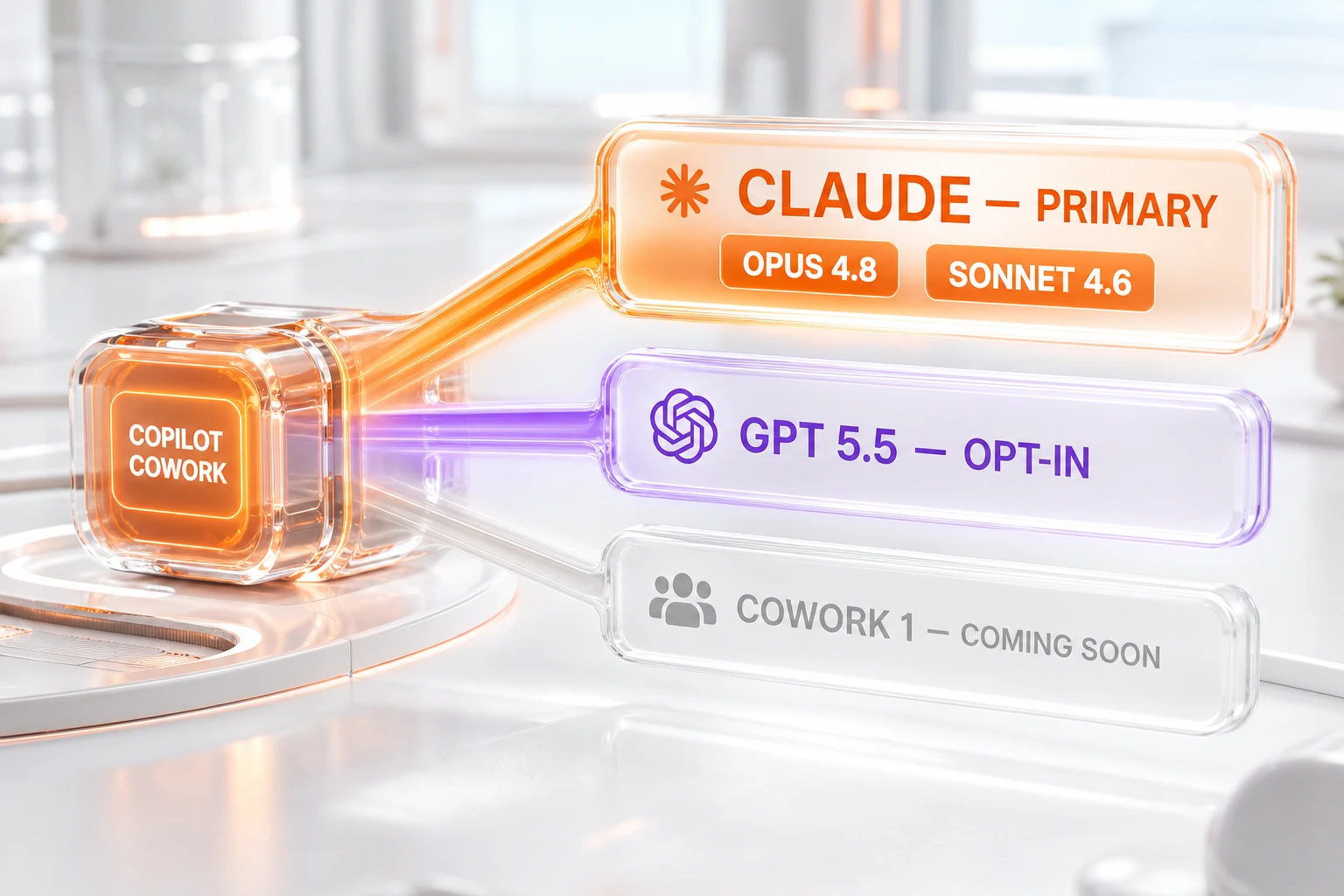
Why Claude, specifically? The honest answer is that agentic reliability — staying coherent across dozens of tool calls, long context windows, and multi-step plans without drifting or hallucinating an action — is the hardest thing in applied AI right now, and it is precisely where Anthropic's models have built a reputation. When the deliverable is a finished spreadsheet or a reconciled file diff rather than a paragraph of prose, a model that quietly fabricates one step in fifty is worse than useless. Microsoft is optimizing for the agent that finishes the job correctly, and in mid-2026 that has repeatedly meant Claude Opus 4.8 for the hardest reasoning and Claude Sonnet 4.6 for high-volume, lower-latency work.
How the Pricing Works — and What It Reveals
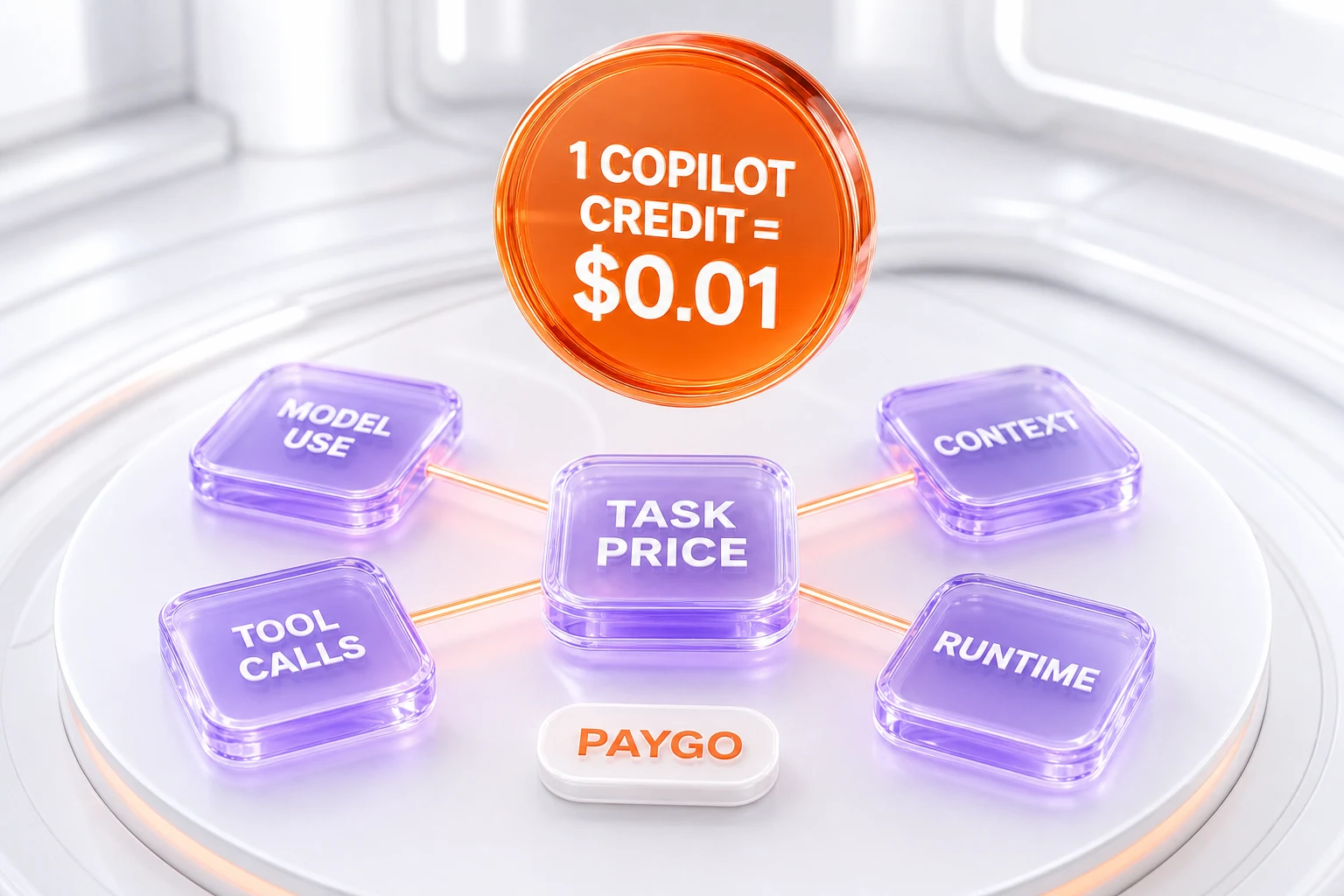
Cowork does not use a flat seat price. It is billed on a usage basis denominated in Copilot Credits, layered on top of the required Microsoft 365 Copilot subscription. Pay-as-you-go is priced at $0.01 per Copilot Credit. Crucially, Microsoft is explicit that "the price for each task is calculated from four inputs: model use, context retrieval, tool calls, and runtime." Organizations that prepay a usage commitment (the P3 option) receive a discount.
That four-input formula is the tell. "Model use" being a distinct, metered cost line is exactly what you would expect from a company that is paying a third party — Anthropic — per token for the intelligence behind each task. Microsoft has wrapped a markup-bearing meter around someone else's model and resold it inside Office. This is the same token-economics pressure we unpacked in our earlier analysis of why Microsoft has been rethinking how it pays for frontier AI, and it maps directly onto the "token capital" thesis that Satya Nadella has been pitching: in an agentic world, tokens are a cost of goods sold, and whoever controls the unit economics controls the margin.
Microsoft also makes a pointed competitive claim: running Cowork on Claude was on average 30 to 40 percent cheaper than running Anthropic's own Claude Cowork through a Microsoft 365 connector. In other words, Microsoft is arguing it can resell Claude inside Office more efficiently than customers can buy Claude's first-party agent and bolt it onto Microsoft 365. That is a striking position — Microsoft monetizing Anthropic's model better than Anthropic monetizes it in the Microsoft ecosystem.
Why Cowork 1 Is the Real Strategy
If launch-day Cowork is a Claude story, the medium-term plan is a margin story. Microsoft says Cowork 1, its own secure fine-tuned model, is "designed to handle everyday Copilot tasks at a substantially lower cost" and ships in the coming weeks. The strategic logic writes itself: route the routine, high-volume tasks to a cheap in-house model, and reserve the expensive frontier engines — Claude Opus 4.8 and Sonnet 4.6 — for the genuinely hard agentic work where reliability justifies the token bill.
This is the standard playbook for any platform that begins life renting intelligence: get the product to market on the best available models, build the demand, then quietly substitute a cheaper owned model under the hood wherever quality allows. The open question is how much of Cowork's workload Cowork 1 can actually absorb. If the answer is "most routine tasks," Microsoft's gross margins improve dramatically and Anthropic's share of the workload shrinks over time. If the answer is "Claude is still doing the heavy lifting a year from now," then Cowork remains, structurally, a Claude product wearing a Microsoft badge.
What This Says About Claude's Enterprise Maturity
Strip away the branding and one fact remains: the company with the deepest enterprise distribution on earth, with its own models and a privileged OpenAI relationship, chose Anthropic's Claude to power the agent it is betting its productivity narrative on. That is arguably the strongest third-party validation Claude has received in the enterprise to date — stronger than any benchmark, because it is a purchasing decision backed by Microsoft's own revenue.
It also fits a broader 2026 pattern. Over the past two months we have tracked Claude being adopted as the reasoning layer across the enterprise stack — from SAP making Claude the reasoning brain of its business AI to consulting giants certifying tens of thousands of staff on it. Microsoft choosing Claude for Cowork is the same signal from the most consequential possible source: when the deliverable has to be correct and the buyer is a Fortune 500 CIO, frontier reliability is winning over first-party convenience.
The Bottom Line
Copilot Cowork's worldwide GA is a genuinely big enterprise-AI moment — autonomous, task-completing agents are now a default, metered feature inside Office for more than half of the Fortune 500. But the deeper story is the one Microsoft would rather frame as a footnote: its flagship agent thinks with Anthropic's brain. The $0.01-per-credit, four-input pricing model exposes that Microsoft is reselling Claude with a meter on top, and the promised Cowork 1 model is the lever it will pull to claw margin back over time.
For now, the takeaway is simple. If you want to know which model is good enough to run an autonomous agent in front of the entire Fortune 500, Microsoft just answered it with its checkbook — and the answer was Claude, not Copilot's own brain. Watch the Cowork 1 rollout closely: it will tell us whether this was a temporary bridge or a permanent admission that, for the hardest agentic work in 2026, Anthropic still sets the bar.
Frequently Asked Questions
What is Microsoft Copilot Cowork?
Copilot Cowork is Microsoft 365's autonomous AI agent, made generally available worldwide on June 16, 2026. Unlike a chatbot that returns a draft, Cowork executes complex, long-running, multi-tool tasks end to end and returns a finished result. It is Microsoft's direct answer to Anthropic's Claude Cowork and Google's Gemini Agent Mode, and it requires the Microsoft 365 Copilot User Subscription License.
Which AI models does Copilot Cowork run on?
According to Microsoft's June 16, 2026 announcement, Copilot Cowork runs on Anthropic models, including Claude Opus 4.8 and Claude Sonnet 4.6, as its primary engines. Customers in Microsoft's Frontier program can also opt into OpenAI's GPT 5.5. Microsoft's own fine-tuned model, Cowork 1, is not yet powering the agent — it is scheduled to arrive in the coming weeks.
Why does Microsoft use Claude instead of its own MAI models or GPT?
Microsoft launched its in-house MAI model family at Build, but for its flagship agent it chose Anthropic's Claude because Claude currently leads on the long-horizon, multi-step, tool-use reliability that agentic work demands. Microsoft frames Cowork on Claude as 30 to 40 percent cheaper on average than running Claude Cowork through a Microsoft 365 connector, signaling that model choice is driven by task reliability and unit economics rather than brand loyalty.
How much does Copilot Cowork cost?
Copilot Cowork is billed on a usage basis denominated in Copilot Credits, on top of a required Microsoft 365 Copilot User Subscription License. Pay-as-you-go (PayGo) is priced at $0.01 per Copilot Credit. The price of each task is calculated from four inputs: model use, context retrieval, tool calls, and runtime. Organizations that commit usage volume in advance (the P3 option) get a discount, and Cowork is off by default with tenant, group, and user-level spending limits.
What is Microsoft's 'Cowork 1' model?
Cowork 1 is Microsoft's own secure, fine-tuned model, announced on June 16, 2026 as releasing in the coming weeks. Microsoft positions it to handle everyday Copilot tasks at a substantially lower cost than the frontier Anthropic models that power Cowork at launch. The likely pattern is a tiered routing system: Cowork 1 for routine work, Claude Opus 4.8 and Sonnet 4.6 for the hardest agentic tasks.
How many companies use Copilot Cowork?
Microsoft says more than half of the Fortune 500 is already using Copilot Cowork as of its June 16, 2026 general availability. Named adopters include Accenture, Avanade, Capital Group, Koch, Ooredoo Qatar, and Zurich Insurance. Microsoft EVP Charles Lamanna called Cowork the fastest-growing feature in the history of the company's Frontier program.