On July 21, 2026, Microsoft and Mistral AI expanded their partnership into what both companies describe as a "multibillion-dollar" commitment — with a counterintuitive core: Microsoft, the world's second-largest cloud provider, will use the French startup's Europe-based GPU infrastructure to increase its own Azure capacity. Neither side disclosed a dollar figure. In the same announcement, Mistral's newest models moved into Microsoft Foundry and Copilot Studio, and Mistral CEO Arthur Mensch said Microsoft is not raising its equity stake through the deal.
Key takeaways
- The deal, announced July 21, 2026, is a "multibillion-dollar commitment from Microsoft." Neither company disclosed a specific dollar amount, and Microsoft declined to specify one.
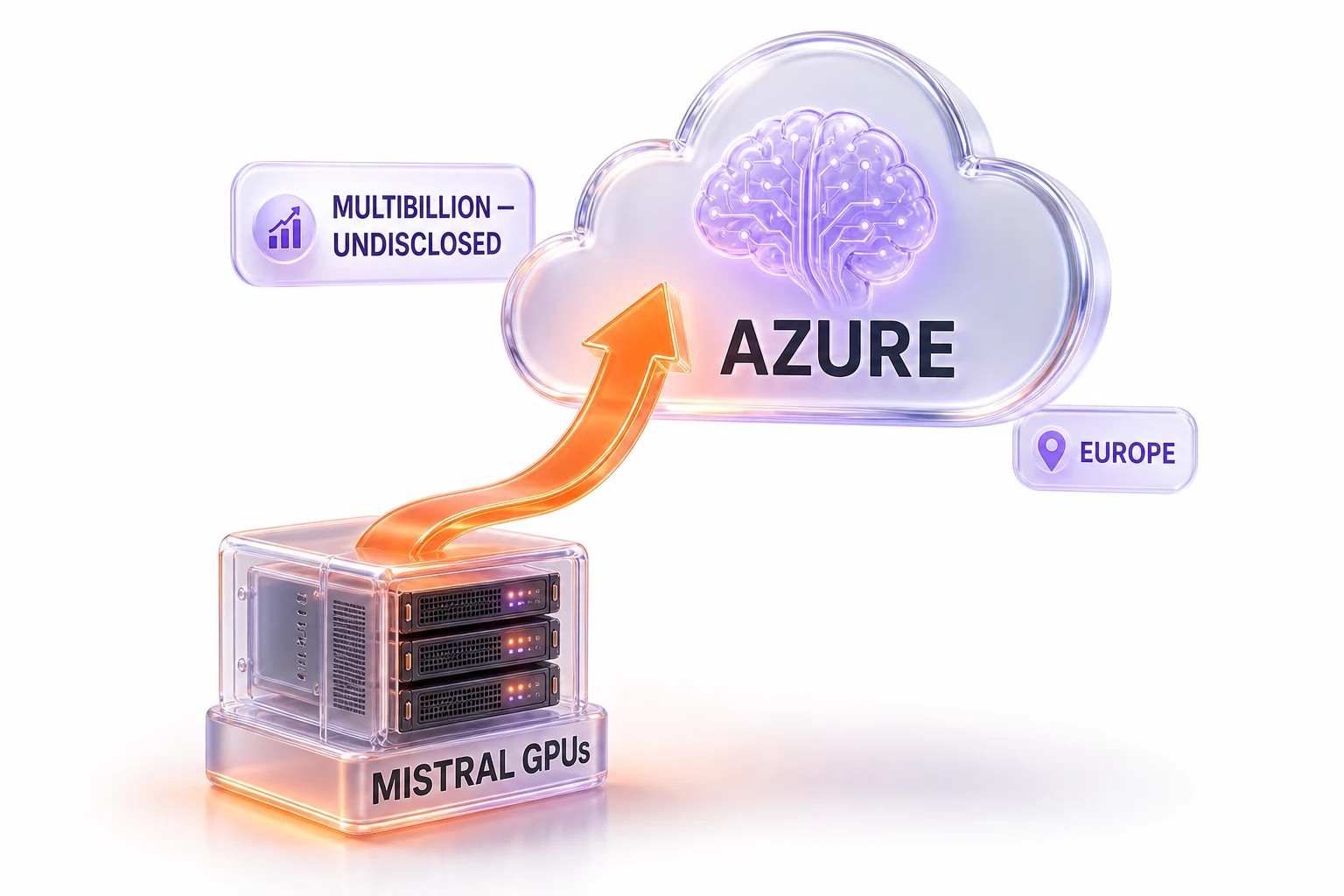
- The headline reversal: Microsoft said it "will leverage Mistral's expanded Europe-based GPU infrastructure to increase capacity for AI development and to support the delivery of" its cloud and AI services — a hyperscaler drawing on a startup's data centers rather than the reverse.
- Mistral Medium 3.5 and OCR 4 are now available in Microsoft Foundry; Medium 3.5 is also in Microsoft Copilot Studio.
- The models can be deployed three ways — public cloud, hybrid through Azure Local, and fully disconnected — aimed at regulated sectors that must keep data and operations under their own control.
- Arthur Mensch said Microsoft is not increasing its equity stake through this deal; separately, Mistral targets 1 gigawatt of compute capacity by 2030.
What Microsoft and Mistral actually announced
Microsoft and Mistral extended their strategic partnership on July 21, 2026 with three moving parts: a "multibillion-dollar" Microsoft commitment tied to Mistral's European GPU capacity, the arrival of Mistral Medium 3.5 and OCR 4 inside Microsoft Foundry and Copilot Studio, and a single deployment model that runs across public cloud, hybrid, and fully disconnected environments. The dollar figure was not disclosed.
The announcement, published on Microsoft's own newsroom, frames the expansion around one word that recurs throughout the release: control. Microsoft's official statement pitches the deal as a way "to give enterprises and regulated industries frontier AI they can control," and pairs European compute capacity with Mistral's frontier models. Reporting by SiliconANGLE described it plainly as Mistral striking "a multibillion-dollar deal with Microsoft" while confirming that no exact amount was attached to the number.
What makes the July deal notable is not that Microsoft and Mistral are working together — they have since 2024 — but the direction of the compute. This is not the familiar arrangement of a startup renting GPUs from a hyperscaler. Here, the hyperscaler is committing billions to lean on the startup's build-out.
The reversal: a hyperscaler leaning on a startup's data centers
In the usual cloud economy, AI startups rent compute from Microsoft, Amazon, or Google. This deal inverts that flow: Microsoft said it "will leverage Mistral's expanded Europe-based GPU infrastructure to increase capacity for AI development and to support the delivery of" its cloud and AI services. In practice, some of Azure's future European capacity will sit on data centers a four-year-old company is building on French soil.
That inversion is the story. Hyperscalers are the landlords of the AI boom; they own the buildings, the racks, and the power contracts, and everyone else pays rent. For Microsoft to commit a "multibillion-dollar" sum to draw on a partner's GPU fleet is a signal that even the largest cloud operators cannot build European capacity fast enough on their own — and that a sovereign, France-based supply of compute is worth paying for. Coverage from Quartz framed the move as Microsoft "deepening its Mistral partnership with a multibillion-dollar AI infrastructure deal," while Neowin read it as a commitment "to expand Mistral AI infrastructure in Europe."
There is a nuance worth keeping. The deal is two-way. Alongside Microsoft tapping Mistral's capacity, Azure customers gain access to Mistral's French data centers, and Mistral's models flow into Microsoft's distribution. But the eye-catching, sourced fact — a hyperscaler paying to use a startup's infrastructure — is real, and it is the part of the announcement that breaks the usual pattern.
"Multibillion-dollar" — but undisclosed, and the stake stays put
The word doing the heavy lifting is "multibillion-dollar," and it is a description rather than a number. Microsoft declined to specify the amount, so any precise figure would be a guess. Just as important: Arthur Mensch said Microsoft is not increasing its equity stake through this deal — this is a commercial and infrastructure arrangement, not a fresh equity injection.
Keeping those two facts straight matters, because it is easy to conflate a large commercial commitment with a large equity buy. According to SiliconANGLE, Mensch said "Microsoft won't be increasing its stake in the company through today's deal." That distinction is politically significant in Europe, where a rising Microsoft ownership share would attract far more regulatory attention than a purchasing agreement.
The financial backdrop is being reported separately by the business press, and should be attributed there rather than to the deal itself. Ahead of the announcement, Bloomberg reporting cited by Yahoo Finance described Mistral as seeking to raise around 3 billion euros at a valuation in the region of 20 billion euros. Those figures are context for how much capital Mistral is marshaling, not terms of the Microsoft deal, and the two should not be added together or treated as the same money.
Mistral's models move inside Microsoft's stack
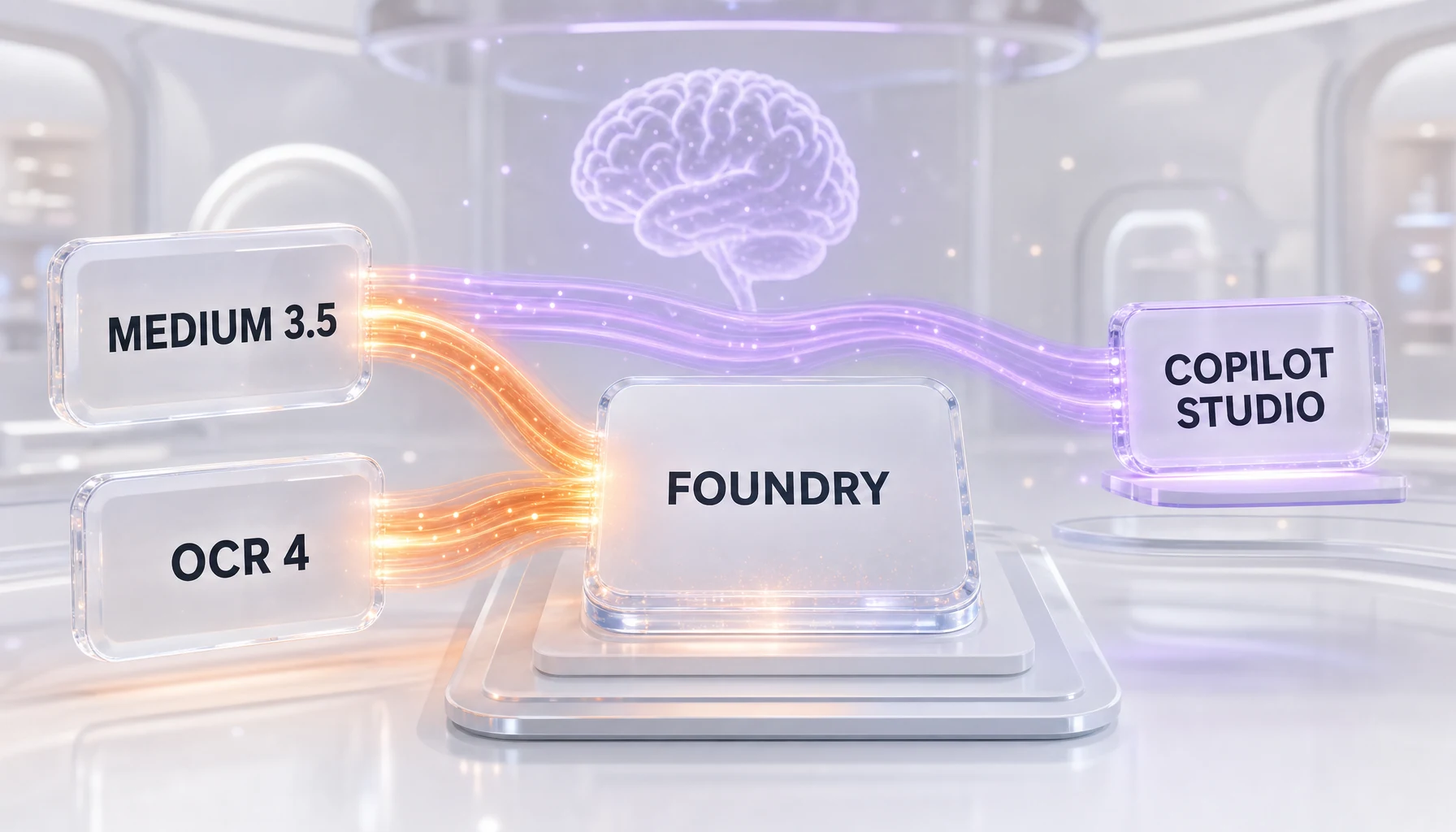
Beyond infrastructure, the deal is a distribution win for Mistral's models. Mistral Medium 3.5 and OCR 4 are now available in Microsoft Foundry, Microsoft's platform for building and deploying AI applications, and Medium 3.5 is additionally available in Copilot Studio, the low-code tool enterprises use to build their own agents. That puts Mistral's frontier models in front of Microsoft's enterprise customer base by default.
The model placement builds on Mistral's spring 2026 push. Medium 3.5 first landed in May with open-weights and cloud coding agents, which we covered in our report on the Medium 3.5 launch; its arrival in Foundry and Copilot Studio now gives it an enterprise distribution channel it did not have on day one. For teams already evaluating the family, Mistral's flagship model is profiled in our Mistral Large 3 overview.
The strategic read, per Microsoft's announcement, is that Microsoft continues to run a multi-model shop rather than betting everything on one lab. Adding Mistral to Foundry sits alongside its existing catalog, and Neowin noted that the OCR 4 document-understanding model rounds out the offering for enterprises with heavy paperwork workloads.
Cloud, hybrid, or fully disconnected: the regulated-industries play
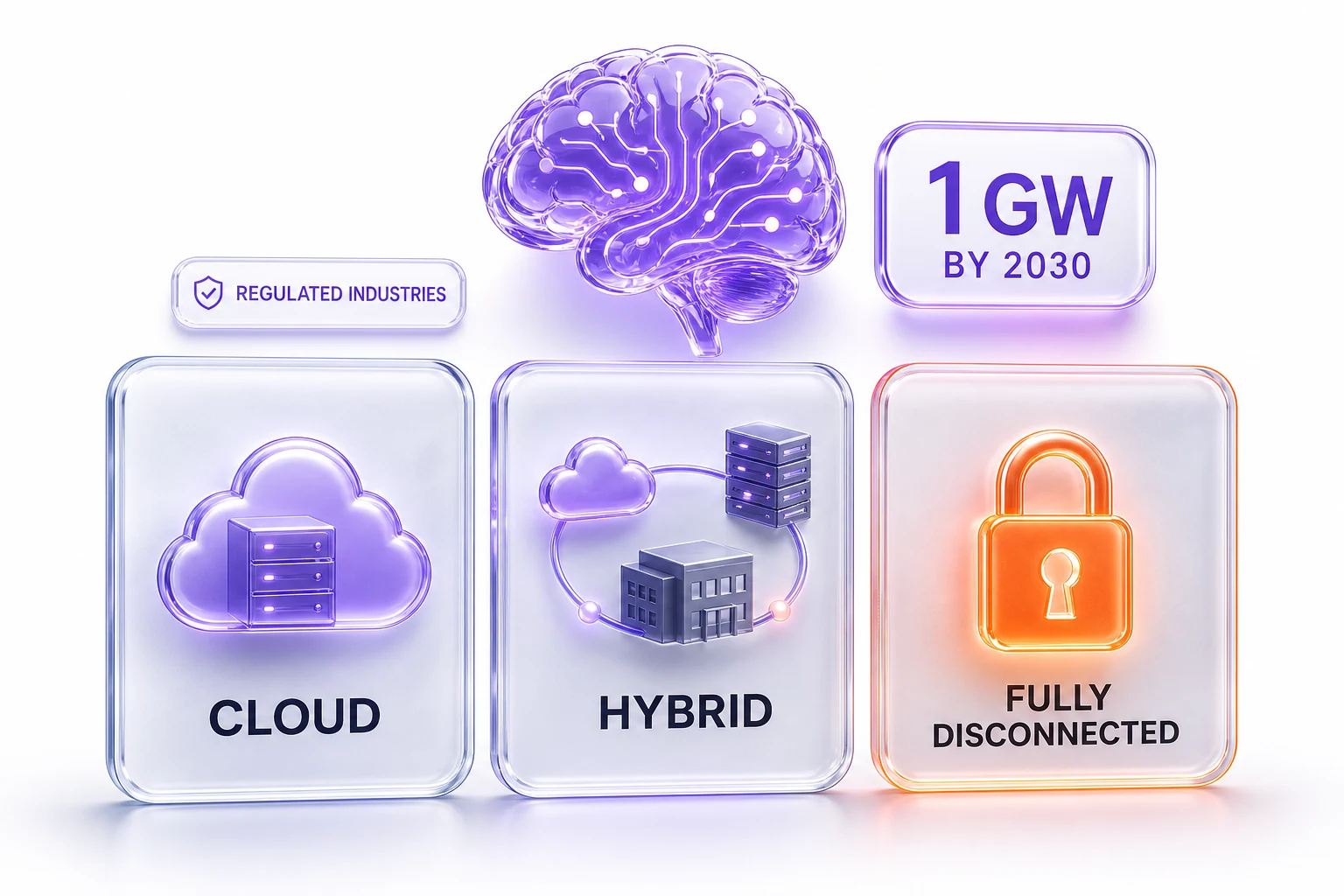
The clearest commercial logic sits in deployment. Microsoft and Mistral are offering the models across three modes: public cloud on Azure, cloud-connected through Azure Local, and fully disconnected — Azure Local deployments that can operate with no link back to the public cloud at all. The target buyers are named directly: financial services, manufacturing, healthcare, and other regulated sectors "where control and resilience are mandatory."
Fully disconnected operation is the differentiator. A bank or hospital that cannot, for legal or security reasons, send data to a public cloud can still run frontier models on hardware inside its own walls. Microsoft's release quotes Vice Chair and President Brad Smith saying that "Europe should have access to the world's most capable AI without compromising control over their data, operations or digital future," and Mensch saying Mistral's mission "has always been to put frontier AI in the hands of every organization while keeping them in control of their technology."
The timing is not accidental. From August 2, 2026, the European Commission can fine the makers of general-purpose AI models, a shift we detailed in our breakdown of the EU AI Act's enforcement date. Sovereignty and on-premises control are exactly what European regulated buyers are being pushed toward, and Mistral has been building for that demand — its cybersecurity model for banks locked out of US providers, which we examined in our piece on Europe's Mythos push, aimed at the same gap. Analysis by SiliconANGLE tied the deployment options directly to that regulatory momentum.
From 15 million euros to multibillion: how far the alliance has traveled
The two companies started small. In February 2024, Microsoft invested 15 million euros — about 16 million dollars — in Mistral and put its models on Azure. That modest tie-up drew immediate scrutiny from the European Commission over competition concerns. Two and a half years later, the relationship is measured in billions and framed around European infrastructure Microsoft wants to use, not just a startup it wants to fund.
The 2024 deal was, by AI-boom standards, tiny. As CNBC reported at the time, Microsoft's investment was a way "to expand beyond OpenAI," and TechCrunch pegged the figure at roughly 16 million dollars. It was small enough to look like a hedge and large enough to alarm Brussels: EU lawmakers and the European Commission signaled they would examine the arrangement for competition concerns, as contemporary reporting documented.
Since then, Mistral has scaled its ambitions on the compute side too. In May 2026, Mensch was openly discussing building custom chips even as he acknowledged the company still runs on Nvidia hardware — a tension we covered in our report on Mistral's chip ambitions. The July deal slots into that trajectory: the European GPU build-out Microsoft is now paying to use is the same infrastructure push Mistral has been signaling for more than a year.
Our analysis: what the deal says about Europe's compute politics
Our read is that this deal is less about Microsoft needing Mistral's chips and more about Microsoft needing European sovereignty credentials it cannot manufacture on its own. Paying a French champion to supply capacity — while explicitly not raising its equity stake — lets Microsoft sell "AI you can control" to regulated European buyers without owning the political liability of being their sole American supplier.
Microsoft has spent 2026 diversifying its dependencies. It renegotiated its OpenAI relationship to unlock multi-cloud freedom, which we analyzed in our breakdown of the OpenAI amendment, and it has been layering third-party and in-house models across Copilot. The Mistral deal fits that same playbook: spread the bets, buy optionality, and keep any single partner from becoming a chokepoint. Reading it as Microsoft "outsourcing" its European AI to a startup misses the point — it is buying insurance against being the wrong nationality in the wrong regulatory season.
What would prove this wrong? If Microsoft quietly raises its equity stake in a later round, or if the "multibillion-dollar" figure turns out to be front-loaded marketing rather than committed capital, the sovereignty framing would look thinner. And if Mistral's 1 gigawatt by 2030 target slips badly, the capacity Microsoft is counting on may not materialize on schedule. For now, though, the signal is clear: in 2026, even the biggest cloud on Earth is willing to rent, not own, the compute it needs to stay welcome in Europe. Coverage from Quartz and Microsoft's own newsroom both point the same way.
Frequently asked questions
What did Microsoft and Mistral announce on July 21, 2026?
They expanded their strategic partnership into a deal both sides call "multibillion-dollar." Microsoft committed to use Mistral's Europe-based GPU infrastructure to increase Azure capacity, Mistral Medium 3.5 and OCR 4 became available in Microsoft Foundry (with Medium 3.5 also in Copilot Studio), and the models are offered across public cloud, hybrid, and fully disconnected deployments aimed at regulated industries.
How much is the Microsoft–Mistral deal worth?
Neither company disclosed a specific figure. Both describe it as a "multibillion-dollar commitment from Microsoft," and Microsoft declined to specify an exact amount. Any precise dollar number reported elsewhere should be treated with caution, because the companies did not attach one to the announcement.
Is Microsoft using Mistral's GPUs, or is it the other way around?
Both directions exist in the deal, but the notable one is that Microsoft will use Mistral's capacity. Microsoft said it "will leverage Mistral's expanded Europe-based GPU infrastructure to increase capacity for AI development and to support the delivery of" its cloud and AI services. Separately, Azure customers also gain access to Mistral's French data centers, so the arrangement flows in both directions.
Which Mistral models are now in Microsoft Foundry and Copilot Studio?
Mistral Medium 3.5 and OCR 4 are now available in Microsoft Foundry, Microsoft's platform for building and deploying AI applications. Mistral Medium 3.5 is additionally available in Microsoft Copilot Studio, the low-code environment enterprises use to build agents.
Is Microsoft increasing its equity stake in Mistral?
No. Arthur Mensch said Microsoft is not increasing its stake in the company through this deal. It is a commercial and infrastructure arrangement rather than a new equity investment, a distinction that carries weight with European regulators.
What are the three deployment modes in the deal?
Public cloud on Azure; cloud-connected through Azure Local; and fully disconnected — Azure Local deployments that can operate independently, with no connection back to the public cloud. The fully disconnected option is the differentiator for organizations that cannot send data off-premises.
Why does this deal matter for regulated industries?
Microsoft named financial services, manufacturing, healthcare, and other regulated sectors as the target buyers — settings where, in its words, "control and resilience are mandatory." Offering frontier models that can run fully disconnected on-premises lets those organizations adopt advanced AI without moving sensitive data into a public cloud.
What is Mistral's 1 gigawatt by 2030 goal?
Mistral aims to have 1 gigawatt of compute capacity up and running by 2030, according to Mensch. It is a separate infrastructure target that provides context for why Microsoft is investing in Mistral's European build-out, not a term of the July 2026 deal itself.
Where are the GPU data centers located?
In Europe, with Mistral's data centers in France at the center of the arrangement. The sovereignty angle — European compute for European regulated buyers — is a core part of how both companies positioned the deal.
How is this different from the original 2024 Microsoft–Mistral partnership?
The February 2024 tie-up was a 15 million euro investment (about 16 million dollars) that put Mistral's models on Azure, and it drew European Commission scrutiny over competition concerns. The July 2026 deal is measured in billions, is framed around infrastructure Microsoft wants to use rather than just funding, and explicitly does not raise Microsoft's equity stake.
What is Mistral's current valuation?
Business-press reporting, citing Bloomberg, describes Mistral as seeking to raise around 3 billion euros at a valuation in the region of 20 billion euros. Those figures are reported context about Mistral's fundraising, not terms of the Microsoft deal, and the two should not be conflated.
Does this make Mistral dependent on Microsoft?
It deepens the commercial relationship, but the structure cuts against pure dependence: Microsoft is paying to use Mistral's infrastructure and is not raising its equity stake, and Mistral is pursuing its own 1 gigawatt compute target. The bigger risk for Mistral is concentration of customers rather than ownership, since much of its enterprise reach now runs through Microsoft's distribution.
Sources
- Microsoft — Microsoft and Mistral expand strategic partnership to give enterprises and regulated industries frontier AI they can control
- SiliconANGLE — Mistral AI strikes multibillion-dollar deal with Microsoft to build out Azure infrastructure in Europe
- Quartz — Microsoft is deepening its Mistral partnership with a multibillion-dollar AI infrastructure deal
- Neowin — Microsoft makes multibillion-dollar commitment to expand Mistral AI infrastructure in Europe
- Yahoo Finance — Microsoft Expands Mistral Alliance to Boost European AI Push
- CNBC (2024) — Microsoft invests in Europe's Mistral AI to expand beyond OpenAI
- TechCrunch (2024) — Microsoft made a $16M investment in Mistral AI
- TechTimes (2024) — EU Lawmakers Alarmed by Microsoft's 15-Million Euro Investment in Mistral AI