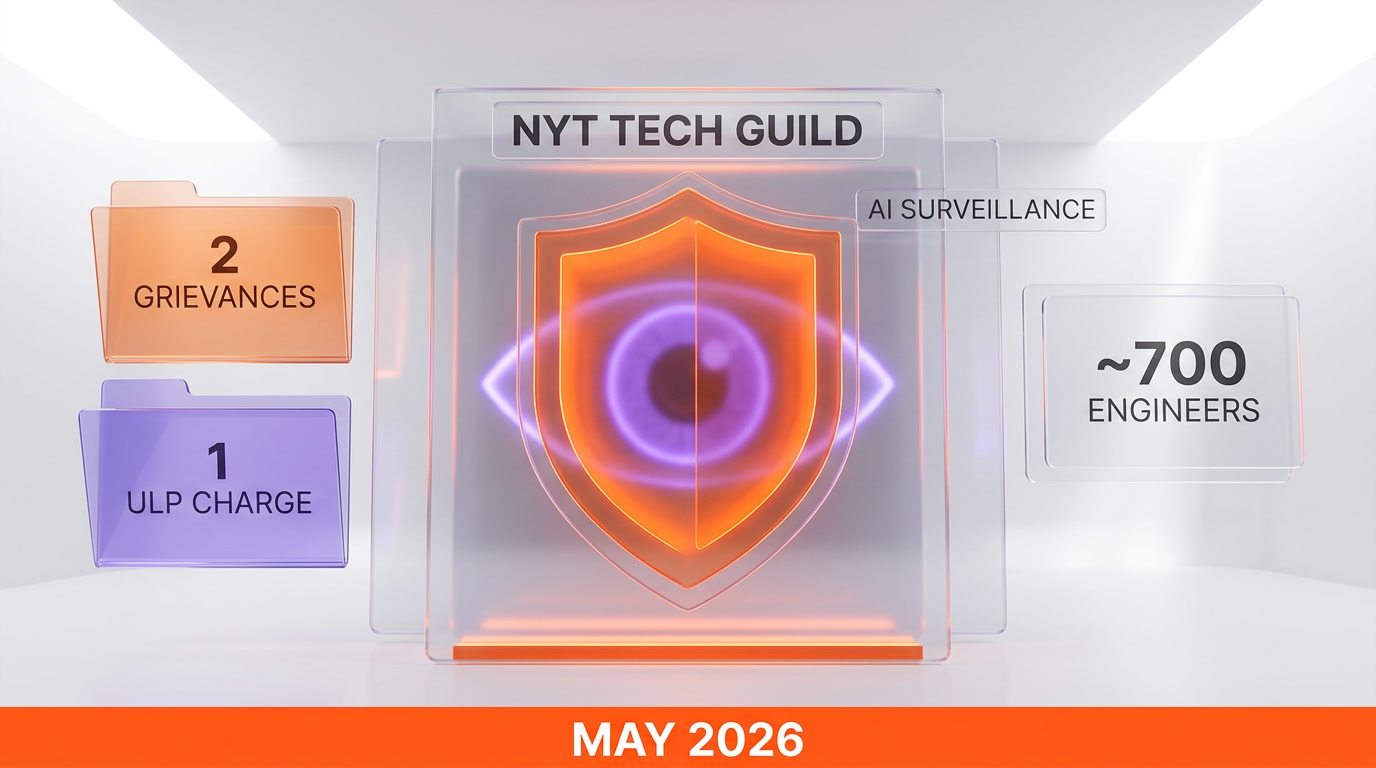
The New York Times Tech Guild filed two grievances and one unfair labor practice charge against the New York Times in May 2026, alleging the company used AI tools to surveil and evaluate roughly 700 unionized engineers without notifying the union, and refused to disclose how it uses AI, its future AI plans, and the impact of AI on jobs. The two tools at the center of the dispute are DX, an engineering-productivity tracker, and Glean, an internal knowledge-search assistant. These are contested allegations in an active labor dispute, not a court ruling — and the Times disputes the union's characterizations, saying it will respond through its normal contractual process.
The dispute, first reported by The Verge and detailed by the NewsGuild of New York on May 27, 2026, is one of the clearest tests yet of a question every knowledge-work employer is quietly facing in 2026: when does measuring productivity with AI cross the line into surveilling employees, and what does a company owe the people it measures? The Times is not a fringe shop experimenting with monitoring software. It is a flagship newsroom with a heavily unionized technical workforce, using two AI tools — DX and Glean — that are sold to thousands of other enterprises. That makes this fight a reference case far beyond one building in Manhattan.
What happened
In May 2026, the New York Times Tech Guild — a unit of the NewsGuild of New York representing about 700 software engineers, designers, product and project managers, and data analysts — filed two grievances and a single unfair labor practice (ULP) charge against the company. The subject of all three filings is the same: the Times' use of artificial intelligence.
The union's argument has two distinct parts. The first is about surveillance. The Tech Guild says the Times used AI tooling to track and evaluate the work of unionized engineers without first notifying the union, a step it says the existing contract requires. The second is about disclosure. The union says management refused to provide information it formally requested — about how the AI tools are used, what the Times plans to do with AI going forward, and how AI is expected to affect jobs and day-to-day workflow — despite obligations under federal labor law to share that kind of information during bargaining.
Benjamin Harnett, chair of the Tech Guild, put the surveillance complaint bluntly: "Using AI to surveil our work violates our contract and creates a skewed, inaccurate picture of our members' work." Susan DeCarava, president of the NewsGuild of New York, framed the disclosure side as management "rejecting both transparency and accountability." The throughline is that the union believes it is being measured by systems it cannot see and was never told about.
It is worth being precise about what these filings are. A grievance is a formal claim that an employer broke the collective-bargaining agreement; it moves through a contractual process that can escalate to arbitration. A ULP charge is a complaint filed with the National Labor Relations Board alleging a violation of federal labor law — here, the alleged failure to provide requested information during bargaining. Neither is a verdict. They start processes; they do not end them.
What DX and Glean actually do
To understand the fight, you have to understand the two tools — because both are real, both are widely used, and they do very different things.
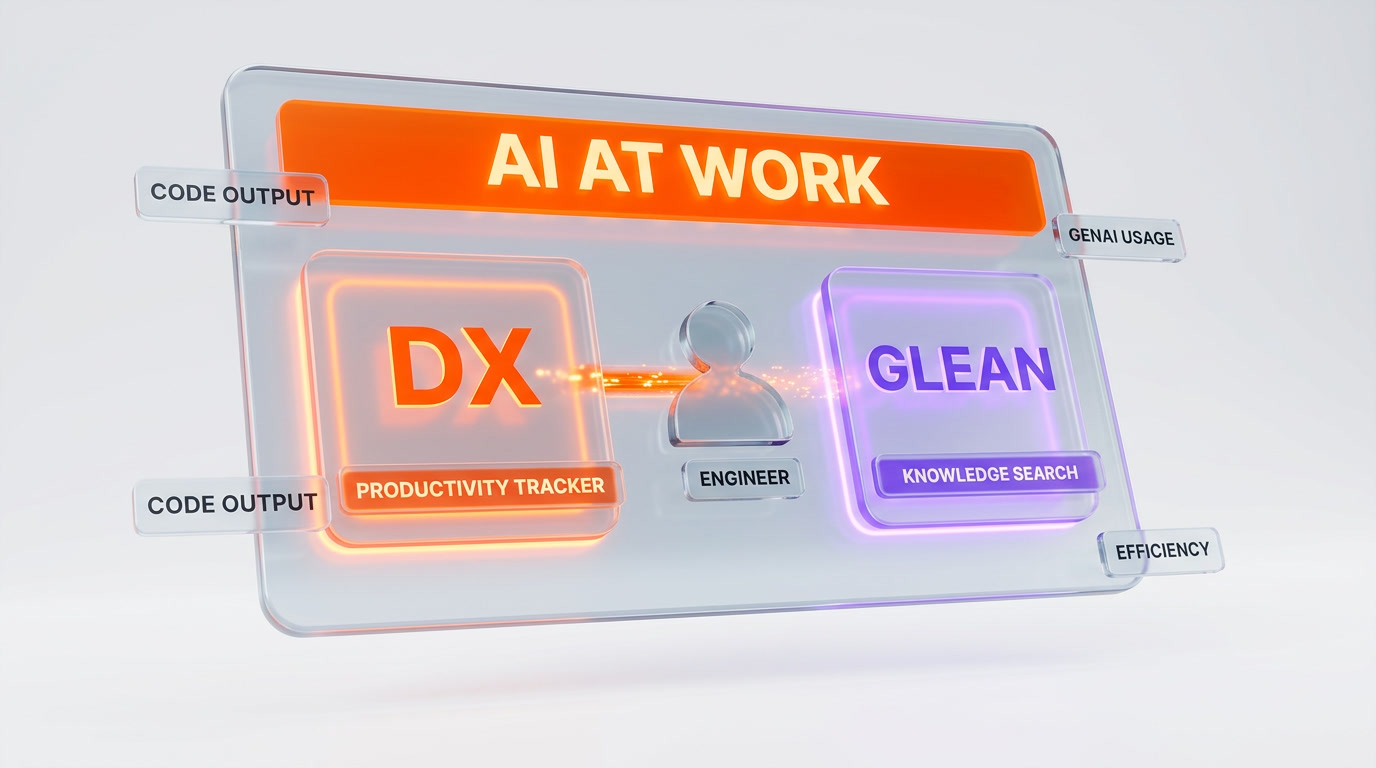
DX is an engineering-productivity platform. Its purpose is to give engineering leaders a measurable picture of how a software organization is performing: how much code is being produced, how developers are using generative-AI assistants, and a range of efficiency metrics. In a healthy framing, DX answers questions like "are our tools making engineers faster?" and "where is friction slowing teams down?" The Tech Guild's objection is not that measurement exists, but that the Times allegedly turned that measurement onto individual unionized engineers, used it to evaluate them, and did so without the contractually required notice. Harnett's specific worry — that productivity AI creates "a skewed, inaccurate picture" — is a substantive technical point: engineering work is collaborative, spiky, and full of high-value activity (reviews, mentoring, debugging, design) that raw output metrics tend to miss or undercount.
Glean is a different category of tool: an enterprise knowledge-search assistant. It indexes a company's internal information — wikis, GitHub documentation, Google Docs, and emails — so employees can ask questions in natural language and get answers drawn from across company systems. Glean's value proposition is finding institutional knowledge fast. But the same capability raises the union's second concern: a tool that indexes emails and internal docs is, by design, ingesting a lot of employee-generated material, and the union wants to know how that data is used, retained, and surfaced. The presence of Glean in the dispute is a reminder that "AI in the workplace" is not one thing — it spans both active scoring (DX) and passive ingestion of everything employees write (Glean).
This is also why the case matters for readers who never set foot in a newsroom. DX and Glean are sold to enterprises across industries. The questions the Tech Guild is raising — what counts as legitimate measurement versus surveillance, who controls the data these tools collect, and what an employer must disclose about AI that scores people — are the exact questions facing any company rolling out the current generation of workplace AI. We have been tracking how fast these deployment debates are accelerating, from Microsoft Copilot crossing 20 million paying enterprise users to vendors pushing autonomous agents directly into the org chart.
Why it matters
The reason this dispute resonates is that it sits at the intersection of three trends that are all peaking at once in 2026: the normalization of AI productivity tracking, the spread of enterprise knowledge-search tools that ingest employee data, and a labor movement that has decided AI governance is a bargaining issue rather than a management prerogative.
Start with the surveillance question. Productivity measurement is not new — managers have counted output for as long as there have been managers. What is new is that AI lowers the cost of granular, continuous, individual-level measurement to near zero, and bundles it with generative-AI usage tracking that did not exist two years ago. When the marginal cost of watching everyone all the time drops to nothing, the only thing standing between "measurement" and "surveillance" is policy — and, for unionized workers, the contract. The Tech Guild's core legal theory is that the contract already drew that line, and that the Times stepped over it without telling anyone.
Then there is the disclosure question, which is arguably the more consequential one. The union is not only objecting to being measured; it is objecting to being kept in the dark about the company's AI plans and their effect on jobs. That is a forward-looking claim. It treats AI not as a discrete tool to be approved or rejected, but as a force that will reshape the workforce — and it asserts that workers have a legal right to information about that reshaping while it is happening, not after. If that theory holds up through the grievance and NLRB processes, it becomes a template other unions can use.

The Times' side of the story
Equally important is the company's response, because this is a two-sided dispute and the Times rejects the union's framing. A New York Times spokesperson, Danielle Rhoades Ha, said the company disagrees with the characterizations in the grievances and will respond through its normal contractual process. She also pointed to a concrete number: the company has already handled more than 80 prior requests for information (RFIs) from the Guild.
That detail matters, because it reframes the disclosure dispute as a disagreement about scope rather than a flat refusal to engage. The Times' implicit argument is that it has been responsive — dozens of RFIs answered — and that the current standoff is about the boundaries of what it must provide, not about stonewalling. The union's implicit counter is that volume is not the same as substance: answering 80 requests does not satisfy the obligation if the specific AI information sought is still being withheld. Both things can be true at once, which is exactly why this ends up in a grievance process rather than a press release.
It is also why the "ClaimReview" temptation should be resisted by anyone covering this: nothing here has been adjudicated. The union has made allegations; the company disputes them; a neutral process will eventually weigh them. Reporting it as a settled fact in either direction would be wrong. The honest framing is that two sophisticated parties disagree about whether the Times' AI practices and disclosures comply with the contract and the law, and they are using the machinery built for exactly that kind of disagreement.
Two unions, two fights
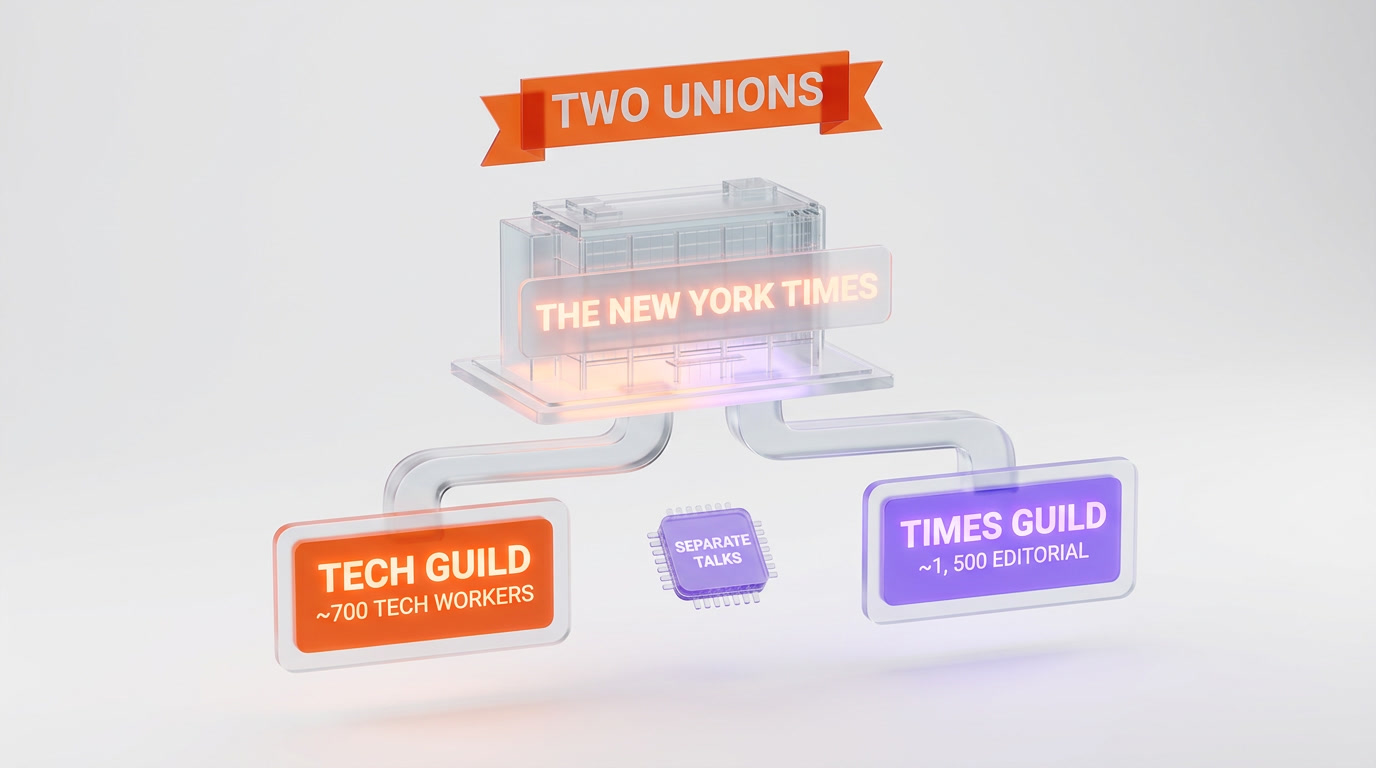
One nuance that is easy to miss: there are two distinct union units at the Times, and they are running parallel but separate AI battles. The Tech Guild — the ~700 software engineers, designers, product and project managers, and data analysts at the center of this story — is the one that filed the grievances and ULP charge over DX, Glean, and AI surveillance. The larger Times Guild, representing roughly 1,500 editorial, advertising, and support staff, negotiates on its own track and is pursuing its own, broader AI protections at the bargaining table.
The split is structural — different work, different contracts, different leverage — but the underlying demands rhyme. Both sides of the house want transparency about how AI is used and limits on how far it can go. The Tech Guild's version is sharply technical: it is about monitoring software pointed at engineers. The Times Guild's version is more editorial: it touches AI-generated text, bylines, and the integrity of journalism. Together they show a single institution being pushed on AI governance from two directions at once.
How we got here
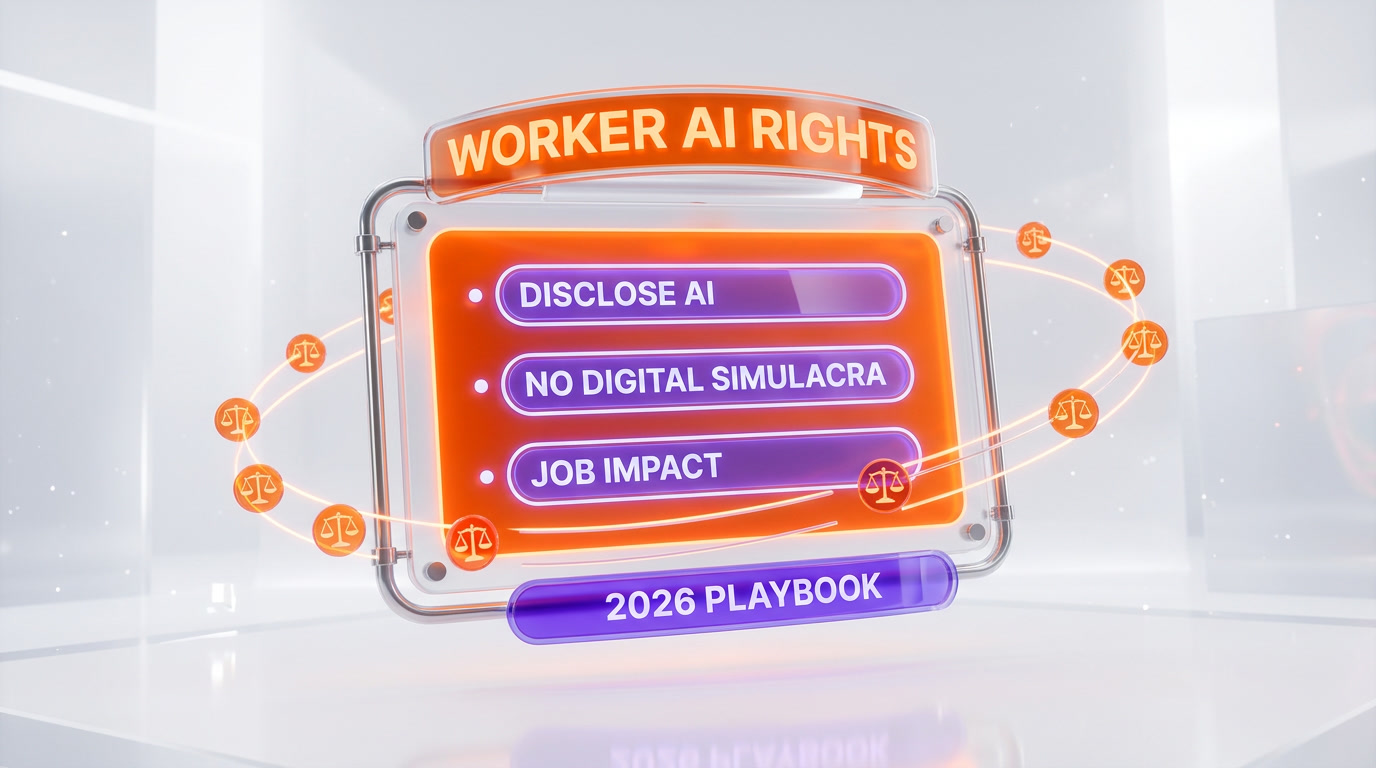
This did not come out of nowhere. Back in March 2026, the union side had already gone on record calling the Times' AI standards "woefully inadequate." At that stage, the demands were concrete and forward-looking: disclosure of when text is generated by AI, and an outright ban on AI "digital simulacra" — systems that would imitate or stand in for human workers. The May filings are the escalation of that earlier frustration from rhetoric at the table to formal grievances and a labor-board charge.
The trajectory matters because it shows a deliberate strategy, not a one-off complaint. The union moved from articulating principles (disclose AI text, no digital clones of workers) to asserting that those principles are already protected by contract and law (the surveillance grievance and the information-access ULP charge). That is how durable workplace norms get built: a union states a value, the value gets contested, and the contested value gets pushed into the legal machinery where it either survives or doesn't. The "digital simulacra" demand in particular is a notable early marker — it anticipates a future where the question is not just whether AI watches workers, but whether AI replaces their likeness and labor outright.
This pattern — AI moving from a productivity story to a workforce-restructuring story — is showing up everywhere we look. Challenger data named AI the single biggest cited reason for layoffs in April 2026, and companies are openly reorganizing around agents, as with ClickUp's bet on 3,000 AI agents alongside a 22% headcount cut. The Tech Guild's disclosure demand — tell us how AI will affect jobs — reads very differently against that backdrop. It is not abstract.
The bigger pattern: AI as a labor issue
Zoom out and the Times dispute is one node in a much larger shift: AI has become a labor-relations issue, not just a technology-adoption one. For most of the last two years, the public conversation about workplace AI was about capability — what the tools can do, how much faster they make people, which jobs they might eliminate. The Tech Guild filings mark a turn toward governance — who decides how the tools are used, what data they collect, and what employers must reveal.
That shift is happening because the tools have crossed a threshold. When AI was a chat box you opened occasionally, it was hard to argue it was "surveilling" anyone. Now that AI is embedded in productivity dashboards (DX) and silently indexing every internal document and email (Glean), the surveillance question is unavoidable. Enterprises are also racing to put AI agents directly into workflows — we have covered everything from ServiceNow's autonomous workforce of AI workers to Coinbase cloning its own executives as AI agents on Slack. The faster AI embeds itself into how work gets measured and done, the more pressure builds for someone to define the rules.
For employers watching this case, the practical takeaway is not "avoid AI." It is that deploying employee-facing AI without a clear, communicated policy is now a legal and labor risk, especially in unionized environments. Measurement tools that quietly become evaluation tools, and knowledge tools that quietly become data-ingestion tools, are exactly the kind of scope creep that generates grievances. The Tech Guild is essentially arguing that the Times skipped the step where it told its workers what it was doing — and that the skipped step is the violation.
What happens next
From here, three processes run in parallel. The two grievances move through the contractual grievance procedure, which can end in arbitration if the parties cannot resolve them. The ULP charge triggers an NLRB investigation into whether the Times unlawfully withheld requested information during bargaining. And both Guild units keep negotiating over AI language at their respective tables. There is no fixed clock on any of this; labor processes are slow by design.
The range of outcomes is wide. The most common ending for disputes like this is a negotiated settlement — new contract language that defines when the company must notify the union before deploying employee-monitoring AI, and what AI information it must share. A less common but more consequential outcome would be an arbitrator's or NLRB decision that sets a clearer precedent on whether AI productivity tracking requires advance union notice, which other newsrooms and tech employers would immediately study. Either way, the substantive questions about DX, Glean, and AI disclosure remain genuinely contested until then.
Our take
The most important thing to hold onto is that this is an allegation in an active dispute, with a real rebuttal from the company — not a finding. The Tech Guild says the Times surveilled engineers and hid its AI plans; the Times says it disagrees with that framing and has already answered 80-plus information requests. Both can be reported honestly only by keeping the "alleged" in front of every claim.
That caveat aside, the strategic significance is hard to overstate. The Tech Guild has converted abstract anxiety about workplace AI into concrete legal demands: notify us before AI evaluates us, and tell us how AI will reshape our jobs. If those demands gain traction — through settlement, arbitration, or an NLRB ruling — they become a playbook. The specific tools, DX and Glean, are almost incidental; what is being litigated is the principle that workers have a right to know when, how, and to what end AI is pointed at them. That principle is going to be tested in workplace after workplace over the next few years, and the New York Times just became one of the first high-profile arenas where it gets argued out in full.
Frequently Asked Questions
What did the New York Times Tech Guild file against the Times over AI?
In May 2026 the New York Times Tech Guild filed two grievances and one unfair labor practice (ULP) charge against the company over its use of AI. The union argues the Times used AI tools to track and evaluate unionized engineers without notifying the union as the contract requires, and that management refused to hand over information about its AI tools, future AI plans, and the impact of AI on jobs and workflow. These are allegations made in a labor dispute, not a court ruling, and the Times disputes the characterizations.
What are DX and Glean, the two AI tools at the center of the dispute?
DX is an engineering-productivity tool that tracks developer output, generative-AI usage, and efficiency metrics. Glean is an internal knowledge-search assistant that indexes wikis, GitHub docs, Google Docs, and emails so employees can search across company systems. Both are real workplace AI tools used inside the Times. The Tech Guild says DX in particular is being used to surveil and evaluate engineers' work in a way it argues paints a skewed and inaccurate picture of what its members actually do.
Who is in the New York Times Tech Guild?
The Tech Guild is a unit of the NewsGuild of New York representing roughly 700 software engineers, designers, product and project managers, and data analysts at the New York Times. It is distinct from the larger Times Guild, which represents about 1,500 editorial, advertising, and support staff. The two units negotiate separately, and the larger Times Guild is pursuing its own set of stronger AI protections in parallel.
What is an unfair labor practice (ULP) charge?
An unfair labor practice charge is a formal complaint filed with the National Labor Relations Board alleging that an employer (or a union) violated federal labor law. One common basis is failing to provide a union with information it is legally entitled to during bargaining. The Tech Guild's ULP charge centers on the claim that the Times refused to share requested information about its AI tools and plans. Filing a charge starts an investigation; it is not itself a finding that the law was broken.
What exactly does the Tech Guild accuse the Times of doing wrong?
The union alleges two violations. First, that the Times used AI to track and evaluate the work of unionized engineers without notifying the union, which it says the contract requires. Second, that management declined to provide requested information about how the AI tools are used, the company's future AI plans, and the effect of AI on jobs and workflow — information the union argues it is owed under federal law during bargaining. Both points are contested allegations, not settled findings.
What did Benjamin Harnett of the Tech Guild say?
Benjamin Harnett, chair of the Tech Guild, said: "Using AI to surveil our work violates our contract and creates a skewed, inaccurate picture of our members' work." His point is that productivity-tracking AI can misrepresent engineering work, which is often collaborative and hard to capture in raw output metrics, and that doing it without union notice breaks the existing agreement.
How has the New York Times responded to the grievances?
A New York Times spokesperson, Danielle Rhoades Ha, said the company disagrees with the characterizations in the grievances and will respond through its normal contractual process. She noted the company has already handled more than 80 previous requests for information (RFIs) from the Guild. The Times has not conceded any of the union's claims, and the matter is proceeding through grievance and labor-board channels rather than being decided in the union's favor.
Is this a court ruling or a final decision against the Times?
No. This is a labor dispute in its early stages. Grievances move through a contractual process that can end in arbitration, and a ULP charge triggers an NLRB investigation. Neither is a court ruling, and neither establishes that the Times broke the law. The union is making allegations, the company is disputing them, and any binding outcome would come later through arbitration, an NLRB decision, or a negotiated settlement.
Why does AI surveillance of engineers matter beyond the New York Times?
Tools like DX and Glean are widely sold to enterprises, so the questions raised here apply far beyond one newsroom: when is productivity tracking legitimate measurement versus surveillance, who owns the data a knowledge-search tool indexes, and what must employers disclose about AI that scores employees. The Tech Guild dispute is one of the first high-profile cases where a unionized technical workforce has formally challenged AI-based monitoring, which makes it a reference point for other workplaces.
What is the difference between the Tech Guild and the larger Times Guild on AI?
The Tech Guild (~700 tech workers) is fighting over AI surveillance of engineers and disclosure of AI tools through grievances and a ULP charge. The larger Times Guild (~1,500 editorial, advertising, and support staff) negotiates separately and is pursuing its own, broader AI protections at the bargaining table. Earlier in 2026 the union side called the Times' AI standards "woefully inadequate" and pushed for disclosure of AI-generated text and a ban on AI "digital simulacra" of workers.
What protections is the union actually asking for?
Across both units, the demands cluster around transparency and limits. The union wants the Times to disclose when text is generated by AI, to ban AI "digital simulacra" that imitate workers, to notify the union before AI is used to track or evaluate represented employees, and to share information about AI tools, future plans, and job and workflow impact. NewsGuild president Susan DeCarava framed the core complaint as management "rejecting both transparency and accountability."
What happens next in the New York Times AI dispute?
The two grievances proceed through the contractual grievance process, which can escalate to arbitration if unresolved, while the ULP charge is investigated by the National Labor Relations Board. In parallel, both Guild units continue bargaining over AI language. There is no fixed timeline, and outcomes range from a negotiated settlement to an arbitrator's or labor-board decision. Until then, the substantive claims about DX, Glean, and AI disclosure remain contested between the union and the company.
This article is based on the NewsGuild of New York's May 27, 2026 statement, reporting by The Verge, and additional coverage by Fox News. It describes allegations made in an active labor dispute and the New York Times' response; nothing described here has been decided by a court or labor board. We have no affiliate relationship with the New York Times, the NewsGuild, DX, or Glean.