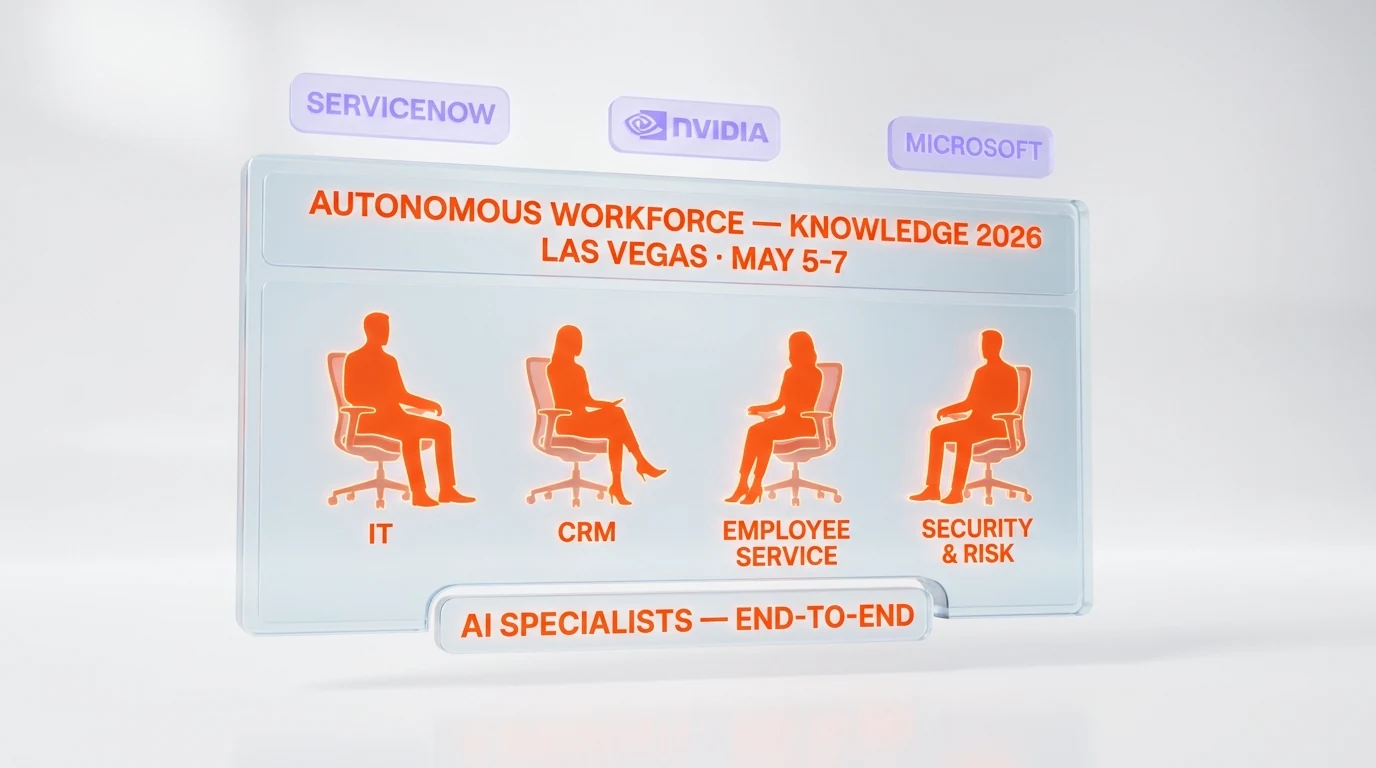
ServiceNow used its Knowledge 2026 conference (Las Vegas, Venetian Resort and Wynn properties, May 5-7, 2026) to expand its Autonomous Workforce platform with a suite of AI "specialists" pitched as completing end-to-end business processes across IT, CRM, employee service, and security & risk — not as assistants helping a human, but as digital workers assigned to roles with permissions, context, and accountability. Per ServiceNow, the framing shift matters: "Enterprises need AI that senses, decides, and securely acts." We tracked this announcement five days before the May 10 Challenger, Gray & Christmas data showing AI as the #1 cited reason for U.S. layoffs in April 2026. The two data points read together describe one of the more consequential weeks for the agentic-AI enterprise narrative we have covered this year.
The announcement: AI specialists, not assistants
ServiceNow Knowledge has been the annual flagship of the company's product roadmap since 2014. The May 2026 edition, anchored at the Venetian Resort and the Wynn in Las Vegas, ran May 5 through May 7 with a keynote-and-demo cadence familiar to anyone who tracks enterprise software conferences. The centerpiece this year was not a new module or pricing tier. It was a category claim: ServiceNow is positioning Autonomous Workforce as a separate product layer above its existing AI offerings, and the unit of work inside that layer is the AI specialist.
The framing is deliberate. Per ServiceNow's May 5 newsroom release, an AI specialist is "assigned to a role, given the context of that role, granted the permissions that role would have, and held to the outcomes of that role." That sentence does work. Assigned implies the specialist is provisioned like an employee, not invoked like a tool. Context implies grounding in the same systems-of-record a human in that seat would touch. Permissions imply scoped access — not a god-mode integration. Outcomes imply a measurable success criterion, not a session log.
We read the rhetoric as deliberate distancing from three other category labels that crowd the enterprise market right now: assistant (chat-first, human-in-loop), copilot (suggests, does not act), and agent (acts, but typically scoped to a task, not a role). ServiceNow is staking ground higher up the stack — claiming the role itself as the addressable unit. Whether the product fully delivers that framing today is the open question; we walk through what was demonstrated below.
The four launch domains: IT, CRM, employee service, security & risk
ServiceNow shipped specialists for four enterprise functions at Knowledge 2026, each tied to a high-volume workflow that the company already serves through its core platform:
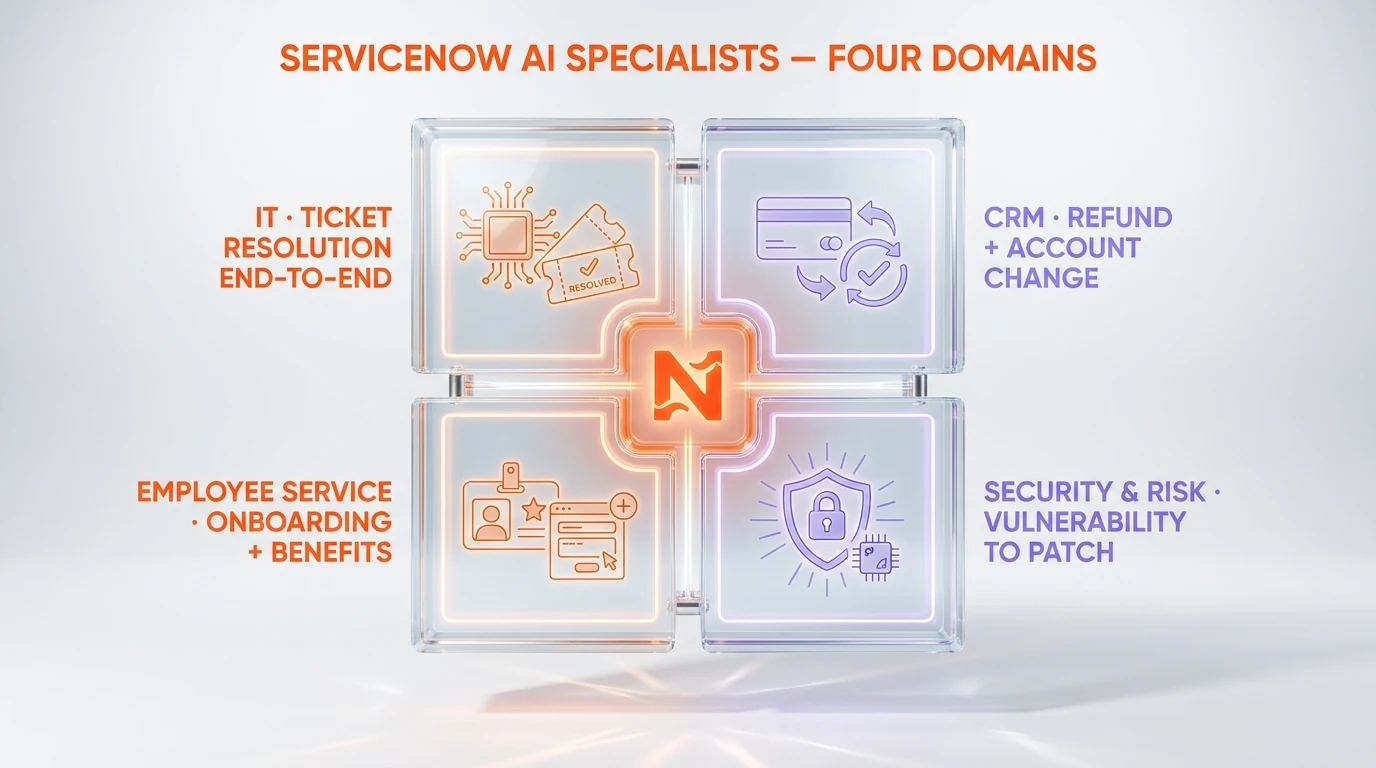
- IT Specialist — resolves a tier-1/tier-2 ticket end-to-end: parses the request, reaches into the CMDB, applies the change, validates with the user, closes the record. Per ServiceNow's demo, the IT specialist handled a representative password-reset-plus-laptop-provisioning workflow with no human touch.
- CRM Specialist — picks up a customer-service case from intake, executes account changes, processes a refund inside the connected financial system, and emails the customer with the resolution and a satisfaction prompt. The demo featured a refund scenario crossing four systems.
- Employee Service Specialist — handles onboarding, benefits enrollment changes, expense queries, internal HR policy lookups, and routine PTO / leave administration. The keynote example was a multi-step new-hire onboarding sequence triggered by a single HRIS event.
- Security & Risk Specialist — triages an inbound vulnerability alert, correlates it to assets via the CMDB, opens the response ticket, coordinates the patch workflow, and produces the audit-grade record. ServiceNow positioned this specialist as the bridge between SOC alerts and the change-management workflow that historically requires human handoff.
The common pattern across all four: a previously multi-team, multi-system workflow compressed into a single specialist that holds the whole job. That compression — not the underlying LLM — is the unit of value ServiceNow is selling.
Specialists versus assistants: the architectural argument
The strongest part of the Knowledge 2026 keynote, in our reading, was the architectural diagram contrasting "AI assistants" with "AI specialists." It mapped onto a question we have heard from enterprise readers since late 2025: why do my AI deployments stall after pilot?
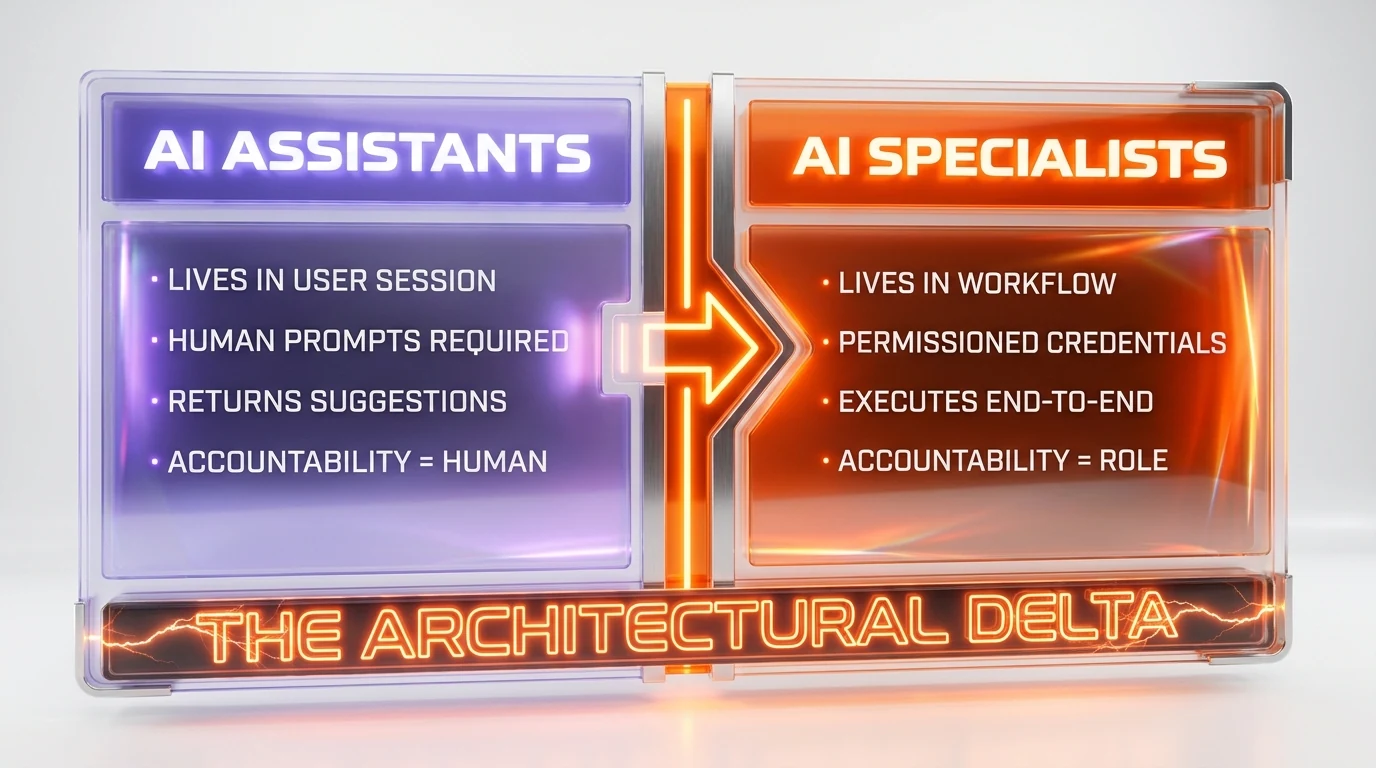
Per ServiceNow's framing, an assistant lives inside a user's session. It needs a human prompt, returns suggestions or drafts, and disappears when the session ends. The accountability lives with the human. The specialist, by contrast, lives inside the workflow itself. It is provisioned with credentials, holds a queue, executes through to completion, and produces an auditable record of every step. The accountability lives with the specialist's role definition — and, by extension, with the team that owns that role.
That architectural distinction matters because it dictates everything downstream: how the specialist is governed (RBAC, not session prompts), how it is observed (run logs, not chat transcripts), how it is improved (role-level KPIs, not user satisfaction scores), and how it is decommissioned (deprovisioned like an employee, not uninstalled like an app). We have seen similar framing from competitors — Microsoft's Copilot Cowork preview (covered May 2026) and Sierra's customer-experience agents ($15.8B valuation in 90 days) — but ServiceNow's pitch is the most operationally specific we have tracked at a single conference.
The governance layer: why ServiceNow believes it wins
ServiceNow's repeated message at Knowledge 2026: enterprises are not short of AI capability, they are short of governed, integrated, accountable AI capability. The CEO's keynote returned to this point in three separate framings:
- Frontier models are a commodity input. The differentiation is the workflow context.
- Integration with systems-of-record (ITSM, CRM, HRIS, GRC) is the moat. ServiceNow already owns four of those for most Fortune 500 customers.
- Audit, RBAC, and change-management are non-negotiable for autonomous AI at enterprise scale. ServiceNow already operates those layers.
That argument is structurally defensible. It is also exactly what we would expect a workflow-platform incumbent to say at the moment a foundation-model commodity wave threatens to bypass platforms entirely. The honest read is that both can be true: foundation models are commoditizing, and integrated workflow platforms with governance built in will capture meaningful enterprise spend on top of those models. ServiceNow is one of a handful of vendors positioned to do so — the others being Microsoft (Copilot stack + Dynamics), Salesforce (Agentforce + Data Cloud), and SAP (Joule + S/4HANA).
The five-day timeline: from Knowledge 2026 to the Challenger #1
The reason we wrote this analysis rather than a straight news brief is the five-day window between Knowledge 2026 closing and the Challenger, Gray & Christmas April Job Cuts Report. Sequenced together, they describe a causal arc most enterprise readers should pay attention to:
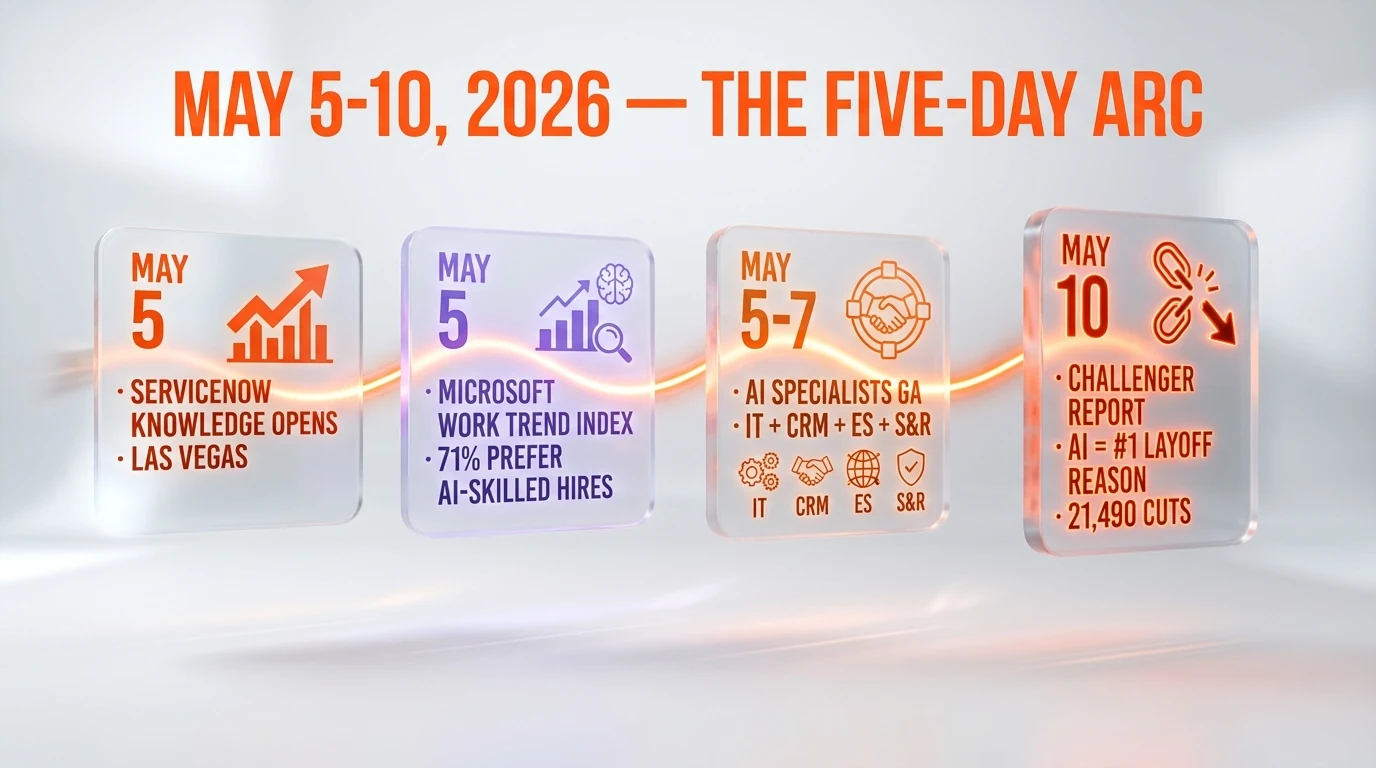
- May 5, 2026 — ServiceNow Knowledge 2026 opens. AI specialists for IT, CRM, employee service, and security & risk announced as generally available.
- May 5, 2026 — Microsoft 2026 Work Trend Index publishes: 71% of leaders say they would prefer to hire a less experienced AI-skilled candidate over a more experienced non-AI candidate. (Our full analysis.)
- May 5-7, 2026 — Knowledge 2026 sessions through Las Vegas. Partner announcements with NVIDIA on accelerated inference and with Microsoft on agent interoperability.
- May 10, 2026 — Challenger, Gray & Christmas April Job Cuts Report attributes 21,490 U.S. layoffs in April 2026 (26% of the 83,387 monthly total) directly to artificial intelligence — making AI the #1 cited reason for the second consecutive month.
We are not claiming the ServiceNow announcement caused the Challenger data — the announcement post-dates the cuts. We are claiming the two events read together describe an enterprise market that is now actively buying systems whose explicit value proposition is workflow autonomy at the role level. The Challenger data is the demand-side proof point for the supply-side roadmap ServiceNow shipped four days earlier. Two sides of the same trade.
The enterprise AI specialist race: who is in the field
ServiceNow is not alone, and that is part of why this matters. Four heavyweight categories of competitor showed up at or around Knowledge 2026 with overlapping framing, and the field is now crowded enough to take seriously as a category, not a single-vendor story.
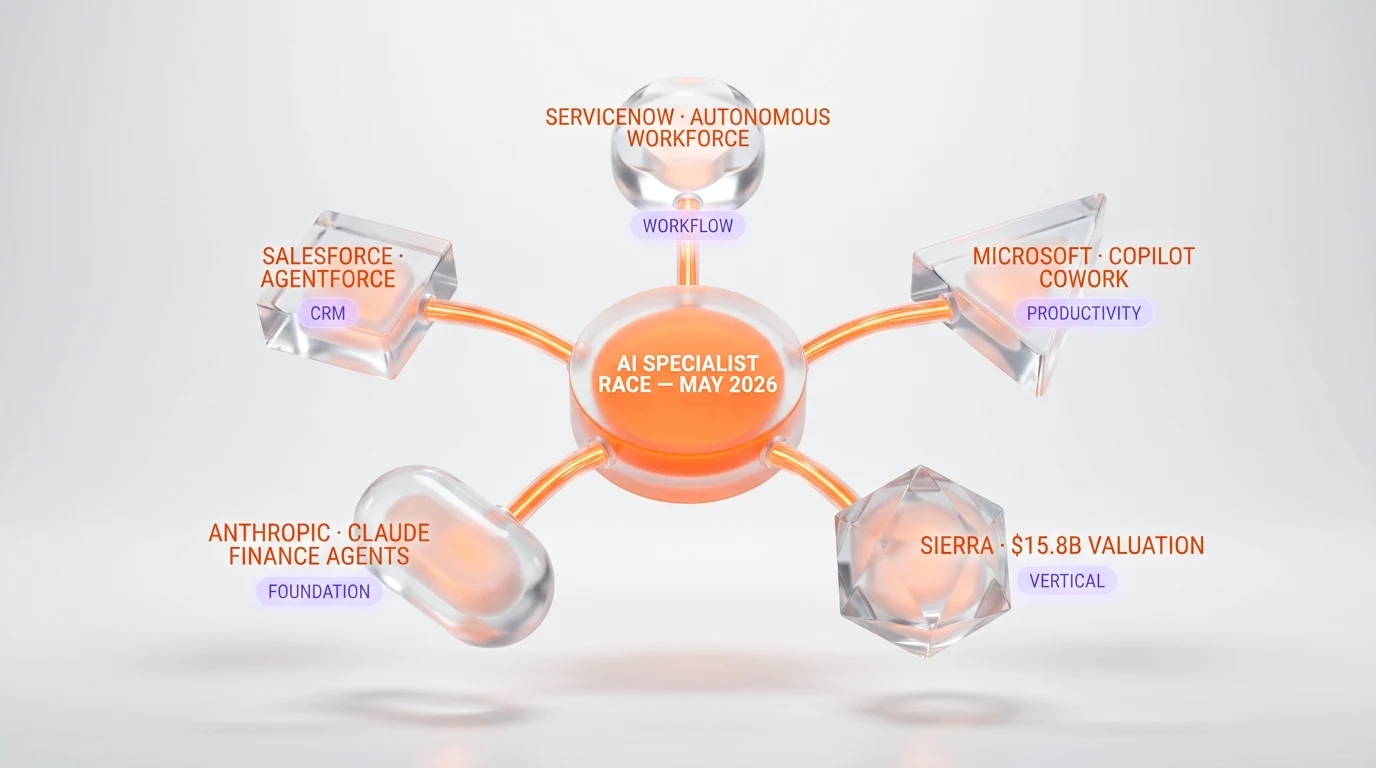
- ServiceNow Autonomous Workforce — workflow-platform incumbent. Strength: integration with ITSM/CRM/HRIS/GRC already owned. Weakness: closed ecosystem dependency. Announced Knowledge 2026, May 5-7.
- Microsoft Copilot Cowork — productivity-suite incumbent. Strength: distribution to every Office user. Weakness: less specialized per-vertical workflow depth. Frontier Preview launch May 2026.
- Sierra customer-experience agents — pure-play customer-service AI built by Bret Taylor. Strength: vertical depth, narrow scope. Weakness: only one workflow served. Recent $15.8B valuation.
- Anthropic Claude finance agents — foundation-model lab going direct to enterprise. Strength: model quality. Weakness: integration burden left to customer. Live at Citadel, BNY, Carlyle.
- Salesforce Agentforce — workflow-platform competitor. Strength: CRM dominance. Weakness: tied to Salesforce data graph. Available since late 2025.
The five vendors share a thesis (AI as a unit of role-level work) but diverge on the entry wedge (workflow platform, productivity suite, vertical pure-play, foundation model, CRM platform). Enterprises picking one over another are mostly picking a moat orientation: do you trust your workflow platform, your productivity suite, your CRM, your model lab, or a pure-play startup to own the autonomous-work layer? That is a five-year strategic bet, not a quarterly software purchase.
The partner announcements: NVIDIA, Microsoft, and the integration layer
Two partner announcements from Knowledge 2026 are worth flagging because they tell us about ServiceNow's view of its own architecture:
NVIDIA — ServiceNow announced expanded use of NVIDIA accelerated inference inside the Autonomous Workforce stack. The reading: ServiceNow does not want to be in the foundation-model business, but does want sub-second specialist response times at enterprise scale, which requires GPU-class inference under the platform. NVIDIA gets the infrastructure-layer revenue; ServiceNow gets the latency.
Microsoft — ServiceNow announced agent-interoperability work with Microsoft, meaning a ServiceNow IT specialist can hand off to a Microsoft Copilot agent and back. The reading: ServiceNow accepts that no single vendor will own the entire enterprise agentic stack, and is building bridges before customers force them to. Microsoft is doing the same on its side. The competitive overlap is real, but so is the integration pressure.
What we did not see: a clear stance on the open-source agent ecosystem. We tracked the OpenClaw controversy around Anthropic Managed Agents in April; ServiceNow's framing at Knowledge 2026 was firmly proprietary-platform, not open-protocol. Whether that holds as the agent-interoperability conversation matures is an open question.
What would prove this overhyped: the honest skeptical case
We are not bullish or bearish on ServiceNow specifically — we are tracking a category claim and the evidence around it. The category claim has real risks. Five specific signals we will be watching that would prove the AI-specialist story overhyped rather than structural:
- Integration friction stays high. ServiceNow's pitch assumes the specialist plugs into systems-of-record cleanly. In practice, every Fortune 500 has 10-30 critical systems with bespoke integrations, custom permission models, and security review cycles measured in quarters. If specialist deployment timelines look more like classic ITSM implementations (12-18 months) than the keynote demos (days), the framing collapses.
- Governance burden does not shrink. The promise is that ServiceNow has already built the governance layer. The risk is that governing autonomous AI demands controls that did not exist for human employees — auditable model versions, drift detection, prompt-injection defenses, role-level model-card disclosures. If enterprises end up building those controls themselves on top of ServiceNow, the platform moat thins.
- Change-management remains the bottleneck. Even with specialists technically ready, enterprises have to redesign workflows, retrain humans, renegotiate union and policy agreements, and absorb cultural pushback. The technical readiness curve and the organizational readiness curve are decoupled. ServiceNow can deliver the first, not the second.
- Outcome accountability fails the first audit. When (not if) a specialist makes a costly error — a wrong refund, an unauthorized change, a missed security ticket — the line of accountability the keynote described will be tested in real audit and litigation contexts. The legal status of "the specialist's role definition is accountable" is untested.
- Foundation-model commoditization disintermediates ServiceNow. If Anthropic, OpenAI, and Google ship integration layers strong enough to bypass workflow platforms, ServiceNow's moat thins. The Anthropic compute buildout hints at a scenario where labs invest directly in the integration layer rather than ceding it to ServiceNow / Salesforce / Microsoft.
We expect at least one of these signals to flash within twelve months. The honest base case is not "this fails" or "this wins" — it is "the category claim is structurally right, the per-vendor share is contested, and the timeline is slower than the keynotes imply." We will be tracking quarterly.
The tool-stack context: what builders are actually using
For the developer and operator readers tracking which tools sit underneath this category, three patterns from our own daily testing are worth surfacing. We run our own production workflows through Claude Code and other agentic AI tools, so the framing below is grounded in usage rather than vendor claims.
First, the agent-platform conversation has bifurcated. Enterprise buyers are evaluating workflow platforms (ServiceNow, Salesforce, Microsoft). Developer buyers are picking foundation-model agent SDKs (Anthropic, OpenAI, Google) and building bespoke integrations. The two populations rarely overlap inside the same procurement.
Second, the "specialist versus assistant" framing is starting to apply downstream. We have observed teams reorganizing internal AI deployments around role-based provisioning rather than user-based licensing — assigning Claude or GPT-class agents to a queue rather than a person. ServiceNow did not invent this pattern; it productized it for enterprises that needed a vendor to standardize it.
Third, the integration layer is where most projects stall. Specialists need permissioned access to systems-of-record. In practice that means SAML SSO, OAuth scopes, audit logging, and a security review per system. We have watched promising specialist prototypes wait four to eight weeks for SOC sign-off on a single integration. ServiceNow's pitch that enterprises do not have to rebuild that plumbing is the most concrete value claim in the entire Autonomous Workforce package.
What this means for the labor narrative
The uncomfortable read, when you sequence Knowledge 2026 alongside the Challenger data and the Microsoft Work Trend Index, is that the enterprise market is not in an exploration phase. It is in a deployment phase. Specifically:
- Vendors are shipping specialists positioned as headcount substitutes, not productivity enhancements.
- Buyers are paying for those specialists with budget that previously funded headcount, per multiple vendor commentary tracks at Knowledge 2026.
- The cited-reason layoff data shows the budget shift is already visible in employer behavior — 21,490 cuts in April 2026 attributed to AI per Challenger.
None of that means displacement is inevitable, evenly distributed, or even net-negative for total employment. Past technology waves expanded the work pie even as they automated tasks within it. We expect this one to follow that pattern broadly. The honest near-term story is composition shift: which roles, which skills, which industries, which geographies, which seniority bands move first. ServiceNow's announcement is a clear signal about which workflows enterprises are now comfortable handing to specialists — and reading that signal accurately is more useful than predicting aggregate displacement numbers.
Our read: the category claim is structurally right, the timeline is slower than the demos
We came out of Knowledge 2026 with three holds we will defend through Q3 2026:
- The architectural distinction (specialist vs. assistant vs. agent) is real and durable. It will shape how enterprises buy, deploy, govern, and decommission AI for the next five years. ServiceNow is not the only vendor articulating it, but it is the most operationally specific we have seen at a single conference.
- The four launch domains were well chosen. IT, CRM, employee service, and security & risk are the workflows where ServiceNow already has the most data, the most integrations, and the most reference customers. Demo risk was minimized; production risk for early customers is still real.
- The competitive race is now serious. Microsoft, Salesforce, Sierra, and the foundation-model labs are all building toward the same role-level autonomy thesis. ServiceNow's moat is its workflow integration depth, but moats only matter if the customer migration cost stays high — which is also untested in the agentic era.
If we had to assign one operational recommendation to enterprise readers right now: pilot one specialist in the function where you already use ServiceNow most heavily. Run it for two quarters. Compare actual cycle time, actual error rate, and actual accountability friction against the demo claims. The data you collect will be more decisive than any analyst opinion — including this one.
The other recommendation: do not extrapolate from Knowledge 2026 to "every white-collar workflow is six months from automation." The signal is structural; the timeline is multi-year. Enterprises that confuse the two will overspend on AI, underspend on change management, and discover the hard way that the bottleneck was never the model.
Sources
This analysis draws on tier-1 reporting from the following outlets. We cite their work directly so readers can verify every figure independently:
- Fortune — ServiceNow Knowledge 2026: Autonomous Workforce, Microsoft and NVIDIA AI announcements (May 5, 2026)
- ServiceNow Newsroom — Autonomous Workforce to every major business function (May 5, 2026)
- Yahoo Finance — ServiceNow turns enterprise AI chaos into governed specialists
- NVIDIA — ServiceNow Knowledge partnership announcement page
Frequently Asked Questions
What did ServiceNow announce at Knowledge 2026?
ServiceNow used its Knowledge 2026 conference, held at the Venetian Resort and Wynn properties in Las Vegas from May 5 through May 7, 2026, to expand its Autonomous Workforce platform with four AI specialists. The specialists cover IT, CRM, employee service, and security & risk, and per ServiceNow are positioned as digital workers assigned to roles with permissions, context, and outcome accountability rather than chat-first assistants that help a human do work faster.
What is the difference between an AI specialist and an AI assistant?
Per the ServiceNow Knowledge 2026 keynote architecture, an AI assistant lives inside a user session, requires human prompts, returns suggestions, and disappears when the session ends — accountability stays with the human. An AI specialist is provisioned with credentials like an employee, holds a queue, executes workflows end-to-end without supervision, and produces an auditable run log. Accountability lives with the specialist's role definition, governed by RBAC and outcome KPIs rather than chat transcripts.
Which four functions did ServiceNow launch specialists for?
ServiceNow launched specialists for four enterprise functions at Knowledge 2026: IT (tier-1 and tier-2 ticket resolution end-to-end), CRM (customer-service cases including refunds and account changes across connected systems), employee service (onboarding, benefits, expense queries, HR policy lookups), and security & risk (vulnerability alert triage, asset correlation via CMDB, patch workflow coordination, audit-grade record production). All four are workflows where ServiceNow already owns the underlying system of record for most Fortune 500 customers.
How does this connect to the Challenger data on AI layoffs in April 2026?
The connection is a five-day arc, not a causal claim. ServiceNow shipped Autonomous Workforce on May 5, 2026. Five days later, Challenger, Gray & Christmas published April 2026 Job Cuts Report data attributing 21,490 of 83,387 U.S. layoffs (26%) directly to AI — the second consecutive month AI ranked #1 as cited reason. The two events read together describe an enterprise market that is buying systems explicitly framed as headcount substitutes and showing the budget shift in the employer-side layoff statistics. We covered the Challenger data separately in our May 11 analysis.
Who are ServiceNow's main competitors in the enterprise AI specialist race?
The competitive map as of May 2026 includes Microsoft Copilot Cowork (productivity-suite distribution moat, Frontier Preview May 2026), Salesforce Agentforce (CRM-dominance moat, available since late 2025), Sierra (customer-experience pure-play, $15.8B valuation in 90 days), Anthropic Claude finance agents (foundation-model lab going direct to enterprise at Citadel, BNY, and Carlyle), and Salesforce's broader Agentforce stack. The five vendors share the thesis that AI is a role-level unit of work but diverge sharply on the entry wedge — workflow platform, productivity suite, vertical pure-play, foundation model, or CRM.
What partner announcements came out of Knowledge 2026?
Two partner announcements stood out. ServiceNow expanded its use of NVIDIA accelerated inference inside the Autonomous Workforce stack — NVIDIA gets infrastructure-layer revenue, ServiceNow gets sub-second specialist response times at enterprise scale. ServiceNow also announced agent-interoperability work with Microsoft, meaning a ServiceNow IT specialist can hand off to a Microsoft Copilot agent and back. The reading: ServiceNow accepts no single vendor will own the entire enterprise agentic stack and is building bridges proactively. Notable absence: no clear stance on open-source agent protocols.
What is ServiceNow's argument for why it wins this category?
Per the CEO keynote, ServiceNow's three-part argument is structural. Frontier models are commoditizing as inputs. Integration with systems-of-record (ITSM, CRM, HRIS, GRC) is the durable moat, and ServiceNow already owns four of those for most Fortune 500 customers. Audit, RBAC, and change-management are non-negotiable for autonomous AI at enterprise scale, and ServiceNow already operates those layers. The pitch is that enterprises do not need to rebuild governance and integration plumbing on top of foundation models — ServiceNow already has it.
What would prove the AI specialist category overhyped?
Five signals we will watch through Q3 2026: integration friction staying high (specialist deployments looking like classic ITSM implementations of 12-18 months rather than days), governance burden not shrinking (enterprises rebuilding controls on top of ServiceNow rather than getting them free), change-management bottlenecks not resolving (technical readiness decoupled from organizational readiness), outcome accountability failing the first audit (the legal status of "specialist role accountability" being untested in litigation), and foundation-model labs disintermediating the workflow layer entirely with integration SDKs strong enough to bypass platforms. At least one of these is likely to flash within twelve months.
Are these specialists actually replacing human workers or augmenting them?
Per ServiceNow's own framing, specialists are positioned as replacements for the role, not augmentations of a human in the role — that is the operational distinction from copilots and assistants. In practice, early deployments are likely to be augmentations because integration friction, governance reviews, and change-management cycles take time. Over a multi-year window, the substitution thesis is what is being sold. The Challenger April 2026 cited-reason data showing 26% of layoffs attributed to AI is the demand-side proof point that some enterprises are already acting on that thesis rather than waiting.
What is the role of NVIDIA in ServiceNow Autonomous Workforce?
NVIDIA provides accelerated inference under the Autonomous Workforce stack so specialists can respond sub-second at enterprise scale. ServiceNow has explicitly stated it does not want to be in the foundation-model business — it wants the workflow context, the integration layer, and the governance frame. NVIDIA gets infrastructure-layer revenue from the partnership. The model layer itself is left open: ServiceNow can route specialist queries to Anthropic, OpenAI, Google, or open-weight models depending on workload, cost, and customer requirements.
How should enterprise readers act on this announcement?
Our operational recommendation: pilot one specialist in the function where you already use ServiceNow most heavily — typically IT or employee service. Run it for two quarters. Track actual cycle time, actual error rate, and actual accountability friction against the keynote demo claims. Do not extrapolate from Knowledge 2026 to "every white-collar workflow is six months from automation" — the signal is structural, the timeline is multi-year. Enterprises that confuse the two will overspend on AI tooling, underspend on change management, and discover the bottleneck was never the model.
How does this fit with the broader 2026 agentic AI narrative?
Knowledge 2026 sits inside a tight cluster of agentic announcements in spring 2026. Anthropic shipped 10 finance agents for Citadel, BNY, and Carlyle. Microsoft previewed Copilot Cowork with 60-day chat-to-agent timelines. Sierra reached a $15.8B valuation in 90 days. Anthropic announced a 10-gigawatt compute buildout. The pattern is unambiguous: 2026 is the year enterprise AI moves from chat to autonomous execution, with multiple vendors converging on overlapping framings of the same role-level autonomy thesis.