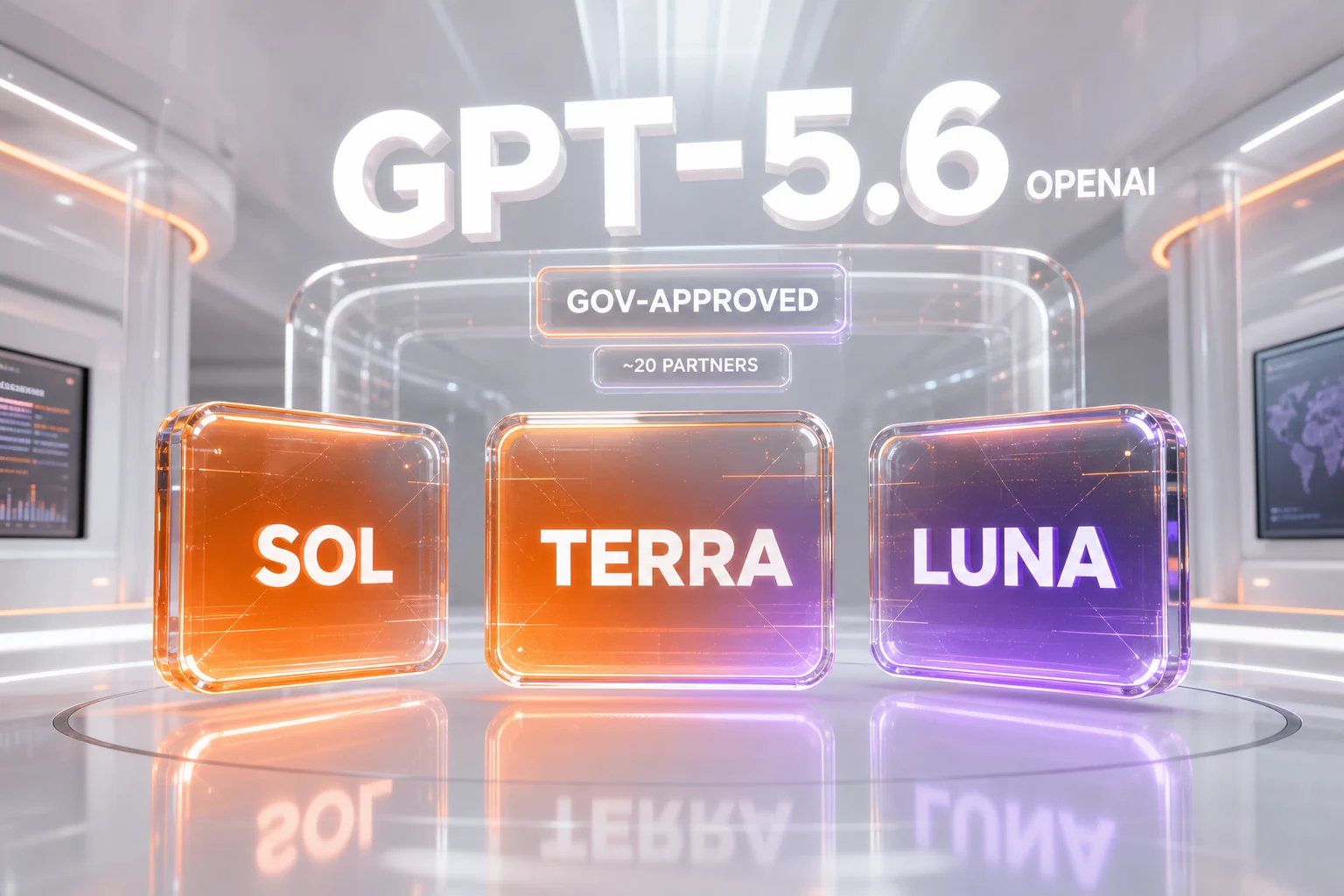
OpenAI unveiled GPT-5.6 on June 26, 2026 — a three-model lineup of Sol (its new flagship), Terra (a balanced everyday model) and Luna (a fast, low-cost model). But the launch carried a condition no frontier model has had before: at the Trump administration's request, OpenAI is limiting the preview to roughly 20 organizations whose names were individually approved by the US government, citing national security. It is the first time a leading American AI company has shipped a frontier model under a government-managed access list. We have not had hands-on access — GPT-5.6 is not publicly available — so what follows is analysis of OpenAI's announcement and the surrounding reporting, not a review.
For two years, the pattern was numbingly familiar: a lab announces a model, posts the pricing, opens the API, and the only gatekeeper between you and the weights is your credit card. GPT-5.6 broke that pattern. The model is real, the benchmarks are bold, the pricing is public — and almost nobody can use it. According to OpenAI's own announcement and reporting from TechCrunch, CNBC, Axios and others, Washington is now sitting in the approval loop, deciding customer by customer who gets in. That is the actual story here, bigger than any benchmark.
What OpenAI Actually Shipped
GPT-5.6 is not one model but three, each tuned to a different point on the cost-versus-capability curve:
- Sol — the flagship, which OpenAI calls its "strongest model yet." It shows its biggest gains in agentic coding, biology and cybersecurity, and ships with two new reasoning controls: a "max" reasoning-effort mode for hard problems, and an "ultra" mode that, in OpenAI's words, "uses coordinated subagents to solve highly complex tasks."
- Terra — the balanced, everyday model. OpenAI positions it as matching the prior-generation GPT-5.5 on quality while costing roughly half as much.
- Luna — the fast, cheap tier, aimed at high-volume and latency-sensitive workloads.
OpenAI is leaning hard on safety framing. It describes Sol as carrying its "most robust security stack yet," hardened against adversarial attacks and deliberately tuned to favor defensive cybersecurity work over offensive exploitation. That framing is not incidental — it is the bridge to why the government got involved at all.
GPT-5.6 Pricing at a Glance
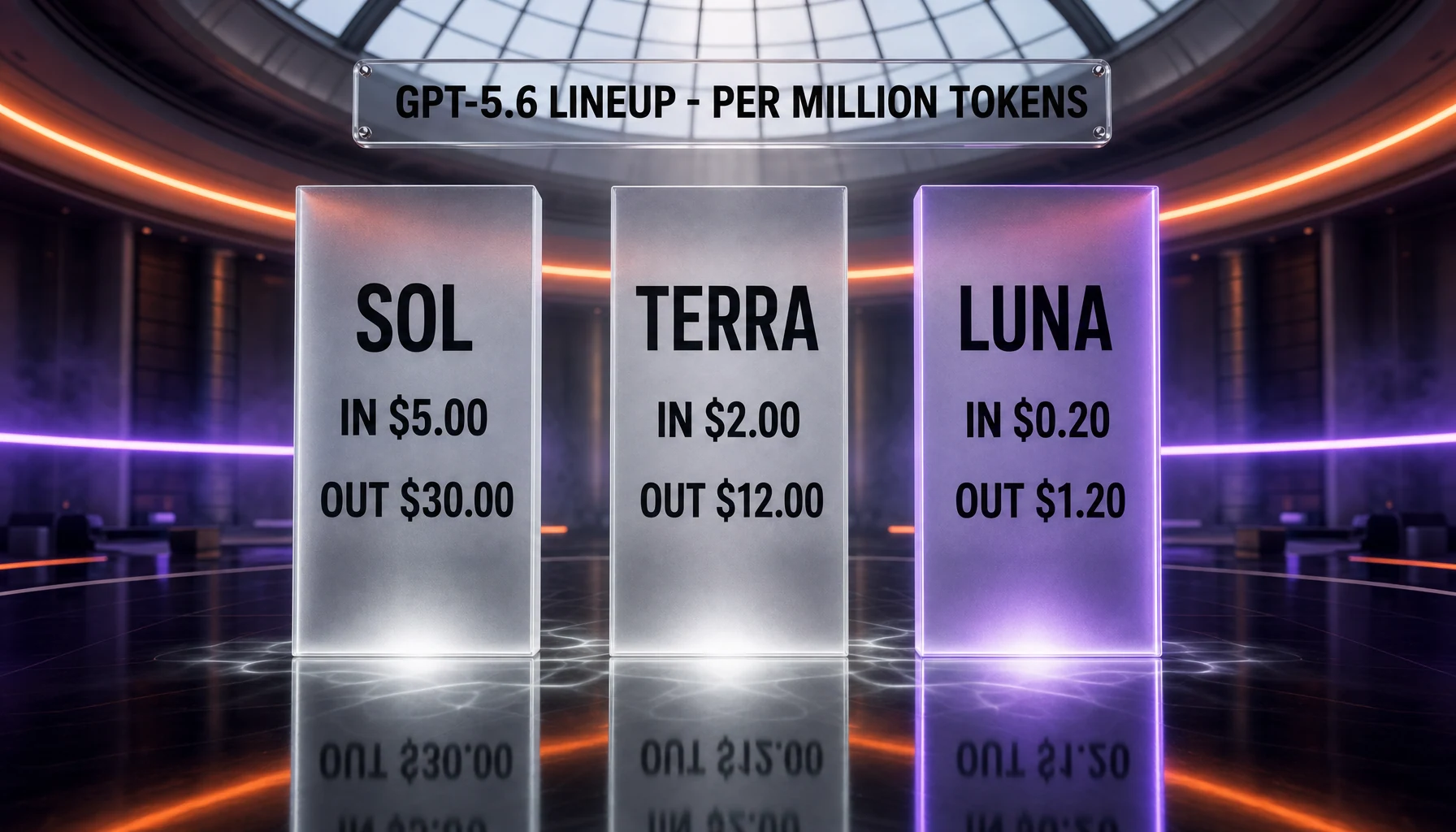
Pricing is public even though access is not. All figures are the list prices per million tokens as they stood in July 2026:
| Model | Input (per 1M tokens) | Output (per 1M tokens) | Positioning |
|---|---|---|---|
| Sol | $5.00 | $30.00 | Flagship — coding, biology, cybersecurity |
| Terra | $2.00 | $12.00 | Balanced everyday model |
| Luna | $0.20 | $1.20 | Fast and low-cost |
The structure is clean, and the steps widened sharply after OpenAI cut Luna and Terra on July 30, 2026. Terra at $2.00 input and $12.00 output undercuts GPT-5.5 while reportedly holding its quality, and Luna at $0.20 input and $1.20 output is built to make high-throughput agent loops cheap. Sol held at $5.00 and $30.00 until August 21, 2026, when OpenAI cut it to $4.00 and $20.00 under promotional pricing. On paper, this is the most aggressive price-to-capability ladder OpenAI has shipped. The catch is that "on paper" is as far as most of the market can take it right now.
The Part That Has Never Happened Before
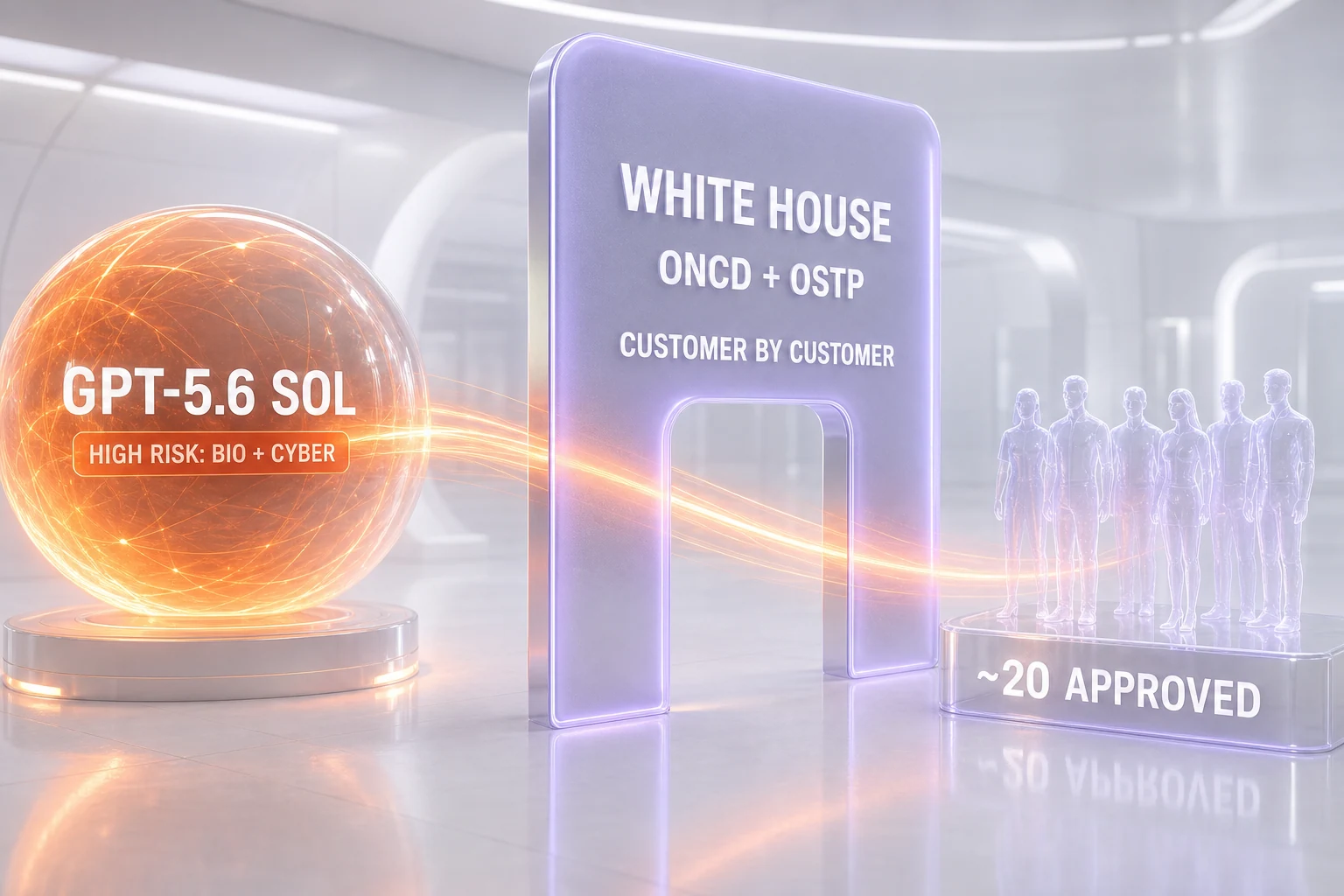
Here is the sentence that makes this a regulatory story and not a product story: OpenAI is restricting GPT-5.6 to roughly 20 organizations whose participation was individually approved by the US government, and it shared the list of those partners with federal agencies. The company says it is complying with a request from the Trump administration to limit the initial rollout to a "small group of trusted partners."
According to reporting from CNBC, TechCrunch and others, the request came through two White House bodies — the Office of the National Cyber Director (ONCD) and the Office of Science and Technology Policy (OSTP) — and the government is approving access on a customer-by-customer basis during the preview window. CEO Sam Altman reportedly told staff exactly that: the government would sign off on access one customer at a time. Commerce Secretary Howard Lutnick separately warned Altman against a broader release without sign-off from additional agencies, even after OpenAI had briefed senior officials.
Strip away the model and look at the mechanism: a US company built a commercial product, and a federal office is deciding which paying customers are allowed to buy it. We have seen export controls on chips, and we have seen labs voluntarily gate dangerous capabilities — OpenAI itself did exactly that when it restricted access to its GPT-5.5-Cyber model. But that was a company choosing its own customers. A government-managed access list for a general-purpose frontier model is, by the accounts of every outlet that covered it, without precedent.
Why Washington Stepped In
The stated rationale is national security, and the specific worry is dual-use capability. OpenAI's own materials flag Sol's strength in biology and cybersecurity — precisely the two domains where a sufficiently capable model could lower the barrier to real-world harm. Reporting indicates all three GPT-5.6 models were rated "high" on internal bio and cyber risk evaluations, which is the trigger that pulled the government into the loop.
This did not come out of nowhere. We covered the White House studying FDA-style pre-release reviews for frontier models earlier this year, and the GPT-5.6 gate is that idea arriving in practice. According to multiple reports, the administration is leaning on its push for federal benchmarking of advanced models, with a formal evaluation framework targeted for around August 2026; the ONCD and OSTP asked OpenAI to keep access narrow while that process is built out. It also fits the broader posture we have tracked, from the industry's joint espionage-defense pact against China to a steady tightening of who can touch the most capable systems.
"Restrictions Shouldn't Be the Norm": OpenAI's Tightrope
OpenAI is cooperating and complaining at the same time, and it is not hiding the tension. In its announcement the company stated plainly: "We don't believe this kind of government access process should become the long-term default. It keeps the best tools from users, developers, enterprises, cyber defenders, and global partners who need them."
It framed the restricted preview as a "short-term step" that puts GPT-5.6 "on the path to broader availability in the coming weeks." OpenAI says it expects to expand access to more companies as soon as the following week, with a broad release to follow once the government's review process catches up. Read between the lines and the message is sharp: we will play along this once, but do not mistake this for a template.
That posture is understandable. Every day Sol sits behind a 20-company wall is a day rivals can court the developers and enterprises who can't get in. It is also a day OpenAI's own revenue engine — the API and ChatGPT — runs on older models while the flagship waits for clearance. Cooperation has a cost, and OpenAI is making sure Washington knows it.
Why the Precedent Matters More Than the Model
Models get superseded every few weeks. Precedents stick. The reason GPT-5.6 matters beyond its benchmarks is that it establishes a workable mechanism for the US government to gate a commercial AI product before launch — and mechanisms, once they exist, tend to get reused.
Consider the second-order effects. If a federal office can approve customers one at a time, it can also decide which countries, which sectors, and eventually which use cases qualify. That is a short conceptual hop from the export-control logic already reshaping the industry — the same pressure that pushed Japan's Sakana AI to build orchestration that routes around frontier-model walls. A government-managed access list is, functionally, an export-control regime pointed inward at the domestic market.
There is also a competitive wrinkle. OpenAI is the one wearing the leash here, while rivals shipping models rated lower on bio and cyber risk — or simply not in the government's crosshairs this week — face no such gate. A safety-first reputation is supposed to be an asset. Under this regime, being the most capable lab in the most sensitive domains becomes a regulatory liability that slows you down. That is a strange incentive to bake into the frontier, and it is worth watching whether Anthropic, Google and others get pulled into the same process or quietly benefit from staying out of it. (For context on the current capability bar, see our field notes on Claude Opus 4.8.)

How GPT-5.6 Fits Against GPT-5.5 and the Field
With no public access, any capability comparison is provisional — these are OpenAI's claims and reporters' summaries, not numbers we have reproduced. With that caveat firmly in place, the shape of the lineup is clear.
Against the outgoing GPT-5.5, the headline is efficiency. Terra is pitched as roughly GPT-5.5-class quality at about half the cost, which would make it the default workhorse the moment it opens up. Sol is the reach model: the "max" and "ultra" reasoning modes target the long-horizon, multi-step problems where coordinated subagents earn their keep — agentic coding being the obvious beneficiary, and a natural fit for tools like OpenAI Codex. Luna rounds out the bottom, going after the cheap-and-fast slot where models like the smaller GPT-5 tiers and rival lightweight offerings compete on price per token.
The one thing we won't do is assign a score. We score tools we have used. Until GPT-5.6 is something a normal developer can actually call, treating OpenAI's launch numbers as settled fact would be exactly the kind of hype we try to avoid.
What Happens Next
Three things to watch over the next several weeks:
- Expansion of the approved list. OpenAI says it expects to add companies within about a week of launch. How fast that list grows — and who is on it — will signal how heavy the government's hand really is.
- The August framework. Reporting points to a federal evaluation process targeted for roughly August 2026. Whether the GPT-5.6 gate lifts before or after that framework lands will tell us if this was a one-off or the first turn of a permanent crank.
- Whether rivals get the same treatment. If the next frontier model from another lab ships freely while Sol stays gated, OpenAI's "this shouldn't be the norm" argument gets a lot louder — and a lot more pointed.
Our Take
Our read: the model is the headline, but the access list is the news. GPT-5.6's pricing ladder is genuinely aggressive and Sol's agentic ambitions are interesting, but we have seen aggressive lineups before. What we have not seen is a US lab handing the federal government a guest list for its flagship product. OpenAI is right to call that out as something that should not become routine — and right to comply anyway, because the alternative is a fight it cannot win in launch week.
The uncomfortable truth is that the mechanism now exists, it worked, and it was built around the most capable model on the market. Whether the next one is even harder to get is no longer a hypothetical. We will keep tracking the approved-partner list and the August framework, and we will hold off on any verdict on GPT-5.6 itself until it is something the rest of us can actually run.
Frequently Asked Questions
What is GPT-5.6, and what are Sol, Terra, and Luna?
GPT-5.6 is OpenAI's new model family, unveiled on June 26, 2026. It comes in three tiers: Sol, the flagship that OpenAI calls its "strongest model yet," with leading gains in agentic coding, biology, and cybersecurity; Terra, a balanced everyday model positioned at roughly GPT-5.5 quality for about half the cost; and Luna, a fast, low-cost model for high-volume work. Sol also adds a "max" reasoning-effort mode and an "ultra" mode that uses coordinated subagents to tackle highly complex tasks.
Why is OpenAI restricting access to GPT-5.6?
At the request of the Trump administration, citing national security, OpenAI is limiting the initial preview to roughly 20 organizations whose participation was individually approved by the US government. Reporting attributes the request to the White House Office of the National Cyber Director and the Office of Science and Technology Policy, which are approving access customer by customer. The concern is dual-use risk: all three models reportedly rated "high" on internal biology and cybersecurity evaluations.
How much does GPT-5.6 cost?
List pricing is per million tokens. Sol was $5.00 for input and $30.00 for output through July 2026; Terra is $2.00 input and $12.00 output; and Luna is $0.20 input and $1.20 output. OpenAI cut Luna and Terra on July 30, 2026, so the steps between tiers are now much wider than a simple halving. It cut Sol to $4.00 and $20.00 on August 21, 2026. Pricing is public even though access is currently restricted to government-approved partners.
Can I use GPT-5.6 right now?
Almost certainly not. As of the June 26, 2026 launch, GPT-5.6 is a limited preview available only to roughly 20 organizations individually approved by the US government. OpenAI says it expects to expand the list to more companies within about a week and to reach a broad release "in the coming weeks," but during the preview the government is approving customers one at a time.
Is GPT-5.6 Sol better than GPT-5.5?
OpenAI describes Sol as its strongest model yet, with notable improvements in agentic coding, biology, and cybersecurity, and positions Terra at roughly GPT-5.5 quality for about half the cost. However, GPT-5.6 is not publicly available, so these are vendor claims and press summaries rather than independently verified benchmarks. We have not had hands-on access and are not assigning it a score until it can be tested by the wider market.
What are Sol's "max" and "ultra" reasoning modes?
"Max" is a high reasoning-effort setting that lets Sol spend more compute deliberating on hard problems. "Ultra" goes further: OpenAI says it "uses coordinated subagents to solve highly complex tasks," meaning the model orchestrates multiple internal agents working in parallel on different parts of a problem. Both are aimed at long-horizon, multi-step work such as agentic coding and research.
Is this the first time the US government has gated an AI model release?
By the accounts of TechCrunch, CNBC, Axios and others, yes — GPT-5.6 appears to be the first frontier AI model from a major US lab released under an access list managed by the federal government, with partners individually approved by the White House. It is distinct from a company voluntarily restricting a model, as OpenAI did earlier with GPT-5.5-Cyber; here the government itself is in the approval loop, deciding access customer by customer.
What did OpenAI say about the restrictions?
OpenAI made clear it disagrees with the approach even as it complies, stating: "We don't believe this kind of government access process should become the long-term default. It keeps the best tools from users, developers, enterprises, cyber defenders, and global partners who need them." The company framed the restricted preview as a "short-term step" on the path to broader availability in the coming weeks.