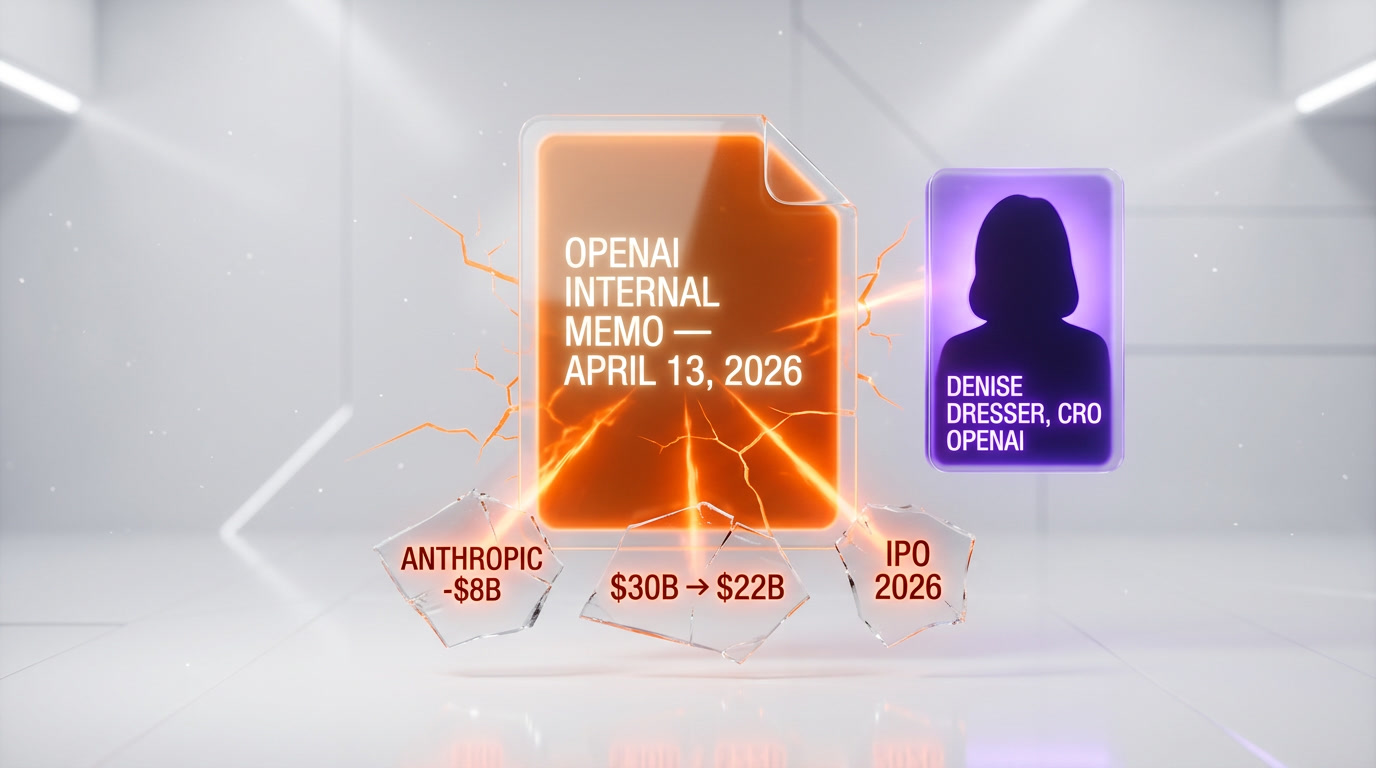
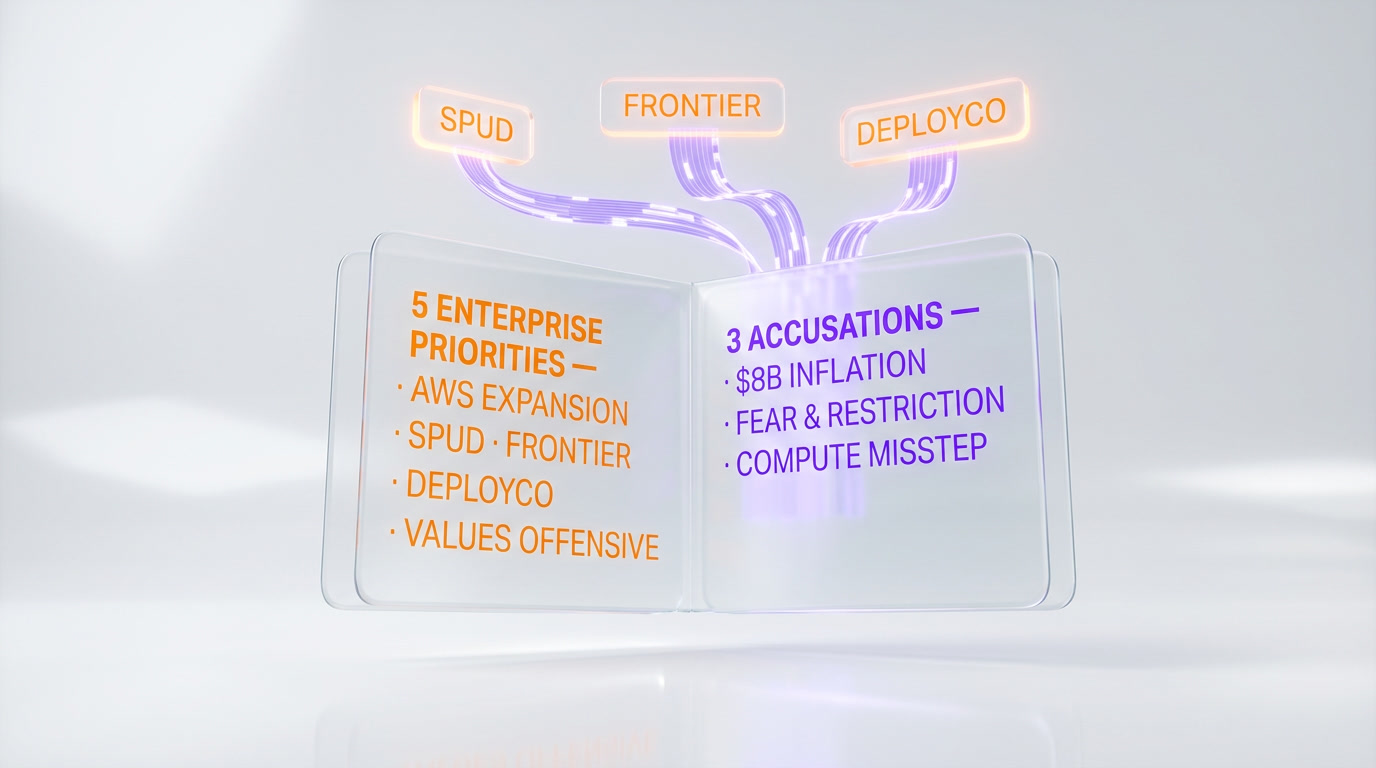
On April 13, 2026, OpenAI Chief Revenue Officer Denise Dresser sent a four-page internal memo to employees, leaked the same day by The Verge and amplified by CNBC, Fortune, Bloomberg and PBS NewsHour. The memo makes three explicit accusations against Anthropic: that its roughly $30 billion annualized run rate is overstated by approximately $8 billion through gross accounting on AWS, Microsoft Azure and Google Cloud partner billings; that Anthropic's strategy is "built on fear, restriction, and the idea that a small group of elites should control AI"; and that Anthropic made "a strategic misstep by not acquiring enough compute." The memo also reveals OpenAI's counter-plan: a new text model codenamed Spud, an agent platform codenamed Frontier, a cloud service codenamed DeployCo, and a deeper AWS alliance where "demand is frankly staggering." This is the first time a named C-level executive at OpenAI has publicly attacked Anthropic by name. It lands four months before a planned OpenAI IPO and into an $852 billion valuation already under investor scrutiny.
What the memo actually says
Denise Dresser was named Chief Revenue Officer of OpenAI in December 2025. She arrived from Slack, where she served as CEO from January 2024 until her exit in November 2025, and before that spent roughly a decade at Salesforce. Her appointment was read at the time as a signal that OpenAI's next chapter would be run on an enterprise sales discipline rather than a consumer-product reflex. The April 13 memo is the first time that discipline has been made visible.
The document is four pages, addressed to "all OpenAI employees," and structured around five enterprise priorities for the remainder of fiscal 2026. The Verge published the scoop on April 13. Within twenty-four hours, CNBC, Fortune, Bloomberg, PBS NewsHour, Gizmodo, The Decoder and Implicator.ai had all confirmed and re-reported the key passages. Three passages matter.
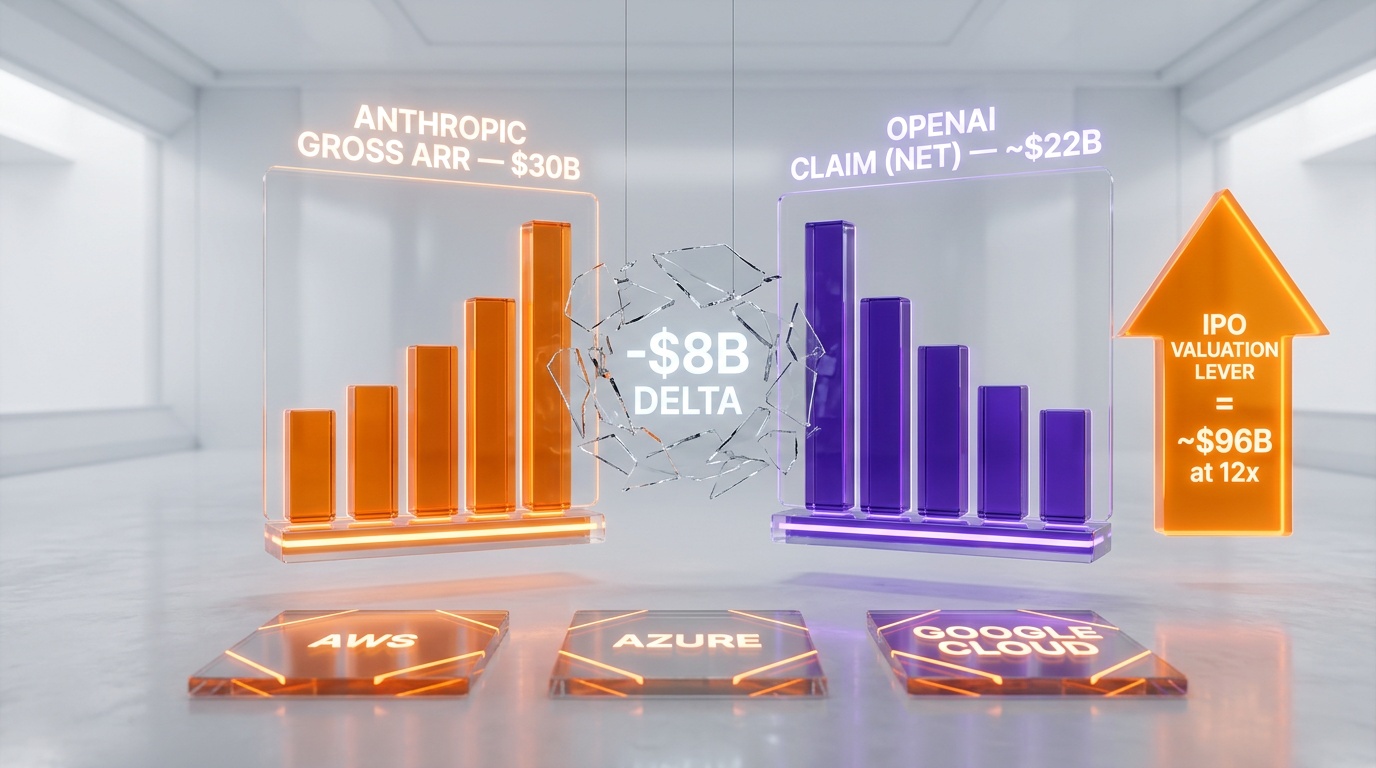
The first passage is the $8 billion accounting accusation. Dresser tells staff that Anthropic's publicly-cited roughly $30 billion annualized run rate is, in her view, closer to $22 billion. The mechanism she reproaches is gross accounting: Anthropic, she writes, books the full amount billed through AWS, Microsoft Azure and Google Cloud as top-line revenue, including the portion that flows back to those cloud partners as their distribution cut. OpenAI, by contrast, reports its Microsoft Azure revenue on a net basis, recognizing only the share it ultimately keeps. The difference, applied to Anthropic's partner-heavy distribution mix, is the $8 billion gap.
The second passage is the values attack. Dresser writes that Anthropic's story is "built on fear, restriction, and the idea that a small group of elites should control AI." This is not an accounting sentence. It is a positioning sentence aimed at enterprise buyers, and it is a direct reframing of Anthropic's safety-first public narrative as an elitist one. In the same document, Dresser argues that "Anthropic made a strategic misstep by not acquiring enough compute" — a claim that directly contradicts Anthropic's own framing of its diversified cloud strategy as a structural advantage.
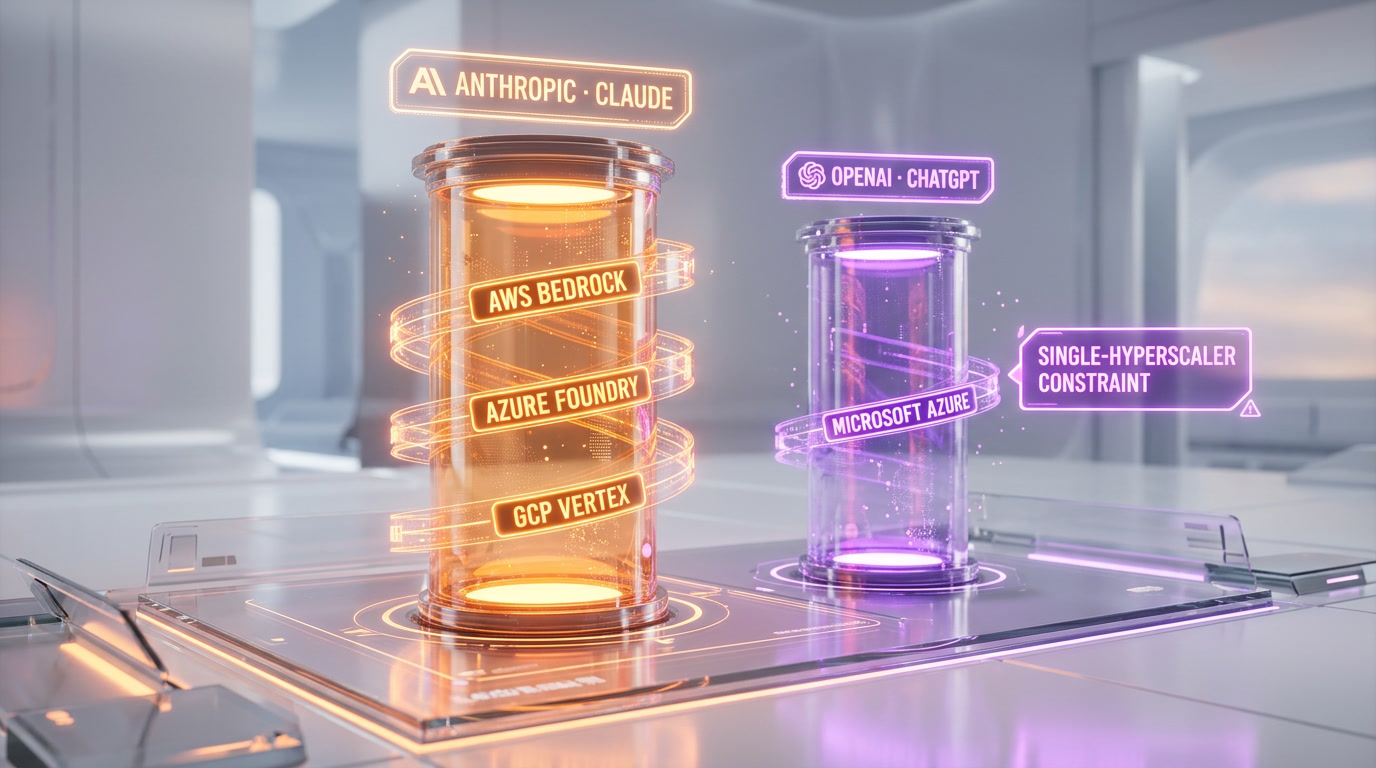
The third passage is the Microsoft line. Dresser writes that "Microsoft has limited our ability to reach enterprises — for many that's Bedrock," a reference to AWS's managed inference service that hosts Anthropic's Claude family. That sentence alone is a reframe of OpenAI's own commercial history: the Microsoft partnership that made ChatGPT possible is now being named, internally, as the thing blocking OpenAI from closing the enterprise market. In the same memo, Dresser calls AWS partnership demand "frankly staggering" and announces that OpenAI is pivoting toward AWS as a distribution channel.
Three internal codenames are also confirmed by the memo. Spud is a new text model that Dresser claims "will make all of our products significantly better." Frontier is an agent platform. DeployCo is a cloud service. None of the three has a public launch date in the memo, but their mere naming is an operational signal: OpenAI is preparing a stack where the model, the agent layer and the infrastructure layer are all OpenAI-branded rather than Microsoft-branded.
The $8 billion question: gross vs net ARR
Our analysis of the gross-versus-net distinction matters because both methods are permitted under US GAAP, and the choice between them determines whether the headline number a company puts in front of IPO investors is a true representation of economic value or a distribution-channel gross-up.
Under US GAAP and IFRS 15, a seller records revenue on a gross basis when it is the principal in the transaction — that is, when it controls the good or service before it is transferred to the end customer. A seller records revenue on a net basis when it is the agent, acting as an intermediary. The test is control, and the control test turns on who sets the price, who bears inventory risk, and who is primarily responsible for fulfillment. In a software context where the distribution partner provides infrastructure and billing, the line is genuinely ambiguous, and the auditor's call can shift the top-line number by tens of billions of dollars.
Anthropic's public position, stated by a company spokesperson to the Financial Times in response to the leak, is that it "recognises gross revenue on sales through partners because it is the principal in the transaction and its cloud partners are the distribution channel." In plain English: when an enterprise customer pays for Claude through AWS Bedrock, Anthropic argues it is Anthropic that controls the model, sets the token pricing, owns the customer relationship for model quality, and bears the delivery obligation. AWS is the storefront. The position is defensible, and large software businesses that sell through channel partners — Salesforce through AppExchange, some ServiceNow deals through hyperscaler marketplaces — have historically taken the gross view.
OpenAI's implicit position, encoded in Dresser's memo and in its own reporting practice, is that the appropriate recognition is net. Applied to Anthropic's disclosed revenue mix, where AWS, Microsoft Azure and Google Cloud are the dominant distribution channels, the net view strips out the portion of each dollar that cycles back to the cloud provider and leaves a headline closer to $22 billion. The $8 billion gap is the compounding effect of the gross-up across three cloud partners and an enterprise book that has grown roughly 1,400 percent year over year.
Neither position is accounting fraud, and neither framing should be read that way. The honest description is that Anthropic has chosen the top end of a legally permissible range, and OpenAI is publicly drawing attention to that choice at the exact moment both companies are pricing an IPO. That choice is the story.
Why this is IPO-critical
Both OpenAI and Anthropic are pricing to be public companies in 2026. Anthropic closed a Series G in February 2026 at a roughly $380 billion valuation, then received unsolicited investor offers at $800 billion in early April, with an IPO target reported for as early as October 2026. OpenAI is sitting on an $852 billion valuation that is now, according to TheNextWeb and other outlets, under scrutiny from its own investors because the revenue story under it is being questioned.
At that scale, the revenue-recognition method is the single largest valuation lever available to either lab. Public software companies typically trade between eight and twenty times forward revenue. A conservative twelve-times multiple applied to an $8 billion swing is a $96 billion valuation difference. That is not a rounding error. It is the gap between the second-largest IPO in history and the fifth.
For Anthropic, the gross method maximises the valuation multiple at the expense of narrative simplicity. For OpenAI, publicly questioning that method ahead of both IPOs is a defensive move: it tells institutional investors that OpenAI's own headline number, which has been ground down through Microsoft's share of Azure, represents a harder kind of dollar. Our read is that Dresser is not writing to OpenAI employees. She is writing through them, to the IPO institutional buy-side, with the memo's accidental leak path doing the distribution.
The timing is not an accident
Four dates anchor this memo. Our analysis places it inside a tight, deliberate window.
On April 6, 2026, OpenAI, Anthropic and Google signed the Frontier Model Forum Chinese-espionage defense pact, the first time the top three US frontier labs formally aligned on a single adversary. That was the peace event. On April 13, seven days later, Dresser's memo broke the peace. On April 14, Fortune and CNBC propagated the accounting accusation into the business-press tier. On April 18, a separate round of OpenAI departures landed, with Kevin Weil, Bill Peebles and Srinivas Narayanan walking out as Sora was being wound down and the internal science team dissolved. Over the same month, Anthropic was accused in the public conversation of silently nerfing Claude 4.7 — a product-quality controversy we tracked at ThePlanetTools and that has since been partially confirmed by Anthropic's own status updates.
The compressed sequence matters. The frontier labs publicly cooperated on national-security threats, then privately attacked each other on valuation metrics, within a single news cycle. The cooperation benefits all three signatories on the regulatory front. The attack benefits OpenAI on the capital-markets front. Both things can be true at once, and they are.
The memo's internal purpose, stated in its own language, is to rally OpenAI's enterprise sales team around five priorities: AWS distribution expansion, a new product stack around Spud and Frontier, a DeployCo cloud offering, pricing discipline on Microsoft-originated enterprise deals, and what Dresser calls a "values offensive" against Anthropic's safety-first positioning. Four of the five are defensive. Only the values offensive is explicitly attacking.
The Microsoft problem, stated out loud
The line in the memo that changes the most inside OpenAI is the Microsoft one. Dresser tells staff that "Microsoft has limited our ability to reach enterprises" and that the binding constraint for many enterprise buyers is the fact that Anthropic is on AWS Bedrock and OpenAI is not. For three years the internal OpenAI narrative has treated the Microsoft partnership as an unalloyed advantage: Azure-funded compute, enterprise sales leverage, a co-engineering relationship on model deployment. The memo names the cost side of that partnership for the first time.
The operational consequence is the AWS pivot. Dresser writes that "demand from AWS partnership is frankly staggering," and the memo frames AWS expansion as one of the five priorities. OpenAI has not left Microsoft — the Azure relationship is contractual and commercial and will continue — but the April 13 document is the first time OpenAI's sales leadership has told its own people, in writing, that the Microsoft-only enterprise distribution strategy is over.
There is a symmetry here. Anthropic's diversified cloud strategy — available on AWS Bedrock, Google Cloud Vertex, and since November 2025 on Azure Foundry — has been one of the reasons its enterprise revenue scaled at 1,400 percent year over year. OpenAI's single-hyperscaler strategy is the reason Dresser is, in 2026, writing a memo about how to get out of it. That is the "strategic misstep" Dresser accuses Anthropic of — not acquiring enough compute — inverted. Both labs made one big infrastructure bet. Both bets are now being renegotiated under duress.
Spud, Frontier, DeployCo — the counter-stack
The three codenames leaked in the memo describe OpenAI's product response. Each one maps to an Anthropic capability that is, today, outsold in specific enterprise segments.
Spud is a new text model. Dresser calls it a model that "will make all of our products significantly better" and frames it as a generational improvement rather than a point upgrade. The name gives nothing away about the architecture. The positioning — a text-only model, not an image or video model, explicitly tied to enterprise product quality — puts Spud in direct competition with Claude Opus 4.7 and the Mythos preview Anthropic has been showing to select design partners. Anthropic's product messaging for Q2 2026 has emphasised Claude's code-editing and long-context reliability. Dresser's framing of Spud as the thing that makes all OpenAI products better is the direct counter.
Frontier is an agent platform. This is the most crowded field in 2026 AI tooling, and the one where Anthropic's Claude Code has set the public benchmark for developer mindshare. An OpenAI agent platform branded as Frontier signals that OpenAI intends to sell agent orchestration as a first-party product, not as a ChatGPT feature. Whether Frontier ships as a standalone SDK, an API surface, or a managed platform is not in the memo. What is in the memo is the intent.
DeployCo is a cloud service. This is the most consequential codename. A first-party OpenAI cloud service — one that lets an enterprise deploy OpenAI models without passing through Microsoft Azure — is the structural answer to the Bedrock problem Dresser named. If DeployCo ships in 2026, it changes the commercial topology of the enterprise AI market: enterprises that today choose between Bedrock (Anthropic) and Azure (OpenAI) would gain a direct third option. Whether Microsoft's 2023-era OpenAI commercial agreements allow for a competing first-party cloud is a contractual question our public analysis cannot resolve. The memo's willingness to name DeployCo internally implies OpenAI believes they do.
Correction corner: the "religion" quote that did not happen
In the forty-eight hours after The Verge's scoop, a sentence circulated heavily on X attributing to Denise Dresser the line "Claude has become a religion." That attribution is wrong. The sentence was actually delivered by Arvind Jain, CEO of enterprise search company Glean, at the HumanX San Francisco conference in early April 2026. Jain was describing enterprise buyer loyalty, not OpenAI's competitive positioning, and his remarks were recorded at a public event — not inside an internal OpenAI memo.
The misattribution propagated because both statements reached social media in the same week and both concerned Anthropic's enterprise narrative. We are flagging it here because several mainstream outlets briefly carried the incorrect version in the first twenty-four hours. The verified text of Dresser's memo, confirmed by The Verge, CNBC, Fortune, Bloomberg, PBS NewsHour, Gizmodo, The Decoder and Implicator.ai, does not contain the religion line. Dresser's memo is sharp, but sharp in the specific register of enterprise sales — not theology.
Anthropic's response
Anthropic's official response, delivered through a company spokesperson to the Financial Times and re-reported by Bloomberg, was limited to the accounting question. The quoted line is that Anthropic "recognises gross revenue on sales through partners because it is the principal in the transaction and its cloud partners are the distribution channel."
That sentence does three things. It asserts a principal-agent posture under IFRS 15 / ASC 606. It names AWS, Azure and Google Cloud collectively as "distribution" — a word that frames the hyperscalers as channels rather than co-producers. And it does not rebut the values attack at all. Anthropic chose to answer the audit question and ignore the positioning question. Our read is that this is deliberate: rebutting the "religion of elites" framing would amplify it. Answering the accounting question with a one-line GAAP defense lets Anthropic's law firm and its auditor carry the rest.
A second element of Anthropic's response is operational rather than rhetorical. In the week following the leak, Anthropic's communications team published expanded enterprise case studies and quietly moved the Mythos preview — a frontier model Anthropic has positioned as more capable than Claude Opus 4.7 but with deliberately limited access — into a second wave of design-partner demos. The combination is consistent: dispute the accounting framing on paper, out-ship on product in public.
What this means for users and buyers
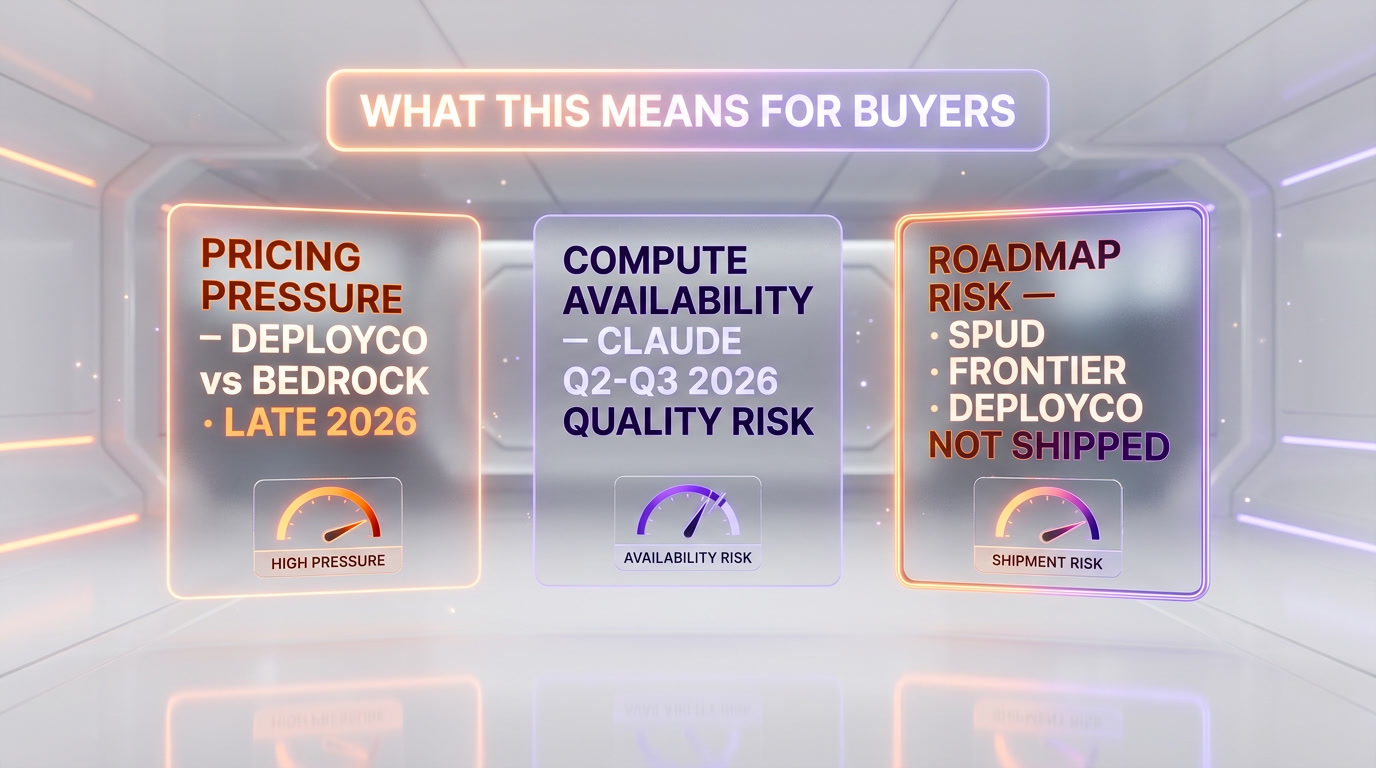
For developers and enterprise buyers who actually use these tools, the memo leak is less immediately disruptive than the IPO story suggests, but there are three second-order effects worth tracking.
The first is pricing pressure. If OpenAI's DeployCo ships as a first-party cloud, and if AWS Bedrock continues to absorb Anthropic's enterprise growth, margin compression between the two labs becomes more likely in late 2026. For heavy-usage buyers paying by the token, that is potentially good news — competitive pricing on Claude Sonnet and GPT-class models has historically moved in lockstep, and a new first-party distribution path tends to surface discounting before it surfaces list-price cuts.
The second is compute availability. The memo's characterisation of Anthropic as under-compute is consistent with the silent-nerf reports we tracked in April, in which Claude users observed measurable degradation in response quality during high-load periods. If Anthropic is genuinely compute-constrained at $30 billion ARR, users on plans without guaranteed throughput should expect further intermittent quality variation through Q2 and Q3 2026 until the Amazon-backed infrastructure expansion closes the gap. OpenAI, with an Azure-anchored compute floor and a new AWS arm opening, is in a structurally looser position for the same period.
The third is roadmap risk. Spud, Frontier and DeployCo are codenames, not ship dates. Enterprise procurement teams planning 2026-to-2027 deployments should treat all three as directional signals rather than committed products. Conversely, Anthropic's Mythos preview and the Claude Code pillar product stack are already shipping, and the public documentation trail is extensive. The memo's leak does not change that asymmetry — it highlights it.
Our verdict
Our position is that the April 13 memo is the first explicitly public C-level attack in what will be, over the next six to nine months, the most expensive narrative war in technology history. The $8 billion accusation is technically legitimate — gross-versus-net recognition genuinely is a gray zone in GAAP — but it is being weaponised at the exact moment both companies are pricing IPOs, and that weaponisation is the point. Dresser is a sales executive, not an auditor, and her job is to make the institutional buy-side ask hard questions about Anthropic's $800 billion number before it asks hard questions about OpenAI's $852 billion one.
On the substance of the accounting dispute, we lean slightly toward Anthropic's framing: in a world where enterprise buyers choose Claude specifically because it is on Bedrock, Anthropic is the principal, AWS is the channel, and gross recognition is defensible. On the substance of the strategic framing, we lean slightly toward OpenAI's: single-hyperscaler distribution is a real constraint, the AWS pivot is overdue, and naming it in writing is the mark of a sales leader doing her job.
On the values attack — the "fear, restriction, elitism" line — we find it rhetorically effective and analytically thin. Anthropic's safety posture has been public since the company was founded, the Responsible Scaling Policy is a public document, and reframing that posture as elitist is a sales tactic rather than a product critique. It will land with some enterprise buyers who view safety as friction and bounce off buyers who view safety as due diligence. The sort of customer who bought Claude in Q1 2026 is the second kind.
The memo is a turning point. Not because any single sentence in it is decisive, but because the era of frenemy politeness between OpenAI and Anthropic is over. What comes next — Spud versus Mythos, Frontier versus Claude Code, DeployCo versus Bedrock, and two IPO prospectuses competing for the same limited institutional attention — is what the rest of 2026 is going to be about.
Frequently asked questions
Who is Denise Dresser?
Denise Dresser is OpenAI's Chief Revenue Officer, appointed in December 2025. She joined from Slack, where she had served as CEO since January 2024, and before that spent roughly a decade in senior revenue and go-to-market roles at Salesforce. Her appointment signaled an enterprise sales discipline at OpenAI, and the April 13 2026 memo is the most visible application of that discipline to date.
What is the $8 billion accusation in the OpenAI memo?
In the April 13, 2026 memo, OpenAI CRO Denise Dresser told employees that Anthropic's roughly $30 billion annualized run rate is overstated by approximately $8 billion. The mechanism is gross accounting: Anthropic books the full amount billed through AWS, Microsoft Azure and Google Cloud, including the cloud partners' distribution cut, as top-line revenue. OpenAI, which reports Azure-billed revenue on a net basis, argues the comparable net-basis number for Anthropic is closer to $22 billion.
What is gross versus net ARR?
Under US GAAP and IFRS 15, gross revenue recognition applies when a seller is the principal in a transaction — it controls the good or service before transfer — and net recognition applies when the seller is the agent. For SaaS billed through cloud partners, the distinction turns on who sets pricing, bears fulfillment risk and owns the customer relationship. Both are permitted; the choice can shift headline ARR by billions.
How did Anthropic respond to the $8 billion accusation?
Anthropic's spokesperson told the Financial Times that the company "recognises gross revenue on sales through partners because it is the principal in the transaction and its cloud partners are the distribution channel." That single sentence asserts the principal-agent posture required to defend gross recognition under GAAP, and names AWS, Microsoft Azure and Google Cloud collectively as distribution channels. Anthropic did not address the values attack.
What are Spud, Frontier and DeployCo?
Three internal codenames revealed in the memo. Spud is a new text model Dresser says will make all OpenAI products "significantly better." Frontier is an agent platform. DeployCo is a cloud service — the most structurally significant of the three, because it would let enterprises deploy OpenAI models without going through Microsoft Azure. None of the three has a public launch date as of April 2026.
Why is this IPO-critical for both companies?
Anthropic is reportedly targeting an IPO as early as October 2026 at up to $800 billion, and OpenAI is sitting on an $852 billion valuation now under scrutiny from its own investors. Public software companies typically trade at eight to twenty times forward revenue; a conservative twelve-times multiple on an $8 billion ARR swing equals roughly $96 billion in valuation. The recognition method is the single largest valuation lever either lab can pull.
Why did Dresser attack Microsoft in the memo?
Dresser wrote that "Microsoft has limited our ability to reach enterprises — for many that's Bedrock," meaning that enterprise buyers who standardised on AWS now default to Anthropic's Claude via Bedrock because OpenAI is not there. It is the first time OpenAI sales leadership has publicly named the single-hyperscaler distribution strategy as a binding commercial constraint. The memo announces an AWS pivot — Dresser calls AWS partnership demand "frankly staggering" — as the structural response.
Did Dresser say "Claude has become a religion"?
No. That line was actually said by Arvind Jain, CEO of enterprise search company Glean, at the HumanX San Francisco conference in early April 2026, describing enterprise buyer loyalty. It was widely misattributed to Dresser on X in the first twenty-four hours after The Verge's scoop. Dresser's verified memo text, confirmed by multiple outlets, does not contain that sentence.
Is gross accounting legal for Anthropic?
Yes. Both gross and net revenue recognition are permitted under US GAAP (ASC 606) and IFRS 15. The determinative test is whether the seller is the principal or the agent in each transaction, which depends on control of the good or service, pricing authority and fulfillment obligation. Large software companies that sell through channel partners have historically taken either view; Anthropic's chosen treatment is defensible and not, by any public evidence, fraudulent.
How does this affect users of Claude and ChatGPT?
Three second-order effects. First, pricing pressure: if DeployCo ships as a first-party OpenAI cloud, enterprise margin competition intensifies by late 2026. Second, compute availability: if Anthropic is genuinely compute-constrained at its current scale, quality variation on non-guaranteed plans is likely through Q2 and Q3 2026. Third, roadmap risk: Spud, Frontier and DeployCo are codenames, not ship dates — buyers should treat them as directional.
What is the broader context with the OpenAI-Anthropic-Google pact?
On April 6, 2026 — seven days before the memo leaked — OpenAI, Anthropic and Google signed the Frontier Model Forum Chinese-espionage defense pact, the first time the top three US frontier labs formally aligned on an external adversary. The April 13 memo attacks Anthropic on valuation and positioning a week after cooperating with it on national-security threats. Both dynamics coexist: rivals on capital markets, allies on regulatory defense.
When will the memo's claims be resolvable?
Not until the S-1 filings. An IPO-bound company publishes audited financials as part of its registration statement with the SEC, and the revenue-recognition policy is disclosed in the footnotes. If Anthropic files on the reported October 2026 timeline, its S-1 will disclose exactly how much revenue is recognised gross versus net and which partners the policy applies to. That is the point at which Dresser's $8 billion figure is either confirmed or rebutted by Anthropic's own auditor.